Drugs and money: Obama puts myth over science

Paul Rosenberg writes:

In December 2007, officials in the Bush White House refused to open an email from the Environmental Protection Agency that concluded that “greenhouse gases are pollutants that must be controlled”. If they didn’t open the email, then the facts didn’t exist, according to their pseudo-logic – much like a child who thinks that if he closes his eyes, he becomes invisible to whatever scary monsters might be hunting him. There’s no similar smoking gun with the Obama Administration – at least not yet – but a strikingly similar denial of scientific knowledge from within the executive branch has just been announced by the Obama Administration.

On Friday, July 8, Obama’s Drug Enforcement Administration Administrator, Michele M. Leonhart, decreed in the Federal Register that marijuana “has no currently accepted medical use in treatment in the United States”, thus keeping it in the same category as heroin, as it has been since 1970. This despite the fact that the National Cancer Institute, part of the cabinet-level Department of Health and Human Services, cites marijuana’s potential helpfulness with nausea, loss of appetite, insomnia and pain.

It’s not just the National Cancer Institute, of course. Sixteen states and the District of Columbia have laws saying exactly the opposite – that marijuana does have an accepted medical use, and that doctors are free to prescribe it. There are, in fact, thousands of such prescriptions written every day, no matter how hard Leonhart and Obama try to deny it. Are some of those prescriptions bogus? Undoubtedly. But it’s the specific claims of individuals that are questionable, not the underlying medicine.

Of course it’s true that rigorous drug trial-type tests are lacking, but that’s largely a result of the government’s refusal to admit there’s anything to investigate, as Dr. Igor Grant, director of the Center for Medicinal Cannabis Research at University of California-San Diego, explained to the LA Times. He told them that state-supported clinical trials have shown marijuana helps with neuropathic pain and muscle spasticity, but that the federal government’s position discourages further research needed to test the drug’s medical effectiveness.

“We’re trapped in kind of a vicious cycle here,” Grant told the Times. “It’s always a danger if the government acts on certain kinds of persuasions or beliefs rather than evidence.”


Facebooktwittermail

The Murdoch pushback: attacking the press

Ryan Chittum writes:

There have been a number of efforts lately—obnoxious efforts—to say News Corporation’s hacking scandal is some kind of “piling on” by opponents with a “commercial or political agenda.” The implication, not least from Rupert Murdoch’s Wall Street Journal editorial page and his “Fox & Friends” show, being that the level of coverage is unfair, somehow, that the story isn’t that big a deal, or that the scandal hasn’t touched Rupert Murdoch as a CEO or News Corp. as a whole—confined as it was to ”the tabloid excesses of one newspaper.”

Perhaps then it would be a good exercise to run through all the wrongdoing—including rampant, institutionalized criminal activity—that is already in the public record as having been committed in the hacking scandal.

For starters, executives, editors, and reporters at News Corp.’s UK unit have: bribed the police; illegally hacked thousands of people’s phones, including a 13-year-old then-missing murder victim’s; tampered with evidence while the victim was still missing. They interfered with a second murder investigation; misled police and Parliament, repeatedly, when questioned about these activities; knowingly employed an ax-murder suspect who had been convicted and imprisoned for planting cocaine on an innocent woman in a divorce case; paid millions of dollars to victims explicitly in exchange for their silence; paid large sums to former employees after they had been convicted of crimes committed at the behest of News Corporation employees; continued to pay for convicted former employees’ high-powered lawyers.

It has further been revealed that a senior News International executive deleted millions of emails in an “apparent attempt to obstruct Scotland Yard’s inquiry”; hid the contents of a top journalist’s desk after he was arrested; stuffed documents into trash bags and took them away as detectives came into the office to investigate; put the scandal’s lead police investigator, whose inquiry was a bad joke, on the News Corp. payroll with a plum columnist job.

Here’s some of what we know of corrupt activities undertaken by government institutions at News Corp.’s behest or which, at a minimum benefited, News Corp.

The police: stuffed thousands of pages of convicted hacker Glenn Mulcaire’s notes in plastic bags, leaving them unexamined (or at least uncataloged) for years; did so while insisting publicly, and before Parliament, that the scandal was limited to two people and, crucially, that a full investigation had been performed; hired Neil Wallis, who was News of the World’s deputy editor while the crimes were committed, to advise the police on how to handle their own PR problems stemming from the hacking scandal; Wallis ferried information back to News Corp.; the police notified just a handful of people that their phones might have been hacked despite having evidence that in fact thousands had been; concealed their payments to Wallis for a year. Meanwhile, top police officials dined repeatedly with News International executives during the investigation.

Political elites: Conservative Prime Minister David Cameron hired the News of the World editor Andy Coulson, who oversaw a newsroom in which criminal activity was commonplace, to be a top aide, despite warnings that Coulson was personally implicated in the scandal; Labour leader Ed Miliband hired a Murdoch journalist to be top flack, and he promptly told the party to tiptoe around the scandal; regulators came very close to approving a massive TV deal for News Corp. that would have furthered its stranglehold on Britain’s private media, all while the scandal was continuing to worsen.

Phew!

Now that we have all that background, enter The Wall Street Journal’s editorial page, which this week has gone into full-on Murdoch mode, defending its parent company from the ”commercial and ideological motives of our competitor-critics.” It has unleashed no fewer than seven defensive editorials and columns this week, reports Bloomberg News, and it’s only Wednesday.

Facebooktwittermail

Where are the next News Corp whistle-blowers?

Does the death of Sean Hoare suggest that anyone who exposes wrongdoing inside the Murdoch empire is putting their life at risk? I don’t think so.

Hoare’s health had been compromised by alcohol and drug addiction. A few days before he died he got accidentally whacked on the head by a relative carrying a heavy pole as they took down a marquee at a children’s party. Reporters for the New York Times who dined with him in his last days described him as “ailing.”

The police force that ordered Hoare’s autopsy is the Hertfordshire force — not the Metropolitan police where officers accepted bribes from News International. The type of autopsy conducted was one ordinarily used in cases of suspicious death, even though investigators have not identified suspicious circumstances.

But now that News International has pulled the plug on its financial aid for Glenn Mulcaire and the world waits for him to break his silence, if he too suddenly dies then of course both deaths would be massively suspicious. Absent such an extraordinary turn of events, I think the reason other News Corp employees don’t speak out has more to do with fears for their wealth than their health.

In 2009, Fox News anchor Stuart Varney set the standard when it comes to the proposition that anyone on his payroll should dare challenge Emperor Murdoch.

Should we be surprised that a Fox journalist would assume such a supine position in relation to his boss? Only if we imagine News Corp attracts employees who are more interested in practicing journalism than they are in the size of their pay checks.

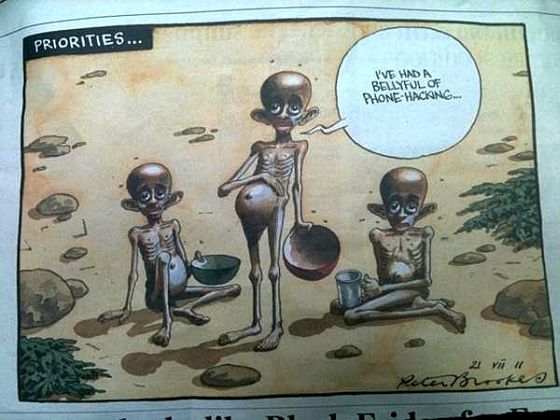
Consider the example of the editors of Murdoch’s Times of London. Today they assumed the posture of having greater concern about starvation in Somalia than they do about the phone hacking story and so they ran this cartoon:

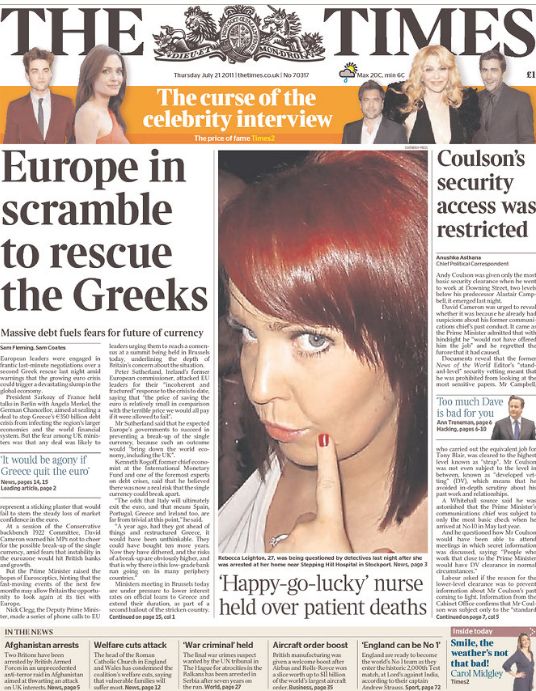
Does the situation in Somalia deserve greater media attention? Of course. But if the Times actually thinks its competitors’ priorities are skewed, how come they couldn’t find space for a single paragraph on Somalia on their own front page?

If a few of Murdoch’s employees are now having sleepless nights wondering whether they should speak out and risk losing their jobs, they must also know that the decision of any whistle-blower is one of the loneliest. Anyone who jumps off the Murdoch ship is unlikely to be quickly offered a lifeline from another.

The corporate media world of which the Murdoch empire is merely one part, does not foster a culture that rewards integrity. Team players are an asset; individuals with an unshackled conscience are risky. Those whose job it is to report, know that there are times when nothing is more highly prized by their employers than their silence.

Facebooktwittermail

Phone hacking: Met police to investigate mobile tracking claims

The Guardian reports:

Scotland Yard has been asked to inspect thousands of files that could reveal whether its officers unlawfully procured mobile phone-tracking data for News of the World reporters.

There were half a million requests by public authorities for communications data in the UK last year – of which almost 144,000 were demands for “traffic” data, which includes location.

A Metropolitan Police Authority (MPA) member has asked the force to investigate allegations that News of the World reporters were able to purchase this data from police for £300 per request.

The claims were made by Sean Hoare, the News of the World whistleblower, days before he was found dead at his home on Monday. His disclosure about the purchase of illicit location data was first made to the New York Times, which said the practice was confirmed by a second source at the tabloid. Police have said Hoare’s death was not suspicious.

Mobile phone location data, which is highly regulated, would give tabloid reporters access to a method of almost total surveillance, arguably even more intrusive than hacking into phone messages.

Facebooktwittermail

News Corp and the hacked Climategate emails: time for an independent investigation

Joe Romm writes:

There have been countless independent investigations into the scientists whose e-mails were hacked in November 2009. And the scientists have been (quietly) vindicated every time (see “The first rule of vindicating climate science is you do not talk about vindicating climate science“).

But we still don’t know who hacked the emails! And now we know that one of the key investigative bodies tasked with tracking down the hackers — Scotland Yard – were compromised at the time.

How were they compromised? Neil Wallis — the former News of the World executive editor — became a “£1,000 a day” consultant to Scotland Yard in October 2009. Last week he became the ninth person arrested in the metastasizing News Corp scandal “on suspicion of conspiring to intercept communications, contrary to section 1(1) Criminal Law Act 1977.”

Certainly Wallis had plenty of motive to join Scotland Yard just to keep an eye on the investigation into the phone-hacking scandal. Indeed, the NY Times reports Wallis “was reporting back to News International while he was working for the police on the hacking case.” But this also suggests how corrupt Wallis was — and how corrupted Scotland Yard was.

In the light of the News Corp phone-hacking scandal, it is clear that Murdoch’s outfit had means, motive, and opportunity for the Climategate email hacking. News Corp certainly has a history of defaming climate scientists and a penchant for hacking.

Facebooktwittermail

LulzSec claims to have News International emails

The Guardian reports:

One of the members of the LulzSec hacking group has claimed on Twitter that the group has got 4GB of emails taken from the Sun and the “royal family” which may be released as soon as lunchtime on Thursday.

The claim follows a hacking attack against News International on Tuesday night during which members of LulzSec apparently broke into computer systems there and redirected readers of the Sun’s website to a faked page claiming News Corp chief executive Rupert Murdoch had been found dead.

Significantly, the group also seems to have broken into the email database at News International.

Some accounts belonging to Anonymous also began tweeting email addresses and passwords for staff at News International, including what seemed to be an email account and password for Rebekah Brooks under her previous married name of Wade while at the Sun.

Facebooktwittermail

Murdoch: This scandal has exposed the scale of elite corruption

Seumas Milne writes:

The Tory operation to bury the phone-hacking scandal in spin and official inquiries is now in full flow. On his way back from Africa, David Cameron declared it was essential to get the whole business into perspective, echoing Rupert Murdoch’s insistence that his competitors had got up “this hysteria”. Today, the prime minister chided Ed Miliband for “chasing conspiracy theories” and claimed it was really Gordon Brown who had been in the pocket of the global media billionaire.

Meanwhile, News International pundits and others with their own reasons to stem the flood of revelations have been loudly insisting that the political clout of Murdoch’s corporate colossus has been exaggerated. The hyper-regulated BBC is the real media monopoly, they say, and in any case the current fixation with phone hacking has meant no one is discussing bankers’ bonuses and the threat of another financial meltdown. This is a “frenzy that has grown out of control”, the Daily Mail complained.

But the real frenzy isn’t the exposure of the scandal – it’s the scale of corruption, collusion and cover-up between News International, politicians and police that the scandal has revealed. As the cast of hacking victims, blaggers and blackmailers has lengthened, and the details of the incestuous payments and job-swapping between News International, government and Scotland Yard become more complex, it’s easy to lose sight of the bigger picture that is now emerging.

If it were not for the uncovering of this cesspit, the Cameron government would be preparing to nod through the outright takeover of BSkyB by News International, taking its dominance of Britain’s media and political world into Silvio Berlusconi territory. But what has been exposed now goes well beyond the hacking of murder victims and dead soldiers’ families – or even the media itself. The scandal has lifted the lid on how power is really exercised in 21st-century Britain – in which the unreformed City and its bankers play a central part.

Murdoch’s overweening political influence has long been recognised, from well before Tony Blair flew to Australia in 1995 to pay public homage at his corporate court. What has been less well understood is how close-up and personal the pressure exerted by his organisation has been throughout public life. The fear that those who crossed him would be given the full tabloid treatment over their personal misdemeanours, real or imagined, has proved to be a powerful Mafia-like racket.

Facebooktwittermail

News Corp’s three wise monkeys knew nothing

Roy Greenslade, who was a senior executive at two News International titles, The Sun and the Sunday Times, says that Rupert Murdoch’s testimony in Britain’s House of Commons yesterday, where he essentially plead ignorance about wrongdoing inside News of the World, clashes with Greenslade’s own experience of the way Murdoch oversees the operations of his companies.

At both newspapers, I was close enough to the editors – sometimes standing in as editor myself – to witness how Rupert Murdoch operated. Despite living in the United States, he ensured that he knew everything that happened at his British papers.

In phone calls marked by a mixture of abrupt questions and periods of intimidating silence, he elicited information from his editors and managers about intimate details of both editorial and commercial affairs.

It was impossible to conceive that anyone would lie to Murdoch either by commission or omission. He was street smart. He saw through bluster and he was not above testing the veracity of what he was told by one executive by running it past another.

His cross-referencing of his internal company sources was journalistic. He wanted to hear the minutiae; who had said what to whom? He relished the gossip.

In those days he was already running a giant company, with a Hollywood film studio, a burgeoning US TV network and media outlets across the world. It is fair to say that, by the turn of the millennium, it had grown bigger still, most noticeably due to News Corp’s global pay-TV interests.

It is also undeniable, as his faltering performance yesterday illustrated, that as Murdoch’s company expanded so he grew older. So he may well have been altogether less hands-on in the past decade than he was during the time I worked for him.

Then again, it beggars belief that he didn’t smell a rat in 2006 when the News of the World‘s royal editor Clive Goodman was arrested along with a private investigator, Glenn Mulcaire, who was being paid more than £100,000 a year under a contract with the paper.

That was the moment I would have expected him to ask searching questions of the editor and the chief executive of his News International division in Wapping. Did he really accept the public stance about voicemail interception being confined to a single rogue reporter?

Facebooktwittermail

Israel lobby’s evangelical Christian foot soldiers gather in Washington

Haaretz reports:

Over 5000 Christians, mainly Evangelicals, gathered this week at the Convention Center in Washington for the annual conference of the organization CUFI, Christians United For Israel.

Prime Minister Benjamin Netanyahu addressed the Christian Zionist conference via satellite, telling them, “When you support Israel, you don’t have to choose between your interests and your values; you get both.”

The prime minister encouraged the conference attendees to not only think of Israel as an ally of the Unites States, but as indistinguishable from it. “Our enemies think that we are you, and that you are us,” added Netanyahu. “And you know something? They are absolutely right.”

Ambassador to the U.S. Michael Oren compared the participants’ support of Israel to British military officer Orde Wingate’s training of Jewish paramilitary units before the establishment of the State of Israel. “We thank you for carrying out this vision,” Oren told the CUFI conference participants.

News commentator Glenn Beck worked the audience into a frenzy, decrying the historical persecution of Jews, insisting that Israel cannot cede control over territories it controls, and calling upon the conference attendees to declare that they, too, are Jewish.

“Jews have been chased out of every corner of this planet,” said Beck. “Enough is enough.” Beck said that new states can be established, but not at the expense of other states, and that Israel is historically the ‘Land of the Jews’, implying that Israel should not relinquish control over the West Bank in order to create a State of Palestine.

Beck repeated a refrain that Netanyahu had introduced earlier, appealing to audience members to self-identify as Israelis and Jews themselves. He exhorted, “When we see Israelis not as part of us, but as us, we can move to the next level as human beings,” adding, “Let us declare ‘I am a Jew,’ they cannot kill all of us”.

The conference attendees learned that Pastor John Hagee, the founder of CUFI, would be joining Beck for his planned rally in Jerusalem in August.

Hagee told the audience, many of whom were waving both Israeli and American flags, “We gathered here with one message: Israel today, Israel tomorrow, and Israel forever.” He added, “President Obama is no friend of Israel”.

“The truth is not what you think that it is – it’s what the Bible says”, Hagee proclaimed. “There are two ways to live your life – the Torah way and the wrong way.”

“If the US Administration forces Israel to divide Jerusalem – God will turn his back to the United States of America. The G-d of Abraham, Isaac and Jacob is watching America,” Hagee continued. “Mister President, go tell Russia and the Chinese what to do.”

“Iran will soon become nuclear. Our President is waiting for Iran to extend a friendly hand, and it’s not going to happen,” Hagee added. “Mister Ahmadinejad, don’t threaten Israel. What you do to the Jewish people, history proves, will be done to you.”

Facebooktwittermail

Amid Murdoch scandal, Israel backers worry about muting of pro-Israel media voice

Ron Kampeas reports:

Pro-Israel leaders in the United States, Britain and Australia are warily watching the unfolding of the phone-hacking scandal that is threatening to engulf the media empire of Rupert Murdoch, founder of News Corp.

Murdoch’s sudden massive reversal of fortune — with 10 top former staffers and executives under arrest in Britain for hacking into the phones of public figures and a murdered schoolgirl, and paying off the police and journalists — has supporters of Israel worried that a diminished Murdoch presence may mute the strongly pro-Israel voice of many of the publications he owns.

“His publications and media have proven to be fairer on the issue of Israel than the rest of the media,” said Malcolm Hoenlein, the executive vice-chairman of the Conference of Presidents of Major American Jewish Organizations. “I hope that won’t be impacted.”

Murdoch’s huge stable encompasses broadsheets such as The Wall Street Journal, the Times of London and The Australian, as well as tabloids, most notably The Sun in Britain and the New York Post. It also includes the influential Fox News Channel in the United States and a 39 percent stake in British Sky Broadcasting, or BSkyB, a satellite broadcaster. Murdoch founded the neoconservative flagship The Weekly Standard in 1995, and sold it last year.

Jewish leaders said that Murdoch’s view of Israel’s dealings with the Palestinians and with its Arab neighbors seemed both knowledgeable and sensitive to the Jewish state’s self-perception as beleaguered and isolated.

“My own perspective is simple: We live in a world where there is an ongoing war against the Jews,” Murdoch said last October at an Anti-Defamation League dinner in his honor. “When Americans think of anti-Semitism, we tend to think of the vulgar caricatures and attacks of the first part of the 20th century. Now it seems that the most virulent strains come from the left. Often this new anti-Semitism dresses itself up as legitimate disagreement with Israel.”

Murdoch, 80, has visited Israel multiple times and met with many of its leaders. In 2009 he was honored by the American Jewish Committee.

“In the West, we are used to thinking that Israel cannot survive without the help of Europe and the United States,” he said at the AJC event. “Tonight I say to you, maybe we should start wondering whether we in Europe and the United States can survive if we allow the terrorists to succeed in Israel. “

Leaders of a number of pro-Israel groups declined to comment for this story because of Murdoch’s current difficulties.

Facebooktwittermail

Boycott the state of Israel, not just the settlements

Yousef Munayyer writes:

Recent legislation passed in the Israeli Knesset, which many people call the “Anti-BDS” bill, has raised a number of questions about a rising tide of “fascism” in Israel. This language is not only used by Palestinian critics, who have long borne the brunt of Israel’s undemocratic policies. Now, many Israeli and Jewish-American writers can no longer ignore the trend.

If something good has come out of the passage of this legislation, it is two things: First, a growing number of people are recognizing that the Zionist aim – the imposition of an ethnocentric majority by force in a territory where the majority of the native inhabitants are disenfranchised – is fundamentally and inherently undemocratic. Second, the passage of this bill has brought discussion of the Boycott, Divestment and Sanctions (BDS) movement to the foreground.

While increased discussion about BDS will only strengthen the movement, a troubling trend has become apparent in some of the commentaries on BDS written in response to the passage of the “Anti-BDS” bill. This is the assertion that boycotting colonies or settlement goods is acceptable, while boycotting the Israeli state or Israeli products outside of the occupied territories is somehow unacceptable.

For many, this argument may be made with consideration for political strategy and not based on moral underpinnings or clarity. There is undoubtedly a hesitation among some who have embraced BDS as a strategy to extend BDS activities beyond products produced in the colonies and settlements.

This attitude is particularly prevalent among Zionists who recognize the danger the occupation poses for Israel, but do not want to be seen as targeting Israel itself. The BDS tent is growing nonetheless, regardless of what part of the occupation system is targeted. This is clearly threatening to Israel. The greatest evidence of the threat this poses is that the state felt threatened enough by the BDS movement to attempt to stop it through legislative repression.

Facebooktwittermail

The method in Netanyahu’s madness

Jonathan Cook writes:

It was an Arab legislator who made the most telling comment to the Israeli parliament last week as it passed the boycott law, which outlaws calls to boycott Israel or its settlements in the occupied territories. Ahmed Tibi asked: “What is a peace activist or Palestinian allowed to do to oppose the occupation? Is there anything you agree to?”

The boycott law is the latest in a series of ever-more draconian laws being introduced by the far-right. The legislation’s goal is to intimidate those Israeli citizens, Jews and Palestinians, who have yet to bow down before the majority-rule mob.

Look out in the coming days and weeks for a bill to block the work of Israeli human rights organisations trying to protect Palestinians in the occupied territories from abuses by the Israeli army and settlers; and a draft law investing a parliamentary committee, headed by the far-right, with the power to veto appointments to the supreme court. The court is the only, and already enfeebled, bulwark against the right’s absolute ascendancy.

The boycott law, backed by Benjamin Netanyahu’s government, marks a watershed in this legislative assault in two respects.

First, it knocks out the keystone of any democratic system: the right to free speech. The new law makes it illegal for Israelis and Palestinians to advocate a non-violent political programme — boycott — to counter the ever-growing power of the half a million Jewish settlers living on stolen Palestinian land.

As the Israeli commentator Gideon Levy observed, the floodgates are now open: “Tomorrow it will be forbidden to call for an end to the occupation [or for] brotherhood between Jews and Arabs.”

Equally of concern is that the law creates a new type of civil, rather than criminal, offence. The state will not be initiating prosecutions. Instead, the job of enforcing the boycott law is being outsourced to the settlers and their lawyers. Anyone backing a boycott can be sued for compensation by the settlers themselves, who — again uniquely — need not prove they suffered actual harm.

Facebooktwittermail

News International ‘deliberately’ blocked criminal investigation

The Guardian reports:

Rupert Murdoch’s News International has been found by a parliamentary committee to have “deliberately” tried to block a Scotland Yard criminal investigation into phone hacking at the News of the World, the Guardian has learned.

The report by MPs from the all-party home affairs committee will be released on Wednesday and its publication has been moved forward in time for today’s statement by prime minister David Cameron on the scandal.

The report’s central finding comes a day after Rupert and James Murdoch testified before the culture, media and sport committee.

The home affairs committee report marks an official damning judgment on News International’s actions.

It finds the company deliberately tried to “thwart” the 2005-6 Metropolitan police investigation into phone hacking carried out by the News of the World.

Facebooktwittermail

16 arrested as FBI hits the hacking group Anonymous

The New York Times reports:

In the most visible law enforcement response to a recent spate of online attacks, the Federal Bureau of Investigation on Tuesday announced the arrests of 16 people across the country in connection with strikes carried out by a loose, secretive federation of hackers called Anonymous.

In an indictment unsealed Tuesday afternoon in United States District Court in San Jose, Calif., 14 people were charged in connection with an attack on the Web site of the payment service PayPal last December, after the company suspended accounts set up for donating funds to WikiLeaks. The suspects, in 10 separate states, are accused of conspiring to “intentionally damage protected computers.”

Anonymous had publicly called on its supporters to attack the sites of companies it said were turning against WikiLeaks, using tools that bombard sites with traffic and knock them offline.

A Florida man was also arrested and accused of breaching the Web site of Tampa InfraGard, an organization affiliated with the F.B.I., and then boasting of his actions on Twitter. And in New Jersey, a former contractor with AT&T was arrested on charges that he lifted files from that company’s computer systems; the information was later distributed by LulzSec, a hacker collective that stemmed from Anonymous.

Facebooktwittermail

Today Maoism speaks to the world’s poor more fluently than ever

Pankaj Mishra writes:

In 2008 in Beijing I met the Chinese novelist Yu Hua shortly after he had returned from Nepal, where revolutionaries inspired by Mao Zedong had overthrown a monarchy. A young Red Guard during the Cultural Revolution, Yu Hua, like many Chinese of his generation, has extremely complicated views on Mao. Still, he was astonished, he told me, to see Nepalese Maoists singing songs from his Maoist youth – sentiments he never expected to hear again in his lifetime.
otto 20/07 Illustration by Otto

In fact, the success of Nepalese Maoists is only one sign of the “return” of Mao. In central India armed groups proudly calling themselves Maoists control a broad swath of territory, fiercely resisting the Indian government’s attempts to make the region’s resource-rich forests safe for the mining operations that, according to a recent report in Foreign Policy magazine, “major global companies like Toyota and Coca-Cola” now rely on.

And – as though not to be outdone by Mao’s foreign admirers – some Chinese have begun to carefully deploy Mao’s still deeply ambiguous memory in China. Texting Mao’s sayings to mobile phones, broadcasting “Red” songs from state-owned radio and television, and sending college students to the countryside, Bo Xilai, the ambitious communist party chief of the southwestern municipality of Chongqing, is leading an unexpected Mao revival in China.

It was the “return” of Marx, rather than of Mao, that was much heralded in academic and journalistic circles after the financial crisis of 2008. And it is true that Marxist theorists, rather than Marx himself, clearly anticipated the problems of excessive capital accumulation, and saw how eager and opportunistic investors cause wildly uneven development across regions and nations, enriching a few and impoverishing many others. But Mao’s “Sinified” and practical Marxism, which includes a blueprint for armed rebellion, appears to speak more directly to many people in poor countries.

Facebooktwittermail