



The Guardian reports:
Relations between Washington and Islamabad deteriorated further when the US justice department charged two men alleged to have been in the pay of the Pakistan intelligence service.
One was involved with the Kashmiri American Council, through which it is alleged that Pakistan channelled millions of dollars to influence members of the US Congress. The US said there are also Kashmiri centres in London and Brussels that the FBI alleged are run by elements of the Pakistani government. FBI special agent Sarah Webb Linden, in an affidavit unsealed on Tuesday, named the one in London as the Justice Foundation/Kashmir Centre run by Nazir Ahmad Shawl.
The FBI arrested the executive director of the Kashmiri American Council, Ghulam-Nabi Fai, aged 62, at his home in Fairfax, Virginia, later. The other, Zaheer Ahmad, 63, is believed to be in Pakistan. Both are US citizens and face a prison sentence of five years if convicted.
Gary Younge writes:
“Action,” argued philosopher Hannah Arendt, “without a name attached to it is meaningless.” It leaves you with objects without subjects and consequences without causes.
So it is with the resignations that have emerged from the phone-hacking scandal so far. Time and again people with huge salaries and immense power acknowledge they had responsibility, but are careful not to concede accountability, for fear that it will suggest culpability. Nobody claims they were just following orders because apparently there were no orders and no one to give them. It appears what we assumed were extremely hierarchical organisations such as News International and the Metropolitan police apparently operated like anarchist collectives.
So with each new revelation – and not before – those who resign concede that “apparently” something terrible was done on their watch but insist that they knew nothing about it nor did anything related to it. They left not because of any wrongdoing but because the wrongs were being done to them – wait for it – by a hostile media. Then they make a break for it to spend more time with their lawyers.
Rebekah Brooks, former News of the World editor and chief executive of News International, said she left because she was feared her presence was “detracting attention from all [her] honest endeavours to fix the problems of the past”.
Andy Coulson, former News of the World editor and prime-ministerial spokesman, said “when the spokesman needs a spokesman, it’s time to move on”.
John Yates, the senior police officer who took just a few hours to dismiss Guardian allegations that the original hacking investigation had been bungled, framed his resignation not as a matter of public disgrace but public service: “This has the potential to be a significant distraction in my current role as the national lead for counter-terrorism. I was unable to give total commitment to the task of protecting London and the country during this period.”
So we have a narrative with no protagonists. Ignorance is claimed lest malfeasance be inferred; a verdict of incompetence is invited in preference to incrimination.
News Corp condemns hacking. That seems to be the corporate PR directive that has landed on the desk of every one of Rupert Murdoch’s minions in their ongoing effort to save him and themselves.
The latest example of this strategy of damage control comes from Wall Street Journal columnist Bret Stephens under the headline: “News of the World vs. WikiLeaks.”
How does this year’s phone hacking scandal at the now-defunct British tabloid News of the World—owned, I hardly need add, by News Corp., the Journal‘s parent company—compare with last year’s contretemps over the release of classified information by Julian Assange’s WikiLeaks and his partners at the New York Times, the Guardian and other newspapers?
At bottom, they’re largely the same story.
In both cases, secret information, initially obtained by illegal means, was disseminated publicly by news organizations that believed the value of the information superseded the letter of the law, as well as the personal interests of those whom it would most directly affect. In both cases, fundamental questions about the lengths to which a news organization should go in pursuit of a scoop have been raised. In both cases, a dreadful human toll has been exacted: The British parents of murdered 13-year-old Milly Dowler, led to the false hope that their child might be alive because some of her voice mails were deleted after her abduction; Afghan citizens, fearful of Taliban reprisals after being exposed by WikiLeaks as U.S. informants.
Both, in short, are despicable instances of journalistic malpractice, for which some kind of price ought to be paid. So why is one a scandal, replete with arrests, resignations and parliamentary inquests, while the other is merely a controversy, with Mr. Assange’s name mooted in some quarters for a Nobel Peace Prize?
Scandal: “A publicized incident that brings about disgrace or offends the moral sensibilities of society.”
We all know why Bret Stephen’s News Corp paymasters have been hauled in front of a parliamentary committee today to answer questions on the News of the World phone hacking scandal. But the Wikileaks scandal?
The treatment of Bradley Manning is certainly a scandal — but not one that has garnered a great deal of attention in the mainstream media. But Wikileaks efforts to promote transparency in government are neither a scandal, nor indeed do they involve hacking. There is no evidence that either Wikileaks or newspapers publishing documents provided by Wikileaks, broke the law.
The real difference between the Wikileaks story and the exposure of business practices employed by News Corp is the difference between public interest and self interest. For Rupert Murdoch’s empire, as ideological driven as some of its components might seem to be, is ultimately an enterprise with a very simple agenda.
The populism that unites News of the World and Fox News is one in which news entertainers exploit the commercial value of popular sentiment in whatever way can grab the largest market share. Sure, they have a broadly conservative agenda, but their philosophy and business practices boil down to this: they’re only in it for the money.
At Open Democracy, Miri Weingarten writes:
An interesting fact about the Israeli boycott ban has been the fact that the storm of opposition to the bill only came into being at the very last minute or even after the passing of the bill into law on July 11.
Indicative of this phenomenon is the heartfelt elegy to democracy written by Israel’s Knesset speaker MK Reuven (Rubi) Rivlin against the law in Israeli newspaper Haaretz, after it was passed. One of the Likud party’s old guard, a staunch disciple of revisionist Zionist Zeev Zabotinsky, Rivlin cannot be suspected of holding dovish views. But he has expressed shock at the ignorance of the younger members of the Knesset of any concept of democracy or even of the basic principles professed, if not respected, by Zabotinsky – who maintained that freedom of expression was sacrosanct.
Brave words. But at the vote itself Rivlin abstained, as did other self-styled supporters of human rights and individual liberties within the Likud.
It was not only the right wing that could not bring itself to defend freedom of expression in the face of the boycott campaign. In fact, all those members of Israel’s opposition in the Knesset and even outside it who now loudly protest against the law had gone to no great lengths to strike the bill off the Knesset’s table before it was too late. Theirs was not so much an outright refusal to do so, as a decision to choose other, less divisive issues as priorities.
In Europe, too, a marked reticence among diplomats, lawmakers and bureaucrats was recorded whenever this particular bill was mentioned. When other anti-democratic bills were proposed, such as a bill to limit EU or other foreign funding to Israeli human rights groups, the EU spoke out quite clearly; and indeed the version of the funding bill that ultimately passed into law was far less restrictive than the original text. There is no doubt that public attention and censure during the discussion of a bill can play a crucial role in the Knesset’s perceptions of how damaging the law can become in terms of public support as well as international support. In such a situation, silence is acquiescence.
Haaretz reports:
The Israel Navy intercepted the French yacht Dignite-Al Karame on Tuesday after it had refused to stop heading toward the Gaza shore, as per IDF instructions.
Elite troops from Shayetet 13, a naval commando unit, boarded the vessel minutes after IDF Chief of Staff Benny Gantz issued the order to intercept it and took it over quickly with no resistance on the part of the passengers.
When the Karame was some 50 miles away from Gaza, the Israel Navy began trailing the yacht and contacted the passengers on board, demanding they state their final destination and disclose if they are carrying any weapons.
A member of the Greek delegation to Gaza answered the questions and promised that they are not carrying any kind of weapons. He said their destination is the Gaza port.
An Israel Defense Forces official confirmed that the Israel Navy contacted the yacht, and warned it that it is nearing a blockaded area. Defense establishment sources stressed that they would not allow any kind of vessels to dock in the Gaza Strip, so any ship trying to break the blockade would be intercepted.
Following the quick interception of the vessel, the IDF sailed it to the Ashdod port where the passengers will be taken into police custody and handled by Israeli immigration authorities.
The IDF spokesperson stressed that the order to intercept the ship was issued only after the passengers repeatedly refused to answer the demands of the navy and stop sailing toward Gaza. According to the IDF spokesperson, none of the passengers were hurt and IDF soldiers offered the passengers food and beverages following the interception.
Greta Berlin of the Free Gaza Movement said the Dignite-Al Karame had previously declared Alexandria, Egypt, as its destination so it could slip out of Greece, and then changed its route to Gaza, saying it was a legal move.
Defense establishment sources said Sunday they expected no violent resistance from the 10 activists and three crew members aboard the Dignite-Al Karame, so its interception should be swift and smooth.
Meanwhile, The Independent reports:
The Israeli parliament has temporarily suspended an Israeli-Arab politician who participated in the Gaza-bound flotilla last year that was intercepted by Israel in a bungled assault that left nine pro-Palestinian activists dead.
Civil rights groups condemned the controversial sanction against Haneen Zoabi, an MP with the Balad Party. Her suspension came as a lone French yacht tried to run Israel’s blockade of Gaza as the sole representative of a much larger convoy that had hoped to sail weeks ago but has been grounded by the authorities in Greece.
The Los Angeles Times reports:
With fallout from the News of the World phone hacking scandal far from contained, corporate ratings firm Standard & Poor’s on Monday said that it was putting Rupert Murdoch’s News Corp. on its “CreditWatch” list, which could result in a possible credit downgrade.
The move would be costly for a company that has already seen $8 billion in market value evaporate during the two weeks since the scandal first blew up.
News Corp. shares tumbled further Monday, closing at $14.97 a share. That is a 17% decline since July 5 when the scandal began to mushroom.
Losing its BBB+ credit rating would result in higher borrowing costs for News Corp.
Standard & Poor’s attributed its action Monday to “the increased business and reputation risks associated with broadening legal inquiries” and investigations, including one by the FBI, into possible criminal behavior by News Corp. journalists and executives.
“In our opinion this and other recent developments materially increase the reputational, management, litigation, and other risks currently faced by News Corp. and its subsidiaries,” Standard & Poor’s credit analyst Michael Altberg said in his company’s release.
The ratings firm also pointed to a “weakening of the company’s executive bench strength.”
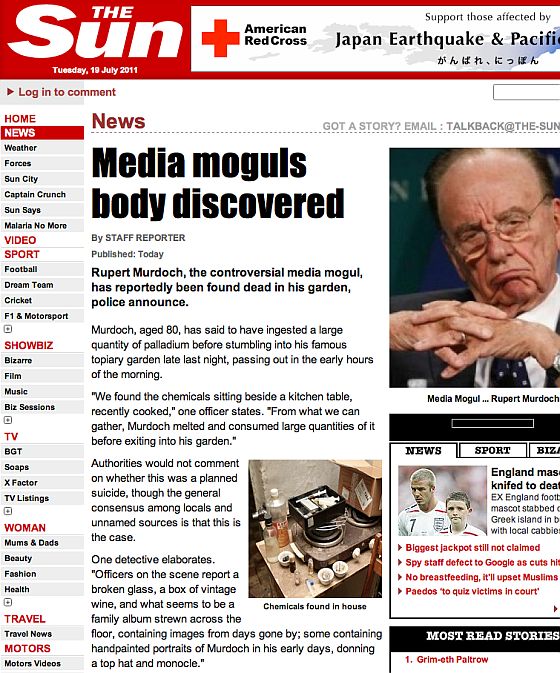
TechCrunch reports:
The web site of The Sun newspaper, part of News International which has been embroiled in the phone hacking scandal in the UK, has been hacked, apparently by hacker group Lulzsec, which tweeted “@LulzSec: We have owned Sun/News of the World – that story is simply phase 1 – expect the lulz to flow”.
The hack is a redirect to “http://www.new-times.co.uk/sun/” and contains a (clearly false) story about Rupert Murdoch being found dead. Ironically the domain ‘new-times.co.uk’ is registered to one News International Newspapers Limited.
The ‘story’ begins:
Rupert Murdoch, the controversial media mogul, has reportedly been found dead in his garden, police announce. Murdoch, aged 80, has said to have ingested a large quantity of palladium before stumbling into his famous topiary garden late last night, passing out in the early hours of the morning.”
No doubt this is in reference to the tragic news tonight that a pivotal informer in the phone hacking scandal, Sean Hoare, was tonight found dead in his apartment, though Police are reporting the circumstances as ‘not suspicious’.

Jeremy Scahill writes:
Nestled in a back corner of Mogadishu’s Aden Adde International Airport is a sprawling walled compound run by the Central Intelligence Agency. Set on the coast of the Indian Ocean, the facility looks like a small gated community, with more than a dozen buildings behind large protective walls and secured by guard towers at each of its four corners. Adjacent to the compound are eight large metal hangars, and the CIA has its own aircraft at the airport. The site, which airport officials and Somali intelligence sources say was completed four months ago, is guarded by Somali soldiers, but the Americans control access. At the facility, the CIA runs a counterterrorism training program for Somali intelligence agents and operatives aimed at building an indigenous strike force capable of snatch operations and targeted “combat” operations against members of Al Shabab, an Islamic militant group with close ties to Al Qaeda.
As part of its expanding counterterrorism program in Somalia, the CIA also uses a secret prison buried in the basement of Somalia’s National Security Agency (NSA) headquarters, where prisoners suspected of being Shabab members or of having links to the group are held. Some of the prisoners have been snatched off the streets of Kenya and rendered by plane to Mogadishu. While the underground prison is officially run by the Somali NSA, US intelligence personnel pay the salaries of intelligence agents and also directly interrogate prisoners. The existence of both facilities and the CIA role was uncovered by The Nation during an extensive on-the-ground investigation in Mogadishu. Among the sources who provided information for this story are senior Somali intelligence officials; senior members of Somalia’s Transitional Federal Government (TFG); former prisoners held at the underground prison; and several well-connected Somali analysts and militia leaders, some of whom have worked with US agents, including those from the CIA. A US official, who confirmed the existence of both sites, told The Nation, “It makes complete sense to have a strong counterterrorism partnership” with the Somali government.
The CIA presence in Mogadishu is part of Washington’s intensifying counterterrorism focus on Somalia, which includes targeted strikes by US Special Operations forces, drone attacks and expanded surveillance operations. The US agents “are here full time,” a senior Somali intelligence official told me. At times, he said, there are as many as thirty of them in Mogadishu, but he stressed that those working with the Somali NSA do not conduct operations; rather, they advise and train Somali agents. “In this environment, it’s very tricky. They want to help us, but the situation is not allowing them to do [it] however they want. They are not in control of the politics, they are not in control of the security,” he adds. “They are not controlling the environment like Afghanistan and Iraq. In Somalia, the situation is fluid, the situation is changing, personalities changing.”
According to well-connected Somali sources, the CIA is reluctant to deal directly with Somali political leaders, who are regarded by US officials as corrupt and untrustworthy. Instead, the United States has Somali intelligence agents on its payroll. Somali sources with knowledge of the program described the agents as lining up to receive $200 monthly cash payments from Americans. “They support us in a big way financially,” says the senior Somali intelligence official. “They are the largest [funder] by far.”
According to former detainees, the underground prison, which is staffed by Somali guards, consists of a long corridor lined with filthy small cells infested with bedbugs and mosquitoes. One said that when he arrived in February, he saw two white men wearing military boots, combat trousers, gray tucked-in shirts and black sunglasses. The former prisoners described the cells as windowless and the air thick, moist and disgusting. Prisoners, they said, are not allowed outside. Many have developed rashes and scratch themselves incessantly. Some have been detained for a year or more. According to one former prisoner, inmates who had been there for long periods would pace around constantly, while others leaned against walls rocking.
Carlo Strenger writes:
MK Zeev Elkin, who initiated the boycott law that was passed by the Knesset this Monday, said that the law was not meant to silence people, but to “protect the citizens of Israel.” Elkin’s statement would, in and of itself, not carry much interest, if it didn’t highlight a hallmark of the eighteenth Knesset that is undermining Israel as a liberal democracy step by step.
American philosopher Harry Frankfurt wrote a much quoted paper titled “On Bullshit” in 1986. In 2005, after George W. Bush was reelected, this paper was re-published as a booklet by Princeton University Press, and became a bestseller. Frankfurt’s philosophical concept of bullshit is of much help in analyzing Elkin’s statement and the current Knesset’s culture.
The Bullshitter’s eye, says Harry Frankfurt, “is not on the facts at all, as the eyes of the honest man and of the liar are, except insofar as they may be pertinent to his interest in getting away with what he says. He does not care whether the things he says describe reality correctly. He just picks them out, or makes them up, to suit his purpose.”
It seems to me that Elkin’s statement is a precise instance of what Frankfurt means by bullshitting. Elkin tries to generate the impression that calls for boycotts threaten the citizens of Israel. The truth is, of course, that calls to boycott do not threaten anybody in any serious way: they call to exert pressure on Israel to end the occupation; nothing more, nothing less.
Furthermore Mr. Elkin is trying to give the impression that his boycott law is not an infringement on the right to free speech, and that it does no harm to Israel’s democracy. That, of course, depends on how we understand democracy. Syria and Iran have regular elections, as did Egypt before Mubarak was toppled. But clearly they are not liberal democracies: there is no freedom of speech; there is no open critical discussion; and there is no clear separation of powers.
Liberal democracy depends not only on institutional structures. It also depends on a culture that values clear speech; coherent, logical argument; and truly critical discussion. This is what philosopher Karl Popper called open society. Because we humans are fallible, errors are unavoidable, and the value of open society is to lower chances to get stuck with falsehoods and wrong strategies, because a truly critical discussion allows for falsification of wrong ideas, for correction of mistakes and for innovation.
Bullshitting, to a certain extent, is an unavoidable facet of political life. But once it goes beyond a certain limit, it endangers open society and liberal democracy. Totalitarianism, as George Orwell showed poignantly, hinges on clouding the mind by polluting our speech. This is precisely what the majority of the eighteenth Knesset and the Netanyahu government have done: they have crossed the line where bullshitting pushes towards totalitarianism.
Amira Hass reports from somewhere in the East Mediterranean.
On Saturday evening a Gaza-bound boat left Greek territorial waters. Its 10 participants regard themselves as representatives of the entire abortive flotilla to Gaza, and are determined to exhaust all possibilities in order to reach their destination, or at least carry out the symbolic act of protesting the blockade. They are well aware of the Lilliputian dimensions of their venture, compared with the massive impact organizers had initially planned to have with the 10-odd vessel flotilla.
Dignite-Al Karama, one of two yachts purchased by the French delegation in the second Freedom Flotilla, left a port in Corsica on June 25. Thus, it was spared the fate of eight other boats which were supposed to sail out of Greek ports, but were impounded by Greek authorities.
Last Wednesday Karama left the port of Sitia in Crete, where it had been anchored for a week, awaiting the other boats in vain. Once it was clear that Greece, under strong Israeli pressure, would not allow those boats to sail, its remaining passengers ¬ three French nationals and one Tunisian ¬ were joined by three representatives of other delegations, a Greek, Swede and a Canadian, and by three more French activists who arrived from France. Also on board are three crew members and three journalists from Al Jazeera and Haaretz.
The decision to carry on the mission of sailing to Gaza was not automatically welcomed by other delegations or by the steering committee of the flotilla. Some preferred to officially end the current campaign. Karama’s participants spent long hours negotiating and convincing the others.
Reuters reports:
When the war in Libya started, many young men now on the rebel front line at Misrata were so interested in computer games and mobile phones that older residents never thought they would turn into fighters. “Before the uprising, all those young men cared about was hair gel, clothes, music, mobile phones and hanging out in cafes,” said Mahmoud Askutri, a businessman who has formed and funds the 1st battalion of the Al Marsa regiment, one of the rebel units fighting here to end Muammar Gaddafi’s 41-year rule.
“But now they fight and are willing to die for a cause.”
Amid the Arab Spring protests that swept the region early this year, the people of Misrata and elsewhere in Libya demanded greater freedom, so Gaddafi sent in the troops to silence their protests.
After those troops opened fire on demonstrators, the people of Misrata rose up, initially fighting back with petrol bombs and hunting rifles.
Since then, they have wrested control of Libya’s third largest city from Gaddafi loyalists and, after mistakes that cost many lives, this army of former civilians has consolidated a front line 36 km (22 miles) west of Misrata.
They have recently encountered better trained troops and have moved forward slowly under sustained bombardment to conserve ammunition, hold territory and reduce casualties.
That they are around 10 km (six miles) east of Zlitan, the largest city between here and the capital, Tripoli, is testimony to the courage of the young men in this force.
“They treat me with great respect,” Askutri said before a visit to the men of Al Masra on the front line. “But when I see them I do not feel worthy of that respect. A few months ago they were civilians. Now they are willing to die for their freedom.”
Salah is typical of many young men on the front line here. The 20-year-old was attending medical school when the uprising started. Life was easy and he spent a lot of time playing soccer games on Playstation.
“Fifty fifty,” he says of his record on Playstation.
Sitting with a group of other young men, he says he is a big fan of FC Barcelona. A second young man shakes his head and says he likes Real Madrid, while a third looks down at the Manchester United logos embossed on his shoes and says nothing.
Salah plans to return to university after the war, as he wants to become a cardiologist.
“But first we must beat Gaddafi,” he says. “We cannot be free if we live under him.”
The Guardian reports:
Sean Hoare, the former News of the World showbiz reporter who was the first named journalist to allege Andy Coulson was aware of phone hacking by his staff, has been found dead, the Guardian has learned.
Hoare, who worked on the Sun and the News of the World with Coulson before being dismissed for drink and drugs problems, is said to have been found dead at his Watford home.
Hertfordshire police would not confirm his identity, but the force said in a statement: “At 10.40am today [Monday 18 July] police were called to Langley Road, Watford, following the concerns for the welfare of a man who lives at an address on the street. Upon police and ambulance arrival at a property, the body of a man was found. The man was pronounced dead at the scene shortly after.
“The death is currently being treated as unexplained, but not thought to be suspicious. Police investigations into this incident are ongoing.”
It looks like the grounds for lack of suspicion might be buried close to the end of this article. When speaking to a Guardian journalist last week, Hoare said “he had been injured the previous weekend while taking down a marquee erected for a children’s party. He said he had broken his nose and badly injured his foot when a relative accidentally struck him with a heavy pole from the marquee.”
Nick Davies writes:
At a time when the reputation of News of the World journalists is at rock bottom, it needs to be said that the paper’s former showbusiness correspondent Sean Hoare, who died on Monday, was a lovely man.
In the saga of the phone-hacking scandal, he distinguished himself by being the first former NoW journalist to come out on the record, telling the New York Times last year that his former friend and editor, Andy Coulson, had actively encouraged him to hack into voicemail.
That took courage. But he had a particularly powerful motive for speaking. He knew how destructive the News of the World could be, not just for the targets of its exposés, but also for the ordinary journalists who worked there, who got caught up in its remorseless drive for headlines.
Explaining why he had spoken out, he told me: “I want to right a wrong, lift the lid on it, the whole culture. I know, we all know, that the hacking and other stuff is endemic. Because there is so much intimidation. In the newsroom, you have people being fired, breaking down in tears, hitting the bottle.”
He knew this very well, because he was himself a victim of the News of the World. As a showbusiness reporter, he had lived what he was happy to call a privileged life. But the reality had ruined his physical health: “I was paid to go out and take drugs with rock stars – get drunk with them, take pills with them, take cocaine with them. It was so competitive. You are going to go beyond the call of duty. You are going to do things that no sane man would do. You’re in a machine.”
Bloomberg reports:
News Corp. (NWSA)’s Rupert Murdoch is struggling to control the destiny of the company he began building six decades ago after a trusted deputy was arrested and Scotland Yard’s top official quit over ties to a suspect in the phone-hacking probe.
Independent directors of New York-based News Corp. have begun questioning the company’s response to the crisis and whether a leadership change is needed, said two people with direct knowledge of the situation who wouldn’t speak publicly. Rebekah Brooks, the former News International chief who Murdoch backed until last week, was arrested yesterday in London.
“The shell of invulnerability that Rupert Murdoch had around him has been cracked,” said James Post, a professor at Boston University’s School of Management who has written about governance and business ethics. “His credibility and the company’s credibility are hemorrhaging.”
Murdoch and his 38-year-old son, James Murdoch, are spending most of their time with advisers preparing for tomorrow’s hearing before a U.K. parliamentary committee. They will face questions over their role in and responsibility for phone hacking that took place at their now-defunct News of the World tabloid. The company took out advertisements in national U.K. newspapers this weekend to apologize for the scandal.
News Corp. (NWS) fell 66 cents, or 4.2 percent, to $14.98 on the Nasdaq Stock Market at 11:18 a.m. New York time. Before today, it had lost 13 percent since July 4, when the Guardian reported that News of the World employees had intercepted the voice mail of Milly Dowler, a schoolgirl who was later found murdered. The tabloid is also alleged to have hacked into the phones of terror victims and dead soldiers, as well as politicians and celebrities.
The slump has shaved more than $6 billion off the combined value of the Class A shares and the Class B voting stock that gives the Murdochs control over the company.
David Carr writes:
“Bury your mistakes,” Rupert Murdoch is fond of saying. But some mistakes don’t stay buried, no matter how much money you throw at them.
Time and again in the United States and elsewhere, Mr. Murdoch’s News Corporation has used blunt force spending to skate past judgment, agreeing to payments to settle legal cases and, undoubtedly more important, silence its critics. In the case of News America Marketing, its obscure but profitable in-store and newspaper insert marketing business, the News Corporation has paid out about $655 million to make embarrassing charges of corporate espionage and anticompetitive behavior go away.
[…]
In 2006 the state of Minnesota accused News America of engaging in unfair trade practices, and the company settled by agreeing to pay costs and not to falsely disparage its competitors.In 2009, a federal case in New Jersey brought by a company called Floorgraphics went to trial, accusing News America of, wait for it, hacking its way into Floorgraphics’s password protected computer system.
The complaint summed up the ethos of News America nicely, saying it had “illegally accessed plaintiff’s computer system and obtained proprietary information” and “disseminated false, misleading and malicious information about the plaintiff.”
The complaint stated that the breach was traced to an I.P. address registered to News America and that after the break-in, Floorgraphics lost contracts from Safeway, Winn-Dixie and Piggly Wiggly.
Much of the lawsuit was based on the testimony of Robert Emmel, a former News America executive who had become a whistle-blower. After a few days of testimony, the News Corporation had heard enough. It settled with Floorgraphics for $29.5 million and then, days later, bought it, even though it reportedly had sales of less than $1 million.
But the problems continued, and keeping a lid on News America turned out to be a busy and expensive exercise. At the beginning of this year, it paid out $125 million to Insignia Systems to settle allegations of anticompetitive behavior and violations of antitrust laws. And in the most costly payout, it spent half a billion dollars in 2010 on another settlement, just days before the case was scheduled to go to trial. The plaintiff, Valassis Communications, had already won a $300 million verdict in Michigan, but dropped the lawsuit in exchange for $500 million and an agreement to cooperate on certain ventures going forward.
The News Corporation is a very large, well-capitalized company, but that single payout to Valassis represented one-fifth of the company’s net income in 2010 and matched the earnings of the entire newspaper and information division that News America was a part of.
The New York Times reports:
The phone hacking scandal in Britain claimed another high-profile casualty on Monday when John Yates, the assistant commissioner of the Metropolitan Police in London, resigned his post. His departure comes a day after the country’s top police officer quit and Rebekah Brooks, the former chief executive of Rupert Murdoch’s News International, was arrested on suspicion of illegally intercepting phone calls and bribing the police.
Such is the severity of the crisis swirling around the Murdoch empire and Britain’s public life that Prime Minister David Cameron cut short an African trip on Monday and, bowing to opposition pressure, called a special parliamentary session on Wednesday to debate the widening scandal.
Mr. Yates is a well-known officer who had been involved in an earlier and inconclusive police review of the scandal. He and other officers have been under scrutiny by lawmakers who are trying to determine why the Metropolitan Police decided in 2009 to strictly limit the initial phone-hacking inquiry, dating to 2006.
Shortly after the Metropolitan Police announced his resignation, Mr. Yates made a defiant public statement: “I have acted with complete integrity,” he said. “My conscience is clear.”
Kiran Stacey notes that the resignation of Met Commisioner, Sir Paul Stephenson, puts the British prime minister in an even tighter corner. If Stephenson had to resign for appointing Neil Wallis, shouldn’t Cameron resign for appointing Andy Coulson?
Sir Paul Stephenson’s resignation yesterday was a significant moment in the phone hacking affair: not only because of the fact of his resigning but because of what he said afterwards.
He made two subtle but important criticisms of the prime minister:
1) He said he had resigned in part for having employed Neil Wallis, the former deputy editor of the News of the World, who has since been arrested, but did not have to resign from the NotW for his part in the scandal. He compared this to Andy Coulson, who had been forced to resign, but was also given subsequent employment – by the prime minister.
2) Sir Paul also said he did not want to “compromise the prime minister” by telling him about Wallis’ involvement either with the Met or the fact that he was a suspect in the hacking affair, given Cameron’s “close relationship with Mr Coulson”. This came close to, without doing so directly, saying that Cameron could not have been trusted with such information, and may have jeopardised the operation (or at least been accused of jeopardising it) by telling Coulson. It’s an extraordinary claim, which [Labour MP and shadow Home Secretary] Yvette Cooper was quick to highlight…
John Nichols writes:
Australian-born billionaire Rupert Murdoch has manipulated not just the news but the news landscape of the United States for decades. He has done so by pressuring the Federal Communications Commission and Congress to alter the laws of the land and regulatory standards in order to give his media conglomerate an unfair advantage in “competition” with more locally focused, more engaged and more responsible media.
It’s an old story: while Murdoch’s Fox News hosts prattle on and on about their enthusiasm for the free market, they work for a firm that seeks to game the system so Murdoch’s “properties” are best positioned to monopolize the discourse.
Now, with Murdoch’s News Corp. empire in crisis—collapsing bit by bit under the weight of a steady stream of allegations about illegal phone hacking and influence peddling in Britain—there is an odd disconnect occurring in much of the major media of the United States. While there is some acknowledgement that Murdoch has interests in the United States (including not just his Fox News channel but the Wall Street Journal and the New York Post), the suggestion is that Murdoch was more manipulative, more influential, more controlling in Britain than here.
But that’s a fantasy. Just as Murdoch has had far too much control over politics and politicians in Britain during periods of conservative dominance—be it under an actual Tory such as former Prime Ministers Margaret Thatcher and John Major and current Prime Minister David Cameron or under a faux Tory such as former Prime Minister Tony Blair—he has had far too much control in the States. And that control, while ideological to some extent, is focused mainly on improving the bottom line for his media properties by securing for them unfair legal and regulatory advantages.