
The cult of the suicide bomber
No one doubts that the road to Baghdad – or Tal Afar or Fallujah or Mosul – lies through Syria, and that the movement of suicide bombers from the Mediterranean coasts to the deserts of Iraq is a planned if not particularly sophisticated affair. What is astonishing – what is not mentioned by the Americans or the Iraqi “government” or the British authorities or indeed by many journalists – is the sheer scale of the suicide campaign, the vast numbers of young men (only occasionally women), who wilfully destroy themselves amid the American convoys, outside the Iraqi police stations, in markets and around mosques and in shopping streets and on lonely roads beside remote checkpoints across the huge cities and vast deserts of Iraq. Never have the true figures for this astonishing and unprecedented campaign of self-liquidation been calculated.
But a month-long investigation by The Independent, culling four Arabic-language newspapers, official Iraqi statistics, two Beirut news agencies and Western reports, shows that an incredible 1,121 Muslim suicide bombers have blown themselves up in Iraq. This is a very conservative figure and – given the propensity of the authorities (and of journalists) to report only those suicide bombings that kill dozens of people – the true estimate may be double this number. On several days, six – even nine – suicide bombers have exploded themselves in Iraq in a display of almost Wal-Mart availability. If life in Iraq is cheap, death is cheaper.
This is perhaps the most frightening and ghoulish legacy of George Bush’s invasion of Iraq five years ago. Suicide bombers in Iraq have killed at least 13,000 men, women and children – our most conservative estimate gives a total figure of 13,132 – and wounded a minimum of 16,112 people. If we include the dead and wounded in the mass stampede at the Baghdad Tigris river bridge in the summer of 2005 – caused by fear of suicide bombers – the figures rise to 14,132 and 16,612 respectively. Again, it must be emphasised that these statistics are minimums. For 529 of the suicide bombings in Iraq, no figures for wounded are available. Where wounded have been listed in news reports as “several”, we have made no addition to the figures. And the number of critically injured who later died remains unknown. Set against a possible death toll of half a million Iraqis since the March 2003 invasion, the suicide bombers’ victims may appear insignificant; but the killers’ ability to terrorise civilians, militiamen and Western troops and mercenaries is incalculable. [complete article]
There is a paradox in the current situation in Iraq. We are told that the surge has worked brilliantly and violence is way down. And yet the plan to reduce troop levels—which was at the heart of the original surge strategy—must be postponed or all hell will once again break loose. Making sense of this paradox is critical. Because in certain crucial ways things are not improving in Iraq, and unless they start improving soon, the United States faces the awful prospect of an unending peacekeeping operation—with continuing if limited casualties—for years to come.
In a brilliant and much-circulated essay written in August 2007, “Anatomy of a Tribal Revolt,” David Kilcullen, a veteran Australian officer who advised Gen. David Petraeus during the early days of the surge, wrote, “Our dilemma in Iraq is, and always has been, finding a way to create a sustainable security architecture that does not require ‘Coalition-in-the-loop,’ thereby allowing Iraq to stabilize and the Coalition to disengage in favorable circumstances.” We have achieved some security in Iraq, though even this should not be overstated. (Violence is still at 2005 levels, which were pretty gruesome.) But we have not built a sustainable security architecture. [complete article]
Iraq’s insurgency runs on stolen oil profits
The Baiji refinery, with its distillation towers rising against the Hamrin Mountains, may be the most important industrial site in the Sunni Arab-dominated regions of Iraq. On a good day, 500 tanker trucks will leave the refinery filled with fuel with a street value of $10 million.
The sea of oil under Iraq is supposed to rebuild the nation, then make it prosper. But at least one-third, and possibly much more, of the fuel from Iraq’s largest refinery here is diverted to the black market, according to American military officials. Tankers are hijacked, drivers are bribed, papers are forged and meters are manipulated — and some of the earnings go to insurgents who are still killing more than 100 Iraqis a week.
“It’s the money pit of the insurgency,” said Capt. Joe Da Silva, who commands several platoons stationed at the refinery.
Five years after the war in Iraq began, the insurgency remains a lethal force. The steady flow of cash is one reason, even as the American troop buildup and the recruitment of former insurgents to American-backed militias have helped push the number of attacks down to 2005 levels. [complete article]



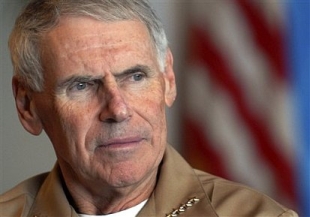 There is a view abroad, commonly held, that Admiral William “Fox” Fallon has been sacrificed, has been gotten out of the way, by the Bush Administration because he disagreed with its policies on Iran. That Fallon stood in the way of the neo-Conservative cabal who is bent on expanding the Middle East conflict and that, when given the order for the attack (at some point in the future), Fallon would have courageously refused the order and reversed the tide of history.
 Brain imaging studies have revealed that when people think about other people, parts of the frontal cortex become active. Advocates of the social brain hypothesis say the frontal cortex expanded in our ancestors because natural selection favored social intelligence.
 Talk about the “kitchen sink”! If Barack Obama wanted to throw it at the eight years of First Lady experience that Hillary Clinton has made central to her resume for “the job” she says she wants us to “hire” her for, there is plenty there. People on the left who say he won’t, he can’t because he’s just like her, a creature of capital and empire, may be right in the grand scheme, but they shouldn’t be smug, because there aren’t exactly models of successful radical or even liberal fights against the Clintons. There are barely models of noble but failed fights. And Hillary’s own revamped self-presentation as the populist fighter, sworn foe of big corporations, friend of the little people, ultimate underdog, makes clear that Obama’s ties to Wall Street should be no more an impediment than hers are in the game of political fisticuffs.