Trump should not be allowed to speak in UK parliament, says Speaker

The Guardian reports: Donald Trump is unfit to address MPs, according to the Speaker of the House of Commons who said that he would refuse to invite the US president to speak at Westminster because of parliament’s long held opposition “to racism and to sexism”.

John Bercow warned that the opportunity to speak in the prestigious Westminster Hall during a state visit “is not an automatic right, it is an earned honour” in an extraordinary intervention that divided MPs and annoyed No 10.

The unprecedented step caused many MPs to pour praise on Bercow, but also triggered an angry response in parts of government with ministers privately claiming that he had overstepped the mark.

Senior figures accused the Speaker of grandstanding – while his counterpart in the House of Lords, Lord Fowler, was understood to be irritated by the unexpected statement.

Bercow, whose role is non-political, told MPs that he did not have the power to block the state visit invitation extended to Trump by Theresa May, but made clear that he would use his authority to prevent what is considered one of the high points of the official trip.

The speaker made clear that he was always against the idea of Trump making a speech in the same hall that Barack Obama did in 2012, but said recent policies had even more determined to block the move. [Continue reading…]


Facebooktwittermail

Former top diplomats, tech giants blast immigration order as court showdown looms

The Washington Post reports: Fresh challenges to President Trump’s court-frozen immigration order took shape Monday with two former secretaries of state claiming the White House was undermining national security and nearly 100 Silicon Valley tech companies arguing it will keep the best minds from coming to America.

The powerful new voices were added with another legal showdown coming as early as Monday. The suspension of the order, meanwhile, has allowed those previously banned more time to try to reach the United States.

A decision Sunday by the U.S. Court of Appeals for the 9th Circuit preserved a lower judge’s order to temporarily halt the ban — and based on a schedule the court outlined, the stop will remain in place at least until sometime on Monday. The Justice Department said it would not elevate the dispute to the Supreme Court before that.

Trump responded to the development Sunday by writing on Twitter that he had “instructed Homeland Security to check people coming into our country VERY CAREFULLY.” A Department of Homeland Security spokeswoman did not immediately return messages seeking comment on how, practically, that screening would be implemented.

“Just cannot believe a judge would put our country in such peril,” Trump wrote. “If something happens blame him and court system. People pouring in. Bad!”

The next few days will be telling for the future of the president’s executive order. The appeals court asked those challenging the ban to file written arguments by 4 a.m. Eastern on Monday and asked Justice Department lawyers to reply by 6 p.m. Eastern. They could then schedule a hearing or rule whether the ban should remain on hold.

Early Monday, two former secretaries of state — John F. Kerry and Madeline Albright — joined a six-page joint statement saying Trump’s order “undermines” national security and will “endanger U.S. troops in the field.” The rare declaration, addressed to the 9th Circuit, was also backed by top former national security officials including Leon Panetta, who served as a past CIA director and defense secretary during the Obama administration. [Continue reading…]

Facebooktwittermail

Trump, Le Pen and the ideas more dangerous than bullets that were planted in the mind of the Quebec City killer

CBC News published a transcript of Imam Hassan Guillet’s English address to the Quebec City convention centre during the funeral for three of the six victims of Sunday night’s mosque shooting, in which he said: Khaled, Aboubaker, Abdelkrim, Azzedine, Mamadou and Ibrahima they selected the place they wanted to live in. They selected the society they wanted to be their society.

They selected with whom they wanted their children to grow. And it was Canada. It was Quebec. It was the city of Quebec in the same way they selected Quebec.

They chose Quebec to live in, and they chose the Canadian passport.

It is up to the society to choose them the same way they have chosen this society.

They had their dream to send their kids to school, to buy a house, to have a business and we have to continue their dreams. We have to continue their dreams the same way they extended their hands to the others. It is up to others to extend their hands toward them.

Now unfortunately, it is a little bit late. But not too late.

The society that could not protect them, the society that could not benefit from their generosity still has a chance. The hands that didn’t shake the hands of Khaled or Aboubaker or Abdelkrim or Azzedine or Mamadou or Ibrahima, that society can shake the hands of their kids.

We have 17 orphans. We have six widows. We have five wounded.

We ask Allah for them to get them out of the hospital as soon as possible.

Did I go through the complete list of victims? No.

There is one victim. None of us want talk about him.

But given my age, I have the courage to say it. This victim, his name is Alexandre Bissonnette.

Alexandre, before being a killer he was a victim himself. Before planting his bullets in the heads of his victims, somebody planted ideas more dangerous than the bullets in his head.

This little kid didn’t wake up in the morning and say ‘Hey guys instead of going to have a picnic or watching the Canadiens, I will go kill some people in the mosque.’ It doesn’t happen that way.

Day after day, week after week, month after month, certain politicians unfortunately, and certain reporters unfortunately, and certain media were poisoning our atmosphere. [Continue reading…]

Facebooktwittermail

Trump signs executive orders without understanding their details while aides fumble around the White House in the dark

The New York Times reports: Mr. Priebus has told Mr. Trump and Mr. Bannon that the administration needs to rethink its policy and communications operation in the wake of embarrassing revelations that key details of the orders were withheld from agencies, White House staff and Republican congressional leaders like Speaker Paul D. Ryan.

Mr. Priebus has also created a 10-point checklist for the release of any new initiatives that includes signoff from the communications department and the White House staff secretary, Robert Porter, according to several aides familiar with the process.

Mr. Priebus bristles at the perception that he occupies a diminished perch in the West Wing pecking order compared with previous chiefs. But for the moment, Mr. Bannon remains the president’s dominant adviser, despite Mr. Trump’s anger that he was not fully briefed on details of the executive order he signed giving his chief strategist a seat on the National Security Council, a greater source of frustration to the president than the fallout from the travel ban. [Emphasis mine]

It is partly because he is seen as having a clear vision on policy. But it is also because others who had been expected to fill major roles have been less confident in asserting their power.

Jared Kushner, Mr. Trump’s son-in-law, occupies a central role in the administration and has been present at most major decisions and photo ops, but he is a father of young children who has taken to life in Washington, and, along with his wife, Ivanka Trump, has already been spotted at events around town.

Mr. Bannon has rushed into the vacuum, telling allies that he and Mr. Miller have a brief window in which to push through their vision of Mr. Trump’s economic nationalism. [Continue reading…]

Facebooktwittermail

Sharpie-sniffing Trump discovers he can change White House décor without getting personally billed

The New York Times reports: Trump remains intensely focused on his brand, but the demands of the job mean he spends less time monitoring the news media — although he recently upgraded the flat-screen TV in his private dining room so he can watch the news while eating lunch.

He often has to wait until the end of the workday before grinding through news clips with Mr. Spicer, marking the ones he does not like with a big arrow in black Sharpie — though he almost always makes time to monitor Mr. Spicer’s performance at the daily briefings, summoning him to offer praise or criticism, a West Wing aide said.

Visitors to the Oval Office say Mr. Trump is obsessed with the décor — it is both a totem of a victory that validates him as a serious person and an image-burnishing backdrop — so he has told his staff to schedule as many televised events in the room as possible.

To pass the time between meetings, Mr. Trump gives quick tours to visitors, highlighting little tweaks he has made after initially expecting he would have to pay for them himself. [Continue reading…]

Donald Trump, a man of “fixed habits,” is famous for his preference for Sharpies. Sharpies contain industrial solvents and even if his pen of preference isn’t chosen on the basis of the effects on his brain, decades of toxic exposure could in part account for the glazed expression in Trump’s eyes. “Chronic inhalant abuse may result in serious and sometimes irreversible damage to the user’s heart, liver, kidneys, lungs, and brain. Brain damage may result in personality changes, diminished cognitive functioning, memory impairment, and slurred speech.”

Sharpies aside, Trump is clearly indifferent or ignorant about the elements of behavior that contribute to good health.

Facebooktwittermail

James Baker on how to run a White House that works and why the world is so scared right now

Politico reports: Democrats and Republicans agree on one thing: James A. Baker III was the gold standard when it came to running a White House. And so far he’s not overly impressed when it comes to the troubled kickoff of the Trump administration.

In his first extensive comments on America’s controversial new president, the former chief of staff, campaign manager, diplomat and all-around GOP wise man offered a serious and substantive critique of the early days of President Trump’s takeover. His advice: Stop blowing up the U.S. relationship with Mexico, don’t expect them to pay for the wall, don’t act as “Israel’s lawyer,” don’t be an isolationist, support NATO and do a much better job of working with the other power centers of Washington — Congress and the Cabinet — before unveiling disruptive new policies like the temporary refugee ban. “The rollout here was deficient, we have to acknowledge that,” he says.

When we met in his Houston office last week for the launch of The Global Politico, our new weekly podcast on international affairs in the Trump era, Baker held forth for nearly an hour about how things are supposed to work in a West Wing that’s got its game on, the ways in which the brash billionaire in the White House is — and is not — like his old boss Ronald Reagan, and his disappointment in Barack Obama for leaving “the world in much worse shape than it was eight years ago.”

He also weighed in on Russia sanctions, taking a firm line that they should remain in place to remind the Russian President Vladimir Putin that “rolling the tanks” into neighboring countries like Ukraine will not be tolerated, worried that Trump will trade those sanctions away for “nothing” and argued that Israel is risking its future by building more settlements. “We have allies that are just scared to death,” he notes, as a result of Trump’s early rhetoric and unpredictable foreign policy. [Continue reading…]

Facebooktwittermail

The battle over truth is now central to our politics

Charles J. Sykes writes: By now, it ought to be evident that enemies are important to this administration, whether they are foreigners, refugees, international bankers or the press.

But discrediting independent sources of information also has two major advantages for Mr. Trump: It helps insulate him from criticism and it allows him to create his own narratives, metrics and “alternative facts.”

All administrations lie, but what we are seeing here is an attack on credibility itself.

The Russian dissident and chess grandmaster Garry Kasparov drew upon long familiarity with that process when he tweeted: “The point of modern propaganda isn’t only to misinform or push an agenda. It is to exhaust your critical thinking, to annihilate truth.”

Mr. Kasparov grasps that the real threat is not merely that a large number of Americans have become accustomed to rejecting factual information, or even that they have become habituated to believing hoaxes. The real danger is that, inundated with “alternative facts,” many voters will simply shrug, asking, “What is truth?” — and not wait for an answer.

In that world, the leader becomes the only reliable source of truth; a familiar phenomenon in an authoritarian state, but a radical departure from the norms of a democratic society. The battle over truth is now central to our politics. [Continue reading…]

Facebooktwittermail

Steve Bannon’s war with Islam

Jalal Baig writes: There seems to be considerable urgency right now to enshrine Donald Trump’s Islamophobia into law. Talk of an immigration ban, a Muslim registry and even internment camps once sounded like the machinations of a spray-tanned salesman looking to indulge the electorate’s need for a good villain narrative. Amid an atmosphere of overwhelming chaos, the early days of Trump’s reign have made clear, however, that Islam is Public Enemy No. 1 and serves as the centerpiece of Steve Bannon’s ethno-nationalist agenda. (Trump’s ban on immigration and travel from certain Muslim-majority nations is currently on hold, thanks to a Friday federal court order. That does nothing to resolve the larger questions.)

Bannon called Trump “a blunt instrument for us” in an interview last summer with Vanity Fair. He added, “I don’t know whether he really gets it or not.” That the former Breitbart executive editor would have an outsized role in a Trump administration should have been evident long ago. In Trump, Bannon found a petulant Twitterphile and a manipulable tool who has minimal interest in policymaking and little insight into his own limitations. As he sought an upheaval to remake an America rife with perceived threats, Trump was, as Lawrence Douglas wrote, “the proper vehicle to carry the fight forward.”

For Bannon, the fight is against Islam. There are echoes of Samuel Huntington’s 1993 essay in Foreign Affairs called “The Clash of Civilizations?” Huntington wrote of a world that had been divided along “fault lines” such as culture, which could spur conflict between Islamic civilization and the West. Bannon speaks of the current war with “jihadist Islamic fascism” in apocalyptic terms and sees it as the latest iteration, as Uri Friedman wrote, “of an existential, centuries old-struggle between the Judeo-Christian West and the Islamic world.” [Continue reading…]

Facebooktwittermail

Steve Bannon’s faith in global war

Time reports: Sometime in the early 2000s, Bannon was captivated by a book called The Fourth Turning by generational theorists William Strauss and Neil Howe. The book argues that American history can be described in a four-phase cycle, repeated again and again, in which successive generations have fallen into crisis, embraced institutions, rebelled against those institutions and forgotten the lessons of the past–which invites the next crisis. These cycles of roughly 80 years each took us from the revolution to the Civil War, and then to World War II, which Bannon might point out was taking shape 80 years ago. During the fourth turning of the phase, institutions are destroyed and rebuilt.

In an interview with TIME, author Howe recalled that Bannon contacted him more than a decade ago about making a film based on the book. That eventually led to Generation Zero, released in 2010, in which Bannon cast the 2008 financial crisis as a sign that the turning was upon us. Howe agrees with the analysis, in part. In each cycle, the postcrisis generation, in this case the baby boomers, eventually rises to “become the senior leaders who have no memory of the last crisis, and they are always the ones who push us into the next one,” Howe said.

But Bannon, who once called himself the “patron saint of commoners,” seemed to relish the opportunity to clean out the old order and build a new one in its place, casting the political events of the nation as moments of extreme historical urgency, pivot points for the world. Historian David Kaiser played a featured role in Generation Zero, and he recalls his filmed interview with Bannon as an engrossing and enjoyable experience.

And yet, he told TIME, he was taken aback when Bannon began to argue that the current phase of history foreshadowed a massive new war. “I remember him saying, ‘Well, look, you have the American revolution, and then you have the Civil War, which was bigger than the revolution. And you have the Second World War, which was bigger than the Civil War,'” Kaiser said. “He even wanted me to say that on camera, and I was not willing.”

Howe, too, was struck by what he calls Bannon’s “rather severe outlook on what our nation is going through.” Bannon noted repeatedly on his radio show that “we’re at war” with radical jihadis in places around the world. This is “a global existential war” that likely will become “a major shooting war in the Middle East again.” War with China may also be looming, he has said. This conviction is central to the Breitbart mission, he explained in November 2015: “Our big belief, one of our central organizing principles at the site, is that we’re at war.” [Continue reading…]

The cover of Time magazine brands Bannon as “The Great Manipulator,” and however accurately that might describe him, it is an image that serves Trump’s interests in this regard: it turns Bannon into Trump’s insurance policy by availing the so-called president with the option of firing Bannon rather than admit the failure of his presidency. Indeed, it’s reasonable to assume that Trump will sooner declare the failure of America than ever take responsibility for his own actions.

Facebooktwittermail

Refugees are already vigorously vetted. I know because I vetted them

Natasha Hall writes: I conducted one of my last interviews as an immigration officer with the Department of Homeland Security in Istanbul, with Mahmoud and his 8-year-old son from Aleppo, Syria. The boy had lost his legs in the explosion that killed Mahmoud’s wife, sister and other children. It was supposed to be his first day at school in two years. Instead, they were in my office, reliving the worst experiences of their lives in an attempt to come to the United States. Mahmoud trembled as he spoke about returning to his home from work one day and digging his family members out of the rubble.

I had never been both so sad and so proud that this boy would be able to come to the United States and start school and a new life. Now I imagine them, four years after leaving Syria and three years after registering as refugees, being told to go back. Go back where?

This is what President Trump’s recent executive order has done. The order bans entry for citizens of seven countries for 90 days, suspends all refugee admissions for 120 days, halves the total number of refugees allowed into the United States this year and bars refugees from Syria indefinitely. It demands “a uniform screening standard and procedure,” “questions aimed at identifying fraudulent answers and malicious intent,” “a mechanism to ensure that the applicant is who the applicant claims to be” and “a mechanism to assess whether or not the applicant has the intent to commit criminal or terrorist acts.”

Whoever wrote this order is evidently not aware that these screenings, procedures and questions already exist. [Continue reading…]

Facebooktwittermail

Canada, leading the free world

Nicholas Kristof writes: President Trump’s harsh travel ban reflects a global pattern: All around the world, countries are slamming the doors shut.

One great exception: Canada. It may now be the finest example of the values of the Statue of Liberty.

This isn’t just because Canadian leaders are particularly enlightened, although there’s some of that. It’s mostly because the Canadian people themselves remain astonishingly hospitable, with many groups clamoring for more Syrian refugees.

“Thank you, Canada,” Omar al-Omar, a Syrian who was shot at age 15 as the war started, said to me at a center here where refugees are getting lessons in English and in Canadian habits, such as excruciating politeness. “I’m very happy. I feel welcome.” [Continue reading…]

Facebooktwittermail

China is eager to fill the vacuum in climate change leadership that is being left by the U.S.

Larry Buhl writes: Earlier this month China halted more than 100 coal-fired power projects. Scrapping these projects, with combined installed capacity of more than 100 gigawatts, may have more to do with China’s current overcapacity in coal production than its commitment to mitigating climate change. Nevertheless, Chinese leaders are likely happy that the move is framing their nation as a green energy leader, according to experts in Chinese and environmental policy.

That’s because, they say, the Chinese government is now eager to fill the vacuum in climate change leadership that is being left by the U.S. And, they say, China is poised to eat America’s lunch in the renewable energy sector.

Saying that China is doing nothing on climate change has long been a right wing talking point used to stop U.S. regulations such as carbon taxes. While that may have been true a decade ago, it certainly isn’t true now.

Already, China is both the world’s leading producer of renewable energy technologies and its biggest consumer. [Continue reading…]

Facebooktwittermail

Donald Trump defends murder

How can the so-called president best be characterized?

Demented?


A slayer of liberty?


Destroyer of global order?


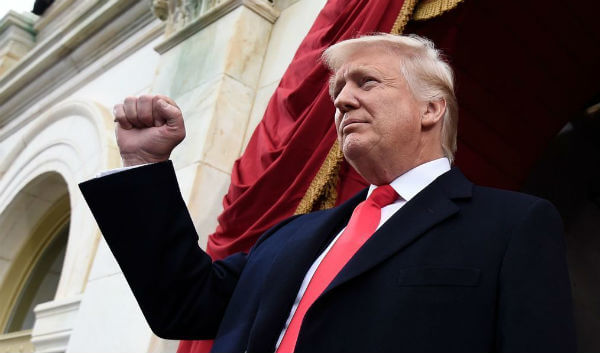
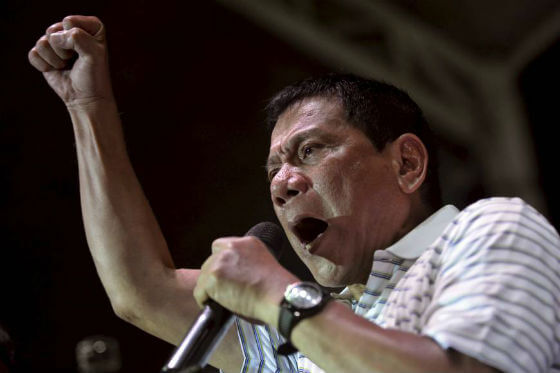
Or as Trump chose to portray himself at the defining moment of his inauguration, with raised fist?

The fist is a multipurpose symbol — a favorite of revolutionary leaders. But Trump’s calls out for comparison with that of another thug who until recently was very adept at grabbing headlines (until he got overshadowed by America’s chief thug): the fist of Philippine president Rodrigo Duterte.
When Hillary Clinton and many other leaders of the political establishment, both Democrats and Republicans, pronounced that Trump was “unfit for office,” many critics of the establishment viewed this charge with cynicism. It was dismissed as an expression of the establishment’s sense of entitlement — a way of saying that Trump could not be allowed to become president simply because he wasn’t an accepted member of the ruling class. It was as though Trump was being damned on the basis of nothing more than his lack of refinement.

What should be clear now, however, is that most of those who spoke out and declared Trump unfit — irrespective of whether those claims came from inside or outside the establishment — really meant what they were saying. This wasn’t just campaign rhetoric.

And yet even now, there are Trump loyalists, sympathizers, and reactionaries of a variety of political complexions who say: give Trump a chance. There are those who downplay the resistance to Trump as shrill.

But I would say this: Anyone at this juncture who remains unwilling to judge Trump as unfit for office is already placing him above the possibility of criticism; they are in effect offering him license to do anything.

When Bill O’Reilly invited Trump to condemn Vladimir Putin by saying, “he’s a killer,” Trump brushed off the charge by effectively saying, so what? — “We’ve got a lot of killers.”


Trump is saying that if Putin helps him kill members of ISIS, he doesn’t care if the Russian president has a habit of killing his own critics, political opponents, journalists, or anyone who threatens his grip on power. And Trump respects Putin not in spite of the measures he’s willing to take to secure his power, but on the contrary because of his success in consolidating his position of domination.

In other words, Trump respects Putin because he respects ruthlessness.

But Trump’s new on the job, he’s still learning, he needs time to polish his rough edges.

Really? Trump at 70 is still maturing? I don’t think so.

On the contrary, after two weeks we have every reason to expect more of the same and much worse.

Already, millions of people have had their lives disrupted, families have been broken apart, and murders have taken place directly or indirectly as a result of Trump moving into the White House.

Those who spent the last six months warning that a Trump presidency would be disastrous, were neither being alarmist nor particularly prescient. They were, on the contrary, simply judging Trump on the basis of the evidence he presents every single day of being a man whose recklessness, belligerence, ignorance, volatility, reactivity, immaturity, incompetence, and fundamental lack of respect for democracy and the rule of law, render him unfit for office.

When the American people speak loudly enough and when the Republicans in Congress conclude that Trump poses an existential threat to their own narrow interests, he will be impeached.

We don’t have to endure this spectacle for a full four years.

Facebooktwittermail

Trump’s belligerence towards Iran plays into the hands of Tehran’s hardliners

Saeed Kamali Dehghan writes: Distorting realities, ignoring nuances and hijacking people’s fears: that’s the recipe for a demagogue who lives not on his own wits but others’ miseries. It is particularly bad when the person or the country being targeted by that demagogue does little to straighten things out, which is exactly what is happening right now with Iran and Donald Trump.

Iranians know too well from their own experience with Mahmoud Ahmadinejad, their hardline former president, how dangerous it is to have a politician telling you passionately half of the truth without caring that the other half is often a lie or a distortion of facts.

Trump’s increasingly bellicose approach towards Iran, first by imposing a blanket travel ban, then putting Tehran “on notice” after a ballistic missile test, as well as by reported plans of new sanctions, carries two subtle messages. The first message is that Iranophobia is going to be his adopted weapon to distract attentions at home, appeal strongly to the US’s wealthy Arab allies who are already welcoming him as a moderate president, and please Benjamin Netanyahu. Iranian foreign minister Mohammad Javad Zarif, reacting on Twitter to the missile test, is right to point out that Iran only spends a fraction on defence compared to the US’s Arab allies in the region, which are big recipients of US, UK and French arms.

Trump’s second message, albeit one barely admitted by his officials, is that his administration’s problem is not just with the Iranian state, but with its people too. His executive order suspending all entries to the US from seven predominantly Muslim countries affects Iranians to a greater extent than it does nationals from the other six states.

There are more Iranians in the US, and far more Iranian students are likely to be affected by the new measures than those from Iraq, Libya, Somalia, Sudan, Syria and Yemen put together. Last year, there were 12,269 Iranian students studying in the US, according to data by the Institute of International Education, compared to 5,085 from the six other countries. Iranians are struggling to understand why they are being targeted in this way. [Continue reading…]

Facebooktwittermail

Democracy in action: Appeals court rejects request to immediately restore travel ban

The New York Times reports: A federal appeals court early Sunday rejected a request by the Justice Department to immediately restore President Trump’s targeted travel ban, deepening a legal showdown over his authority to tighten the nation’s borders in the name of protecting Americans from terrorism.

In the legal back and forth over the travel ban, the United States Court of Appeals for the Ninth Circuit in San Francisco said a reply from the Trump administration was now due on Monday.

The ruling meant that refugees and travelers from seven predominantly Muslim nations — Iran, Iraq, Libya, Somalia, Sudan, Syria and Yemen — who were barred by an executive order signed by the president on Jan. 27 would, for now, continue to be able to enter the country.

After a Federal District Court in Seattle blocked Mr. Trump’s order nationwide on Friday, the Justice Department appealed the ruling late Saturday, saying that the president had the constitutional authority to order the ban and that the court ruling “second-guesses the president’s national security judgment.”

On Saturday night, as Mr. Trump arrived at a Red Cross gala at Mar-a-Lago, his waterfront Florida resort, where he was spending the first getaway weekend of his presidency, reporters asked him if he was confident he would prevail in the government’s appeal. “We’ll win,” he replied. “For the safety of the country, we’ll win.”

The legal maneuvering led Mr. Trump to lash out at Judge James Robart of the Federal District Court in Seattle throughout the day, prompting criticism that the president had failed to respect the judicial branch and its power to check on his authority. [Continue reading…]

Facebooktwittermail