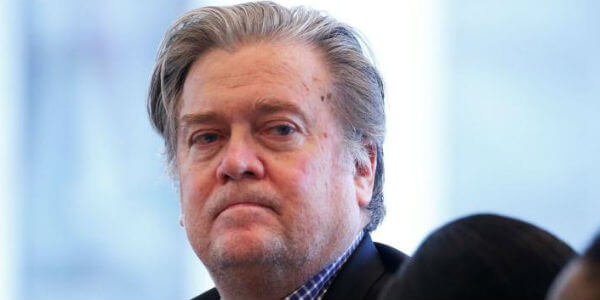
The price of arrogance: Steve Bannon and the best and the brightest

On the day after Christmas, Marc Tracy ran into Steve Bannon in Atlanta’s Hartsfield-Jackson International Airport. Bannon was reading David Halberstam’s The Best and the Brightest which documents the Kennedy administration’s failings leading to the Vietnam War. Tracy writes: If “The Best and the Brightest” is a brief against the East Coast meritocracy, though, its proposed alternative is not pure ideology. It is expertise.

Time and again, in Mr. Halberstam’s telling, lower-level government officials who understood Vietnamese politics, sentiments and even geography assessed reality accurately and offered correct policy recommendations to the major characters — who shunted them aside.

In early 1964, for instance, a State Department study concluded that bombing North Vietnam to reach a favorable political settlement would fail. The finding “reflected the genuine expertise of the government from deep within its bowels,” Mr. Halberstam writes. But the higher-ups favored bombing, and so there was bombing. (Which failed.)

“You’ve got these guys that are so brilliant, but they’re generalists,” said Mr. Logevall. “There’s a distinction to be drawn, he concludes, between this abstract quickness, this verbal facility, and true wisdom, which he says was missing.”

Such a reading prompts thought of the more than 1,000 State Department employees who signed a dissent cable opposing the immigration executive order — an order that, according to reports, was written by Mr. Bannon and the Trump adviser Stephen Miller, neither of whom are counterterrorism experts (or lawyers).

In this light, Mr. Bannon seems less a repudiation than a reincarnation of the tragic protagonists of “The Best and the Brightest.” [Continue reading…]

Facebooktwittermail

Federal judge’s ruling is ‘another stinging rejection of President Trump’s unconstitutional Muslim ban,’ says ACLU

The Washington Post reports: U.S. District Judge James L. Robart on Friday entered a temporary but nationwide stop to the order, saying he concluded the court “must intervene to fulfill its constitutional role in our tripart government.”

The Trump administration said it would go to court as quickly as possible to dissolve Robart’s order, and the president himself issued an extraordinarily personal criticism of Robart.

“The opinion of this so-called judge, which essentially takes law-enforcement away from our country, is ridiculous and will be overturned!” Trump said in a Saturday morning tweet.

Robart has been on the bench since 2004, and was nominated by President George W. Bush.

Department of Justice lawyers were preparing to immediately ask the U.S. Court of Appeals for the 9th Circuit to dissolve Robart’s order, but had not filed anything as of Saturday afternoon. It is not clear how quickly those appeals court judges would consider the government’s stay request. And although the 9th Circuit is considered one of the country’s most liberal, its randomly assigned three-judge panels can be unpredictable.

If not successful, the government has the option of asking the Supreme Court to get involved. Justice Anthony M. Kennedy is designated to hear emergency requests that arise from the 9th Circuit. But in high-profile cases such as this, such applications are generally considered by the full court.

The issue could reach the high court in days — or weeks.

“This ruling is another stinging rejection of President Trump’s unconstitutional Muslim ban,” said Omar Jadwat, director of the American Civil Liberties Union’s Immigrants’ Rights Project. “We will keep fighting to permanently dismantle this un-American executive order.” [Continue reading…]

The New York Daily News reports: Before he made headlines for temporarily blocking President Trump’s controversial travel ban, Federal Judge James Robart was quietly assisting refugees and speaking out against injustice from his bench in Seattle.

Robart, who presides in Washington State, was nominated by President George W. Bush to a seat on the United States District Court for the Western District of Washington in 2003 and was unanimously confirmed by the Senate in 2004.

During Robart’s confirmation hearing, Republican Sen. Orrin Hatch, of Utah, praised the judge for his pro bono legal work, noting he’d represented a number of refugees over the course of his decades-long career, according to CNN.

“He has been active in the representation of the disadvantaged through his work with Evergreen Legal Services and the independent representation of Southeast Asian refugees,” Hatch said at the time.

His community service and outreach has additionally extended to members of at-risk communities and special needs children. Robart is the former president and trustee of Seattle Children’s Home, as well as the former co-chair of Second Century Society and Children’s Home Society of Washington State, according to his official bio. [Continue reading…]

CNN reports: Following the judge’s ruling — and before the government’s announcements Saturday morning — the International Air Transportation Association, a worldwide airline industry trade group, cited US Customs and Border Protection in telling its members to follow procedures “as if the executive order never existed.” [Continue reading…]

Facebooktwittermail

Iran carries out new missile tests after Trump imposes sanctions

Bloomberg reports: Iran carried out further missile tests during an annual military exercise, a day after President Donald Trump imposed fresh sanctions on a raft of individuals and companies in response to the country test-firing a ballistic rocket last week.

The country successfully tested a range of land-to-land missiles and radar systems during the drills in a 35,000 square-kilometer stretch of desert in the northern Iranian province of Semnan, the semi-official Tasnim agency reported Saturday, citing Amir Ali Hajizadeh, commander of the Islamic Revolutionary Guards Corps’ aerospace division.

“If the enemy falls out of line, our missiles will pour down on them,” the brigadier general was cited as telling reporters on the sidelines of the military trials, without referring to any particular nations. Any threats made by the U.S. against Iran were “nonsensical,” Tasnim cited him as saying. [Continue reading…]

Facebooktwittermail

New York’s attorney general is emerging as the leader of the Trump resistance

Politico reports: “I like you. You and me, we’re going to be best friends.”

It is early January, and Eric Schneiderman is sitting in his 25th-floor office above Lower Manhattan, doing his best Donald Trump impression, puckering his lips into a duck face, scrunching up his nose and lowering his voice into something that resembles the president’s outer-borough growl.

Schneiderman is recalling his meeting with Trump in 2010. Back then, Schneiderman was running for attorney general of New York, and Trump was still in his pre-birther, reality TV host phase. Trump had donated money to one of Schneiderman’s opponents in the Democratic primary. Schneiderman managed to pull off a come-from-behind victory, and after the race, he went to Trump Tower to ask for a donation for the general election. Trump coughed up $12,500 to the Democrat, and Schneiderman went on to beat his Republican opponent and win.

But Trump and Schneiderman did not become best friends. That meeting was the beginning of a long and increasingly bitter saga between the two. Schneiderman took up the state’s existing case against Trump University — New York wanted the school to drop the “university” from its name, since it was not chartered as an institution of higher learning and lacked a license to offer instruction — and as he pursued it over the next five years, he became the target of a relentless series of personal attacks from the Trump camp. Trump filed an ethics complaint alleging that Schneiderman offered to drop the suit in exchange for donations; he went on television to denounce Schneiderman as a hack and a lightweight, and said he was wasting millions of taxpayer dollars when he should have been going after Wall Street. (Never mind that Schneiderman had already been declared “the man the banks fear most” by the liberal magazine The American Prospect.) “The whole scorched-earth strategy towards those who would challenge him, we got a preview of,” says Schneiderman. [Continue reading…]

Facebooktwittermail

Trust records show Trump is still closely tied to his empire

The New York Times reports: Just days before his inauguration, President-elect Donald J. Trump stood beside his tax lawyer at a Midtown Manhattan news conference as she announced that he planned to place his vast business holdings in a trust, a move she said would allay fears that he might exploit the Oval Office for personal gain.

However, a number of questions were left unanswered — including who would ultimately benefit from the trust — raising concerns about just how meaningful the move was.

Now, records have emerged that show just how closely tied Mr. Trump remains to the empire he built.

While the president says he has walked away from the day-to-day operations of his business, two people close to him are the named trustees and have broad legal authority over his assets: his eldest son, Donald Jr., and Allen H. Weisselberg, the Trump Organization’s chief financial officer. Mr. Trump, who will receive reports on any profit, or loss, on his company as a whole, can revoke their authority at any time.

What’s more, the purpose of the Donald J. Trump Revocable Trust is to hold assets for the “exclusive benefit” of the president. This trust remains under Mr. Trump’s Social Security number, at least as far as federal taxes are concerned.

Since his election, there have been widespread calls for Mr. Trump to sell his assets and put the proceeds in a blind trust. He has resisted those calls, stressing that the president has no legal obligation to do so.

While the trust structure, outlined in documents made public through a Freedom of Information Act request by ProPublica, may give the president the appearance of distance from his business, it drew sharp criticism from experts in government ethics. [Continue reading…]

Facebooktwittermail

Doctor angling for position as White House physician is doubtful about testing Trump for dementia

The New York Times reports on an interview with longtime Trump physician, Dr. Harold N. Bornstein: Dr. Bornstein also addressed questions about Mr. Trump’s recent description of himself as a “germophobe.” Dr. Bornstein said he had never discussed that phenomenon with Mr. Trump, but “we are very careful to keep the examining rooms spotlessly clean, which we do anyway.” He added, “He always stands there and changes the paper on the table himself” after an examination. “Other than that, nothing.”

Dr. Bornstein said that he was sure that Mr. Trump was up to date on an H.I.V. test, which the Centers for Disease Control and Prevention recommends that all adults get at least once. He said if he became the White House doctor he doubted that he would include in Mr. Trump’s annual checkup any psychometric tests as a base line for potential dementia. Mr. Trump’s father, Fred, suffered from Alzheimer’s disease in his eighties and a number of experts have urged that older political leaders undergo such tests.

Dr. Bornstein also said he had cared for Mr. Trump’s first and third wives, and occasionally for the second. “I am probably the only person in the world who has every phone number for him and all the wives,” Dr. Bornstein said.

About a month ago, Dr. Bornstein said he told Mr. Trump’s secretary, Rhona Graff, “You know, I should be the White House physician.” Past presidents like Ronald Reagan and George H. W. Bush brought their own doctors to the White House, but others have used a White House physician.

Dr. Bornstein was invited to Mr. Trump’s inaugural, although he said it was not as pleasant an experience as he expected. [Continue reading…]

Facebooktwittermail

Not ‘lone wolves’ after all: How ISIS guides world’s terror plots from afar

The New York Times reports: When the Islamic State identified a promising young recruit willing to carry out an attack in one of India’s major tech hubs, the group made sure to arrange everything down to the bullets he needed to kill victims.

For 17 months, terrorist operatives guided the recruit, a young engineer named Mohammed Ibrahim Yazdani, through every step of what they planned to be the Islamic State’s first strike on Indian soil.

They vetted each new member of the cell as Mr. Yazdani recruited helpers. They taught him how to pledge allegiance to the terrorist group and securely send the statement.

And from Syria, investigators believe, the group’s virtual plotters organized for the delivery of weapons as well as the precursor chemicals used to make explosives, directing the Indian men to hidden pickup spots.

Until just moments before the arrest of the Indian cell, here last June, the Islamic State’s cyberplanners kept in near-constant touch with the men, according to the interrogation records of three of the eight suspects obtained by The New York Times.

As officials around the world have faced a confusing barrage of attacks dedicated to the Islamic State, cases like Mr. Yazdani’s offer troubling examples of what counterterrorism experts are calling enabled or remote-controlled attacks: violence conceived and guided by operatives in areas controlled by the Islamic State whose only connection to the would-be attacker is the internet. [Continue reading…]

Facebooktwittermail

In response to mass protests, Romania reverses decision to weaken corruption law

The New York Times reports: After five straight days of spirited mass protests, and predictions that a half-million or more people might take to the streets on Sunday, Romania’s month-old government backed down Saturday and withdrew a decree that had decriminalized some corruption offenses.

“We will hold an extraordinary meeting on Sunday to repeal the decree, withdraw it, cancel it,” Prime Minister Sorin Grindeanu said late Saturday evening.

It was a remarkable and rapid turnaround for a government that had shown every sign of holding firm against the protests.

As recently as Thursday, Mr. Grindeanu said, “We took a decision in the government and we are going to press ahead.”

As word of the government’s retreat spread through Piata Victoriei — the square outside the main government building that has been the center of the protests — a subdued wave of celebration passed through the throng of more than 100,000 people, mixing with grim determination to continue the fight, if needed.

“I feel a bit better, but it isn’t enough,” said Mihai Saru, 20, a student. “They lost our trust when they released this emergency ordinance in the night. How do we know it won’t happen again in two weeks, a month? But tonight is a little victory.” [Continue reading…]

Facebooktwittermail

Justice Department to challenge judge’s halt of travel ban

CNN reports: The White House is preparing to fight for President Donald Trump’s immigration order after a federal judge on Friday halted it nationwide.

A chaotic night set up the nation for a second straight weekend of widespread uncertainty over the controversial ban, this time with the administration on defense.

Federal Judge James Robart, a George W. Bush appointee who presides in Washington state, temporarily stopped the order. US Customs and Border Protection then alerted airlines the US government would quickly begin reinstating visas that were previously canceled, and CBP advised airlines that refugees that are in possession of US visas will be admitted as well, an airline executive said.

But the White House quickly countered, first calling the order “outrageous” and then dropping that word minutes later in a second statement.

“At the earliest possible time, the Department of Justice intends to file an emergency stay of this outrageous order and defend the executive order of the President, which we believe is lawful and appropriate,” White House Press Secretary Sean Spicer said in a statement. “The President’s order is intended to protect the homeland and he has the constitutional authority and responsibility to protect the American people.” [Continue reading…]

Facebooktwittermail

Steve Bannon’s lust for bloodshed

Jonathan Freedland writes: Donald Trump doesn’t read books. He leaves that to his chief strategist, Steve Bannon, the man rapidly emerging as the true power behind the gaudy Trump throne. Given Bannon’s influence – he is the innermost member of the president’s inner circle and will have a permanent seat on the National Security Council, a privilege Trump has denied the head of the US military – it’s worth taking a good look at the books on his bedside table.

Close to the top of the pile, according to this week’s Time magazine, is a book called The Fourth Turning, which argues that human history moves in 80- to 100-year cycles, each one climaxing in a violent cataclysm that destroys the old order and replaces it with something new. For the US, there have been three such upheavals: the founding revolutionary war that ended in 1783, the civil war of the 1860s and the second world war of the 1940s. According to the book, America is on the brink of another.

You’ll notice what all those previous transformations have in common: war on an epic scale. For Bannon, previously impresario of the far-right Breitbart website, that is not a prospect to fear but to relish. Time, which has Bannon on the cover, quotes him all but yearning for large-scale and bloody conflict. “We’re at war” is a favourite Bannon slogan, whether it’s the struggle against jihadism, which Bannon describes as “a global existential war” that may turn into “a major shooting war in the Middle East”, or the looming clash with China.

All this lust for bloodshed may explain why Bannon was unperturbed by the chaos and loathing unleashed by last weekend’s refugee ban, which he drove through with next to no consultation with the rest of the US government. For Bannon is an advocate of the “shock event”. He’s described himself as a “Leninist”, telling one writer in 2013: “Lenin wanted to destroy the state, and that’s my goal too. I want to bring everything crashing down.” It seems war is his chosen method. [Continue reading…]

Facebooktwittermail

Trump travel ban, if interpreted as written, ‘would basically shut down tourism’ says former U.S. official

Politico reports: When President Donald Trump issued his executive order on immigration last week, it was the travel ban on seven Muslim-majority countries that dominated headlines — leaving hundreds of people in limbo, provoking airport protests, and raising questions about whether the U.S. was targeting religion in the guise of a new security rule.

But immigration lawyers who have read the order carefully are now increasingly concerned that one of its provisions could have much wider repercussions, affecting literally every foreign visitor to America, from tourists to diplomats.

The little-noticed section, appearing immediately after the travel ban, calls for the government to develop a “uniform screening standard and procedure” for all individuals seeking to enter the United States. As written, it appears to require all visitors to go through the same vetting measures, regardless of where they come from or how long they intend to stay.

If interpreted as broadly as it’s written, “It would basically shut down tourism,” said Stephen Legomsky, the former chief counsel for U.S. Citizenship and Immigration Services during the Obama administration. [Continue reading…]

Facebooktwittermail

Federal judge issues broad block against Trump’s Muslim ban

Politico reports: President Donald Trump’s travel ban executive order suffered its most severe legal blow to date Friday, as a federal judge in Seattle blocked the impact of the directive nationwide.

U.S. District Court Judge James Robart ruled in favor of the attorneys general of Washington state and Minnesota on a lawsuit they brought seeking to overturn the order limiting travel to the U.S. by citizens of seven Muslim-majority countries.

“The state has met its burden in demonstrating immediate and irreparable injury,” Robart said, according to local press reports.

The temporary ruling from Robart, an appointee of President George W. Bush, appeared to be the most sweeping legal rebuke to the order since Trump issued it a week ago.

“Judge Robart’s decision, effective immediately, effective now, puts a halt to President Trump’s unconstitutional and unlawful executive order. It puts a stop to it immediately, nationwide,” Washington State Attorney General Bob Ferguson told reporters. “What the judge announced today was nationwide; the president’s executive order does not apply.”

Ferguson said the also nullifies the impact of the order on people seeking to travel to the U.S.

“That relief is significant, to put it mildly,” Ferguson said. [Continue reading…]

Facebooktwittermail

America’s long history of rejecting immigrants

Paul A Kramer writes: The Statue of Liberty’s long career as a beacon to the oppressed began in 1882 with refugees whose religion some Americans feared. The czar was cracking down on Jews, and tens of thousands of people fled across Europe, many reaching the East Coast of the United States. Jewish American organizations rushed to aid them, as commentators debated what the sudden influx meant. What, if anything, did America owe these impoverished strangers, with their non-Christian faith? In a booming industrial society hungry for workers but fearful of beggars and bomb-throwers, were they a benefit or a danger?

It was at this moment that a Jewish American poet in New York, Emma Lazarus, made her way to the depot on Wards Island, where the refugees were being housed. Moved by their suffering, she taught classes and pressed for better shelter, food, and sanitation. Later, Lazarus was asked to contribute a poem for an auction to raise funds for the Statue of Liberty’s pedestal, and here she did something strange.

Until then, the icon had symbolized Franco-American friendship and trans-Atlantic republicanism. But in her sonnet, Lazarus recast it as a welcome signal to the poor and threatened, a “Mother of Exiles” calling out to the world to give over its “huddled masses yearning to breathe free.” Lazarus’ statue was not asking: “Send these, the homeless, tempest-tost, to me”; it commanded. The poem wore its ambivalence about immigrants on its sleeve — “wretched refuse,” it called them — but it also expressed the idea of the United States as a haven for outcasts in bold new ways, ways that would face repeated onslaughts in the coming decades.

Last week, Donald Trump launched the latest of these attacks, issuing an executive order that suspends the entrance of all refugees for 120 days, prohibits the entry of citizens from seven Muslim-majority countries for at least 90 days, and bars Syrian refugees indefinitely. Given the racist, anti-immigrant nationalism at the center of Trump’s presidential campaign, his action came as no surprise. For his supporters, it represented a blow against menacing Islam and an assertion of white, Protestant identity as the genuine core of what it means to be American. For Trump’s many critics, it represented an outrageous affront to the United States’ deepest values as a beckoning “nation of immigrants,” the tradition that Lazarus championed.

Both stories about immigration and America — that there was a glorious past in which America was pure and protected from outsiders, or that Americans have always prized multicultural inclusion — remake the past to score political points in the present. In fact, Trump’s vile exercise in nativism — the xenophobic celebration of the national self — is only the latest maneuver in a series of battles over immigrants’ role in American life and America’s place in the world. Viewed historically, the claim that these anti-immigrant policies are “not who we are,” while stirring, does not hold water. American nativist politics have deep roots.

The founders made clear enough who among immigrants they envisioned to be potential citizens, barring naturalization to all but “free white persons” who had been in the country two years. In the mid-19th century, America’s first mass nativist movement directed Protestant nationalist fury against Irish Catholic immigrants suspected of depravity and papal allegiances that would corrupt the United States’ free institutions. In the 1880s, anti-Chinese movements, fired by fears of labor competition and civilizational decline, won the first congressional legislation restricting immigrants on the basis of racialized national origin. Hatred of immigrants as poor and working people — assumed to be lazy, immoral, and given to “dependency” on American largesse — animated U.S. nativism from its birth. [Continue reading…]

Facebooktwittermail

Muslim ban results in over 100,000 visas being permanently revoked

The Washington Post reports: Over 100,000 visas have been revoked as a result of President Trump’s ban on travel from seven predominantly Muslim countries, an attorney for the government revealed in Alexandria federal court Friday.

The number came out during a hearing in a lawsuit filed by attorneys for two Yemeni brothers who arrived at Dulles International Airport last Saturday. They were coerced into giving up their immigrant visas, they argue, and quickly put on a return flight to Ethiopia.

That figure was immediately disputed by the State Department, which said the number of visas revoked was roughly 60,000. Virginia Elliott, a spokeswoman for the Bureau of Consular Affairs at the State Department, said the revocation has no impact on the legal status of people already in the United States. If those people were to leave U.S. soil and try to return, the visas would no longer be valid.

During the hearing in federal court in Alexandria, Erez Reuveni from the Justice Department’s Office of Immigration Litigation, could not say how many people with visas were sent back to their home countries from Dulles in response to the travel ban. However, he did say that all people with green cards who came through the airport have been let into the United States.

“The number 100,000 sucked the air out of my lungs,” said Simon Sandoval-Moshenberg of the Legal Aid Justice Center, who represents the brothers.

For people such as the brothers, Tareq and Ammar Aqel Mohammed Aziz, who tried to enter the country over the weekend with valid visas and were sent back, the government appears to be attempting a case-by-case reprieve. They and other plaintiffs in lawsuits around the country are being offered new visas and the opportunity to come to the United States in exchange for dropping their suits. [Continue reading…]

Politico reports: Hours after a federal judge ordered customs officers to provide lawyers to travelers detained at Dulles airport last Saturday, senior Trump administration officials instructed the guards to give the travelers phone numbers of legal services organizations, ignoring a mass of lawyers who had gathered at the airport.

Most of the legal services offices were closed for the weekend, effectively preventing travelers with green cards from obtaining legal advice.

The move was part of what lawyers contend was a series of foot-dragging actions by the administration that appeared to violate court orders against the Trump’s controversial travel ban.

A little over 24 hours after Trump ordered the ban, federal judges in New York, Massachusetts and Virginia issued emergency rulings blocking parts of it. But at Dulles and other airports, customs officers refused to change their procedures until their superiors conveyed instructions from agency lawyers reviewing the court decisions, according to three lawyers familiar with the situation and a congressional staff member investigating the matter. [Continue reading…]

Facebooktwittermail

With lowest approval rating in history, Trump faces more than 50 lawsuits and 40% of Americans polled want him impeached

CNN reports: It’s been two weeks since Donald Trump’s inauguration, and the new President’s work so far hasn’t impressed the American people.

A majority, 53%, disapprove of the way the President is handling his job, according to a new CNN/ORC poll, marking the highest disapproval for a new elected president since polls began tracking those results. Trump is the only President to hold a net-negative rating this early in his tenure. [Continue reading…]

NPR reports: Donald Trump has been president for two weeks, and he is already facing dozens of lawsuits over White House policies and his personal business dealings. That’s far more than his predecessors faced in their first days on the job. The lawsuits started on Inauguration Day, and they haven’t let up.

Most of the 50-plus lawsuits filed so far relate to the travel ban on refugees and nationals from seven mostly-Muslim countries that Trump ordered on Jan. 27. They were filed in 17 different states by doctors, professors, students, people fleeing violence and Iraqis who have worked for the U.S. military. Some were detained in American airports for hours over the weekend; others were barred overseas from boarding planes bound for the U.S. Two Syrian brothers with visas to enter the country say they were turned around at Philadelphia International Airport and sent back to Damascus. [Continue reading…]

McClatchy reports: Another poll has reaffirmed what most people already believed: Donald Trump is among the most polarizing presidents in modern political history.

Public Policy Polling (PPP) released the results of a new survey Thursday that found that, less than two weeks into Trump’s presidency, 40 percent of Americans want him impeached. [Continue reading…]

Facebooktwittermail

The United States abandons Ukraine

Maxim Eristavi writes: The citizens of Ukraine have never had any illusions about the international community’s willingness to take their side in their bloody conflict with Russia. Ukrainians collectively roll their eyes whenever one of their well-meaning friends abroad expresses “grave concern” about Moscow’s aggression, because those fine-sounding words are so rarely followed by concrete actions.

But at least they knew they could count on the Americans. Ukraine and the United States have enjoyed friendly relations for a good 25 years now. And over for the past two years — ever since Moscow seized and occupied the Ukrainian territory of Crimea, and then launched its invasion of the country’s eastern territories shortly thereafter — Ukrainians always saw Washington as their most important diplomatic ally. That was especially true when it came to maintaining and imposing sanctions aimed at holding the Russian military in check.

Now that long-standing alliance appears to be over. On Jan. 28, President Trump spoke on the phone with his Russian counterpart, Vladimir Putin. The conversation, by all accounts, was marked by an air of friendship and conciliation. In the hours that followed, the fighting in eastern Ukraine suddenly spiked. The number of explosions tracked by monitors from the Organization for Security and Cooperation in Europe (OSCE) skyrocketed from 420 on Jan. 26 to 10,330 on Jan. 31, the sharpest increase ever recorded by the observers. Targeted attacks on civilian infrastructure have left potentially hundreds of thousands of people in the region without water even as they face temperatures well below freezing. Ukraine now confronts a major humanitarian crisis, as thousands of civilians in the government-controlled town of Avdiivka huddle in the dark and cold under intense shelling by combined Russian and separatist forces.

This appalling situation prompted a public outcry from several countries. But as the fighting escalated, many Ukrainians were desperately waiting for a strong statement of support from their biggest ally, the United States. It never came — at least not in the form they were hoping for. [Continue reading…]

Facebooktwittermail

Trump overshadows EU summit as Merkel says ‘Europe has its own destiny in its hands’

Bloomberg reports: U.S. President Donald Trump loomed over a Mediterranean gathering of European leaders, who used the meeting Friday to hit back at the new administration that has upended trans-Atlantic relations by dismissing the European Union’s validity.

“It is unacceptable that there be, through a certain number of statements by the president of the United States, a pressure on what Europe must be or what it must not be,” French President Francois Hollande told reporters Friday at the EU summit in Valletta, Malta.

As the EU grapples with the region’s biggest migration crisis since World War II, Britain’s impending exit and how to hold the group together in an increasingly uncertain world, several leaders showed themselves annoyed by the new U.S. president’s biting remarks about the viability of the EU project, which celebrates its 60th anniversary this year.

Laying bare the tensions, Ted Malloch, who says he’s been interviewed for the role of U.S. ambassador to the EU, lashed out at the 28-member bloc in an interview with Bloomberg TV on Friday. Following Trump’s lead, he encouraged other member states to hold referendums similar to the U.K., which voted last year to leave the bloc.

The EU “is an overly complex fairly bloated bureaucratic organization,” Malloch said. “Its ambitions have basically overstepped its capabilities, so the question really is what the European member states want to see for that European Union.”

As the presidents and prime ministers filed into the Grand Master’s Palace in the capital Valletta for their first meeting, German Chancellor Angela Merkel struck a calmer tone, urging the leaders to more forcefully tackle the EU’s problems in defining any new relationship with the U.S.

“Europe has its own destiny in its hands,” Merkel told reporters. “The clearer we are, how we define our role in the world, the better we can maintain our trans-Atlantic relationship.” [Continue reading…]

Facebooktwittermail