After the U.S. dropped bombs on a hospital run by Doctors Without Borders (Médecins Sans Frontières (MSF) in the Afghan city of Kunduz on October 3, Glenn Greenwald wrote:
Doctors who travel to dangerous war zones to treat injured human beings are regarded as noble and trustworthy. They’re difficult to marginalize and demonize. They give compelling, articulate interviews in English to U.S. media outlets. They are heard, and listened to.
MSF has used this platform, unapologetically and aggressively. Its staff are clearly infuriated by the attack on their hospital and the deaths of their colleagues and patients. From the start, they have signaled an unwillingness to be shunted away with the usual “collateral damage” banalities and, more important, have refused to let the U.S. military and its allies get away with spouting obvious falsehoods.
Greenwald shared MSF’s disgust in response to statements which amounted to justifications for war crimes.
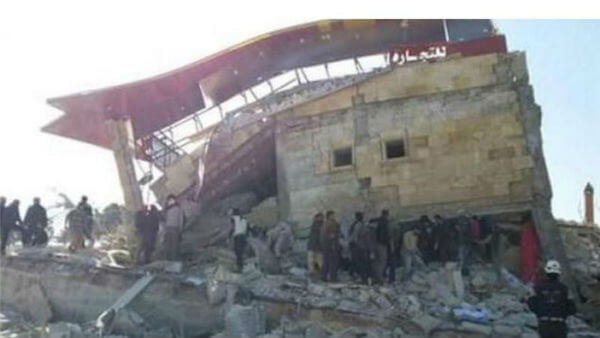
Following the latest airstrikes on MSF hospitals in Syria, Greenwald’s reaction has so far been much more muted. It has yet to go beyond a couple of tweets which rather than being directed at the likely culprit of these war crimes, Russia, focus instead on the hypocrisy of the U.S. government.
Indeed, the U.S. can’t credibly denounce Russia for bombing MSF hospitals in Syria when it has done the same in Afghanistan.
By the same token, however, how can Greenwald credibly denounce American war crimes if he’s going to refrain from denouncing Russia’s?
He can’t be accused of being a hypocritical U.S. official. He doesn’t represent the American government.
Maybe at the moment he’s suspending judgment about who was responsible for the latest airstrikes in Syria — even though MSF says the attack was “deliberate” and says “either the [Syrian] government or Russia” was “clearly” responsible:
That’s a pointless question in this case since as far as Russia is concerned, there is nothing to investigate.
As TASS reports:
Asked for a comment regarding reports a hospital in Syria’s Idlib province had been bombed, as well as claims the Russian air group was responsible, [Russian presidential spokesman Dmitry] Peskov invited everybody to rely “on the root source first and foremost.” “In this particular case the representatives of Syrian authorities are the root source,” he said.
Peskov recalled that Syria’s ambassador to Russia, Riyadh Haddad, said on Tuesday the hospital in Idlib province was destroyed by the Americans, and not the Russian air group.
If Greenwald actually believed Haddad’s claim, I would expect him to be now denouncing U.S. airstrikes on MSF hospitals in Syria, but he isn’t — most likely because he realizes the Syrian ambassador was spouting obvious falsehoods.
Instead, Greenwald’s primary interest is in using these war crimes as an opportunity to take shots at the U.S. government — even though as Physicians for Human Rights (PHR) and others have documented, attacks on medical facilities are neither accidental nor incidental to the conflict: they are an integral feature of the war strategy used by Assad and his allies.
Writing in the New England Journal of Medicine in December, doctors with PHR said:
Since the conflict began in 2011, PHR has documented the killings of 679 medical personnel, 95% of them perpetrated by government forces. Some personnel were killed in bombings of their hospitals or clinics; some were shot dead; at least 157 were executed or tortured to death.
The issue here is that anyone who wants to resolutely challenge American double standards needs, for the sake of credibility, to avoid having their own double standards on war crimes.
As for the notion that Greenwald, as an American, has a duty to challenge his own government rather than Russia’s, he might pause to consider that his tweets and articles probably attract more attention in the Kremlin than they do in the White House.