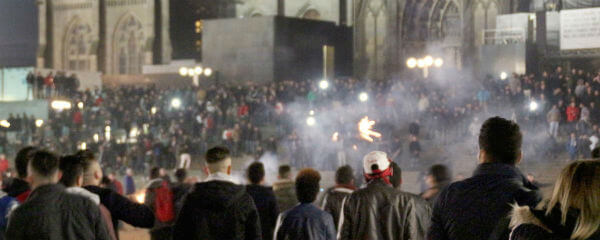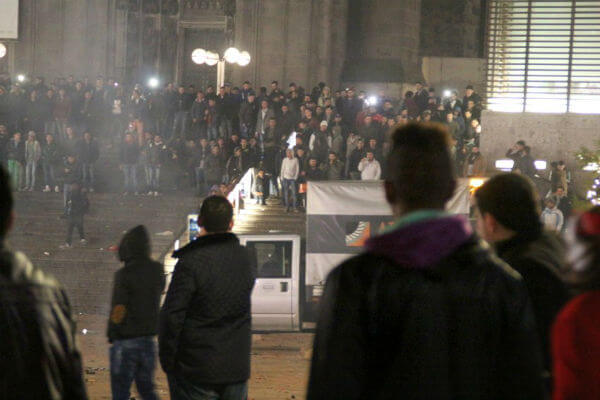
Victim of Cologne attacks says ‘we were systematically sexually harassed’

Der Spiegel reports: The stories of Lara, Jeanette and Paul, three university students from Bonn, paint a vivid picture of what so many women experienced on New Year’s Eve. The trio had traveled to Cologne with two other female friends because the parties there are simply better than they are in Bonn. They arrived at the square in front of the train station just as the police were clearing it. They didn’t know what was going on — all they saw was police officers in helmets pushing people back. They continued on to the banks of the Rhine River, a vantage point from which they could view the fireworks, when Jeanette realized that her money, ID and entry ticket for that night’s club had been stolen.

At midnight, they shared a bottle of cheap champagne out of plastic cups and then headed back to the central train station. In front of the stairs leading from the cathedral down to the train station, they had to squeeze past a large group of men. They locked hands, letting Jeanette take the lead because she knew judo. Paul tried to provide some cover for the girls. At one point, Lara cried out: “Someone just grabbed my crotch!” That was just the beginning.

Hands seemed to come from every direction to grab the women’s bodies. They always went for between the legs. Paul’s attempts to protect the women were futile. Providing cover for one left another to fend for herself. “It was one hand after another,” Jeanette says. She was able to throw one attacker “really violently to the side” with a judo grip.

None of the three students can say for sure who attacked them. They are, however, all in agreement that all of the men surrounding them were speaking the same language, and that it sounded a lot like Arabic.

What Lara, Jeanette and Paul experienced in Cologne wasn’t unique to that city. Police reports indicate that a large group of men also gathered along the famous street in Hamburg’s St. Pauli district known as Grosse Freiheit, most of whom were probably of North African descent. These men committed a series of “property thefts with sexual components.”

In Stuttgart, a 20-year-old Iraqi has been in custody since the morning of Jan. 1 for allegedly groping two women at the city’s Schlossplatz square. Police in Frankfurt am Main have reported similar incidents.

Jeanette and Lara, the two students from Bonn, went to the police six days after New Year’s to file complaints for sexual assault. “We want this to be documented,” Lara says. It makes them furious to read in the newspaper that what happened in Cologne came from the pickpocket milieu. The way Lara sees it: “We were systematically sexually harassed.”

By the time Jeanette, Lara and Paul boarded the delayed train that would take them back to Bonn on New Year’s, it was 2 a.m. During the ride, they met a young Syrian who told them about his flight from Damascus through Lebanon and Turkey and eventually by boat to Greece. From there, he continued on foot through the Balkans and on to Germany. Afterwards, they told him about their night in Cologne. He was horrified, they say. [Continue reading…]

Facebooktwittermail

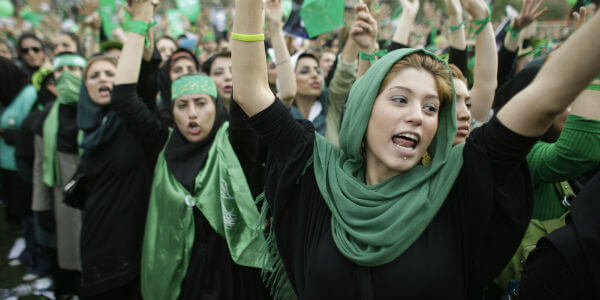
In pursuit of a nuclear deal, Obama shunned Iran’s democracy movement

green-movement

The Wall Street Journal reports: Iranian opposition leaders secretly reached out to the White House in the summer of 2009 to gauge Mr. Obama’s support for their “green revolution,” which drew millions of people to protest the allegedly fraudulent re-election of President Mahmoud Ahmadinejad.
The demonstrations caught the White House off guard, said current and former U.S. officials who worked on Iran in the Obama administration.

Some U.S. officials pressed Mr. Obama to publicly back the fledgling Green Movement, arguing in Oval Office meetings that it marked the most important democratic opening since the 1979 Islamic revolution.

Mr. Obama wasn’t convinced. “‘Let’s give it a few days,’ was the answer,” said a senior U.S. official present at some of the White House meetings. “It was made clear: ‘We should monitor, but do nothing.’ ”

The president was invested heavily in developing a secret diplomatic outreach to Mr. Khamenei that year, sending two letters to the supreme leader in the months before the disputed election of Mr. Ahmadinejad, said current and former U.S. officials.

Obama administration officials at the time were working behind the scenes with the Sultan of Oman to open a channel to Tehran. The potential for talks with Iran — and with Mr. Khamenei as the ultimate arbiter of any nuclear agreement — influenced Mr. Obama’s thinking, current and former U.S. officials said.

U.S. officials said the White House also was getting conflicting messages from Green Movement leaders. Some wanted Mr. Obama to publicly warn Mr. Khamenei against using force. Others said such a declaration would give Iran’s supreme leader an excuse to paint the opposition as American lackeys.

Mr. Obama and his advisers decided to maintain silence in the early days of the 2009 uprising. The Central Intelligence Agency was ordered away from any covert work to support the Green Movement either inside Iran or overseas, said current and former U.S. officials involved in the discussions.

“If you were working on the nuclear deal, you were saying, ‘Don’t do too much,’ ” said Michael McFaul, who served as a senior National Security Council official at the White House before becoming ambassador to Russia in 2012.

After a week of demonstrations, Iran’s security forces went on to kill as many as 150 people and jail thousands of others over the following months, according to opposition and human rights groups. Mr. Khamenei accused the U.S. of instigating the uprising. Iran denied killing protesters.

Some of Mr. Obama’s closest advisers, including former Secretary of State Hillary Clinton, said in retrospect the U.S. should have backed the Green Movement. “If we could do it again, I would give different counsel,” said Dennis Ross, Mr. Obama’s top Mideast adviser during his first term. At the time, he said, he argued against embracing the protests.

A senior U.S. official said this week that the Obama administration argued against covert support for the Green Movement because it risked undermining its credibility domestically, not out of fear of Mr. Khamenei’s reaction. “We did not want to tar the movement,” the official said. [Continue reading…]

Facebooktwittermail

Assad/Hezbollah supporters share food photos to taunt starving civilians trapped in Madaya

The Independent reports: Supporters of the Syrian regime are sharing photos of their dinners to taunt thousands of starving civilians in a besieged town.

The hashtag #متضامن_مع_حصار_مضايا, meaning “solidarity with the siege of Madaya”, has sparked a new wave of outrage over the continuing crisis, with those using it condemned as “sadistic” and “unbelievably disgusting”.

Photos showed people posting with sumptuous-looking spreads of food including kebabs, grilled prawns, whole fish, chips, salad and mountains of bread. [Continue reading…]

Facebooktwittermail

How New Year’s Eve in Cologne has changed Germany

cologne-attacks2

Der Spiegel reports: A lot happened on New Year’s Eve in Cologne, much of it contradictory, much of it real, much of it imagined. Some was happenstance, some was exaggerated and much of it was horrifying. In its entirety, the events of Cologne on New Year’s Eve and in the days that followed adhered to a script that many had feared would come true even before it actually did. The fears of both immigration supporters and virulent xenophobes came true. The fears of Pegida people and refugee helpers; the fears of unknown women and of Chancellor Angela Merkel. Even Donald Trump, the brash Republican presidential candidate in the US, felt it necessary to comment. Germany, he trumpeted, “is going through massive attacks to its people by the migrants allowed to enter the country.”

For some, the events finally bring to light what they have always been saying: that too many foreigners in the country bring too many problems along with them. For the others, that which happened is what they have been afraid of from the very beginning: that ugly images of ugly behavior by migrants would endanger what has been a generally positive mood in Germany with respect to the refugees.

As inexact and unclear as the facts from Cologne may be, they carry a clear message: Difficult days are ahead. And they beg a couple of clear questions: Is Germany really sure that it can handle the influx of refugees? And: Does Germany really have the courage and the desire to become the country in Europe with the greatest number of immigrants?

The first week of 2016 was a hectic one. Tempers flared and hysteria spread. It should be noted that an attack would have triggered similar national emotions, or the murder of a child in a park or any other crime that touched on our deepest fears and serviced our long-held stereotypes — any crime in which a foreigner was involved. On New Year’s Eve in Cologne, it was — according to numerous witness reports — drunk young men from North Africa who formed gangs to go after defenseless individuals. They humiliated and robbed — and they sexually assaulted women.

Their behavior, and the subsequent discussion of their behavior in the halls of political power in Berlin, in the media and on the Internet, could easily trigger a radical shift in Germany’s refugee and immigration policies. The pressure built up by the images and stories from Cologne make it virtually impossible to continue on as before. That, too, is a paradox: The pressure would be no less intense even if not a single one of the refugees and migrants who arrived in 2015 were among the perpetrators. [Continue reading…]

CNN reports: German authorities have identified 31 people, including 18 asylum-seekers, as suspects in mob sex attacks and muggings in Cologne on New Year’s Eve — one of several such incidents in Europe.

In Cologne, where most of the attacks took place, a police spokesman confirmed Chief Wolfgang Albers was fired Friday. Albers’ dismissal comes amid criticism of his department’s handling of the violence.

One victim of the Cologne violence told CNN there were too few police on the streets to prevent attacks.

“We ran to the police. But we saw the police were so understaffed,” the victim said. “They couldn’t take care of us and we as women suffered the price.”

Spiegel Online reported that groups of men prevented officers from reaching those crying out for help.

Interior Minister Thomas de Maiziere has slammed the response of Cologne police while German Justice Minister Heiko Maas was among many who blasted Cologne Mayor Henriette Reker for advising women to keep “more than an arm’s length” from unknown men.

Reker later complained the comments were taken out of context.

Cologne police spokeswoman Christoph Gilles told reporters Friday that some 170 criminal complaints have been filed related to the apparently coordinated attacks, “at least 120 of which have a sexual angle.”

An 80-person investigative team is looking at 250 videos (with about 350 hours of footage), Gilles added.

The suspects include nine Algerian nationals, eight people from Morocco, five from Iran and four from Syria, German interior ministry spokesman Tobias Plate said. Two are German citizens, while one each are from Iraq, Serbia and the United States.

Other German cities had similar attacks that same night, including the northern city of Hamburg, where more than 50 similar incidents were reported. Other European cities also reported attacks.

Six women in Zurich, Switzerland, told authorities they were “robbed from one side, [while] being groped … on the other side” by groups of men described as having dark skin, according to a Zurich police statement released Friday.

And in Helsinki, Finland, police said they are investigating two possible criminal offenses related to New Year’s Eve harassment centered around “a gathering of asylum-seekers.”

Both the Zurich and Helsinki allegations became public well after the incidents took place. [Continue reading…]

As well as the fact that there were significant delays in the reporting of many of these events, another element of the story has as far as I’m aware received virtually no attention: the fact that at the very time these assaults were taking place, every major city in Europe (and much of the rest of the world) was under heightened security because of the anticipated risk of an attack by ISIS.

It’s as though security services in their hypervigilance watching out for masked men brandishing AK-47s and wearing suicide belts, regarded drunken mayhem and mob violence as a distraction. By being geared towards dealing with atrocities, the task of handling law and order got downgraded. The all-important preemptive police-work of keeping the peace, failed.

Facebooktwittermail

The U.S. ‘right’ to own guns came with the ‘right’ to own slaves

Christopher Dickey writes: For most of the last two centuries, Europeans have been puzzling over their American cousins’ totemic obsession with guns and their passion for concealed weapons. And back in the decades before the American Civil War, several British visitors to American shores thought they’d discerned an important connection: People who owned slaves or lived among them wanted to carry guns to keep the blacks intimidated and docile, but often shot each other, too.

In 1842, the novelist Charles Dickens, on a book tour of the United States, saw a link between the sheer savagery of slave ownership and what he called the cowardly practice of carrying pistols or daggers or both. The author of Oliver Twist listened with a mixture of horror and contempt as Americans defended their utterly indefensible “rights” to tote guns and carry Bowie knives, right along with their “right” to own other human beings who could be shackled, whipped, raped, and mutilated at will.

As damning evidence of the way slaves were treated, in his American Notes Dickens published texts from scores of advertisements for the capture of runaways. Often these public notices described the wanted men and women by their scars. One especially memorable example:

“Ran away, a negro woman and two children. A few days before she went off, I burnt her with a hot iron, on the left side of her face. I tried to make the letter M.”

Dickens also compiled a list of several shooting incidents, not all of them in the South: a county councilman blown away in the council chamber of Brown County, Wisconsin; a fatal shootout in the street in St. Louis; the murder of Missouri’s governor; two 13-year-old boys defending their “honor” by dueling with long rifles, and other examples.

What could one expect, he asked, of those who “learn to write with pens of red-hot iron on the human face” but that they carry guns and daggers to use on each other. “These are the weapons of Freedom,” Dickens wrote with brutal irony. “With sharp points and edges such as these, Liberty in America hews and hacks her slaves; or, failing that pursuit, her sons devote themselves to a better use, and turn them on each other.” [Continue reading…]

Facebooktwittermail

Russia helps shift balance against rebels in southern Syria

Financial Times reports: President Bashar al-Assad’s forces are making a new push in southern Syria with the help of Russian air cover in a move that could not only weaken one of the country’s remaining rebel strongholds, but also threaten the balance of power on a combustible border with Israel.

The growing Russian role in the south has surprised many regional diplomats who believed Moscow had an understanding with Syria’s southern neighbours, Jordan and Israel, not to extend into their sphere of influence.

Rebels from Syria’s Southern Front alliance say they too were surprised to become the target of the new campaign: their forces are directly supplied by the Military Operations Command (MOC), an operations room staffed by Arab and western military forces, including the US.

“They (MOC) should be nervous,” says Abu Ghayath al-Shami, a spokesman for the Southern Front’s Seif al-Sham Brigades. “This area was one of their last cards, the one area where there was still a functioning relationship between the rebels and the international community.” [Continue reading…]

Facebooktwittermail

Seeing the starving children of Madaya is shocking – but so is the world’s neglect

starving-child-madaya

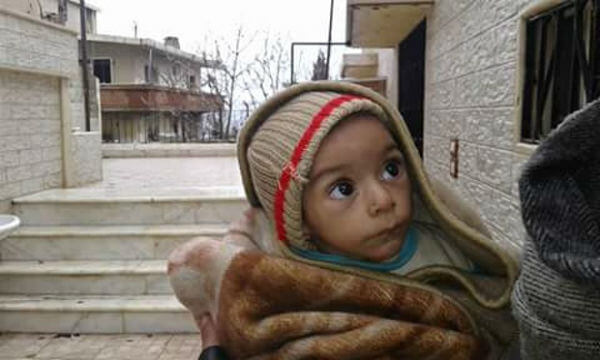
Lina Khatib writes: Horrific images and stories of starving children have suddenly flooded the media as the reality of life in the town of Madaya in Syria, besieged by Syrian regime sources and Hezbollah, has surfaced. But what is perhaps more shocking than the images is how the deliberate targeting of the population of Madaya has been taking place since July 2015 without the international community noticing.

This is despite activists in Madaya desperately trying to direct global attention to the atrocities committed there by the Syrian regime and its ally Hezbollah. It is only when the situation in Madaya reached the level of mass starvation that the international media have paid attention.

The Syrian regime and Hezbollah have put Madaya under siege for more than six months now as a response to the siege of the northern towns of Fua and Kefraya by anti-regime forces. In besieging Madaya and neighbouring Zabadani on the Lebanese border, the regime is trying to pressure its rebel opponents to agree to a population transfer between the two sets of towns that would consolidate regime control over Syrian towns bordering Lebanon. The regime’s plan is to empty Zabadani and Madaya from Sunni residents and populate them with Shia who would be brought in from Fua and Kefraya. This “sectarian cleansing” would allow the Shia Hezbollah to consolidate its control over areas serving as supply lines for regime strongholds in Damascus and the Syrian coast (the Sahel) as well as for Hezbollah itself. [Continue reading…]

Facebooktwittermail

Hezbollah follows Israel’s example while trying to manage its siege PR problem

Hezbollah (“Party of God”) now seen as “Party of (forced) starvation”:

Facebooktwittermail

For activists fighting ISIS, Turkey has become as dangerous as Syria

The Guardian reports: The past six months have not been good for Isis. In addition to mounting losses on the battlefield, the organisation has been struggling to dominate the information war despite the enormous resources it devotes to shaping its message.

Central to Isis’s anger has been the activist group Raqqa Is Being Slaughtered Silently (RBSS). It numbers roughly 100 members who for more than a year have chronicled airstrikes, terror attacks, executions and other events in the Syrian city, often in real time. Life in the so-called caliphate is detailed without gloss or spin. No one else has been able to offer such insight into the organisation’s stronghold. And none have paid a bigger price for trying.

Late last year, Isis cut the internet and satellite television connections to Raqqa. It announced that anyone caught collaborating with the group would be killed, and it set about trying to weed out agents across the city and within its own ranks. According to one Isis member spoken to by the Guardian, the group has put extra resources into counter-espionage.

Since then at least four prominent activists and journalists have been killed, including three who were living and working in Turkey.

“The situation is getting more and more difficult, especially after the assassinations in Turkey,” said one member of the Raqqa group. “We are under immense pressure inside and outside Syria. Many activists have shut down their accounts and reduced their work in the areas under Isis control. Others [have remained] more driven to challenge Isis and continue their work relying on Thuraya phones and constantly changing their locations and contact details. We can still manage to get information from inside Isis but video has become more difficult now. They have built tremendous fear inside people.”

Another member of the group, who also insisted on remaining anonymous, said: “We have been receiving lots of death threats since 2012 but the situation right now is extremely dangerous. All I can do is move house every month or so and move cities. We ran away from Syria to Turkey for a safe place to work and live in but now Turkey has become as dangerous as Syria. [Continue reading…]

Facebooktwittermail

The Saudi–Iran rift over Syria

Syria Deeply sought the opinion of several experts. Nader Hashemi said: In broad terms, the recent fallout only serves to entrench existing positions. These positions have long solidified over the course of the past five years. The recent deterioration of relations and antagonism between Saudi Arabia and Iran do not, in my reading, fundamentally change this dynamic.

The fallout at this stage does not completely undermine the Vienna Peace Process. Both Saudi and Iran, over a series of several meetings, basically agreed to a broad framework that was enshrined in a U.N. Security Council Resolution 2254 on December 18. Now the ball is out of the court of the Iranians and Saudis and is in the court of the Syrian actors and Staffan de Mistura. That’s the next stage of the Vienna process – to try and bring Syrians from both the Assad regime and the opposition around the table. Thus, at this stage, Iran and Saudi Arabia really don’t have much to contribute. Perhaps, as a result of recent events, they might decide to take a more hardline stance when it comes to determining which Syrian rebel groups are terrorists and can have a seat at the table and which cannot.

I’m very skeptical about the Vienna Process. I think it was essentially dead on arrival because it assumes that after five years of a neo-genocidal war, and having already gone down this road before in Switzerland in January 2014 with Lakhdar Brahimi, that somehow something substantial has changed. Why should anyone assume that just because the regional and international powers have agreed to a broad framework, all of the Syrian participants in this conflict are going to meet in Geneva at the end of January, kiss and make up, and agree to some unity government and peace plan? There is little room for optimism on this point. [Continue reading…]

Facebooktwittermail

Divisions in the Middle East are driven more by regional rivalries than religion

TSG IntelBrief: In a region beset with chronic and widespread problems, ranging from poor governance, war, violent extremism, and resource scarcity, one threat stands above the rest in terms of potential for destruction and cost in opportunity: the use of sectarianism as a geopolitical weapon. Sectarianism encourages extremist rhetoric and violence and serves to distract a populations from economic and social concerns by providing a convenient enemy on which to focus. While the Sunni-Shi’a divide is as old as Islam, current divisions are driven far more by regional rivalries and political gamesmanship than by religion, though the latter remains a primary factor.

While sectarianism as a geopolitical weapon is nothing new, its use is reaching new heights while its consequences find new lows. The current era of sectarianism stems, in part, from the 2003 Iraq War. The shift in Sunni-Shi’a power dynamics in Iraq triggered regional quakes that are still being felt today. It is difficult to overstate how Saudi Arabia’s fears of an ascendent Iran—now, with an Iraqi ally—have led to more than a decade of Saudi maneuvers driven by sectarian concerns. The sectarian war wanted so badly by Abu Mus’ab al-Zarqawi—founder of the group that would become the so-called Islamic State—has metastasized far from Anbar and Baghdad, and morphed into both direct and proxy warfare. [Continue reading…]

Facebooktwittermail

Why the only leader hoping to see Britain exit the EU is Vladimir Putin

Guy Verhofstadt writes: t is highly likely that David Cameron’s British referendum on membership of the European Union will take place at some point in 2016. Despite the fact that the respective “leave” and “remain” campaigns have yet to begin in earnest, a host of world leaders, including Barack Obama and those of most European and many commonwealth countries, have been privately urging David Cameron and his Conservative party against a “Brexit”.

Despite the economically illiterate central tenets of the leave campaign – that a Brexit will somehow enable Britain to “go global” – it is striking that very few countries, if any, have been campaigning for Britain to leave the EU. This is perhaps because a significant number of countries have committed time and resources to negotiating trade agreements with the EU, of which Britain is such an important part.

Thanks to the hard work of the many British civil servants in Brussels, the EU is now negotiating fully fledged free-trade agreements with Australia, New Zealand, Japan and the US. A deal with Canada is already concluded. The notion that these countries would relish the possibility of negotiating a separate trade agreement with Britain, or indeed that Britain would secure preferential trade deals by leaving the world’s largest common market, is absurd.

British people should reflect on the fact that the only leader who would stand to gain from a British withdrawal from the European Union is Vladimir Putin. There are several reasons for thinking this. [Continue reading…]

Facebooktwittermail

How you can play a part in tackling climate change – long after the Paris hype is over

By Stuart Capstick, Cardiff University and Adam Corner, Cardiff University

There’s a curious paradox at the heart of climate change. Despite scientists asserting the need for urgent action and the widespread acceptance of the reality of climate change by people worldwide, it is a subject that we tend not to talk about with friends, family or colleagues. Just 6% of the British public say they discuss climate change often, whereas approaching half (44%) do so at most rarely. Likewise, two-thirds of Americans rarely or never discuss the subject.

Perhaps we are too fearful of appearing worthy or hectoring to express our concerns, or maybe the issues seem too complex and overwhelming. Or we have grown tired of seeing polar bears floating on melting icebergs. Whatever the reasons for our reticence, however, it is hard to see how a global impetus for public engagement and action can be realised if it remains out of bounds for discussion by all but an interested few.

The Paris summit meant climate change was headline news for a week or two. Perhaps you did find yourself reflecting on the unusual weather or the fate of low-lying Pacific nations. But now that Christmas has come and gone, are you still worrying about these things? The discussion can’t tail off from here – after Paris, we need public conversation about climate change more than ever before. Whether you think the agreement was a resounding success or are troubled by its limitations, it is clear that the hard work still lies ahead.

Continue reading

Facebooktwittermail

Stories about our deepest values activate brain region once thought to be its autopilot

University of Southern California: Everyone has at least a few non-negotiable values. These are the things that, no matter what the circumstance, you’d never compromise for any reason – such as “I’d never hurt a child,” or “I’m against the death penalty.”

Real-time brain scans show that when people read stories that deal with these core, protected values, the “default mode network” in their brains activates.

This network was once thought of as just the brain’s autopilot, since it has been shown to be active when you’re not engaged by anything in the outside world – but studies like this one suggest that it’s actually working to find meaning in the narratives.

“The brain is devoting a huge amount of energy to whatever that network is doing. We need to understand why,” said Jonas Kaplan of the USC Dornsife Brain and Creativity Institute. Kaplan was the lead author of the study, which was published on Jan. 7 in the journal Cerebral Cortex.

Kaplan thinks that it’s not just that the brain is presented with a moral quandary, but rather that the quandary is presented in a narrative format.

“Stories help us to organize information in a unique way,” he said. Continue reading

Facebooktwittermail

Babies have more acute powers of perception than adults

Science News reports: Six-month-old babies can spot subtle differences between two monkey faces easy as pie. But 9-month-olds — and adults — are blind to the differences. In a 2002 study of facial recognition, scientists pitted 30 6-month-old babies against 30 9-month-olds and 11 adults. First, the groups got familiar with a series of monkey and human faces that flashed on a screen. Then new faces showed up, interspersed with already familiar faces. The idea is that the babies would spend more time looking at new faces than ones they had already seen.

When viewing human faces, all of the observers, babies and adults alike, did indeed spend more time looking at the new people, showing that they could easily pick out familiar human faces. But when it came to recognizing monkey faces, the youngsters blew the competition out of the water. Six-month-old babies recognized familiar monkey faces and stared at the newcomers longer. But both adults and 9-month-old babies were flummoxed, and looked at the new and familiar monkey faces for about the same amount of time.

Superior visual skills don’t apply to just faces, either. Three- to 4-month-old babies can see differences in lighting that are undetectable to adults. This ephemeral superskill evaporates just months later, scientists reported in December in Current Biology. To test babies’ visual acuity, researchers led by Jiale Yang of Chuo University in Tokyo first generated a series of 3-D pictures of snails. The shiny snails were made to look as though light was hitting them from different places. Like adults, 5- to 6-month-old babies couldn’t spot the lighting differences. But younger babies could, the team found. [Continue reading…]

Facebooktwittermail

From Tailhook to Cologne — the patterns in sexual violence

cologne-attacks

On New Year’s Eve, as many as 1,000 young men who according to police and witnesses were of north African and Arab appearance, took part in mass sexual violence and assaults on women outside the railway station in the German city of Cologne. BBC News reports that more than 100 women and girls have come forward with reports of sexual assault and robbery.

One victim, named as Busra, spoke of a sense of lawlessness outside the station, where the attackers felt they could do as they pleased.

“They felt like they were in power and that they could do anything with the women who were out in the street partying,” she said.

“They touched us everywhere. It was truly terrible.”

One of the most obvious parallels that is now being drawn is with the mass sexual assaults in Cairo that, as The Guardian reported in 2013, “have been endemic at Tahrir protests since at least the 2011 revolution”.

An internal report by Germany’s national police, the Bundespolizei, obtained by Der Spiegel, lists police officers’ experiences including one who quoted a suspect as saying: “I’m a Syrian! You have to treat me kindly! Mrs. Merkel invited me.”

Cologne’s mayor, Henriette Reker, has drawn scorn by suggesting that young women and girls need to protect themselves by adopting a code of conduct which includes, as The Independent reports, “maintaining an arm’s length distance from strangers, to stick within your own group, to ask bystanders for help or to intervene as a witness, or to inform the police if you are the victim of such an assault.”

As the accounts of victims of the attacks make clear, such a code would have been impossible to adopt on New Year’s Eve:

One woman, whose identity has been protected, told German television how gangs of men assaulted her in the crowd.

“All of a sudden these men around us began groping us,” she said. “They touched our behinds and grabbed between our legs. They touched us everywhere.

“So my girlfriend wanted to get out of the crowd. When I turned around one guy grabbed my bag and ripped it off my body.”

She said she felt in extreme danger, but there were no police officers to help.

“I thought to myself that if we stay here in this crowd they could kill us, they could rape us and nobody would notice. I thought we simply had to accept it.

“There was no one around us who helped or was in a position to help. All I wanted was to get out.

“I was scared that I wouldn’t leave this crowd alive. I was scared that if someone showed up with a knife I could be raped in the middle of the street.”

In another account reported by BBC News, a 17-year-old British girl described what she witnessed:

I was at Cologne on New Year’s Eve with my boyfriend. Upon arriving at 10pm at the train station, I felt afraid the moment I saw the strange behaviour of the people around me.

The main station was full of wobbly teenagers and young adults, of all ages, some possibly below 18, very drunk and unaware of their whereabouts. Some had already passed out on the floor in their own vomit.

Bottles were smashed on the ground and you could feel shards of glass crunching beneath your feet with every step.

Fights had taken place in the station and police were trying to contain them, but the amount of fighting made it difficult for the police to focus on every individual dispute.

We walked towards the exit of the station towards the cathedral, only to be welcomed by a huge crowd blocking the exits.

We heard a woman screaming and crying somewhere in the midst of this crowd, appearing to be escaping from a foreign man, who was shouting back and pointing his finger at her and chasing her with his accomplices.

Later on, we saw two men corner women at the cathedral and touch them while they were screaming for help and trying to fight back.

For those in Europe and North America who want to gin up fears of immigrants and refugees, the events in Cologne will seem to demonstrate that their fears are warranted, that Donald Trump’s proposed ban on Muslims is justifiable, and that those of us who repeat the slogan, “refugees welcome!” are naive.

Understandably, the attacks have sent shock-waves through Germany.

In an interview by Human Rights Watch reporting on sexual violence in Egypt in 2013, a young man in typical Western attire with gelled hair, says: “It’s not a good habit, it’s wrong, but they [women] lead us to do this. From the way they dress. From the way they walk. Everything. They push Egyptian men to do this.”

A young woman, in hijab, says: “It has happened to me several times but I don’t always react, because I’m afraid of the reaction from the guy in front of me. And I’m afraid the people around me won’t back me up.”

Al Jazeera reported in 2014:

Many Egyptian men, including members of the police force, either downplay or shrug off sexual harassment, reflecting popular views that women either should remain at home or bring trouble on themselves by dressing provocatively if they go out on the street.

“She can’t go anywhere without me,” Capt. Ahmed Mahmoud, a police officer in a working-class Cairo neighborhood, told the Huffington Post in May, speaking about his wife. “If a woman is wearing provocative clothing, the change needs to come from her.”

If this blame-the-victim mentality represented a distinctive feature of Middle Eastern societies, it might be difficult to counter the arguments being made by those in the West who want to block the entry of refugees, especially young men.

The fact is, however, that a pandemic of sexual violence involves the same factors:

  • a sense of impunity among perpetrators
  • the perpetrators’ belief that their victims deserve to be abused
  • the expectation among victims that they have little chance of finding justice

The perpetrators of most of this violence are not mobs on the rampage; they are the victims’ own intimate partners.

Both on the streets and behind closed doors, alcohol is often a contributing factor.

A 2014 report by the European Union Agency for Fundamental Rights which found that an estimated 3.7 million women in the EU had been the targets of sexual violence during the preceding 12 months, noted:

Prevalence of physical and/or sexual violence by a current partner is also markedly higher among women whose partner gets drunk frequently. If a current partner is said never to drink, or never to drink so much as to get drunk, the prevalence of this type of violence was 5%. The prevalence climbs, however, to 23% for women whose current partner gets drunk once a month or more often.

In the 1991 Tailhook scandal involving the U.S. Navy and Marines, 83 women and seven men were victims of sexual assault and harassment. The 4,000 attendees in Las Vegas “viewed the annual conference as a type of ‘free fire zone’ wherein they could act indiscriminately and without fear of censure or retribution in matters of sexual conduct or drunkenness,” according to a Pentagon investigation.

While cultural factors in sexual violence should not be ignored, there are ultimately two reasons why this kind of conduct is so commonplace:

  • the perpetrators know they can get away with it;
  • they know this because other men so often turn a blind eye.

Those who now claim that in defense of “our women” we need to guard against a foreign threat, are choosing to ignore the fact that the far more pervasive threat is much closer to home in the familiar face of a former boyfriend, an ex-husband, boyfriend, husband, father, step-father, brother, cousin, friend, or a neighbor.

Guys, the collective failure here is ours.

Facebooktwittermail