The brutal nature of war and the culture of revenge

Keith Lowe talks to historian Antony Beevor about his latest book, Ardennes 1944: The Battle of the Bulge.

The book begins with a description of one of the battles that preceded Hitler’s massive Ardennes offensive, and it is this that sets the tone of the pages to come. In the autumn of 1944, the Allied advance across western Europe finally got bogged down on the borders of Germany. The Americans found themselves entangled in a bitter fight for the Hürtgen forest, a place that, in Beevor’s words, was “so dense and so dark that it soon seemed cursed, as if in a sinister fairy-tale of witches and ogres”. There is no hyperbole in this description, he insists. “It is purely a reflection of the way the soldiers saw it themselves. Everybody who described that place talked of it in those sort of terms.” As part of his research, Beevor visited the forest, “and there is something spooky about it”.


Here, men on both sides developed extraordinarily creative ways of killing one another. They fired bursts of artillery at the tree tops so that splinters would tear through the people below. They learnt to play on the instincts of their enemies, placing landmines wherever they might seek shelter, such as in hollows or shell holes. Soldiers were often afraid to look about them, because they were too busy scanning the forest floor for trip wires. The Germans, in particular, developed a habit of placing explosive charges beneath American wounded or dead, knowing that as soon as a rescue team or burial party tried to move them, they, too, would be killed by the explosion.

“This is not a normal part of human behaviour,” Beevor tells me. The purpose of tactics such as this was not only to kill the enemy but also destroy their spirit. Both sides, he says, knew that demoralising the enemy could be the key to winning each battle; thus brutality, even atrocity, became an integral part of the fighting.

Over the coming weeks, the logic of such brutality would be tested to the full. On December 16, 1944, the Germans launched their counter-attack across the boggy fields and wooded hills of south east Belgium. Much of the German army was made up of SS soldiers who had served in Russia, where they were notorious for torching villages and killing all the inhabitants. Now they brought the fighting methods of the eastern front to the heart of Belgium: civilians suspected of sympathising with the Americans were murdered, women were raped, farmhouses looted, and prisoners of war were shot. There were several massacres, most notably at Malmédy, where 130 American prisoners were herded into a field by SS Panzergrenadiers and 84 were machine-gunned to death.

Faced with this onslaught, the American defenders fell back in disarray. The units defending this part of the line were already demoralised by their recent encounters in the Hürtgen forest, and many of them now simply broke down. Those who suffered worst were the new recruits who had only recently joined their units to replace men who had already died. “There probably is no more desperate position than finding yourself in combat for the first time,” Beevor says. “It’s counter to every form of normal human experience. It becomes intensely personal, as if every bullet is aimed at you, as if every shell is aimed at you. The poor b——- came in without proper training – they were the ones who cracked in no time at all.”

The morale of American troops quickly became a serious problem. Instances of self-inflicted injuries increased as traumatised soldiers did whatever they could to escape the violence of the front. Usually these injuries took the form of an “accidental” rifle shot through the left hand or the foot, but one soldier from the 99th Infantry Division was so desperate that he lay down beside a large tree, reached around it, and exploded a grenade in his hand.

However, if the shock of the German attack struck fear into some American soldiers, it seemed to have the opposite effect on others. “The determination to fight back was astonishing,” says Beevor, “and probably the most important contribution to the eventual outcome.” News of the atrocities committed by SS troops also strengthened American resolve.

At this point, Beevor begins to tell me some of the savage details of American revenge. Their first targets, he says, were SS soldiers, who were often shot out of hand. He also talks of at least one platoon that vowed never to take any prisoners at all: whenever the Germans raised a white flag, a sergeant would stand up and beckon them closer before giving his men the command to fire. At Chenogne the 11th Armoured Division shot 60 German prisoners: “There was no secret about it – Patton even mentions it in his diaries.”

Perhaps the most shocking thing about this culture of revenge is that the American commanders were not only complicit but actively encouraged it. [Continue reading…]

Facebooktwittermail

Climate change poses risk to U.S. military bases, says Obama

Reuters: Rising seas, thawing permafrost and longer wildfires caused by warmer global temperatures threaten US military bases and will change the way the US armed services defend the country, President Obama is set to say on Wednesday.

In his commencement address at the United States Coast Guard academy in New London, Connecticut, the White House said Obama will underscore the risks to national security posed by climate change, one of his top priorities for action in his remaining 19 months in office.

Facebooktwittermail

Government appears helpless as hundreds of young Britons click through to jihad

By Natasha Underhill, Nottingham Trent University

We have been hearing for some time now that hundreds of mainly young people have left the UK and found their way to Iraq and Syria to join the Islamic State. Headlines about young schoolgirls with excellent exam results and bright prospects sneaking across the border from Turkey, or the cold brutality of “Jihadi John” as a representative of Britain’s IS executioners have made for chilling reading.

While the media obsesses about the individual stories behind these defections, the UK government – like those in Australia, Germany, France, the United Kingdom, United States, Spain, as well as a number of northern African states – are desperately seeking a strategy to combat the lure of recruitment to jihad.

Overall, the police have noted that more than 700 potential terrorist suspects have travelled to Syria over the past year.

Meanwhile Scotland Yard reported recently that a record 338 people were arrested for terror-related activities in the UK in the year to march 2015 – almost one per day. This represents a dramatic increase of 33% on the 254 who were arrested in 2013/14 – a shocking statistic. Close analysis of those 338 arrests, shows that more than half were arrested in relation to their activities in Syria. Almost eight in ten of these suspects arrested were British nationals.

Continue reading

Facebooktwittermail

Russia bans ‘undesirable’ international organisations ahead of 2016 elections

The Guardian reports: Russia’s parliament has passed a law banning “undesirable” international organisations, raising fears of a further crackdown on voices critical of the Kremlin.

According to the legislation, the prosecutor general and foreign ministry can register as undesirable any “foreign or international organisation that presents a threat to the defensive capabilities or security of the state, to the public order, or to the health of the population”.

Blacklisted groups will be forbidden from operating branches or distributing information in Russia and banks will have to notify the prosecutor general and justice ministry of any financial transfers involving them. Although the language of the threat posed was vague, the bill’s authors suggested that international NGOs often work in the interests of foreign intelligence agencies. [Continue reading…]

Facebooktwittermail

It’s time to price in the hidden costs of fossil fuels

Nicholas Stern writes: The world is starting to realise that fossil fuels are not cheap. It is increasingly clear that oil, coal and gas have huge hidden costs that are omitted from prices, and they are therefore heavily subsidised.

The latest evidence about how expensive fossil fuels really are has been provided this week by the International Monetary Fund (IMF), an organisation that monitors the progress of the world’s economy. It estimates that oil, coal and gas will receive US$5.3tn in subsidies this year around the world. That is the equivalent of 6.3% of global GDP. The IMF correctly argues that the damages and costs caused by fossil fuels, through impacts such as air pollution, congestion, traffic accidents and climate change, should be treated as subsidies if they are not included in the prices paid for oil, coal and gas.

The increase from previous estimates is due to a number of factors, particularly a deepening understanding of the immense costs of air pollution. The unpriced costs of fossil fuels are in addition to, and much greater than, the direct financial support for fossil fuels through, for instance, tax breaks for oil and gas exploration and subsidies for consumers. The IMF points out that coal receives the biggest subsidies worldwide, and has the largest negative impact on human health through the pollution that it causes. [Continue reading…]

Facebooktwittermail

Stakes getting dangerously high for Saudi Arabia and its young prince

Bruce Riedel writes: As the war in Yemen resumes after a short humanitarian truce, the stakes are getting higher for Saudi Arabia’s princes.

The Royal Saudi Air Force and its allies resumed their bombing campaign this week after a five-day cease-fire to allow humanitarian supplies into Yemen. Saudi Arabia’s 29-year-old Defense Minister Prince Mohammed bin Salman has staked his future and his country’s on achieving some kind of victory in the kingdom’s war in Yemen. A truce that leaves Sanaa under the control of what the Saudis claim is an Iranian protégé regime is clearly not a decisive victory for the royals.

Instead — after weeks of air attacks on the Zaydi Shiite Houthi rebels and their allies — the prince’s war looks like a stalemate. The immense damage done to Yemen’s weak infrastructure has created considerable bad blood between Yemenis and their rich Gulf neighbors that will poison relations for years. Yemenis always resented their rich brothers, and now many will want revenge. Iran is scoring a victory on its Gulf rival without any cost to Tehran and with only limited Iranian assistance to the Zaydis. [Continue reading…]

Facebooktwittermail

Wanted in Saudi Arabia: Executioners

The New York Times reports: Job seekers in Saudi Arabia who have a strong constitution and endorse strict Islamic law might consider new opportunities carrying out public beheadings and amputating the hands of convicted thieves.

The eight positions, as advertised on the website of the Ministry of Civil Service, require no specific skills or educational background for “carrying out the death sentence according to Islamic Shariah after it is ordered by a legal ruling.” But given the grisly nature of the job, a scarcity of qualified swordsmen in some regions of the country and a rise in the frequency of executions, candidates might face a heavy workload.

Saudi Arabia’s justice system punishes drug dealing, arms smuggling, and murder and other violent crimes with death, usually by beheading in a public square.

Although the law also mandates that thieves in some cases have their hands cut off, that punishment is rarely carried out because judges consider it distasteful, according to Saudi lawyers.

On Sunday, Saudi Arabia beheaded a man for a drug offense, making him the 85th person to be executed this year, according to a count by Human Rights Watch based on Saudi government statements. That is almost as many people as the country executed in all of last year, when 88 people were beheaded. Thirty-eight of this year’s executions, including the one on Sunday, were for drug-related crimes with no allegations of violence, according to Adam Coogle, a researcher with Human Rights Watch.

In the United States, 35 prisoners were executed in 2014. [Continue reading…]

Facebooktwittermail

Israeli scheme to ban Palestinians from buses tantamount to apartheid

The Guardian reports: Israel’s prime minister, Binyamin Netanyahu, has cancelled a pilot scheme banning Palestinian workers from Israeli buses in the occupied territories – denounced as tantamount to apartheid – only hours after it was announced.

The plan had been approved by Netanyahu’s defence minister, Moshe Yaalon, but was cancelled amid fierce criticism from Israeli opposition figures, human rights groups and a former minister in Netanyahu’s own party, who said it was a “stain on the face Israel” that would damage its international image.

The move had been enthusiastically welcomed by settler groups and pro-settlement MPs who had long been lobbying for the ban.

The three month pilot scheme – which had been due to come into force on Wednesday – would have imposed strict new controls on thousands of Palestinians with permits to work in Israel, insisting they travel home through certain designated checkpoints and banning them from using Israeli run buses in the occupied West Bank.

The timing of the scheme’s launch – during visits by world football head Sepp Blatter and the EU’s foreign policy chief, Federica Mogherini – had seemed bizarre. Blatter is seeking to defuse moves to have a vote on Israel’s suspension from Fifa for alleged discrimination against Palestinians. [Continue reading…]

Facebooktwittermail

Americans should start paying attention to their quality of death

Lauren Alix Brown writes: At the end, they both required antipsychotics. Each had become unrecognizable to their families.

On the day that Sandy Bem, a Cornell psychology professor, 65, was diagnosed with Alzheimer’s, she decided that she would take her own life before the disease obliterated her entirely. As Robin Marantz Henig writes in the New York Times Magazine, Bem said, “I want to live only for as long as I continue to be myself.”

When she was 34, Nicole Teague was diagnosed with metastatic ovarian cancer. Her husband Matthew writes about the ordeal in Esquire: “We don’t tell each other the truth about dying, as a people. Not real dying. Real dying, regular and mundane dying, is so hard and so ugly that it becomes the worst thing of all: It’s grotesque. It’s undignified. No one ever told me the truth about it, not once.”

Matthew tells the truth, and it is horrifying. Over the course of two years, Nicole’s body becomes a rejection of the living. Extensive wounds on her abdomen from surgery expel feces and fistulas filled with food. Matthew spends his days tending to her needs, packing her wounds with ribbon, administering morphine and eventually Dilaudid; at night he goes into a closet, wraps a blanket around his head, stuffs it into a pile of dirty laundry, and screams.

These two stories bring into sharp focus what it looks like when an individual and her family shepherd death, instead of a team of doctors and a hospital. It’s a conversation that is being had more frequently in the US as the baby boomer population ages (pdf) and more Americans face end-of-life choices. As a nation, we are learning — in addition to our quality of life, we should pay attention to the quality of our death. [Continue reading…]

Facebooktwittermail

The GOP’s core is dying off by the day

Politico reports: It turns out that one of the Grand Old Party’s biggest — and least discussed — challenges going into 2016 is lying in plain sight, written right into the party’s own nickname. The Republican Party voter is old — and getting older, and as the adage goes, there are two certainties in life: Death and taxes. Right now, both are enemies of the GOP and they might want to worry more about the former than the latter.

There’s been much written about how millennials are becoming a reliable voting bloc for Democrats, but there’s been much less attention paid to one of the biggest get-out-the-vote challenges for the Republican Party heading into the next presidential election: Hundreds of thousands of their traditional core supporters won’t be able to turn out to vote at all.

The party’s core is dying off by the day.

Since the average Republican is significantly older than the average Democrat, far more Republicans than Democrats have died since the 2012 elections. To make matters worse, the GOP is attracting fewer first-time voters. Unless the party is able to make inroads with new voters, or discover a fountain of youth, the GOP’s slow demographic slide will continue election to election. Actuarial tables make that part clear, but just how much of a problem for the GOP is this? [Continue reading…]

Facebooktwittermail

Snowden sees some victories, from a distance

Scott Shane reports: For an international fugitive hiding out in Russia from American espionage charges, Edward J. Snowden gets around.

May has been another month of virtual globe-hopping for Mr. Snowden, the former National Security Agency contractor, with video appearances so far at Princeton and in a “distinguished speakers” series at Stanford and at conferences in Norway and Australia. Before the month is out, he is scheduled to speak by video to audiences in Italy, and also in Ecuador, where there will be a screening of “Citizenfour,” the Oscar-winning documentary about him.

But there have been far more consequential victories for Mr. Snowden’s cause two years after he flew from Hawaii to Hong Kong carrying laptops loaded with N.S.A. secrets.

Two weeks ago, a federal appeals court ruled that the first N.S.A. program he disclosed, which collects the phone call records of millions of Americans, is illegal. Last week, the House of Representatives voted overwhelmingly to transform the program by keeping the bulk phone records out of government hands, a change President Obama has endorsed and the Senate is now debating. And Apple and Google have angered the F.B.I. by stepping up encryption, including on smartphones, to scramble communications and protect customers from the kind of government surveillance Mr. Snowden exposed. [Continue reading…]

Facebooktwittermail

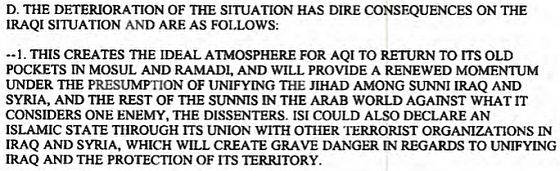
Defense Intelligence Agency report in 2012 warned about rise of ISIS in Iraq

Fox News reports: Seventeen months before President Obama dismissed the Islamic State as a “JV team,” a Defense Intelligence Agency report predicted the rise of the terror group and likely establishment of a caliphate if its momentum was not reversed.

While the report was circulated to the CIA, State Department and senior military leaders, among others, it’s not known whether Obama was ever briefed on the document.

The DIA report, which was reviewed by Fox News, was obtained through a federal lawsuit by conservative watchdog Judicial Watch. Documents from the lawsuit also reveal a host of new details about events leading up to the 2012 Benghazi terror attack — and how the movement of weapons from Libya to Syria fueled the violence there. [Continue reading…]

Facebooktwittermail

Experts: U.S. claims Ramadi a mere setback are ‘delusional’

McClatchy reports: The Obama administration Monday called the fall of the capital of Iraq’s Anbar province to the Islamic State a temporary setback that Iraqi forces would reverse with U.S. support. Experts dismissed that assessment as ludicrous.

“Delusional, really, is the better word,” Ali Khedery, a former U.S. official who served as an adviser to five U.S. ambassadors to Iraq and three heads of U.S. Central Command, said of the administration’s statement. “It’s unbelievable, frankly. I now know what it’s like to have lived through Vietnam, I guess.”

Experts called the loss a stunning blow to the Iraqi government and U.S. strategy.

It wasn’t clear why the administration clung to an upbeat message three days after the Islamic State overran most of Ramadi and a day after Iraq’s best special forces unit fled the city with other troops, local police and tribal fighters. The message was delivered in nearly identical verbiage by White House, State Department and Pentagon spokesmen and was reinforced by a statement from Army Gen. Martin Dempsey, the chairman of the Joint Chiefs of Staff. [Continue reading…]

Facebooktwittermail

Giving ISIS the battle they want in Iraq

Imran Khan writes: It was the worst defeat for Iraq’s elite security forces since the f‎all of Mosul just under year ago.

The images coming from Ramadi, the capital of Anbar province, looked more like a force in defeat rather than a tactical withdrawal.

They fled in the face of a campaign by the Islamic State of Iraq and the Levant (ISIL) group, which used firepower, car bombs and brute force for over a year to wear the Iraqi security forces down.

For ISIL it was a big victory.

Reports from Anbar suggest ISIL forces are now massing and gearing up for the next battle. A battle that they have wanted for a long time.

On Monday the Iraqi government announced that it had deployed at least ,3000 ‎Shia militia members to Habbineyeh airbase in Anbar in preparation for an assault on ISIL fighters.

The Iranians have stepped up support for the militias and the US-led coalition has increased air strikes in the last 72 hours on ISIL targets in Ramadi.

A very loose coalition of Iraqi Shia forces, Iranian support and America and the West. It is the war that ISIL have always wanted.

Across ISIL messages boards and social media accounts, ISIL sympathisers have drawn parallels between this conflict and ‎the Battle of Badr fought in 624 CE between the earliest followers of the Prophet Muhammad and the Quraish, the largest tribe in what is now Saudi Arabia. [Continue reading…]

Facebooktwittermail

To recapture Ramadi from Islamic State, Iraq must use this formula

Hayder al-Khoei writes: The fall of Ramadi, the capital of Iraq’s largest province, is a major defeat for the Iraqi security forces. It follows a period in which a number of strategic advances have been made by Iraqi forces elsewhere in the north and east of the war-torn country. Dreams of an offensive to defeat Islamic State in Mosul this year will now be crushed. Iraq will instead focus its resources and attention on liberating Ramadi, which lies just 60 miles to the west of Baghdad.

The complex realities on the ground will also lead to difficult choices being made on all sides of the conflict. Iraqi Prime Minister Haidar al-Abadi’s approval to send in the Shi’ite-dominated Hashid Shaabi paramilitary forces to the Sunni-dominated Anbar region will worry many, but it comes at the request of local Sunnis who are desperate to defend their areas against Islamic State. The Anbar governor, provincial council and local tribes have publically asked Baghdad to send in these paramilitary forces to support Iraq’s security forces and Sunni tribesmen.

Unlike in Tikrit, several Sunni tribes in Ramadi have already been resisting Islamic State for years now. As 3,000 Shi’ite fighters have deployed to the west of Ramadi following Abadi’s green light, 4,000 Sunni tribesmen have now been deployed in the west to prevent further Islamic State advances in Anbar. Sunni-Shi’ite military cooperation — aside from the official security forces that are themselves mixed — will be a crucial element in this campaign. Sunni tribal fighters are also officially part of the Hashid Shaabi in Anbar, so this paramilitary force is no longer exclusively Shi’ite. [Continue reading…]

Facebooktwittermail

ISIS solidifies foothold in Libya to expand reach

The Wall Street Journal reports: Islamic State leaders in Syria have sent money, trainers and fighters to Libya in increasing numbers, raising new concerns for the U.S. that the militant group is gaining traction in its attempts to broaden its reach and expand its influence.

In recent months, U.S. military officials said, Islamic State has solidified its foothold in Libya as it searches for ways to capitalize on rising popularity among extremist groups around the world.

“ISIL now has an operational presence in Libya, and they have aspirations to make Libya their African hub,” said one U.S. military official, using an acronym for the group. “Libya is part of their terror map now.”

Islamic State’s growth as a powerful anti-Western force has militant groups throughout the world trying to latch onto its notoriety. But until recently, affiliates have operated with a great degree of independence and there was little evidence they were taking orders from the group’s core leadership in Syria and Iraq, American officials said.

The core group benefited by pointing to the mushrooming number of affiliates to show its self-styled caliphate was expanding. But the gains in North Africa mark the first expansion of the group’s reach outside the Middle East beyond rebranding efforts by militants trying to secure direct support from the Syrian-based extremists, U.S. officials said. [Continue reading…]

Facebooktwittermail

ISIS is not as exceptional as it appears

Reyko Huang writes: The attention heaped on the Islamic State in Western media and public debate has centered primarily on two issues: its religion and its violence. On both fronts, the group has left observers aghast with its extremism. Those analysts focusing on the religion try to make sense of the group’s distinctive brand of Islamic ideology as well as the “psychopaths” who choose to become its followers. Those fixated on the group’s violence posit that its seemingly unlimited capacity to brutalize and terrorize has few parallels among violent organizations, so much so that “even al-Qaeda,” as is repeatedly pointed out, has disavowed the group.

Nevertheless, as Marc Lynch recently argued in the Monkey Cage, putting the Islamic State in a broader comparative perspective shows that the group is hardly unique among armed non-state organizations. This in turn points to ways scholars and observers might most productively study and write about the group.

Much of the media coverage and popular discussion of the Islamic State has focused on the group’s atrocious acts of violence. In their orchestrated murders and in the savvyness with which they broadcast them to the world’s horrified viewers, they are perhaps unmatched in the present age. And yet, to portray the Islamic State as uniquely brutal or unrivaled in its savagery is to forget our unfortunate history – even recent history – that is filled with episodes of extreme violence against civilians committed in the name of some political goal. One would be hard pressed to argue that the Islamic State’s actions are more unconscionable than those of the Khmer Rouge who created the killing fields of Cambodia, or Renamo of Mozambique whose fighters specialized in the kidnapping, rape and mutilation of women, men and children, or the systematic use of sexual violence as a weapon in the Bosnian war; or that the group’s staged beheadings are any more appalling than the thousands of “forced disappearances” conducted behind the scenes in the Salvadoran conflict. The only difference between cases such as these and the Islamic State when it comes to violence is that the latter operates in the age of social media and uses it to the fullest for shock-and-awe effects. [Continue reading…]

Facebooktwittermail