Egyptian women jailed for 11 years for peaceful protests

Al Jazeera reports: A group of women have been jailed for 11 years for a peaceful protest in Alexandria, as Egypt’s interim prime minister gave a strong defence of a law further restricting public demonstrations.

The women, supporters of the deposed president Mohamed Morsi, received 11-year jail sentences on Wednesday for forming a human chain and passing out flyers earlier this month. Seven minors among the group were remanded to juvenile detention until they reach legal age. The youngest in the group is 15 years old.

Six men, described by prosecutors as Muslim Brotherhood leaders, were sentenced to 15-year terms, accused of being members of a “terrorist organisation”.

In a news conference also on Wednesday, Hazem el-Beblawi, the interim prime minister, defended a new law requires which citizens to apply for permission before marching as a “necessary step”.

“The cabinet confirms that it will apply the law fully to show its support for the police in the face of terrorism. The law is subject to change, but through the proper channels.” [Continue reading…]

Facebooktwittermail

Rumsfeld’s war and its consequences now

Mark Danner writes: A bare two weeks after the attacks of September 11, at the end of a long and emotional day at the White House, a sixty-nine-year-old politician and businessman—a midwesterner, born of modest means but grown wealthy and prominent and powerful—returned to his enormous suite of offices on the seventh floor of the flood-lit and wounded Pentagon and, as was his habit, scrawled out a memorandum on his calendar:

Interesting day—
NSC mtg. with President—
As [it] ended he asked to see me alone…
After the meeting ended I went to Oval Office—He was alone
He was at his desk—
He talked about the meet
Then he said I want you to develop a plan to invade Ir[aq]. Do it outside the normal channels. Do it creatively so we don’t have to take so much cover [?]

Then he said Dick [Cheney] told me about your son—I broke down and cried. I couldn’t speak—
said I love him so much
He said I can’t imagine the burden you are carrying for the country and your son—
He said much more.
Stood and hugged me
An amazing day—
He is a fine human being—
I am so grateful he is President.
I am proud to be working for him.

It is a touching and fateful scene, this trading of confidences between the recovering alcoholic president and the defense secretary whose son is struggling with drug addiction, and shows the intimacy that can be forged amid danger and turmoil and stress. Trust brings trust, confidence builds on confidence: the young inexperienced president, days before American bombs begin falling on Afghanistan, wants a “creative” plan to invade Iraq, developed “outside the normal channels”; the old veteran defense secretary, in a rare moment of weakness, craves human comfort and understanding.

And yet they’d hardly known one another, these two, before George W. Bush chose him for his secretary of defense nine months before. To George W., Donald Henry Rumsfeld had been little more than a political enemy of the Bush family. It was Rumsfeld, as President Gerald Ford’s ambitious young chief of staff, who had been instrumental in the so-called “Halloween Massacre” in 1975 that—so the legend goes—had helped clear the way for his own presidential ambitions by shunting George H.W. Bush, the wealthy eastern born-with-a-silver-spoon-in-his-mouth preppie who was the scrappy Illinois-born wrestler’s main rival, off to be CIA director. This was a job for which Bush could gain Senate confirmation only by agreeing not to accept the vice-presidential nomination in 1976—even as Rumsfeld, as he tells us in his memoir, “for the third time in three years,…found myself being discussed for the vice presidential nomination.” As Bush family consigliere James A. Baker III cautioned George W. a quarter-century later, when Rumsfeld’s name was bruited for secretary of defense, “You know what he did to your daddy.”

Certainly he knew, and one can be forgiven for suspecting that this knowledge might have been a strong part of the attraction, perhaps for both men. When Errol Morris asks Rumsfeld whether his former aide Dick Cheney had brought him into the Bush administration, Rumsfeld replies, “I assume that’s the case. I don’t think George W. Bush’s father recommended it,” and then beams with self-congratulatory mischievousness. [Continue reading…]

Facebooktwittermail

Fear rises of return to sectarian violence in Iraq

The New York Times reports: A family of five killed in their home. A group of men shot dead in a field. Eight bodies, tied up in cable, discovered on a farm, each with a bullet in the head.

More than 300 Iraqis have been killed this month in bombings and shootings in markets, along roadsides, near schools and mosques, and in bakeries. On Tuesday, the United Nations Security Council condemned the recent spike in violence in Iraq and the deliberate targeting of places where civilians congregate.

But on Wednesday, the daily tally of violence took on an air of pinpoint deliberation with the execution-style killings of several groups of civilians, a grim reminder of the worst days of sectarian warfare in the country. While major bombings have become common, the killings reintroduced the prospect of a resurgence in the type of violence that rattled Iraq in 2006 and 2007.

The bodies of the eight young men tied in cable were found on a farm in Jubor, a Sunni city south of Baghdad, the same place other bodies had been dumped during the sectarian turmoil seven years ago.

The bodies of five men shot in the head and chest were found in an open field in Shula, a Shiite neighborhood in Baghdad, the authorities said.

The five family members, including two boys and a girl, were killed by gunshot in their house in Hurriya, a Shiite-majority neighborhood of Baghdad, the police said. They were identified as Sunni, but no further information about them was immediately released.

The 18 dead were among at least 40 people, including security forces, who were killed in attacks across Iraq on Wednesday. [Continue reading…]

Facebooktwittermail

U.S. nears decision to split leadership of NSA, Cyber Command

Reuters reports: The White House is nearing a decision on splitting up the eavesdropping National Security Agency and U.S. Cyber Command, which conducts cyber warfare, a proposed reform prompted in part by revelations of NSA’s widespread snooping, individuals briefed on the matter said on Wednesday.

As part of the emerging plan, the NSA likely would get a civilian director for the first time in its 61-year history, the individuals said.

Both agencies are now headed by the same person, Army General Keith Alexander, who is retiring in March as NSA’s longest-serving director.

While Alexander is highly regarded in the intelligence community, critics have questioned the current arrangement. They say it concentrates too much power in one individual and that the two agencies have different missions. [Continue reading…]

Facebooktwittermail

Pakistan’s PTI party names CIA station chief

Firedoglake: A political party in Pakistan has named the CIA station chief in the country and accused the chief and CIA director John Brennan of murder for their role in a recent drone strike in Hangu, where an Islamic school was targeted.

The drone strike on November 21 killed six and, injured a “large number of those present including children,” according to a letter submitted to police by Dr. Shireen M. Mazari, the central information secretary for Pakistan Tehreek-e-Insaf (PTI).

Following the strike in the Khyber Pakhtunkwa province, a settled urban area, a First Information Report (FIR) was submitted to a nearby police station asking them to investigate crimes committed by those who were behind the strike.

Firedoglake is not revealing the alleged station chief’s name. The identity of the alleged CIA station chief in Pakistan has already been exposed by PTI, and his alleged name is circulating in the country.

The letter nominates Brennan and alleged CIA station chief Craig Osth for “committing the gross offenses of committing murder and waging war against Pakistan.” [Continue reading…]

Facebooktwittermail

Penny Lane: Gitmo’s other secret CIA facility

The Associated Press reports: A few hundred yards from the administrative offices of the Guantánamo Bay prison, hidden behind a ridge covered in thick scrub and cactus, sits a closely held secret.

A dirt road winds its way to a clearing where eight small cottages sit in two rows of four. They have long been abandoned. The special detachment of Marines that once provided security is gone.

But in the early years after 9/11, these cottages were part of a covert CIA program. Its secrecy has outlasted black prisons, waterboarding and rendition.

In these buildings, CIA officers turned terrorists into double agents and sent them home.

It was a risky gamble. If it worked, their agents might help the CIA find terrorist leaders to kill with drones. But officials knew there was a chance that some prisoners might quickly spurn their deal and kill Americans.

For the CIA, that was an acceptable risk in a dangerous business. For the American public, which was never told, it was one of the many secret trade-offs the government made on its behalf. At the same time the government used the threat of terrorism to justify imprisoning people indefinitely, it was releasing dangerous people from prison to work for the CIA.

Nearly a dozen current and former U.S. officials described aspects of the program to The Associated Press. All spoke on condition of anonymity because they were not authorized to publicly discuss the secret program, even though it ended in about 2006. [Continue reading…]

Facebooktwittermail

Iran deal exposes the limits of the Israel lobby’s power

Mohammed Ayoob writes: The impact of the Iran nuclear deal is unlikely to be limited to the nuclear proliferation arena. While the question whether the deal has prevented Iran from ever developing nuclear weapons capability or has merely postponed the inevitable by a few months or years will continue to be debated, one should not ignore the wider strategic consequences of the agreement for several reasons.

First, it has the potential of introducing a sea change in the relationship of the United States that could unfetter Iranian diplomatic capabilities that can be used in pursuit of its broader regional goals. This is the reason why Saudi Arabia and its Gulf allies have reacted so harshly and negatively to the agreement. If things proceed down the path of an Iranian-U.S. rapprochement in the context of a war weary American public opinion, Riyadh can no longer automatically depend upon U.S. diplomatic and military support against Iran in its competition for power and influence in the Persian Gulf.

Second, it has demonstrated unequivocally that on vital strategic issues in which U.S. and Israeli interests diverge Washington does possess the residual political will to make hard decisions in the teeth of Israeli opposition, something that analysts of all hues had doubted for a long time. This may signal the beginning of the unraveling of the prevailing myth that U.S. policy toward the Middle East is shaped in Tel Aviv and not in Washington. It also explodes the myth that the American Israel Public Affairs Committee (AIPAC) is an all-powerful force when it comes to fashioning U.S. policy toward the Middle East. Its consequences, therefore, go beyond the Iranian nuclear issue and are likely to impact public perceptions in the United States and abroad regarding the deadlock over the Palestinian issue and the likely direction of U.S. policy on the unending Israeli-Palestinian conflict. This explains Israeli Prime Minister Benjamin Netanyahu’s uncompromising hostility toward the Geneva agreement even at the expense of doing grave damage to Israeli-U.S. relations. [Continue reading…]

One of the paradoxes of the practice of railing against power — be that the power of the Israel lobby, or government, or corporations — is that those who persistently issue such warnings can be reluctant to acknowledge that such power has limits.

Thus in the current situation there are those who will insist that sooner or later Congress, on the command of AIPAC, will impose new sanctions and destroy the agreement Iran. Or, that due to pressure from Israel and Saudi Arabia the current agreement will expire without a permanent agreement being reached.

Both of those scenarios are certainly possibilities but my sense is that what this weekend’s agreement reveals is that the opponents of U.S.-Iranian rapprochement are manifestly swimming against the international tide.

The neocon trolls, beguiled by their own apocalyptic rhetoric, are convinced that the evil Islamic republic, hellbent on its pursuit of nuclear weapons, can pursue no other course. Yet what all the evidence makes clear is that Iran’s leaders — like those of any other state — are acting in accordance with what they perceive as their own interests and currently they see those interests best served by improved international relations.

The lesson here is about flexibility. Those with the skill to hold on to power are often more pragmatic than their opponents.

Facebooktwittermail

Iran deal could reconfigure the Mideast

Rami G. Khouri writes: The most striking implication of the agreement signed in Geneva last weekend to ensure that Iran’s nuclear industry does not develop nuclear weapons while gradually removing the sanctions on the country is more about Iran than it is about Iran’s nuclear industry. The important new dynamic that has been set in motion is likely to profoundly impact almost every significant political situation around the Middle East and the world, including both domestic conditions within countries and diplomatic relations among countries.This agreement breaks the long spell of estrangement and hostility between the U.S. and Iran, and signals important new diplomatic behavior by both countries, which augurs well for the entire region. It is also likely to trigger the resumption of the suspended domestic political and cultural evolution of Iran, which also will spur new developments across the Middle East.

Perhaps we can see the changes starting to occur in Iran as similar to the developments in Poland in the early 1980s, when the bold political thrust of the Solidarity movement that enjoyed popular support broke the Soviet Union’s hold on Polish political life, and a decade later led to the collapse of the entire Soviet Empire. The resumption of political evolution inside Iran will probably move rapidly in the years ahead, as renewed economic growth, more personal freedoms, and more satisfying interactions with the region and the world expand and strengthen the relatively “liberal” forces around Rouhani, Rafsanjani, Khatami and others; this should slowly temper, then redefine and reposition, the Islamic revolutionary autocrats who have controlled the power structure for decades but whose hard-line controls are increasingly alien to the sentiments of ordinary Iranians.

These domestic and regional reconfigurations will occur slowly, comprising the situations in Syria, Lebanon, Iraq and the Gulf Cooperation Council states led by Saudi Arabia. The critical link remains a healthy, normal, nonhostile relationship between Saudi Arabia and Iran, which I suspect will start to come about in the months ahead, as both grasp the exaggerated nature of their competition for influence in the region and learn to behave like normal countries. They will learn to compete on the basis of their soft power among a region of half a billion people who increasingly feel and behave like citizens who have the right to choose how they live, rather than to be dictated to and herded like cattle. [Continue reading…]

Facebooktwittermail

Americans back Iran deal by 2-to-1 margin

Reuters reports: Americans back a newly brokered nuclear deal with Iran by a 2-to-1 margin and are very wary of the United States resorting to military action against Tehran even if the historic diplomatic effort falls through, a Reuters/Ipsos poll showed on Tuesday.

The findings were rare good news in the polls for President Barack Obama, whose approval ratings have dropped in recent weeks because of the botched rollout of his signature healthcare reform law.

According to the Reuters/Ipsos survey, 44 percent of Americans support the interim deal reached between Iran and six world powers in Geneva last weekend, and 22 percent oppose it.

Facebooktwittermail

Fallout from NSA surveillance threatens ‘the existence of the World Wide Web’ says agency’s former director

The Wall Street Journal reports: Revelations about the NSA’s surveillance operations are fueling international efforts to divide up the Internet by country, [Michael Hayden, former director of both the NSA and the CIA] said, which is a movement the U.S. government — and U.S. tech companies — have worked hard to prevent.

“This is threatening the existence of the World Wide Web,” Mr. Hayden said, adding that a Balkanization of the Internet is “a no-fooling danger.”

In the near term, Germany wants a “no-spy” agreement and has sought to insert tough data-privacy measures into a long-sought U.S.-European trade pact. Ms. Merkel told parliament last Monday the NSA affair was “putting to the test” Germany’s relationship with the U.S., and the trade pact negotiations in particular.

Facebooktwittermail

Microsoft boosts effort to encrypt its Internet traffic to avoid NSA spying

The Washington Post reports: Microsoft is moving toward a major new effort to encrypt its Internet traffic amid fears that the National Security Agency may have broken into its global communications links, said people familiar with the emerging plans.

Suspicions at Microsoft, while building for several months, sharpened in October when it was reported that the NSA was intercepting traffic inside the private networks of Google and Yahoo, two industry rivals with similar global infrastructures, said people with direct knowledge of the company’s deliberations. They said top Microsoft executives are meeting this week to decide what encryption initiatives to deploy and how quickly.

Documents obtained from former NSA contractor Edward Snowden suggest — but do not prove — that the company is right to be concerned. Two previously unreleased slides that describe operations against Google and Yahoo include references to Microsoft’s Hotmail and Windows Live Messenger services. A separate NSA e-mail mentions Microsoft Passport, a Web-based service formerly offered by Microsoft, as a possible target of that same surveillance project, called MUSCULAR, which was first disclosed by The Washington Post last month.

Though Microsoft officials said they had no independent verification of the NSA targeting the company in this way, general counsel Brad Smith said Tuesday that it would be “very disturbing” and a possible constitutional breach if true. [Continue reading…]

Facebooktwittermail

Snowden spyware revelations: we need to unmask the five-eyed monster

Eric King, head of research at Privacy International, writes: As the global public reels from yet another Snowden revelation – this time, that the US and UK intelligence forces have hacked into and planted spyware on more than 50,000 computer networks worldwide – the hypocrisy of the US and British governments is brought into sharp relief. Less than four years ago Hillary Clinton, chastising China, declared that “countries or individuals that engage in cyber attacks should face consequences and international condemnation. In an interconnected world, an attack on one nation’s networks can be an attack on all.” Given what we now know to be the “Five Eyes” complete stranglehold on the world’s internet infrastructure, how can we possibly reconcile repeated American appeals to internet freedom and condemnation of Chinese internet monitoring with US-sponsored network hacking?

Intelligence agencies and the governments that operate them have been revealed to be not merely secretive, but also hypocritical, and dismissive of any legitimate public concerns. It is time to bring these practices, and the covert agreements that underpin them, into the light. For more than 60 years, the secret patchwork of spying arrangements and intelligence-sharing agreements that makes up the Five Eyes alliance has remained obfuscated by the states that it benefits – Australia, the US, Canada, New Zealand and the UK. Save for one critically important release of declassified documents in 2010, the Five Eyes states have spent almost 70 years concealing from their citizens the scope and extent of their global surveillance ambitions – eroding the public’s ability to communicate privately and securely without examination or question.

That’s why today, Privacy International has written to the governments of the Five Eyes states demanding the publication of the treaties and agreements that underpin the alliance. At the same time, a group of civil society actors are launching a Campaign to End Mass Surveillance, enlisting citizens from around the world to urgently call on their governments to put down this mysterious arrangement. While these arrangements have been in existence for decades, the alliance is now coming out of the shadows to block UN resolutions condemning the mass surveillance that has been revealed over the summer. [Continue reading…]

Facebooktwittermail

Spies worry over ‘doomsday’ cache alleged to be stashed on cloud by Snowden

Reuters reports: British and U.S. intelligence officials say they are worried about a “doomsday” cache of highly classified, heavily encrypted material they believe former National Security Agency contractor Edward Snowden has stored on a data cloud.

The cache contains documents generated by the NSA and other agencies and includes names of U.S. and allied intelligence personnel, seven current and former U.S. officials and other sources briefed on the matter said.

The data is protected with sophisticated encryption, and multiple passwords are needed to open it, said two of the sources, who like the others spoke on condition of anonymity to discuss intelligence matters.

The passwords are in the possession of at least three different people and are valid for only a brief time window each day, they said. The identities of persons who might have the passwords are unknown.

Spokespeople for both NSA and the U.S. Office of the Director of National Intelligence declined to comment.

One source described the cache of still unpublished material as Snowden’s “insurance policy” against arrest or physical harm.

U.S. officials and other sources said only a small proportion of the classified material Snowden downloaded during stints as a contract systems administrator for NSA has been made public. Some Obama Administration officials have said privately that Snowden downloaded enough material to fuel two more years of news stories.

“The worst is yet to come,” said one former U.S. official who follows the investigation closely. [Continue reading…]

Facebooktwittermail

Obama’s overhaul of spy programs cloaked in more secrecy

McClatchy reports: President Barack Obama has faced withering criticism around the globe for his secret spying programs. How has he responded? With more secrecy.

Obama has been gradually tweaking his vast government surveillance policies. But he is not disclosing those changes to the public. Has he stopped spying on friendly world leaders? He won’t say. Has he stopped eavesdropping on the United Nations, the World Bank and the International Monetary Fund? He won’t say.

Even the report by the group Obama created to review and recommend changes to his surveillance programs has been kept secret.

Critics note that this comes after he famously promised the most open administration in history.

“They seem to have reverted to a much more traditional model of secrecy except when it’s politically advantageous,” said Steven Aftergood, who directs the Federation of American Scientists Project on Government Secrecy, and is an expert on – and prominent critic of – government secrecy. “That’s normal but not consistent with their pledge. [Continue reading…]

Facebooktwittermail

Top-secret document reveals NSA propaganda operations designed to discredit ‘radicalizers’

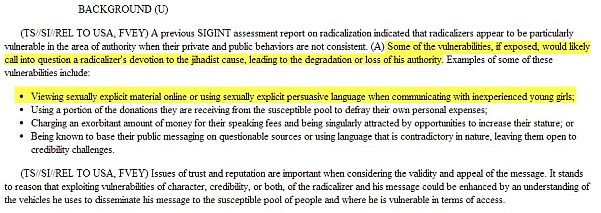
The Huffington Post reports: The National Security Agency has been gathering records of online sexual activity and evidence of visits to pornographic websites as part of a proposed plan to harm the reputations of those whom the agency believes are radicalizing others through incendiary speeches, according to a top-secret NSA document. The document, provided by NSA whistleblower Edward Snowden, identifies six targets, all Muslims, as “exemplars” of how “personal vulnerabilities” can be learned through electronic surveillance, and then exploited to undermine a target’s credibility, reputation and authority.

The NSA document, dated Oct. 3, 2012, repeatedly refers to the power of charges of hypocrisy to undermine such a messenger. “A previous SIGINT” — or signals intelligence, the interception of communications — “assessment report on radicalization indicated that radicalizers appear to be particularly vulnerable in the area of authority when their private and public behaviors are not consistent,” the document argues.

Among the vulnerabilities listed by the NSA that can be effectively exploited are “viewing sexually explicit material online” and “using sexually explicit persuasive language when communicating with inexperienced young girls.”

nsa-doc

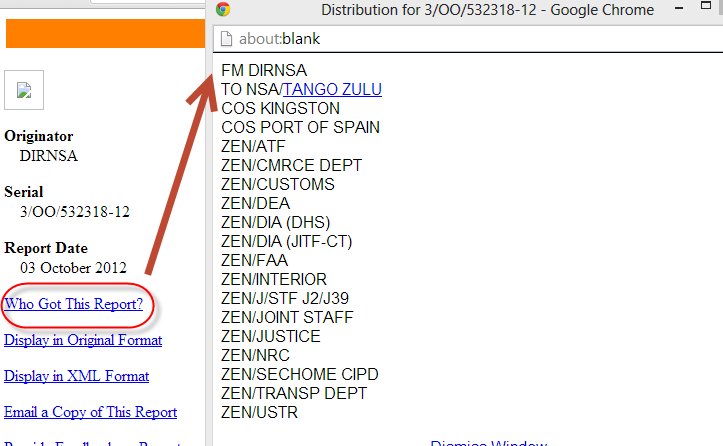
The Director of the National Security Agency — described as “DIRNSA” — is listed as the “originator” of the document. Beyond the NSA itself, the listed recipients include officials with the Departments of Justice and Commerce and the Drug Enforcement Administration. [Continue reading…]

Facebooktwittermail

Pope attacks ‘tyranny’ of capitalism

Reuters reports: Pope Francis attacked unfettered capitalism as “a new tyranny” and beseeched global leaders to fight poverty and growing inequality, in a document on Tuesday setting out a platform for his papacy and calling for a renewal of the Catholic Church.

The 84-page document, known as an apostolic exhortation, was the first major work he has authored alone as pope and makes official many views he has aired in sermons and remarks since he became the first non-European pontiff in 1,300 years in March.

In it, Francis went further than previous comments criticizing the global economic system, attacking the “idolatry of money”, and urged politicians to “attack the structural causes of inequality” and strive to provide work, healthcare and education to all citizens.

He also called on rich people to share their wealth. “Just as the commandment ‘Thou shalt not kill’ sets a clear limit in order to safeguard the value of human life, today we also have to say ‘thou shalt not’ to an economy of exclusion and inequality. Such an economy kills,” Francis wrote in the document issued on Tuesday. [Continue reading…]

Facebooktwittermail

NSA may have hit Internet companies at a weak spot

The New York Times reports: The recent revelation that the National Security Agency was able to eavesdrop on the communications of Google and Yahoo users without breaking into either company’s data centers sounded like something pulled from a Robert Ludlum spy thriller.

How on earth, the companies asked, did the N.S.A. get their data without their knowing about it?

The most likely answer is a modern spin on a century-old eavesdropping tradition.

People knowledgeable about Google and Yahoo’s infrastructure say they believe that government spies bypassed the big Internet companies and hit them at a weak spot — the fiber-optic cables that connect data centers around the world and are owned by companies like Verizon Communications, the BT Group, the Vodafone Group and Level 3 Communications. In particular, fingers have been pointed at Level 3, the world’s largest so-called Internet backbone provider, whose cables are used by Google and Yahoo.

The Internet companies’ data centers are locked down with full-time security and state-of-the-art surveillance, including heat sensors and iris scanners. But between the data centers — on Level 3’s fiber-optic cables that connected those massive computer farms — information was unencrypted and an easier target for government intercept efforts, according to three people with knowledge of Google’s and Yahoo’s systems who spoke on the condition of anonymity. [Continue reading…]

Facebooktwittermail

End the NSA dragnet now

Senators Ron Wyden, Mark Udall, and Martin Heinrich write: The framers of the Constitution declared that government officials had no power to seize the records of individual Americans without evidence of wrongdoing, and they embedded this principle in the Fourth Amendment. The bulk collection of Americans’ telephone records — so-called metadata — by the National Security Agency is, in our view, a clear case of a general warrant that violates the spirit of the framers’ intentions. This intrusive program was authorized under a secret legal process by the Foreign Intelligence Surveillance Court, so for years American citizens did not have the knowledge needed to challenge the infringement of their privacy rights.

Our first priority is to keep Americans safe from the threat of terrorism. If government agencies identify a suspected terrorist, they should absolutely go to the relevant phone companies to get that person’s phone records. But this can be done without collecting the records of millions of law-abiding Americans. We recall Benjamin Franklin’s famous admonition that those who would give up essential liberty in the pursuit of temporary safety will lose both and deserve neither.

The usefulness of the bulk collection program has been greatly exaggerated. We have yet to see any proof that it provides real, unique value in protecting national security. In spite of our repeated requests, the N.S.A. has not provided evidence of any instance when the agency used this program to review phone records that could not have been obtained using a regular court order or emergency authorization.

Despite this, the surveillance reform bill recently ratified by the Senate Intelligence Committee would explicitly permit the government to engage in dragnet collection as long as there were rules about when officials could look at these phone records. It would also give intelligence agencies wide latitude to conduct warrantless searches for Americans’ phone calls and emails.

This is not the true reform that poll after poll has shown the American people want. It is preserving business as usual. [Continue reading…]

Facebooktwittermail