Surveillance goes on trial

An editorial in the New York Times says: There was a lot that was ordinary about the hearing in Courtroom 20B of the Manhattan federal courthouse on Friday morning: a team of lawyers at the plaintiff’s table, spectators in the gallery. What was extraordinary was the defendant, the United States government, and the lawsuit it is facing over the National Security Agency’s seven-year-old, once top-secret phone-surveillance program, which until this week it never had to defend in open court.

Until Edward Snowden, a disaffected N.S.A. contractor, came along and documented the stunning scope of the phone program — which vacuums up information about every call made in the United States every day for the purpose of identifying possible terror suspects — intelligence and law-enforcement officials were accustomed to operating in the friendlier confines of the Foreign Intelligence Surveillance Court.

That is not a court by any standard definition. A rotating slate of federal judges considers secret warrant applications from the government and issues secret opinions, without hearing any opposing argument. In 2012, the court approved 1,855 of 1,856 requests that came before it.

The environment on Friday was very different, as lawyers for the A.C.L.U. vigorously contested the legality of the phone-data sweep, and Federal District Judge William Pauley III expressed a proper skepticism of the government’s claim that the program raised no constitutional concerns. When a government lawyer argued that Congress twice reauthorized the Patriot Act section under which the phone program has been approved, Judge Pauley reminded him that several members of Congress have said publicly they were not made aware of what was in the program. Others have said they believe it is being abused.

The A.C.L.U., which filed its suit days after the revelation of the phone-data sweep, called the program a “vast dragnet” that violates both federal law and the Constitution. The fact that the government must show a higher level of suspicion before it can examine a specific call’s data is irrelevant, the group’s lawyers said. The collection of so much data on millions of innocent Americans is itself an unconstitutional search, they argued, and under the government’s theory, the power to collect even more is “absolutely without limit.”

In the wake of the Snowden disclosures and the ensuing public debate, the agency and the intelligence court have declassified some rulings and other documents in an attempt to justify the various surveillance programs. But far from providing comfort, the releases have only highlighted the dubious grounds on which the programs have been approved, and how often and how systematically the N.S.A. violates the court’s orders.

However Judge Pauley and the other federal judges facing similar litigation eventually rule, the most important reforms to the programs must come from Congress, which has the power to end or drastically curtail the bulk data collection and to strengthen oversight and transparency of an agency that needs much more of both.


Facebooktwittermail

House intel bill adds $75 million to NSA budget to stop future Snowdens

Ars Technica reports: On Thursday, the House Intelligence Committee approved a spending bill to fund the National Security Agency and other intelligence organizations. Included in the bill is a provision that would set aside $75 million for the NSA to improve its internal security and mitigate insider threats to classified material. In other words, the bill seeks to prevent future Edward Snowdens.

Facebooktwittermail

U.S. ranks #27 in Web freedom and openness

Web Index: Designed and produced by the World Wide Web Foundation, the Web Index is the first multi-dimensional measure of the World Wide Web’s contribution to development and human rights globally. It covers 81 countries, incorporating indicators that assess the areas of universal access; freedom and openness; relevant content; and empowerment.

First released in 2012, the 2013 Index has been expanded and refined to include 20 new countries and features an enhanced data set, particularly in the areas of gender, Open Data, privacy rights and censorship. The Index combines existing secondary data with new primary data derived from an evidence-based expert assessment survey.

This is the second edition of the Web Index, which will be published annually. It will eventually allow for comparisons of trends over time and the benchmarking of performance across countries, continuously improving our understanding of the Web’s value for humanity.

Facebooktwittermail

How the government can discover your health problems, political beliefs, and religious practices using just your metadata

Dahlia Lithwick and Steve Vladeck write: This week brought a new round of revelations about yet another National Security Agency surveillance program, this one created to hoover up details about how individual Americans use the Internet. The new disclosures were met by most observers with a fatalistic shrug. After all, we’ve quickly grown accustomed — or at least desensitized — to the fact that the government is looking at much of the information we voluntarily provide to others. And the material being collected in this case was only “metadata”: the details of when, where, and how we used the Internet — not what we actually read or wrote.

Should NSA sweeps of our “to” and “from” lines be fair game? How much can the government really learn about us without knowing what we’re saying in the text?

The legality of the “telephony metadata” program — the initiative revealed by Glenn Greenwald in the Guardian in June that showed the government collecting telephone records of Americans on a mass scale — will be considered by a federal district judge in Manhattan on Friday. According to the now disclosed orders of the secret Foreign Intelligence Surveillance Court, such “metadata” includes “the originating and terminating telephone number and the time and duration of any call.” It also includes information about the location of both parties to the call and the international mobile subscriber identity (IMSI) and international mobile station equipment identity (IMEI) numbers, which allow Uncle Sam to “identify the user or device that is making or receiving a call.” But because it doesn’t include the content of the phone calls, the story goes, there’s no invasion of our privacy. Nothing, therefore, to worry about?

As Professor Edward Felten, director of the Center for Information Technology Policy at Princeton University, explains in a declaration filed in that phone records case, our metadata in fact tells the government a lot more about us than we might realize, especially when different types of metadata are aggregated together. Consider calls to single-purpose hotlines: NSA collection of our metadata means the government knows when we’ve called a rape hotline, a domestic violence hotline, an addiction hotline, or a support line for gay teens. Hotlines for whistleblowers in every agency are fair game, as are police hotlines for “anonymous” reports of crimes. Charities that make it possible to text a donation to a particular cause (say, Planned Parenthood) or political candidate or super PAC could reveal an enormous amount about our political activities. And calling patterns can reveal our religious beliefs (no calls on Sabbath? Heaps of calls on Christmas?) or new medical conditions. If, for instance, the government knows that, within an hour, we called an HIV testing service, then our doctor, and then our health insurance company, they may not “know” what was discussed, but anyone with common sense — even a government official — could probably figure it out. [Continue reading…]

Facebooktwittermail

The FBI files on being and nothingness

Andy Martin writes: I was leafing through some FBI files on French philosophers when a new candidate for occupancy of the populous Grassy Knoll in Dallas leapt out at me. To the massed ranks of the CIA, the Mafia, the KGB, Castro, Hoover, and LBJ, we can now add: Jean-Paul Sartre. FBI and State Department reports of the 1960s had drawn attention to Sartre’s membership of the Fair Play for Cuba Committee, of which Lee Harvey Oswald was also a member. And — prophetically? — Sartre had “dismissed the US as a headless nation.” Naturally I rushed around trying to work out exactly where Sartre might have been on 22nd November 1963. Could he, after all, have been the Second Shooter? Suddenly all the pieces started to fall into place.

But subsequent references in the main Oswald file showed that the FBI, although generally perturbed by the “Leftist tendencies” of Sartre, and his association with Communists, Castro, and Bertrand Russell, were specifically concerned that he was now — in addition to protesting against US involvement in Vietnam — threatening to “take an active part in the French Who Killed Kennedy Committee” (according to an article in the Washington Post of 14th June 1964). The FBI was wedded to the Lone Gunman theory. The emphasis of their interest in Sartre, then, was not on whether he had participated in any conspiracy, but rather that he was a believer in conspiracy theory and “supported the position that Oswald was not the true assassin of President Kennedy.”

The FBI had been keeping an eye on Sartre from as early as 1945. Soon after, they began to investigate his contemporary, Albert Camus. On 7th February, 1946, John Edgar Hoover, director of the FBI, wrote a letter to “Special Agent in Charge” at the New York field office, drawing his attention to one ALBERT CANUS, “reportedly the New York correspondent of Combat [who] has been filing inaccurate reports which are unfavorable to the public interest of this country.” Hoover gave orders “to conduct a preliminary investigation to ascertain his background, activities and affiliations in this country.” One of Hoover’s underlings had the guts to inform the director that “the subject’s true name is ALBERT CAMUS, not ALBERT CANUS” (diplomatically hypothesizing that “Canus” was probably an alias he had cunningly adopted).

The irony that emerges from the FBI files on Camus and Sartre, spanning several decades (and which, still partly redacted, I accessed thanks to the open-sesame of the Freedom of Information Act) is that the G-men, initially so anti-philosophical, find themselves reluctantly philosophizing. They become (in GK Chesterton’s phrase) philosophical policemen. [Continue reading…]

Facebooktwittermail

Son of Israeli ex-president takes helm of Labor Party, urging peace

The New York Times reports: Isaac Herzog, the son of a former president, took the helm of Israel’s Labor Party and thus Parliament’s opposition on Friday, vowing to restore the party’s historic focus on promoting peace with the Palestinians and to mount a vigorous challenge to Prime Minister Benjamin Netanyahu’s right-leaning government.

“Only bold steps toward peace with the Palestinians will enable us to break through on all fronts,” Mr. Herzog said at a news conference in Tel Aviv. “I am not sure — I have grave doubts — whether Prime Minister Netanyahu understands this and if he’s working toward it.”

Promising to “restore the political banner to center stage” for “the sake of a just state,” he said he would “outflank those in power until we return to lead the country.”

A lawyer universally known as Buji and a father of three, Mr. Herzog, 53, hails from a beloved Israeli dynasty: His father, Chaim Herzog, a military man and diplomat, served as Israel’s sixth president, from 1983 to 1993, and his grandfather Yitzhak HaLevi Herzog was the first Ashkenazi chief rabbi of the modern state.

Mr. Herzog, who has served in Parliament since 2003 and held several ministerial posts, replaced Shelly Yacimovich, a former journalist who emphasized domestic socioeconomic concerns during her two years leading Labor, and was virtually invisible on the international stage. [Continue reading…]

Facebooktwittermail

Toxic mix of frustration and aggravation among U.S. officers controlling nuclear weapons

The Associated Press reports: Trouble inside the Air Force’s nuclear missile force runs deeper and wider than officials have let on.

An unpublished study for the Air Force, obtained by The Associated Press, cites “burnout” among launch officers with their fingers on the triggers of 450 weapons of mass destruction. Also, evidence of broader behavioral issues across the intercontinental ballistic missile force, including sexual assaults and domestic violence.

The study, provided to the AP in draft form, says that court-martial rates in the nuclear missile force in 2011 and 2012 were more than twice as high as in the overall Air Force. Administrative punishments, such as written reprimands for rules violations and other misbehavior, also were higher in those years.

These indicators add a new dimension to an emerging picture of malaise and worse inside the ICBM force, an arm of the Air Force with a proud heritage but an uncertain future.

Concerned about heightened levels of misconduct, the Air Force directed RAND Corp., the federally funded research house, to conduct a three-month study of work conditions and attitudes among the men and women inside the ICBM force. It found a toxic mix of frustration and aggravation, heightened by a sense of being unappreciated, overworked, micromanaged and at constant risk of failure.

Remote and rarely seen, the ICBM force gets little public attention. The AP, however, this year has documented a string of missteps that call into question the management of a force that demands strict obedience to procedures. [Continue reading…]

Facebooktwittermail

Imagining the post-antibiotics future

Maryn McKenna writes: A few years ago, I started looking online to fill in chapters of my family history that no one had ever spoken of. I registered on Ancestry.com, plugged in the little I knew, and soon was found by a cousin whom I had not known existed, the granddaughter of my grandfather’s older sister. We started exchanging documents: a copy of a birth certificate, a photo from an old wedding album. After a few months, she sent me something disturbing.

It was a black-and-white scan of an article clipped from the long-gone Argus of Rockaway Beach, New York. In the scan, the type was faded and there were ragged gaps where the soft newsprint had worn through. The clipping must have been folded and carried around a long time before it was pasted back together and put away.

The article was about my great-uncle Joe, the youngest brother of my cousin’s grandmother and my grandfather. In a family that never talked much about the past, he had been discussed even less than the rest. I knew he had been a fireman in New York City and died young, and that his death scarred his family with a grief they never recovered from. I knew that my father, a small child when his uncle died, was thought to resemble him. I also knew that when my father made his Catholic confirmation a few years afterward, he chose as his spiritual guardian the saint that his uncle had been named for: St. Joseph, the patron of a good death.

I had always heard Joe had been injured at work: not burned, but bruised and cut when a heavy brass hose nozzle fell on him. The article revealed what happened next. Through one of the scrapes, an infection set in. After a few days, he developed an ache in one shoulder; two days later, a fever. His wife and the neighborhood doctor struggled for two weeks to take care of him, then flagged down a taxi and drove him fifteen miles to the hospital in my grandparents’ town. He was there one more week, shaking with chills and muttering through hallucinations, and then sinking into a coma as his organs failed. Desperate to save his life, the men from his firehouse lined up to give blood. Nothing worked. He was thirty when he died, in March 1938.

The date is important. Five years after my great-uncle’s death, penicillin changed medicine forever. Infections that had been death sentences—from battlefield wounds, industrial accidents, childbirth—suddenly could be cured in a few days. So when I first read the story of his death, it lit up for me what life must have been like before antibiotics started saving us.

Lately, though, I read it differently. In Joe’s story, I see what life might become if we did not have antibiotics any more. [Continue reading…]

Facebooktwittermail

Saudi prince frets about ‘this perception that America is going down.’

The Wall Street Journal reports: ‘The U.S. has to have a foreign policy. Well-defined, well-structured. You don’t have it right now, unfortunately. It’s just complete chaos. Confusion. No policy. I mean, we feel it. We sense it, you know.”

Members of the Saudi royal family have voiced their displeasure with the Obama administration’s approach to the Middle East through private channels and recently in public as well. None of them puts it quite like HRH Prince Alwaleed bin Talal bin Abdulaziz Alsaud.

One of some three-dozen living grandsons of the first Saudi King Abdulaziz, this prince is a prominent but atypical royal. His investment company made him the Arab world’s richest businessman. He strikes a modern image for a Saudi, employing female aides and jet-setting on a private Boeing. He’s at ease with Western media.

Passing through New York earlier this week, Mr. Alwaleed, who is 58, sits down with the Journal editorial board between a couple of television appearances. He wears a blue suit, shirt and tie. These days, his bouffant widow’s peak has more salt than pepper. The prince holds no important government post in Saudi Arabia, but it’s hard to shake the impression that here is the uncensored id of the reserved House of Saud.

“America is shooting itself in the foot,” he says. “Saudi Arabia and me, myself, we love the United States. But what’s happening right now here, from Republicans and Democrats, is just not helping the image of the United States and is making this perception that America is going down a reality.” [Continue reading…]

Facebooktwittermail

Egypt expels Turkish ambassador, Turkey retaliates

Reuters reports: Egypt said on Saturday it was expelling Turkey’s ambassador and accused Ankara of backing organizations bent on undermining the country – an apparent reference to the Muslim Brotherhood of ousted Egyptian president Mohamed Mursi.

Turkey, which had forged close ties with Egypt under Mursi, responded by declaring the Egyptian ambassador, currently out of the country, persona non grata.

“We are saddened by this situation,” Turkey’s foreign ministry said in a statement. “But responsibility before history belongs to Egypt’s temporary administration which came to power under the extraordinary circumstances of the July 3 coup.”

Turkey has emerged as one of the fiercest international critics of Mursi’s removal, calling it an “unacceptable coup”. Mursi’s Muslim Brotherhood, which has been staging protests calling for his reinstatement, has close ties with Turkish Prime Minster Tayyip Erdogan’s AK Party.

Facebooktwittermail

Iran nuclear deal appears imminent

The Los Angeles Times reports: A deal to limit Iran’s nuclear program appeared close to completion Friday as negotiators from six world powers and Tehran smoothed remaining conflicts and top diplomats began arriving to join the talks.

After a rocky day Thursday, negotiators appeared for now to have overcome their differences on Iran’s entitlement to enrich uranium and on how to curb progress on a partially built nuclear research reactor that Western powers view as a particular threat.

U.S. Secretary of State John F. Kerry left late Friday for Geneva to help “narrow the differences and move closer to an agreement,” the State Department said. Sergei Lavrov, Russia’s foreign minister, arrived from Moscow early Friday evening, making him the first of the six nations’ ministers to show up for a possible signing ceremony that would end a decade of usually stalemated negotiations.

“Negotiations are moving on a positive track,” Iranian Deputy Foreign Minister Takht Ravanchi said.

A deal would be a first-stage agreement that would give Iran temporary relief from the crushing Western sanctions on its economy in exchange for temporary limits on its nuclear program. Many nations fear that Iran, despite its insistence that its program is for peaceful purposes only, is seeking weapons capability with its huge nuclear infrastructure.

This deal would open the way for tough bargaining on a final, comprehensive agreement that would take six months or longer to be reached.

A preliminary agreement would be a major step and could reduce the threat of another war in the Middle East. But as soon as it is signed it is likely to come under attack by Republican and Democratic lawmakers and U.S. allies such as Israel and Saudi Arabia, who fear that it will be too lenient. [Continue reading…]

Facebooktwittermail

White House: Israel’s all-or-nothing proposal on Iran would lead to war

JTA reports: Israel’s proposal that Iran totally dismantle its nuclear capacity in exchange for sanctions relief would likely lead to war, a top White House official said.

The official, in a conference call on Wednesday with think tanks and advocacy groups sympathetic to the Obama administration’s Iran strategy, outlined the proposal that the major powers will put forward at a third round of negotiations in Geneva beginning Thursday.

JTA obtained a recording of the call on condition that it not name the participants or fully quote them.

A think tank participant on the call said Israel’s posture — demanding a total halt to enrichment and the dismantling of all of Iran’s centrifuges — was a path to war. [Continue reading…]

Facebooktwittermail

Israeli military signals positive view of nuclear deal with Iran

Christian Science Monitor reports: Even as Prime Minister Benjamin Netanyahu continues his diplomatic offensive against what he calls a “dangerous” compromise on Iran’s nuclear program, Israel’s military intelligence seems open to a deal, even one that relaxes the Western sanctions on Iran that Mr. Netanyahu has vocally supported.

According to an unclassified assessment shared by a senior Israeli officer, military intelligence is focused on the implications of a potential compromise between Iran and the P5+1 (the US, Britain, France, Russia, China, and Germany).

A deal would boost President Hassan Rouhani, whose surprise victory in June appeared to herald a political shift in Iran – although he is up against hardliners who oppose a deal.

In the background briefing with foreign journalists, which covered a wide range of Middle East hotspots, the intelligence officer said Iran was one of several countries that could buck the general turmoil across the region.

“We see a bit of a possibility, although it’s quite problematic, of more … stability,” said the officer, who spoke on the basis of anonymity. But that is dependent on the success of negotiations “over the nuclear project, but more than that, over the relief of the sanctions on the Iranian economy,” he said. [Continue reading…]

Facebooktwittermail

Gaps narrowing as Iran nuclear talks continue

Laura Rozen reports: A second day of high level of nuclear talks broke for the night here Thursday with Iranian and western negotiators saying progress was being being made in narrowing gaps, but four or five issues still remain to be resolved and need more time. Talks are set to continue here Friday and are very likely to extend into the weekend.

A day “of intense, substantial and detailed negotiations on Iran nuclear programme, conducted in good atmosphere,” Michael Mann, spokesperson for European Union foreign policy chief Catherine Ashton, said Thursday. “Talks continue tomorrow.”

There are fewer and fewer gaps between the two sides, “the process is efficient, we have a very deep treatment” of the issues, a senior European diplomat, speaking not for attribution, said Thursday of the days’ discussions.

“Some big obstacles [to an accord] have been removed, but not all of them,” the European diplomat said. There are still about four to five elements on the table for negotiation, he said, most of them pertaining to the first phase of the agreement, which is intended to halt the expansion of Iran’s nuclear program over the course of six months while a comprehensive agreement is negotiated.

There is “no rupture with the Iranians, but it doesn’t mean agreement tomorrow,” the European diplomat said. “There is a feeling something could happen tomorrow, or after tomorrow,” but there’s no guarantee, he said. If an accord is reached over the next day, P5+1 foreign ministers could possibly come on Saturday. [Continue reading…]

This morning, Reuters reports that Russian Foreign Minister Sergei Lavrov is already on his way to Geneva.

Facebooktwittermail

Sen. Mark Kirk’s unshakable loyalty to Israel

Eli Clifton and Ali Gharib report: During an invitation-only phone briefing for supporters, one of the Senate’s top Iran hawks relished his battle with the Obama administration over the imposition of more sanctions against Iran amid the latest round of diplomatic negotiations underway in Geneva. During the call, Sen. Mark Kirk, R-Ill., reserved special attacks for Secretary of State John Kerry and lead U.S. negotiator Under Secretary of State Wendy Sherman.

“It’s the reason why I ran for the Senate, [it] is all wrapped up in this battle. I am totally dedicated to the survival of the state of Israel in the 21st century,” said Kirk, whose office framed the call as an update on Iran’s nuclear program and Kirk’s efforts to pass additional sanctions. “This has been very much a one-senator show, unfortunately,” he said of his confrontational, public approach.

Kirk is leading the Republican effort to introduce new sanctions in the Senate. Along with six co-sponsors, Kirk on Tuesday announced his intention to introduce amendments to the National Defense Authorization Act, the annual bill that budgets for the military, that would increase sanctions on Iran and impose restrictions on any possible interim nuclear deal with Iran. The effort is currently being held up by the upper chamber’s Democratic leadership.

The 28-minute phone call with Kirk, which occurred on Monday afternoon, was by invitation only, but Salon reporters obtained an invitation and RSVPed by name to Kirk for Senate finance director Barret Kedzior. [Continue reading…]

Facebooktwittermail

Working around Keystone XL, Suncor Energy steps up oil production in Canada

The New York Times reports: Suncor Energy, Canada’s top petroleum producer, announced on Thursday that it would expand its oil production in 2014 by 10 percent in another sign that the Obama administration’s delay in approving the Keystone XL pipeline extension is not holding back growth in the western Canadian oil sands fields.

“We’re set for a strong year of continued production,” Suncor’s chief executive, Steven W. Williams, said. The company announced a capital spending program of $7.45 billion for 2014, $477 million more than it had forecast earlier this year.

Suncor, which is based in Calgary, produces oil and gas around Canada, and has operations in North Africa and the North Sea. But its oil sands operations are the main driver for the company. In the most recent quarter, its oil sands output rose 16 percent from the year before for a record of 396,000 barrels a day, nearly 20 percent of the country’s total oil sands production.

The company said it expected its oil sands production to increase again next year to 430,000 barrels a day.

Reports of increased production are coming even as Canadian oil executives are privately questioning whether the Obama administration will ever approve the Keystone XL pipeline, which it has been considering for more than two years.

The extension is intended to transport more than 800,000 barrels a day of oil sands output to refineries on the Gulf of Mexico coast, but environmentalists have made stopping the pipeline their top priority since emissions from oil sands production are higher than for most crude oils consumed in the United States.

But over the last several months, oil companies have sought to go around the dispute by announcing plans for three large rail loading terminals with the combined capacity of transporting 350,000 barrels a day.

The companies are poised to quadruple rail-loading capacity over the next few years to as many as 900,000 barrels a day, whether or not the Keystone pipeline is built. [Continue reading…]

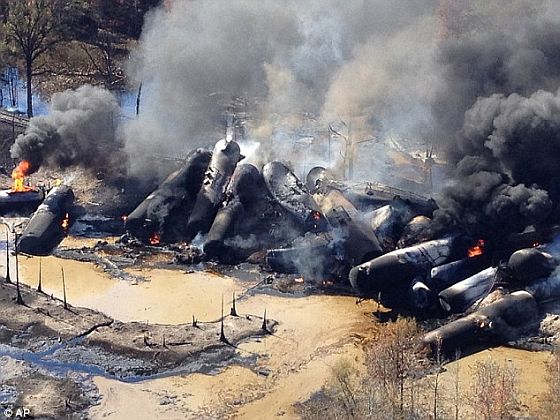
It’s long been reported that rail transportation of oil was already making the construction of Keystone XL an issue of questionable relevance in relation to the environmental consequences of oil sands production, which makes me wonder why so much activist energy was focused on the pipeline. Was it simply because “stop the pipeline” is such an easy rallying-cry?

Ironically, the dangers posed by rail delivery of oil are probably far greater than those posed by Keystone XL as an accident in Alabama earlier this month made all too clear:

oil-spill

Facebooktwittermail

A theory of how networks become conscious

Wired: It’s a question that’s perplexed philosophers for centuries and scientists for decades: Where does consciousness come from? We know it exists, at least in ourselves. But how it arises from chemistry and electricity in our brains is an unsolved mystery.

Neuroscientist Christof Koch, chief scientific officer at the Allen Institute for Brain Science, thinks he might know the answer. According to Koch, consciousness arises within any sufficiently complex, information-processing system. All animals, from humans on down to earthworms, are conscious; even the internet could be. That’s just the way the universe works.

“The electric charge of an electron doesn’t arise out of more elemental properties. It simply has a charge,” says Koch. “Likewise, I argue that we live in a universe of space, time, mass, energy, and consciousness arising out of complex systems.”

What Koch proposes is a scientifically refined version of an ancient philosophical doctrine called panpsychism — and, coming from someone else, it might sound more like spirituality than science. But Koch has devoted the last three decades to studying the neurological basis of consciousness. His work at the Allen Institute now puts him at the forefront of the BRAIN Initiative, the massive new effort to understand how brains work, which will begin next year.

Koch’s insights have been detailed in dozens of scientific articles and a series of books, including last year’s Consciousness: Confessions of a Romantic Reductionist. WIRED talked to Koch about his understanding of this age-old question. [Continue reading…]

Facebooktwittermail