Monthly Archives: January 2008

OPINION & ANALYSIS: Pakistan’s chaotic stability

Crisis, what crisis?

How long will it be until Pakistan implodes? Take your pick of the analysts: a week or so as opposition parties take to the streets to complain about the postponement of elections, just announced; two weeks if the elections take place and the country descends into chaos; a few months and the mullahs will have poured down from the North West Frontier Province, seized Islamabad and the nuclear button; a year or so and Pakistan will have become another Afghanistan. Or perhaps it won’t implode at all.

The latter seems the most likely to me. On my first trip to Pakistan, in 1993, the country was as unstable as ever. Nawaz Sharif’s first government had fallen. Benazir Bhutto was back in power. Everyone was talking about a default on the country’s debts, rampant militancy, war, political chaos, inefficiency, corruption, and so on. Living there in the late 90s, I heard the same refrain every day. Clearly the events of the last week have shaken many – and rightfully given the strategically critical nature of the world’s second largest Muslim state – but perhaps the thing we should wonder at most is the astonishing fact that Pakistan successfully manages to keep itself together – apart from the inevitable and logical splitting off of eastern Pakistan to form Bangladesh in 1971 – not its manifest and manifold problems over 60 years of history. [complete article]

A revenger’s tragedy

Quite what motivation Musharraf’s government would have for assassinating Bhutto, it is hard to discern. He expected her to provide legitimacy for his presidency. Indeed, the very fact that she was eager to participate in the elections put a democratic sheen on his clinging to power. Her death not only weakens Musharraf’s position further, but may actually write the final chapter of his rule.

Security experts in Pakistan have little doubt who is behind the assassination. “I am convinced that the intelligence services were involved,” says Ayesha Siddiqa, author of the highly acclaimed book Military Inc: Inside Pakistan’s Military Economy. Only through the collusion of the security services could both a gunman and a suicide bomber have got so close to Bhutto, she says. Other analysts agree. There seems to be a general consensus that renegade current and former members of the ISI are working with religious extremists to spread a reign of terror.

Benazir Bhutto is the highest-value victim so far, but it is not just the PPP that is being targeted. Almost all Pakistani politicians are under threat. Hours before Bhutto’s assassination, an election rally organised by the Muslim League, the party of the other former prime minister, Nawaz Sharif, was attacked by unknown gunmen. Four party workers were killed. The Muslim League blames a pro-Musharraf party, the PML(Q), for the incident. But Musharraf allies are themselves under attack.

On 21 December, the day of the festival of Eid ul-Adha, a suicide bomber attacked a mosque in Charsadda District, near Pesha war, during Friday prayers. The intended victim, the former interior minister Aftab Sherpao, escaped unhurt but the blast killed more than 50 people. Even religious politicians, such as Maulana Fazlur Rahman, head of the Jamiat Ulema-e-Islam (Islamic Party of Religious Leaders), who has close ties with the Taliban, have received death threats. “The truth is that anyone can be bumped off in Pakistan,” says Imran Khan, the former cricketer and leader of the Movement for Justice Party, and it can simply be “blamed on al-Qaeda”. [complete article]

Pakistan: Restore democracy

In the next two months, Pakistan must work towards the following outcomes, with the strong and consistent support of the international community:

* Musharraf’s resignation, with Senate Chairman Mohammadmian Soomro taking over under the constitution as acting president and appointing neutral caretaker governments at the national and provincial levels with the consensus of the major political parties in all four federal units;
* postponement of the polls, accompanied with the announcement of an early new election date. The Election Commission announced on 2 January a postponement to 18 February but said nothing about other necessary changes needed if this step is to contribute to restoration of democracy in Pakistan,
* full restoration of the constitution, including an independent judiciary and constitutionally guaranteed fundamental freedoms of speech, assembly and association and safeguards against illegal arrest and detention;
* reconstitution of the Election Commission of Pakistan, with the consensus of all major political parties; and,
* the transfer of power and legitimate authority to elected civilian hands. [complete article]

Musharraf denies role in Bhutto’s assassination

Bhutto’s followers have focused their suspicions on several people with either past or present ties to Musharraf, four of whom Bhutto had named in a letter to the president as enemies plotting to kill her. One of those she implicated was Chaudhry Pervez Elahi, a former chief minister of Punjab province and a likely candidate to be prime minister if Musharraf’s allies do well enough in next month’s elections to form a government.

But Musharraf said the allegation that Elahi, or anyone else from the government, had participated in the attack was baseless and that Scotland Yard investigators whom he had invited to probe the matter would not be pursuing that possibility.

“I would like to know how she died, ultimately,” Musharraf said. “But I will not like anyone to go on a wild goose chase and start creating a disturbance.”

Sherry Rehman, spokeswoman for Bhutto’s Pakistan People’s Party, accused Musharraf of trying to set the terms of Scotland Yard’s investigation before it even began. “It’s not for him to decide what’s a wild goose chase,” she said. [complete article]

See also, British police to help investigate Bhutto murder (The Indepedent), Pakistani opposition parties decry election delay (NYT), Musharraf not ‘fully satisfied’ by Bhutto inquiry (AP), and Gingerly, U.S. reaches out to Sharif in Pakistan (CSM).


Facebooktwittermail

NEWS & OPINION: Libya’s official redemption

Libya officially welcomed back to the U.S. fold

Abdel-Rahman Shalqam and his wife received a personal tour of the White House, an official escort on Capitol Hill and a luncheon with executives from Lockheed Martin, Boeing, Northrop Grumman, Occidental Petroleum and Raytheon, as well as the U.S. trade representative’s office.

So began the official redemption of Libya yesterday, as the foreign minister of a country once equated with “barbarism” became that nation’s highest ranking official to visit Washington in 35 years.

Shalqam continues meetings today with the secretaries of state, homeland security and energy, as well as the deputy secretary of defense, about ways to deepen ties between Washington and Tripoli, according to both U.S. and Libyan officials. At lunch yesterday, he virtually gushed about the importance of Libyan students getting an American education and U.S. companies doing business in Libya. [complete article]

Libya’s inconvenient truth

Tomorrow, Libyan Foreign Minister Abdel-Rahman Shalqam is to meet with Secretary of State Condoleezza Rice. Their sit-down at the State Department will come nearly seven months after President Bush declared himself a “dissident president” and promised active support for dissidents around the world. “I asked Secretary Rice,” Bush said during a speech in Prague, “to send a directive to every U.S. ambassador in an un-free nation: Seek out and meet with activists for democracy. Seek out those who demand human rights.”

Nothing of the sort happened. In fact, in its embrace of Tripoli, the Foreign Service has built a wall of silence around human rights concerns.

More than a year and a half ago the State Department removed Libya from its list of state sponsors of terrorism, confirming Libya’s status change from pariah to example. “Libya is an important model to point to as we press for changes in policy by other countries,” a department statement declared. But if Libya is a model, human rights advocacy and reform will be casualties. [complete article]

Facebooktwittermail

NEWS: Investigation into the destruction of the torture tapes

Justice Dept. sets criminal inquiry on CIA tapes

Attorney General Michael B. Mukasey said Wednesday that the Justice Department had elevated its inquiry into the destruction of Central Intelligence Agency interrogation videotapes to a formal criminal investigation headed by a career federal prosecutor.

The announcement is the first indication that investigators have concluded on a preliminary basis that C.I.A. officers, possibly along with other government officials, may have committed criminal acts in their handling of the tapes, which recorded the interrogations in 2002 of two operatives with Al Qaeda and were destroyed in 2005.

C.I.A. officials have for years feared becoming entangled in a criminal investigation involving alleged improprieties in secret counterterrorism programs. Now, the investigation and a probable grand jury inquiry will scrutinize the actions of some of the highest-ranking current and former officials at the agency.

The tapes were never provided to the courts or to the Sept. 11 commission, which had requested all C.I.A. documents related to Qaeda prisoners. The question of whether to destroy the tapes was for nearly three years the subject of deliberations among lawyers at the highest levels of the Bush administration. [complete article]

Lawmaker told CIA not to destroy tapes

The top Democrat on the House Intelligence Committee warned in a 2003 letter that destroying videotapes of terrorist interrogations would put the CIA under a cloud of suspicion, according to a newly declassified copy of the letter.

“Even if the videotape does not constitute an official record that must be preserved under the law, the videotape would be the best proof that the written record is accurate, if such record is called into question in the future,” Rep. Jane Harman, D-Calif., wrote in a Feb. 10, 2003 letter to then-CIA general counsel Scott Muller. “The fact of destruction would reflect badly on the agency.”

Harman’s office released the declassified letter on Thursday, a day after the Justice Department announced it had opened a criminal investigation into the destruction of the tapes. The letter notes that a copy also went to then-CIA Director George Tenet. [complete article]

Probe leader called a tough prosecutor

John H. Durham, who was appointed yesterday to lead a criminal probe into the destruction of the CIA’s interrogation tapes, oversaw corruption charges against a Republican governor in Connecticut, put away FBI agents in Boston and prosecuted many of New England’s Mafia bosses.

Former colleagues said the deputy U.S. attorney is known for seeking maximum sentences, shunning plea bargains and avoiding the spotlight. Four friends said they could not recall him losing a case in more than 30 years as a prosecutor, almost all of it spent fighting organized crime and gang violence in Connecticut. [complete article]

Editor’s Comment — I surely won’t be the first to make this observation, but Durham’s experience in investigating the Mafia should serve him well when it comes to uncovering the workings of the Bush adminstration.

Facebooktwittermail

NEWS: Egypt outrages Israel; Israel ready to talk to Syria; Syria alienates France

Egypt opens crossing so Palestinians can return

Egypt opened its main crossing into the Gaza Strip on Wednesday to allow more than 2,000 Palestinian pilgrims — including at least one official of the armed Hamas movement — to return to their homes there, outraging Israel in a growing dispute over border security.

The return followed a month of increasingly bitter words between the two neighbors over Egypt’s policing of its border with Gaza, which Israeli Foreign Minister Tzipi Livni last month described as “terrible.”

The friction between the two long-standing partners in U.S.-brokered peace deals comes as President Bush prepares to visit the region next week with a goal of smoothing the way for further peace accords. [complete article]

Israel signals willingness to reopen talks with Syria

Following a softening of the Bush administration’s opposition to Israeli-Syrian contacts, the Israeli government is actively exploring the possibility of reopening negotiations with Syria, according to Israeli sources and a senior Republican lawmaker who visited Damascus last week.

The Republican lawmaker, Senator Arlen Specter of Pennsylvania, spoke after meeting last Sunday, December 30, with Syrian President Bashar al-Assad and conveying a message from Israel’s prime minister, Ehud Olmert.

Specter, accompanied by Democratic Rep. Patrick Kennedy of Rhode Island, told Assad that Israel is still waiting for a response to its request that Syria take public actions to prove its readiness for peace negotiations. For Specter, this message was seen as giving a green light to negotiations. “The time is right now, and prospects are very good,” the senator told reporters in Damascus after meeting Assad. “The parties will continue talks through intermediaries, and it’s my hope and expectation at some point, if preliminary progress has been made, the U.S. government would be ready, too.” [complete article]

Israel does not expect war with Iran: Peres

Israeli President Shimon Peres said he did not believe a war with Iran would be necessary but called for the end of the current government in Tehran, in an interview published Wednesday.

Peres told the German daily Sueddeutsche Zeitung that Iranian President Mahmoud Ahmadinejad was dangerous for Israel and the region but that other means could be used to contain the threat. [complete article]

Syria’s foreign politics

The French president, Nicolas Sarkozy, has made good on his threat to take action against Syria on account of its presumed role in blocking the election of a new president of Lebanon. Speaking in Cairo at the end of a holiday-cum-official visit, Mr Sarkozy said that France will henceforth suspend all diplomatic contact with Syria “as long as we do not have proof of their [the Syrians’] willingness to allow Lebanon to have a consensus president”. In a further swipe at the regime of Syria’s president, Bashar al-Assad, Mr Sarkozy said that France was willing to bankroll the tribunal that has been established under UN auspices to try those charged with the assassination of Rafiq al-Hariri, a former Lebanese prime minister, and a series of subsequent political murders in Lebanon—Syrian involvement is strongly suspected, although Mr Assad has consistently denied responsibility.

Mr Sarkozy’s exasperation follows several weeks of intensive French diplomacy aimed at working with Syria on a solution to the Lebanese presidential impasse. The French president dispatched several of his senior foreign policy advisers to Damascus, and spoke to Mr Assad on the telephone on three occasions in pursuit of a breakthrough. This approach appeared to mark a shift from that of the outgoing president, Jacques Chirac, in that it invited Syria to wield its influence in Lebanon. Mr Chirac had been the architect of a joint policy with the US that sought to extirpate all Syrian influence over Lebanese affairs in the interest of enabling Lebanon to achieve full independence and sovereignty over its territory. [complete article]

Eight Gazans killed by IDF fire; Katyusha hits north Ashkelon

A Katyusha rocket fired by Palestinian militants in the Gaza Strip on Thursday morning struck an open field in northern Ashkelon, the furthest distance a rocket has struck yet – traveling some 16.5 kilometers.

Also Thursday, at least eight Palestinians were killed by Israel Defense Forces fire in several separate incidents in the Gaza Strip, including at least four militants. [complete article]

Facebooktwittermail

NEWS, ANALYSIS & INTERVIEW: America’s attention shifting away from Iraq

On campaign trail, domestic issues now outweigh Iraq

The Democratic and Republican presidential candidates are navigating a far different set of issues as they approach the Iowa caucuses on Thursday than when they first started campaigning here a year ago, and that is likely to change even more as the campaigns move to New Hampshire and across the country.

Even though polls show that Iowa Democrats still consider the war in Iraq the top issue facing the country, the war is becoming a less defining issue among Democrats nationally, and it has moved to the back of the stage in the rush of campaign rallies, town hall meetings and speeches that are bringing the caucus competition to an end. Instead, candidates are being asked about, and are increasingly talking about, the mortgage crisis, rising gas costs, health care, immigration, the environment and taxes.

The shift suggests that economic anxiety may be at least matching national security as a factor driving the 2008 presidential contest as the voting begins. [complete article]

Edwards calls for quick end to Iraq training

John Edwards says that if elected president he would withdraw the American troops who are training the Iraqi army and police as part of a broader plan to remove virtually all American forces within 10 months.

Mr. Edwards, the former senator from North Carolina who is waging a populist campaign for the Democratic nomination, said that extending the American training effort in Iraq into the next presidency would require the deployment of tens of thousands of troops to provide logistical support and protect the advisers.

“To me, that is a continuation of the occupation of Iraq,” he said in a 40-minute interview on Sunday aboard his campaign bus as it rumbled through western Iowa. [complete article]

Attacker bombs pro-U.S. Sunnis in Iraq

A suicide bomber in turbulent Diyala Province detonated an explosive vest on Wednesday at a checkpoint operated by armed Sunni Arab tribesmen who have turned against Al Qaeda in Mesopotamia and pledged support to the United States military.

The bomber emerged from behind a fruit stand near the checkpoint in downtown Baquba, leapt onto the hood of a BMW and detonated the explosives, killing Abu Sadjat, a local tribal chief who had just left a meeting with American military officials. The Iraqi police said the blast killed at least six Iraqis and wounded 22 others. [complete article]

Seven questions: Gen. David Petraeus on winding down the surge

Foreign Policy: These days when you speak about the surge, you always highlight positive developments but you also appear very cautious. What are your concerns?

Gen. David Petraeus: We are trying to be cautious as we describe the progress that is taking place in Iraq. It has been substantial. We have seen a consistent reduction in the level of violence—a reduction of 60 percent since June, really to a level not seen since the spring of 2005. There has been a corresponding reduction in the loss of civilian lives, Iraqi, and coalition force casualties. Having said all that, it is a fragile achievement, and there are a number of concerns that we do have. We feel as if we’ve knocked al Qaeda to the canvas, but we know that, like any boxer, they can come back up off that canvas and lend a big, right-hand punch. We also have concerns about the militias and the elements of the [Mahdi Army] militia that have not been honoring Moqtada al-Sadr’s cease-fire pledge.

FP: Based on the experience of the British, who as they draw down are leaving a lot of instability behind them in southern Iraq, how can you can be confident going forward as U.S. forces withdraw?

DP: We have already begun a reduction, and we’ll reduce another number over the course of the next seven months. We do that with a reasonable degree of confidence because our surge is taking place and the Iraqi surge is taking place as well, and it amplifies what we have done. In fact, the Iraqis have formed 160,000 police, soldiers, border police, and other security force elements during the past year. To be sure, there’s an uneven nature to their quality, to their capability, and to their level of training and equipping, but they’re significant in quantity. And quantity does mean quality in counterinsurgency operations, because you’ve got to secure so many infrastructures against the terrorist and insurgent and militia elements. We think that what we have been handing over has been winnowed down in terms of the nature of the problem in a way that they can handle it. And only when they can handle it we will have this transfer. [complete article]

Facebooktwittermail

EDITORIAL: The vanishing facade of democracy

The vanishing facade of democracy

The undemocratic tendencies of Pervez Musharraf have never deeply offended President Bush. Even after declaring a state of emergency, firing the Supreme Court and jailing most of his political opponents, Bush claimed that, “truly,” Musharraf was “somebody who believes in democracy.” Bush, on the other hand, is somebody who truly believes in loyalty. This is the glue that holds together the edifice of his own power. Musharraf might be Bush’s most dangerous friend but the fear of what might happen if the general feels betrayed indicates why, in the name of democracy, the president has so far only asked his friend to set aside his military uniform but not relinquish the presidency.

pervez-and-george.jpgAccording to Bruce Riedel, former CIA officer, National Security Council staff member and now a Brookings fellow, when Deputy Secretary of State John D. Negroponte went to Islamabad in September, “he basically delivered a message to Musharraf that we would stand by him, but he needed a democratic facade on the government, and we thought Benazir was the right choice for that face.”

The message from the Bush administration to Musharraf over the last seven years has been consistent: the appearance of democracy (or at least the promise of democracy) is more important than democracy itself.

Now, after it turns out that democracy will need a new face in Pakistan, we learn from Bhutto’s aides, that there is damning evidence that Pakistan’s Inter-Services Intelligence agency, have been busy laying the groundwork for rigging the upcoming parliamentary elections. Bhutto’s Pakistan People’s Party (PPP) has prepared a detailed report that Benazir Bhutto herself planned to share with two members of Congress in a meeting due to take place the day she was assassinated. The PPP trusted Senator Arlen Specter, a Republican, and Democratic Congressman Patrick Kennedy, rather than representatives from the Bush administration which they regard as too closely aligned with Musharraf. From The Independent we learn that:

The report compiled by the PPP apparently includes information on an alleged “safehouse” being run by the ISI in a neighbourhood of Islamabad called G-5, from which the rigging operation was run. “It was compiled from sources within the [intelligence] services who were working directly with Benazir Bhutto,” said Mr Lashari [a member of the PPP election monitoring cell].

The report names a recently retired ISI officer who has allegedly been running the rigging unit and claims he worked in tandem with another named senior intelligence officer. It also claims that US aid funds were being used for the projects.

At the heart of the scheme, the report says, was a project in which ballot papers – stamped in favour of the Pakistan Muslim League-Q (PML-Q), which supports Mr Musharraf – were to be produced by the intelligence agencies in about 100 constituencies. Mr Lashari said the effort was directed at constituencies where the result was likely to be decided by a small margin, so it would not be obvious. “They diverted money from aid activities. We had evidence of where they were spending the money,” he added.

Is it possible that the Bush administration already knew of, or had received intimations that Musharaff’s intelligence services had such a scheme in operation? Even before Bhutto’s assassination and while expectations of vote rigging remained high, the administration had no qualms about sending an assistant secretary of state up to Capitol Hill to assert in the face of deep skepticism that, “I do think they can have a good election. They can have a credible election. They can have a transparent election and a fair election.”

The aroma of complicity (which it should be noted necessitates neither foreknowledge, nor support, but simply acquiescence) is perhaps evident in the way Washington responded to Bhutto’s assassination. First came the chorus that this was the dastardly work of al Qaeda, or one of its allies, the Taliban leader, Baitullah Meshud, who is effectively the Amir of South Waziristan. Then some intelligence sources started pulling back from that line and instead suggested that this was the work of al Qaeda infiltrators in the lower echelons of Pakistan’s intelligence services. What no administration official was willing to concede was that the jihadists might in this instance have been acting as minions for high-ranking intelligence officers.

Ever since 9/11, President Bush has been a captive of his own for-us-or-against-us logic when it comes to dealing with Pervez Musharraf. If Musharraf could not be painted as an ally, the risks of turning him into an enemy seemed too daunting to contemplate. In Musharraf’s hands, nuclear deterrence became a principle with new meaning as it served to deter threats to a regime rather than a state.

Pakistan’s nuclear arsenal continues to protect Musharraf’s power for as long as Washington is paralyzed by the fear that nuclear material could slip out of his control and fall into the hands of al Qaeda. What Bush wants us to view as the Musharraf nuclear insurance policy is in fact a nuclear protection racket. Fearful of the mayhem that the boss’ removal might unleash, we have funneled billions of dollars in aid to Pakistan’s military, no strings attached, all in the tenuous name of keeping the neighborhood safe.

To those with a firm grasp on power, democracy must always appear risky and threatening. Democracy necessarily entails the dispersal of power and challenges the claims of those who would make themselves the guardians of power. Yet the pledge that all such guardians effectively make with the people they claim to be serving amounts to this: Trust me, because I can’t trust you.

Facebooktwittermail

NEWS: Things go up and down

Pakistan’s days of rage leave cloud of uncertainty

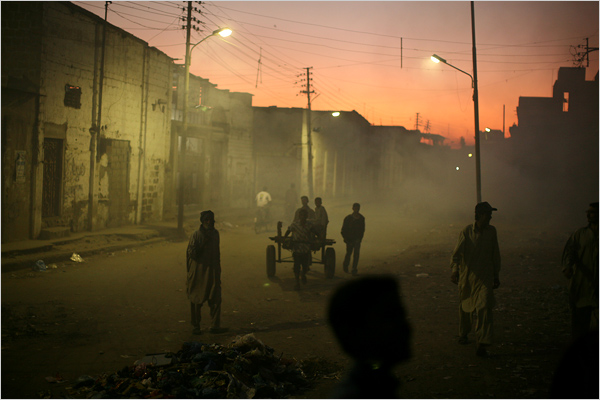
karachi.JPG
The highway that leads from Benazir Bhutto’s ancestral village to this, her hometown, is one long road of ruin. Here and there along a stretch of 200 miles lie twisted hulks of tractor-trailers, their contents spilling out on the highway, casualties of the riots that broke out after Ms. Bhutto’s assassination last Thursday.

On New Year’s Eve, as the last light of 2007 fell from the sky, piles of coal still smoldered on the pavement. Rotten oranges littered the road. A consignment of pickup trucks that the United States had bought for Pakistani law enforcement officials fighting militants had been picked clean; brakes, steering wheels, batteries had been carted away.

The truck drivers, most of them ethnic Pashtuns from the faraway tribal areas of the northwest, waited in vain for rescue here in the southern ethnic Sindhi heartland. One of them had his left ear caked with blood; the mobs had pelted him with stones and then burned his coal truck, costing him his only source of income.

The road was a perfect emblem of the mood of this country, as it ushered in a new year under a thick shroud woven of rage and uncertainty. [complete article]

Pakistan elections delayed until Feb. 18

Pakistan’s election commission announced Wednesday that parliamentary elections would be postponed until Feb. 18, a delay of six weeks, after the death of the opposition leader Benazir Bhutto and the riots that have damaged some election commission offices and paralyzed parts of Sindh Province. [complete article]

See also, U.S. isn’t ready to accept Pakistan’s initial findings (NYT), In reversal, Pakistan welcomes outside help with inquiry on Bhutto (NYT), Benazir Bhutto’s tainted widower Asif Ali Zadari reemerges as kingmaker (The Times), Zardari rejects claim of al-Qaida link to Bhutto’s murder (The Guardian), The future Pakistan deserves (Muhammad Nawaz Sharif), Opponent calls for Musharraf to quit at once (NYT), and Doctors cite pressure to keep silent on Bhutto (WP).

Facebooktwittermail

OPINION: The presidency of outlaws

Looking at America

In the years since 9/11, we have seen American soldiers abuse, sexually humiliate, torment and murder prisoners in Afghanistan and Iraq. A few have been punished, but their leaders have never been called to account. We have seen mercenaries gun down Iraqi civilians with no fear of prosecution. We have seen the president, sworn to defend the Constitution, turn his powers on his own citizens, authorizing the intelligence agencies to spy on Americans, wiretapping phones and intercepting international e-mail messages without a warrant.

We have read accounts of how the government’s top lawyers huddled in secret after the attacks in New York and Washington and plotted ways to circumvent the Geneva Conventions — and both American and international law — to hold anyone the president chose indefinitely without charges or judicial review.

Those same lawyers then twisted other laws beyond recognition to allow Mr. Bush to turn intelligence agents into torturers, to force doctors to abdicate their professional oaths and responsibilities to prepare prisoners for abuse, and then to monitor the torment to make sure it didn’t go just a bit too far and actually kill them.

The White House used the fear of terrorism and the sense of national unity to ram laws through Congress that gave law-enforcement agencies far more power than they truly needed to respond to the threat — and at the same time fulfilled the imperial fantasies of Vice President Dick Cheney and others determined to use the tragedy of 9/11 to arrogate as much power as they could. [complete article]

Stonewalled by the CIA

More than five years ago, Congress and President Bush created the 9/11 commission. The goal was to provide the American people with the fullest possible account of the “facts and circumstances relating to the terrorist attacks of Sept. 11, 2001” — and to offer recommendations to prevent future attacks. Soon after its creation, the president’s chief of staff directed all executive branch agencies to cooperate with the commission.

The commission’s mandate was sweeping and it explicitly included the intelligence agencies. But the recent revelations that the C.I.A. destroyed videotaped interrogations of Qaeda operatives leads us to conclude that the agency failed to respond to our lawful requests for information about the 9/11 plot. Those who knew about those videotapes — and did not tell us about them — obstructed our investigation.

There could have been absolutely no doubt in the mind of anyone at the C.I.A. — or the White House — of the commission’s interest in any and all information related to Qaeda detainees involved in the 9/11 plot. Yet no one in the administration ever told the commission of the existence of videotapes of detainee interrogations. [complete article]

Judgement and torture

The Administration has launched what Laura Rozen recently termed “Operation Stop Talking,” a program designed to insure that all intelligence officers and former officers maintain complete silence about what transpired with these tapes. This has included some very heavy handed measures, including an FBI investigation targeting John Kiriakou. My own sources tell me that Rozen’s reporting is right on the money about this—the word has been put out that any one allowing further information to slip out, or corroborating Kiriakou’s account, can expect severe retribution. And what is the objective of this extraordinary public relations project? Again, the aspect of Kiriakou’s remarks that gave rise to it was his detailed depiction of the Justice Department’s and the White House’s role in the entire process.

The Bush Administration’s containment strategy for this matter is very clear: it was a CIA affair, start to finish. The decision to make and destroy the tapes came down in the ranks of the CIA. Other agencies and particularly the White House were uninvolved. Yes, there will be a scapegoat offered up. [complete article]

Facebooktwittermail

OPINION: Threatening Muslims

Giuliani campaign’s Muslim fallout

Traveling around New Hampshire last week, the GuardianFilms team dropped in on a Rudy Giuliani house party. With cameras running we caught one of Giuliani’s New Hampshire state leaders as he derided and even threatened Muslims. The story turned out to have some resonance, winding its way from Guardian Unlimited, through the liberal blogosphere and into the US mainstream media before becoming an embarrassment for the Giuliani campaign.

At Manchester mayor Frank Guinta’s house party John Deady blended in with the mostly white, professional crowd. A retired military intelligence officer and state co-chair of Veterans for Rudy, he has been active in Republican politics for decades. He was eager to share his enthusiasm for Giuliani and what he saw as Rudy’s no-nonsense, get tough approach to America’s legions of enemies around the world, particularly the Muslims.

He has got, I believe, the knowledge and the judgment to attack one of the most difficult problems in current history, and that is the rise of the Muslims. Make no mistake about it; this hasn’t happened for a thousand years. These people are very, very dedicated. They’re also very smart in their own way, and we need to keep the feet to the fire and keep pressing these people until we defeat them or chase them back to their caves, or, in other words, get rid of them.

Deady wasn’t the only one with intense pro-Rudy sentiments at the party. Another supporter told us, “We are going to protect what is ours. If it means we’ve got to shoot you in the head then so be it. I think he’s the guy who can do that.” [complete article]

Facebooktwittermail

NEWS: Old and new year in Iraq

In a safer Baghdad, Iraqis party for 2008

On New Year’s Eve Ridaa al-Azzawi squeezed into his pointy snakeskin boots, his tight black sweater and his snazzy corduroy flared jeans, hustled down to a Baghdad hotel ballroom and partied for peace.

2008 arrived in a less-violent Baghdad, and residents said it was the first real party they had seen in years.

At the stroke of midnight, exuberant locals fired into the air with automatic rifles, sending red tracer fire streaking over the city, as fireworks lit up the sky. [complete article]

Iraq deaths surged and also fell in 2007

December emerged as possibly the safest month for U.S. forces in Iraq since the 2003 invasion and the least deadly for Iraqi civilians in the last 12 months, but overall 2007 was the bloodiest year of the war, according to figures released Monday.

The Iraqi Ministry of Health said 481 civilians died nationwide last month in war-related violence such as bombings, mortar attacks and sectarian slayings. It said 16,232 civilians died last year. The 2006 death toll was 12,320. [complete article]

Facebooktwittermail

NEWS: Saudi blogger arrested

Dissident Saudi blogger is arrested

Saudi Arabia’s most popular blogger, Fouad al-Farhan, has been detained for questioning, an Interior Ministry spokesman confirmed Monday. It was the first known arrest of an online critic in the kingdom.

Farhan, 32, who used his blog to criticize corruption and call for political reform, was detained “for violating rules not related to state security,” according to the spokesman, Maj. Gen. Mansour al-Turki, responding to repeated requests for comment with a brief cellphone text message.

Farhan’s Dec. 10 arrest was reported last week on the Internet and has been condemned by bloggers in Egypt, Tunisia, Morocco and Bahrain. The Saudi news media have not yet reported the arrest, but more than 200 bloggers in the kingdom have criticized Farhan’s detention, and a group of supporters have set up a Free Fouad Web site. [complete article]

Facebooktwittermail