
Revolutionary Guards Corps extends grip over a splintered Iran
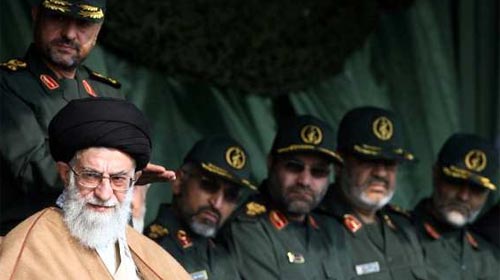
As Iran’s political elite and clerical establishment splinter over the election crisis, the nation’s most powerful economic, social and political institution — the Islamic Revolutionary Guards Corps — has emerged as a driving force behind efforts to crush a still-defiant opposition movement.
From its origin 30 years ago as an ideologically driven militia force serving Islamic revolutionary leaders, the corps has grown to assume an increasingly assertive role in virtually every aspect of Iranian society.
And its aggressive drive to silence dissenting views has led many political analysts to describe the events surrounding the June 12 presidential election as a military coup.
“It is not a theocracy anymore,” said Rasool Nafisi, an expert in Iranian affairs and a co-author of an exhaustive study of the corps for the RAND Corporation. “It is a regular military security government with a facade of a Shiite clerical system.” [continued…]
Khamenei warns opposition of ‘collapse’
Ayatollah Ali Khamenei, Iran’s supreme leader, warned the country’s opposition leaders on Monday that they faced “collapse” if they continued to incite protests over the disputed presidential election.
The warning came amid an unprecedented war of words between the regime’s senior leaders and looked like a retort to Akbar Hashemi-Rafsanjani, the influential former president who has backed the opposition. Mr Rafsanjani said on Friday the country was in “crisis” and the regime had to regain people’s trust. [continued…]
Iran: Mir-Hossein Mousavi says nation ‘awakened’ by election
Mir-Hossein Mousavi, Iran’s opposition leader, has warned the country’s rulers that an “awakened” nation is “determined” to defend its rights.
Mr Mousavi, the presidential candidate, said it was “insulting” to suggest that foreigners had organised mass demonstrations against the outcome of last month’s election and demanded the release of all political prisoners.
His words showed that President Mahmoud Ahmadinejad, whose bitterly controversial re-election sparked the crisis, has failed to suppress the popular challenge to his rule. Mr Mousavi’s latest intervention also amounts to open defiance of Ayatollah Ali Khamenei, the Supreme Leader, and shows the deep divisions within the regime.
Mr Mousavi met the families of people who have been arrested for protesting against Mr Ahmadinejad’s alleged victory in a poll that many regard as rigged. “You are facing something new: an awakened nation, a nation that has been born again and is here to defend its achievements,” he told Iran’s rulers. [continued…]
What president would celebrate a “victory” by two-thirds of the vote with a clampdown resembling a putsch? What self-respecting nation would attribute the appearance in the streets of three million protesters convinced their votes were stolen to Zionists, “evil” media and British agents?
(The former British ambassador to Iran told me with a smile last January that Tehran was an interesting place to serve “because it’s one of the very few places left on earth where people still believe we have some influence!”)
What sort of country invites hundreds of journalists to witness an election only to throw them all out? What kind of revolutionary authority invokes “ethics” and “religious democracy” as it allows plain-clothes thugs to beat women?
What is to be thought of a supreme leader who calls an election result divine, then says there are some questions that need resolution by an oversight council, and then tells that council what the result of its recount is before it’s over? [continued…]
Rafsanjani’s steps to resolve Iran’s crisis
The reform movement and its allies among pragmatic conservatives have developed a narrative about Khomeinist Iran. They allege that it is ultimately democratic, and that the will of the people is paramount. It is popular sovereignty that authorizes political change and greater political and cultural openness. Precisely because democracy and popular sovereignty are the key values for this movement, the alleged stealing of the June 12 presidential elections by Supreme Leader Ali Khamenei for his candidate, Mahmoud Ahmadinejad, is intolerable. A crime has been committed, in their eyes. A social contract has been violated. The will of the people has been thwarted.
The hard liners hold a competing and incompatible view of the meaning of Khomeini’s 1979 revolution. They discount the element of elections, democracy and popular sovereignty. They view these procedures and institutions as little more than window-dressing. True power and authority lies with the Supreme Leader and ultimately all important decisions are made by him. Ayatollah Mohammad Taqi Misbah-Yazdi is an important exponent of this authoritarian view of the Islamic Republic. The Leader in this view is a kind of philosopher-king, who can overrule the people at will. The hard liners do not believe that the election was stolen. But they probably cannot get very excited about the election in the first place. Khamenei and his power and his appointments and his ability to intervene to disqualify candidates, close newspapers, and overrule parliament are what is important. From a hard line point of view, the election is what Khamenei says it is and therefore cannot be stolen. [continued…]
The revolution will not be televised (accurately)
Every week since the founding of the Islamic Republic of Iran in 1979, the country’s public television has broadcast the Friday prayers at the University of Tehran, at which powerful clerics outline the state’s position and criticize its enemies.
Not last Friday. As former president Ali Akbar Hashemi Rafsanjani was leading prayers, televisions were showing old footage of current President Mahmoud Ahmadinejad selecting his cabinet. [continued…]
There was no hint of reconciliation, or any mediation “message” for Iran’s supreme leader in the sermon delivered by Akbar Hashemi Rafsanjani last Friday. For a mild-mannered political player, Rafsanjani looked angry and confrontational. As the second most powerful man in the political structure of the Islamic Republic, he challenged the supremacy of the supreme leader.
More than that, by associating himself with founder of the revolution, Ayatollah Khomeini, he undermined the position of Khamenei. So much so that commentators in pro-government press in Iran have complained. Mojtaba Shakeri, of the ultra-conservative Devotees of Islamic Revolution, said Rafsanjani “should at least have made some respectful reference to the supreme leader. I did not hear one word about him.”
Rafsanjani’s entire speech sounded as if he was speaking from a position of strength. He demanded debate and discussion about the elections, thereby rejecting the supreme leader’s approval of the results. He questioned how Iran could have got into this deep crisis and why officials were not listening to people. He stressed it had caused serious tension and distrust among the population and this “had to be put right”. [continued…]
Will Iran’s political turmoil shake Hezbollah?
The political turmoil that has shaken Iran following its disputed presidential election last month is being keenly observed by Lebanon’s militant Shiite Hezbollah, which takes many of its cues – earthly and spiritual – from the Islamic Republic.
Hezbollah is the only organization outside Iran that subscribes to that nation’s ideology of theocratic leadership. The group was founded with Iranian help, still receives Iranian funding, and has at times turned to Iran’s supreme leader for guidance on major political issues. Therefore, the outcome of current debates there over the way theocratic authority is wielded and the secular question of how Iran should manage its external relations is sure to reverberate inside Lebanon.
“Those who argue that this is only a disagreement between revolutionary elites are patently wrong,” says Karim Sadjadpour, an Iran specialist at the Carnegie Endowment for International Peace. “Even … a former senior Revolutionary Guard commander claimed that over 3 million people demonstrated in Tehran.” [continued…]



