Daily Archives: September 8, 2009

UN: Gaza in worst condition since 1967

UN: Gaza in worst condition since 1967

A UN report published Tuesday says poverty in the Gaza Strip has deteriorated to levels unseen since 1967.

The UN trade and development agency says 90% of Gaza’s residents are currently beneath the poverty line and rates the damages caused by the IDF’s Operation Cast Lead at $4 billion, a sum it claims is three times larger than the Strip’s annual market performance.

The agency claims the operation halted all trade in the Gaza Strip, creating a defecit of around $88 million. This, in addition to material damages and loss of finances due to the siege and trade limitations later imposed on the Strip, make up the final sum.

The agency’s report claims the Strip has not been in such dire straits since 1967, and that the government has become the residents’ main force of employment. [continued…]

Not one penny has reached Gaza

It has been six months since the international community pledged nearly US$5 billion (Dh18bn) in aid to the Palestinian people, chiefly for the reconstruction of the Gaza Strip after Israel’s devastating offensive there this year.

None of this aid has reached Gaza and no reconstruction has started.

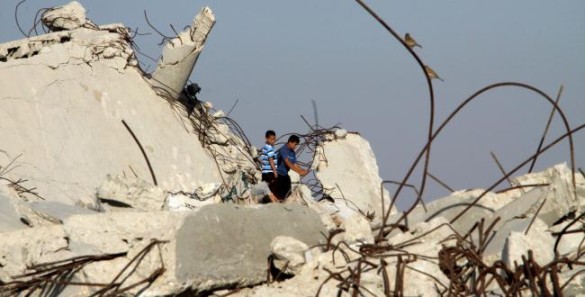
Although Israel is slowly easing its restrictions on the flow of basic humanitarian goods to Gaza, including food and medicine, construction materials remain prohibited from entering, institutions and homes still lie in rubble, and critically needed projects to repair and upgrade Gaza’s power plant and tottering sewage network lie dormant. [continued…]

Facebooktwittermail

Israeli settlement expansion may bring one-state solution closer

Israeli settlement expansion may bring one-state solution closer

As Israel announced plans to expand settlements in the West Bank in anticipation of a settlement “freeze”, the former US president, Jimmy Carter, who recently returned from a trip to the Holy Land, suggested that the implementation of a two-state solution is becoming increasingly unlikely.

“A more likely alternative to the present debacle is one state, which is obviously the goal of Israeli leaders who insist on colonising the West Bank and East Jerusalem. A majority of the Palestinian leaders with whom we met are seriously considering acceptance of one state, between the Jordan River and the Mediterranean Sea. By renouncing the dream of an independent Palestine, they would become fellow citizens with their Jewish neighbours and then demand equal rights within a democracy. In this nonviolent civil rights struggle, their examples would be Mahatma Gandhi, Martin Luther King Jr and Nelson Mandela.”

Mr Carter belongs to a group of veteran world leaders, known as the Elders, who recently visited Israel and the West Bank. Another member of the group, former Irish president and UN Human Rights Commissioner Mary Robinson told The Jerusalem Post last month that if Israel does not freeze settlement construction, a two-state solution may no longer be possible. [continued…]

Facebooktwittermail

Airline bomb plotters case threatened by US fears

Airline bomb plotters case threatened by US fears

Several months of high-level surveillance on the key suspects in the airline bomb plot was almost foiled by the nervousness of US authorities who “lost their nerve”, according to Scotland Yard’s then head of counter-terrorism operations.

Andy Hayman, who was assistant commissioner specialist operations in the Metropolitan police in 2006, today outlined how the suspects were being filmed, their purchases and rubbish monitored and cars bugged in the lead-up to their arrests in August 2006, but said the police operation in the UK came close to being undermined by anxiousness from the US that the plotters be arrested as soon as possible.

“At the very highest level, the Americans wanted to be reassured that this was not going to slip through our hands. I was briefing the home secretary, who was briefing Tony Blair, who was briefing George Bush…” he wrote in the Times today. [continued…]

Why I suspect jittery Americans nearly ruined efforts to foil plot

For several months in 2006 the key suspects in the airline plot — some of whom were convicted yesterday — were under intensive surveillance.

We logged every item they bought, we sifted every piece of rubbish they threw away (at their homes or in litterbins). We filmed and listened to them; we broke into their homes and cars to plant bugs and searched their luggage when they passed through airports.

We had been concerned about this group since early 2006. They were linked to a suspicious bookshop in Forest Gate, East London, and knew one of the July 21 bombers. The inquiry was labelled Operation Overt.

When a key figure, Abdulla Ahmed Ali, returned from Pakistan in June 2006, we searched his luggage and resealed it without him noticing. Inside was a soft drink powder, Tang, and a large number of batteries; they were bombmaking components and their discovery led to a step change in the operation. Another man, Assad Sarwar, seemed to be taking on the role of quartermaster — buying clamps, drills, syringes, glue and latex gloves. We watched him dispose of empty hydrogen peroxide containers; the substance could be used to dye hair or, as in July 2005, as an essential explosives component.

We were on their tail when Ali bought a flat in Walthamstow for £138,000 cash and we “burgled” the property to wire it up for covert sound and cameras. We watched as they experimented with turning soft-drinks containers into bottle bombs, listened as they recorded martyrdom videos and heard them discuss “18 or 19”. Were they talking about numbers of targets, bombs or bombers? [continued…]

Facebooktwittermail

U.S. tried to soften treaty on detainees

U.S. tried to soften treaty on detainees

From 2003 to 2006, the Bush administration quietly tried to relax the draft language of a treaty meant to bar and punish “enforced disappearances” so that those overseeing the CIA’s secret prison system would not be criminally prosecuted under its provisions, according to former officials and hundreds of pages of documents recently declassified by the State Department.

The aim of the global treaty, long supported by the United States, was to end official kidnappings, detentions and killings like those that plagued Latin America in the 1970s and 1980s, and that allegedly still occur in Russia, China, Iran, Colombia, Sri Lanka and elsewhere. But the documents suggest that initial U.S. support for the negotiations collided head-on with the then-undisclosed goal of seizing suspected terrorists anywhere in the world for questioning by CIA interrogators or indefinite detention by the U.S. military at foreign sites.

Instead of embracing a far-reaching ban on arrests, detentions and abductions of people without disclosing their fate or whereabouts or ensuring “the protection of the law,” the United States pressed in 2004 for a more limited prohibition on intentionally placing detainees outside legal protections for “a prolonged period of time.” At the time, the CIA was secretly holding about a dozen prisoners. [continued…]

The complicit general

With regard to the interrogation of detainees after September 11, it is well established that the path to torture was based on three key decisions. First, on February 7, 2002, President Bush decided that none of the detainees held at Guantánamo would have any legal rights under the Geneva Conventions. Second, starting in July 2002 the administration decided to authorize the use of waterboarding and other “enhanced interrogation techniques” against certain detainees held by the CIA, and obtained legal approval from the Department of Justice, in the form of two now notorious memos signed by Jay Bybee and largely written by John Yoo, with input from Dick Cheney’s legal counsel, David Addington.[1] Third, on December 2, 2002, came Secretary Rumsfeld’s memo approving the use of fifteen techniques on prisoners held by the military at Guantánamo, causing the military to adopt some of the interrogation practices used by the CIA. Each decision was significant. The cumulative effect was devastating, opening the path to the abuses at Abu Ghraib and elsewhere. [continued…]

Facebooktwittermail

Measuring success in Afghanistan

Measuring success in Afghanistan

Here may be the single strangest fact of our American world: that at least three administrations — Ronald Reagan’s, George W. Bush’s, and now Barack Obama’s — drew the U.S. “defense” perimeter at the Hindu Kush; that is, in the rugged, mountainous lands of Afghanistan. Put another way, while Americans argue feverishly and angrily over what kind of money, if any, to put into health care, or decaying infrastructure, or other key places of need, until recently just about no one in the mainstream raised a peep about the fact that, for nearly eight years (not to say much of the last three decades), we’ve been pouring billions of dollars, American military know-how, and American lives into a black hole in Afghanistan that is, at least in significant part, of our own creation.

Imagine for a moment, as you read this post, what might have happened if Americans had decided to sink the same sort of money — $228 billion and rising fast — the same “civilian surges,” the same planning, thought, and effort (but not the same staggering ineffectiveness) into reclaiming New Orleans or Detroit, or into planning an American future here at home. Imagine, for a moment, when you read about the multi-millions going into further construction at Bagram Air Base, or to the mercenary company that provides “Lord of the Flies” hire-a-gun guards for American diplomats in massive super-embassies, or about the half-a-billion dollars sunk into a corrupt and fraudulent Afghan election, what a similar investment in our own country might have meant.

Ask yourself: Wouldn’t the U.S. have been safer and more secure if all the money, effort, and planning had gone towards “nation-building” in America? Or do you really think we’re safer now, with an official unemployment rate of 9.7%, an underemployment rate of 16.8%, and a record 25.5% teen unemployment rate, with soaring health-care costs, with vast infrastructural weaknesses and failures, and in debt up to our eyeballs, while tens of thousands of troops and massive infusions of cash are mustered ostensibly to fight a terrorist outfit that may number in the low hundreds or at most thousands, that, by all accounts, isn’t now even based in Afghanistan, and that has shown itself perfectly capable of settling into broken states like Somalia or well functioning cities like Hamburg. [continued…]

Evidence of ballot fraud for Karzai forces U.S. into action

Evidence of electoral fraud on behalf of incumbent Afghan President Hamid Karzai has become so overwhelming, some U.S. and Western officials say, that they are scrambling to avoid a potential political crisis if he claims victory.

Afghanistan’s election commission decided Monday that it will release a complete preliminary tally from the Aug. 20 presidential election, including votes tainted by fraud charges but not disqualified, a commission official said. Western officials now say they believe almost one of every six of Afghanistan’s more than 25,000 polling stations is tainted by fraud, most of it on behalf of Mr. Karzai.

Including those votes, the preliminary tally is expected to show Mr. Karzai with more than 50% of the vote — enough to avoid a runoff election, Afghan and Western officials say. [continued…]

Facebooktwittermail

Ahmadinejad invites six powers to Tehran

Ahmadinejad invites six powers to Tehran

Iranian President Mahmoud Ahmadinejad on Monday invited representatives from a group of six world powers, including the United States, to Tehran, but he said negotiations over his country’s right to a nuclear program would be off the table.

Discussion on the nuclear issue, he told reporters at a news conference, is “finished.”

“We will never negotiate on the Iranian nation’s obvious rights,” he said, adding that Iran would not halt its uranium enrichment efforts. Ahmadinejad said Iran had prepared a proposal for breaking the deadlock on its nuclear program, and he asked diplomats to come to Tehran to pick it up. [continued…]

Ahmadinejad levels new broadside at opponents

Three months after Iranian President Mahmoud Ahmadinejad derided his opponents as “dirt and dust,” sending hundreds of thousands of angry protesters into the streets, he risked enraging them again Monday by likening them to “pollutants” staining “the gown of the revolution.”

The comment, during prepared remarks at a news conference, drew an immediate rebuke from a conservative clerical association in the holy city of Qom, which urged the president and his staff to “concentrate their minds seriously on economic woes and social challenges and avoid uttering unnecessary and provocative remarks.”

But along with Ahmadinejad’s defiant and boastful tone on the sensitive nuclear issue, Monday’s statement also suggested that three months of the worst domestic unrest in the Islamic Republic’s history had not caused the president to change his ways. [continued…]

Khamenei tells Ahmadinejad to listen to criticism

Iran’s supreme leader Ayatollah Ali Khamenei told President Mahmoud Ahmadinejad to listen to “benevolent criticism” as the hardliner began another term in office amid opposition claims his re-election was fraudulent.

“There is internal criticism backed by foreign media with the aim of sabotage but there is also benevolent criticism which may not come from supporters of the government but they contain good comments,” Khamenei said in a meeting with Ahmadinejad and his cabinet, state television reported.

He called on the government to have its “ears open to criticism.”

Also on Monday a leading Iranian conservative clerical group told Ahmadinejad to avoid “provocative” comments, in a first such message to the hardliner whose disputed re-election has bitterly divided the political elite. [continued…]

Facebooktwittermail

Israel gets tough on intermarriage

Israel gets tough on intermarriage

The Israeli government has launched a television and internet advertising campaign urging Israelis to inform on Jewish friends and relatives abroad who may be in danger of marrying non-Jews.

The advertisements, employing what the Israeli media described as “scare tactics”, are designed to stop assimilation through intermarriage among young diaspora Jews by encouraging them to move to Israel.

The campaign, which cost US$800,000 (Dh2.9 million), was created in response to reports that half of all Jews outside Israel marry non-Jews. It is just one of several initiatives by the Israeli state and private organisations to try to increase the size of Israel’s Jewish population. [continued…]

‘Missing Jews’ video shows Israeli chutzpah towards Diaspora Jewry

An Israel outreach program has pulled from its Web site a campaign video meant to scare the Israeli public about the inevitable ‘de-Judaization’ that occurs to good Jewish stock in the Diaspora.

The Masa organization last week released a video, which shows eery headshots of young, smiling youths with painfully Jewish names. Each of these faces gaze at the camera from atop flyers that read ‘Missing’ and ‘Lost’ in English, Russian, and Spanish.

Though the organization could not be reached for comment Tuesday, the video no longer appears on Masa’s Web site, YouTube or Facebook pages.

The unexpected viral reaction it has stirred among Diaspora Jews both still abroad and in Israel may have something to do with its sudden removal. Continue reading

Facebooktwittermail
