Ever since 1945, the US has regarded itself as the leader of the “free world”. But the Obama administration is facing an unexpected and unwelcome development in global politics. Four of the biggest and most strategically important democracies in the developing world – Brazil, India, South Africa and Turkey – are increasingly at odds with American foreign policy. Rather than siding with the US on the big international issues, they are just as likely to line up with authoritarian powers such as China and Iran.
The US has been slow to pick up on this development, perhaps because it seems so surprising and unnatural. Most Americans assume that fellow democracies will share their values and opinions on international affairs. During the last presidential election campaign, John McCain, the Republican candidate, called for the formation of a global alliance of democracies to push back against authoritarian powers. Some of President Barack Obama’s senior advisers have also written enthusiastically about an international league of democracies.
But the assumption that the world’s democracies will naturally stick together is proving unfounded. The latest example came during the Copenhagen climate summit. On the last day of the talks, the Americans tried to fix up one-to-one meetings between Mr Obama and the leaders of South Africa, Brazil and India – but failed each time. The Indians even said that their prime minister, Manmohan Singh, had already left for the airport. [continued…]
After a year with President Barack Obama at the helm of U.S. foreign policy, an observer could be forgiven for concluding that the presidency is more like taking over the controls of a train than getting behind the wheel of a car. That’s because you can’t steer a train; you can only determine its speed. So far, the menu of foreign policy challenges, and the Administration’s response to each, is remarkably similar at the close of 2009 to what it was at the close of 2008.
Obama’s promises of outreach to adversaries and consultation and coordination with allies certainly cleared away some of the negative atmospherics left by the Bush Administration. However, his substantial policy positions have proven to be remarkably similar to those of the second-term, chastened-by-reality George W. Bush. Indeed, anti-war Democrats groaned when the President, in his Nobel Peace Prize acceptance speech, referred to “evil in the world” and hailed America’s willingness to use force abroad over the past six decades as an essential component of global security. The neoconservatives cheered.
The reality is far more complex than that snapshot, of course, but a survey of Obama’s handling of the main strategic challenges appears to affirm the old Cold War dictum that domestic political partisanship ends at the water’s edge. [continued…]
Concerned about the “regional and global threat” from terrorists in Yemen, Gordon Brown is to host an emergency summit in London later this month. Yemen, at the southern tip of the Arabian peninsula, is a country that tends to be off the radar except when something untoward happens affecting foreigners – when it gets a brief period of attention before it’s forgotten again.
The current wave of attention results from the attempt to blow up flight 253 last month, the Fort Hood shootings in November and, to a lesser extent, the attempted assassination of the Saudi deputy interior minister last August – all of which had a Yemeni connection.
Though the fears these incidents arouse internationally are very real, they are not fears that Yemenis themselves necessarily share. Alongside the country’s other problems, al-Qaida and like-minded types are little more than a persistent nuisance. In the meantime, there’s a war in the north with the Shia Houthi rebels that has cost thousands of lives and, in the last few months, has made well over 100,000 homeless. There is also agitation and occasional violence by secessionists in the south, plus widespread disaffection with the government in other parts. The economy is in dire straits and corruption is rampant.
Looming on the horizon is drought and overpopulation. Yemen has the highest birth rate in the Middle East – at any given time 16% of Yemeni women are pregnant – along with a steady and growing influx of refugees from the Horn of Africa. It’s also running out of water as wells are drilled deeper and deeper. [continued…]
In 2004, the CIA sent a team from the private security firm Blackwater, now Xe, to Hamburg to kill an alleged al Qaeda financier who was investigated for years by German authorities on suspicion of links to al Qaeda, according to a little-highlighted element in a Vanity Fair article to be published this month.
The report cited a source familiar with the program as saying the mission had been kept secret from the German government.
“Among the team’s targets, according to a source familiar with the program, was Mamoun Darkazanli, an al Qaeda financier living in Hamburg who had been on the agency’s radar for years because of his ties to three of the 9/11 hijackers and to operatives convicted of the 1998 bombings of U.S. embassies in East Africa,” writes Vanity Fair’s Adam Ciralsky. [continued…]
The German government said on Monday it knew nothing about a magazine report that the CIA had planned a secret operation to kill a German-Syrian in Hamburg linked to the September 11 attacks on U.S. targets.
The U.S. magazine Vanity Fair had reported that the CIA had in 2004 sent a team from the private security firm Blackwater, now Xe, to Hamburg to kill Mamoun Darkazanli, who was investigated for years by German authorities on suspicion of links to al Qaeda. [continued…]
Five Turkish MPs will on Monday join an international aid convoy that has reached Egyptian port one-week later after the date that they initially hoped to reach Gaza Strip on the first anniversary of Israel’s 22-day offensive.
Viva Palestina Convoy is now at the Egyptian port of El-Arish with Turkish ship ULUSOY-6, which carried the convoy from the Syrian port of Lattakia to Egypt.
The aid volunteers who stay at Lattakia will fly in the day in 3 separate flights to Al-Arish to join the convoy. After everyone arrives at the Al- Arish port, the convoy will make an hour-drive to the Rafah border.
It is expected that the convoy will enter Gaza on Tuesday evening. It will be able to stay in Gaza for 24 hours only. During this time, all aid, drugs and medical tools will be delivered to the Gazan authorities. After 24 hours, all volunteers who travel with the convoy will go to Egypt and then fly back to their own countries. [continued…]
This is change: we’ve gone from change we can believe in, to a change in the mood music.
If Dick Cheney was the éminence grise behind George Bush, one could now be forgiven for thinking that George Bush himself has quietly taken on the same role for Barack Obama. And if this administration — like the one before — can be accused of losing touch with reality, there is no more compelling piece of evidence than this: Obama regards his speech in Cairo last summer as one of the most important things he’s done in the fight against terrorism.
The New York Times — reporting as always from “inside” the administration, reveals in, “Inside Obama’s War on Terrorism”:
perhaps the biggest change Obama has made is what one former adviser calls the “mood music” — choice of language, outreach to Muslims, rhetorical fidelity to the rule of law and a shift in tone from the all-or-nothing days of the Bush administration. He is committed to taking aggressive actions to disrupt terrorist cells, aides said, but he also considers his speech in Cairo to the Islamic world in June central to his efforts to combat terrorism. “If you asked him what are the most important things he’s done to fight terrorism in his first year, he would put Cairo in the top three,” Rahm Emanuel, his chief of staff, told me.
Really? There might have been good reason for Obama to have thought that at the time and for a few weeks afterwards, but by the time Washington caved under Israeli pressure by supporting a bogus settlement freeze, it became clear that the Cairo speech would be remembered across the Middle East as a bitter harbinger of disappointment.
As for Obama’s campaign promise that he would not only end the war in Iraq but end the mindset that took the US to war, it now turns out that as president he is quite content to follow in the footsteps of his predecessor:
A half-dozen former senior Bush officials involved in counterterrorism told me before the Christmas Day incident that for the most part, they were comfortable with Obama’s policies, although they were reluctant to say so on the record. Some worried they would draw the ire of Cheney’s circle if they did, while others calculated that calling attention to the similarities to Bush would only make it harder for Obama to stay the course. And they generally resent Obama’s anti-Bush rhetoric and are unwilling to give him political cover by defending him.
Michael Hayden, the last C.I.A. director under Bush, was willing to say publicly what others would not. “There is a continuum from the Bush administration, particularly as it changed in the second administration as circumstances changed, and the Obama administration,” Hayden told me. James Jay Carafano, a homeland-security expert at the Heritage Foundation, was blunter. “I don’t think it’s even fair to call it Bush Lite,” he said. “It’s Bush. It’s really, really hard to find a difference that’s meaningful and not atmospheric. You see a lot of straining on things trying to make things look repackaged, but they’re really not that different.”
Hours after last week’s deadly attack on a CIA base in Afghanistan, a revision was made in official accounts of the number of intelligence operatives killed in the suicide bombing. Instead of eight deaths, as initially reported, the CIA acknowledged only seven.
The eighth victim resurfaced over the weekend when his flag-draped coffin arrived in his native country, Jordan. The man, a captain in the Jordanian intelligence service, was given full military honors at a ceremony that referred only to his “humanitarian work” in war-torn Afghanistan.
In fact, the man’s death offered a rare window into a partnership that U.S. officials describe as crucial to their counterterrorism strategy. Although its participation is rarely acknowledged publicly, Jordan is playing an increasingly vital role in the fight against al-Qaeda and other terrorist groups, sometimes in countries far beyond the Middle East, according to current and former government officials from both countries.
Traditionally close ties between the CIA and the Jordanian spy agency — known as the General Intelligence Department — strengthened after the Sept. 11, 2001, attacks, occasionally prompting allegations by human rights groups that Jordan was serving as a surrogate jailer and interrogator for the U.S. intelligence agency. In the past two years, in the face of new threats in Afghanistan and Yemen, the United States has again called on its ally for help, current and former officials from both countries said. [continued…]
Editor’s Comment — When the war on terrorism began, George Bush spoke in a language that ten-year olds would understand: America had been attacked by some bad guys and we would now hunt them down.
Those ten-year olds are now entering adulthood yet government officials and journalists still insist in talking like children.
In describing the reason a Jordanian intelligence officer was working alongside CIA officers in Afghanistan as all fell victim to a suicide attack last week, Jamie Smith, a former CIA officer who worked in the border region in the years immediately after the US-led invasion, told The Washington Post: “They know the bad guy’s . . . culture, his associates, and more [than anyone] about the network to which he belongs.”
In this narrative, there’s reason to be unsure about the status of the Jordanians. Are they “good guys” like us? They’ve shown themselves as being indispensable to the United States — as sources of intelligence (who sometimes were not listened to when they should have been, such as when they forewarned the US about 9/11) and as interrogators, which is to say, torturers.
Of course, good guys don’t torture — they have someone else do it for them. And good guys don’t suppress democracy, but the Jordanians are loyal friends to America so I guess in this instance we shouldn’t be too particular about how we assign moral status.
Meanwhile, in the real world, the most striking thing about the attack on Forward Operating Base Chapman was not that it was a devastating event for the CIA — it was the inescapable degree of equivalence in the conflict.
Two groups of combatants, neither of whom wear uniforms are slugging it out on the Afghan-Pakistan border. Each group has identified what it regards as high-value targets and each are using their own available means to hit these targets. The Taliban/Qaeda are using suicide bombers while the CIA is using Hellfire missiles.
When the Taliban struck last week, as far as the reports indicate, there doesn’t appear to have been a single civilian casualty. According to Pakistani reports, on the other hand, Predator strikes have so far resulted in 140 innocent civilians killed for each al Qaeda or Taliban target hit.
So, on the basis of considering who’s killing who, there seems to be sufficient reason to set aside the term “bad guys” and the implied “good guys”. The crucial difference between the two sides does not hinge on who can make the more credible claim of virtue. It comes from the contest between the indigenous and the foreign — a contest in which the advantage of the indigenous is inherent and insurmountable.
However long Americans reside in Afghanistan, it will never become home; their departure is inevitable. All that remains unknown is when we will leave.
A teacher and his 9-year-old son were killed Sunday night by a suspected U.S. drone, a Pakistani administration official and an intelligence official told CNN.
The incident occurred in the village of Musaki in the North Waziristan district. The suspected U.S. drone fired two guided missiles at the compound of local resident Sadiq Noor, the officials said. There were reports Noor’s home was used by local and foreign militants. [continued…]
U.S. missiles flattened an extremist hideout in Pakistan’s lawless tribal belt Sunday, killing five militants in the latest strike in a recent spike in drone attacks, Pakistani officials said.
The attack targeted a house in Mosakki village, about 25 kilometres (16 miles) east of Miranshah, the main town in North Waziristan, and was the third suspected US missile attack in the tribal district in less than a week. [continued…]
… let’s pause a moment as the New Year begins and take stock of ourselves as what we truly are: the preeminent war-making machine on planet Earth. Let’s peer into the future, and consider just what the American way of war might have in store for us in 2010. Here are 10 questions, the answers to which might offer reasonable hints as to just how much U.S. war efforts are likely to intensify in the Greater Middle East, as well as Central and South Asia, in the year to come.
1. How busted will the largest defense budget in history be in 2010?
Strange, isn’t it, that the debate about hundreds of billions of dollars in health-care costs in Congress can last almost a year, filled with turmoil and daily headlines, while a $636 billion defense budget can pass in a few days, as it did in late December, essentially without discussion and with nary a headline in sight? And in case you think that $636 billion is an honest figure, think again — and not just because funding for the U.S. nuclear arsenal and actual “homeland defense,” among other things most countries would chalk up as military costs, wasn’t included.
If you want to put a finger to the winds of war in 2010, keep your eye on something else not included in that budget: the Obama administration’s upcoming supplemental funding request for the Afghan surge. In his West Point speech announcing his surge decision, the president spoke of sending 30,000 new troops to Afghanistan in 2010 at a cost of $30 billion. In news reports, that figure quickly morphed into “$30-$40 billion,” none of it in the just-passed Pentagon budget. To fund his widening war, sometime in the first months of the New Year, the president will have to submit a supplemental budget to Congress — something the Bush administration did repeatedly to pay for George W.’s wars, and something this president, while still a candidate, swore he wouldn’t do. Nonetheless, it will happen. So keep your eye on that $30 billion figure. Even that distinctly low-ball number is going to cause discomfort and opposition in the president’s party — and yet there’s no way it will fully fund this year’s striking escalation of the war. The question is: How high will it go or, if the president doesn’t dare ask this Congress for more all at once, how will the extra funds be found? Keep your eye out, then, for hints of future supplemental budgets, because fighting the Afghan War (forget Iraq) over the next decade could prove a near trillion-dollar prospect. [continued…]
Yemeni officials on Sunday dismissed the threat posed by Al Qaeda in their country as “exaggerated” and downplayed the possibility of cooperating closely with the United States in fighting Islamic militants, even as the U.S. and Britain temporarily closed their diplomatic outposts in Yemen because of unspecified Al Qaeda threats.
The statements by Yemen’s foreign minister, chief of national security and Interior Ministry came a day after the region’s top American military commander vowed to step up U.S. military support for the beleaguered Arabian Peninsula nation.
Analysts said the Yemeni statements reflected domestic political concerns about President Ali Abdullah Saleh appearing weak and beholden to the West as he faces numerous political challenges. [continued…]
Any direct US strike against al Qa’eda militants in Yemen will further push the state towards failure and boost al Qa’eda’s presence, a tribal leader and political analysts say.
“It is very serious and unacceptable that the Americans get involved in striking al Qa’eda militants because this is against the sovereignty of the country, would cause resentment and increase sympathy with al Qa’eda as in such strikes a lot of innocent civilians are hit,” said Sheikh Arfaj bin Hadhban, a chief of the Dahm tribe in al Jawf province, north-east of the capital Sana’a.
Abdulbari Taher, an independent political analyst and highly-regarded Yemeni writer and commentator, said: “The US military involvement will do nothing but create another Pakistan or Afghanistan. It will speed up the failure of the state and the collapse of the system. It will bring another catastrophe to the region.” [continued…]
But Israel needs Barghouti as well. He is the key to the future of the two-state solution, and therefore, to an Israel which is democratic without qualification, peaceable without biennial war, demographically Jewish without apartheid, a true neighbor to its neighbors – for once, a full member of the community of nations, economically, diplomatically, and, on the level of one-on-one human interaction.
Israeli leaders who have worked with Barghouti – even some who had him arrested and nearly assassinated – know the potential value to a future peace of his political skills, his standing and charisma among Palestinians, his work on behalf of Israeli-Palestinian negotiations in the past.
The senior Israeli security and government officials who have lobbied for Barghouti’s release include former senior Shin Bet official and ex-public security minister Gideon Ezra, and cabinet minister Benjamin Ben-Eliezer, who served as defense minister under Ariel Sharon during the second intifada. [continued…]
Palestinian security forces in the West Bank have stopped torturing Hamas prisoners, ending two years of systematic abuse, Hamas inmates said in jailhouse interviews.
The change in practice, said to have taken effect in October, was confirmed by a West Bank Hamas leader, human rights activists and the Palestinian prime minister. Prime Minister Salam Fayyad said the decision to halt any abuse was part of an effort to make sure a future state is built on the right foundations.
Hamas legislators and human rights researchers said the worst behavior — prisoners beaten with clubs and cables; suspended from the ceiling while tied up in painful positions; and forced to stand for days — had ended.
But they said they still received sporadic reports of prisoners being slapped or forced to stand for several hours during interrogations. And security forces often arrest Hamas activists and hold them for lengthy periods without charge. [continued…]
In a clear signal to President Hamid Karzai that he cannot count on Parliament for support, lawmakers resoundingly rejected most of his nominees for cabinet posts and expressed discontent with the candidates’ competence.
Of Mr. Karzai’s 24 cabinet nominees, 17 were rejected and 7 approved. Of those who received votes of confidence, all but one are currently cabinet ministers.
The president’s office had no comment on Saturday’s vote; the deputy spokesman, Hamid Elmi, said a news conference would be held on Sunday.
After being declared the winner of an election tainted by fraud, Mr. Karzai has been under pressure from Western leaders and Afghan opposition figures to help make things right by choosing cabinet officials not linked to corruption or incompetence. Parliament’s action on Saturday made it clear that they felt he had not met those requirements.
In particular, they said that they were not consulted enough during the nomination process and that many cabinet nominees lacked the professional backgrounds necessary to do their jobs. However, ethnic politics were also in play, raising questions about whether lawmakers were primarily interested in being partisan defenders of their own ethnic constituencies, though many denied that that was a factor. [continued…]
Chinese companies banned from doing business in the U.S. for allegedly selling missile technology to Iran continue to do a brisk trade with American companies, according to an analysis of shipping records.
A unit of state-owned China Precision Machinery Import-Export Corp., for example, has made nearly 300 illegal shipments to U.S. firms since a ban was imposed on CPMIEC and its affiliates in mid-2006, according to an analysis of shipping records by the Wisconsin Project on Nuclear Arms Control, a nonprofit proliferation watchdog.
A Wall Street Journal review of the records and interviews with officials at some of the American companies indicate that the U.S. firms likely were unaware they were doing business with banned entities, and in many cases were tripped up by altered company names. [continued…]
Of the 44 predator strikes carried out by US drones in the tribal areas of Pakistan over the past 12 months, only five were able to hit their actual targets, killing five key Al-Qaeda and Taliban leaders, but at the cost of over 700 innocent civilians.
According to the statistics compiled by Pakistani authorities, the Afghanistan-based US drones killed 708 people in 44 predator attacks targeting the tribal areas between January 1 and December 31, 2009.
For each Al Qaeda and Taliban terrorist killed by US drones, 140 innocent Pakistanis also had to die. Over 90 per cent of those killed in the deadly missile strikes were civilians, claim authorities. [continued…]
A senior commander connected to the Afghan Taliban and involved with the attack against the CIA that left eight people dead said Saturday that the bombing was retaliation for U.S. drone strikes in the Afghan-Pakistan border region.
“We attacked this base because the team there was organizing drone strikes in Loya Paktia and surrounding area,” the commander said, referring to the area around Khost, the city where the U.S. facility was attacked. The commander, a prominent member of the Afghan insurgency, spoke on the condition of anonymity.
The suicide attack, which dealt the biggest loss to the agency in more than 25 years, killed a woman who was the station chief along with six other CIA officers and one private security contractor. [continued…]
The suicide bomber who killed at least six Central Intelligence Agency officers in a base along the Afghan-Pakistan border on Wednesday was a regular CIA informant who had visited the same base multiple times in the past, according to someone close to the base’s security director.
The informant was a Pakistani and a member of the Wazir tribe from the Pakistani tribal area North Waziristan, according to the same source. The base security director, an Afghan named Arghawan, would pick up the informant at the Ghulam Khan border crossing and drive him about two hours into Forward Operating Base Chapman, from where the CIA operates. [continued…]
You know, one of the intense pleasures of travel and one of the delights of ethnographic research is the opportunity to live amongst those who have not forgotten the old ways, who still feel their past in the wind, touch it in stones polished by rain, taste it in the bitter leaves of plants. Just to know that Jaguar shamans still journey beyond the Milky Way, or the myths of the Inuit elders still resonate with meaning, or that in the Himalaya, the Buddhists still pursue the breath of the Dharma, is to really remember the central revelation of anthropology, and that is the idea that the world in which we live in does not exist in some absolute sense, but is just one model of reality, the consequence of one particular set of adaptive choices that our lineage made, albeit successfully, many generations ago.
And of course, we all share the same adaptive imperatives. We’re all born. We all bring our children into the world. We go through initiation rites. We have to deal with the inexorable separation of death, so it shouldn’t surprise us that we all sing, we all dance, we all have art.
But what’s interesting is the unique cadence of the song, the rhythm of the dance in every culture. And whether it is the Penan in the forests of Borneo, or the Voodoo acolytes in Haiti, or the warriors in the Kaisut desert of Northern Kenya, the Curandero in the mountains of the Andes, or a caravanserai in the middle of the Sahara. This is incidentally the fellow that I travelled into the desert with a month ago, or indeed a yak herder in the slopes of Qomolangma, Everest, the goddess mother of the world.
All of these peoples teach us that there are other ways of being, other ways of thinking, other ways of orienting yourself in the Earth. And this is an idea, if you think about it, can only fill you with hope. Now, together the myriad cultures of the world make up a web of spiritual life and cultural life that envelops the planet, and is as important to the well-being of the planet as indeed is the biological web of life that you know as a biosphere. And you might think of this cultural web of life as being an ethnosphere and you might define the ethnosphere as being the sum total of all thoughts and dreams, myths, ideas, inspirations, intuitions brought into being by the human imagination since the dawn of consciousness. The ethnosphere is humanity’s great legacy. It’s the symbol of all that we are and all that we can be as an astonishingly inquisitive species.
The paramount question these days, six months into the making of the Green Movement, is will the Islamic republic fall? Is this yet another revolution in the making, like the one we saw in 1979? Or will the military apparatus of the Islamic republic crash through the streets of Tehran and other cities like a fully charged armadillo and turn Iran into a theocratic dictatorship, ruled by a military junta like Pakistan, clad in an ideological fanaticism borrowed and expanded from Mullah Omar and the Afghan Taliban?
For the last six months and since Day One of this uprising, lovingly code-named the Green Movement (Jonbesh-e Sabz), I have consistently called and continue to call it a civil-rights movement. This does not mean I am blind to its revolutionary potentials, violent dimensions, or destructive forces. It does not mean that the Islamic republic may not, or should not, fall. I keep calling it a civil-rights movement because I believe that the underlying social changes that have caused and continue to condition this movement are hidden behind a political smoke screen. As our attention is distracted by the politics of the moment, I have kept my ears to the ground listening to the subterranean sounds and tremors of an earth holding some 200 years of an anti-colonial modernity in it sinuous silences.
Beyond the pale and patience of politics, and the attention span of a Twitter phrase, I have called this a civil-rights movement because I see something in that polyclonal green that defies augury. That color green is a sign that signals and means many things to many people, and no one is entirely in charge to legislate or regulate or incarcerate exactly what. [continued…]
The funeral of Grand Ayatollah Hossein Ali Montazeri on Dec. 21, and the Ashura demonstrations on Dec. 27, marked a turning point for Iran’s democratic movement. The demonstrations showed that even after a violent six-month crackdown on peaceful protesters, political figures, journalists, and human right advocates, the Green Movement has not been weakened, but that it has strengthened and expanded to many cities and towns around the country. This is already a significant victory for the Green Movement. The question is: where is the Green Movement going to go from here?
First off, let’s be realistic. Many Iranians would like to believe that the hardline regime is in its death throes. But such optimism must be tempered. The hardliners’ ability to maintain power through force has not been diminished and is likely to outlast the Islamic Republic’s crisis of legitimacy. The struggle for democracy in Iran is a Marathon, not a sprint. There is still a long way to go. [continued…]
With President Obama declaring a “systemic failure” of our security system in the wake of the attempted Christmas bombing of a Detroit-bound airliner, familiar arguments about what can and should be done to reduce America’s vulnerabilities are again filling the airwaves, editorial pages and blogosphere. Several of these arguments are based on assumptions that guided the U.S. response to the Sept. 11, 2001, attacks — and unfortunately, they are as unfounded now as they were then. The biggest whopper of all? The paternalistic assertion that the government can keep us all safe without our help. [continued…]
The rhetoric is different, but there has been more continuity than change in US foreign policy from George Bush’s second term to Barack Obama’s first.
The US is leaving Iraq on the terms laid down by Mr Bush’s Status of Forces Agreement with the Baghdad government. Mr Obama has opted for a troop surge in Afghanistan, just as Mr Bush would surely have done. Having accepted “no, but” as Israel’s answer to his settlement-freeze demand, Mr Obama is pursuing his predecessor’s policy of propping up the Palestinian president Mahmoud Abbas and a hypothetical peace process while condoning Israel’s chokehold on Gaza and trying to marginalise Hamas.
So while “What would George Bush have done?” may seem like an odd place to start in discussing Mr Obama’s options over al Qa’eda in Yemen, the truth is that his positions on the key strategic challenges after a year in office are remarkably similar to those adopted by the man before.
The question is whether he will respond to the attempted bombing of a US airliner over Detroit by a Nigerian trained by al Qa’eda in Yemen with a military campaign like that launched by Mr Bush in Afghanistan after 9/11. [continued…]
The rush to partner with the Yemeni government to “tackle extremism”, as Gordon Brown says, illustrates the need to think carefully about the political dimension. The government of Ali Abdullah Saleh is to a great extent the problem, not the solution. Ever since Saleh recanted on his vow to not seek re-election and cheated his way to victory over Faisal bin Shamlan (who symbolically died this week), Yemen’s political system has taken a sharp turn for the worse. Corruption, always bad, has skyrocketed. So have human rights abuses and political repression, including a wide range of attacks on media freedoms. Heavy-handed security services have a lot to do with the outbreak and perpetuation of the Houthi rebellion; as Joost Hilterman points out, “the Houthi leadership has portrayed its position as purely defensive against acts of state oppression and attacks by the Yemeni army.” In short, partnering with the Yemeni government to provide honest, legitimate government may seem like a good response, but it is not likely to succeed. If you like working with Hamid Karzai, you’re going to love Ali Abdullah Saleh. [continued…]
Al-Qaeda in the Arabian Peninsula (AQAP) was formed in January 2009 by a merger between two regional offshoots of the international Islamist militant network in neighbouring Yemen and Saudi Arabia.
Led by a former aide to Osama Bin Laden , the group has vowed to attack oil facilities, foreigners and security forces as it seeks to topple the Saudi monarchy and Yemeni government, and establish an Islamic caliphate. [continued…]
The US has indications that al-Qaeda is planning an attack in the Yemeni capital Sanaa, President Barack Obama’s top counter-terrorism adviser has said.
John Brennan was speaking after the US shut its embassy in Yemen. “We’re not going to take any chances,” he told the Associated Press news agency.
Britain also closed its embassy, after threats from an al-Qaeda offshoot which claimed a failed bomb plot in the US. [continued…]
Yemen’s problems are many, and some are already spreading beyond its borders. Security and stability are deteriorating. The population is growing rapidly. The economy is collapsing. There are few good options today; things will look worse tomorrow. Immediate and sustained international attention is needed to at least lessen the impact of some problems.
Yemen is a weak state with little history of central government control. The government’s first priorities have been a civil war in the north and a growing secessionist movement in the south; lower on the list has been confronting al-Qaeda, which is now resurgent. The government does not fully control all territory, nor does it have the authority or capacity to adequately deliver social services in many rural areas. Organizations inspired or directed by al-Qaeda have sought refuge in undergoverned spaces.
Spending is not directed toward the root causes of instability but toward war costs, accelerating the economic collapse. [continued…]
The iron wall By Uri Avnery, Gush Shalom, January 2, 2010
Egypt considers itself as the leader of the Arab world. It is the most populous Arab country, situated at the center of the Arab world. Fifty years ago the president of Egypt, Gamal Abd-al-Nasser, was the idol of all the Arabs, especially of the Palestinians. How can Egypt collaborate with the “Zionist enemy”, as Egyptians called Israel then, in bringing 1.5 million brother Arabs to their knees?
Until recently, the Egyptian government had been sticking to a solution that exemplifies the 6000-year old Egyptian political acumen. It participated in the blockade but closed its eyes to the hundreds of tunnels dug under the Egyptian-Gaza border, through which the daily supplies for the population were flowing (for exorbitant prices, and with high profits for Egyptian merchants), together with the stream of arms. People also passed through them – from Hamas activists to brides.
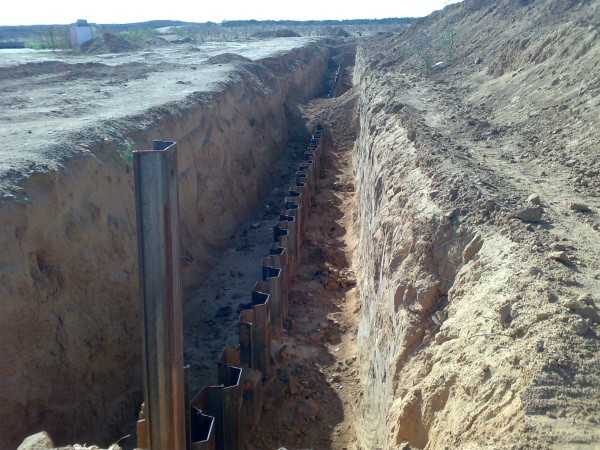
This is about to change. Egypt has started building an iron wall – literally – along the full length of the Gaza border, consisting of steel pillars thrust deep into the ground, in order to block all tunnels. That will finally choke the inhabitants.
When the most extreme Zionist, Vladimir Ze’ev Jabotinsky, wrote 80 years ago about erecting an “Iron Wall” against the Palestinians, he did not dream of Arabs doing just that. [continued…]
Hamas on Sunday urged leading Islamic clerics in Egypt to reverse a recent edict supporting the construction of a metal wall cutting off smuggling tunnels under the border with the Gaza Strip.
It emerged late last week that scholars at Cairo’s Al-Azhar University, Sunni Islam’s highest seat of learning, issued a fatwa in favor of the wall.
“It is one of Egypt’s legitimate rights to place a barrier that prevents the harm from the tunnels under Rafah, which are used to smuggle drugs and other [contraband] that threaten Egypt’s stability,” the newspaper Al-Masri Al-Yom quoted the scholars as saying, according to AFP.
“Those who oppose building this wall are violating the commands of Islamic law,” they added, after a meeting attended by Egypt’s top cleric Sheikh Muhammad Said Tantawi, who is a government appointee. [continued…]
A British-led aid convoy bound for the Gaza Strip is on its way to the Egyptian port of Al-Arish after departing Syria by boat, organizers said on Sunday.
The Viva Palestina convoy, led in part by firebrand British MP George Galloway, loaded 210 truckloads of food and medical supplies onto a ferry in the Syrian port of Latakia.
The group, which set out from London nearly a month ago and drove through Turkey and Syria, spent five days stranded in Jordan after Egypt denied it permission to travel to the Red Sea port of Nuweiba, insisting that aid convoys should transit through the port of Al-Arish, on the Mediterranean. [continued…]
This website or its third-party tools use cookies, which are necessary to its functioning. By closing this banner, you agree to the use of cookies.

 Ever since 1945, the US has regarded itself as the leader of the “free world”. But the Obama administration is facing an unexpected and unwelcome development in global politics. Four of the biggest and most strategically important democracies in the developing world – Brazil, India, South Africa and Turkey – are increasingly at odds with American foreign policy. Rather than siding with the US on the big international issues, they are just as likely to line up with authoritarian powers such as China and Iran.