Daily Archives: February 3, 2010

On Israel-Palestine, no more of the same

Yossi Alpher:

President Obama and Mr. Mitchell must recognize that in the current regional strategic lineup, Syria is more relevant than Palestine. Syria’s president, Bashar al-Assad, declares himself ready to deal. A Syrian-Israeli process has a better chance of getting underway than a Palestinian-Israeli process. A successful Syrian-Israeli effort offers the United States, Israel and the moderate Arab states immediate benefits by reducing Iran’s penetration of the Levant, weakening its regional proxies and allies and rendering the U.S. withdrawal from Iraq — a major strategic event of the coming year — more likely to succeed. The mere fact of Israel-Syria negotiations would hurt Hamas, thereby strengthening Mr. Abbas.

Such a potential payoff justifies applying some pressure if necessary on Mr. Netanyahu. It justifies the risk of failure. And it justifies devoting more U.S. diplomatic energy to Damascus instead of Ramallah.

A second revised priority should address Hamas itself. It’s time to recognize that all the strategies mustered against the Hamas “emirate” in Gaza since the takeover of June 2007 have failed. The economic warfare policy invoked by Israel, the Quartet powers — the European Union, the United States, Russia and the United Nations — and Egypt has punished 1.4 million Gazans, impoverished the moderate middle class and empowered and enriched Islamist smugglers, yet has failed to dislodge the Hamas regime. It is plainly counterproductive. Israel’s use of military force in Gaza, most recently a year ago, may have bought it some deterrent time but proved devastating for its international image. Egypt finally acknowledges that its mediation efforts with Hamas have failed. And the fiction that the P.L.O. will soon return to power in Gaza is just that — a fiction.


Facebooktwittermail

How to talk to a jihadist

Andrew Sullivan:

Watching senators and pundits huff and puff about Mirandizing terrorists when they should apparently be declared enemy combatants and tortured at length is a depressing spectacle. To see political leaders in the West have such a low view of the American judicial system and such an elevated view of the world-historical significance of these pathetic, twisted, religious nutjobs … well, they look like a bunch of scaredy cats to me. What the hell happened to “Live Free Or Die?” What happened to the confidence of a society that its ancient traditions are perfectly capable, indeed precisely tailored, to cut down to size these narcissistic, fundamentalist celebrity-seekers?

Which reminds me. One of the high points in the West’s defense against these losers was the trial of one Richard Reid, an unspeakably ugly and deeply stupid Brit whom Dick Cheney decided should – gasp – be treated as a terrorist under the criminal law in the months after 9/11. Not an enemy combatant to be flown to Gitmo and tortured. A terrorist brought to justice in the light of day. Eight years later, Cheneyites are drumming up panic that the Obama administration would do exactly the same thing for exactly the same reasons. But that they have lost their shit is no reason for the rest of us to lose ours.

Facebooktwittermail

‘It’s better to join the Taliban; they pay more money.’


When President Obama announced his 30,000-strong troop surge in December he said: “these additional American and international troops will allow us to accelerate handing over responsibility to Afghan forces and allow us to begin the transfer of our forces out of Afghanistan in July of 2011.”

It was another example of what has become all too familiar: Obama’s ability to govern like Bush without sounding exactly like Bush. He might as well have simply reused Bush’s line and said: “As Afghan forces stand up, we will stand down.” The difference in language is trivial. The real difference between now and 2005 when Bush said that in reference to Iraqi forces is that it turns out Bush’s objective was a bit more realistic.

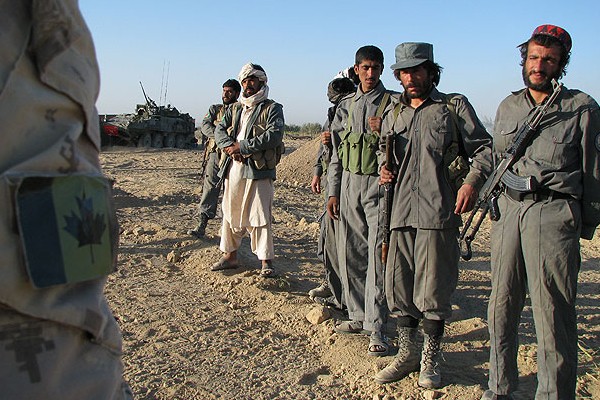
Consider Rod Nordland’s portrayal or the way the Afghan National Police force is shaping up:

The NATO general in charge of training the Afghan police has some tongue-in-cheek career advice for the country’s recruits.

“It’s better to join the Taliban; they pay more money,” said Brig. Gen. Carmelo Burgio, from Italy’s paramilitary Carabinieri force.

That sardonic view reflects a sobering reality. The attempts to build a credible Afghan police force are faltering badly even as officials acknowledge that the force will be a crucial piece of the effort to have Afghans manage their own security so American forces can begin leaving next year.

Though they have revamped the program recently and put it under new leadership, Afghan, NATO and American officials involved in the training effort list a daunting array of challenges, as familiar as they are intractable.

One in five recruits tests positive for drugs, while fewer than one in 10 can read and write — a rate even lower than the Afghan norm of 15 percent literacy. Many cannot even read a license plate number. Taliban infiltration is a constant worry; incompetence an even bigger one.

Now consider this description of the resistance that US Marines are facing in Helmand Province:

In areas where they have built bases, the Marines have undermined the Taliban’s position. But the insurgents have consolidated and adapted, and remain a persistent and cunning presence.

On the morning of the sweep, made by Weapons Company, Third Battalion, First Marines, a large communications antenna that rose from one compound vanished before the Marines could reach it. The man inside insisted that he had seen nothing. And when the Marines moved within the compounds’ walls, people in nearby houses released white pigeons, revealing the Americans’ locations to anyone watching from afar.

The Taliban and their supporters use other signals besides car horns and pigeons, including kites flown near American movements and dense puffs of smoke released from chimneys near where a unit patrols.

“You’ll go to one place, and for some reason there will be a big plume of smoke ahead of you,” said Capt. Paul D. Stubbs, the Weapons Company commander. “As you go to the next place, there will be another.”

“Our impression,” he added, “is the people are doing it because they are getting paid to do it.”

The people are getting paid… right.

You don’t have to be a Holywood screenwriter to see this description — the smoke signals, pigeon alerts and so forth — as a classic image of resistance. The foreign fighters are better armed, but the resistance fighters have the home-turf advantage — they’re being protected by the civilian population. Do the civilians have to get paid for their services? Conceivably, but I kind of doubt it. More likely it simply comes down to knowing who are “our boys”.

Facebooktwittermail

Israeli commander: ‘We rewrote the rules of war for Gaza’

From The Independent:

A high-ranking officer has acknowledged for the first time that the Israeli army went beyond its previous rules of engagement on the protection of civilian lives in order to minimise military casualties during last year’s Gaza war, The Independent can reveal.

The officer, who served as a commander during Operation Cast Lead, made it clear that he did not regard the longstanding principle of military conduct known as “means and intentions” – whereby a targeted suspect must have a weapon and show signs of intending to use it before being fired upon – as being applicable before calling in fire from drones and helicopters in Gaza last winter. A more junior officer who served at a brigade headquarters during the operation described the new policy – devised in part to avoid the heavy military casualties of the 2006 Lebanon war – as one of “literally zero risk to the soldiers”.

The officers’ revelations will pile more pressure on Israeli Prime Minister Benjamin Netanyahu to set up an independent inquiry into the war, as demanded in the UN-commissioned Goldstone Report, which harshly criticised the conduct of both Israel and Hamas. One of Israel’s most prominent human rights lawyers, Michael Sfard, said last night that the senior commander’s acknowledgement – if accurate – was “a smoking gun”.

A policy of “zero risk to the soldiers” — think about that. Isn’t that exactly what the infamous Rabbi Yitzhak Shapira believes in — a rabbi, it should be noted, who has been portrayed as being a fanatic and an extremist.

This is how the views of Shapira, head of the Od Yosef Chai Yeshiva, were described in the Jerusalem Post a few days ago:

In sharp contrast to the Goldstone Report, which criticizes the IDF for purportedly committing “war crimes” against Palestinians during Operation Cast Lead, Od Yosef Chai’s criticism of the IDF is totally different.

IDF battlefield ethics are seen as immoral not because they allow for the killing of innocent bystanders but because they force Jewish soldiers to needlessly endanger themselves to protect gentiles.

The measures taken by the IDF to protect non-combatants, such as using ground forces to weed out terrorists embedded in highly populated civilian areas so as to minimize collateral damage, are viewed by Shapira as downright evil, because they lead to the needless injury or death of Jewish soldiers.

So, Shapira should be relieved to hear that Jewish soldiers were not put at unnecessary risk — though he’d hardly need to have waited a year to figure that out, since the war’s casualty figures (six soldiers killed, not including four killed by friendly fire) make it transparent that Israel minimized its risks. Indeed, as the Independent report reveals, one of the principal ways the operation kept soldiers out of harms way was through heavy reliance on drone attacks.

“Most of the guys taken down were taken down by order of headquarters. The number of enemy killed by HQ-operated remote … compared to enemy killed by soldiers on the ground had absolutely inverted,” an Israeli soldier told Yedhiot Ahronot.

Since the Independent has, at least in part, run Yedhiot Ahronot‘s own story, hopefully the Israeli newspaper can muster the courage to print the rest of it.

Facebooktwittermail

Avi Shlaim – Blair: Gaza’s great betrayer

From The Guardian:

The savage attack Israel ­unleashed against Gaza on 27 December 2008 was both immoral and unjustified. Immoral in the use of force against civilians for political purposes. Unjustified because Israel had a political alternative to the use of force. The home-made Qassam rockets fired by Hamas militants from Gaza on Israeli towns were only the ­excuse, not the reason for Operation Cast Lead. In June 2008, Egypt had ­brokered a ceasefire between Israel and Hamas, the Islamic resistance movement. ­Contrary to Israeli propaganda, this was a success: the average number of rockets fired monthly from Gaza dropped from 179 to three. Yet on 4 November Israel violated the ceasefire by launching a raid into Gaza, killing six Hamas fighters. When Hamas ­retaliated, Israel seized the renewed rocket attacks as the ­excuse for launching its insane offensive. If all Israel wanted was to protect its citizens from Qassam rockets, it only needed to ­observe the ceasefire.

While the war failed in its primary aim of regime change in Gaza, it left ­behind a trail of death, devastation, ­destruction and indescribable human suffering. Israel lost 13 people, three in so-called friendly fire. The Palestinian death toll was 1,387, including 773 civilians (115 women and 300 children), and more than 5,300 people were injured. The ­entire population of 1.5 million was left traumatised. Across the Gaza Strip, 3,530 homes were completely ­destroyed, 2,850 severely damaged and 11,000 suffered structural damage.

The UN Relief and Works Agency for Palestinian Refugees, tending to the needs of four million Palestinian ­refugees, stated that Gaza had been “bombed back, not to the Stone Age, but to the mud age”; its inhabitants ­reduced to building homes from mud after the fierce 22-day offensive.

War crimes were committed and possibly even crimes against humanity, documented in horrific detail in Judge Richard Goldstone’s report for the UN human rights council. The report ­condemned both Israel and Hamas, but reserved its strongest criticism for Israel, accusing it of deliberately targeting and terrorising civilians in Gaza. The British government did not take part in the vote on the report, sending a signal to the hawks in Israel that they can continue to disregard the laws of war. Gordon Brown’s 2007 appointment as a patron of the Jewish National Fund UK presumably played a part in the adoption of this ­pusillanimous position.

One year on, the Gaza Strip, one of the most densely populated areas on earth, continues to teeter on the verge of a humanitarian disaster. Israel’s ­illegal blockade of Gaza, in force since June 2007, restricts the flow not only of arms but also food, fuel and medical supplies to well below the minimum necessary for normal, everyday life. Reconstruction work has hardly begun because of the Israeli ban on bringing in cement and other building materials to Gaza. Thousands of families still live in the ruins of their former homes. Hospitals, health facilities, schools, government buildings and mosques cannot be rebuilt. Nor can the basic ­infrastructure of the Gaza Strip, including Gaza City’s sewage disposal plant. Today, 80% of Gaza’s population ­remain dependent on food aid, 43% are unemployed, and 70% live on less than $1 a day.

Facebooktwittermail

Blair lied in build-up to Iraq invasion, claims Clare Short

From The Times:

The former development secretary was scathing about Mr Blair’s failure to ask Washington to delay the invasion despite warnings that the military and aid officials were not ready.

“I think he was so frantic to be with America that all that was thrown away. If he had done that, his place in history and the UK’s role in the world would have been so much more honourable,” she said.

She told that inquiry that she believed Mr Blair genuinely believed he was right to overthrow Saddam. “I am not saying he was insincere. I think he was willing to be deceitful because he thought it was right.”

(Note: The Sky News clip appearing above is different from the one appearing at the top of the Times article – the latter includes interesting comments from Short on Britain’s need to re-conceive what it means to have a “special relationship” with the United States.)

Facebooktwittermail

Riz Khan – Iraq: Reopening sectarian wounds?

Al Jazeera English’s Riz Khan: Now, of course, in 2005 when the Sunni community generally boycotted the elections taking place then, there was violence on the street. And I wonder, because there’s, you know, if there’s a sense of being sidelined and excluded and being left out of any kind of voice in Iraqi politics? Whether there’s a chance of people taking to the streets again this time? What do you expect?

Dr. Saleh al-Mutlaq, a leading Sunni Iraqi politician: Well, it is really a very dangerous and worrying situation because although we told people when we heard this news about excluding us from the election, we told them they should not worry about this. They should go to the election. They should vote. Whether we are in or we are out and we will struggle against dictatorship, against the oppressing government whether we are inside the political process or outside the political process, whether we are inside the election process or outside the election process.

But we could not convince people. People, now, are depressed, pessimistic about what’s going on. They say to us, they still saying, that if you are in the political process and you are a leader in this process that you cannot protect yourself. So how could we protect ourself when we go to the election? So they cannot guarantee their lives and their family lives if they go to the election. Plus they do not guarantee that the results will not be fixed from now.

If the IHEC [Iraq’s Accountability and Justice Commission], the, I mean, the election committee and the government is capable of cheating the people and fixing the situation as they want in a very obvious way. So aren’t they able to cheat the people and to make the fraud in the coming election? These are the arguments the people argue and most of the people, we talk to them, they said we will not go to the election. And this is very dangerous because then they will lose hope. And if they lose hope, then they will go to the violence again.

Facebooktwittermail

The Iraqi oil conundrum

At TomDispatch, Michael Schwartz writes:

How the mighty have fallen. Just a few years ago, an overconfident Bush administration expected to oust Iraqi dictator Saddam Hussein, pacify the country, install a compliant client government, privatize the economy, and establish Iraq as the political and military headquarters for a dominating U.S. presence in the Middle East. These successes were, in turn, expected to pave the way for ambitious goals, enshrined in the 2001 report of Vice President Dick Cheney’s secretive task force on energy. That report focused on exploiting Iraq’s monstrous, largely untapped energy reserves — more than any country other than Saudi Arabia and Iran — including the quadrupling of Iraq’s capacity to pump oil and the privatization of the production process.

The dream in those distant days was to strip OPEC — the cartel consisting of the planet’s main petroleum exporters — of the power to control the oil supply and its price on the world market. As a reward for vastly expanding Iraqi production and freeing its distribution from OPEC’s control, key figures in the Bush administration imagined that the U.S. could skim off a small proportion of that increased oil production to offset the projected $40 billion cost of the invasion and occupation of the country.

All in a year or two.

Almost seven years later, it will come as little surprise that things turned out to cost a bit more than expected in Iraq and didn’t work out exactly as imagined. Though the March 2003 invasion quickly ousted Saddam Hussein, the rest of the Bush administration’s ambitious agenda remains largely unfulfilled.

Facebooktwittermail

Iraq’s coming civil war?

Steve Clemons at The Washington Note writes:

As Iraq tilts towards March 7th elections, there are disconcerting trends unfolding inside the Maliki-run government that portend serious problems and potentially civil war in the not distant future.

Iraq expert and military affairs specialist Tom Ricks recently commented on Wolf Blitzer’s Situation Room on CNN that he believed that there was a 50-50 chance Iraq would erupt in civil war, and a 10-15% chance that the growing tensions in and around Iraq could become a regional war involving several of the other major states around Iraq.

maliki.jpgPart of the growing trouble inside Iraq stems from the growing sense that politically empowered Shiites in the Iraq Government led by Prime Minister Nouri al-Maliki are still carrying on campaigns against Sunni political interests.

Facebooktwittermail