Author Archives: News Sources

Historic handshake in Belfast

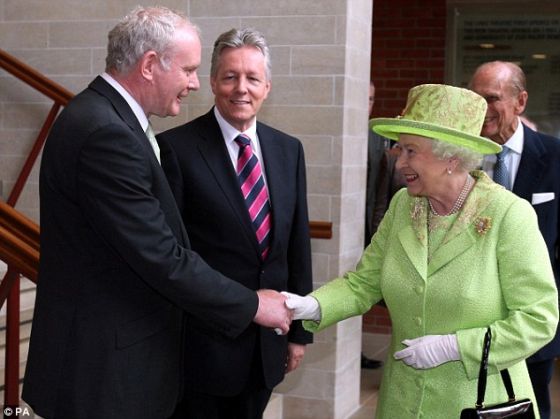
Martin McGuiness, Northern Ireland's deputy first minister, shakes hands with Queen Elizabeth II. The former IRA commander said when he shook the hand of the Queen he would be symbolically shaking the hand of every unionist in Northern Ireland.

The Guardian reports: Anglo-Irish relations took a momentous step forward on Wednesday when the Queen shook hands with Sinn Féin’s Martin McGuinness.

The historic encounter between the former IRA commander – now Northern Ireland’s deputy first minister – and the Queen was unthinkable a little over 10 years ago.

But the success of the peace process and the Queen’s acclaimed visit to the Republic of Ireland last year, when her conciliatory words and gestures won over many critics of the monarchy, paved the way for their meeting.

The much-anticipated first handshake took place away from the media spotlight behind closed doors.

They later shook hands in public. McGuinness held the monarch’s hands for a few moments and spoke to her in Irish. He told her the words meant: “Goodbye and God’s speed.”

McGuinness was a senior member of the IRA when it killed the Queen’s cousin Lord Mountbatten in a bomb blast in 1979.

The Queen is the head of Britain’s armed forces, seen in the past by Republicans as occupying troops in Northern Ireland.

Facebooktwittermail

Fear grows of consequences of euro collapse

Der Spiegel reports: It wasn’t long ago that Mario Draghi was spreading confidence and good cheer. “The worst is over,” the head of the European Central Bank (ECB) told Germany’s Bild newspaper only a few weeks ago. The situation in the euro zone had “stabilized,” Draghi said, and “investor confidence was returning.” And because everything seemed to be on track, Draghi even accepted a Prussian spiked helmet from the reporters. Hurrah.

Last week, however, Europe’s chief monetary watchdog wasn’t looking nearly as happy in photos taken in front of a circle of blue-and-yellow stars inside the Euro Tower, the ECB’s Frankfurt headquarters, where he was congratulating the winners of an international student contest. He smiled, shook hands and handed out certificates. But what he had to tell his listeners no longer sounded optimistic. Instead, Draghi sounded deeply concerned and even displayed a touch of resignation. “You are the first generation that has grown up with the euro and is no longer familiar with the old currencies,” he said. “I hope we won’t experience them again.”

The fact that Europe’s top central banker is no longer willing to rule out a return to the old national currencies shows how serious the situation is. Until recently, it was seen as a sign of political correctness to not even consider the possibility of a euro collapse. But now that the currency dispute has escalated in Europe, the inconceivable is becoming conceivable, at all levels of politics and the economy.

Investment experts at Deutsche Bank now feel that a collapse of the common currency is “a very likely scenario.” German companies are preparing themselves for the possibility that their business contacts in Madrid and Barcelona could soon be paying with pesetas again. And in Italy, former Prime Minister Silvio Berlusconi is thinking of running a new election campaign, possibly this year, on a return-to-the-lira platform.

Nothing seems impossible anymore, not even a scenario in which all members of the currency zone dust off their old coins and bills — bidding farewell to the euro, and instead welcoming back the guilder, deutsche mark and drachma.

It would be a dream for nationalist politicians, and a nightmare for the economy. Everything that has grown together in two decades of euro history would have to be painstakingly torn apart. Millions of contracts, business relationships and partnerships would have to be reassessed, while thousands of companies would need protection from bankruptcy. All of Europe would plunge into a deep recession. Governments, which would be forced to borrow additional billions to meet their needs, would face the choice between two unattractive options: either to drastically increase taxes or to impose significant financial burdens on their citizens in the form of higher inflation.

A horrific scenario would become a reality, a prospect so frightening that it ought to convince every European leader to seek a consensus as quickly as possible. But there can be no talk of consensus today. On the contrary, as the economic crisis worsens in southern Europe, the fronts between governments are only becoming more rigid.

The Italians and Spaniards want Germany to issue stronger guarantees for their debts. But the Germans are only willing to do so if all euro countries transfer more power to Brussels — steps the southern member states, for their part, don’t want to take.

The discussion has been going in circles for months, which is why the continent’s debtor countries continue to squander confidence, among both the international financial markets and their citizens. No matter what medicine European politicians prescribe, the patient isn’t getting any better. In fact, it’s only getting worse. [Continue reading…]

Facebooktwittermail

U.S. intelligence sees few cracks in Assad’s inner circle

Reuters reports: Despite some military defections, Syrian President Bashar al-Assad’s inner circle remains cohesive and the 16-month conflict with rebels is likely to be a drawn-out struggle, senior U.S. intelligence officials said on Tuesday.

That assessment appears to dash any U.S. hopes that Assad, whose ouster Washington has called for, will fall soon of his own accord. The Obama administration has declined to intervene militarily in Syria, citing the lack of international backing and the country’s sectarian divisions.

White House spokesman Jay Carney said on Tuesday that Assad “has been slowly, too slowly, losing his grip over his country. The process, because of his refusal to step aside, has been horrific and has exacted a terrible toll on the Syrian people.”

But U.S. intelligence agencies, watching closely for cracks in Assad’s inner circle, do not see them so far.

“The regime inner circle and those at the next level still seem to be holding fairly firm in support of the regime and Assad,” one intelligence official said on condition of anonymity.

Assad said on Tuesday that Syria was in a “state of war” and snubbed those calling for him to step aside, saying the West “takes and never gives and this has been proven at every stage.

Despite the deterioration in Syria, so far there has been no sign of an appetite for Western intervention like that by NATO against Libya’s Muammar Gaddafi last year. On Tuesday, the Western alliance called the shooting-down of a Turkish warplane by Syrian forces last week “unacceptable” but stopped short of threatening retaliation.

The Independent reports: Some of the fiercest fighting seen since the start of the conflict in Syria raged on the outskirts of Damascus yesterday as better trained and equipped rebels attacked elite forces loyal to the regime.

The increase in violence came as Turkey’s Prime Minister, Recep Tayyip Erdogan, warned that he would order his troops to attack Syrian army units if they dared to approach the countries’ 550-mile shared border.

“Turkey is not a kind of country whose borders and hostility can be tested,” Mr Erdogan told his parliament in Ankara. The threat came after Syria admitted shooting down a Turkish F-4 Phantom jet last Friday, which Turkey claimed was in international airspace after briefly violating Syrian territory.

Describing the Syrian regime as presenting a “clear and present” threat to Turkish security, Mr Erdogan announced a change in the rules of engagement for the country’s military.

Any Syrian military offensive that approached the country’s borders would be considered a legitimate target. Claiming that Syrian helicopters had recently violated Turkish airspace, he said that any future infringement would be met with military action.

Facebooktwittermail

Syrian forces fire at second Turkish plane

Reuters reports: Turkey said on Monday Syrian forces had fired towards a Turkish military transport plane involved in a search for an F-4 reconnaissance jet shot down by Syria last week, but the second aircraft was not brought down.

Damascus described its shooting down of the F-4 jet on Friday as an act of self-defence and warned Ankara and its NATO allies against any retaliation. Turkey said the incident would “not go unpunished” but it did not intend to go to war over it.

The disclosure of the second incident came on the eve of a NATO crisis meeting that Turkey summoned to address the shooting down of its F-4 jet, which Ankara has described as an unprovoked attack in international airspace.

Facebooktwittermail

Mohamed Morsi to pick woman and Christian as Egypt’s vice-presidents

The Guardian reports: Mohamed Morsi’s first appointments as president-elect of Egypt will be a woman and a Coptic Christian, his spokesman has told the Guardian, as he moves to allay fears of the Muslim Brotherhood.

Sameh el-Essawy said that although the names of the two choices had not been finalised, they would be Morsi’s two vice-presidents.

When the appointments go through, they will constitute the first time in Egypt’s history that either a woman or a Coptic Christian has occupied such an elevated position in the executive branch.

The Muslim Brotherhood is at pains to calm fears of what an Islamist president might mean for Egypt and the region at large. Appointing both a woman and a Coptic Christian is an attempt at a show of unity, and a rule by consensus.

Meanwhile, defeated presidential candidate Ahmed Shafik – Mubarak’s last prime minister and Morsi’s rival in the runoff election – flew to Abu Dhabi on Tuesday morning with his two daughters. His camp denied that he had fled as investigations begin into allegations of corruption against him while minister of civil aviation. He was in Abu Dhabi for “tourism” purposes, they said. [Continue reading…]

Facebooktwittermail

Stuxnet will come back to haunt us

Misha Glenny writes: The decision by the United States and Israel to develop and then deploy the Stuxnet computer worm against an Iranian nuclear facility late in George W. Bush’s presidency marked a significant and dangerous turning point in the gradual militarization of the Internet. Washington has begun to cross the Rubicon. If it continues, contemporary warfare will change fundamentally as we move into hazardous and uncharted territory.

It is one thing to write viruses and lock them away safely for future use should circumstances dictate it. It is quite another to deploy them in peacetime. Stuxnet has effectively fired the starting gun in a new arms race that is very likely to lead to the spread of similar and still more powerful offensive cyberweaponry across the Internet. Unlike nuclear or chemical weapons, however, countries are developing cyberweapons outside any regulatory framework.

There is no international treaty or agreement restricting the use of cyberweapons, which can do anything from controlling an individual laptop to disrupting an entire country’s critical telecommunications or banking infrastructure. It is in the United States’ interest to push for one before the monster it has unleashed comes home to roost.

Stuxnet was originally deployed with the specific aim of infecting the Natanz uranium enrichment facility in Iran. This required sneaking a memory stick into the plant to introduce the virus to its private and secure “offline” network. But despite Natanz’s isolation, Stuxnet somehow escaped into the cyberwild, eventually affecting hundreds of thousands of systems worldwide.

This is one of the frightening dangers of an uncontrolled arms race in cyberspace; once released, virus developers generally lose control of their inventions, which will inevitably seek out and attack the networks of innocent parties. Moreover, all countries that possess an offensive cyber capability will be tempted to use it now that the first shot has been fired. [Continue reading…]

Facebooktwittermail

German court outlaws genital mutilation of newborn boys

AFP reports: Circumcising young boys on religious grounds causes grievous bodily harm, a German court ruled Tuesday in a landmark decision that the Jewish community said trampled on parents’ religious rights.

The regional court in Cologne, western Germany, ruled that the “fundamental right of the child to bodily integrity outweighed the fundamental rights of the parents”, a judgement that is expected to set a legal precedent.

“The religious freedom of the parents and their right to educate their child would not be unacceptably compromised, if they were obliged to wait until the child could himself decide to be circumcised,” the court added.

The case was brought against a doctor in Cologne who had circumcised a four-year-old Muslim boy on his parents’ wishes.

A few days after the operation, his parents took him to hospital as he was bleeding heavily. Prosecutors then charged the doctor with grievous bodily harm.

The doctor was acquitted by a lower court that judged he had acted within the law as the parents had given their consent.

On appeal, the regional court also acquitted the doctor but for different reasons.

The regional court upheld the original charge of grievous bodily harm but also ruled that the doctor was innocent as there was too much confusion on the legal situation around circumcision.

The court came down firmly against parents’ right to have the ritual performed on young children.

“The body of the child is irreparably and permanently changed by a circumcision,” the court said. “This change contravenes the interests of the child to decide later on his religious beliefs.”

The decision caused outrage in Germany’s Jewish community.

Facebooktwittermail

Israeli author: Israel is the most racist state in the ‘developed’ world

Haaretz reports: Israeli culture is no less toxic than fanatic Islam, and the country’s discriminatory attitude toward Mizrahi Jews and Arabs qualifies it for the title of “most racist state,” prominent Israeli author Sami Michael said on Monday.

“Israel can claim the title of most racist state in the developed world,” Michael, who heads the Association for Civil Rights in Israel, said at the opening of an international conference of the Association for Israel Studies at Haifa University.

“More than 60 years after the establishment of the Israeli state, the rift between European and Mizrahi Jewry has not mended. It is reflected in racism and social gaps,” the author said.

“To this day people from Arab states are underrepresented in the state’s central institutions, especially academic and cultural ones,” he said.

The racism is encouraged by cabinet members and MKs, and fueled by increasing religious extremism in the country, he said.

Michael also criticized the social inequalities in Israel and what he characterized as the failure of the left to adequately contend with these issues.

“Israel is in danger unless its leadership understands it isn’t located in Europe’s tranquil north but in the Middle East’s seething center,” said Michael. “We may lose everything. Israel could be a transient construct, like the First and Second Temples.”

Michael said Israeli children are trained to hate the other.

“Israeli culture is no less poisoned than the fanatic Islamic factions,” he said.

“From kindergarten to old age we feed our children hatred, suspicion and disgust toward the stranger and the other, and especially toward the Arabs,” he said.

He called the occupation “disaster incarnate” for Israel.

Facebooktwittermail

The more Germans know about the Mideast, the more they root for the Palestinians

Akiva Eldar writes: Official Jerusalem hasn’t been caught saying a bad word about the Muslim Brotherhood victory in the Egyptian elections and probably won’t have any slips of the tongue regarding the president-elect, Mohammed Morsi. All these years we’ve been saying that a secure peace is made with democratic regimes. And a democratic regime is what Egyptian democracy has managed to produce as a result of the protests in Tahrir Square.

The problems will start when people from the lunatic right decide the time has come to take over a few more houses in Silwan in East Jerusalem, or to refurbish some gate on the Temple Mount, Haram al-Sharif to the Arabs. Then we will hear that the worsening of relations with Egypt has nothing to do with the flourishing of the settlements or the withering of the peace process. That is when they will explain to us that it all starts from the anti-Semitism, rooted deep in the religion of Islam. Just like the European criticism of the government stems from Christian anti-Semitism.

Last year I wrote here about the book “Muslim Attitudes to Jews and Israel,” edited by Prof. Moshe Ma’oz (“How can Israel change Muslim extremists’ attitude toward Israel?” March 29, 2011 ). The book questions the common perception that Islam is anti-Semitic and anti-Israel. According to the Middle East scholar from Jerusalem, most researchers of Islam agree that along with periods of oppression and persecution, the Jewish communities in the Islamic countries enjoyed long eras of coexistence and tolerance. Ma’oz stresses that most of the regimes in the Arab and Muslim world, and most leading Muslim clerics, have adapted pragmatic attitudes toward Israel and the Jews. He pointed out the close connection between the occupation in the territories, the dispute regarding the Jerusalem sites that are sacred to Islam and the strengthening of the anti-Semitic and anti-Israel tendencies in the Muslim world.

A new study conducted recently in Germany also knocks the ground out from under the assertion that most of Israel’s critics in Europe are anti-Semitic. In presenting the findings of his research at a conference held last month in Istanbul, political psychologist Wilhelm Kempf related that both Muslim and Jewish colleagues initially voiced the suspicion that he was aiming to label criticism of Israel in the context of the conflict with the Palestinians as anti-Semitism. The findings were far more complex; 45 percent of the Germans who participated in the study interpreted the conflict in terms of the value of peace. One-third of them showed pro-Palestinian tendencies and 12 percent expressed pro-Israeli opinions. [Continue reading…]

Facebooktwittermail

Israel’s ‘price tag’ terrorism has tactical political goals

Jonathan Cook writes: Violent, so-called “price tag” attacks by Jewish settlers have become a staple of life for Palestinian communities over the past few months. The latest is the torching this week of a mosque in the village of Jaba, close to the city of Ramallah.

Palestinians in areas of the West Bank under Israeli control live with settler neighbours who beat and shoot them, set alight fields, poison wells, kill livestock and steal crops. These acts of terror have begun to spread elsewhere: homes, cars, cemeteries, mosques and churches are now targets in East Jerusalem and Israel too. Earlier this month a school and several cars were vandalised in Neve Shalom, the only genuinely mixed Jewish-Arab community in Israel.

Invariably the “price” invoked by the settlers is unrelated to any Palestinian action. Instead Palestinians are punished indiscriminately for the smallest concession the settlers fear Israel might make in the diplomatic arena.

Superficially, the settlers’ behaviour looks like a particularly vicious form of tantrum-throwing, but there are tangible benefits to be gained from the trail of destruction they leave behind.

They provided a clue to their reasoning, as they always do in “price-tag” attacks, on the walls of Jaba’s mosque. In black spray-paint, they spelt out their grievance: “Ulpana”.

Ulpana, also near Ramallah and home to 30 Jewish families, is a settler “outpost” – one of more than 100 such settlements-in-the-making that are scattered across the West Bank. Unlike a similar number of much larger and more established settlements, which are illegal under international law, the outposts violate Israeli law too.

After years of petitions from human-rights groups, Israel’s Supreme Court has reluctantly ruled recently that Ulpana must be removed. D-Day for the settlers, July 1, is rapidly approaching.

The torching of the mosque – the settlers’ trump card – was intended chiefly as a reminder to Israel’s right-wing government, led by Benjamin Netanyahu, that any move against them risks triggering a round of intensified violence that will further damage Israel’s image with the international community.

But it was also designed to dampen the enthusiasm of the courts for further costly run-ins with settlers. The Supreme Court, settlers hope, will be in no hurry to enforce the destruction of future Ulpanas. [Continue reading…]

Facebooktwittermail

The creation of the myth of the global terrorist network

This is a long passage from an article on Adam Curtis’ blog, published on September 11, 2010. Curtis illustrates his piece with lots of photographs and video clips. Much of the video is integral to the narrative but unfortunately no embedding code is available. The passage I’ve selected includes a couple of videos and readers will need to go to the BBC website to view these.

In July 1979 a conference was held in Jerusalem to discuss the phenomenon of “International Terrorism”. It was organised by a young Benjamin Netanyahu at the Jonathan Institute, named after his brother who had been killed by terrorists at Entebbe.

All sorts of people were there, including George Bush Snr, many Neoconservatives who would become influential in Bush Jnr’s adminsitration, and Prime Minister Begin.

But the agenda of the conference was shaped by a new breed of what would become known as “terror experts”. And all of them were convinced by the new theory that the KGB were running almost all terrorism around the world.

They were also great, and sometimes very weird, characters.

One was an Australian journalist and novelist who wrote for the British Economist called Robert Moss.

Moss was one of the earliest promoters of the idea of hidden Soviet control. And in 1976 he helped write the speech for Mrs Thatcher that led the Soviets to call her the Iron Lady.

Later – in the mid 80s – Moss decided he had found a route to perceiving higher truths in the world. Truths hidden from ordinary mundane consciousness.

Through his dreams.

He developed a system he called Active Dreaming. You can find his theory here.

“When we act to bring the energy and imagery of dreams into physical reality, we become poets of consciousness and infuse our world with magic. Deep into multidimensional reality”

Another “terror expert” was a French historian called Annie Kriegel.

She had been a hardline Stalinist in the French Communist Party, but had turned violently against the Soviet Union.

Kriegel was convinced that all the terrorist acts in the Middle East were being co-ordinated from Moscow. This was music to the ears of Benjamin Netanyahu and the Israeli leaders who were seeking further US support.

In 1982 Kriegel wrote a book that said that the massacres in the Sabra-Chatila camps were organised by the Soviets and carried out by German terrorists under KGB control.

But perhaps the most important expert was another ex-communist. An American called Claire Sterling.

Sterling was a journalist who lived in Italy. She took all the “evidence” of Soviet control that was produced a the conference and bundled it up together into a book called The Terror Network.

It had a dramatic thesis.

It said that there was a “Global Terror Network” underneath the surface of most Western societies and the Middle East.

That all of them – the Red Brigades, Baader-Meinhof gang, Provisional IRA, South Moluccans, Japanese Red Army, Iranian terrorists, Turkish People’s Liberation Army, Spain’s ETA, Popular Front for the Liberation of Palestine and Fatah, the military arm of the Palestine Liberation Organization were all part of a grand Soviet scheme.

The aim of the scheme was to force the police in a Western democracies to crack down on individual freedoms. Then a repressive police state would emerge and breed resentment – making the masses ripe for Communist revolution.

One of Sterling’s closest friends in Italy was a young American academic called Michael Ledeen. He was fascinated by the theory.

And then early in 1981 he became a special assistant to the new US Secretary of State in the first Reagan administration.

Who was General Alexander Haig.

Haig read The Terror Network and immediately bought Sterling’s theory – because it proved what he instinctively knew about the Soviet threat.

And few days later Haig went to Congress and publicly accused Moscow of “training, funding, and equipping” international terrorists. He announced that “international counterterrorism will take the place of human rights.”

William Casey, the new head of the CIA also read and believed Sterling’s book.

The only problem was the no-one else took it seriously.

Many of those running the Reagan administration knew that the Soviet Union was supporting and arming liberation movements in the developing world, but they didn’t believe in the Global Terror Network.

Casey met with his CIA analysts. He told them that the book – The Terror Network – “has told me more than you bastards whom I pay $50,000 a year.”

His analysts then patiently explained to him that much of Claire Sterling’s evidence was composed of Black Propaganda they themselves had invented and spread around Europe to discredit to Soviets.

Even Reagan – for all his anti-communism – didn’t take it seriously.

But then – on 13th of May 1981 – Mehmet Ali Agca tried to kill the Pope in Rome.

Agca was a member of an extreme right wing Turkish group called the Grey Wolves. But at first Agca said he had done it on his own – it was neither right or left, he said. He was tried and put in prison.

But then in May 1982 Agca suddenly changed his story.

But he didn’t say he had done it as a member of the extreme right. Instead he insisted he had been part of a communist conspiracy to kill the Pope that had been organised by the Bulgarian secret service – and was being controlled behind that by Moscow.
[…]
Claire Sterling seized on this and went into action. She talked to lots of “intelligence informants” in Italy and the rest of Europe and wrote an article for Readers Digest. It caused a worldwide sensation.

Sterling said that Agca showed the incredible spider’s web that Moscow had created to control terrorism throughout the world. It had been built in such a way that it was normally impossible to see the links. But, like a flash of lightning on a dark night, Agca had shown how web really worked.

In his case, the KGB controlled the Bulgarian Secret service, and they in turn controlled the Turkish criminal mafia.

The Bulgarians had told the Mafia to find someone who could never be suspected of being linked to Moscow, bring him to Rome and tell him to shoot the Pope.

He would be interpreted as a Muslim fanatic, while Moscow would be rid of a Polish Pope who was a supporting the Solidarity movement in Poland.

Claire Sterling became a media celebrity. She appeared on TV across America and the world.
[…]
Sterling’s theory caused consternation in the Reagan administration, and especially in the CIA.

Almost all CIA officers and analysts were united in a belief that what Sterling was saying was rubbish. They produced an internal report saying there was no evidence linking the KGB to the assassination attempt.

But the head of the CIA, William Casey, was convinced by Sterling.

A senior CIA analyst called Melvin Goodman testified in 1991 to a Senate Committee as to what Casey then did.

He forced CIA officers to alter the report’s main judgements and to “stack the deck” in favour of KGB complicity. The sections of the report that expressed doubts and had counter arguments were erased.

The altered report was then sent to the White House. And it became one of the underpinnings of President Reagan’s increasingly simplified view of the world – that there was an interconnected network of terror in the world.

Although a new puppet master had also appeared, along with the Soviet Union – Iran. [Continue reading…]

Facebooktwittermail

Iran is trying to broker a political solution in Syria

Mohammad Ataie writes: During the past few months, Iranian diplomats have contacted the Syrian opposition to assist the Assad-led reform and facilitate negotiations between the president and the opposition.

According to the Iranian ambassador to Damascus, their contacts have been extensive and have included opposition leaders in and outside Syria. They have carried messages back and forth between opposition leaders and Damascus and at one point Iranian diplomats, who met Syrian Muslim Brotherhood leaders in Turkey, even offered a roadmap for reconciliation between the Islamist group and Assad.

The deal, disclosed by a leader of the Muslim Brotherhood, included a power-sharing arrangement that handed the premiership to the Islamist group in return for Assad retaining the presidency. But such efforts have been fruitless in the light of the ongoing violence and the Syrian government’s recourse to a security crackdown.

The recent “multi-party parliamentary election” – which was devoid of meaningful participation by opposition groups – and the formation of the new Syrian government by a member of the ruling Ba’ath party, have in particular disenchanted Iranian officials with Assad’s strategy for a political solution.

Iranian officials, according to various political sources in Tehran, were unhappy with the exclusion of the opposition from the election and the nomination of a loyalist Ba’athist, Riad Hijab, by the Syrian president as the new prime minister. Iranian political and military leaders are dismayed at the over-reliance of Damascus on a security solution and believe that Assad could have done better to lend credibility to his reforms.

A few days ago, in a private conversation, a top general who is in charge of Iran’s key regional files, expressed his frustration with the Syrian president’s failure to heed calls for reform, saying: “Assad takes the pills in front of us. But once we turn our heads, he spits them out.”

A year and a half into the Syrian crisis, Iranian leaders have seen themselves drawn into a protracted crisis that has strained Iran’s broader strategic interests in the region. The vortex of violence and unrelenting bloodshed in Syria bodes ill for Iran’s soft power and its credentials as the standard bearer of resistance in the Islamic world. As Hamas has distanced itself from Damascus, this crisis is also posing a serious challenge to the “axis of resistance” – the alliance of Syria, Iran, Hamas and Hezbollah.

In the eyes of the Iranian leadership, civil war and sectarian violence in Syria only benefit Israel. In their view, the ramifications of sectarian violence in Syria extend far beyond Syria’s borders and could entirely shift the anti-Israeli struggle to a regional Sunni-Shia conflict that could isolate Iran, a predominantly Shia and Persian state, that presents itself at the heart of Muslim anti-Israel and anti-US struggle in the region.

Iran, though certainly intent on safeguarding its key regional ally, does not see its fundamental interest in a security crackdown, but rather in reform and serious dialogue between Assad and the opposition.

In the strategic thinking of the Islamic republic, a political solution is essential for long-term stability in the Levant and the protection of its regional interests. This is where Iran’s interests intersect with current international diplomatic efforts to find a political solution to the crisis. [Continue reading…]

Al Jazeera reports: Iran on Tuesday offered to use its good ties with Damascus and Ankara to help resolve the row between the two countries over Syria’s downing of a Turkish warplane.

Syria’s shooting down of the jet last Friday was “a very sensitive issue” that also concerns Tehran, Iran’s foreign ministry spokesman said, just ahead of an emergency NATO meeting on the incident.

“We will use our good relationship with the two countries to resolve the issue,” Ramin Mehmanparast said in his weekly news briefing.

“It should be resolved through restraint and negotiations and [the two sides] should avoid measures that disturb the security of the region,” he said. “We hope this issue will be resolved rapidly.”

Facebooktwittermail

Turkey threatens force if Syrian troops near border

The New York Times reports: Buoyed by support from NATO allies, Prime Minister Recep Tayyip Erdogan on Tuesday warned Syrian forces to stay clear of their troubled border or face a Turkish military response to any perceived threat, following the disputed downing of a Turkish warplane.

The Turkish leader’s bellicose tone signaled no discernible easing of tensions between the two Mediterranean neighbors as ambassadors from the NATO alliance, desperate to avoid a wider conflict, held emergency talks in Brussels.

After the meeting, the NATO secretary general, Anders Fogh Rasmussen, said the alliance considered Syria’s actions in shooting down the Turkish warplane last Friday “unacceptable.”

In a unanimous statement, the NATO allies called the episode “another example of the Syrian authorities’ disregard for international norms, peace and security, and human life.” Turkey is a member of the alliance.

“I would certainly expect that such an incident won’t happen again,” Mr. Rasmussen said at a news conference at NATO headquarters in Brussels. He added that the alliance would closely follow developments and “if necessary, consult and discuss what else could be done.”

In Ankara, Mr. Erdogan said Turkey had revised its military rules of engagement toward Syria.

“Every military element that approaches the Turkish border from Syria in a manner that constitutes a security risk or danger would be considered as a threat and would be treated as a military target,” he said in a speech to lawmakers attended by Arab diplomats.

“From here, we warn the Syrian regime not to make any mistakes, not to test Turkey’s decisiveness and wisdom,” Mr. Erdogan said.

Facebooktwittermail

Morsi’s Fars News Agency interview

Iran’s Fars News Agency reports on an interview with Egypt’s newly-elected president. (Note: The Guardian reports “Fars is linked to the revolutionary guards controlled by Supreme Leader Ali Khamenei. But now the Islamic Republic News Agency, linked to President Mahmoud Ahmadinejad, is reporting a denial of the story from Morsi’s spokesman.)

Part 1: Egypt’s newly-elected President Mohammed Mursi underlined his enthusiasm for the further expansion of ties with Iran, and said relations between Tehran and Cairo will create a strategic balance in the region.

“The issue will create a strategic balance in the region,” Mursi told FNA on Sunday, hours before the final results of the presidential election was announced.

Part 2: Mursi voiced strong protest at the [ruling military] council’s forced dissolution and closure of the parliament, and said the move was aimed at hitting a blow to the Islamist candidate in the presidential election.

“The dissolution of Majlis al-Sha’b (parliament) targeted me,” Mursi said in an interview with FNA, adding, “When the generals saw that I have come close to the presidential post, they attempted to take away certain authorities in their own interest.”

He also dismissed the SCAF’s decision to issue a supplement to the Constitution, and said, “The military council is not entitled to issue an amendment to the Constitution and we reject the Constitutional declaration which disclaims the elected president’s authorities.”

His remarks came after Egypt’s military told parliament earlier this month that it has been dissolved and banned its members from entering the house.

Part 3: Mursi rejected rumors claiming that the country’s Supreme Council of the Armed Forces (SCAF) seeks to decrease his presidency term to one year.

“Such comments are not correct since the new Constitution will be compiled by the elected Constituent Assembly which was formed one day before the parliament’s dissolution and no one can ever cancel the presidential election,” Mursi said…

Part 4: Mursi rejected rumors and media news about paying his first foreign trip to Saudi Arabia, stressing that no such visit is on his agenda.

“I have said nothing so and my first international trips after victory in presidential election have not yet been specified,” Mursi said in an exclusive interview with FNA on Sunday.

“My visit to Saudi Arabia was an issue proposed by a number of young people and not an official plan,” he added.

Asked about his future plan for relations with the regional countries, Mursi said, “(My plan) is establishment of relations with all countries of the region to revive Egypt’s identity in the region through economic cooperation among the Arab countries and making certain reforms in the Arab League to activate its role on the international scene and beside that, supporting the Palestinian nation in its legitimate campaign for materializing its rights.”

Facebooktwittermail

Muslim Brotherhood tallies and keeping Egypt honest

At The Arabist, Bilal Ahmed writes: The most striking thing about these elections, and probably one of its most important lasting effects, is the accuracy of the independent tallies conducted by the Muslim Brotherhood and its political faction the Freedom and Justice Party. There is no other organized political force in Egypt with the resources to accurately conduct polling at all of Egypt’s 16,000 polling stations, and the MB has not squandered its opportunity to occupy this role.

The MB results for the Egyptian revolutionary parliament seven months ago and the first round of presidential elections at the end of May were more or less in line with the final election results. The results that were announced for the Morsi/Shafiq contest this morning only differed from the MB figures by about 0.06%, which ranks this election among the least manipulated in Egyptian history. Through this successful organizing, the MB has successfully implanted an idea in the media and political consciousness where its results can be trusted as accurate figures. This makes it difficult for manipulation to occur on a state level, as defying the Muslim Brotherhood figures now makes voter fraud much more evident.

Given the thousands of people who flocked into Tahrir Square and staged sit-ins when voting results were delayed last week, this is a severe political risk for institutions attempting to preserve their Mubarak-era privilege.

Last week’s announcement of victory at Morsi’s campaign headquarters put massive pressure on senior officials to not consider tampering with election results and cause a Shafik presidency. This pressure was felt in Tahrir Square as equally as it was in the Obama Administration, which announced that it would reconsider its lucrative military assistance package to Egypt if power was not handed to a civilian government. It is true that in all likelihood, the Supreme Council of the Armed Forces is satisfied with a Morsi executive that is stripped of its power, but its obvious preference for Ahmed Shafiq was made much more difficult the moment that the MB’s independent exit polls announced this morning’s results.

It may seem odd to state in a political climate where many revolutionaries don’t trust the MB and its FJP candidates, but the Muslim Brotherhood electoral results are trustworthy. It may, in fact, be the most trustworthy part of the entire organization and its most positive contribution to the ongoing Egyptian revolution. The Muslim Brotherhood now officially has a reputation of offering a source of accurate electoral information that minimizes the chance of voter fraud.

Zeynep Tufekci adds: [T]he Muslim Brotherhood (or Ikhwan as Egyptians refer to them) made it harder for the election to be stolen because they combined a superior ground game with active and sophisticated online presence to control the narrative and force a level of transparency. (In other words, they forced it such that if the elections were going to be stolen, it was going to be “in-your-face” stolen which is a very different method with greatly different political implications than “under-the-rug” stolen).

Here’s how.

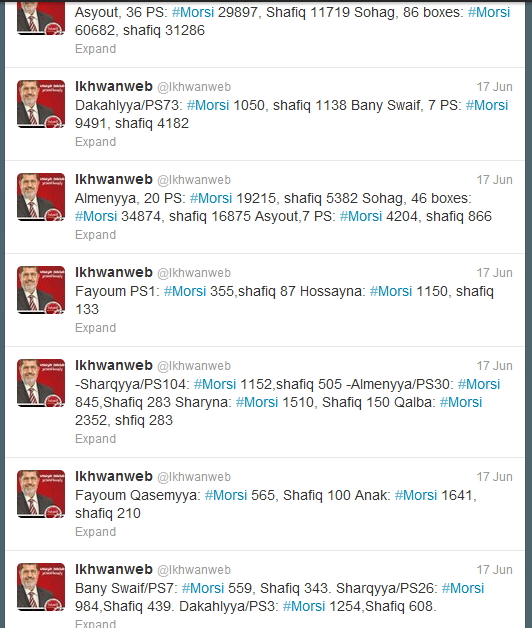
First, Muslim Brotherhood has a fairly active presence online, and especially in Twitter (although only their English feed is interactive at the moment). Throughout the election night, they kept tweeting out updated results:

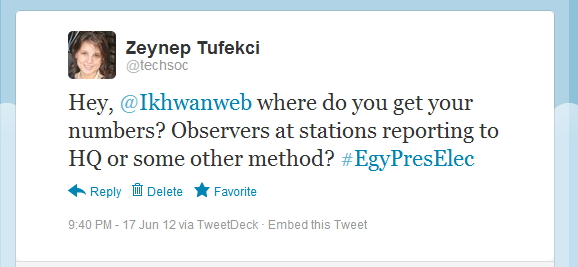
I was curious about where they got their numbers so I asked them:

About 10 minutes later, I had a reply that they had people at polling stations who updated them regularly. [Full disclosure: I do personally know at least one of the young woman who runs their English feed; in fact, most of my contacts with Muslim Brotherhood have been with young women as they happen to be quite active on their new media operations]. Other people I knew confirmed that MB had people on the ground at polling stations and were feeding results to the central headquarters as they became available. [Continue reading…]

Facebooktwittermail

New York Times accused of killing Anthony Shadid

Politico reports: Anthony Shadid, the Pulitzer prize-winning New York Times reporter who died in Syria this year, had heated arguments with his editors just prior to his final trip into the country, a cousin of Shadid’s says, and told his wife that were he to die the New York Times would be to blame.

“The phone call the night before he left [Turkey for Syria], there was screaming and slamming on the phone in discussions with editors,” Ed Shadid, a cousin to the late reporter, said last night at the Arab-American Anti-Discrimination Committee’s convention in Washington, D.C.

“It was at this time that he called his wife and gave his last haunting directive that if anything happens to me I want the world to know the New York Times killed me,” Ed Shadid said. [Continue reading…]

Facebooktwittermail

Defections and downed Turkish jet worsen Syria crisis

The New York Times reports: Syria’s isolation deepened on Monday, hit by a rash of high-ranking military defectors who sought refuge in Turkey, new European Union sanctions and plans for an emergency NATO meeting over its shooting down of a Turkish warplane.

Seeking to publicly justify the shooting of the plane off the Mediterranean coast last Friday and to profess no ill will toward Turkey despite rising tensions between the neighbors, the Foreign Ministry’s spokesman told reporters in Damascus that the plane had violated Syria’s territory.

“We had to react immediately,” said the spokesman, Jihad Makdissi. “Even if the plane was Syrian we would have shot it down.” Turkey says the airplane was over international waters when it was shot down after straying briefly into Syrian airspace.

Mr. Makdissi’s comments came a day before emergency talks at NATO headquarters in Brussels over the episode, which has heightened regional tensions springing from the 16-month crackdown on the antigovernment uprising in Syria. Referring to the NATO gathering, Mr. Makdissi said that “if the goal of that meeting is aggression, we say that Syrian airspace, territory and waters are sacred.”

The warning came as Turkish officials on Monday reported a further group defection by high-ranking Syrian military officers, adding to the strains between the two countries.

Facebooktwittermail

Why is the U.S. selling billions in weapons to autocrats?

Zach Toombs and Jeffrey Smith write: Every May and June, different branches of the State Department paint contrasting portraits of how Washington views dozens of strategically significant countries around the world, in seemingly rivalrous reports by its Human Rights and Political-Military Affairs bureaus.

The former routinely criticizes other nations for a lack of fealty to democratic principles, citing abuses of the right to expression, assembly, speech, and political choice. The latter tallies the government’s latest successes in the export of American weaponry, often to the same countries criticized by the former.

This year was no different. The State Department’s Military Assistance Report on June 8 stated that it approved $44.28 billion in arms shipments to 173 nations in the last fiscal year, including some that struggled with human rights problems. These nations include the United Arab Emirates, Qatar, Israel, Djibouti, Honduras, Saudi Arabia, Kuwait, and Bahrain.

Three nations with records of suppressing democratic dissent in the last year — Algeria, Egypt, and Peru — are listed in the report as recently receiving U.S. firearms, armored vehicles, and items from a category that includes chemical and riot control agents like tear gas. The State Department confirmed that U.S. tear gas was delivered to Egypt up to the end of November, but has declined to confirm it was also sent to Algeria and Peru.

The export of American arms to countries around the world — what the State Department calls a tangible expression of American “partnership” — is in fact booming. The commercial arms sales reviewed by the State Department reached $44.28 billion in fiscal year 2011, a $10 billion sales increase since 2010. Next year should see another increase of 70 percent, the department says. [Continue reading…]

Facebooktwittermail