Gareth Porter writes: President Barack Obama has finally begun in recent months to signal to Israel that the United States would not get involved in a war started by Binyamin Netanyahu without US approval. If it is pursued firmly and consistently through 2012, the approach stands a very good chance of averting war altogether. If Obama falters, however, the temptation for Netanyahu to launch an attack on Iran, indulging in what one close Israeli observer calls his “messianism” toward the issue of Iran.
Netanyahu, like every previous Israeli prime minister, understands that an Israeli strike against Iran depends not only on US tolerance, but direct involvement against Iran, at least after the initial attack. In May 2008, his predecessor, Ehud Olmert, had requested the approval of George W Bush for an air attack on Iran, only to be refused by Bush.
Netanyahu apparently feels, however, that he can manipulate right-wing Israeli influence on American politics to make it impossible for Obama to stay out of an Israeli war on Iran. He has defied the Obama administration by refusing to assure Washington that he would consult them before making any decision on war with Iran.
The Obama administration’s warning signal on the danger of an Israeli attack began flashing red after Secretary of Defence Leon Panetta came back empty-handed from a trip to Israel in September.
US officials then came up with a new strategy for pulling Israel back from the precipice of war by letting Netanyahu know that, if the US were denied a full role in coordinating military policy toward Iran, it would not come to Israel’s aid in such a war.
The first step in the strategy came when Panetta was answering questions after a talk at the Saban Centre of Brookings Institution on December 2. He not only expressed clear disapproval of an Israeli attack as counter-productive – something the administration had avoided in 2009 and 2010 – but went on to indicate that the US was concerned that it “could possibly be the target of retaliation from Iran, striking our ships, striking our military bases”.
Without saying so directly, that remark hinted that the US would take steps to avoid that situation, if necessary. It was evidently aimed at planting the seed of doubt in Netanyahu’s mind that Obama would be willing to respond to Iranian retaliation against Israel in the event of an Israeli strike.
Author Archives: News Sources
Iran seems an unlikely culprit for the attacks on Israeli diplomats
Arshin Adib-Moghaddam writes: Let’s assume that sections of the military and security apparatus in Iran are responsible for the string of bombings in Georgia, Thailand and India. What would be the motive? The argument that Iran is retaliating for the murder of five civilian nuclear scientists in Iran is not plausible. If Iran wanted to target Israeli interests, it has other means at its disposal. It is hard to imagine that the Iranian government would send Iranian operatives to friendly countries, completely equipped with Iranian money and passports – making the case against them as obvious as possible.
If the Iranian Revolutionary Guards are as professional, highly trained and politically savvy as we have been told repeatedly by Israeli politicians themselves, if they have successfully trained and equipped the cadres of Hezbollah and other movements with paramilitary wings in the region, then why would they launch such a clumsy and self-defeating operation?
And why India, Georgia and Thailand, three countries that Iran has had cordial relations with during a period when Iran is facing increasing sanctions spearheaded by the United States? A few days ago, India agreed a rupee-based oil and gas deal with Iran and resisted US pressures to join the western boycott of the Iranian energy sector. As a net importer of 12% of Iranian oil, India’s total trade with Iran amounted to $13.67bn in 2010-2011. What would be the motive for damaging relations with one of Iran’s major trading partners and regional heavyweights?
For Iran it doesn’t make sense to risk alienating India by launching an assassination attempt in the capital of the country. Similarly, Iran has good economic and political relations with Georgia and Thailand. Why would the leadership in Tehran risk a major crisis with these countries during this sensitive period when IAEA inspectors are moving in and out of Iran to investigate the country’s nuclear programme?
Video: Robert Fisk — Arab League using war in Syria to attack Iran
Video: Arab League’s cynical support for Syrian opposition
One Libyan in three wants return to authoritarian rule
The Independent reports: Almost a year after the start of the Libyan uprising that led to the ousting and killing of Colonel Muammar Gaddafi, new research suggests more than a third of its citizens would rather return to being ruled by a strongman than embrace democracy.
Despite thousands of deaths in the revolt against Colonel Gaddafi’s 40-year rule, fewer than a third of Libyans would welcome democracy, according to the study published by the Institute of Human Sciences, at the University of Oxford, and Oxford Research International.
Libya is traditionally a tribal society and there are concerns that the vacuum created by Colonel Gaddafi’s removal in October could lead to clashes between the factions that toppled him. In recent weeks, medical and human-rights groups have complained that the situation in parts of country is getting out of control.
The deaths of 12 detainees who lost their lives after being tortured by the various militias running law and order in towns and cities across country are documented in an Amnesty International report released today. The study follows last month’s decision by Médecins sans Frontières to halt operations in Misrata after being asked by officials to treat prisoners midway through torture sessions, allowing authorities to abuse the victims again.
Still, the survey found 35 per cent would still like a strong leader in five years’ time, although more than two-thirds wanted some say in future governance.
Egypt’s constitution: it’s not really about the religious clauses
Nathan J Brown writes: As Egypt’s parliament prepares to designate the drafters of a new constitution, the country is embarking on an unprecedented and difficult journey. This is not the first time a constitution has been written for Egypt but it is the first time so many Egyptians will be focused on writing one. Previous constitutions have been authored by small committees serving existing rulers; now a wide range of voices insist on being heard.
In the year since the vast celebration in Tahrir Square marking Mubarak’s departure, Egyptians have come to discover how many differences they harbour. Class, faith, degree of religiosity, ideology and gender lead them to see their society very differently and develop deeply contrasting ideas about the best political course for the country. Egyptians continue to demand that the military leave politics; others show dismay at the disruption that the revolution has brought to Egyptian society; some relish the opportunity to implant Islamic practices more deeply in daily life; others fear that pockets of secularist society will be endangered.
And all these various orientations must now work together to build the fundamental structures of political life by writing a constitution. This will hardly be Egypt’s first such document, but all past efforts have been spearheaded by rulers or narrow elites surrounding them. For the first time, a diverse and politicised society will be watching and participating in setting down the basic rules of politics. What will they need to do to accomplish this goal in a democratic, just, and stable manner?
Most international eyes – and many domestic ones – will go straight to the clauses that concern religion. Since 1980, Egyptians have been governed by a clause that proclaims “the principles of the Islamic sharia are the main source of legislation”. Debate has already begun on whether to modify, tighten, or loosen that phrase. But for all the emotion that such debate generates, the real focus of attention should be directed elsewhere. What so many observers miss is that these formulas are extremely general. Whatever specific meaning they carry will rest not so much on what the words say as on who is empowered to interpret and implement them.
Q&A: Nir Rosen on Syria’s armed opposition
Al Jazeera: Who were the first to take up arms?
NR: The armed phenomenon began in rural areas, known in Arabic as the reef, and in the working class urban shaabi areas. Men there were more likely to own guns and were known as qabaday – “tough” men more likely to have the courage (and potential for violence) that one needs to respond violently to security forces. They had more grievances – and less to lose – than middle or upper class activists with university degrees.AJ: Who do the armed groups target?
NR: From an early stage of the uprising, suspected informants for the regime have been intimidated, expelled and often killed.
These are called mukhbir [“sources”], or in colloquial Syrian awayneh or fasfus. Executions of those suspected of spying for the regime take place regularly all throughout Syria, including in Damascus. By the summer there were regular ambushes of security officers on the roads, as well as attacks against shabiha [“thugs”], as the civilian paramilitary or militia forces of the security agencies are known.
AJ: What methods and weapons do the fighters use?
NR: Initially, individuals responded to the violent crackdown on demonstrations by using any weapons they had at home to take pot shots at security forces. Then groups of demonstrators used rocks, Molotov cocktails, dynamite sticks, knives, shotguns, hunting rifles, pistols and the occasional automatic rifle to defend demonstrations when security forces attacked.
This escalated into attacks on buses, or gatherings of security forces believed to be on their way to attack demonstrations, and evolved into a classic insurgency. In some places, demonstrators also responded to attacks by security forces by attacking buildings belonging to the ruling Baath Party, the police, the security forces or courthouses – and ridding these of any state presence.
The armed groups generally operate secretly and in small groups, conducting ambushes on targets of opportunity using light arms and, increasingly, improvised explosive devices. For the past few months, insurgents have been using improvised explosive devices such as those found in Iraq, Afghanistan or southern Lebanon. Unlike in Iraq, however, the explosives used in these IEDs are fertiliser-based. These have been used in Idlib, Hama and Homs. In addition, rocket-propelled grenades – such as LAW anti-tank shells – have also more recently been used as shoulder-fired anti-armour missiles. The fighters have access to some sniper rifles as well.
I have seen evidence of complex attacks, involving several IEDs followed by heavy machine-gun fire.
AJ: How do armed groups get their arms?
NR: The Syrian insurgency is not well-armed or well-funded. Fighters purchase their weapons locally on the black market, from arms dealers and smugglers who are profiting from the violence in Syria. I have been with insurgents purchasing weapons and seen how they arrange to do so via smugglers from Iraq, Lebanon and Turkey.
They also capture weapons from security forces in attacks on regime arms depots. One armed group in Idlib captured several dozen Kornet anti-tank missiles. Sometimes they even purchase them from corrupt officers within the security apparatus.
AJ: How do the groups finance their arms purchases?
NR: Many fund their arms purchases by turning to their savings or selling what valuables they have, or the products of their shops or farms. Others borrow money from friends. Much of the financing comes from Syrian businessmen inside or outside the country. Some Syrian opposition activists and politicians in exile are sending money to people inside. In addition, diaspora Syrians tied to Islamist movements, such as the Muslim Brotherhood, or to conservative clerics in the Gulf, also send money to certain groups.
The fighters usually belong to small cadres, such as “Abu Muhamad’s Group”, where Abu Muhamad may have access to some money with which he supports his band of fighters. Some groups give their “companies” or “brigades” names – often after “martyrs” or those with “heroic” religious connotations. This creates the false impression in much of the foreign media that there is some national leader, a chain of command, a structure or order of battle and divisions.
The fighters arm themselves and fund themselves as individuals or small groups, not as the “Free Syrian Army”. Nor are they funded directly by any state actor or intelligence agency. Indirectly, however, some Syrian exile religious movements or opposition political figures might be channelling funding from various countries to groups inside Syria.
AJ: How much impact do army defections have?
NR: There is a steady stream of army defectors, and to a lesser extent from the security agencies. Some defect with their weapons.
The regime is in a quandary. Its security agencies alone cannot clear or hold a village or a neighbourhood or a city. They need the Syrian army to back them up. But Syrian conscripts are often from the Sunni majority – and so is most of the opposition – from all over Syria, including from hotspots of the revolution. So it is soldiers’ own brothers and cousins who are demonstrating. Moreover, when the poorly paid Syrian soldiers are deployed to an area, they fraternise with the local population. Locals feed them and let them use their mobile phones to call home. Local activists persuade them to defect and arrange for their safe haven.
Meanwhile, Sunni members of the army are coming under increasing suspicion by the security agencies, and there have been cases of security men killing soldiers for refusing to obey orders to shoot. Hundreds of soldiers and officers have also been arrested.
AJ: What is the rank of the defecting officers?
NR: I did not meet any more senior than lieutenants, but some majors and colonels have also defected.
Local opposition leaders will say that they need fighters more than officers. They are also suspicious of officers who have waited so long to defect. They will ask: “What have they been waiting for?” They are worried that some defecting officers are double agents who would inform on them, which has already happened.
Additionally, opposition leaders claim they are in touch with senior officers who have “made their allegiance to the revolution clear” and who provide them with intelligence – and are thus more valuable to their cause if they remain inside the system. Finally, defecting officers face a logistical challenge. They must arrange for a safe place to flee – and they must arrange protection for their families.
AJ: To what extent is the Syrian uprising a peaceful one?
NR: The debate over whether or not it is peaceful is not based on empirical research but on propaganda from both sides. The pro-regime media wants to portray the revolutionaries as nothing more than armed criminals and terrorist gangs. In response, opposition supporters have, until recently, denied all violence – fetishising the notion of a peaceful revolution – which has hurt not only their credibility, but the credibility of foreign media which often uncritically report their accounts.
The debate is also largely irrelevant. On the ground it was clear that by the end of Ramadan (late August), that there was a growing consensus on the part of opposition supporters that only an armed struggle could overthrow the regime. [Continue reading…]

U.S. media pushing for war against Iran
Glenn Greenwald writes: Many have compared the coordinated propaganda campaign now being disseminated about The Iranian Threat to that which preceded the Iraq War, but there is one notable difference. Whereas the American media in 2002 followed the lead of the U.S. government in beating the war drums against Saddam, they now seem even more eager for war against Iran than the U.S. government itself, which actually appears somewhat reluctant. Consider this highly illustrative, one-minute report yesterday from the nightly broadcast of NBC News with Brian Williams, by the network’s Chief Pentagon Correspondent Jim “Mik” Miklaszewski, which packs multiple misleading narratives into one short package:
We’re told that if the U.S. ends up in a war with Iran, then “the U.S. Navy’s Fifth Fleet would be the world’s first line of defense“: because Iran is threatening the entire world, and the U.S. would be defending “the world” from this grave Persian menace. Then there’s the ominous claim that “Iranian leaders have threatened all-out war”: but that’s “if Israel launches air strikes against Iran’s nuclear program,” which would already itself be “all-out war.” The NBC story — which begins with video shots of Iranians in lab coats lurking around complex, James-Bond-villain-like nuclear-ish machines — ends with twenty seconds of scary video footage of Iranian missiles being launched, accompanied with this narration: “U.S. officials warn that Iran’s massive stockpile of ballistic missiles is the more serious threat”; after all, “within just the past few days, Iranian leaders [cue video of a scary, ranting Ahmedinijad] have threatened that if attacked, they would launch those missiles at U.S. targets.”
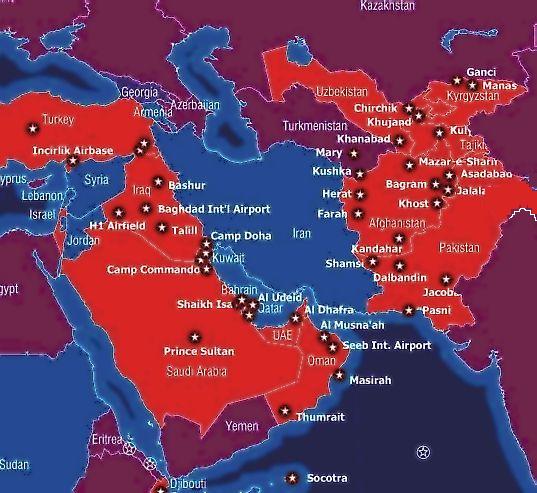
It’s just remarkable to watch the American media depict Iran as the threatening, aggressive party here. Literally on a daily basis, political and media figures in both the U.S. and Israel openly threaten to attack Iran and debate how the attack should happen with a casualness that most people use to contemplate what to have for lunch. The U.S. has orchestrated devastating and always-escalating sanctions which, by design, are wrecking the Iranian economy, collapsing its currency, and generating serious hardship for its 75 million citizens. The U.S. military has that country almost completely encircled. The U.S. military behemoth, and Israel’s massive nuclear stockpile and sophisticated weaponry, make the Iranian military by comparison look almost as laughable as Saddam’s. Iran’s scientists have been serially murdered on its own soil, their facilities bombarded with sophisticated cyber attacks, and dissident groups devoted to the overthrow of their government (ones even the U.S. designates as Terrorists) have been armed, trained and funded by Israel while leading American politicians openly shill for them in exchange for substantial payments. [Continue reading…]

Iran under siege: Each star represents a U.S.-manned beacon of hope -- the only thing that stands between us and Armageddon.
For Iraqis, aid to rebels in Syria repays a debt
The New York Times reports: Not so long ago, Syrians worked to send weapons and fighters into Iraq to help Sunnis fighting a sectarian conflict; suddenly, it is the other way around.
A belated celebration of the Prophet Muhammad’s birthday on the outskirts of this western Iraqi city on Saturday quickly took on the trappings of a rally for Syria’s rebels. Young boys waved the old green, black and white flag Syria adopted in the 1930s after declaring independence from the French. Others collected money to send aid and weapons to the fighters opposing President Bashar al-Assad’s government across the border.
“I wish I could go there with my gun and fight,” said Sheik Hamid al-Hais, a tribal leader interviewed at his compound in Ramadi, the capital of Anbar Province.
It is increasingly clear that Syria’s sectarian war is becoming the regional conflict that analysts have long feared. The rush of recent events — including bombings and assassinations in Damascus and Aleppo, and intensifying violence in northern Lebanon coming directly out of the sectarian hostilities in Syria — suggest that the Assad government now also faces antagonists across its borders.
Like Iraq and Afghanistan before it, analysts say, Syria is likely to become the training ground for a new era of international conflict, and jihadists are already signing up. This weekend, Al Qaeda’s ideological leadership and, more troublingly, the more mainstream Jordanian branch of the Muslim Brotherhood, called for jihadists around the world to fight Mr. Assad’s government.
Nowhere is the cross-border nature of sectarian hostilities more clear than in Iraq’s western desert, where Sunni Arabs are beginning to rally to the cause of the Syrian opposition and, in the process, perhaps strengthen their hand in dealings with an antagonistic Shiite-led national government in Baghdad.
A weapons dealer who operates in Anbar, who said he goes by the alias Ahmed al-Masri, said, “Five months ago I was told that the Syrian brothers are in need of weapons. I started to buy the weapons from the same guys that I previously sold to — the fighters of Anbar and Mosul. I used to bring them from Syria; now it’s the other way around.”
Video: Ralph Nader and Bruce Fein — America’s lawless empire: The constitutional crimes of Bush and Obama
How secret renditions shed light on MI6’s licence to kill and torture
The Guardian reports: In fiction, James Bond drew quite judiciously upon his licence to kill, bumping off just 38 adversaries in a dozen Ian Fleming novels. In each case, the individual received his or her just deserts.
In real life, MI6 insists its officers do not kill anyone. “Assassination,” its former head Sir Richard Dearlove has said, “is no part of the policy of Her Majesty’s government” and would be entirely contrary to the agency’s ethos.
But there can be circumstances in which MI6 officers do have a licence to kill or commit any other crime, enshrined in a curious and little-known law that was intended to protect British spies from being prosecuted or sued in the UK after committing crimes abroad.
Section 7 of the 1994 Intelligence Services Act offers protection not only to spies involved in bugging or bribery, but also to any who become embroiled in far more serious matters, such as murder, kidnap or torture – as long as their actions have been authorised in writing by a secretary of state.
And as such, the section is certain to come under intense scrutiny in the months ahead, as detectives and human rights lawyers pore over the details of the secret rendition operations that MI6 ran in co-operation with Muammar Gaddafi’s regime in 2004.
Last month Scotland Yard and the Crown Prosecution Service announced that the operations, in which two leading Libyan dissidents were abducted and taken to Tripoli with their families, were to be the subject of a criminal investigation.
A few days later lawyers for both families began civil proceedings against Sir Mark Allen, the former head of counter-terrorism at MI6, accusing him of complicity in their “extraordinary rendition”, torture and inhuman and degrading treatment. Proceedings against the government, MI6 and MI5 are to follow.
The case is based in large part upon a batch of documents discovered in an abandoned Libyan government office last September. These showed that the abductions were plotted with the help of MI6: it was all part of the rapprochement between Gaddafi and the UK and US that saw the dictator abandon his WMD programme and open oil and gas exploration opportunities to western firms.
When a researcher for Human Rights Watch stumbled upon the documents, no attempt was made to deny MI6 involvement in the rendition operations they described.
Instead, Whitehall sources immediately said the operations were part of “ministerially authorised government policy”. The statement was intended as a clear signal that a secretary of state had signed off a “clause 7 authorisation” under the Intelligence Services Act.
Section 7 is entitled Authorisation of Acts outside the British Islands, and says: “If, apart from this section, a person would be liable in the United Kingdom for any act done outside the British Islands, he shall not be so liable if the act is one which is authorised to be done by virtue of an authorisation given by the secretary of state under this section.”
It adds that liable in the United Kingdom “means liable under the criminal or civil law of any part of the United Kingdom”.
The “acts” can take place only overseas and remain illegal both under the laws of the country where they are committed and possibly under international law. But, section 7 says, with the stroke of a pen a secretary of state can rule that no UK law can be brought to bear.
Video: Is the U.S. occupation of Iraq really over?
Alternate Focus: With the departure of the last American soldier from Iraq, a bloody and expensive adventure ends—not with a bang, but with a whimper. As the Iraq War passes into history, Raed Jarrar, Tom Hayden, Nadia Keilani, and Johan Galtung comment on the lessons learned from this nine-year event, and debate whether the war and occupation are really over.
Video: Debate about Iran strategy heats up in Israel
Dear Israel Lobby, we give up — please give us an acceptable way of insulting you
Joshua Holland writes: The latest round in the long and nasty debate over Israel, Palestine and our own government’s Mideast policy began with a coordinated campaign — initiated by a former AIPAC staffer and eagerly picked up by the conservative media — to marginalize a handful of progressive bloggers at the Center for American Progress and Media Matters who wrote critically of Israel’s hard-right government and called its enablers in the United States “Israel Firsters.” (I wrote about the dust-up in December.)
The back and forth has continued since then, and it’s now become clear that we need to offer a simple challenge to those who say that such terms are beyond the pale because they bear some vague resemblance to some old “anti-Semitic trope” or another. What, exactly, is an acceptable way of mixing it up with these people? How can we marginalize their malign policy preferences without being smeared as anti-Semites or self-loathing Jews?
America’s political discourse is not a garden party. We’re factionalized, and we throw sharp elbows, especially online, where conservatives call liberals “moonbats,” and accuse them of hating America, and liberals lob back terms like “wingnut,” and accuse their counterparts of being morons.
In the debate over Israel and Palestine – and U.S. policy in the Middle East – one side has been disarmed, their derogatory labels rejected as singularly unacceptable, while their opponents remain free to use the coarsest insults against them with impunity.
The problem stems from the objective fact that there are a group of Americans – disproportionately represented among right-wing Christian evangelicals and older generations of Jewish-Americans – who ally themselves with the Israeli government. They do so regardless of its ideological bent at the moment and deny that the Palestinians have legitimate grievances (sometimes going so far as to deny their existence). They wish away the cruelty of the occupation, pretend that there are only rejectionists on the Palestinian side and Israel only wants peace, claim Israel has never violated international law or trampled on human rights, insist that Israeli Arabs don’t face hostility and discrimination and go around calling everyone who disagrees anti-Semites and terror supporters.
And despite the fact that their views are totally out of sync with most liberal Israelis, and many of the policies they favor, like a military attack on Iran, would likely result in an utter disaster for Israel as well as its neighbors, they insist on calling themselves “pro-Israel.”
People who do not accept these arguments have attempted to characterize the views of this group and to come up with a variety of typically rough-and-tumble labels to apply t it. But all of them have been condemned as entirely out of bounds because, if held up to the light in just the right way, they kind of, sort of resemble some old anti-Semitic stereotype.
Video: Class war in Greece
The Israeli leadership is at war with itself over Iran
Yossi Melman writes: Israeli Defense Minister Ehud Barak and former Mossad chief Meir Dagan have a lot in common. They are both chubby and in their late sixties. They are both war heroes, decorated generals. And each rose to the highest positions in the Israeli defense establishment. But don’t mistake such biographical similarities for personal affinity. Barak and Dagan hate each other. Their animosity goes back years—and at the heart of their dispute is the critical question of how the Jewish state should deal with its enemies’ nuclear ambitions.
In December 2010, together with some 30 Israeli defense and political journalists, I boarded a bus that took us to a building on the top of a hill overlooking Glilot junction, five miles north of Tel Aviv. We had come to Mossad headquarters for a meeting with Dagan, who was then the head of the agency. It was supposed to be an off-the-record briefing. But this being Israel, within hours after the meeting ended, most of what Dagan told us was on the Web and in the papers.
What he said was shocking. The Mossad chief told us that Iran would obtain nuclear warheads by 2014 at the earliest, and thus, he argued, there was no need for an Israeli military strike for the time being. Dagan’s claim ran directly counter to the public line of Israel’s defense establishment: that Iran would obtain the bomb much sooner.
Since that meeting more than a year ago, Dagan has been on a crusade to stop Israel from launching an imminent military strike against Iran. He has reiterated the argument that he laid out to us in Mossad headquarters—against a strike and in favor of sanctions and covert operations—at various public events and private conversations over the past year. And though Dagan is no longer head of Mossad, his view carries tremendous weight: His perspective on a possible Israeli strike is shared by many of Prime Minister Benjamin Netanyahu’s Cabinet ministers and Israel’s security establishment.
Dagan’s campaign has enraged Barak and Netanyahu, who accuse him of undermining Israeli deterrence. Barak and Netanyahu support an Israeli military strike in the near future, and for the past few months, with increasing intensity, they have tried to create the impression that they are considering such an attack this year.
Which view will prevail? At stake is the future of Israel, the lives of Iranians and Israelis, the supply of oil to the United States and the West, and the stability of the whole Middle East.
In Melman’s analysis of the struggle between Dagan and Barak, he pays a lot of attention to Israel’s attack on a nuclear reactor that Syria was alleged to be constructing in 2007. At the time and no doubt still now, there are those who viewed these allegations as part of a neocon conspiracy. The Syrians themselves claimed that the facility which got flattened in the Israeli attack was an agricultural research facility. Were that the case, it’s hard to understand why Bashir Assad would have failed to then make use of such a valuable propaganda opportunity. Western reporters could have been escorted around the site and shown all the shattered plant pots. Instead, bulldozers were swiftly moved in to bury every last trace of whatever the Syrians had been constructing. If they wanted to prove they had been falsely accused, this was a strange way of going about it.
Unfazed by U.S. sanctions, India to step up ties with Iran
The Times of India reports: Unfazed by US sanctions and Israel linking Tehran to the attack on an Israeli embassy car here, India is set to ramp up its energy and business ties with Iran, with a commerce ministry team heading to Tehran to explore fresh business opportunities.
The team is expected to go to Tehran later this month to discuss steps to expand India’s trade with Iran, part of a larger strategy to pay for Iranian oil, said highly-placed sources.
Despite the US and European Union sanctions on Iran, India recently sealed a payment mechanism under which Indian companies will pay for 45 percent of their crude oil imports from Iran in rupees.
Not just oil, India is also stepping up the refurbishing of the Chabahar Port in Iran and a strategic railway link that will offer it direct access to Afghanistan and the energy-rich Central Asia.
Explosions in Bangkok but no known target
The New York Times reports from Bangkok: A series of explosions rocked a residential neighborhood here on Tuesday, leading Thai authorities to a cache of bombs in a rented house and the capture of two men identified in Thai media reports as Iranians. A third suspect was being sought.
Witnesses said the three men, all of whom appeared to be foreigners, fled a house in the Sukhumvit neighborhood of Bangkok after an explosion in the early afternoon tore off the roof of the house. Two of the men ran immediately from the house, witnesses said; one was later detained at the city’s main international airport. The third man emerged shortly after the first two, seeming disoriented, with his face and ears bloodied, they said. As the third man tried to leave the area, he threw two grenades, one at a taxi and one at approaching police officers. The blast from the second struck him, however, blowing off his legs and injuring several Thais.
As of late Tuesday no evidence had emerged connecting the explosions in Bangkok with the escalating tensions between Iran and Israel. But the Israeli defense minister, Ehud Barak, linked the explosions with the attacks on Israeli Embassy personnel on Monday in the capitals of India and Georgia, which Israel blamed on Iran and on Hezbollah, the Lebanon-based militant group Iran backs.
“The attempted terrorist attack in Bangkok proves once again that Iran and its proxies continue to perpetrate terrorism,” Mr. Barak said. “The recent terror attacks are yet another example of this.” Mr. Barak, who had been in Bangkok for a few hours on Sunday, made his comments Tuesday in Singapore, according to a statement from his office. “Iran and Hezbollah are unrelenting terror elements endangering the stability of the region and the stability of the world,” Mr. Barak added.
It’s a bit soon to talk about the geostrategic implications of whatever happened in Bangkok. Whoever these guys were, they clearly didn’t belong to anyone’s A-team. The only thing they seemed to have to had a talent in was unintentionally blowing themselves up.