Author Archives: News Sources

Why Cornel West was arrested in memory of MLK, in support of the Occupy movement

John Nichols writes: On the day that President Obama and others celebrated the memory of the Rev. Dr. Martin Luther King Jr. at the dedication of Washington’s King memorial, Dr. Cornel West was a few blocks away—celebrating King with activism on behalf of economic justice and the "Occupy" movement.

After attending the dedication of the King memorial, West joined a "Stop the Machine! Create a New World!" protest march.

On the steps of the U.S. Supreme Court, with fellow activists, he called out the high court for making decisions that allow corporations to dominate the economic life and the politics of the nation.

"We want to bear witness today that we know the relation between corporate greed and what goes on too often in the Supreme Court decisions," West declared. "We want to send a lesson to ourselves, to our loved ones, our families, our communities, our nation and the world, that out of deep love for working and poor people that we are willing to put whatever it takes (on the line)—even if we get arrested today—and say we will not allow this day of Martin Luther King Jr’s memorial to go by without somebody going to jail. Because Martin King would be here right with us, willing to throw down out of deep love."

Facebooktwittermail

Global day of rage: Hundreds of thousands march against inequity, big banks as occupy movement grows

From Buenos Aires to Toronto, Kuala Lumpur to London, hundreds of thousands of people rallied on Saturday in a global day of action against corporate greed and budget cutbacks, demanding better living conditions and a more equitable distribution of wealth and resources. Protests reportedly took place in 1,500 cities, including 100 cities in the United States — all in solidarity with the Occupy Wall Street movement that launched one month ago in New York City.

Facebooktwittermail

Charting inequality in America

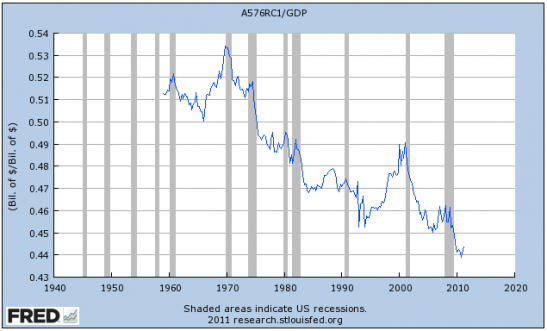
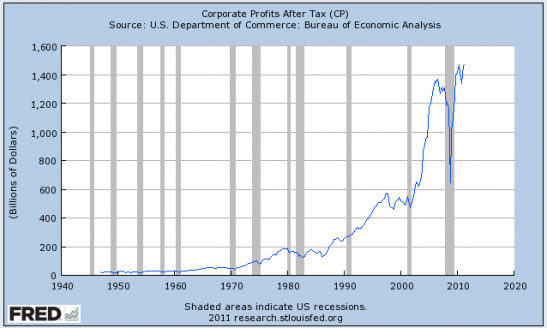
Henry Blodget writes: Inequality in this country has hit a level that has been seen only once in the nation’s history, and unemployment has reached a level that has been seen only once since the Great Depression. And, at the same time, corporate profits are at a record high.

In other words, in the never-ending tug-of-war between “labor” and “capital,” there has rarely—if ever—been a time when “capital” was so clearly winning.

Wages as a percent of the US economy are the lowest they have ever been.

Corporate profits are at an all-time high

See 30 more charts tracking inequality in the United States.

Facebooktwittermail

Israel plans new settlement of 2,600 homes that will isolate Arab East Jerusalem

The Guardian reports: Israel has submitted plans to build the first big Jewish settlement in the occupied territories in 25 years, in a move condemned as an “assassination” of attempts to revive peace negotiations.

A leading Israeli peace group, Peace Now, denounced the plan to build 2,600 homes at Givat Hamatos on the southern edge of Jerusalem as a “game changer” because it would virtually cut off the Arab east of the city from the rest of the occupied West Bank.

The UN, the EU and Britain joined the Palestinians in condemning the move as provocative at a time when the major powers are struggling to rekindle negotiations while the Palestinian bid for statehood is still before the UN security council.

The Palestinian leadership, which has said there can be no new talks if settlement building continues, said the plans were further evidence that Israel “wants to destroy the peace process”.

Givat Hamatos would form a big part of the crescent of Jewish settlements which, in parallel with the West Bank wall and fence, has increasingly isolated East Jerusalem from the rest of the occupied territories. Israeli peace activists say the intention is to solidify Israel’s claim to all of Jerusalem and to minimise the amount of the city ceded to an independent Palestine. Work could begin as early as next year.

Facebooktwittermail

Mark Cuban’s soapbox advice to the OWS movement and then some

On Blog Maverick, Mark Cuban writes: I may not know much, but I know a lot of it. So I decided to share my opinions and thoughts on what I would do if the OWS movement either elected me Grand Poobah or asked for my advice:

1. The Great Lie of Wall Street.

Every CEO tells the same great white lie. It is at the heart of every communication. It is at the heart of every financial decision. It is, at it’s very base, the reason why you all are in the 99pct and they are in the 1pct. The Lie ?

Great CEO White Lie = “We are acting in the best interests of shareholders.”

When a CEO utters this lie, everyone automatically forgives whatever they do. Add 10k jobless to the unemployment rolls ? Sorry, we did it in the BEST INTEREST OF SHAREHOLDERS. Merge or buy a company and cut back across the board ? We did it in the Best Interest of Shareholders.

The problem is that unless the company is losing money and it is the only way to keep the company alive, in this era of 9.1pct unemployment it NEVER is in the BEST INTEREST OF SHAREHOLDERS.

Shareholders , whether they own shares directly or through mutual funds or pensions do not live in a corporate vacuum. Their lives are impacted by far more than the share price of a stock. Every layoff in the name of more earnings per share puts a stress on the economy, on the federal, state and local governments which is in turn paid for through taxes or assumption of government debt by….wait for it.. the same shareholders CEOs say they want to benefit.

If OWS really wants to change corporate structure and impact the economy, talk to shareholders. Talk to your parents, uncles/aunts, cousins, friends who own shares of stocks either directly or indirectly and have them state loudly and clearly that they would rather have a higher Price to Earnings Ratio and even a lower stock price than have their TAXES increase in order to support all the people laid off from their jobs in the name of shareholders !

You might even consider buying a share of stock. Just 1. Maybe you can all pitch in and then go to a shareholders meeting and let them know how you feel about the best interests of shareholders.

2. Push to Make All Financial Institutions Partnerships

We should make all investment banks become reporting partnerships (meaning they still have the same reporting requirements they have today ). I would have no problem with our government loaning money to the partners of Goldman Sachs and Morgan Stanley and other Too Big To Fail Institutions so that they can buy back all public shares of their stock. Of course all those partners would become personally liable for repaying that money back to the government. It would probably be about 120B dollars in total to take these 2 companies private. That is far, far less than a possible bailout would cost.

Those personal guarantees would change EVERYTHING in the banking industry. It would change the decision making process across the board. There would be a moral hazard to every decision. Today , a wrong decision and they vacation on their yacht. As a partner, the wrong decision and they are protesting right next to the OWS crowd as a 99pct er. It would be the definition of having “skin in the game”

3. Limit the Size of Student Loans to $2,000 per year

Crazy ? Maybe, maybe not. What happened to the price of homes when the mortgage loan bubble popped ? They plummeted. If the size of student loans are capped at a low level, you know what will happen to the price of going to a college or university ? It will plummet. Colleges and universities will have to completely rethink what they are, what purpose they serve and who their customers will be. Will some go out of business ? Absolutely. That is real world. Will the quality of education suffer ? Given that TAs will still work for cheap, I doubt it.

Now some might argue that limiting student loans will limit the ability of lower income students to go to better schools. I say nonsense on two fronts. The only thing that allowing students to graduate with 50k , 80k or even more debt does is assure they will stay low income for a long, long time after they graduate ! The 2nd improvement will be that smart students will find the schools that adapt to the new rules and offer the best education they can afford. Just as they do now, but without loading up on debt.

The beauty of capitalism is that people like me will figure out new and better ways to create and operate for profit universities that educate as well or better as today’s state institutions, AND I have no doubt that the state colleges and universities will figure out how to adapt to the new world of limited student loans as well.

Finally, the impact on the overall economy will be ENORMOUS. There is more student loan debt than credit card debt outstanding today. By relieving this burden at graduation, students will be able to participate in the economy

4. Tax the Hell Out of Wall Street; Give it to Main Street

In a world of High Frequency Trading and black box trading that does nothing but create a platform for “financial hackers” to turn the market into their own proprietary financial playground, we need to figure out a way to revert the Stock and Bond Markets, and the derivative instruments created from these equities, back to their original purpose, a place to raise capital for growing business. Instead, today its a platform for financial engineers and hackers looking to exploit every and any opportunity. When 60pct or more of trades are from High Frequency/Algorithmic traders and the correlation for every market index rushes past .7, the market is no longer a market, its a platform.

The simplest way to change this is to place a very simple per share tax on every transaction. 10 cents a trade. Every share. Every option. Every Bond. Every currency transaction. Every trade.

Facebooktwittermail

To isolate Iran, U.S. presses inspectors on nuclear data

The New York Times reports: President Obama is pressing United Nations nuclear inspectors to release classified intelligence information showing that Iran is designing and experimenting with nuclear weapons technology. The president’s push is part of a larger American effort to further isolate and increase pressure on Iran after accusing it of a plot to assassinate Saudi Arabia’s ambassador to the United States.

If the United Nations’ watchdog group agrees to publicize the evidence, including new data from recent months, it would almost certainly revive a debate that has been dormant during the Arab Spring about how aggressively the United States and its allies, including Israel, should move to halt Iran’s suspected weapons program.

Over the longer term, several senior Obama administration officials said in interviews, they are mulling a ban on financial transactions with Iran’s central bank — a move that has been opposed by China and other Asian nations. Also being considered is an expansion of the ban on the purchase of petroleum products sold by companies controlled by the country’s elite military force, the Islamic Revolutionary Guards Corps.

The Revolutionary Guards are also believed to oversee the military side of the nuclear program, and they are the parent of the Quds Force, which Washington has accused of directing the assassination plot.

The proposed sanctions come as administration officials confront skepticism around the world about their allegations that Iran was behind the plot and limited options about what they can do — as well as growing pressure from Republicans and some Democrats in Congress to take tougher action against Iran, with the central bank and the oil industry high on lawmakers’ lists.

All of the proposed sanctions carry with them considerable political and economic risks. Yukiya Amano, the cautious director general of the United Nations group, the International Atomic Energy Agency, talked publicly in September about publishing some of the most delicate data suggesting Iran worked on nuclear triggers and warheads. But officials who have spoken with him say he is concerned that his inspectors could be ejected from Iran, shutting the best, though narrow, window into its nuclear activities.

Similarly, China and Russia, among other major Iranian trading partners, have resisted further oil and financial sanctions, saying the goal of isolating Iran is a poor strategy. Even inside the Obama administration, some officials say they fear any crackdown on Iranian oil exports could drive up oil prices when the United States and European economies are weak. As one senior official put it, “You don’t want to tip the U.S. into a downturn just to punish the Iranians.”

Facebooktwittermail

The dirty fucking hippies were right!

There’s a black granite wall in Washington D.C. that bears 58,260 names on it. All of those whose names are carved on that wall are dead. For what? Freedom? If this country had listened when kids were screaming to stop that slaughter, that wall would have been one hell of a lot shorter. Yet we as a nation still wage wars of choice. Wars encouraged by pluotcrats. Peace is never discussed. Peace has somehow become a pejorative. Peace is no perjoritive. Peace is essential to the survival of the human race. And those who advocate for war are a dangerous and fearful group who should be marginalized and disavowed. War is always the last choice.

The dirty fucking hippies, were right! Continue reading

Facebooktwittermail

From Occupy Wall Street to Occupy Everywhere

Nathan Schneider writes: It all started with an e-mail. On July 13 Adbusters magazine sent out a call to its 90,000-strong list proclaiming a Twitter hashtag (#OccupyWallStreet) and a date, September 17. It quickly spread among the mostly young, tech-savvy radical set, along with an especially alluring poster the magazine put together of a ballerina atop the Charging Bull statue, the financial district’s totem to testosterone.

The idea became a meme, and the angel of history (or at least of the Internet) was somehow ready. Halfway into a revolutionary year—after the Arab Spring and Europe’s tumultuous summer—cyberactivists in the United States were primed for a piece of the action. The Adbusters editors weren’t the only ones organizing; similar occupations were already in the works, including a very well-laid plan to occupy Freedom Plaza in Washington, starting October 6.

Websites cropped up to gather news and announcements. US Day of Rage, the Twitter- and web-driven project of a determined IT strategist, endorsed the action, promoted it and started preparing with online nonviolence trainings and tactical plans. Then, in late August, the hacktivists of Anonymous signed on, posting menacing videos and flooding social media networks.

But a meme alone does not an occupation make. An occupation needs people on the ground. By early August, a band of activists in New York began meeting in public parks to plan. Many were fresh off the streets of Bloombergville, a three-week encampment near City Hall in protest of layoffs and cuts to social services. Others joined them, especially artists, students and anarchists—academic and otherwise. (US Day of Rage’s founder was there too.) This “NYC General Assembly” met first at the Charging Bull, then at the Irish Hunger Memorial along the Hudson River and then at the south end of Tompkins Square Park. The turnout was usually around sixty to 100.

The General Assembly, which would eventually morph from a planning committee into the de facto decision-making body of the occupation, was a hodgepodge of procedures and hand signals with origins as various as Quakerism, ancient Athens, the indignados of Spain (some of whom were present) and the spokescouncils of the 1999 anti-globalization movement. Basically, it’s an attempt to create a nonhierarchical, egalitarian, consensus-driven process—the purest kind of democracy.

Facebooktwittermail

Obama plans to hijack Occupy Wall Street

The Washington Post reports: President Obama and his team have decided to turn public anger at Wall Street into a central tenet of their reelection strategy.

The move comes as the Occupy Wall Street protests gain momentum across the country and as polls show deep public distrust of the nation’s major financial institutions.

And it sets up what strategists see as a potent line of attack against Republican front-runner Mitt Romney, a former investment executive whom Obama aides plan to portray as a wealthy Wall Street sympathizer.

Many Democrats consider Romney, the former Massachusetts governor, the greatest threat to Obama when it comes to wooing centrist independents next year, and Romney this week has begun to present himself as a champion of middle-income Americans.

Obama aides point to recent surveys that show anger at Wall Street spanning ideologies, including a new Washington Post-ABC News poll in which 68 percent of independents and 60 percent of Republicans say they have unfavorable impressions of the big financial institutions.

But the strategy of channeling anti-Wall Street anger carries risks. Many of Obama’s senior advisers have ties to the financial industry — a point that makes Occupy protesters wary of the president and his party.

In recent days, Obama has ramped up his rhetoric. He took the unusual step of targeting an individual company when he attacked Bank of America for its new $5 monthly debit-card fee, calling it “exactly the sort of stuff that folks are frustrated by.” And his campaign and the White House have distributed messages blasting GOP candidates and lawmakers for wanting to repeal Wall Street regulations pushed by Obama and opposing the confirmation of a leader for the consumer protection bureau created as part of the overhaul.

“We intend to make it one of the central elements of the campaign next year,” Obama senior adviser David Plouffe said in an interview. “One of the main elements of the contrast will be that the president passed Wall Street reform and our opponent and the other party want to repeal it.”

“I’m pretty confident 12 months from now, as people make the decision about who to go vote for, the gut check is going to be about, ‘Who would make decisions more about helping my life than Wall Street?’ ” Plouffe added.

Romney, no doubt anticipating the White House’s new attack line, sought to show solidarity with the demonstrators during this week’s GOP candidates debate.

“The reason you’re seeing protests . . . is middle-income Americans are having a hard time making ends meet,” he said.

GOP leaders say the Wall Street law is government overreach, and Romney’s economic plan calls for replacing it with a “streamlined regulatory framework.”

Obama has tried this line of attack before, railing in 2009 against “fat-cat bankers” who he accused of taking excessive bonuses in the wake of the financial meltdown. But after complaints from Democrats on Wall Street and business leaders, the president has spent much of the past year courting companies — even hiring a new chief of staff, William Daley, from the banking industry.

And many on the left have attacked Obama and his administration for its ties to Wall Street, arguing that the financial regulatory overhaul fell far short of an industry makeover that many critics believed necessary.

Much of his top economic team has roots in the financial services industry, and in recent months Daley and top campaign aides have devoted much of their time improving the relationship with big-dollar donors on Wall Street.

Facebooktwittermail

Some U.S. officials question administration response to Iran plot

Reuters reports: While President Barack Obama and top aides have been united this week in grave warnings over an alleged Iranian assassination plot, some U.S. government officials are privately expressing disquiet that the outlandish-sounding plan has triggered U.S. calls for stiff new action against Iran.

These officials, while not disputing many facts of the case, say that if anything, the scheme reveals weaknesses in Iran’s security agencies, and the increasingly fractured state of Iran’s government as it faces intense international pressure.

They also questioned the wisdom of the White House strategy in using the affair to rapidly push for tougher sanctions on Tehran, increasing regional tensions.

“A lot of people basically feel really suspicious about this,” one official said, questioning the White House’s motivation “in ratcheting this thing up so quickly.”

Like others, this official insisted on anonymity because he was not authorized to speak publicly.

A second U.S. official said he shared those concerns, and questioned whether new sanctions, especially unilateral U.S. ones, would have much more than a cosmetic effect on the already heavily sanctioned country.

The consensus view in the administration is that Iran’s supreme leader, Ayatollah Ali Khamanei, probably knew of the alleged plot to kill Saudi Arabia’s ambassador in Washington, while President Mahmoud Ahmadinejad did not.

But the skeptical officials said there is no hard evidence Khamanei knew or approved of the plan.

Facebooktwittermail

A manifesto for regime change on behalf of all humanity

Ana Sofia Suarez and Shimri Zameret write: The following manifesto was produced over four months through consultation among groups, activists and people’s assemblies in countries such as Britain, Egypt, Tunisia, Germany, Spain, the US, Palestine, Israel, Brazil, Mexico, Uruguay, Argentina, India and Australia. We got comments, suggestions, support, and wrote and rewrote it again and again. The text has been supported by Canadian-based Naomi Klein, Indian-based Vandana Shiva, the US-based Michael Hardt and Noam Chomsky, as well as Uruguayan Eduardo Galeano.

United for #GlobalDemocracy

On 15 October 2011, united in our diversity, united for global change, we demand global democracy: global governance by the people, for the people. Inspired by our sisters and brothers in Tunisia, Egypt, Libya, Syria, Bahrain, New York, Palestine-Israel, Spain and Greece, we too call for a regime change: a global regime change.

In the words of Vandana Shiva, the Indian activist, today we demand replacing the G8 with the whole of humanity – the G7,000,000,000.

Undemocratic international institutions are our global Mubarak, our global Assad, our global Gaddafi. These include: the IMF, the WTO, global markets, multinational banks, the G8/G20, the European Central Bank and the UN security council. Like Mubarak and Assad, these institutions must not be allowed to run people’s lives without their consent. We are all born equal, rich or poor, woman or man. Every African and Asian is equal to every European and American. Our global institutions must reflect this, or be overturned.

Today, more than ever before, global forces shape people’s lives. Our jobs, health, housing, education and pensions are controlled by global banks, markets, tax-havens, corporations and financial crises. Our environment is being destroyed by pollution in other continents. Our safety is determined by international wars and international trade in arms, drugs and natural resources. We are losing control over our lives. This must stop. This will stop. The citizens of the world must get control over the decisions that influence them in all levels – from global to local. That is global democracy. That is what we demand today.

Today, like the Mexican Zapatistas, we say “¡Ya basta! Aquí el pueblo manda y el gobierno obedece&#8221: “Enough! Here the people command and global institutions obey!” Like the Spanish Tomalaplaza we say “Democracia Real Ya&#8221: “True global democracy now!” Today we call the citizens of the world: let us globalise Tahrir Square! Let us globalise Puerta del Sol!

This manifesto is not endorsed by all the people that participate in the worldwide protests on Saturday, of course. With social movements, you can never have everyone writing the text together or endorsing it. But to the extent that we could – we tried to create a process of writing that was truly participatory as possible, worldwide. We feel the text is legitimate as a manifesto coming from the protests, supported by many involved, such as Democracia Real Ya International, the main assembly in Madrid, the main assembly in Boston, in Buenos Aires and Sao Paolo. We hope it is the beginning of a movement.

We decided to call international institutions such as the IMF, the UN Security Council, global markets and international banks our “global Mubarak, our global Assad”. These words were debated vigorously. We decided to keep them. Hard words for hard times. We didn’t define what democratic global institutions are because not everyone completely agrees on a definition.

We prefer to leave it as a principle, and know that there are many suggestions on how to give people control over the global decisions that shape our lives. When French activists demanded national democracy for the first time, no one believed it was possible. Today no one believes global people’s control is possible. Future generations will judge things differently. Today we start building a movement for global democracy. .

• Discuss this on Twitter with the hashtag #globaldemocracy, and #globalchange

Follow the movement on Facebook

Facebooktwittermail

Occupy Wall Street goes global

The New York Times reports: In dozens of cities around the world on Saturday, people took to the streets, clutching placards and chanting slogans as part of a planned day of protests against the financial system.

In Rome, a protest thick with tension spread over several miles. Protesters set fire to at least one building and clashed violently with the police, who responded with water cannons and tear gas.

In other European cities, including Berlin and London, the demonstrations were largely peaceful, with thousands of people marching past ancient monuments and many gathering in front of capitalist symbols like the European Central Bank in Frankfurt. Elsewhere, the turnout was more modest, but rallies of a few hundred people were held in several cities, including Sydney, Australia, Tokyo and Hong Kong. Protests were also held in New York and several other cities in the United States and Canada.

But just as the rallies in New York have represented a variety of messages — signs have been held in opposition to President Obama yards away from signs in support — so Saturday’s protests contained a grab bag of messages, opposing nuclear power, political corruption and the privatization of water.

Despite the difference in language, landscape and scale, the protests were united in frustration with the widening gap between the rich and the poor.

Occupy Wall Street from David Sauvage on Vimeo.

Facebooktwittermail

Wall Street tells senators: We pay you to represent us

The New York Times reports: Publicly, bankers say they understand the anger at Wall Street — but believe they are misunderstood by the protesters camped on their doorstep.

But when they speak privately, it is often a different story.

“Most people view it as a ragtag group looking for sex, drugs and rock ’n’ roll,” said one top hedge fund manager.

“It’s not a middle-class uprising,” adds another veteran bank executive. “It’s fringe groups. It’s people who have the time to do this.”

As the Occupy Wall Street demonstrations have grown and spread to other cities, an open question is: Do the bankers get it? Their different worldview speaks volumes about the wide chasms that have opened over who is to blame for the continuing economic malaise and what is best for the country.

Some on Wall Street viewed the protesters with disdain, and a degree of caution, as hundreds marched through the financial district on Friday. Others say they feel their pain, but are befuddled about what they are supposed to do to ease it. A few even feel personally attacked, and say the Occupy Wall Street protesters who have been in Zuccotti Park for weeks are just bitter about their own economic fate and looking for an easy target. If anything, they say, people should show some gratitude.

“Who do you think pays the taxes?” said one longtime money manager. “Financial services are one of the last things we do in this country and do it well. Let’s embrace it. If you want to keep having jobs outsourced, keep attacking financial services. This is just disgruntled people.”

He added that he was disappointed that members of Congress from New York, especially Senator Charles E. Schumer and Senator Kirsten Gillibrand, had not come out swinging for an industry that donates heavily to their campaigns. “They need to understand who their constituency is,” he said.

CNBC reports: Several employees of Goldman Sachs have said that they have been told to stay away from the Occupy Wall Street protests in Zuccotti Park.

Goldman headquarters is at 200 West Street in New York City is just about 1,000 yards from the park where protesters have been encamped since Sept. 17. Until recently, it was possible to see the square from some offices in Goldman’s headquarters. Recent construction has blocked the view.

“I was going to come down to say hello yesterday,” one of my Goldman sources wrote to me on Wednesday. He was told by his employer that he should not go to the square for any reason.

At least five others have related similar stories. Supervisors and co-workers have said that they should stay out of the park. The reasons vary. Some say it is unsafe — although there are plenty of people who look like they work in Wall Street jobs around the protest every day. Others say that it could “endanger your career.”

None of the people I spoke with knew whether their was an official policy against going to the park.

“It feels officially unofficial,” one person said.

A spokesman for Goldman declined to comment.

Facebooktwittermail

Insiders voice doubts about CIA’s 9/11 story

Rory O’Connor and Ray Nowosielski write: A growing number of former government insiders — all responsible officials who served in a number of federal posts — are now on record as doubting ex-CIA director George Tenet’s account of events leading up to the Sept. 11, 2001, attacks on the United States. Among them are several special agents of the FBI, the former counterterrorism head in the Clinton and Bush administrations, and the chairman of the 9/11 Commission, who told us the CIA chief had been “obviously not forthcoming” in his testimony and had misled the commissioners.

These doubts about the CIA first emerged among a group of 9/11 victims’ families whose struggle to force the government to investigate the causes of the attacks, we chronicled in our 2006 documentary film “Press for Truth.” At that time, we thought we were done with the subject. But tantalizing information unearthed by the 9/11 Commission’s final report and spotted by the families (Chapter 6, footnote 44) raised a question too important to be put aside:

Did Tenet fail to share intelligence with the White House and the FBI in 2000 and 2001 that could have prevented the attacks? Specifically, did a group in the CIA’s al-Qaida office engage in a domestic covert action operation involving two of the 9/11 hijackers, that — however legitimate the agency’s goals may have been — hindered the type of intelligence-sharing that could have prevented the attacks? And if not, then what would explain seemingly inexplicable actions by CIA employees?

As we sought to clarify how the CIA had handled information about the hijackers before 9/11, we found a half dozen former government insiders who came away from the Sept. 11 tragedy feeling burned by the CIA, particularly by a small group of employees within the agency’s bin Laden unit in 2000 and 2001, then known as Alec Station.

Among them was Gov. Thomas Kean, co-chairman of the National Commission on Terrorist Attacks Upon the United States, which was responsible for investigating 9/11. He agreed to an on-camera interview for our documentary in 2008. He surprised us by voicing many doubts and questions about the CIA’s actions preceding Sept. 11 — and especially about former CIA director George Tenet.

Four years after Tenet testified to the commission, Kean said the CIA director had been “obviously not forthcoming” in some of his testimony. Tenet said under oath that he had not met with President Bush in the month of August 2001, Kean recalled. It was later learned he had done so twice.

Did Tenet misspeak? we asked the New Jersey Republican.

“No, I don’t think he misspoke,” Kean responded. “I think he misled.”

Facebooktwittermail

Egypt’s military, with U.S. support, blocks transition to civilian rule

The New York Times reports: Egypt’s military rulers are moving to assert and extend their own power so broadly that a growing number of lawyers and activists are questioning their willingness to ultimately submit to civilian authority.

Two members of the military council that took power after the ouster of former President Hosni Mubarak said for the first time in interviews this week that they planned to retain full control of the Egyptian government even after the election of a new Parliament begins in November. The legislature will remain in a subordinate role similar to Mr. Mubarak’s former Parliament, they said, with the military council appointing the prime minister and cabinet.

“We will keep the power until we have a president,” Maj. Gen. Mahmoud Hegazy said. The military had pledged in formal communiqués last March to hold the presidential election by September. But the generals now say that will come only after the election of a Parliament, the formation of a constitutional assembly and the ratification of a new constitution — a process that could stretch into 2013 or longer.

A transition to civilian rule before and not after the drafting of a new constitution was also a core component of a national referendum on a “constitutional declaration” that passed in March as well. The declaration required that the military put in place democratic institutions and suspend a 30-year-old emergency law allowing arrests without trial before the drafting of the constitution to ensure a free debate. But by extending its mandate, the military will now preside over the constitutional process.

The military’s new plan “is a violation of the constitutional declaration,” Tarek el-Bishry, the jurist who led the writing of that declaration, wrote this week in the newspaper Al Sharouk, arguing that the now-defunct referendum had been the military’s only source of legitimacy.

The United States, where concerns run high that early elections could bring unfriendly Islamists to power and further strain relations with Israel, has so far signaled approval of the military’s slower approach to handing over authority. In an appearance this week with the Egyptian foreign minister, Secretary of State Hillary Rodham Clinton urged an early end to the emergency law but called the plan for elections “an appropriate timetable.”

Facebooktwittermail

The war on Copts in Egypt: its origins

As’ad AbuKhalil writes: There is a war on Copts in Egypt. It is unmistakable and state military and religious institutions are guilty in sponsoring and launching the war. It was no coincidence that the chief of Al-Azhar (a former puppet of Mubarak and his ruling party) was on an official visit to Saudi Arabia during the week of killing the Copts in the streets of Cairo.

The official statement about the visit by Al-Azhar chief and his meeting with Wahhabi clerics of the House of Saud was blatantly sectarian and spoke about protecting Sunnis, as if the majority of the world’s Muslims are under attack in the region from Muslim sects and non-Muslims. The meeting in Saudi Arabia is an example of the fanatical religious movement that leads and sponsors the industries of religious and sectarian hate in the region. But it is not only the Egyptian government which squarely bears the responsibility for the savage attacks on Copts on the streets, and for sponsoring the blatant sectarian agitation that filled Egyptian state airwaves.

The US and Saudi Arabia are also responsible. It is fair to say that the US was party to the Saudi-directed campaign of global religious fanaticism – in two stages. The first phase was during the Cold War when Saudi Arabia, in partnership with the US, unleashed international religious forces to undermine the cause of communism and leftism in general. The movement that produced Bin Laden and his terrorist organization was mid-wived by Saudi Arabia and the US during the war in Afghanistan. The goal was to defeat communism at any price, even if the regimes that followed were much worse than what prevailed under communism, especially if one cares about women’s rights. It can be argued for instance that the Soviet-supported regime in Kabul was far more reformist and enlightened than the reactionary regime that the US installed in Kabul in 2001.

The second wave of global fanaticism was unleashed by Saudi Arabia after the 2003 invasion of Iraq and with the full support of Israel and the US. The US wanted to divert the attention of Arabs from Israel and its crimes and demonized Iran, promoting it as the only danger to Arabs (only Muslims because non-Muslims don’t figure in US calculations and certainly not in the calculations of the Wahhabi clerics). Israel was not to be seen as the enemy, or so wanted the American government, and Saudi Arabia was more than happy to oblige.

Facebooktwittermail