Author Archives: News Sources

As assassination plot becomes a sideshow, U.S.-Iran tensions hinge on the nuclear issue

Tony Karon writes: A used car salesman, a Mexican narco snitch, and an Iranian spook walk into a bar. What is this, says the ex-CIA barman, some kind of a joke?

Let’s just say that the ostensibly Iranian plot to blow up Saudi Arabia’s ambassador to Washington is not yet proving to be the smoking gun that allows the Obama Administration to rally uncommitted governments to the cause of isolating Tehran. Sure, the Saudis have brought the matter to the attention of the U.N. Security Council, although they have not as yet indicated that they intend to call for any specific response. But with skepticism rife even in Washington about this plot having been authorized by the Iranian leadership, the narco-proxy terror scheme may not change the minds of Russia, China, Turkey and other opponents of any new sanctions. After being briefed on the plot by U.S. diplomats, those countries and others have said they want more information before making up their minds — as have the Iranians, although Tehran has also tossed out a curveball by suggesting that the fugitive accused in the case is, in fact, an operative of the Mujahedeen e-Khalq, an exiled opposition group currently listed as a terrorist organization by the U.S. State Department.

But the Administration is reportedly unlikely to provide further evidence, for fear of compromising sources and methods.

So, as things stand, the Saudi ambassador plot looks unlikely to be a game-changer. Of course, the same hawkish crowd in Washington that agitated for the Iraq invasion are demanding military action against Iran, but despite President Obama’s tough talk last week about imposing “the toughest sanctions” and keeping the proverbial “all options” on the table, it’s the five-year nuclear stalemate, rather than the alleged assassination plot, that will frame the international response to Iran.

Facebooktwittermail

New U.N. Sec Gen report slams Israeli occupation justice system

Roee Ruttenberg writes: In the last twenty-four hours, so much attention has been given to Palestinians with Israeli “blood on their hands” being released from prison, but little-to-no attention has been given to Israelis with Palestinian “blood on their hands” who never went to prison in the first place. A new report by the United Nation’s Secretary General calls into question the double standard.

In one of the harshest reports, if not THE harshest reports, issued by the United Nations Secretary General, Ban Ki-Moon has strongly criticized Israel’s continued post-1967 occupation of Palestinian territory, the expansion of its population into those territories, and – notably – the continued attacks against the Arab population that already lives there and the impunity for the Israelis involved in those attacks. Secretary Ban’s report goes further to suggest that in many cases, the Israeli military is not only complicit in the attacks against the Palestinian population, but sometimes supportive or directly involved.

The report offers a number of examples of lacking justice:

On 27 January 2011, an 18-year-old Palestinian grazing his goats on his land was shot dead at point blank range by a settler on Palestinian land south of the village of Iraq Burin. Footage of the killing captured by a security camera appeared in various media.

On 15 February 2011, an 18-year-old Palestinian from the village of Jalud south of Nablus, which is surrounded by six Israeli settlements and ‘outputs,’ was shot in his stomach with live ammunition by one of three settlers from a distance of about 40 metres. The settlers then fled towards Kida settlement.

Facebooktwittermail

U.S. awaits inquiry ahead of Bahrain arms deal

Al Jazeera reports: The US has said that it will consider a special investigation of alleged human rights abuses in Bahrain before moving ahead with a $53m arms deal to the Gulf kingdom.

In a letter to Ron Wyden, a US Democratic senator, and in public statement, the state department said on Tuesday that it shared congressional misgivings about Bahrain’s treatment of protesters and would await the results of a special inquiry established by the king.

The commission’s report to King Hamad bin Isa Al Khalifa is due on October 30.

“That’s something we would look at closely,” Mark Toner, the State Department spokesman, said, speaking about the commission’s report.

“We’re going to continue to take human rights considerations into account as we move toward the finalization of this deal.”

He added that several procedural steps remain before the US could deliver the weapons to Bahrain and noted the sale pertained to equipment for Bahrain’s “external defence purposes”.

Wyden and Jim McGovern, a US Democratic representative, have introduced a resolution to block the arms sale to Bahrain, which includes Humvee combat vehicles and missiles.

Facebooktwittermail

U.S. Marine Corps Sgt. Shamar Thomas gives NYPD a lesson on honor

United States Marine Corps. Sgt. Shamar Thomas from Roosevelt, NY went toe to toe with the New York Police Department. An activist in the Occupy Wall Street movement, Thomas voiced his opinions of the NYPD police brutality that had and has been plaguing the #OWS movement. Thomas is a 24-year-old Marine veteran (two tours in Iraq), he currently plays amateur football and is in college. Thomas comes from a long line of people who sacrifice for their country: mother, Army veteran (Iraq), stepfather, Army, active duty (Afghanistan), grandfather, Air Force veteran (Vietnam), great grandfather Navy veteran (World War II).

Thomas later appeared on Countdown with Keith Olbermann:

Facebooktwittermail

Jailed Egyptian blogger on hunger strike says ‘he is ready to die’

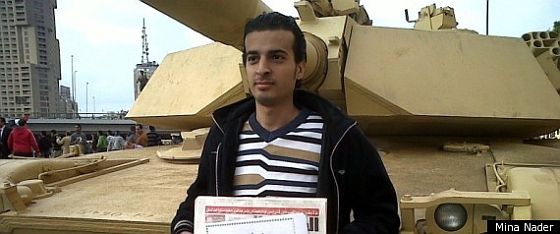
The Guardian reports: An Egyptian blogger jailed for criticising the country’s military junta has declared himself ready to die, as his hunger strike enters its 57th day.

“If the militarists thought that I would be tired of my hunger strike and accept imprisonment and enslavement, then they are dreamers,” said Maikel Nabil Sanad, in a statement announcing that he would boycott the latest court case against him, which began last Thursday. “It’s more honourable [for] me to die committing suicide than [it is] allowing a bunch of Nazi criminals to feel that they succeeded in restricting my freedom. I am bigger than that farce.”

Sanad, whom Amnesty International has declared to be a prisoner of conscience, was sentenced by a military tribunal in March to three years in jail after publishing a blog post entitled “The people and the army were never on one hand”. The online statement, which deliberately inverted a popular pro-military chant, infuriated Egypt’s ruling generals who took power after the ousting of former president Hosni Mubarak, and have since been accused of multiple human rights violations in an effort to shut down legitimate protest and stifle revolutionary change.

The 26-year-old was found guilty of “insulting the Egyptian army”. The case helped spark a nationwide opposition movement to military trials for civilians, and cast further doubt on the intentions of the Supreme Council of the Armed Forces (Scaf), whose promises regarding Egypt’s post-Mubarak transition to democracy appear increasingly hollow.

In mid-September, Saki Knafo wrote: Nabil is not the only civilian to have undergone a military trial since the revolution. An article from the Pulitzer Center for Crisis Reporting places the total number at 12,000, and says that suspects have been typically tried in three or four days and have been given sentences of between a few months to several years.

Earlier this year, Asmaa Mahfouz, a prominent Egyptian activist, wrote the following Tweet (translated from Arabic): “If the judiciary does not get us our rights, don’t be upset if armed groups carry out a series of assassinations as there is neither law nor justice.”

She was brought before the military prosecutor last month and charged with insulting the military. The case became a flashpoint in the growing movement to end the military trials, with presidential candidates and political groups criticizing the decision. The military council eventually ordered that the charges be dropped.

But Nabil is different from Mahfouz. He isn’t a star, for one thing. “Maikel isn’t a prominent public figure,” his father told the press during a recent demonstration in support of his son. “Maikel is a normal person and that is why they imprisoned him. Others who had a lot of public support and had similar charges were released. But Maikel is one of the general public and he doesn’t have anyone to defend him.”

There’s also the fact that Nabil supports Israel. He says he objected to military conscription in the first place because he refused to “point a gun at an Israeli youth who is defending his country’s right to exist,” and a section of his website is in Hebrew.

Several organizations are again calling for his release. A statement from Reporters Without Borders observed that Nabil “could very soon die” and warned that he could become “the symbol of a repressive and unjust post-Mubarak Egypt.”

In response, a military official was quoted as saying that what Nabil wrote on his blog was “a clear transgression of all boundaries of insult and libel.”

In April, shortly after Nabil’s arrest, a friend of Nabil’s and fellow blogger wrote an email to The Huffington Post in which he said that Nabil’s sentencing proved “every word Nabil has ever said about our regime.”

“The military council wants to annihilate anyone who questions what it does,” wrote the blogger, who calls himself Kefaya Punk. “That reminds me of how the Catholic church treated its opponents in the medieval ages.”

Facebooktwittermail

Gilad Shalit and the end of the Israeli-Palestinian peace process

Tony Karon writes: As momentous as Tuesday’s release of Sergeant Gilad Shalit and 477 Palestinian prisoners (with another 550 to freed within two months) may be, it is unlikely to be a game-changer — or a milestone on the road to peace. Indeed, while the spectacle of Prime Minister Benjamin Netanyahu breaking the ostensible taboo on negotiating with Hamas and heeding many of its demands in order to bring home the captive Israeli soldier may look like a sea-change, it’s more likely to reinforce the stalemate in the wider conflict — and possibly even raise the danger of a new hostilities.

Despite the fervent opposition of some Israelis — from families of terror victims to prominent cabinet members — to freeing men with Israeli blood on their hands, Netanyahu’s decision remains a popular one. A poll conducted by the daily Yediot Ahronot published Monday showed that 79% of Israelis support the deal, reconciling themselves to paying a bitter price for bringing home the soldier captured, at age 19, more than five years ago. Still, it should come as no surprise in the months ahead if an Israeli government forced into what it will see as a humiliating agreement seeks to restore its self-image of resolute toughness by dealing harshly with future challenges. And the fact that Netanyahu’s climb-down on Shalit has been accompanied by the announcement of new settlement construction on occupied land underscores the sense that Israel’s hawkish government has no intention of making the compromises necessary to bring President Mahmoud Abbas back to the table. Abbas, after all, holds no Israeli captives, and may not have much else Netanyahu believes he needs right now.

Indeed, the Shalit agreement has been something of a setback for Abbas. Hamas’ achievement in freeing some of the thousands of Palestinians held in Israeli prison is a more tangible gain, in Palestinian eyes, than the hypothetical statehood amid continued occupation being pursued by Abbas at United Nations. Palestinian society doesn’t regard these men and women as criminals, but rather fighters in the national cause — a peace agreement with the Palestinians would ultimately require the release of all Palestinians who remain in Israeli custody, even if convicted of acts of terrorism.

But no such painful moment of reckoning is in the offing, of course, because neither side harbors any hope of negotiating an end to the conflict any time soon. The recent speeches at the United Nations by President Mahmoud Abbas and Prime Minister Benjamin Netanyahu underscored the vast gulf between the two sides, and only the most Pollyanna-ish of Western diplomats expect anything significant to come from the current effort by the U.S. and its “Quartet” allies to restart direct talks as an alternative to Abbas’ U.N. effort. Abbas has made clear that even if he agrees to meet Israeli leaders, he won’t drop the U.N. bid — which, after all, is what forced the Obama Administration to address the issue with greater urgency.

Michael Warschawski at the Alternative Information Center, writes: For the thousands of Palestinian families who will soon meet their loved ones I’m happy, and for the Shalit family I’m also happy. However, beyond happiness over the release, there exists no symmetry: The Palestinian political prisoners, women and men, who will be freed are all freedom fighters who fulfilled their political and moral duty in the struggle against the Israeli colonial occupation. Gilad Shalit, on the other hand, was a soldier, and a soldier in Israel’s colonial occupation army which violates international law on a daily basis and regularly commits war crimes. As was done by hundreds of Israelis before him, Shalit should have refused to take part in this war, which he did not do.

Those in Israel dubbed the “kidnappers” of Gilad Shalit actually took a prisoner of war and according to all testimonies at our disposal, he was treated as such. The Palestinian political prisoners, on the other hand, do not even dare dream of receiving treatment similar to that received by Shalit.

Just as an injured soldier is not left on the battlefield, the state is obligated to do everything in its power to return its prisoners of war, whatever the price may be. There is no “particularly special Jewish humanism” here, as related by the Israeli media, which is nourished by the office of Benjamin Netanyahu, but a regular and accepted act in a situation of war. What is not usual, and is in fact scandalous, is the intentional foot-dragging which characterized the governments responsible for the Shalit file. The agreement reached with the assistance of the German negotiator and the Egyptian and Turkish governments was closed already three years ago, but the Israeli government chose to ignore it and fantasise about a commando operation, which undoubtedly would have resulted in the death of the soldier.

It is easy to assume that if a child of Netanyhu or Lieberman was in captivity, the government would have moved must faster and accepted the agreement placed on its table. No! The government did not demonstrate any “Jewish humanism” but actually a true lack of humanity. Only the quiet determination of the Shalit family and their public support moved this immoral and heartless government.

Facebooktwittermail

The evolutionary roots of collective intelligence

Big Think: For much of the 20th century, social scientists assumed that competition and strife were the natural order of things, as ingrained as the need for food and shelter. The world would be a better place if we could all just be a little more like John Wayne, the thinking went.

Now researchers are beginning to see teamwork as a biological imperative, present in even the most basic life forms on Earth. And it’s not just about fairness, or the strong lifting up the weak. Collective problem-solving is simply more efficient than rugged individualism.

Facebooktwittermail

A dark day in Israel

In early October, Eyal Raz described the incident on which this Bloggingheads conversation centers: Were you ever at a lynching? Were you ever someplace where an unbridled mob was beating you and your friends and then chasing you to beat you again? Were you ever the victim of wild violence before the blind eyes of policemen who ignored your desperate calls for help? Have you ever felt abandoned? The following story begins with blood, but its point is the abandonment.

What happened Friday afternoon at the entrance to the settlement of Anatot was a pogrom, a lynching. There’s no other way to describe an event in which hundreds of large men are wildly beating and pursuing a nonviolent group of male and female activists for an extended period of time. There’s no way to convey to those who weren’t there the threatening sense of the approaching dark – not in words, not in pictures, not even in video.

They came to destroy, to break, perhaps even to kill. They used their hands, their fists and their teeth, along with stones, pipes and knives. They aimed for the photographers, the women, for the young and the old alike. They brought individuals down to the ground and assaulted them as they lay there, surrounded. They pounced on the hindmost of those trying to flee as they pursued their battered victims.

And all this was taking place before the very eyes of the police, who didn’t do a thing to prevent people from being hurt. It all passed, as usual, in a thunderous silence.

Facebooktwittermail

The Occupy Wall Street image that marks the end of the global consensus

Jonathan Jones writes: A New York police officer leans forward and yells as if attempting, with the sheer force of his anger, to hold back time. His rage is understandable for, in this photograph, you can actually see the world turn upside down and all that was solid melt into air. This truly is a picture of a turning point in the history of the world.

It shows the moment when Occupy Wall Street campaigners reached Times Square, whose giant hoardings glow brightly in broad daylight even as furious protesters confront mounted police. When this photograph was taken, movements were simultaneously starting up around the world in emulation of Occupy Wall Street and its attempt to hold finance capitalists to account. In London and Vancouver, Brussels and – with a violent twist – in Rome, the call went out and the people came. But of all the weekend’s photographs of global protest against capitalist excess, this, surely, is the image that will endure.

That is because it captures the surrealism of a moment when the stabilities and certainties of an era suddenly became yesterday’s distant memory. Times Square makes a powerful setting for this picture. Shiny walls of towing glass, the citadels of corporate entertainment, dazzle among the giant screens – is that Apu from The Simpsons? – in the bright autumn air.

But no one is entertained. The faces in the crowd are genuinely angry and determined. A man in the foreground has a red star on his T-shirt. Sixty years ago they hunted reds in Times Square, metaphorically at least, as America fought the cold war. Today that red star says it all. These people have not come to protest just against a bad law or a single issue, but the system itself. They are putting capitalism in the dock. The photograph powerfully captures this moment because it so vividly shows the symbols of the order of things that inhabitants of western economies have up to now accepted.

There were “anti-capitalist” protests in the boom years but these were self-evidently marginal to a society lapping up the joys of credit. Today, the world is ready to listen to Occupy Wall Street and its claim to speak for the 99% against the profiteering 1%. Everyone knows what they are talking about and everyone can see some truth in it.

Facebooktwittermail

Occupy Wall Street finds mainstream support

Will Oremus writes: If Occupy Wall Street is a fringe movement, it’s looking like a pretty big fringe.

In a Quinnipiac University poll released Monday, two-thirds of New York City voters said they support the protests. The backers included 81 percent of Democrats and, perhaps more surprisingly, 35 percent of Republicans. And an overwhelming majority, 87 percent, said it’s “okay that they are protesting.”

And for all the criticism lobbed at the protesters for not having a formal list of demands, their general message seems to be getting across. Nearly three-fourths of New York City voters said they understand the protesters’ views “very well” or “fairly well.”

Respondents split evenly on whether police are handling the protests well.

And who’s to blame for the nation’s economic mess? Thirty-seven percent of New York City voters fingered George W. Bush, while 21 percent blamed Wall Street, 18 percent Congress, and 11 percent President Obama. Those figures are probably not representative of the nation at large, however. The survey’s demographic summary shows that 55 percent of those polled were Democrats, while just 13 percent were Republicans, reflecting New Yorkers’ liberal bent.

Still, the numbers suggest it’s not just hippies and socialists who are rooting for the movement. The Washington Post’s Plum Line blog asks, “What if working class Americans actually like Occupy Wall Street?” Blogger Greg Sargent quotes union leader Karen Nussbaum as saying that the protests have helped organizers sign up tens of thousands of recruits in recent weeks:

“These are not the folks who normally wear dreadlocks and participate in drum circles,” Nussbaum says. “They’re working class moderates who work as child care employees or in cafeterias or in construction. They’re people who work in lower middle class suburbs around the country.” Pressed on whether the movement’s excesses and lack of a clear agenda risk alienating such voters, Nussbaum said: “We’re proving every day that that’s not the case.”

Indeed, a national poll last week found that the Occupy movement is twice as popular as the Tea Party. A Siena poll of New York state voters this week turned up similar numbers, with 49 percent saying they’d rather join Occupy Wall Street, while 28 percent picked the Tea Party.

Facebooktwittermail

Time for the U.S. to stop bankrolling Israel’s defense

Walter Pincus, in a column for the Washington Post, writes: As the country reviews its spending on defense and foreign assistance, it is time to examine the funding the United States provides to Israel.

Let me put it another way: Nine days ago, the Israeli cabinet reacted to months of demonstrations against the high cost of living there and agreed to raise taxes on corporations and people with high incomes ($130,000 a year). It also approved cutting more than $850 million, or about 5 percent, from its roughly $16 billion defense budget in each of the next two years.

If Israel can reduce its defense spending because of its domestic economic problems, shouldn’t the United States — which must cut military costs because of its major budget deficit — consider reducing its aid to Israel?

First, a review of what the American taxpayer provides to Israel.

In late March 2003, just days after the invasion of Iraq, President George W. Bush requested the approval of $4.7 billion in military assistance for more than 20 countries that had contributed to the conflict or the broader fight against terrorism. Israel, Jordan, Egypt, Afghanistan, Pakistan and Turkey were on that list.

A major share of the money, $1 billion, went to Israel, “on top of the $2.7 billion regular fiscal year 2003 assistance and $9 billion in economic loans guaranteed by the U.S. government over the next three years,” according to a 2003 study by the Congressional Research Service (CRS).

Then in 2007, the Bush administration worked out an agreement to raise the annual military aid grant, which had grown to $2.5 billion, incrementally over the next 10 years. This year, it has reached just over $3 billion. That is almost half of all such military assistance that Washington gives out each year and represents about 18 percent of the Israeli defense budget.

In addition, the military funding for Israel is handled differently than it is for other countries. Israel’s $3 billion is put almost immediately into an interest-bearing account with the Federal Reserve Bank. The interest, collected by Israel on its military aid balance, is used to pay down debt from earlier Israeli non-guaranteed loans from the United States.

Another unique aspect of the assistance package is that about 25 percent of it can be used to buy arms from Israeli companies. No other country has that privilege, according to a September 2010 CRS report.

The U.S. purchases subsidize the Israeli arms business, but Washington maintains a veto over sales of Israeli weapons that may contain U.S. technology.

Look for a minute at the bizarre formula that has become an element of U.S.-Israel military aid, the so-called qualitative military edge (QME). Enshrined in congressional legislation, it requires certification that any proposed arms sale to any other country in the Middle East “will not adversely affect Israel’s qualitative military edge over military threats to Israel.”

In 2009 meetings with defense officials in Israel, Undersecretary of State Ellen Tauscher “reiterated the United States’ strong commitment” to the formula and “expressed appreciation” for Israel’s willingness to work with newly created “QME working groups,” according to a cable of her meetings that was released by WikiLeaks.

The formula has an obvious problem. Because some neighboring countries, such as Saudi Arabia and Egypt, are U.S. allies but also considered threats by Israel, arms provided to them automatically mean that better weapons must go to Israel. The result is a U.S.-generated arms race.

MJ Rosenberg writes: Aid to Israel is virtually the only program, domestic or foreign, that is exempt from every budget cutting proposal pending in Congress. No matter that our own military is facing major cuts along with Medicare, cancer research and hundreds of other programs, Israel’s friends in Congress in both parties make sure that aid to Israel is protected at current levels.

Back when I was a Congressional staffer, I was part of the process by which aid to Israel was secured. Every member of the Congressional Appropriations Committees sent a “wish list” to the chairman of the committee telling him or her which programs he wanted funded and by what amounts. Each letter reflected the particular interest of a particular Representative or Senator and of his own district or state.

There was always one exception: aid to Israel, which apparently is a local issue for every legislator. The American Israel Public Affairs Committee (AIPAC) would provide the list of Israel’s aid requirements for the coming year and, with few if any exceptions, every letter would include the AIPAC language. Not a punctuation mark would be changed.

At the end of the process, the AIPAC wish list would become law of the land. (Woe to any Member of Congress who dared to resist the AIPAC juggernaut).

That is how it has been for decades and not even the current economic crisis is likely to change it. On this issue, Congress is hopeless and will remain so as long as its members rely so heavily on campaign contributions (PAC or individual) delivered by AIPAC.

JTA reports: Mitt Romney said he would increase defense assistance to Israel, raise the U.S. military profile near Iran and recognize Israel as a Jewish state.

Facebooktwittermail

Significant holes in U.S. legal case against alleged Iran plotter

Marcy Wheeler writes: In the wake of the Obama Administration’s announcement that an Iranian-American used car salesman had set up a plot to kill the Saudi Ambassador to the U.S., a number of Iran and intelligence experts have raised questions about the plausibility of the alleged Iranian plot.

But few have commented on problems in the legal case presented against the used car salesman, Manssor Arbabsiar, and his alleged co-conspirators from Iran’s Quds Force, a branch of its special forces. There is a handful of what appear to be holes in the complaint. Though individually they are small, taken together they raise difficult questions about the government’s case. The apparent holes also seem to match up with some of the same concerns raised by skeptical Iran analysts, such as Arbabsiar’s rationale in confessing and the extent of his connection to the Quds Force.

The government claims that Arbabsiar sought out someone he thought was a Mexican drug cartel member in May; he was actually a Drug Enforcement Agency confidential informant. Over a series of meetings, the government alleges, Arbabsiar arranged to forward $100,000 to the informant as down payment for the attack, promised $1.5 million more, and agreed that the informant should kill Saudi Ambassador Adel al-Jubeir with a bomb blast at a DC restaurant, one that would possibly be full of civilians and U.S. members of Congress.

In the complaint [PDF] against Arbabsiar, the government has described four pieces of evidence to support its allegations (it undoubtedly has more intelligence that it doesn’t describe in the complaint):

  • Taped conversations and phone calls between the informant and Arbabsiar
  • Details about a $100,000 bank transfer described as a down payment for the assassination
  • Taped conversations Arbabsiar had with his alleged co-conspirator, Quds Force member Gholam Shakuri, while Arbabsiar was in FBI custody
  • A confession Arbabsiar made after he was arrested on September 29

Two of the conversations between Arbabsiar and the informant, on July 14 and July 17, include very damning comments. Arbabsiar tells the informant, “he wants you to kill this guy” and goes on to say that it is “no big deal” if the informant kills hundreds of civilians and some Senators in the course of the assassination.

But there is a problem with each of these four key pieces of evidence.

Al Jazeera reports: Mahmoud Ahmadinejad, the president of Iran, has said that an alleged plot to kill the Saudi ambassador to the Washington was fabricated by the US to cause a rift between Tehran and Riyadh, and to divert attention from US economic problems.

In an exclusive interview with Al Jazeera in Tehran on Monday, Ahmadinejad said that anyone who hears the claims “laughs”, but warned the US to be mindful of the allegations it makes.

“We’re not worried about expressing our opposition … The US administration is sorely mistaken. The US administration might want to divert attention from what’s going on inside the US,” he said, speaking through a translator, during an interview broadcast live.

“The economic problems of the US are very serious, and by accusing Iran it’s not going to solve any problem.”

Facebooktwittermail

The deal behind the “Shalit deal”: prisoners, power, racism

Toufic Haddad writes: Passing judgment on the Shalit deal cannot take place from a detached precipice of moral or political purity but, rather, must derive from an appreciation for the basic balance of forces at play between the contending parties and their historical precedents in relations between one another. There are no absolute criteria for judging such matters, with interests and needs within each negotiating party variegated, subject to shifts over time, and difficult to quantify to begin with.

For this reason, it is helpful to begin analyzing the Shalit deal by understanding that before Shalit’s capture, Israel refused to recognize Hamas as a legitimate political entity; this non-recognition continued despite the Hamas victory in democratic elections in 2006. Israel subsequently refused all formal interaction with Hamas, encouraging other countries to do the same. Soon after Shalit’s capture, Israel’s Prime Minister’s Bureau reiterated this stance, asserting, “There will be no negotiations to release prisoners…The government of Israel will not give in to extortion by the Palestinian Authority and the Hamas government, which are headed by murderous terror organizations. The Palestinian Authority bears full responsibility for the welfare of Gilad Shalit and for returning him to Israel in good condition.”

In this respect, the very sealing of a deal with Hamas was a major Israeli concession. Israel sought every possible way to retrieve Shalit without having to negotiate, but failed. The weeks after the capture of Shalit witnessed more than 400 Palestinians killed in Israel’s “Operation Summer Rains” in a failed effort to retrieve him. Israel’s massive offensive “Operation Cast lead” in December 2008/January 2009, which left 1400 Palestinians dead, also put the recovery of Shalit as a central objective of the mission. The siege of Gaza is still justified as necessary in the context of Shalit’s continued detention.

All of this was part and parcel of a broader Israeli strategy vis-à-vis Palestinians which entailed not only the historic rejection of all Palestinian political rights, but an on-the-ground military doctrine which holds that “might makes right,” Israel has a “long arm of justice,” and Israel will “burn into [Palestinian] consciousness” their own defeat.

Viewed in this context, Shalit’s capture and detention for five years, and Hamas’ ultimate successful negotiation for a prisoner release are all the more impressive.

Gideon Levy writes: [Gilad Shalit] will return not to a country but rather to a telenovela in which emotions are forever and always the only language. It must be hoped that he will return in good mental health, but he certainly won’t be returning to a healthy society. He will return to a society in psychosis. The national psychosis surrounding his fate began the day he was captured, and is now reaching its peak. The IDF readied a few sets of uniforms for him, it was reported, in the event that the national boy lost a great deal of weight – the main thing is to show him off in uniform, as befits a war hero.

Yedioth Ahronoth has already launched a sales campaign disguised under the banner of “Do you want to write to Gilad?” and the hundreds of thousands of yellow ribbons that fluttered from every tree and the side mirrors of every car will flutter for the last time in the autumn breeze. Israel will once again pat itself on the back in sticky solidarity, in brotherhood and in mutual responsibility – there’s no one like us.

Over the weekend a retired brigadier general already wrote, “That’s exactly the difference between us and them.” (What exactly is the difference? That wasn’t clear. ) And a general in the reserves declared: “Hamas has a heart of stone” (as if someone who detains tens of thousands of Palestinian prisoners, some of them political, some of them without trial, some of them held for years with no family visits, has a heart of gold ).

In the last five years not a single Israeli has remained apathetic about Shalit’s fate. That is how it should be, and it is cause for pride. That humanization of a single soldier, with a (pale ) face, with (noble ) parents and a (worried ) grandfather, and even his having been turned into a “boy,” is a sign of a humanitarian society. One can even somehow accept the frenetic nature of Israeli society, which goes from one extreme situation to another in a flash. The two soldiers who were killed during Shalit’s abduction are unknown soldiers, Shalit became an iconic hero; Yitzhak Rabin turned overnight from a despised prime minister into a saint. MIA soldiers have been forgotten, other captive soldiers never became national symbols, and only Shalit became what he became.

Five years with only a rare news broadcast that did not mention his existence. Apparently there was something about Shalit and about his parents that captured the nation’s heart. And this too is only for the good.

The problem starts with the ridiculous crowns we claimed for ourselves and with the hypocrisy, emptiness and blindness characterizing them. The campaign to free Shalit, which was not free of repellent aspects, such as the efforts to prevent visits to Palestinian prisoners, turned into a campaign of the state, a pressure release valve for the demonstration of caring and civil involvement – hollow and shallow, just like the “candle youth” who sobbed over Rabin’s murder and voted for Netanyahu in the next election.

Who isn’t against terror and for Shalit’s release? But that same sobbing society did not for a moment ask itself, with honesty and with courage, why Shalit was captured. It did not for a moment say to itself, with courage and with honesty, that if it continued along the same path there will be many more Gilad Shalits, dead or captured. In successive elections it voted, again and again, for centrist and right-wing governments, the kind that guarantee that Shalit will not be the last. It tied yellow ribbons and supported all of the black flags. And no one ever told it, with courage and with honesty: Shalit is the unavoidable price of a state that chooses to live by the sword forever.

Facebooktwittermail

Ending the 30-year stranglehold on the human imagination

David Graeber writes: It’s becoming increasingly obvious that the real priority of those running the world for the last few decades has not been creating a viable form of capitalism, but rather, convincing us all that the current form of capitalism is the only conceivable economic system, so its flaws are irrelevant. As a result, we’re all sitting around dumbfounded as the whole apparatus falls apart.

What we’ve learned now is that the economic crisis of the 1970s never really went away. It was fobbed off by cheap credit at home and massive plunder abroad – the latter, in the name of the “third world debt crisis”. But the global south fought back. The “alter-globalisation movement“, was in the end, successful: the IMF has been driven out of East Asia and Latin America, just as it is now being driven from the Middle East. As a result, the debt crisis has come home to Europe and North America, replete with the exact same approach: declare a financial crisis, appoint supposedly neutral technocrats to manage it, and then engage in an orgy of plunder in the name of “austerity”.

The form of resistance that has emerged looks remarkably similar to the old global justice movement, too: we see the rejection of old-fashioned party politics, the same embrace of radical diversity, the same emphasis on inventing new forms of democracy from below. What’s different is largely the target: where in 2000, it was directed at the power of unprecedented new planetary bureaucracies (the WTO, IMF, World Bank, Nafta), institutions with no democratic accountability, which existed only to serve the interests of transnational capital; now, it is at the entire political classes of countries like Greece, Spain and, now, the US – for exactly the same reason. This is why protesters are often hesitant even to issue formal demands, since that might imply recognising the legitimacy of the politicians against whom they are ranged.

When the history is finally written, though, it’s likely all of this tumult – beginning with the Arab Spring – will be remembered as the opening salvo in a wave of negotiations over the dissolution of the American Empire. Thirty years of relentless prioritising of propaganda over substance, and snuffing out anything that might look like a political basis for opposition, might make the prospects for the young protesters look bleak; and it’s clear that the rich are determined to seize as large a share of the spoils as remain, tossing a whole generation of young people to the wolves in order to do so. But history is not on their side.

We might do well to consider the collapse of the European colonial empires. It certainly did not lead to the rich successfully grabbing all the cookies, but to the creation of the modern welfare state. We don’t know precisely what will come out of this round. But if the occupiers finally manage to break the 30-year stranglehold that has been placed on the human imagination, as in those first weeks after September 2008, everything will once again be on the table – and the occupiers of Wall Street and other cities around the US will have done us the greatest favour anyone possibly can.

Facebooktwittermail

Occupy Phoenix — who do the police protect and serve?

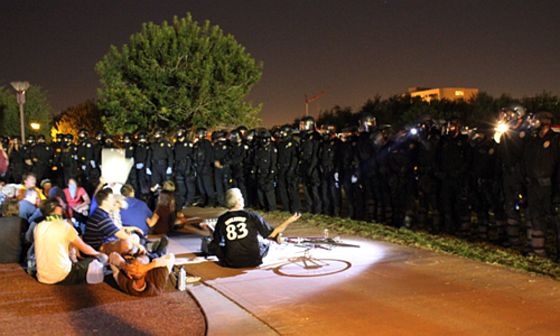
Police arrested 45 protesters attending Occupy Phoenix on Saturday night. Photo: Mauro Whiteman for the Downtown Devil.

The Associated Press reports: Authorities in Arizona arrested nearly 100 people after two separate protests in support of the Occupy Wall Street movement.

The 53 arrests in Tucson and 45 in Phoenix on Saturday night came hours after peaceful protests against financial institutions as part of a series of such demonstrations across the country. Police said demonstrators in each city failed to leave parks at curfew.

Facebooktwittermail

What’s behind the “Iranian plot”?

Laura Secor writes: The weirdness of the Arbabsiar case has, unfortunately, fed a mill that already loves to churn up conspiracies. Who benefits? Blowing up a Washington, D.C., restaurant to kill a Saudi ambassador: exactly what would Iran stand to gain? Is that particular Saudi ambassador really in the way of any Iranian political objective? It doesn’t take a foreign-policy mastermind or an evil genius to see that assassinating him could only result in increased hostilities between Iran and the United States, Saudi Arabia, and Israel. At worst, it could furnish the perfect pretext for a military attack on Iran. At best, it might provoke Saudi Arabia to harass Iran with all the means at its disposal: driving down the price of oil, suppressing Bahraini Shiites, stirring up sectarian trouble in Iraq, and encouraging the Syrian opposition, to name a few.

I’ve long believed that the Iranian regime stands to gain from provoking external antagonism— up to a point. Not war, but rumors of war: the Iranian regime excels in dancing up to the line, then drawing back. (Here again the current plot looks out of character: too brash, too clumsy, too direct.) From its very inception, the Islamic Republic defined and strengthened itself by promoting an atmosphere of siege, whether the external enemy was Iraq, the United States, or the West more generally. That the Islamic Republic is an affront to America, and that America presents a military threat and a cultural onslaught, is practically a raison d’être. After 1989, with the end of the Iran-Iraq war and the petering out of the Cold War, sustaining this atmosphere became more difficult. Fortunately for the Supreme Leader, Ali Khamenei, it got a lot easier during the Bush years, with the Axis of Evil and with U.S. troops in two neighboring countries.

The Obama Administration, however, confounded all that. It came in with a rhetoric of engagement and dialogue. And yet it took less than two years for parties on all sides to once again sound the alarm about a coming U.S. war with Iran.

I’m skeptical. Part of that is experience: the alarm has been sounding for decades, and the war never comes. Part is the creeping suspicion that too many people have too much invested in stoking hysteria. The Iranian regime wants its people to believe the Americans will attack, because it believes this will help it hang on to power. The U.S. government wants the Iranians to believe it just might attack, because otherwise the United States has very little leverage in nuclear negotiations. The Israelis want the Iranians to fear an American attack, because they believe this will deter Iranian moves against Israeli interests. The Saudis, too, would like to use a bellicose American ally as leverage against Iran, their regional rival. Then, there’s American domestic politics. The Republicans bluster against Iran to prove that they are tough and that the Democrats are appeasers; the Democrats bluster against Iran to prove that they are no such thing. The neoconservative right encourages the conclusion that the only solution is military; the anti-imperialist left forever argues that the neoconservatives are secretly steering America toward war. It could be my sheer perversity that prevents me from believing what everyone wants me to believe. Or it could be that none of these parties have satisfactorily proved that anyone actually in power believes an attack on Iran would advance American interests more than it would set them back.

Gareth Porter writes: On May 24, when Arbabsiar first met with the DEA informant he thought was part of a Mexican drug cartel, it was not to hire a hit squad to kill the ambassador. Rather, there is reason to believe that the main purpose was to arrange a deal to sell large amounts of opium from Afghanistan.

In the complaint, the closest to a semblance of evidence that Arbabsiar sought help during that first meeting to assassinate the Saudi ambassador is the allegation, attributed to the DEA informant, that Arbabsiar said he was “interested in, among other things, attacking an embassy of Saudi Arabia”.

Among the “other things” was almost certainly a deal on heroin controlled by officers in the Islamic Revolutionary Guard Corps (IRGC). Three Bloomberg reporters, citing a “federal law enforcement official”, wrote that Arbabsiar told the DEA informant he represented Iranians who “controlled drug smuggling and could provide tons of opium”.

Because of opium entering Iran from Afghanistan, Iranian authorities hold 85 percent of the world’s opium seizures, according to Iran’s Fars News Agency. Iranian security personnel, including those in the IRGC and its Quds Force, then have the opportunity to sell the opium to traffickers in the Middle East, Europe and now Mexico.

Mexican drug cartels have begun connecting with Middle Eastern drug traffickers, in many cases stationing operatives in Middle East locations to facilitate heroin production and sales, according to a report last January in Borderland Beat.

But the FBI account of the contacts between Arbabsiar and the DEA informant does not reference any discussions of drugs.

Interview with Gareth Porter — Part One:

Interview with Gareth Porter — Part Two:

Facebooktwittermail