Author Archives: News Sources

‘The right have a lot to say about parenting, but no one on the left wants to talk about this.’

In The Guardian, David Lammy, Tottenham’s Labour member of parliament, notes the absence of fathers and other adult men to serve as role models in young men’s lives and asks:

“How do you find your masculinity in the absence of role models? Through hip-hop, through gang culture, through peer groups. It is hugely problematic. Teenagers are in school until 3.30, and then MTV, Facebook, the internet, kicks in with a set of values that comes with it. It is not clear to me that parents are equipped to deal with that. There’s an inability to delay gratification, alcohol, sex, drugs – this is presenting real challenges, and as always it hurts the poorest hardest. Why? Because if you have money you can bring in other things – ballet, football classes.”

Lammy knows the subject of weak parenting is so politically explosive that he was momentarily reluctant to discuss it at such a tense juncture.

The Conservative narrative of a broken Britain, championed by Cameron and the work and pensions minister, Iain Duncan Smith, which identifies poor parenting skills as the root of most social problems, had been broadly rejected by the left, he said. “The right have a lot to say about parenting, but no one on the left wants to talk about this. A void has emerged around it. It’s a profound problem.”

He laments the closure of a number of local youth clubs as a result of funding cuts. “These were some of the people who could talk to these young people, and they’ve lost their jobs.”

Last year, he proposed the introduction of the national civic service, to help instil an ethic of service in young people, but the proposal got little traction. He would like government parenting programmes to move beyond focusing on the first few years of a child’s life. “I’ve opened so many adventure playgrounds for under fives, but what about the teenagers? Sure Start is fine, but you need it to continue until the age of 18.”

As well as maternity leave, he thinks parents of teenagers should be allowed to take chunks of time off to look after their children at difficult moments in their development. “We need to move away from a narrative that is just about the early years.”

Facebooktwittermail

Assad rebuffs Turkish envoy’s plea to end crackdown

The New York Times reports:

President Bashar al-Assad of Syria rebuffed an appeal from Turkey on Tuesday to end the Syrian crackdown that has emerged as one of the bloodiest chapters in the Arab uprising and has plunged his country into its deepest isolation in years.

Mr. Assad said in a statement after a six-hour meeting with Turkey’s foreign minister, Ahmet Davutoglu, that his government would press ahead with its fight against militant Islamists, the term the government has often used to describe the instigators of an uprising that began in March and has posed the gravest challenge to Mr. Assad’s rule.

Sana, Syria’s state news agency, quoted Mr. Assad as telling Mr. Davutoglu that Damascus “will not relent in pursuing the terrorist groups in order to protect the stability of the country and the security of the citizens.”

“But it is also determined to continue reforms. And is open to any help offered by friendly and brotherly states,” the statement published by Sana said.

The Turkish foreign minister arrived in Syria on Tuesday morning to deliver a message that Prime Minister Recep Tayyip Erdogan has summarized as Ankara’s having “run out of patience” with a crackdown that has killed, by the count of some Syrian opposition groups, more than 2,000 people.

The Associated Press reports:

The Obama administration is preparing to explicitly demand the departure of Syrian President Bashar Assad and hit his regime with tough new sanctions, U.S. officials said Tuesday as the State Department signaled for the first time that American efforts to engage the government are finally over.

The White House is expected to lay out the tougher line by the end of this week, possibly on Thursday, according to officials who said the move will be a direct response to Assad’s decision to step up the ruthlessness of the crackdown against pro-reform demonstrators by sending tanks into opposition hotbeds. The officials spoke on condition of anonymity to discuss internal administration deliberations.

President Barack Obama and other top U.S. officials previously had said Assad has “lost legitimacy” as a leader and that he either had to spearhead a transition to democracy or get out of the way. They had not specifically demanded that he step down. The new formulation will make it clear that Assad can no longer be a credible reformist and should leave power, the officials said.

Rana Kabbani writes:

One of two eye doctors are determining the future of Syria. The first is alive and kicking: son of a brutal military dictator; heir to a corrupt family junta that has ruled the country for 41 years. The second is a long-dead private citizen, buried at the bottom of his family’s modest garden.

Dr Hikmat Khani was head of Hama’s national hospital when, in 1982, his city was besieged and bombarded on the orders of Bashar Assad’s father Hafiz and his uncle Rif’at. To rout 1,500 armed Islamists there, the Assads killed 25,000 innocent civilians. Tens of thousands were rounded up and tortured. Young girls were gang-raped and women had their hands chopped off so their bracelets could be stolen more quickly after their men had been murdered.

The maimed lay on the streets of the half-flattened city, crying out in agony, as many eyewitnesses have recounted since. Dr Khani sought to help what wounded he could treat. For this, he was taken to the state porcelain factory, which had been turned into a detention centre. There, this renowned specialist was made an example of in front of the other prisoners. He had his right eye gouged out, then was left to bleed for three hours before being beaten to death. His broken mess of a body was sent to his pregnant wife, with his identity card nailed to his naked chest.

Today Hama is being bombarded in much the same way by Bashar and Maher, with weaponry paid for by an impoverished Syrian people through the stiff “defence tax”. It is thus that Deraa, Deir Ezzor, Qamishli, Homs, Hama, Latakia, Maarat al-Numan, Idlib, Jisr al-Shughour, Muadhamiya, Zabadani, Midan and all our other towns and cities and quarters have been made to subsidise the murder of their own sons and daughters.

Though all the undemocratic regimes of the Arab world are unremittingly cruel, Assad’s must stand out as the most inventively macabre. Its brutish, uncouth, illiterate and famously greedy Shabbiha death squads are being bussed around the country, with orders to rape, loot, burn, and kill. It is they who pull out the fingernails of young boys, they who torture them to death, castrate their bodies, only to force their grief-crazed parents to recant their accusations on the state’s propaganda television.

Facebooktwittermail

Breivik embodies the intersection between rightist populism and liberal political correctness

The philosopher, Slavoj Žižek, writes:

In Anders Behring Breivik’s ideological self-justification as well as in reactions to his murderous act there are things that should make us think. The manifesto of this Christian “Marxist hunter” who killed more than 70 people in Norway is precisely not a case of a deranged man’s rambling; it is simply a consequent exposition of “Europe’s crisis” which serves as the (more or less) implicit foundation of the rising anti-immigrant populism – its very inconsistencies are symptomatic of the inner contradictions of this view.

The first thing that sticks out is how Breivik constructs his enemy: the combination of three elements (Marxism, multiculturalism and Islamism), each of which belongs to a different political space: the Marxist radical left, multiculturalist liberalism, Islamic religious fundamentalism. The old fascist habit of attributing to the enemy mutually exclusive features (“Bolshevik-plutocratic Jewish plot” – Bolshevik radical left, plutocratic capitalism, ethnic-religious identity) returns here in a new guise.

Even more indicative is the way Breivik’s self-designation shuffles the cards of radical rightist ideology. Breivik advocates Christianity, but remains a secular agnostic: Christianity is for him merely a cultural construct to oppose Islam. He is anti-feminist and thinks women should be discouraged from pursuing higher education; but he favours a “secular” society, supports abortion and declares himself pro-gay.

His predecessor in this respect was Pim Fortuyn, the Dutch rightist populist politician who was killed in early May 2002, two weeks before elections in which he was expected to gain one fifth of the votes. Fortuyn was a paradoxical figure: a rightist populist whose personal features and even opinions (most of them) were almost perfectly “politically correct”. He was gay, had good personal relations with many immigrants, displayed an innate sense of irony – in short, he was a good tolerant liberal with regard to everything except his basic stance towards Muslim immigrants.

What Fortuyn embodied was thus the intersection between rightist populism and liberal political correctness. Indeed, he was the living proof that the opposition between rightist populism and liberal tolerance is a false one, that we are dealing with two sides of the same coin: ie we can have a racism which rejects the other with the argument that it is racist.

Furthermore, Breivik combines Nazi features (also in details – for example, his sympathy for Saga, the Swedish pro-Nazi folk singer) with a hatred of Hitler: one of his heroes is Max Manus, the leader of the Norway anti-Nazi resistance. Breivik is not so much racist as anti-Muslim: all his hatred is focused on the Muslim threat.

And, last but not least, Breivik is antisemitic but pro-Israel, as the state of Israel is the first line of defence against the Muslim expansion – he even wants to see the Jerusalem temple rebuilt. His view is that Jews are OK as long as there aren’t too many of them – or, as he wrote in his manifesto: “There is no Jewish problem in western Europe (with the exception of the UK and France) as we only have 1 million in western Europe, whereas 800,000 out of these 1 million live in France and the UK. The US, on the other hand, with more than 6 million Jews (600% more than Europe) actually has a considerable Jewish problem.” He realises the ultimate paradox of a Zionist Nazi – how is this possible?

A key is provided by the reactions of the European right to Breivik’s attack: its mantra was that in condemning his murderous act, we should not forget that he addressed “legitimate concerns about genuine problems” – mainstream politics is failing to address the corrosion of Europe by Islamicisation and multiculturalism, or, to quote the Jerusalem Post, we should use the Oslo tragedy “as an opportunity to seriously re-evaluate policies for immigrant integration in Norway and elsewhere”. The newspaper has since apologised for this editorial. (Incidentally, we are yet to hear a similar interpretation of the Palestinian acts of terror, something like “these acts of terror should serve as an opportunity to re-evaluate Israeli politics”.)

A reference to Israel is, of course, implicit in this evaluation: a “multicultural” Israel has no chance to survive; apartheid is the only realistic option. The price for this properly perverse Zionist-rightist pact is that, in order to justify the claim to Palestine, one has to acknowledge retroactively the line of argumentation which was previously, in earlier European history, used against the Jews: the implicit deal is “we are ready to acknowledge your intolerance towards other cultures in your midst if you acknowledge our right not to tolerate Palestinians in our midst”.

Facebooktwittermail

Syrian death toll passes 2,000

The Guardian reports:

Syria defied Arab isolation and mounting international anger on Monday as President Bashar al-Assad’s security forces continued attacks on pro-democracy protesters across the country.

The US secretary of state, Hillary Clinton, urged al-Assad to return his troops to barracks and release all prisoners, one of the bluntest demands yet made of the Syrian leader, after regional powerhouse Saudi Arabia led a rare chorus of Arab states in condemning the repression.

Reports from Deir al-Zor described artillery and heavy machinegun fire and snipers on roofs as troops and intelligence agents carried out mass arrests in the north-eastern city. On Sunday, 42 people were killed there, nudging the death total during five months of the uprising to more than 2,000.

Brian Whitaker writes:

Saudi Arabia has become the first Arab country to take a firm stand against the Syrian regime’s killing of civilians. In a statement issued late on Sunday night, King Abdullah demanded an end to the bloodshed and announced that the kingdom was recalling its ambassador from Damascus.

There are only two options for Syria, the king said: “Either it chooses wisdom willingly, or drifts into the depths of chaos and loss.” He called for “quick and comprehensive reforms” – “reforms that are not entwined with promises, but actually achieved so that our brothers the citizens in Syria can feel them in their lives”.

These are the strongest comments made so far by any Arab leader, and on that basis we should probably welcome them – especially if they encourage other countries in the region to take a stand. But, as one Twitter user noted, the king’s denunciation of the Assad regime does make him sound a bit like Al Capone condemning the Kray twins.

Back home, King Abdullah has shown no inclination towards the “quick and comprehensive reforms” that he is now urging upon Syria; Saudi Arabia has nothing to teach Syria about democracy, and protest demonstrations in the kingdom are totally banned. So the king’s message to Syria betrays more than a little irony.

Perhaps more troubling, though, is the negative role that Saudi Arabia has been playing during the “Arab spring” – a role that now it seems to be extending to include Syria.

Facebooktwittermail

In valley where SEALs died, U.S. raids boost Taliban support

McClatchy reports:

The 30 U.S. soldiers, many of them Navy SEALs, who died Saturday in the U.S. military’s single biggest loss of the Afghan war, were operating in a Taliban-controlled valley where frequent U.S.-led night raids have won the insurgents popular support, area residents said Sunday.

The raids occur “every night. We are very much miserable,” said Roshanak Wardak, a doctor and a former member of the national Parliament. “They are coming to our houses at night.”

Wardak runs a clinic about 3 miles from the rugged Tangi Valley where insurgents early Saturday shot down a helicopter carrying the U.S. troops, an Afghan translator and seven Afghan commandoes.

Night raids have become a significant part of the U.S. strategy aimed at weakening the insurgents and compelling their leaders to accept U.S. and Afghan government offers to hold talks on a political settlement of the decade-old war.

The Taliban have suffered heavy losses in the operations, which have soared since last year to an average of 340 per month, according to a Western intelligence official, who requested anonymity in order to discuss the issue.

There has been no apparent progress toward convening peace talks, but U.S. commanders defend the raids as effective in eliminating and capturing insurgents, and gaining intelligence that leads to other militants and arms caches.

“Eight-five percent are shots not fired, when you’re talking about night raids and disruption,” said the Western intelligence official. “Over 50 percent of the time they hit the target that they’re after, which shows the intelligence has been accurate.”

Afghan commandoes participate in all such operations, he added.

The tactic, however, has proven highly controversial with ordinary Afghans amid charges that they claim civilian lives. President Hamid Karzai has demanded that they stop.

Residents of the Tangi Valley area, in eastern Wardak Province, about 60 miles southwest of Kabul, issued similar complaints about the night raids in their vicinity, charging that they have killed civilians, disrupted their lives and fueled popular support for the Taliban.

“There are night raids every day or every other day,” said a second doctor who asked not to be identified because he feared for his safety. He said he lives about 100 yards from the parched riverbed where the U.S. Chinook helicopter crashed.

“The Americans are committing barbaric acts in the area and this is the reason that the Taliban have influence,” he said.

Facebooktwittermail

Israel’s Arab citizens must join the social struggle

Oudeh Basharat writes:

In days gone by there were long lines of cars at the gas stations on the eve of a rise in prices. The late comedian Dudu Topaz ridiculed the Israeli citizen who “puts one over” on the state by stocking up before the price increase, opportunistic individualism was at its zenith, and people used elbows energetically to obtain yet one more cheap liter of fuel.

Moreover, up until half an hour before the Rothschild intifada erupted, the economics reporters were still feeding us stories about the paradise in which we live, about the wonders of the Israeli economy that survived the worldwide crash. The ordinary citizen asked himself: If the economy is so far up, why are we so far down?

Now, it emerges, the economic press has been like a cunning high-school principal who allows five of 40 students to take the matriculation exams, and then boasts of 100 percent success. For the tycoons everything is glitzy whereas nobody ever goes to see the backyard. And all along representatives of the government and the “court” reporters explained that Israel is the only democracy in the Middle East, and the masses who couldn’t make it until the end of the month were urged to stand tall and show their pride in this hollow patriotism.

After a while, however, the masses discovered that in the only democracy there is no voice except that of swinish capitalism, and an opposition functioning as the coalition’s watchdog. The dizzying economic “success” was the second episode in the series; in the first, Finance Minister Benjamin Netanyahu – during his term in Prime Minister Ariel Sharon’s government – wiped out the welfare state, and the press told us that the Israeli economy had been saved. About this kind of paradox, people say: “The operation was a success, but the patient died.”

This month it has emerged that this dead man is alive and kicking – and hurting. “I wonder from where you came to know the struggle?” poet Abdel Rahman Abnoudi asked the young people at Tahrir Square in Cairo, the “mother” of all squares. There as here, after years of despondency, they had eulogized the young generation. They had convinced them it wasn’t worth struggling because there was no other way: either corrupt dictatorship or fanatical religious zealousness. In this country, they convinced the young people that there was nothing to be done: The choice was either Prime Minister Benjamin Netanyahu and Foreign Minister Avigodor Lieberman with the tycoons – or opposition leader Tzipi Livni with Lieberman and the tycoons.

The young people of Rothschild, like the young people of Tahrir, have proved that revolutions bubble like subterranean currents, and even when they are not visible they continue to flow. This outburst will grow even stronger and will start to raise fundamental questions about the connections between the huge investment in the settlements and the worsening plight of other citizens. This outburst will yet lead the Rothschild revolutionaries, who are fighting against the tycoons’ exploitation, to conclude that they cannot fight their exploiters and at the same time be the exploiters of the another people’s young population.

The Arab population, schooled in suffering and struggles, is watching what is happening on Rothschild with tremendous sympathy. The fight against exploitation has captured its heart – whether in Tel Aviv or in Aleppo. After the bitter experience that has been this population’s lot, the state is perceived as destructive, not constructive.

The Arab citizens and their leadership must now join the general struggle and insist that the government treat them as equal citizens. This integration will be a worthy opening shot in a process that will lead to deeper understanding of the civil essence of their struggle.

And let us return to Abnoudi, who warned the Tahrir revolutionaries about “the wolves.” This advice is also sound for the Rothschild revolutionaries. After all, in the tall buildings where the lights are burning nonstop, people are not necessarily working on rectifying injustice. Perhaps someone there is thinking about how to make the September tsunami happen sooner.

Facebooktwittermail

News Corp.’s soft power in the U.S.

David Carr writes:

Over the last month, many Americans watched from a distance in horror or amusement as it became evident that the News Corporation regarded Britain’s legal and political institutions as its own private club.

That could never happen in the United States, right?

As it turns out, a News Corporation division has twice come under significant civil and criminal investigations in the United States, but neither inquiry went anywhere. Given what has happened in Britain with the growing phone-hacking scandal, it is worth wondering why.

Both cases involve News America Marketing, an obscure but lucrative division of the News Corporation that is a big player in the business of retail marketing, including newspaper coupon inserts and in-store promotions. The company has come under scrutiny for a pattern of conduct that includes below-cost pricing, paying customers not to do business with competitors and accusations of computer hacking.

News America Marketing came to control 90 percent of the in-store advertising business, according to Fortune, aided in part by a particularly quick and favorable antitrust decision made by the Justice Department in 1997. That year, the News Corporation announced it wanted to buy Heritage Media, a big competitor, for about $754 million in stock plus $600 million in assumed debt. The News Corporation said it would sell the broadcast properties and hang onto the marketing division, which serviced 40,000 groceries and other retailers.

The deal would make News America Marketing the dominant player in the business and, for that reason, the San Francisco field office of the Justice Department recommended to Washington that the News Corporation’s takeover bid be challenged on antitrust grounds. Typically, such a request from a field office would carry great weight in Washington and, at a minimum, delay the deal for months.

But the Justice Department brass overrode San Francisco’s objections and gave its blessing in just two weeks. So who ran the antitrust division at the Justice Department at the time? Joel Klein, who this year became an executive vice president at the News Corporation, head of its education division and a close adviser to Rupert Murdoch on the phone-hacking scandal in Britain.

Facebooktwittermail

Enter the cyber-dragon

In the September issue of Vanity Fair, Michael Joseph Gross writes:

Lying there in the junk-mail folder, in the spammy mess of mortgage offers and erectile-dysfunction drug ads, an e-mail from an associate with a subject line that looked legitimate caught the man’s eye. The subject line said “2011 Recruitment Plan.” It was late winter of 2011. The man clicked on the message, downloaded the attached Excel spreadsheet file, and unwittingly set in motion a chain of events allowing hackers to raid the computer networks of his employer, RSA. RSA is the security division of the high-tech company EMC. Its products protect computer networks at the White House, the Central Intelligence Agency, the National Security Agency, the Pentagon, the Department of Homeland Security, most top defense contractors, and a majority of Fortune 500 corporations.

The parent company disclosed the breach on March 17 in a filing with the Securities and Exchange Commission. The hack gravely undermined the reputation of RSA’s popular SecurID security service. As spring gave way to summer, bloggers and computer-security experts found evidence that the attack on RSA had come from China. They also linked the RSA attack to the penetration of computer networks at some of RSA’s most powerful defense-contractor clients—among them, Lockheed Martin, Northrop Grumman, and L-3 Communications. Few details of these episodes have been made public.

The RSA and defense-contractor hacks are among the latest battles in a decade-long spy war. Hackers from many countries have been exfiltrating—that is, stealing—intellectual property from American corporations and the U.S. government on a massive scale, and Chinese hackers are among the main culprits. Because virtual attacks can be routed through computer servers anywhere in the world, it is almost impossible to attribute any hack with total certainty. Dozens of nations have highly developed industrial cyber-espionage programs, including American allies such as France and Israel. And because the People’s Republic of China is such a massive entity, it is impossible to know how much Chinese hacking is done on explicit orders from the government. In some cases, the evidence suggests that government and military groups are executing the attacks themselves. In others, Chinese authorities are merely turning a blind eye to illegal activities that are good for China’s economy and bad for America’s. Last year Google became the first major company to blow the whistle on Chinese hacking when it admitted to a penetration known as Operation Aurora, which also hit Intel, Morgan Stanley, and several dozen other corporations. (The attack was given that name because the word “aurora” appears in the malware that victims downloaded.) Earlier this year, details concerning the most sweeping intrusion since Operation Aurora were discovered by the cyber-security firm McAfee. Dubbed “Operation Shady rat,” the attacks (of which more later) are being reported here for the first time. Most companies have preferred not to talk about or even acknowledge violations of their computer systems, for fear of panicking shareholders and exposing themselves to lawsuits—or for fear of offending the Chinese and jeopardizing their share of that country’s exploding markets. The U.S. government, for its part, has been fecklessly circumspect in calling out the Chinese.

Facebooktwittermail

Mossad behind Tehran assassinations, says source

Der Spiegel reports:

One atomic researcher after the other has died in a series of recent murders in Iran. Is Israel’s Mossad trying to sabotage the construction of a nuclear bomb with the attacks? Officials in Jerusalem aren’t denying anything. Israeli military generals are even more hawkish, and their calls for air strikes on Iran are growing louder.

“Israel is not responding,” Israeli Defense Minister Ehud Barak said earlier this week when asked if his country had been involved in the latest slaying of an Iranian nuclear scientist. It didn’t exactly sound like a denial, and the smile on his face suggested Israel isn’t too bothered by suspicions that it is responsible for a series of murders of physicists involved in the controversial Iranian nuclear program.

There is little doubt in the shadowy world of intelligence agencies that Israel is behind the assassination of Darioush Rezaei. “That was the first serious action taken by the new Mossad chief Tamir Pardo,” an Israeli intelligence source told SPIEGEL ONLINE.

On July 23, Rezaei became the latest victim in a mysterious series of attacks over the past 20 months which has seen the virtual decimation of the Islamic republic’s elite physicists. The 35-year-old died after being shot in the throat in front of his daughter’s kindergarten in east Tehran. The Iranian press has reported that the two alleged perpetrators in the attack escaped on a motorcycle.

So who was the man who was shot in front of his wife and daughter? Israeli media reported the scientist, who had a PhD in physics, was working on the development of a trigger for a nuclear warhead. The physicist had apparently been seen daily at a nuclear research center in northern Tehran. An official from a member nation of the Vienna-based International Atomic Energy Agency later told the Associated Press that Rezaei had participated in developing high-voltage switches, a key component in setting off the explosions needed to trigger a nuclear warhead.

The fact that Rezaei’s death has struck a nerve in Iran is apparent in the official reaction to the killing. Kazem Jalali, the head of the Iranian parliament’s national security committee, said the murder of Iranian physicists showed that the United States and Israel are “desperate” in the face of Tehran’s nuclear ambitions.

Facebooktwittermail

Israel’s J14 protest movement may challenge something even deeper than the occupation

Dimi Reider writes:

The social justice demonstrations have been accused of ignoring the key issue of the occupation. But their tremendous groundswell of solidarity and cooperation is slowly gnawing at something even more significant than that – the principle of separation, of which the occupation is just one exercise.

One of the most impressive aspects of the J14 movement is how quickly it is snowballing, drawing more and more groups and communities into a torrent of discontent. Pouring out into the streets is everything that Israelis, of all national identities, creeds and most classes complained about for years: The climbing rents, the rising prices on fuel, the parenting costs, the free-fall in the quality of public education, the overworked, unsustainable healthcare system, the complete and utter detachment of most politicians, on most levels, from most of the nation.

All this has been obfuscated for decades by the conflict, by a perpetual state of emergency; one of the benefits from leaving the occupation outside the protests, for now, was to neutralise the entire discourse of militarist fear-mongering. Contrary to what Dahlia and Joseph wrote last week, the government so far utterly failed to convince the people military needs must come before social justice; Iran has largely vanished from the news pages, and attempts to scare Israelis with references to a possible escalation with Lebanon or the Palestinian are relegated to third, fourth and fifth places in the headlines, with the texts often written in a sarcastic tone rarely employed in Israeli media on “serious” military matters.

Over the past week, though, the Palestinians themselves have begun gaining presence in the protests; not as an external threat or exclusively as monolithic victims of a monolithic Israel, but as a part and parcel of the protest movement, with their demands to rectify injustices unique to the Palestinians organically integrating with demands made by the protests on behalf of all Israelis.

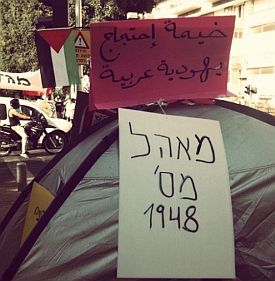
First, a tent titled “1948″ was pitched on Rothschild boulevard, housing Palestinian and Jewish activists determined to discuss Palestinian collective rights and Palestinian grievances as a legitimate part of the protests. They activists tell me the arguments are exhaustive, wild and sometimes downright strange; but unlike the ultra-right activists who tried pitching a tent calling for a Jewish Tel Aviv and hoisting homophobic signs, the 1948 tenters were not pushed out, and are fast becoming part of the fabric of this “apolitical” protest.

A few days after the 1948 tent was pitched, the council of the protests – democratically elected delegates from 40 protest camps across the country – published their list of demands, including, startlingly, two of the key social justice issues unique to the Palestinians within Israel: Sweeping recognition of unrecognised Bedouin villages in the Negev; and expanding the municipal borders of Palestinian towns and villages to allow for natural development.

The demands chimed in perfectly with the initial drive of the protest – lack of affordable housing. Neither issue has ever been included in the list of demands of a national, non-sectarian movement capable of bringing 300,000 people out into the streets.

And, finally, on Wednesday, residents of the Jewish poverty-stricken neighbourhood of Hatikva, many of them dyed-in-the-wool Likud activists, signed a covenant of cooperation with the Palestinian and Jewish Jaffa protesters, many of them activists with Jewish-Palestinian Hadash and nationalist-Palestinian Balad. They agreed they had more in common with each other than with the middle class national leadership of the protest, and that while not wishing to break apart from the J14 movement, they thought their unique demands would be better heard if they act together. At the rally, they marched together, arguing bitterly at times but sticking to each other, eventually even chanting mixed Hebrew and Arabic renditions of slogans from Tahrir.

Facebooktwittermail

How Israel trains its children to hate and kill Palestinians

The Guardian reports:

Nurit Peled-Elhanan, an Israeli academic, mother and political radical, summons up an image of rows of Jewish schoolchildren, bent over their books, learning about their neighbours, the Palestinians. But, she says, they are never referred to as Palestinians unless the context is terrorism.

They are called Arabs. “The Arab with a camel, in an Ali Baba dress. They describe them as vile and deviant and criminal, people who don’t pay taxes, people who live off the state, people who don’t want to develop,” she says. “The only representation is as refugees, primitive farmers and terrorists. You never see a Palestinian child or doctor or teacher or engineer or modern farmer.”

Peled-Elhanan, a professor of language and education at the Hebrew University of Jerusalem, has studied the content of Israeli school books for the past five years, and her account, Palestine in Israeli School Books: Ideology and Propaganda in Education, is to be published in the UK this month. She describes what she found as racism– but, more than that, a racism that prepares young Israelis for their compulsory military service.

“People don’t really know what their children are reading in textbooks,” she said. “One question that bothers many people is how do you explain the cruel behaviour of Israeli soldiers towards Palestinians, an indifference to human suffering, the inflicting of suffering. People ask how can these nice Jewish boys and girls become monsters once they put on a uniform. I think the major reason for that is education. So I wanted to see how school books represent Palestinians.”

In “hundreds and hundreds” of books, she claims she did not find one photograph that depicted an Arab as a “normal person”. The most important finding in the books she studied – all authorised by the ministry of education – concerned the historical narrative of events in 1948, the year in which Israel fought a war to establish itself as an independent state, and hundreds of thousands of Palestinians fled the ensuing conflict.

The killing of Palestinians is depicted as something that was necessary for the survival of the nascent Jewish state, she claims. “It’s not that the massacres are denied, they are represented in Israeli school books as something that in the long run was good for the Jewish state. For example, Deir Yassin [a pre-1948 Palestinian village close to Jerusalem] was a terrible slaughter by Israeli soldiers. In school books they tell you that this massacre initiated the massive flight of Arabs from Israel and enabled the establishment of a Jewish state with a Jewish majority. So it was for the best. Maybe it was unfortunate, but in the long run the consequences for us were good.”

Children, she says, grow up to serve in the army and internalise the message that Palestinians are “people whose life is dispensable with impunity. And not only that, but people whose number has to be diminished.”

Facebooktwittermail

When Truman opened the nuclear era — with a lie

Greg Mitchell writes:

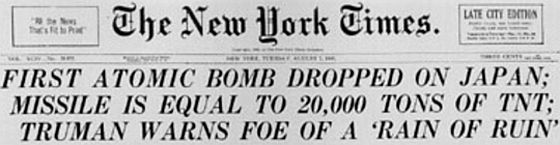
On August 6, 1945, President Harry S. Truman faced the task of telling the press, and the world, that America’s crusade against fascism had culminated in exploding a revolutionary new weapon of extraordinary destructive power over a Japanese city.

It was vital that this event be understood as a reflection of dominant military power and at the same time consistent with American decency and concern for human life. Everyone involved in preparing the presidential statement sensed that the stakes were high, for this marked the unveiling of both the atomic bomb and the official narrative of Hiroshima.

When the astonishing news emerged that morning, exactly sixty-six years ago, it took the form of a routine press release, a little more than a thousand words long. President Truman was at sea a thousand miles away, returning from the Potsdam conference. Shortly before eleven o’clock, an information officer from the War Department arrived at the White House bearing bundles of press releases. A few minutes later, assistant press secretary Eben Ayers began reading the president’s announcement to about a dozen members of the Washington press corps.

The atmosphere was so casual, and the statement so momentous, that the reporters had difficulty grasping it. “The thing didn’t penetrate with most of them,” Ayers later remarked. Finally, they rushed to call their editors, and at least one reporter found a disbeliever at the other end of the line. The first few sentences of the statement set the tone:

“Sixteen hours ago an American airplane dropped one bomb on Hiroshima, an important Japanese Army base. That bomb had more power than 20,000 tons of TNT.… The Japanese began the war from the air at Pearl Harbor. They have been repaid many fold.… It is an atomic bomb. It is a harnessing of the basic power of the universe.”

Although details were modified at the last moment, Truman’s four-page statement had been crafted with considerable care over many months. If use of the atomic bomb was inherent in its invention, an announcement of this sort was inevitable. Only the timing was in doubt.

From its very first words, however, the official narrative was built on a lie. Hiroshima was not an “army base” but a city of 350,000. It did contain one important military base, but the bomb had been aimed at the very center of a city (and far from its industrial area). This was a continuation of the American policy of bombing civilian populations in Japan to undermine the morale of the enemy. It was also to take advantage of what those who picked the targed called the special “focusing effect” provided by the hills which surrounded the city on three sides. This would allow the blast to bounce back on the city, destroying more of it, and its citizens.

The vast majority of the dead in Hiroshima would not be military personnel and defense workers but women and children.

There was something else missing in Truman’s announcement: because the president in his statement failed to mention radiation effects, which officials knew were horrendous, the imagery of just a bigger bomb would prevail in the press. Truman described the new weapon as “revolutionary” but only in regard to the destruction it could cause, failing to mention its most lethal new feature: radiation.

Many Americans first heard the news from the radio, which broadcast the text of Truman’s statement shortly after its release. The afternoon papers quickly arrived with banner headlines: “Atom Bomb, World’s Greatest, Hits Japs!” and “Japan City Blasted by Atomic Bomb.” The Pentagon had released no pictures, so most of the newspapers relied on maps of Japan with Hiroshima circled.

By that evening, radio commentators were weighing in with observations that often transcended Truman’s announcement, suggesting that the public imagination was outrunning the official story. Contrasting emotions of gratification and anxiety had already emerged. H.V. Kaltenhorn warned, “We must assume that with the passage of only a little time, an improved form of the new weapon we use today can be turned against us.”

It wasn’t until the following morning, August 7, that the government’s press offensive appeared, with the first detailed account of the making of the atomic bomb, and the Hiroshima mission. Nearly every US newspaper carried all or parts of fourteen separate press releases distributed by the Pentagon several hours after the president’s announcement. They carried headlines such as: “Atom Bombs Made in 3 Hidden Cities” and “New Age Ushered.”

Many of them written by one man: W.L. Laurence, a Pulitzer Prize–winning reporter for the New York Times, “embedded” with the atomic project. General Leslie Groves, military director of the Manhattan Project, would later reflect, with satisfaction, that “most newspapers published our releases in their entirety. This is one of the few times since government releases have become so common that this has been done.”

Facebooktwittermail

Egypt comes to Israel

Noam Sheizaf reports:

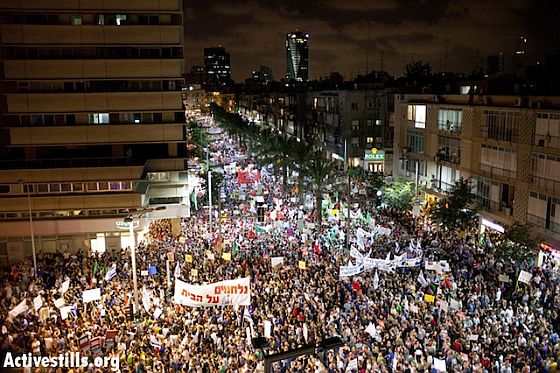
Around 300 thousands Israelis took the streets on Saturday night, calling for social justice and the introduction of a welfare state. Estimates are that this has been the largest demonstration in the country’s history.

The biggest of several rallies took place in Tel Aviv, where over 200,000 marched to the government building on Kaplan Street (Rabin Square, the usual site of such protests, is being renovated and was closed to the public). 30,000 marched in Jerusalem to PM Netanyahu’s house. Smaller rallies were held in Modi’in, Haifa, Nes Tziona and other towns. In Kiryat Shmone, protesters blocked the highway leading north.

Despite attempts by the organizers to convey a non-partisan message, many of the demonstrators directed their calls at Prime Minister Binyamin Netanyahu, and some held signs calling for his resignation. Former activist and Hadash MK called to the protesters: “With you, we will win over this pathetic government.” As was the case in previous rallies, the most popular call was “the people demand social justice,” followed by “Here comes the welfare state.”

Gideon Levy writes:

Tel Aviv was bursting at the seams last night. It was not the mother of all protests – it was the grandmother of all protests. The city looked yesterday like one of the stormiest cities on earth. Streams of people were flowing in every direction, some on foot, some in cars. Buses and trains spewed out the crowds, and not everyone even managed to get to the area of the protest. An amazingly large sign, in Hebrew and Arabic – the latter is about to cease being an official language in this country – read “Egypt is here.”

Indeed, the pictures last night looked like the nights of Tahrir Square. Now the comparison to the Cairo revolution is not exaggerated or wishful thinking. Now it really does resemble it, not including the violence, of course.

And really, when size talks, as it did last night, violence is not needed. A regime that remains impassive to such gigantic rallies would be completely insensitive, and in any case is destined to fall.

Prime Minister Benjamin Netanyahu can go on joking with his ministers; his fate is sealed. The cynics can continue tsk-tsking and talking about the “confused” and “spoiled” protest, and yet, a protest it is, the likes of which has never been seen here.

Facebooktwittermail

After historic downgrade, U.S. must address its chronic debt problems

A commentary in China’s official Xinhua News Agency says:

The days when the debt-ridden Uncle Sam could leisurely squander unlimited overseas borrowing appeared to be numbered as its triple A-credit rating was slashed by Standard & Poor’s (S&P) for the first time on Friday.

Though the U.S. Treasury promptly challenged the unprecedented downgrade, many outside the United States believe the credit rating cut is an overdue bill that America has to pay for its own debt addition and the short-sighted political wrangling in Washington.

Dagong Global, a fledgling Chinese rating agency, degraded the U.S. treasury bonds late last year, yet its move was met then with a sense of arrogance and cynicism from some Western commentators. Now S&P has proved what its Chinese counterpart has done is nothing but telling the global investors the ugly truth.

China, the largest creditor of the world’s sole superpower, has every right now to demand the United States to address its structural debt problems and ensure the safety of China’s dollar assets.

To cure its addiction to debts, the United States has to reestablish the common sense principle that one should live within its means.

Facebooktwittermail

‘Israel is inadvertently becoming a part of the Middle East’

Amira Hass reports:

Palestinian social leaders believe the social protests that have erupted throughout Israel are largely influenced by the Arab Spring, contending Israelis must realize they too are suffering due to the occupation and money spent on settlements in the West Bank.

Israelis are imitating the Arab world, and West Bank Palestinians believe this to be a good thing. According to the Ma’an news agency, 14,032 (nearly 75%) of the 18,722 readers who responded to their online survey, believe that what is happening in Israel’s streets is influenced by and imitating the “Arab Spring”.

“Israel is inadvertantly becoming a part of the Middle East,” said sociologist Honaida Ghanim, who researches Israeli society, adding that “this is the power of bottom-up activity, when the country’s ideologists aren’t consulted.”

Ghanim wasn’t surprised when the protests began. As an Israeli citizen, born in Marja and General Director of “MADAR” the Palestinian Forum for Israeli Studies, the sociologist is well acquainted with Israeli polarization. However, she is certain that the recent events in Egypt and Tunisia had a large impact on the Israeli protest movement.

Sufian Abu Zaida is a member of Fatah and former prisoner, who currently teaches about Israeli society in the Birzeit University and the Al-Quds Open University. He was born in Jabaliya, a refugee camp in the Gaza Strip, to a family of refugees from the town Burayr (today Bror Hayil).

The Palestinian teacher promises to remind his students next year that “this might be the first thing Israelis learnt from Arabs. They have always presented themselves as the only positive ray of light in a pitch black Middle East. Suddenly there is something to learn from these retards.”

Ghanim cited additional sociological factors as part of the impetus for change in Israel, saying “on the one hand, there is neo-liberalism and globalization that have resulted in an unacceptable gap between the wealth of the state and individuals and the harshness of life for the masses. On the other hand, these are similar tools – online social networks, with Facebook heading the list, which had a far-reaching effect on the media.”

Despite this, there isn’t much interest among the Palestinians in the protest occupying Israel for over three weeks. “We are a people in perpetual struggle with the government, three weeks of protest are not long enough to seriously catch our attention,” said Nariman al-Tamimi, from Nabi Salih, and Afaf Ghatasha, a feminist activist and member of the Palestinian People’s Party.

However, they are both impressed – as are other Palestinians –that the Israeli movement is geared toward improving the already high level standard of living in Israel in comparison to that of most Palestinians. Israelis are making “demands that are luxuries,” according to Ghatasha.

Facebooktwittermail

Tent 1948

Abir Kopty writes:

If you are Palestinian, it will be difficult to find anything to identify with in Tel Aviv’s tents’ city, until you reach Tent 1948. My first tour there was a few days ago, when I decided to join Tent 1948. Tent 1948’s main message is that social justice should be for all. It brings together Jewish and Palestinian citizens who believe in shared sovereignty in the state of all its citizens.

For me, as Palestinian, I don’t feel part of the July 14 movement, and I’m not there because I feel part, almost every corner of this encampment reminds me that this place does not want me. My first tour there was pretty depressing, I found lots of Israeli flags, a man giving a lecture to youth about his memories from ’48 war’ from a Zionist perspective, another group marching with signs calling for the release of Gilad Shalit, another singing Zionist songs. This is certainly not a place that the 20% of the population would feel belong to. The second day I found Ronen Shuval, from Im Tirtzu, the extreme right wing organization giving a talk full of incitement and hatred to the left and human rights organizations. Settlers already set a tent and were dancing with joy.

The existence of Tent 1948 in the encampment constitutes a challenge to people taking part in the July 14 movement. In the first few days, the tent was attacked by group of rightwing activists, who beat activists in the tent and broke down the Palestinian flag of the tent. Some of the leaders of the July 14 movement have said clearly that raising core issues related to Palestinian community in Israel or the occupation will make the struggle “lose momentum”. They often said the struggle is social, not political, as if there was a difference. They are afraid of losing supporters if they make Palestinian issues bold.

The truth is that this is the truth.

The truth is, this is exactly what might help Netanyahu, if he presses the button of fear, recreates the ‘enemy’ and reproduce the ‘security threat’, he might be able to silence this movement. The problem is not with Netanyahu, he is not the first Israeli leader to rely on this. The main problem is that Israelis are not ready yet to see beyond the walls surrounding them.

Facebooktwittermail