The US suffered its worst single loss of life in the nearly 10-year Afghan war when a helicopter carrying 31 special forces soldiers crashed on Friday night in the east of the country.
Both the Taliban, via a spokesman reached by telephone, and Afghan officials in Wardak province, to the west of Kabul, said insurgents had shot down the Chinook helicoter with a rocket.
Nato would only confirm that “there was enemy activity in the area” and that the US-led alliance was still trying to work out what had happened. US air force captain Justin Brockhoff, a Nato spokesman, said: “We are in the process of accessing the facts.”
A western official said 37 people were on board, all of whom were killed. The Afghan president, Hamid Karzai, said the helicopter was carrying 31 US special forces and seven members of the Afghan national army.
It is very unusual for Nato deaths from a single incident to reach double figures. The previous most deadly day for foreign troops was in June 2005 when 16 US soldiers were killed when a Taliban rocket hit a Chinook in the eastern province of Kunar.
The crash happened at 3am when the helicopter was hovering over the town of Tangi Joi Zareen, in the district of Saidabad, according to a spokesman for the provincial governor.
A Taliban spokesman, Zabiullah Mujahid, said Nato attacked a house in the district where insurgent fighters were gathering. He said eight insurgents died in the fighting.
Special forces from many nations, including the UK, conduct up to half a dozen such operations every night, usually targeting mid-level insurgent commanders whose whereabouts are pinpointed by high-tech intelligence gathering teams.
The downing of a helicopter, quite apart from the massive loss of life, will alarm war planners who rely heavily on Nato’s air superiority in the fight against the Taliban. They will want to discover whether the aircraft was downed by a lucky shot from a rocket-propelled grenade, a highly inaccurate weapon, or by something more sophisticated.
Syria’s state news media broadcast stark images of the destruction in the besieged city of Hama for the first time on Friday, showing burned buildings, makeshift barricades and deserted streets strewn with rubble in footage that appeared designed to show that government forces had put down a rebellion in the city.
The images were unmistakably Hama, Syria’s fourth-largest city and a focal point of the five-month-old uprising that has left President Bashar al-Assad’s leadership isolated and weakened. They suggested the military had retaken control of a city that had briefly wrested itself from four decades of authoritarian rule by the Assad family and enjoyed an unprecedented measure of freedom.
The reports by Syrian television and Sana, the official news agency, portrayed the army as Hama’s savior. The news appeared aimed at reinforcing the leadership’s message to internal opponents that they are regarded as armed insurrectionist gangs inspired by hostile foreign powers and will be dealt with accordingly. But the television footage of the wreckage in Hama also implicitly acknowledged that the violence there had been far more serious than Mr. Assad’s government had until now been willing to publicly admit.
It also underlined a legacy of the assault: Hama was remarkably peaceful after security forces withdrew in June. Violence erupted only when the government, fearing the momentum the city might provide the uprising, began its ferocious assault on Sunday. Although government officials insist the protesters were armed, not a single weapon was seen in the streets on a recent visit, an account confirmed by diplomats in their trips there. Barricades were set up, but only to block the return of the military and security forces.
“Today we are alive, but tomorrow we don’t know,” said a resident reached by telephone who gave his name as Fadi. “The humanitarian situation is getting worse day by day.”
Government officials offered an altogether different version of events, in reports from Damascus, the capital, that appeared more and more to defy reality.
In these times of hope and anticipation, it is difficult not to wonder what form the protest might have taken, and what results it might already have achieved, if there had been a large and authentic social-democratic party here with a labor union worthy of the name, at its side. Indeed a spontaneous uprising that does not find political expression very soon, and does not threaten those who are in power, will of necessity have very limited achievements.
Even Prime Minister Benjamin Netanyahu understands that when there is no opposition with an ideology of structural social change, and which is capable of garnering electoral support for a comprehensive national economic program, the danger facing him and his party is negligible. The truth is that the protesters themselves have already presented him with a way out. His representatives will anoint the protest leaders with pure oil, will set up teams and present ideas, will throw them a few bones and then will move to the area where there is no greater expert than Netanyahu: drawing out time and making promises that no one intends to keep.
The real problem, however, is not the government but rather the political elite. Except for a small number of politicians on the center-left, like Knesset member Shelly Yachimovich (Labor ), most of the political leadership is partner to the blind belief in the unique qualities of a free market. There were indeed people outside the political arena who for decades contended that a free market creates no less poverty and misery than wealth and welfare; there were those who believed that poverty is not some kind of natural phenomenon but rather something created by man. But all of them were considered “populist.” There were people who saw in the state a tool for correcting distortions and supplying cheap and good-quality services to the entire population, but they were denounced as wanting to return to the 1950s.
Therefore the young demonstrators would do well to remember May 1968 in Europe. Beyond the obvious differences, there is a common denominator: a protest that does not find immediate political expression is destined to disintegrate.
It all started in a remote little town in Tunisia, when an unlicensed market vendor was arrested by a policewoman. It seems that in the ensuing altercation, the woman struck the man in the face, a terrible humiliation for a Tunisian man. He set himself on fire. What followed is history: the revolution in Tunisia, regime change in Egypt, uprisings all over the Middle East.
The Israeli government saw all this with growing concern – but they didn’t imagine that there might be an effect in Israel itself. Israeli society, with its ingrained contempt for Arabs, could hardly be expected to follow suit.
But follow suit it did. People in the street spoke with growing admiration of the Arab revolt. It showed that people acting together could dare to confront leaders far more fearsome than our bumbling Binyamin Netanyahu.
Some of the most popular posters on the tents were “Rothschild corner Tahrir” and, in a Hebrew rhyme, “Tahrir – Not only in Cahir” – Cahir being the Hebrew version of al-Cahira, the Arabic name for Cairo. And also: “Mubarak, Assad, Netanyahu”.
In Tahrir Square, the central slogan was “The People Want to Overthrow the Regime”. In conscious emulation, the central slogan of the tent cities is “The People Want Social Justice”.
Who are these people? What exactly do they want?
It started with a demand for “Affordable Housing”. Rents in Tel Aviv, Jerusalem and elsewhere are extremely high, after years of Government neglect. But the protest soon engulfed other subjects: the high price of foodstuffs and gasoline, the low wages . The ridiculously low salaries of physicians and teachers, the deterioration of the education and health services. There is a general feeling that 18 tycoons control everything, including the politicians. (Politicians who dared to show up in the tent cities were chased away.) They could have quoted an American saying: “Democracy must be something more than two wolves and a sheep voting on what to have for dinner.”
A selection of the slogans gives an impression: We want a welfare state! Fighting for the home! Justice, not charity! If the government is against the people, the people are against the government! Bibi, this is not the US Congress, you will not buy us with empty words! If you don’t join our war, we shall not fight your wars! Give us our state back! Three partners with three salaries cannot pay for three rooms! The answer to privatization: revolution! We were slaves to Pharaoh in Egypt, we are slaves to Bibi in Israel! I have no other homeland! Bibi, go home, we’ll pay for the gas! Overthrow swinish capitalism! Be practical, demand the impossible!
What is missing in this array of slogans? Of course: the occupation, the settlements, the huge expenditure on the military.
This is by design. The organizers, anonymous young men and women – mainly women – are very determined not to be branded as “leftists”. They know that bringing up the occupation would provide Netanyahu with an easy weapon, split the tent-dwellers and derail the protests.
We in the peace movement know and respect this. All of us are exercising strenuous self-restraint, so that Netanyahu will not succeed in marginalizing the movement and depicting it as a plot to overthrow the right-wing government.
Israel’s Interior Ministry gave the final green light Thursday to the construction of more than 900 new homes in a Jewish development built on land seized during the 1967 Mideast war.
Palestinians and anti-settlement groups said the Har Homa expansion, which has been working its way through Israeli regulatory agencies since last year, will occupy one of the last remaining undeveloped hillsides in the area and effectively cut off direct access between Palestinian neighborhoods in East Jerusalem and Bethlehem.
Palestinians hope to one day include both areas in a contiguous, independent state.
“This is very alarming because it will create a very big obstacle to the two-state solution,” said Hagit Ofran of Peace Now, an Israeli group that tracks settlements.
She said the project, one of the largest planned in East Jerusalem in recent years, appears to have been fast-tracked, based on the speed of the approval process. Nevertheless, she said construction would not likely break ground for three more years.
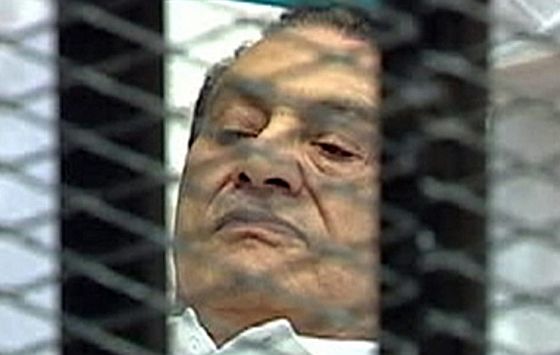
Just when the Arab dictators desperately need to drink the secure, cool waters of an Arab summer, along came the Egyptians yesterday to poison the well. Deep into its depths, those dictators could see a flickering enmeshed face, fragile, fingers playing over its nose and mouth, the arm of a man on a stretcher raised to prevent the light getting too close but – for just a few brief moments – with the same old arrogant eyes. Then the heavy black mike appeared in the man’s left hand. “I am here, your honour,” said a chillingly strong voice. “I have not committed any such crimes.”
Yes, the Egyptians really did put their wretched, ancient dictator on trial yesterday, along with his effete, sullen sons – both dressed in white as if heading for yet another summer tennis party, an illusion broken only by the green Koran under Alaa Mubarak’s arm. An encouragement to his dessicated, 83-year-old father, Hosni? Or an insult to the dead?
The lawyers screamed their clients’ pain; of torture, of snipers, of the murder of Egypt’s own people in the January-February uprising, of the brutality of the security forces, of corruption on a Mafia scale. And to whom else did these terrible charges apply? We thought about Damascus, of course. And Tripoli. And the Bahraini capital of Manama. And of Rabat and Amman and Algiers and Riyadh…
And across the vast, arid wastelands of the Arab despots, the government televisions continued to show game shows and cooking classes and domestic dramas and friendly crowds, all of whom loved their presidents and kings and potentates, who could never – could they? – be accused of these awful crimes. Outside Egypt itself, the only live coverage of the trial was broadcast by post-revolutionary Tunisia and that nemesis of the Mubarak regime and of the United States and of Israel: the Hezbollah’s Al-Manar television.
“Are you Mohamed Hosni Sayed Mubarak?” asked Judge Ahmed Refaat. Or Bachar al-Assad? Or Muammar Gaddafi? Or His Majesty King Hamad? Or even His Highness King Abdullah, Guardian of the Three Holy Places in a place called Saudi Arabia?
“All Americans think I’m a terrorist,” 34-year-old Salafi political organizer Mohammed Tolba exhales with his trademark belly laugh. He grips his gearshift and accelerates to 115 miles per hour down a winding overpass in Cairo. “But I only terrorize the highways.” Since the fall of Egyptian president Hosni Mubarak, Tolba has constantly been on the go. “The media says we all wear galabeyas (long Islamic dress), put our women in niqabs (a face veil), and will cut off people’s hands,” Tolba says, dramatically feigning a yawn. “We’re the new boogey-man, but people need to know we’re normal — that we drink lattes and laugh.”
To this end, the silver-tongued IT consultant shuttles regularly from the modish offices of popular television personality Bassem Youssef (he’s starring in a segment on the “Egyptian Jon Stewart’s” highly anticipated new show) to the considerably less shiny quarters of Cairo’s foremost Salafist centers. He’s been conducting leadership and media-training workshops for Salafis. “These guys don’t know how to talk to the public,” says Tolba, rubbing his eyes in exhaustion. “Once they open their mouths and face a camera, man, they ruin everything.”
The same might be said for their debut on Egypt’s main stage last Friday, as hundreds of thousands of Salafis joined other Islamist groups in Cairo’s Tahrir Square. Droves of people from governorates across Egypt got off buses near Tahrir Square, chanting “Islamic, Islamic, we don’t want secular.” One Salafi, Hisham al-Ashry, beamed with pride as he walked back from the square to his tailor shop downtown. “Today is a turning point, we finally showed our strength.” Meanwhile, “the liberals and the leftists are freaking out. God protect the nation and revolution,” noted popular blogger Zeinobia.
Who are the faces and voices of an oft-deemed bearded and veiled monolith that packed the square? And what exactly do they want?
“Salafi” has become something of a catchall name for any Muslim with a long beard, but Salafism is not a singular ideology or movement with one leader. As Stéphane Lacroix, a French scholar of Islamist movements, explains, it’s more a “label for a way of thinking” guided by a strict interpretation of religious text. Salafis aspire to emulate the ways of the first three generations of Islam. Many Salafis have cultivated a distinctive appearance and code of personal behavior, including untrimmed beards for men and the niqab for women.
The Salafi culture has been growing in Egypt for decades, but until the revolution had little formal political presence. “Satellite salafism” hit Egypt in 2003, with around 10 Salafi-themed TV channels broadcasting from Egypt on Nilesat. The intensely popular Al-Nas, Arabic for the People, began broadcasting in 2006. Its programming focuses on issues of social justice and sermons by prominent Salafi preachers, like Mohammed Yaqoub and Mohammed Hassan, whose tapes and books are common fixtures among street vendors throughout Cairo. Nobody knows exactly how many Salafis there now are in Egypt, but Abdel Moneim Abouel Fotouh, a presidential candidate formerly of the Muslim Brotherhood, recently estimated their number at around 20 times the number of Muslim Brotherhood members (unofficial reports estimate Muslim Brotherhood membership between 400,000 to 700,000 members).
Kaltum Mohamed sits beside a small mound of earth, alone with her thoughts. It is her child’s grave—and there are three others like it.
Just three weeks ago, Mohamed was the mother of five young children. But the famine that has rocked Somalia has claimed the lives of four of them. Only a daughter remains. The others starved to death before Mohamed’s eyes as she and her husband trekked to Somalia’s capital, Mogadishu, in search of aid.
Thousands of parents are grieving in Somalia and in refugee camps in neighboring countries amid Somalia’s worst drought in 60 years.
The drought and famine in Somalia have killed more than 29,000 children under the age of 5 in the last 90 days in southern Somalia alone, according to U.S. estimates. The U.N. says 640,000 Somali children are acutely malnourished, suggesting the death toll of small children will rise.
The Pentagon’s budget has risen for 13 years, which is unprecedented. Between 2001 and 2009, overall spending on defense rose from $412 billion to $699 billion, a 70 percent increase, which is larger than in any comparable period since the Korean War. Including the supplementary spending on Iraq and Afghanistan, we spent $250 billion more than average U.S. defense expenditures during the Cold War — a time when the Soviet, Chinese and Eastern European militaries were arrayed against the United States and its allies. Over the past decade, when we had no serious national adversaries, U.S. defense spending has gone from about a third of total worldwide defense spending to 50 percent. In other words, we spend more on defense than the planet’s remaining countries put together.
It is not unprecedented for defense spending to fall substantially as we scale back or end military actions. After the Korean War, President Dwight Eisenhower cut defense spending 27 percent. Richard Nixon cut it 29 percent after Vietnam. As tensions declined in the 1980s, Ronald Reagan began scaling back his military spending, a process accelerated under Presidents George H.W. Bush and Bill Clinton. Given the enormous run-up in spending under George W. Bush, even if President Obama made comparable cuts to that of those presidents today, defense spending would remain substantially above the levels under all those presidents. The Bowles-Simpson commission’s plan proposed $750 billion in defense cuts over 10 years. Lawrence Korb, who worked at the Pentagon for Ronald Reagan, believes that a $1 trillion cut over 10 to 12 years is feasible without compromising national security.
Serious conservatives should examine the defense budget, which contains tons of evidence of liberalism run amok that they usually decry. Most talk of waste, fraud and abuse in government is vastly exaggerated; there simply isn’t enough money in discretionary spending. Most of the federal government’s spending is transfer payments and tax expenditures, which are — whatever their merits — highly efficient at funneling money to their beneficiaries. The exception is defense, a cradle-to-grave system of housing, subsidies, cost-plus procurement, early retirement and lifetime pension and health-care guarantees. There is so much overlap among the military services, so much duplication and so much waste that no one bothers to defend it anymore. Today, the U.S. defense establishment is the world’s largest socialist economy.
A new bill presented in Israel’s Knesset aims to have the “Jewish nature” of the state preferred over democracy, to end Arabic’s status as one of Israel’s official languages, and to have Jewish law “guide” courts’ rulings. Noam Sheizaf reports:
There is one talking point repeated in every hasbara (the Hebrew term for state sponsored propaganda) talk given by an Israeli representative, or in every booklet your campus’ Jewish Agency representative might hand you. It has to do with “the full rights” of Palestinian citizens in Israel, including the status of Arabic as an official language, and the equality of all Israeli citizens under the law. This is the heart of “the only democracy in the Middle East” claim.
Those who are familiar with Israeli society, know that Arab citizens are discriminated against in many ways: Some of these ways are formal—like the new bill allowing segregated communities; the law against family unification of Arab citizens; the absentees’ property laws, and more—while other are a matter of practice, such as the fact that some government agencies won”t hire Arabs, or the that the courts mete out harsher sentences to Arab citizens convicted of the same crimes as Jewish citizens.
Yet a new bill, signed by members of opposition and coalition alike, aims to strip Israel even of the appearance of democracy. If passed (it has a fair chance), this law will determine that in any case of contradiction between democratic values and the Jewish nature of the state, the Jewish element will prevail. More specifically, the bill aims to cancel the status of Arabic as one of Israel’s two official languages; it orders the state to develop communities for Jews only; and in a passage that seems to be taken from the Iranian constitution, declares that when there is no law referring to a certain case, courts should rule in the spirit of halakha, or Jewish religious jurisprudence.
At least 45 civilians were killed in a tank assault by Syrian President Bashar al-Assad’s forces to occupy the center of Hama, an activist said on Thursday, in a sharp escalation of a military campaign aimed at ending an uprising against his rule.
Reacting to intensifying assaults on Syrian cities and towns, the U.N. Security Council overcame deep divisions and condemned Assad’s bloody crackdown on civilian protesters. It was the first substantive action by the United Nations on Syria’s five-month-old uprising for political freedoms.
An activist who managed to leave the besieged city told Reuters that 40 people were killed by heavy machinegun fire and shelling by tanks in al-Hader district north of the Orontes river on Wednesday and early on Thursday.
The activist, who gave his name as Thaer, said five more people from the Fakhri and Assa’ad families, including two children, were killed as they were trying to leave Hama by car on the al-Dhahirya highway.
Syrian authorities have expelled most independent media, making it difficult to verify witness accounts and official statements.
Residents earlier said tanks had advanced into central Hama on Wednesday after heavily shelling the city and occupied the main Orontes Square, the site of some of the largest protests against Assad, who succeeded his father, the late President Hafez al-Assad, in 2000.
Snipers spread onto rooftops and into the nearby citadel. They said shelling concentrated on al-Hader district, large parts of which were razed in 1982 when forces loyal to Hafez al-Assad overran Hama to crush Islamist insurgents, killing many thousands of people.
An Italian parliamentary commission has approved a draft law that would ban women from wearing veils that cover their faces in public, if passed by parliament in September.
The draft approved by the constitutional affairs commission on Tuesday would prohibit women from wearing a burqa, niqab or any other garb that covers the face in such circumstances.
It would expand a decades-old law that for security reasons prohibits people from wearing face-covering items such as masks in public places.
Women who violate the ban would face fines of $140 to $400, while third parties who force women to cover their faces in public would be fined $42,000 and face up to 12 months in jail.
Italy, an overwhelmingly Catholic country with a small Muslim minority, is the latest European country to act against the burqa. France and Belgium have banned the wearing of burqa-style Islamic dress in public, as has a city in Spain. The Belgium law cited security concerns.
The narrative of American officialdom here, civilian and military alike, is that United States muscle is used merely in service of supporting Iraq’s fledgling democracy. Iraq’s leaders and soldiers are the ones responsible, and seek American support only as needed. That may be literally true, but the reaction to a botched weekend raid in a village north of the capital that left three men dead, none the targeted insurgent, laid bare another truth: In Iraq, where grievances run deep, America will still bear the brunt of the blame when things go wrong, even if the facts don’t completely align.
On Saturday news began filtering out of Al Rufait, the grape farming village near Saddam Hussein’s hometown, Tikrit, that a nighttime operation conducted by Iraqi and American forces aimed at a suspected member of Al Qaeda had turned in to a shootout involving bullets, grenades and American Apache helicopters that left the tribal Sheik and two others dead, and several wounded, including two young girls.
A cloud of competing stories emerged, but the outrage from village residents and local officials was directed at the Americans, even though it was Iraq’s own security forces in charge of the mission, and Iraqi soldiers far outnumbered the amount of American boots on the ground, a United States military spokesman said.
Stories of American complicity in civilian deaths here are rare these days, and we made plans to head to the village the next morning. Before 8 a.m., two tribal leaders met us on the side of the main highway that connects the capital with the country’s north, and we followed their white pickup through winding roads that cut through vast green fields of grape vines. Visiting a village in the Sunni triangle suspected of having Al Qaeda sympathies on a day of anger toward a suspected American role in the killing of a respected tribal leader is a fraught exercise, and for only the second time of nearly a year in Iraq, I heard the metallic clank of one of our guards chambering a round in his assault rifle.
But the villagers were respectful, and just wanted to tell their story to a Western journalist, even if none of the customary tribal traditions such as a cup of chai were on offer. Surrounded by perhaps two dozen men, they took us through the village, recounting the raid and blaming the Americans. Not a cross word was said about Iraqi forces who the Americans said led the raid, nor of the Iraqi legal system, which had validated the raid with a judicial warrant.
“We will follow them to America and file cases there against them,” one of the villagers said. “There were more than 30 people here that saw what happened and all are ready to be witnesses.”
One tribal sheik, Youseff Ahmad, spoke about the debate about the future role of United States forces here that has dominated Iraqi public life of late. “We want them to leave, even before the end of this year,” Mr. Ahmad said. “They’ve destroyed us. They’ve only brought killing and disaster.”
Few political terrorists in recent history took as much care to articulate their ideological influences and political views as Anders Behring Breivik did. The right-wing Norwegian Islamophobe who murdered 76 children and adults in Oslo and at a government-run youth camp spent months, if not years, preparing his 1,500 page manifesto.
Besides its length, one of the most remarkable aspects of the manifesto is the extent to which its European author quoted from the writings of figures from the American conservative movement. Though he referred heavily to his fellow Norwegian, the blogger Fjordman, it was Robert Spencer, the American Islamophobic pseudo-academic, who received the most references from Breivik — 55 in all. Then there was Daniel Pipes, the Muslim-bashing American neoconservative who earned 18 citations from the terrorist. Other American anti-Muslim characters appear prominently in the manifesto, including the extremist blogger Pam Geller, who operates an Islamophobic organization in partnership with Spencer.
Breivik may have developed his destructive sensibility in the stark political environment of a European continent riveted by mass immigration from the Muslim world, but his conceptualization of the changes he was witnessing reflect the influence of a cadre of far-right bloggers and activists from across the Atlantic Ocean. He not only mimicked their terminology and emulated their language, he substantially adopted their political worldview. The profound impact of the American right’s Islamophobic subculture on Breivik’s thinking raises a question that has not been adequately explored: Where is the American version of Breivik and why has he not struck yet? Or has he?
Many of the American writers who influenced Breivik spent years churning out calls for the mass murder of Muslims, Palestinians and their left-wing Western supporters. But the sort of terrorism these US-based rightists incited for was not the style the Norwegian killer would eventually adopt. Instead of Breivik’s renegade free-booting, they preferred the “shock and awe” brand of state terror perfected by Western armies against the brown hordes threatening to impose Sharia law on the people in Peoria. This kind of violence provides a righteous satisfaction so powerful it can be experienced from thousands of miles away.
And so most American Islamophobes simply sit back from the comfort of their homes and cheer as American and Israeli troops — and their remote-controlled aerial drones — leave a trail of charred bodies from Waziristan to Gaza City. Only a select group of able-bodied Islamophobes are willing to suit up in a uniform and rush to the front lines of the clash of civilizations. There, they have discovered that they can mow down Muslim non-combatants without much fear of legal consequences, and that when they return, they will be celebrated as the elite Crusader-warriors of the new Islamophobic right — a few particularly violent figures have been rewarded with seats in Congress. Given the variety of culturally acceptable, officially approved outlets for venting violent anti-Muslim resentment, there is little reason for any American to follow in Breivik’s path of infamy.
“You should definitely postpone your book launch in Jerusalem”, warned a close friend who felt that the planned event for launching my recently published book on the Palestinian-led movement for boycott, divestment, and sanctions (BDS) against Israel. He warned it might be too risky in light of the recently passed Israel law that effectively bans support for the thriving boycott movement. At the packed bookshop-cafe in occupied East Jerusalem last Thursday, however, the engaged and Italian-coffee scented atmosphere was almost jubilant, as if declaring a collective defiance of Israel’s latest draconian measure.
Much controversy has arisen since the Israeli parliament passed legislation that would effectively criminalize support for any boycott against Israel or its institutions, under threat of heavy penalties and worse, without the need to prove “guilt”. Dozens of Israeli civil society organizations and leading legal scholars, including many opposing the boycott, have resolutely opposed this exceptionally authoritarian law on diverse grounds, ranging from the most principled to the downright pragmatic.
Missing in most of the debate is the Palestinian perspective, which is undoubtedly most relevant given that this law was entirely motivated by the spectacular growth in recent years of the global boycott, divestment and sanctions (BDS) movement against Israel, which was launched in 2005 and is led by the largest coalition of Palestinian civil society parties, unions, and NGOs: the Boycott National Committee (BNC).
While expressing alarm at this latest repressive attempt by Israel to crush Palestinian peaceful resistance and support for it among conscientious Israelis, a BNC statement conveyed confidence that this law will bolster the spread of BDS even faster among liberal communities the world over. Hind Awwad, coordinator with the BNC, reacted: “This new legislation, which violates international law, is testament to the success of the rapidly growing global BDS movement and a realization within political elites inside Israel that the state is becoming a world pariah in the way that South Africa once was.”
As President Obama and congressional leaders wrangled over the debt ceiling last Saturday evening, Russell Pearce, Arizona’s controversial state Senate president, turned to Facebook to express his own personal outrage.
“Folks,” he wrote, “if there was ever an argument for NO to raising the debt limit and YES to stop the reckless socialist spending in this Gangster Government in DC. Watch this video.”
Just one problem: The five-month-old viral video — which was created by a far-right gadfly from Tacoma, Wash. — had already been thoroughly debunked by the Tacoma News Tribune. By Sunday morning, Pearce had deleted the post from his Facebook site.
But this was hardly the first time that Pearce, whose ultraconservative immigration views have won him national attention and who will face a historic recall election in his Arizona district on Nov. 8, associates himself with the work of a fringe character.
For several years, media outlets in Arizona and at the national level have explored links between Pearce and extremist groups, and in 2006 he was caught circulating a Holocaust-denying article from a West Virginia-based white supremacist group. In issuing an apology, Pearce claimed to not have known about the National Alliance’s views.
But a new examination of Pearce’s website and public statements reveals that the self-proclaimed architect of Arizona’s “papers please” immigration law has regularly borrowed significant portions of text from the writings of hard-line white nationalists, fringe anti-immigrant activists, and others whose views far fall outside the mainstream and presented them as his own.
The United States Air Force has been training young missile officers about the morals and ethics of launching nuclear weapons by citing passages from the New Testament and commentary from a former member of the Nazi Party, according to newly released documents.
The mandatory Nuclear Ethics and Nuclear Warfare session, which includes a discussion on St. Augustine’s “Christian Just War Theory,” is led by Air Force chaplains and takes place during a missile officer’s first week in training at Vandenberg Air Force Base in California.
St. Augustine’s “Qualifications for Just War,” according to the way it is cited in a 43-page PowerPoint presentation, are: “to avenge or to avert evil; to protect the innocent and restore moral social order (just cause)” and “to restore moral order; not expand power, not for pride or revenge (just intent).”
The Air Force documents were released under the Freedom of Information Act (FOIA) and provided to Truthout by the Military Religious Freedom Foundation (MRFF), a civil rights organization. MRFF President Mikey Weinstein said more than 30 Air Force officers, a majority of whom describe themselves as practicing Protestants and Roman Catholics, have contacted his group over the past week in hopes of enlisting him to work with the Air Force to have the Christian-themed teachings removed from the nuclear weapons ethics training session. [Full disclosure: Weinstein is a member of Truthout’s Board of Advisers.]
Included with the PowerPoint presentation are more than 500 pages of other documents pertaining to a missile officer’s first week of training, which takes place before they are sent to one of three Air Force bases to guard the country’s Intercontinental Ballistic Missile (ICBM) arsenal and, if called upon to do so by the president, launch their nuclear-armed Minuteman IIIs.
One of the most disturbing slides quotes Wernher Von Braun, a former member of the Nazi Party and SS officer. Von Braun, regarded as the father of the US space program, is not being cited as a scientific expert, rather he’s specifically being referenced as a moral authority, which is remarkable considering that the Nazi scientist used Jews imprisoned in concentration camps and captured French anti-Nazi partisans and civilians to help build the V-2 rocket, a weapon responsible for the death of thousands of British civilians.
“We knew that we had created a new means of warfare and the question as to what nation, to what victorious nation we were willing to entrust this brainchild of ours was a moral decision [emphasis in document] more than anything else,” Von Braun said upon surrendering to American forces in May 1945. “We wanted to see the world spared another conflict such as Germany had just been through and we felt that only by surrendering such a weapon to people who are guided by the Bible could such an assurance to the world be best secured.” [emphasis in document]
The Air Force has suspended a training course for nuclear missile launch officers that used Bible passages and religious imagery to teach them about the ethics of war.
The course had apparently been taught by chaplains at Vandenberg Air Force Base in California for more than 20 years, but officials pulled the plug after an article from the liberal Web site Truthout.org appeared online last week.
The group obtained a PowerPoint presentation used in the course that referenced religious figures including Abraham, John the Baptist and Saint Augustine. The presentation also said that there are “many examples of believers engaged in wars in the Old Testament” and “no pacifistic sentiment in mainstream Jewish history.”
David Smith, a spokesman for the Air Force’s Air Education and Training Command, said that the program had initially been designed to “help folks understand why we’re doing what we’re doing. In the missile launch industry, it takes a certain mindset to be able to walk in the door and say, yes, I can do that.”
But he added: “Senior leadership looked at [the material for the course] and said, no, we could do better than this.”
The reversal marks a victory for the Military Religious Freedom Foundation, a watchdog group that provided the documents to Truthout and that has waged a series of battles, legal and otherwise, to preserve the separation of church and state in the services.
In downtown Cairo on Wednesday morning, people huddled around television sets to watch an historical moment unfold as former President Hosni Mubarak, his two sons Gamal and Alaa, and former Interior Minister Habib al-Adly faced trial on charges of murder for killing protesters during the 18-day uprising that led to Mubarak’s resignation.
Their gazes were glued to the TV screens in disbelief as they watched the dictator who ruled them for 30 years lying on a hospital bed inside a cage, wearing the white uniform of a defendant.
In a car parts shop downtown, a dozen people stood chatting and waiting in anticipation. When the former president appeared on screen, the observers cheered. Then suddenly quiet fell on the shop. As the employees of the shop and passersby watched the trial, they demanded complete silence, asking anyone who talked to remain quiet.
Many around Cairo expressed joy that some kind of real justice is being served.
“This is a historic day,” said Islam Khalil, a 28-year-old lawyer. “It shows progress and development of our country. I feel that I took my right and the rights of all those who have been living under his suppression.”
Mostafa, who owns a clothing shop in Bab al-Louk, agreed. “Glimpses of justice are finally starting to show in the country. I do not feel sorry for him. If someone stole LE 100 from you, would you be sorry for that person? What if he stole a whole country?” he said.
The sheer symbolism of the day made it one of the most visceral episodes in modern Arab history. In a region whose destiny was so long determined by rulers who deemed their people unfit to rule, one of those rulers was being tried by his public. On this day, the aura of power — uncontested and distant — was made mundane, and Mr. Mubarak, dressed in white and bearing a look some read as disdain, was humbled.
“The first defendant, Mohammed Hosni al-Sayyid Mubarak,” the judge, Ahmed Rifaat, said, speaking in a wood-paneled courtroom to a cage holding Mr. Mubarak, his two sons, Gamal and Alaa, former Interior Minister Habib e-Adly and six other senior officers.
“Sir, I am present,” Mr. Mubarak replied into a microphone, from his bed.
“You heard the changes that the prosecutor made against you,” the judge said from the podium. “What do you say?”
“I deny all these accusations completely,” he replied, wearily waving his hand.
Then he handed the microphone to his son, Gamal.
The trial began precisely at its start time, 10 a.m. in Cairo. While the other defendants took a seat, Mr. Mubarak’s sons remained standing, the youngest, Gamal, seeming to block the view of his father from the cameras in the courtroom. Mr. Mubarak appeared tired but alert, occasionally speaking with his sons, who both held Korans.
As Mr. Mubarak denied the charges in the proceedings, which were broadcast on a large-screen television outside the police academy, his opponents gathered there roared in disapproval.
“Then who did it?” some asked.
The scene was tumultuous there on a sun-drenched parking lot, with a few dozen of Mr. Mubarak’s supporters sharing space with his opponents. At times, they scuffled; in intermittent clashes, the two sides threw rocks at each other. As Mr. Mubarak arrived at the courtroom, some of his supporters cried, waving pictures that read, “The insult to Mubarak is an insult to all honorable Egyptians.” Others shouted adulation at the screen.
“We love you, Mr. President,” some chanted.
Those sentiments were overwhelmed by the denunciations of his critics, in a trial that seemed to incarnate all the frustrations and degradations of a state that treated its people as rabble. Someone was finally being held to account, many said Wednesday.
This website or its third-party tools use cookies, which are necessary to its functioning. By closing this banner, you agree to the use of cookies.