Author Archives: News Sources

You thought the Koch brothers were bad? Turns out they’re even worse than you thought

Adele M. Stan writes:

You knew they were big. You knew they were evil. From the union-busting actions of their minions in Wisconsin and Ohio to their war on health-care reform, to their assault on the environment and their attacks on the science of climatology, Charles and David Koch have earned their place as the focus of progressives’ scrutiny in the age of the Tea Party — the destructive and regressive movement they bankroll. But a new report from the Center for American Progress Action Fund shows that, as bad as you thought the Kochs were, they’re actually worse. And their reach into virtually every aspect of political, economic and physical life on the planet is probably greater than you thought possible.

In The Koch Brothers: What You Need to Know About the Financiers of the Radical Right, author Tony Carrk, policy director of the CAP Action War Room, lays out a case that is breathtaking in its scope, showing how the Koch brothers are using their billions with the aim of reshaping the global economic system in such a way as to enrich themselves and their heirs at the expense of most other inhabitants of the planet.

Facebooktwittermail

The price of the divide on Libya

At KABOBfest, Tasnim writes:

The military intervention in Libya has divided the left into two camps, the pro-interventionists and the anti-imperialists who define it as a military assault equivalent to the war in Iraq. At the centre of this division is an apparent contradiction between supporting the people’s revolution against autocracy and an anti-imperialist stance which denounces western hypocrisy. As a Libyan, I reject this false contradiction. I see myself as an anti-imperialist, I denounce western double standards, and I supported the revolution and the intervention. I see no need to twist myself into an arguing position where I declare myself to be for the people’s revolution, but against the intervention that sustained it. That, to me, would be the contradiction.

The accusations levelled at the pro-interventionists include naivety, hypocrisy, and selling their soul (and dignity) to the devil. The rhetorical questions fly: How can you believe this is a humanitarian intervention? Who bolstered Gaddafi? How about Bahrain, Yemen, Palestine? Afghanistan, Iraq, see what they did there? Rwanda, see what they didn’t do there? Do the three letters O-I-L mean anything to you?

The charge of naivety is popular, because proving you’re not naive can be difficult. I don’t speak for Libyans, but I can speak for myself and those I know, and we don’t need to be told that those intervening in Libya are acting in their own interests. None of us believe that this so-called humanitarian intervention is motivated solely by concern for human life. We know who rehabilitated Gaddafi. We watched Berlusconi kiss his hand and Clinton pose with his son Mutassim and Blair sit in his tent and announce a New Era, all when the brutality of the regime was being masked by the thinnest possible patina of change, the change of Saif’s western bought PR.

We also remember when Gaddafi was lionized by some in the left as an anti-imperialist Nasserite during the 70s and 80s, a time when people were hung in public and Libyans were poisoned against progressive ideas because of the brutality of the regime that pretended to espouse them. We remember when Gaddafi was the enemy of the west. We remember Operation El Dorado Canyon. We remember the collective punishment of sanctions as a whole nation was held responsible for Pan Am 103, only adding to the suffering of the most vulnerable. We remember when we were the pariah-state, and Libyans were the terrorists after the plutonium. We don’t need to be told that this intervention is, as one friend put it, mish ashan sawad eyona – not for the sake of our eyes. None of us are apolitical or naive, we haven’t had a chance to be. Yet all of us support the intervention.

To denounce Libyan pro-interventionist stances as naive is condescending, imperious and an insult to our knowledge of our own history. I find it amusing that self-declared anti-imperialists flourish Libya’s history in the face of Libyans who support the intervention, when some of them knew no more about Libya a couple of months ago than its location on the map. And that it was ruled by a madman.

Cross-examining the military intervention does not make me uncomfortable. I am aware of the need to be wary. I am aware that western countries could easily have looked the other way and continued benefiting from their deals with the Gaddafi regime, and I am aware that by intervening they are banking on new deals and new interests.

What saddens me is the morally bankrupt arguments made by those intent on justifying their anti-imperialist stance at all costs, to the extent they will mine neoconservative material and echo Gaddafi’s accusations to prove the “rebels” are Al Qaeda, or CIA. Some have justified the crackdown, using Gaddafi’s claims of secessionist movements, ignoring the fact that resistance is as strong in Misrata in the West as in Benghazi in the East. Some have gone further than that to deny Gaddafi’s atrocities took place. Others don’t even venture into this territory but still elect to wag their fingers at Libyans for submitting to imperialism. And when these arguments offend a Libyan, an anti-imperialist declares: “I relish in the fact that you are offended. I enjoy it.”

I find it a little counter-intuitive to deny atrocities took place to prove that atrocities will take place. Yet when I look at the arguments of those who oppose the intervention and the methods some of them resort to, I’m reminded why I made my decision. I need the reminder because it was not an easy decision to make. The morning I woke up to find a column of tanks a few kilometres outside Benghazi and wished for air-strikes to make them disappear, I asked myself whether it was only because I am Libyan. I imagined an alternate universe where the Arab League and the UN had made the same choices during the Gaza massacre. For me, it’s a no-brainer. Whether they called it a “no fly zone plus” or a “kinetic military action,” if it took out the jets and the tanks heading into town, I would have supported it, as long as those on the ground supported it.

I look to the cities that have been bombarded by Gaddafi’s forces for over a month – Misrata and Zintan and the western mountain area – and I see none of the intellectual arguments against intervention coming from them. So I support them. I support the opposition in every Arab country rising up, I am an activist for Palestine and against the War on Terror, and I support the Libyan uprising. In all cases, I take my cue from the people most affected, not from pundits. [Continue reading…]

Facebooktwittermail

The Obama administration’s appalling decision to give Khalid Sheikh Mohammed a military trial

Dahlia Lithwick writes:

Today, by ordering a military trial at Guantanamo for 9/11 plotter Khalid Sheikh Mohammed and his co-defendants, Attorney General Eric Holder finally put the Obama administration’s stamp on the proposition that some criminals are “too dangerous to have fair trials.”

In reversing one of its last principled positions—that American courts are sufficiently nimble, fair, and transparent to try Mohammed and his confederates—the administration surrendered to the bullying, fear-mongering, and demagoguery of those seeking to create two separate kinds of American law. This isn’t just about the administration allowing itself to be bullied out of its commitment to the rule of law. It’s about the president and his Justice Department conceding that the system of justice in the United States will have multiple tiers—first-class law for some and junk law for others.

Every argument advanced to scuttle the Manhattan trial for KSM was false or feeble: Open trials are too dangerous; major trials are too expensive; too many secrets will be spilled; public trials will radicalize the enemy; the public doesn’t want it.

Of course, exactly the same unpersuasive claims could have been made about every major criminal trial in Western history, from the first World Trade Center prosecution to the Rosenberg trial to the Scopes Monkey trial to Nuremburg. Each of those trials could have been moved to some dark cave for everyone’s comfort and well-being. Each of those defendants could have been tried using some handy choose-your-own-ending legal system to ensure a conviction. But the principle that you don’t tailor justice to the accused won out, and, time after time, the world benefited.

Now the Obama administration—having loudly and proudly made every possible argument against a two-tier justice system—is capitulating to it.

But make no mistake about it: It won’t stop here. Putting the administration’s imprimatur on the idea that some defendants are more worthy of real justice than others legitimates the whole creeping, toxic American system of providing one class of legal protections for some but not others: special laws for children of immigrants, special laws for people who might look like immigrants, different jails for those who seem too dangerous, special laws for people worthy of wiretapping, and special laws for corporations. After today it will be easier than ever to use words and slogans to invent classes of people who are too scary to try in regular proceedings.

Say what you want about how Congress forced Obama’s hand today by making it all but impossible to try the 9/11 conspirators in regular Article II courts. The only lesson learned is that Obama’s hand can be forced. That there is no principle he can’t be bullied into abandoning. In the future, when seeking to pass laws that treat different people differently for purely political reasons, Congress need only fear-monger and fabricate to get the president to cave. Nobody claims that this was a legal decision. It was a political triumph or loss, depending on your viewpoint. The rule of law is an afterthought, either way.

Facebooktwittermail

The fight for Libya

The Guardian reports:

There has been much to terrorise the people of Misrata over the past weeks of bloody siege. Tank shells and mortars have fallen at random in the heart of the rebel-held Libyan city, with little warning bar the final whistle of the explosive flying through the air. Muammar Gaddafi’s planes have periodically bombed the revolutionary enclave in the west of the country.

But residents say there has been nothing like the snipers.

“We are afraid even to step into the street any time. You can just be shot. I’ve seen children shot. They come in here with arms and legs destroyed. The snipers know who they are shooting. It’s terror,” said a doctor reached at one of the town’s hospitals who said he wanted to give his name only as Ali because he feared for the safety of his family elsewhere in Libya.

“Before you could go out when they weren’t shelling and bombing. But now you never know. Some of the snipers are not even wearing uniforms.”

The New York Times reports:

Friendly to Iran even as it serves as a base for the American military, Qatar has long had one of the most creative foreign policies in this unstable region. But now, by sending its tiny air force to fly missions over Libya and granting other critical aid to the Libyan rebels in their fight for freedom and democracy, this very rich Persian Gulf emirate is playing a more ambitious and potentially more risky role.

But for an absolute monarchy that was part of an alliance that supported Saudi Arabia’s move into Bahrain to crush democracy protests there, it is also somewhat incongruous.

A week ago, Qatar became the first Arab country to grant political recognition to the Libyan rebels, and its six Mirage fighter jets flying with Western coalition partners are giving the United States and European allies political cover in a region long suspicious of outside intervention.

Qatari officials say they are discussing ways to market Libyan oil from any ports they might hold in the future, to give the rebels crucial financial support, and they are looking for ways to support them with food and medical supplies. Qatar — the home base for the Al Jazeera satellite news channel, which is supported by the Qatari government — is also helping the Libyan opposition create a television station using a French satellite, to offset the state-controlled media.

Experts who follow Qatar say the current policies are consistent with two long-held objectives: to emerge as a world player despite its tiny size, and to play off its stronger neighbors, particularly Saudi Arabia and Iran, to protect its sovereignty and natural gas wealth.

“They are staking a claim to being a leading voice in defining Arab nationalism for Arabs no matter their location,” said Toby Jones, a Rutgers University historian of the modern Middle East. He added that the nation’s leadership was seeking “to step out of the shadow of more powerful regional neighbors like the Saudis and Iranians.”

The New York Times reports:

At least two sons of Col. Muammar el-Qaddafi are proposing a resolution to the Libyan conflict that would entail pushing their father aside to make way for a transition to a constitutional democracy under the direction of his son Seif al-Islam el-Qaddafi, a diplomat and a Libyan official briefed on the plan said Sunday.

The rebels challenging Colonel Qaddafi as well as the American and European powers supporting them with air strikes have so far insisted on a more radical break with his 40 years of rule. And it is not clear whether Colonel Qaddafi, 68, has signed on to the reported proposal backed by his sons, Seif and Saadi el-Qaddafi, although one person close to the sons said the father appeared willing to go along.

But the proposal offers a new window into the dynamics of the Qaddafi family at a time when the colonel, who has seven sons, is relying heavily on them. Stripped of one of his closest confidantes by the defection of Foreign Minister Moussa Koussa and isolated by decades of attempted coups and internal purges, he is leaning on his sons as trusted aides and military commanders.

The idea also touches on longstanding differences among his sons. While Seif and Saadi have leaned toward Western-style economic and political openings, Colonel Qaddafi’s sons Khamis and Mutuassim are considered hard-liners. Khamis leads a fearsome militia focused on repressing internal unrest.

Al Jazeera reports:

Clashes have continued between pro-democracy troops and forces loyal to Muammar Gaddafi, the Libyan leader, at the key oil town of Brega, with the rebels saying they have taken control of a portion of the town.

On Monday, columns of opposition fighters drove up the main coastal highway, regaining ground they had given up the day before, but the effective use of artillery and landmines by Gaddafi’s troops kept them at bay.

Al Jazeera’s Sue Turton, reporting from the road to the east of Brega, said rebels had spotted trip wires in the sands on either side of the highway and were instructing fellow troops and journalists to stay on the pavement.

Human Rights Watch has reported that Gaddafi’s troops laid anti-tank and anti-personnel mines around Ajdabiya when they controlled the city last week.

The regime’s troops seem better able to hold onto ground than the untrained and undisciplined rebels; they dig entrenchments and have not retreated from Brega, even after another night of coalition air strikes on their positions on Sunday.

Facebooktwittermail

Faces of the displaced

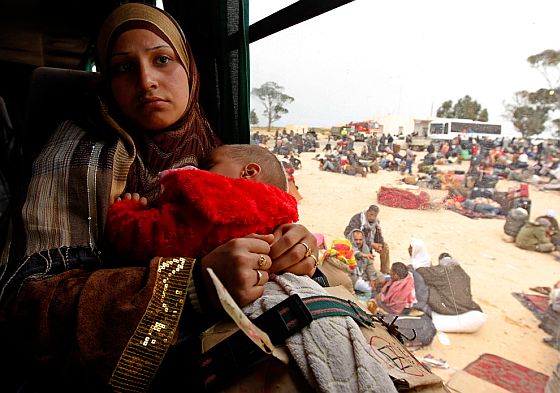
For more than a month, refugees have been fleeing the violence and uncertainty of Libya into Tunisia. The United Nations High Commission for Refugees has reported nearly 180,000 people have fled — a rate of 2,000 a day. Most end up at border transit camps, desperately trying to find a way home. Here are the faces of a few of them. (Boston Globe)

An Egyptian woman and child sit on a bus at a refugee camp near Ras Jdir on Feb. 28 after fleeing unrest. People in Tunisia and Egypt are driving to the border to help those arriving from Libya, with many hosting strangers in their homes, international aid groups have said.

Facebooktwittermail

Intifada update

AFP reports:

Yemeni security forces shot dead 17 anti-regime demonstrators and wounded scores more on Monday, on the second day of lethal clashes in Taez, south of the capital, medics said.

“The death toll has gone up to 17, in addition to dozens wounded,” said Sadeq al-Shujaa, head of a makeshift field hospital at a square in central Taez, updating an earlier casualty toll.

The bloodshed came as demonstrators staged a march on the governorate headquarters in the city about 200 kilometres (125 miles) from the capital to demand the ouster of Yemen’s embattled President Ali Abdullah Saleh.

The New York Times reports:

The United States, which long supported Yemen’s president, even in the face of recent widespread protests, has now quietly shifted positions and has concluded that he is unlikely to bring about the required reforms and must be eased out of office, according to American and Yemeni officials.

The Obama administration had maintained its support of President Ali Abdullah Saleh in private and refrained from directly criticizing him in public, even as his supporters fired on peaceful demonstrators, because he was considered a critical ally in fighting the Yemeni branch of Al Qaeda. This position has fueled criticism of the United States in some quarters for hypocrisy for rushing to oust a repressive autocrat in Libya but not in strategic allies like Yemen and Bahrain.

That position began to shift in the past week, administration officials said. While American officials have not publicly pressed Mr. Saleh to go, they have told allies that they now view his hold on office as untenable, and they believe he should leave.

A Yemeni official said that the American position changed when the negotiations with Mr. Saleh on the terms of his potential departure began a little over a week ago.

“The Americans have been pushing for transfer of power since the beginning” of those negotiations, the official said, but have not said so publicly because “they still were involved in the negotiations.”

Those negotiations now center on a proposal for Mr. Saleh to hand over power to a provisional government led by his vice president until new elections are held. That principle “is not in dispute,” the Yemeni official said, only the timing and mechanism for how he would depart.

The Yemen Observer adds: “Yemen’s opposition coalition Joint Meeting Parties (JMP) has presented a five-point plan on Saturday that outlines the details of how President Ali Abdullah Saleh should hand over power.”

Lamis Andoni writes:

Bashar al-Assad, the Syrian president, insists on believing that his support for the ”resistance against Israel” distinguishes his regime from others in the region and, therefore, makes it immune to the revolutions that have brought down pro-Western presidents in Tunisia and Egypt.

His support for Hamas and Hezbollah may make the Syrian president more popular among Arabs, but he is engaged in dangerous delusions if he thinks this makes the killings of peaceful Syrian protesters less reprehensible.

The eruption of Arab revolutions has been a reaction to decades of repression and the skewed distribution of wealth; two problems that have plagued anti- and pro-Western Arab governments alike.

And Syria is one of the most repressive states in the region; hundreds, if not thousands, of people have disappeared into its infamous prisons. Some reappear after years, some after decades, many never resurface at all.

Syrians have not been the only victims. Other Arabs – Lebanese who were abducted during the decades of Syrian control over its neighbour, Jordanian members of the ruling Baath party who disagreed with its leadership and members of different Palestinian factions – have also been victimised.

Syrian critics of the regime are often arrested and charged – without due process – with serving external – often American and Israeli – agendas to undermine the country”s “steadfastness and confrontational policies”.

But these acts have never been adequately condemned by Arab political parties and civil society, which have supported Syria”s position on Israel while turning a blind eye to its repressive policies.

The National reports:

From euphoria to stalemate: this is the epitaph of Bahrain’s recent experience in what some are calling the “Arab spring” of revolutionary movements.

What started out slowly in mid-February drawing a few hundred protesters gradually swelled beyond expectations into what looked like a semi-permanent presence of thousands of protesters who could, at a moment’s notice, be galvanised for marches anywhere in the capital, Manama.

Its base camp at the Pearl Roundabout had a stage, big TV screens, and tents for those who stayed overnight and for the 30-plus political factions and parties spreading their views among the crowds.

It was an exhilarating experience for many Bahrainis, angry about corruption and what they said was the government’s resistance to political reform.

“We saw it as something incredible,” said one woman who became a regular visitor to Pearl Roundabout. “This gave us hope. We felt like, as Barack Obama, said, ‘Yes, we can’.”

Today, the protest movement is in tatters, many of its leaders and activists imprisoned and its followers, most of them Shiite, subject to harsh emergency laws. Where Tunisia and Egypt saw change, Bahrain saw more of the same.

The clampdown continued yesterday, as Bahraini authorities banned Al Wasat, the country’s main opposition newspaper, and blocked its website.

The state-run Bahrain News Agency accused the paper of “unethical” coverage of the unrest.

Several days of interviews with Bahraini Sunni and Shiite political figures, human rights activists and journalists underscore that the tense impasse is due to mistakes on all sides, but principally, in most analyses, to the ascendancy of hardliners in both the government and the protest movement.

Facebooktwittermail

Weapons sales to the Arab world under scrutiny

Der Spiegel reports:

The revolutions in the Arab world caught British Prime Minister David Cameron off guard. For some time, diplomats had been planning a trip for Cameron that would take him to several countries in the Middle East. In fact, it was meant to be more of a trade mission, with Cameron’s delegation consisting largely of high-level executives from Great Britain’s weapons industry.

But then came the revolutions in Arab countries and the fighting in Libya. Ignoring them was impossible, and Cameron added a six hour stopover in Cairo to his already tight schedule. It was almost exactly a month ago that he visited Tahrir Square in the center of the city, the focal point of mass demonstration which ultimately forced Egypt’s aging leader, Hosni Mubarak, out of office.
“Meeting the young people and the representatives of the groups in Tahrir Square was genuinely inspiring,” Cameron said. “These are people who have risked a huge amount for what they believe in.”

From Egypt, Cameron flew on to Kuwait, where he got down to the real purpose of his trip: selling weapons to Arab autocrats. When members of parliament back home attacked him for this lack of tact, the prime minister insisted there was nothing wrong with such business transactions and that, in any case, his government made weapons buyers pledge to not use them to violate human rights under any circumstances. Great Britain, he said, has “nothing to be ashamed of.”

Britain, though, has exported over €100 million ($142 million) in weapons to Libyan dictator Moammar Gadhafi in the last two years alone. Included in those shipments are sniper rifles that may currently be in use against the Libyan opposition. Furthermore, Gadhafi’s terror police are British-trained. Indeed, British officials were forced to hastily revoke 50 arms export licenses to Libya and Bahrain.

Cameron now finds himself in a tight spot shared by many Western politicians. Policies that seemed fine prior to the revolutions are now questionable. Regional paradigms are shifting and, at a time when populations are throwing off the yoke of oppression, Realpolitik is a poor guide to Western policy.

Reuters reports:

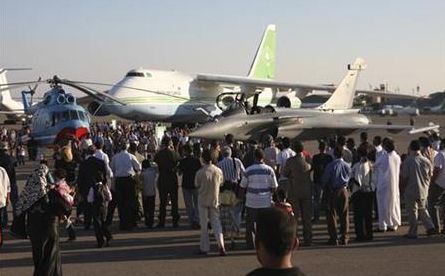
The photograph shows a French Rafale warplane at the Mitiga air base outside Tripoli. A small crowd of men, women and children mill around the fighter, its tail fin lit up by the North African sun.

Taken at an air show in October 2009, the picture is one of several grabbed by military aviation photographers from Dutch website scramble.nl that highlight one of the ironies in the West’s enforcement of a no-fly zone over Libya. To take out Muammar Gaddafi’s air defenses, western powers such as France and Italy are using the very aircraft and weapons that only months ago they were showing off to the Libyan leader. French Rafales like those on show in 2009 flew the western alliance’s very first missions over Libya just over two weeks ago. One of the Rafale’s theoretical targets: Libya’s French-built Mirage jets which Paris had recently agreed to repair.

The Libyan operation also marks the combat debut for the Eurofighter Typhoon, a competitor to the Dassault Rafale built by Britain, Germany, Italy and Spain. An Italian Air Force version of that plane was snapped at the 2009 show hosted by Libyan generals. Two weeks ago, that base – to which arms firms including Dassault returned last November – was attacked by western bombs.

Times change, allegiances shift, but weapons companies will always find takers for their goods. Libya won’t be buying new kit any time soon. But the no-fly zone has become a prime showcase for other potential weapons customers, underlining the power of western combat jets and smart bombs, or reminding potential buyers of the defensive systems needed to repel them.

“This is turning into the best shop window for competing aircraft for years. More even than in Iraq in 2003,” says Francis Tusa, editor of UK-based Defense Analysis. “You are seeing for the first time on an operation the Typhoon and the Rafale up against each other, and both countries want to place an emphasis on exports. France is particularly desperate to sell the Rafale.”

Almost every modern conflict from the Spanish Civil War to Kosovo has served as a test of air power. But the Libyan operation to enforce UN resolution 1973 coincides with a new arms race –a surge of demand in the $60 billion a year global fighter market and the arrival of a new generation of equipment in the air and at sea. For the countries and companies behind those planes and weapons, there’s no better sales tool than real combat. For air forces facing cuts, it is a strike for the value of air power itself.

“As soon as an aircraft or weapon is used on operational deployment, that instantly becomes a major marketing ploy; it becomes ‘proven in combat’,” says a former defense export official with a NATO country, speaking on condition of anonymity about the sensitive subject.

Facebooktwittermail

Follow the money

Samir Aita writes:

The reasons for the Arab spring go deeper than immediate demands for freedom and democracy. The protesters want to end the political economy and the authoritarian regimes in place since the 1970s.

Monarchies in the Arab world have been absolute, and life-long presidents (with hereditary office) ruled the republics, because they created a supreme power above both state and post-independence institutions. They set up and controlled their own security services to ensure that their powers would endure; the services escaped parliamentary or government supervision, and their members could reprimand a minister and impose decisions. It costs money to run such services, and the clientelist networks of one-party states. The funds derive not from public budgets, as do those for the police and the army, but from different sources of revenue. (The New York Times recently reported that Muammar Gaddafi had demanded in 2009 that oil firms operating in Libya should contribute to the $1.5bn he had promised to pay in compensation for the Lockerbie terrorist murders – or lose their licences. Many paid. And Gaddafi’s immediate cash holdings of billions of dollars are thought to be funding his mercenaries and supporters to defend him.)

After the spectacular 1973 rise in crude oil prices, Middle Eastern revenues increased considerably. Through the distribution circuits, and in collusion with major multinationals, part of the revenue went direct to the coffers of the royal or “republican” families instead of to the state. Nor was oil their only source of revenue. After there were no more commissions on major public contracts, civil and military, because of budget deficits and structural adjustments, new opportunities arose. In the 1990s there were mobile telephone network launches, and the first major privatisations of public services, with public-private partnerships and build-operate-transfer (BOT) contracts. Mobile networks had massive margins, especially at the start when better-off clients were prepared to pay high prices. The major multinational operators, influential businessmen and governments fought to capture the income. (There is evidence for this in the legal dispute over Djezzy, the Algerian branch of the Egyptian operator Orascom, and the Algerian military, and in a previous dispute between Orascom and Syria’s Syriatel, which happened just as the first large Arab multinationals emerged.)

The globalisation of Arab economies and the demands of the International Monetary Fund – supported by the European Commission for the Mediterranean countries – tightened the regimes’ hold on the economy, especially after the oil price crash of 1986. The ensuing decline in public investment and weakening of the governmental regulatory role ensured that the major multinationals held monopolies or oligopolies in exchange for sharing revenue with the powers-that-be. The senior management of the global corporations knew exactly where major decisions were taken and who the imposed local partners were for any new investment: the Trabelsi and Materi families in Tunisia, the Ezz and Sawires in Egypt, the Makhlouf in Syria, Hariri in Lebanon. The Sawires sold their shares in Orascom-Mobinil to France Telecom and offloaded their cement holdings before the Egyptian revolution. Najib Mikati, who had sold Investcom to the South African group MTN, is currently in charge of appointing the new government in Lebanon.

Facebooktwittermail

Heading toward an Israeli apartheid state

Daniel Blatman writes:

It has been 60 years since the apartheid state was established in South Africa. In March 1951, a few years after the racist National Party came to power, racial segregation was anchored in law. As was common in other countries that adopted racist laws in the 20th century, those in South Africa were accompanied by “laundered” explanations.

Hitler declared after the Nuremberg Race Laws were passed in 1935 that they would create a suitable basis for a separate but worthy existence for Jews in Germany alongside German society. The race laws in South Africa established that people of different colors cannot exist when mixed with each other – only in separate, protected spaces.

The tsunami of racist laws passed by the Knesset in recent months is also being explained by reasoned and worthy arguments: the right of small communities to preserve their own character (the Acceptance Committees Law ); the state’s right to prevent hostile use of the funds it allocates to education and culture (the Nakba Law ); and the right to deny citizenship to persons convicted of espionage or treason (the Citizenship Law ). But I believe that as in other historical instances, the aim of this legislation is the gradual establishment of an apartheid state in Israel, and the future separation on a racial basis of Jews and non-Jews.

An apartheid state is not created in the blink of an eye. What was created in Germany in 1935 was the outcome of a long and sometimes violent debate, which had been ongoing since the middle of the 19th century, about the place of Jews in modern Germany and Europe. Indeed, the desire to isolate and distance the Jews from society – legally and socially – was part of the belief system of anti-Semites in Europe for decades before Hitler came into power.

In this respect the Nazi regime, along with other regimes that passed racial separation laws (among them those in Romania, Hungary, Italy and Vichy France in 1940 ), only anchored in legislation a reality that had already been enthusiastically received by the populace. Of course, when such laws were enacted, the regimes involved did not support or imagine that at the end of the road, a “final solution” was waiting in its Nazi format. However, once the seeds were sown, no one was able to figure out what fruit they would bear.

The historical background of the Israeli apartheid state-in-the-making that is emerging before our eyes should be sought in 1967. It is part of a process that has been going on for about 44 years: What started as rule over another people has gradually ripened – especially since the latter part of the 1970s – into a colonialism that is nurturing a regime of oppression and discrimination with regard to the Palestinian population. It is robbing that population of its land and of its basic civil rights, and is encouraging a minority group (the settlers ) to develop a crude, violent attitude toward the Arabs in the territories. This was exactly the reality that, after many years, led to the establishment of the apartheid state in South Africa. [continue reading…]

Facebooktwittermail

Egypt: Israel must pay us back for cut-price gas

Ynet reports:

Egyptian Foreign Minister Nabil al-Arabi stated Sunday that his country would demand that Israel pay the price differences for the reduced gas it purchased during the Hosni Mubarak era.

“We will honor everything we signed on and we’ll demand that they uphold it too,” he was quoted as saying in an interview to the Dream TV channel.

According to the minister, clause No. 8 in the Israel-Egypt peace agreement allows the parties to appoint a joint committee to discuss settling financial disputes, “and we will demand from Israel the price differences of the gas exported to Israel during the previous regime.”

Al-Arabi noted that the Camp David Accords do not include a clause on selling gas and oil to Israel for a reduced price, and that those who interpreted it that way were “wrong” or “wanted to interpret it that way”.

Al-Arabi, who is considered hostile towards Israel, is the first official to raise the possibility that Egypt would demand that Israel pay for the gas retroactively. These comments contradict remarks made by the new oil minister, who said Egypt wanted to enter negotiations with Israel on the possibility of raising the gas prices from now on.

The Egyptian foreign minister added that former President Mubarak was a “strategic treasure” for Israel, implying that this would not be the situation from now on. He also said that Iran should not be considered an enemy state.

Tehran Times reports:

Iranian Foreign Minister Ali Akbar Salehi has welcomed a proposal by his Egyptian counterpart Nabil el-Arabi that Cairo is willing to reestablish diplomatic ties with the Islamic Republic of Iran.

“Good relationship between the two countries will definitely help stability, security, and development in the region,” Salehi noted.

Salehi again praised the Egyptian revolution and said, “The Egyptian people by taking steps toward realizing their just demands opened a new chapter in the history of the country and again I congratulate them on this victory.”

Facebooktwittermail

The fight for Libya

Al Jazeera reports:

US and Egyptian special forces have reportedly been offering covert armed training to rebel fighters in the battle for Libya, Al Jazeera has been told.

An unnamed rebel source related how he had undergone training in military techniques at a “secret facility” in eastern Libya.

He told our correspondent Laurence Lee, reporting from the rebel-stronghold of Benghazi, that he was sent to fire Katyusha rockets but was given a simple, unguided version of the rocket instead.

“He told us that on Thursday night a new shipment of Katyusha rockets had been sent into eastern Libya from Egypt. He didn’t say they were sourced from Egypt, but that was their route through,” our correspondent said.

“He said these were state-of-the-art, heat-seeking rockets and that they needed to be trained on how to use them, which was one of the things the American and Egyptian special forces were there to do.”

The intriguing development has raised several uncomfortable questions, about Egypt’s private involvement and what the arms embargo exactly means, said our correspondent.

The Associated Press reports:

Something new has appeared at the Libyan front: a semblance of order among rebel forces. Rebels without training — sometimes even without weapons — have rushed in and out of fighting in a free-for-all for weeks, repeatedly getting trounced by Moammar Gadhafi’s more heavily armed forces.

But on Friday only former military officers and the lightly trained volunteers serving under them were allowed on the front lines. Some were recent arrivals, hoping to rally against forces loyal to the Libyan leader who have pushed rebels back about 100 miles (160 kilometers) this week.

The better organized fighters, unlike some of their predecessors, can tell the difference between incoming and outgoing fire. They know how to avoid sticking to the roads, a weakness in the untrained forces that Gadhafi’s troops have exploited. And they know how to take orders.

“The problem with the young untrained guys is they’ll weaken us at the front, so we’re trying to use them as a backup force,” said Mohammed Majah, 33, a former sergeant.

“They don’t even know how to use weapons. They have great enthusiasm, but that’s not enough now,” he said.

Majah said the only people at the front now are former soldiers, “experienced guys who have been in reserves, and about 20 percent are young revolutionaries who have been in training and are in organized units.”

The Guardian reports:

The regime of Muammar Gaddafi has initiated a concerted effort to open lines of communication with western governments in an attempt to bring the conflict in the country to an end.

Libya’s former prime minister, Abdul Ati al-Obeidi, told Channel 4: “We are trying to talk to the British, the French and the Americans to stop the killing of people. We are trying to find a mutual solution.”

Although the regime last night rejected a rebel offer of a ceasefire if Gaddafi withdraws his military from Libya’s cities and permits peaceful protests, senior British sources said the Gaddafi government was open to dialogue.

“If people on the Gaddafi side want to have a conversation, we are happy to talk,” one said. “But we will deliver a clear and consistent message: Gaddafi has to go, and there has to be a better future for Libya.”

The regime rejected the rebels’ ceasefire conditions, saying government troops would not leave cities as demanded.

However, signs that the regime was looking to reach out to the west came after the Guardian reported that a meeting had taken place between Mohammed Ismail, a senior aide to Gaddafi’s influential son Saif al-Islam, and British officials on Wednesday in London. Ismail is a fixer who has been used by the Gaddafi family to negotiate arms deals and has considerable contacts in the west.

The Associated Press reports:

Government forces killed six civilians in the city of Misrata on Saturday in an unrelenting campaign of shelling and sniper fire aimed at driving rebels from the main city they hold in western Libya, medical officials said.

Doctors said that 243 people have been killed and some 1,000 wounded in more than a month and a half of fighting between Moammar Gadhafi’s forces and rebels in Misrata. Most of those slain Saturday were hit by snipers, they said.

One said government forces appeared to be trying to wound civilians.

“The weapons that the Gadhafi brigades use are not meant to prevent movement in the city, but to cause also deformation or paralysis so the suffering of the people endures all their lives,” the doctor told The Associated Press on condition of anonymity for fear of retaliation.

Simon Tisdall writes:

As the Libya conflict enters its third month, Whitehall is full of whispered talk of secret defections and cloak-and-dagger deals with more “reasonable” elements within the much-weakened Tripoli regime. The embattled sons of Muammar Gaddafi are looking for a way out, and may even be prepared to dump their father to save their own skins – or so the grapevine has it.

Security analysts and diplomatic insiders see things differently. It’s clear, they say, that after weeks of inconclusive conflict, neither side can win a military victory. Without a western ground invasion, the rebels are not strong enough to dislodge Gaddafi. So instead, Britain and the US are increasingly engaged in psychological warfare in the hope of fomenting internal dissension and regime collapse. This campaign includes disinformation about the other side’s intentions.

The revamped approach apparently scored a big success this week with the defection of Moussa Koussa, Gaddafi’s foreign minister. But two can play at this game. Gaddafi’s most prominent sons, Saif al-Islam and Mutassim, the national security adviser, were also waging their own “war of nerves”, the sources said. They appeared to be calculating that the Nato-led coalition will run out of time, split apart, and forfeit crucial Arab and domestic support.

Reuters reports:

At least 10 rebels were killed by a coalition air strike on Friday, fighters at the scene said on Saturday, in an increasingly chaotic battle with Muammar Gaddafi’s forces over the oil town of Brega.

The rebel leadership described the deaths as an unfortunate mistake and called for continued air strikes against Gaddafi’s forces, who have reversed a rebel advance along the coastal highway linking their eastern stronghold with western Libya.

Hundreds of mostly young, inexperienced volunteers could later be seen fleeing east from Brega toward the town of Ajdabiyah after coming under heavy mortar and machinegun fire.

A contingent of more experienced and better organized rebel units initially held their ground in Brega, but with most journalists forced east, it was unclear whether they had remained inside the town or pulled back into the desert.

Facebooktwittermail

Can Israel survive without anti-Semitism?

Avraham Burg writes:

In a very short time we will no longer be able to evade the real questions: Are we capable of apprehending our existence without the hatred of others? Do we really need external anti-Semitism as a means to define our inner identity? Think for a moment about a world in which Jews are not hated; about a utopia of peace in the Middle East, fraternity wherever our brethren live. Unreasonable? Definitely not! A hundred years ago, who believed in the existential transformations being played out before our eyes? Few, indeed.

A hundred years ago, Europe was awash in bloodshed that had lasted a thousand years, yet now it is a peaceful continent. Only a few months ago, the Middle East was one of the world’s largest repositories of nasty, bizarre dictatorships, yet today we are on the brink of what appears to be a historic and positive change. And with the world going into this mode, immediately or soon, will the Jewish people be able to survive without an external enemy? It’s not certain.

We have proven methods of coping with persecution, hatred and pogroms. But we don’t have a clue and don’t have experience when it comes to openness, acceptance and full equality for Jews, as for everyone else. That prospect threatens us in the deepest recesses of our being and confronts us with questions about our national existence as such, as “a people that shall dwell alone, and shall not be reckoned among the nations.” This being so, we tend to return to the sick, pathological molds which are so familiar to us: junkies of hatred, we isolate ourselves from the haters, real or imagined. As though the evil we know is preferable to the potential – and threatening – good.

From this point of view, the establishment of the State of Israel not only failed to solve the problems for the sake of which it was founded but, on the contrary, made them a great deal worse. Israel is the biggest shtetl in the history of the world. One big town around which walls of segregation and resentment rise higher every day, cutting it off from its surroundings. Few of us know any other existential reality apart from our unrelenting war with everyone, all the time and over all issues.

Facebooktwittermail

It’s the plutocracy, stupid

M J Rosenberg writes:

I received an email from a Capitol Hill aide who thinks my criticism of AIPAC, the powerful pro-Israel lobby, is overly simplistic. He doesn’t dispute the fact that AIPAC has a disproportionate influence on our Middle East foreign policy. He argues, however, that AIPAC is no different than other powerful special interest lobbies.

I think his whole email is worth a read:

I work on Capitol Hill and I disagree with you about AIPAC. You make it seem as if AIPAC is the only lobby that gets what it wants through threats of cutting off campaign contributions, as if only AIPAC dictates legislation through intimidation.

WRONG! My colleague who handles the Israel issue confirms your analysis. But it’s no different on the domestic issues I cover. The issues of jobs, health, taxes, the environment, regulation to protect kids’ health, oil drilling, workers’ safety, education, guns…they are all dictated by lobbies just as overbearing as AIPAC. All we do up here is cater to rich, selfish people and their special interests. And their interest is cutting all social programs so we can keep cutting taxes to make them even richer.

True, most of them don’t brag as much as AIPAC but that doesn’t make them any better or worse, just smarter (AIPAC gets more negative attention because of its swagger). Big deal. The public is getting screwed eight ways to Sunday by special interests and AIPAC is just one of them. Don’t mislead your readers into thinking it is unique. Not only is it not unique, it’s insignificant in the sense that it’s not the guys robbing the poor to put money in their own pockets. They own US Middle East policy. But the real fat cats own everything else.

I agree with everything my correspondent writes. The American democracy we learned about in school no longer exists. It’s been sold to the highest bidders. And the highest bidder is not, as the Tea Partiers like to say, “We The People.”

Facebooktwittermail

Libya’s challenge: democracy under the gun

At Open Democracy, Mark Taylor writes:

The demonstrators at the heart of the Arab spring have redefined the political space in their countries and as a result laid down a new dividing-line in the region. No longer is the political contest between east and west, Muslim against the rest, or pro- or anti-imperialist, humanitarian intervention versus regime change. The dividing-line in the region today is between democratic revolution or counter-revolution.

The new reality means that, for most in the region, the United States and its allies will be judged by their actions and whether these support or forestall democratic change. This change has forced outside powers to adapt and the Libyan intervention is the most dramatic example of this. In stark contrast to only a few weeks ago, not to intervene in Libya would have transformed the struggle in the region into one that defined the fight for democracy as a fight against the US. The US would have been blamed squarely for the defeat of democracy and, because of the changed political landscape, that would have been devastating for US interests in the region.

Doing nothing and allowing the Libyan opposition to be slaughtered held the potential for a backlash that would undermine all US-backed regimes, including Saudi Arabia (in Hillary Clinton’s mind, the violence of Gaddafi probably also raised the spectre of repeating Bill Clinton’s mistake on Rwanda).

The US, long a supporter of dictators in the region, had no good option in Libya. Instead, it chose the less bad one, one which held the possibility of staying on the right side of this story for now – and provided cover in advance for the fact that it will almost certainly be on the wrong side in Bahrain, Saudi Arabia, Yemen and even Syria.

Facebooktwittermail

Why the Libyan revolution deserves support from everyone who believes in democracy

By Anjali Kamat and Ahmad Shokr, Economic and Political Weekly, March 19, 2011

A month into the Libyan revolution, it is easy to forget that what is now an armed rebellion led by a council seeking international recognition began – much like the protests in Tunisia, Egypt, and Yemen – as a peaceful and leaderless popular uprising. Its primary demands were – and to a large extent remain – almost identical to those articulated by demonstrators in other parts of north Africa and west Asia: freedom of expression, democracy, and the ousting of a dictator and his repressive security apparatus. These are fundamentally liberal demands, but when made in a quasi-fascist police state like that ruled by colonel Muammar Gaddafi for nearly 42 years, they acquire a much more radical hue.

The transformation from street protests to armed revolt happened quickly, certainly faster than anyone in Libya could have imagined. After just four days of demonstrations and violent clashes, the long neglected cities of eastern Libya shook off four decades of Gaddafi’s iron-fisted rule. One by one, Benghazi, Al-Bayda, Derna, and Tubruk, all declared their liberation. Almost immediately, protestors established city councils made up of prominent residents and organised popular committees of young men to direct traffic and guard against looting. Even as state-controlled media continued to describe them as treacherous elements implementing a wide range of foreign agendas (western, Egyptian, Tunisian, and Al Qaida), groups of people in Benghazi set up independent newspapers and a handful of former state radio employees took over the local airwaves, broadcasting news about the overnight rebellion and urging everyone to join what came to be known as the “17 February revolution”.

Libya’s revolutionaries are largely middleclass professionals who were suddenly thrust into the leadership of a popular rebellion. They do not represent any single ideological position, but what they do share is a lack of experience with governance or popular mobilisation. This is not surprising given that one of the key achievements of Gaddafi’s four decades in power has been the systematic annihilation of civil society. Any effort towards community or labour organisation or building political associations was swiftly and brutally stamped out as an unacceptable form of dissent, punishable, in some cases, by death. Professional associations that existed were tightly controlled by the state. Notwithstanding his son Saif alIslam’s much-touted PhD dissertation at the London School of Economics on the role of civil society in democratisation, Gaddafi famously said in a televised address last year that civil society is a bourgeois invention of the west with no place in Libya. Labour unions, he added, are for the weak.

A rare exception in this otherwise bleak scenario was the Benghazi Bar Association whose members had been agitating in recent years for relatively minor legal reforms. Their main goal was to oust the former association head, a Gaddafi loyalist who stayed on well past his legally-mandated term. In early February, nervous about the wave of popular uprisings sweeping the Arab world, Gaddafi himself met with the Benghazi lawyers to discuss the standoff. He tried to placate them with promises of reform, and the head of the bar association was dismissed one week before the uprising. But coming on the heels of the dramatic events in Tunisia and Egypt, it was too little, too late.

A Variegated Group

Lawyers, more than any other group, were instrumental in paving the way for the Libyan uprising and several prominent members of the Benghazi Bar Association are now part of Libya’s rebel organisation, the National Transitional Council. Among them are outspoken human rights advocates like Fathy Terbil and Abdel Hafiz Ghogha, who is now the spokesperson of the National Transitional Council. Terbil represented the victims of one of the Gaddafi regime’s most notorious crimes, the mass killing of at least 1,200 inmates of the Abu Salim prison in 1996. When Libyan youth issued a call over Facebook for a “Day of Rage” against the regime on 17 February, the Abu Salim families were among the first to join.

Most of the other figures on the 31-member council have, in the past, publicly questioned Gaddafi’s policies and the terror of his revolutionary committees – and, in some cases, paid for their dissent with long prison terms. Ahmed Zubeir Sanusi, a descendant of Idriss Sanusi, the monarch Gaddafi deposed in 1969, spent 31 years in prison. He is now the council member in charge of political prisoners. Also on the council, in charge of military affairs, is Omar Hariri, who was a young officer who took part in Gaddafi’s coup against Idriss. But since his foiled attempt to overthrow Gaddafi in 1975, Hariri has either been in prison or under house arrest.

A handful of council members held posts in the Gaddafi regime before publicly quitting over the excessive use of force against peaceful demonstrators. The head of the council is the former justice minister, Mustafa Abdel Jalil. During his tenure as a judge and then justice minister since 2007, human rights observers noted that Jalil was unusual in his consistent criticism of the regime’s security forces. The two men on the council responsible for foreign affairs come from pro-business backgrounds. Ali Issawi, who was most recently Libya’s ambassador to India, was minister for economy, trade and investment before that, and holds a doctorate in privatisation. Mahmood Jibril, widely regarded as a reformist, was recently appointed to head the country’s National Planning Council and National Economic Development. He is described in a leaked US diplomatic cable as “a serious interlocutor who gets the US perspective”.

The newly formed council is still grappling with the reality that what began as a hopeful pro-democracy uprising has transformed into a war that they might very well lose. Few among the rebel leadership have military experience. While the rebel army has some defectors from Gaddafi’s forces, it is largely composed of untrained young volunteers who remain bitterly aware that they are in for a long and bloody fight against a far better equipped opponent. As the casualties rise in the besieged towns of the west as well as the frontline towns in the east, some estimates place the numbers of the dead in the thousands.

When asked about the kind of Libyan society they seek to build, members of the National Transitional Council espouse ideals of freedom, human rights, and democracy that some of them have spent years defending. But they have no illusions that translating these ideals into practice will be an easy task. In the current moment, the council does not seem poised – nor does it have a mandate – to formulate a long-term political vision for the country. Its priority, at present, is to gain official recognition from the international community as the legitimate representative of the Libyan people and to bring Gaddafi’s intransigent regime to an end.

No-Fly Zone

One of the council’s immediate, although more controversial, demands is for a no-fly zone over Libya. Council members know full well that a no-fly zone would not necessarily clinch the battle in their favour and could well backfire. Like the courageous protestors in other parts of the region, Libyans want their victory to be their own, achieved without outside help. Everywhere in the east, large banners oppose foreign military intervention. But as the death toll rises, the Libyan’s call for a no-fly zone is a desperate attempt to buy some time.

The anti-imperialist arguments against imposing a no-fly zone are many and convincing. Neutralising Gaddafi’s air power may not give the rebels a much-desired strategic advantage over his ground forces, which are better trained and equipped. Moreover, the decision by foreign powers to impose a no-fly zone is likely to be motivated by their own regional interests rather than a genuine concern for the well-being of Libya’s people.

However, at this crucial time, debates about a no-fly zone should not replace conversations about solidarity. The struggle of the Libyan people for freedom deserves the strongest support. The imperative for solidarity with the Libyan rebels is being lost in anti-imperialist polemics, some of which has casually dismissed those Libyans who call for a no-fly zone as naïve or, even worse, as imperial stooges. This is disrespectful to the many Libyans who have paid a heavy price for challenging Gaddafi’s regime on the streets. A more sensible antiimperialist position would focus less on what a no-fly zone means for western powers and more on listening to Libyan voices on the ground and finding ways to meaningfully support their struggle.

The authors were in eastern Libya when the rebels declared that the area had been liberated. Anjali Kamat (akam47@yahoo.com) reports for the US-based news channel Democracy Now!. Ahmad Shokr (shokr.ahmad@gmail.com) is a doctoral candidate in the History and Middle Eastern and Islamic Studies Departments at New York University and an editor at the independent Egyptian online daily Al-Masry Al-Youm (http://www.almasryalyoum.com/en).

Facebooktwittermail

The fight for Libya

Colonel Gaddafi’s regime has sent one of its most trusted envoys to London for confidential talks with British officials, The Guardian can reveal.

Mohammed Ismail, a senior aide to Gaddafi’s son Saif al-Islam, visited London in recent days, British government sources familiar with the meeting have confirmed. The contacts with Ismail are believed to have been one of a number between Libyan officials and the west in the last fortnight, amid signs that the regime may be looking for an exit strategy.

Disclosure of Ismail’s visit comes in the immediate aftermath of the defection to Britain of Moussa Koussa, Libya’s foreign minister and its former external intelligence head, who has been Britain’s main conduit to the Gaddafi regime since the early 1990s.

A team led by the British ambassador to Libya, Richard Northern, and MI6 officers embarked on a lengthy debriefing of Koussa at a safe house after he flew into Farnborough airport on Wednesday night from Tunisia. Government sources said the questioning would take time because Koussa’s state of mind was “delicate” after he left his family in Libya.

The Foreign Office has declined “to provide a running commentary” on contacts with Ismail or other regime officials. But news of the meeting comes amid mounting speculation that Gaddafi’s sons, foremost among them Saif al-Islam, Saadi and Mutassim, are anxious to talk. “There has been increasing evidence recently that the sons want a way out,” said a western diplomatic source.

Al Jazeera reports:

There are unconfirmed reports that more people have left the inner circle of Muammar Gaddafi, the Libyan leader, following the high level desertion of Moussa Koussa, Libya”s foreign minister, who arrived in the UK on Wednesday.

It is understood a group of top officials who had headed to Tunisia for talks have decided to stay there.

Some Arabic newspapers said Mohammad Abu Al Qassim Al Zawi, the head of Libya”s Popular Committee, the country’s equivalent of a parliament, is among the defectors.

Nazanine Moshiri, Al Jazeera”s correspondent in Tunis, said that Abu Zayed Dordah, Libya”s prime minister from 1990 to 1994, has also been mentioned.

On Thursday, a second top official confirmed that he would not serve in Gaddfai”s regime.

Ali Abdessalam Treki, a former foreign minister and UN general assembly president, had been named to represent Libya at the UN after a wave of defections early in the uprising.

Treki, who is currently in Cairo, said in a statement posted on several opposition websites that he was
not going to accept that job or any other.

“We should not let our country fall into an unknown fate,” he said. “It is our nation”s right to live in freedom, democracy and a good life.”

Facebooktwittermail

CIA agents in Libya aid airstrikes and meet rebels

The New York Times reports:

The Central Intelligence Agency has inserted clandestine operatives into Libya to gather intelligence for military airstrikes and to contact and vet the beleaguered rebels battling Col. Muammar el-Qaddafi’s forces, according to American officials.

While President Obama has insisted that no American military ground troops participate in the Libyan campaign, small groups of C.I.A. operatives have been working in Libya for several weeks as part of a shadow force of Westerners that the Obama administration hopes can help bleed Colonel Qaddafi’s military, the officials said.

In addition to the C.I.A. presence, composed of an unknown number of Americans who had worked at the spy agency’s station in Tripoli and others who arrived more recently, current and former British officials said that dozens of British special forces and MI6 intelligence officers are working inside Libya. The British operatives have been directing airstrikes from British jets and gathering intelligence about the whereabouts of Libyan government tank columns, artillery pieces and missile installations, the officials said.

American officials hope that similar information gathered by American intelligence officers — including the location of Colonel Qaddafi’s munitions depots and the clusters of government troops inside towns — might help weaken Libya’s military enough to encourage defections within its ranks.

In addition, the American spies are meeting with rebels to try to fill in gaps in understanding who their leaders are and the allegiances of the groups opposed to Colonel Qaddafi, said United States government officials, speaking on the condition of anonymity because of the classified nature of the activities. American officials cautioned, though, that the Western operatives were not directing the actions of rebel forces.

A C.I.A. spokesman declined to comment.

The United States and its allies have been scrambling to gather detailed information on the location and abilities of Libyan infantry and armored forces that normally takes months of painstaking analysis.

“We didn’t have great data,” Gen. Carter F. Ham, who handed over control of the Libya mission to NATO on Wednesday, said in an e-mail last week. “Libya hasn’t been a country we focused on a lot over past few years.”

Several weeks ago, President Obama signed a secret finding authorizing the C.I.A. to provide arms and other support to Libyan rebels, American officials said Wednesday. But weapons have not yet been shipped into Libya, as Obama administration officials debate the effects of giving them to the rebel groups. The presidential finding was first reported by Reuters.

Facebooktwittermail

Civilian toll from Western airstrikes in Libya

Here’s a report from the New York Times that needs to be read by anyone who opposes intervention in Libya, primarily on the grounds that there are always innocent victims in war. Have no doubt, that ever since the Western air attacks on Libya began, the Gaddafi regime has been on the lookout for opportunities to take Western journalists to show the toll that has been taken on ordinary Libyan civilians.

Standing at the grave of an 18-month-old baby on Wednesday, officials of the Qaddafi government presented the first specific and credible case of a civilian death caused by Western airstrikes.

But relatives speaking a few yards away said they blamed Col. Muammar el-Qaddafi and welcomed the bombs.

“No, no, no, this is not from NATO,” one relative said, speaking quietly and on condition of anonymity for fear of retaliation. The Western planes had struck an ammunition depot at a military base nearby, he said, and the explosion had sent a tank shell flying into the bedroom of the baby, a boy, in a civilian’s home. “What NATO is doing is good,” he said, referring to the Western military alliance that is enforcing a no-fly zone in Libya.

The testimony of the boy’s parents, a hole in the wall, damage to the house, quietly grieving family members, and a baby-sized and freshly covered grave appeared to confirm the relative’s account of the death.

That made the baby, Siraj Najib Mohamed Suessi, the first specific and credible civilian death from the airstrikes that the Qaddafi government has presented in 10 days of official statements decrying what they say are widespread casualties.

The Qaddafi government’s press office drove journalists 70 miles to this mountain town south of Tripoli to get to it. But as government minders directed journalists to the house and the grave, several residents approached foreign correspondents to tell them surreptitiously of their hatred of Colonel Qaddafi.

“He is not a man. He is Dracula,” one said. “For 42 years, it has been dark. Anyone who speaks, he kills. But everyone here wants Qaddafi to go.”

The town presented none of the theatrical displays of support for Colonel Qaddafi that usually greet official tours. There were no green flags, Qaddafi posters or chanting crowds, and residents were notably cool to the official tour escorts.

Facebooktwittermail