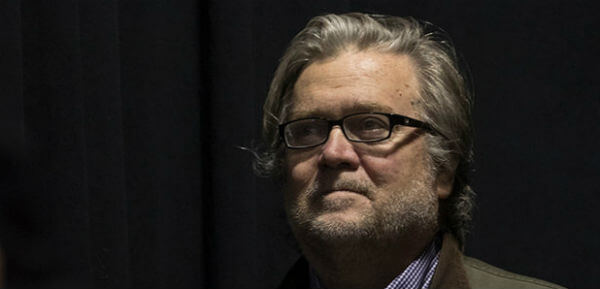
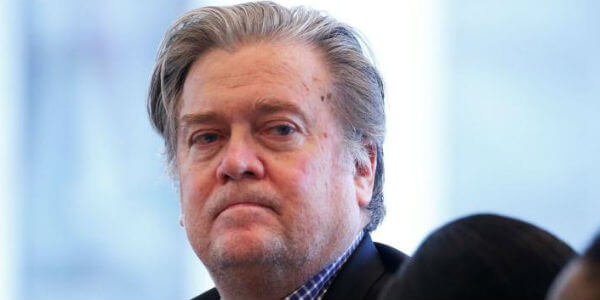
Jalal Baig writes: There seems to be considerable urgency right now to enshrine Donald Trump’s Islamophobia into law. Talk of an immigration ban, a Muslim registry and even internment camps once sounded like the machinations of a spray-tanned salesman looking to indulge the electorate’s need for a good villain narrative. Amid an atmosphere of overwhelming chaos, the early days of Trump’s reign have made clear, however, that Islam is Public Enemy No. 1 and serves as the centerpiece of Steve Bannon’s ethno-nationalist agenda. (Trump’s ban on immigration and travel from certain Muslim-majority nations is currently on hold, thanks to a Friday federal court order. That does nothing to resolve the larger questions.)
Bannon called Trump “a blunt instrument for us” in an interview last summer with Vanity Fair. He added, “I don’t know whether he really gets it or not.” That the former Breitbart executive editor would have an outsized role in a Trump administration should have been evident long ago. In Trump, Bannon found a petulant Twitterphile and a manipulable tool who has minimal interest in policymaking and little insight into his own limitations. As he sought an upheaval to remake an America rife with perceived threats, Trump was, as Lawrence Douglas wrote, “the proper vehicle to carry the fight forward.”
For Bannon, the fight is against Islam. There are echoes of Samuel Huntington’s 1993 essay in Foreign Affairs called “The Clash of Civilizations?” Huntington wrote of a world that had been divided along “fault lines” such as culture, which could spur conflict between Islamic civilization and the West. Bannon speaks of the current war with “jihadist Islamic fascism” in apocalyptic terms and sees it as the latest iteration, as Uri Friedman wrote, “of an existential, centuries old-struggle between the Judeo-Christian West and the Islamic world.” [Continue reading…]
Author Archives: News Sources
Bernie Sanders: Trump is ‘working for Wall Street’
Steve Bannon’s faith in global war

Time reports: Sometime in the early 2000s, Bannon was captivated by a book called The Fourth Turning by generational theorists William Strauss and Neil Howe. The book argues that American history can be described in a four-phase cycle, repeated again and again, in which successive generations have fallen into crisis, embraced institutions, rebelled against those institutions and forgotten the lessons of the past–which invites the next crisis. These cycles of roughly 80 years each took us from the revolution to the Civil War, and then to World War II, which Bannon might point out was taking shape 80 years ago. During the fourth turning of the phase, institutions are destroyed and rebuilt.
In an interview with TIME, author Howe recalled that Bannon contacted him more than a decade ago about making a film based on the book. That eventually led to Generation Zero, released in 2010, in which Bannon cast the 2008 financial crisis as a sign that the turning was upon us. Howe agrees with the analysis, in part. In each cycle, the postcrisis generation, in this case the baby boomers, eventually rises to “become the senior leaders who have no memory of the last crisis, and they are always the ones who push us into the next one,” Howe said.
But Bannon, who once called himself the “patron saint of commoners,” seemed to relish the opportunity to clean out the old order and build a new one in its place, casting the political events of the nation as moments of extreme historical urgency, pivot points for the world. Historian David Kaiser played a featured role in Generation Zero, and he recalls his filmed interview with Bannon as an engrossing and enjoyable experience.
And yet, he told TIME, he was taken aback when Bannon began to argue that the current phase of history foreshadowed a massive new war. “I remember him saying, ‘Well, look, you have the American revolution, and then you have the Civil War, which was bigger than the revolution. And you have the Second World War, which was bigger than the Civil War,'” Kaiser said. “He even wanted me to say that on camera, and I was not willing.”
Howe, too, was struck by what he calls Bannon’s “rather severe outlook on what our nation is going through.” Bannon noted repeatedly on his radio show that “we’re at war” with radical jihadis in places around the world. This is “a global existential war” that likely will become “a major shooting war in the Middle East again.” War with China may also be looming, he has said. This conviction is central to the Breitbart mission, he explained in November 2015: “Our big belief, one of our central organizing principles at the site, is that we’re at war.” [Continue reading…]
The cover of Time magazine brands Bannon as “The Great Manipulator,” and however accurately that might describe him, it is an image that serves Trump’s interests in this regard: it turns Bannon into Trump’s insurance policy by availing the so-called president with the option of firing Bannon rather than admit the failure of his presidency. Indeed, it’s reasonable to assume that Trump will sooner declare the failure of America than ever take responsibility for his own actions.
Refugees are already vigorously vetted. I know because I vetted them
Natasha Hall writes: I conducted one of my last interviews as an immigration officer with the Department of Homeland Security in Istanbul, with Mahmoud and his 8-year-old son from Aleppo, Syria. The boy had lost his legs in the explosion that killed Mahmoud’s wife, sister and other children. It was supposed to be his first day at school in two years. Instead, they were in my office, reliving the worst experiences of their lives in an attempt to come to the United States. Mahmoud trembled as he spoke about returning to his home from work one day and digging his family members out of the rubble.
I had never been both so sad and so proud that this boy would be able to come to the United States and start school and a new life. Now I imagine them, four years after leaving Syria and three years after registering as refugees, being told to go back. Go back where?
This is what President Trump’s recent executive order has done. The order bans entry for citizens of seven countries for 90 days, suspends all refugee admissions for 120 days, halves the total number of refugees allowed into the United States this year and bars refugees from Syria indefinitely. It demands “a uniform screening standard and procedure,” “questions aimed at identifying fraudulent answers and malicious intent,” “a mechanism to ensure that the applicant is who the applicant claims to be” and “a mechanism to assess whether or not the applicant has the intent to commit criminal or terrorist acts.”
Whoever wrote this order is evidently not aware that these screenings, procedures and questions already exist. [Continue reading…]
Canada, leading the free world
Nicholas Kristof writes: President Trump’s harsh travel ban reflects a global pattern: All around the world, countries are slamming the doors shut.
One great exception: Canada. It may now be the finest example of the values of the Statue of Liberty.
This isn’t just because Canadian leaders are particularly enlightened, although there’s some of that. It’s mostly because the Canadian people themselves remain astonishingly hospitable, with many groups clamoring for more Syrian refugees.
“Thank you, Canada,” Omar al-Omar, a Syrian who was shot at age 15 as the war started, said to me at a center here where refugees are getting lessons in English and in Canadian habits, such as excruciating politeness. “I’m very happy. I feel welcome.” [Continue reading…]
China is eager to fill the vacuum in climate change leadership that is being left by the U.S.
Larry Buhl writes: Earlier this month China halted more than 100 coal-fired power projects. Scrapping these projects, with combined installed capacity of more than 100 gigawatts, may have more to do with China’s current overcapacity in coal production than its commitment to mitigating climate change. Nevertheless, Chinese leaders are likely happy that the move is framing their nation as a green energy leader, according to experts in Chinese and environmental policy.
That’s because, they say, the Chinese government is now eager to fill the vacuum in climate change leadership that is being left by the U.S. And, they say, China is poised to eat America’s lunch in the renewable energy sector.
Saying that China is doing nothing on climate change has long been a right wing talking point used to stop U.S. regulations such as carbon taxes. While that may have been true a decade ago, it certainly isn’t true now.
Already, China is both the world’s leading producer of renewable energy technologies and its biggest consumer. [Continue reading…]
Trump’s belligerence towards Iran plays into the hands of Tehran’s hardliners
Saeed Kamali Dehghan writes: Distorting realities, ignoring nuances and hijacking people’s fears: that’s the recipe for a demagogue who lives not on his own wits but others’ miseries. It is particularly bad when the person or the country being targeted by that demagogue does little to straighten things out, which is exactly what is happening right now with Iran and Donald Trump.
Iranians know too well from their own experience with Mahmoud Ahmadinejad, their hardline former president, how dangerous it is to have a politician telling you passionately half of the truth without caring that the other half is often a lie or a distortion of facts.
Trump’s increasingly bellicose approach towards Iran, first by imposing a blanket travel ban, then putting Tehran “on notice” after a ballistic missile test, as well as by reported plans of new sanctions, carries two subtle messages. The first message is that Iranophobia is going to be his adopted weapon to distract attentions at home, appeal strongly to the US’s wealthy Arab allies who are already welcoming him as a moderate president, and please Benjamin Netanyahu. Iranian foreign minister Mohammad Javad Zarif, reacting on Twitter to the missile test, is right to point out that Iran only spends a fraction on defence compared to the US’s Arab allies in the region, which are big recipients of US, UK and French arms.
Trump’s second message, albeit one barely admitted by his officials, is that his administration’s problem is not just with the Iranian state, but with its people too. His executive order suspending all entries to the US from seven predominantly Muslim countries affects Iranians to a greater extent than it does nationals from the other six states.
There are more Iranians in the US, and far more Iranian students are likely to be affected by the new measures than those from Iraq, Libya, Somalia, Sudan, Syria and Yemen put together. Last year, there were 12,269 Iranian students studying in the US, according to data by the Institute of International Education, compared to 5,085 from the six other countries. Iranians are struggling to understand why they are being targeted in this way. [Continue reading…]
Democracy in action: Appeals court rejects request to immediately restore travel ban
The New York Times reports: A federal appeals court early Sunday rejected a request by the Justice Department to immediately restore President Trump’s targeted travel ban, deepening a legal showdown over his authority to tighten the nation’s borders in the name of protecting Americans from terrorism.
In the legal back and forth over the travel ban, the United States Court of Appeals for the Ninth Circuit in San Francisco said a reply from the Trump administration was now due on Monday.
The ruling meant that refugees and travelers from seven predominantly Muslim nations — Iran, Iraq, Libya, Somalia, Sudan, Syria and Yemen — who were barred by an executive order signed by the president on Jan. 27 would, for now, continue to be able to enter the country.
After a Federal District Court in Seattle blocked Mr. Trump’s order nationwide on Friday, the Justice Department appealed the ruling late Saturday, saying that the president had the constitutional authority to order the ban and that the court ruling “second-guesses the president’s national security judgment.”
On Saturday night, as Mr. Trump arrived at a Red Cross gala at Mar-a-Lago, his waterfront Florida resort, where he was spending the first getaway weekend of his presidency, reporters asked him if he was confident he would prevail in the government’s appeal. “We’ll win,” he replied. “For the safety of the country, we’ll win.”
The legal maneuvering led Mr. Trump to lash out at Judge James Robart of the Federal District Court in Seattle throughout the day, prompting criticism that the president had failed to respect the judicial branch and its power to check on his authority. [Continue reading…]
The price of arrogance: Steve Bannon and the best and the brightest
On the day after Christmas, Marc Tracy ran into Steve Bannon in Atlanta’s Hartsfield-Jackson International Airport. Bannon was reading David Halberstam’s The Best and the Brightest which documents the Kennedy administration’s failings leading to the Vietnam War. Tracy writes: If “The Best and the Brightest” is a brief against the East Coast meritocracy, though, its proposed alternative is not pure ideology. It is expertise.
Time and again, in Mr. Halberstam’s telling, lower-level government officials who understood Vietnamese politics, sentiments and even geography assessed reality accurately and offered correct policy recommendations to the major characters — who shunted them aside.
In early 1964, for instance, a State Department study concluded that bombing North Vietnam to reach a favorable political settlement would fail. The finding “reflected the genuine expertise of the government from deep within its bowels,” Mr. Halberstam writes. But the higher-ups favored bombing, and so there was bombing. (Which failed.)
“You’ve got these guys that are so brilliant, but they’re generalists,” said Mr. Logevall. “There’s a distinction to be drawn, he concludes, between this abstract quickness, this verbal facility, and true wisdom, which he says was missing.”
Such a reading prompts thought of the more than 1,000 State Department employees who signed a dissent cable opposing the immigration executive order — an order that, according to reports, was written by Mr. Bannon and the Trump adviser Stephen Miller, neither of whom are counterterrorism experts (or lawyers).
In this light, Mr. Bannon seems less a repudiation than a reincarnation of the tragic protagonists of “The Best and the Brightest.” [Continue reading…]
Federal judge’s ruling is ‘another stinging rejection of President Trump’s unconstitutional Muslim ban,’ says ACLU
The Washington Post reports: U.S. District Judge James L. Robart on Friday entered a temporary but nationwide stop to the order, saying he concluded the court “must intervene to fulfill its constitutional role in our tripart government.”
The Trump administration said it would go to court as quickly as possible to dissolve Robart’s order, and the president himself issued an extraordinarily personal criticism of Robart.
“The opinion of this so-called judge, which essentially takes law-enforcement away from our country, is ridiculous and will be overturned!” Trump said in a Saturday morning tweet.
Robart has been on the bench since 2004, and was nominated by President George W. Bush.
Department of Justice lawyers were preparing to immediately ask the U.S. Court of Appeals for the 9th Circuit to dissolve Robart’s order, but had not filed anything as of Saturday afternoon. It is not clear how quickly those appeals court judges would consider the government’s stay request. And although the 9th Circuit is considered one of the country’s most liberal, its randomly assigned three-judge panels can be unpredictable.
If not successful, the government has the option of asking the Supreme Court to get involved. Justice Anthony M. Kennedy is designated to hear emergency requests that arise from the 9th Circuit. But in high-profile cases such as this, such applications are generally considered by the full court.
The issue could reach the high court in days — or weeks.
“This ruling is another stinging rejection of President Trump’s unconstitutional Muslim ban,” said Omar Jadwat, director of the American Civil Liberties Union’s Immigrants’ Rights Project. “We will keep fighting to permanently dismantle this un-American executive order.” [Continue reading…]
The New York Daily News reports: Before he made headlines for temporarily blocking President Trump’s controversial travel ban, Federal Judge James Robart was quietly assisting refugees and speaking out against injustice from his bench in Seattle.
Robart, who presides in Washington State, was nominated by President George W. Bush to a seat on the United States District Court for the Western District of Washington in 2003 and was unanimously confirmed by the Senate in 2004.
During Robart’s confirmation hearing, Republican Sen. Orrin Hatch, of Utah, praised the judge for his pro bono legal work, noting he’d represented a number of refugees over the course of his decades-long career, according to CNN.
“He has been active in the representation of the disadvantaged through his work with Evergreen Legal Services and the independent representation of Southeast Asian refugees,” Hatch said at the time.
His community service and outreach has additionally extended to members of at-risk communities and special needs children. Robart is the former president and trustee of Seattle Children’s Home, as well as the former co-chair of Second Century Society and Children’s Home Society of Washington State, according to his official bio. [Continue reading…]
CNN reports: Following the judge’s ruling — and before the government’s announcements Saturday morning — the International Air Transportation Association, a worldwide airline industry trade group, cited US Customs and Border Protection in telling its members to follow procedures “as if the executive order never existed.” [Continue reading…]
Iran carries out new missile tests after Trump imposes sanctions
Bloomberg reports: Iran carried out further missile tests during an annual military exercise, a day after President Donald Trump imposed fresh sanctions on a raft of individuals and companies in response to the country test-firing a ballistic rocket last week.
The country successfully tested a range of land-to-land missiles and radar systems during the drills in a 35,000 square-kilometer stretch of desert in the northern Iranian province of Semnan, the semi-official Tasnim agency reported Saturday, citing Amir Ali Hajizadeh, commander of the Islamic Revolutionary Guards Corps’ aerospace division.
“If the enemy falls out of line, our missiles will pour down on them,” the brigadier general was cited as telling reporters on the sidelines of the military trials, without referring to any particular nations. Any threats made by the U.S. against Iran were “nonsensical,” Tasnim cited him as saying. [Continue reading…]
New York’s attorney general is emerging as the leader of the Trump resistance
Politico reports: “I like you. You and me, we’re going to be best friends.”
It is early January, and Eric Schneiderman is sitting in his 25th-floor office above Lower Manhattan, doing his best Donald Trump impression, puckering his lips into a duck face, scrunching up his nose and lowering his voice into something that resembles the president’s outer-borough growl.
Schneiderman is recalling his meeting with Trump in 2010. Back then, Schneiderman was running for attorney general of New York, and Trump was still in his pre-birther, reality TV host phase. Trump had donated money to one of Schneiderman’s opponents in the Democratic primary. Schneiderman managed to pull off a come-from-behind victory, and after the race, he went to Trump Tower to ask for a donation for the general election. Trump coughed up $12,500 to the Democrat, and Schneiderman went on to beat his Republican opponent and win.
But Trump and Schneiderman did not become best friends. That meeting was the beginning of a long and increasingly bitter saga between the two. Schneiderman took up the state’s existing case against Trump University — New York wanted the school to drop the “university” from its name, since it was not chartered as an institution of higher learning and lacked a license to offer instruction — and as he pursued it over the next five years, he became the target of a relentless series of personal attacks from the Trump camp. Trump filed an ethics complaint alleging that Schneiderman offered to drop the suit in exchange for donations; he went on television to denounce Schneiderman as a hack and a lightweight, and said he was wasting millions of taxpayer dollars when he should have been going after Wall Street. (Never mind that Schneiderman had already been declared “the man the banks fear most” by the liberal magazine The American Prospect.) “The whole scorched-earth strategy towards those who would challenge him, we got a preview of,” says Schneiderman. [Continue reading…]
Trust records show Trump is still closely tied to his empire
The New York Times reports: Just days before his inauguration, President-elect Donald J. Trump stood beside his tax lawyer at a Midtown Manhattan news conference as she announced that he planned to place his vast business holdings in a trust, a move she said would allay fears that he might exploit the Oval Office for personal gain.
However, a number of questions were left unanswered — including who would ultimately benefit from the trust — raising concerns about just how meaningful the move was.
Now, records have emerged that show just how closely tied Mr. Trump remains to the empire he built.
While the president says he has walked away from the day-to-day operations of his business, two people close to him are the named trustees and have broad legal authority over his assets: his eldest son, Donald Jr., and Allen H. Weisselberg, the Trump Organization’s chief financial officer. Mr. Trump, who will receive reports on any profit, or loss, on his company as a whole, can revoke their authority at any time.
What’s more, the purpose of the Donald J. Trump Revocable Trust is to hold assets for the “exclusive benefit” of the president. This trust remains under Mr. Trump’s Social Security number, at least as far as federal taxes are concerned.
Since his election, there have been widespread calls for Mr. Trump to sell his assets and put the proceeds in a blind trust. He has resisted those calls, stressing that the president has no legal obligation to do so.
While the trust structure, outlined in documents made public through a Freedom of Information Act request by ProPublica, may give the president the appearance of distance from his business, it drew sharp criticism from experts in government ethics. [Continue reading…]
Doctor angling for position as White House physician is doubtful about testing Trump for dementia
The New York Times reports on an interview with longtime Trump physician, Dr. Harold N. Bornstein: Dr. Bornstein also addressed questions about Mr. Trump’s recent description of himself as a “germophobe.” Dr. Bornstein said he had never discussed that phenomenon with Mr. Trump, but “we are very careful to keep the examining rooms spotlessly clean, which we do anyway.” He added, “He always stands there and changes the paper on the table himself” after an examination. “Other than that, nothing.”
Dr. Bornstein said that he was sure that Mr. Trump was up to date on an H.I.V. test, which the Centers for Disease Control and Prevention recommends that all adults get at least once. He said if he became the White House doctor he doubted that he would include in Mr. Trump’s annual checkup any psychometric tests as a base line for potential dementia. Mr. Trump’s father, Fred, suffered from Alzheimer’s disease in his eighties and a number of experts have urged that older political leaders undergo such tests.
Dr. Bornstein also said he had cared for Mr. Trump’s first and third wives, and occasionally for the second. “I am probably the only person in the world who has every phone number for him and all the wives,” Dr. Bornstein said.
About a month ago, Dr. Bornstein said he told Mr. Trump’s secretary, Rhona Graff, “You know, I should be the White House physician.” Past presidents like Ronald Reagan and George H. W. Bush brought their own doctors to the White House, but others have used a White House physician.
Dr. Bornstein was invited to Mr. Trump’s inaugural, although he said it was not as pleasant an experience as he expected. [Continue reading…]
Not ‘lone wolves’ after all: How ISIS guides world’s terror plots from afar
The New York Times reports: When the Islamic State identified a promising young recruit willing to carry out an attack in one of India’s major tech hubs, the group made sure to arrange everything down to the bullets he needed to kill victims.
For 17 months, terrorist operatives guided the recruit, a young engineer named Mohammed Ibrahim Yazdani, through every step of what they planned to be the Islamic State’s first strike on Indian soil.
They vetted each new member of the cell as Mr. Yazdani recruited helpers. They taught him how to pledge allegiance to the terrorist group and securely send the statement.
And from Syria, investigators believe, the group’s virtual plotters organized for the delivery of weapons as well as the precursor chemicals used to make explosives, directing the Indian men to hidden pickup spots.
Until just moments before the arrest of the Indian cell, here last June, the Islamic State’s cyberplanners kept in near-constant touch with the men, according to the interrogation records of three of the eight suspects obtained by The New York Times.
As officials around the world have faced a confusing barrage of attacks dedicated to the Islamic State, cases like Mr. Yazdani’s offer troubling examples of what counterterrorism experts are calling enabled or remote-controlled attacks: violence conceived and guided by operatives in areas controlled by the Islamic State whose only connection to the would-be attacker is the internet. [Continue reading…]
In response to mass protests, Romania reverses decision to weaken corruption law
The New York Times reports: After five straight days of spirited mass protests, and predictions that a half-million or more people might take to the streets on Sunday, Romania’s month-old government backed down Saturday and withdrew a decree that had decriminalized some corruption offenses.
“We will hold an extraordinary meeting on Sunday to repeal the decree, withdraw it, cancel it,” Prime Minister Sorin Grindeanu said late Saturday evening.
It was a remarkable and rapid turnaround for a government that had shown every sign of holding firm against the protests.
As recently as Thursday, Mr. Grindeanu said, “We took a decision in the government and we are going to press ahead.”
As word of the government’s retreat spread through Piata Victoriei — the square outside the main government building that has been the center of the protests — a subdued wave of celebration passed through the throng of more than 100,000 people, mixing with grim determination to continue the fight, if needed.
“I feel a bit better, but it isn’t enough,” said Mihai Saru, 20, a student. “They lost our trust when they released this emergency ordinance in the night. How do we know it won’t happen again in two weeks, a month? But tonight is a little victory.” [Continue reading…]
Justice Department to challenge judge’s halt of travel ban
CNN reports: The White House is preparing to fight for President Donald Trump’s immigration order after a federal judge on Friday halted it nationwide.
A chaotic night set up the nation for a second straight weekend of widespread uncertainty over the controversial ban, this time with the administration on defense.
Federal Judge James Robart, a George W. Bush appointee who presides in Washington state, temporarily stopped the order. US Customs and Border Protection then alerted airlines the US government would quickly begin reinstating visas that were previously canceled, and CBP advised airlines that refugees that are in possession of US visas will be admitted as well, an airline executive said.
But the White House quickly countered, first calling the order “outrageous” and then dropping that word minutes later in a second statement.
“At the earliest possible time, the Department of Justice intends to file an emergency stay of this outrageous order and defend the executive order of the President, which we believe is lawful and appropriate,” White House Press Secretary Sean Spicer said in a statement. “The President’s order is intended to protect the homeland and he has the constitutional authority and responsibility to protect the American people.” [Continue reading…]
Steve Bannon’s lust for bloodshed

Jonathan Freedland writes: Donald Trump doesn’t read books. He leaves that to his chief strategist, Steve Bannon, the man rapidly emerging as the true power behind the gaudy Trump throne. Given Bannon’s influence – he is the innermost member of the president’s inner circle and will have a permanent seat on the National Security Council, a privilege Trump has denied the head of the US military – it’s worth taking a good look at the books on his bedside table.
Close to the top of the pile, according to this week’s Time magazine, is a book called The Fourth Turning, which argues that human history moves in 80- to 100-year cycles, each one climaxing in a violent cataclysm that destroys the old order and replaces it with something new. For the US, there have been three such upheavals: the founding revolutionary war that ended in 1783, the civil war of the 1860s and the second world war of the 1940s. According to the book, America is on the brink of another.
You’ll notice what all those previous transformations have in common: war on an epic scale. For Bannon, previously impresario of the far-right Breitbart website, that is not a prospect to fear but to relish. Time, which has Bannon on the cover, quotes him all but yearning for large-scale and bloody conflict. “We’re at war” is a favourite Bannon slogan, whether it’s the struggle against jihadism, which Bannon describes as “a global existential war” that may turn into “a major shooting war in the Middle East”, or the looming clash with China.
All this lust for bloodshed may explain why Bannon was unperturbed by the chaos and loathing unleashed by last weekend’s refugee ban, which he drove through with next to no consultation with the rest of the US government. For Bannon is an advocate of the “shock event”. He’s described himself as a “Leninist”, telling one writer in 2013: “Lenin wanted to destroy the state, and that’s my goal too. I want to bring everything crashing down.” It seems war is his chosen method. [Continue reading…]