Author Archives: News Sources

António Guterres: Refugees have the right to be protected


BBC News reports: The nomination of Antonio Guterres as next UN secretary general came despite efforts by some politicians for the role to go to a woman, or to someone from eastern Europe.

He is widely expected to select a woman as deputy secretary-general, having said that “gender parity” is crucial at the United Nations.

Speaking earlier this year, Richard Gowan, a UN expert at the European Council on Foreign Relations, said insiders believed Mr Guterres, from Portugal, “could give the UN the kind of kick up the backside it needs”.

Mr Guterres was born in Lisbon in 1949. He studied engineering and physics at the Instituto Superior Tecnico, before going into academia after graduating in 1971.

But academia only held the fervent Catholic’s interest for a couple of years. He joined the Socialist party in 1974 – the same year five decades of dictatorship came to an end in Portugal – and soon became a full-time politician.

In 1995, three years after being elected the Socialist party’s secretary general, he was voted in as prime minister, a position he held until 2002.

Then Mr Guterres, fluent in Portuguese, English, Spanish and French, turned his attention to the world of international diplomacy, becoming the UN’s high commissioner for refugees in 2005. [Continue reading…]

Facebooktwittermail

Aleppo’s White Helmets reject foreign influence claims

Al Jazeera reports: Members of the Syrian Civil Defence units – or White Helmets – have dismissed claims that they are biased actors in the conflict following a controversial report linking the organisation to alleged US government attempts to overthrow the Syrian government.

In an article published by US-based progressive website AlterNet on Monday, journalist Max Blumenthal accused the group of undermining United Nations aid work in Syria.

The two-part report, which was shared thousands of times on Twitter, was widely condemned by journalists and anti-Assad activists. [Continue reading…]

Facebooktwittermail

Whoever saves a life

In June 2014, Matthieu Aikins visited Aleppo and rode with Civil Defense volunteers (the “White Helmets”) in their donated truck in the neighborhood of Hanano. He wrote: The members of Civil Defense were attendants to the city’s trauma, one of the few first responders left to care for the civilians caught on the front lines in a war between Syrian President Bashar al Assad and rebel fighters. The team evacuated the injured, cleaned up the bodies, and fought fires. But what they were best known for  — what they had become famous for in Syria and abroad  — were the dramatic rescues, the lives they pulled from under the rubble.

When they spotted a blast, they’d cram into the cabin, ten or more on its two bench seats, and set off in search of the impact site. The truck had a loose, shaky suspension and the cab would smash up and down off the craters and potholes, jangling the men like change inside of a tin cup. The siren atop was an old-school wailer, deafening and sonorous. Sometimes they’d catch sight of an ambulance and give chase; often they’d be the first to the scene. As they rushed along, they’d lean out and ask pedestrians where the bomb had fallen. They could tell by the reaction if they were getting closer. At first it was just a pointed arm or a shrug, but as they neared, the onlookers would get increasingly agitated, until they saw in their eyes the wildness of a close brush with death or the panic for a trapped neighbor. The missions were all the more dangerous because of the regime’s tactic of “double-tap” strikes, where they would return to bomb the same site and hit the rescuers and whatever crowd had gathered. In March, three members of the Hanano team had been killed that way, along with an Egyptian-Canadian photographer who had come to document their work.

Khaled flicked the cigarette into the parking lot. Thirty years old, he looked more like a graduate student than someone who had spent the last year immersed in blood and rubble: shaggy hair, a straight, full-bridged nose and a pointed jaw softened by full lips and cheeks. In a city dominated increasingly by anti-Western Islamist groups, he had until recently worn a pony tail. He was growing a slight paunch from all the nights spent sitting up snacking on fruit and nuts, listening to the sound of the city’s bombardment and waiting for a call. When he smiled, a net of crow’s feet crinkled into the corners of his eyes, but mostly his face maintained an unshakable placidity, even in the presence of death. It was this stillness, more than anything else, that accounted for his unruly team’s respect and obedience. “It’s the quiet ones you should fear,” was how Surkhai, the group’s joker, had put it.

After washing his face in the rickety outbuilding that served as their bathroom, Khaled returned to his office, which was furnished with a scuffed desk, a shelf that held the station’s paperwork, and a couple of love seats. On the wall hung a certificate of appreciation from the city council. Two bare bulbs dangled from the ceiling.

Khaled could hear the rest of the team stirring. Present that day were some of his most reliable veterans  —  though of course they were really still boys. At 28, the twins, Surkhai and Shahoud, heavyset with thick hair covering everywhere but the top of their heads, were among the eldest. The rest were mostly 20 or 21. Scrawny Ali, with his mullet, was only 19. Only Ahmed, a lanky, goateed kid who had been a firefighter like his father, had any experience as a first responder before the war. In all, there were 30 of them, but they worked in shifts, so that only a dozen or so were typically in the station at any one time. Except for the leader, Khaled. He had not taken a single day off. He loved the team  —  loved the physical closeness, the emotional bond. These guys had become his life. His old self, the former law student who taught at a trade school, seemed as remote to him as his family’s home, now behind regime lines. [Continue reading…]

Facebooktwittermail

Selective outrage: Why the silence? What’s outrageous in Gaza is no less so in Aleppo

Fintan O’Toole writes: The United States and Israel are bombing an ancient city, targeting hospitals and slaughtering children, women and other non-combatants. All across Europe, ordinary people are appalled. Protest marches to the US and Israeli embassies attract hundreds of thousands of people, denouncing these crimes against humanity. But what if the perpetrators are Russia and the Assad regime in Syria? Protests against the bombing of Aleppo, such as that in Dublin last weekend, have been small and muted. Why are Russian war crimes so much less obnoxious than American atrocities?

On Vimeo, there’s a short film of a demonstration against the Aleppo bombing at the Russian embassy in Dublin on August 27th, led by the veteran peace campaigner Brendan Butler. It is a very fine gesture by compassionate and concerned people. But I counted the crowd stretching a banner across the entrance to the embassy. It didn’t take long – there are 14 people. One of them is a young boy with a poster that says “This isn’t happening in a galaxy far, far away”. But it might as well be. [Continue reading…]

Facebooktwittermail

Syrian military announces an easefire aimed at reducing the number of Aleppo headlines

The Wall Street Journal reports: Syria’s military said Wednesday it will decrease airstrikes on Aleppo’s rebel-held areas after an international outcry over its Russian-backed bombardment of civilians over the past few weeks.

The military command accused rebel groups in Aleppo of using civilians as human shields and claimed that it wanted to improve the humanitarian situation in Aleppo’s opposition-held neighborhoods, where some 300,000 people live under siege by the government.

The army “has decided to reduce the number of air and artillery strikes on the positions of the terrorists to help civilians who want to leave [for] safe areas,” it said in a statement carried by Syria’s state news agency SANA. The Syrian government routinely describes its opponents as terrorists.

The Syrian army and its allies, including key military backer Russia, launched a new offensive in Aleppo’s eastern neighborhoods after a U.S.-Russian brokered cease-fire collapsed last month. Heavy bombardment has since targeted hospitals and killed hundreds of civilians.

The Syrian government continued to bomb Aleppo on Wednesday, according to the U.K.-based opposition monitoring group Syrian Observatory for Human Rights, as rebel groups targeted the city’s government-held areas with rocket-propelled grenades. [Continue reading…]

Facebooktwittermail

Iraqi militias complicate Aleppo battle

The Wall Street Journal reports: Iraqi militia fighters are pouring into Syria to reinforce the Assad regime’s siege of rebels in Aleppo, further complicating the tangled web of alliances the U.S. relies on to fight Islamic State, which can turn an ally on one side of the border into an enemy on the other.

The Shiite militias, who have fought alongside U.S.-backed Iraqi government forces against Islamic State in Iraq, are now fighting Syrian Sunni rebels, some of them armed and trained by the U.S.

More than 1,000 Iraqi Shiite militants have traveled from Iraq since early September, joining the ranks of as many as 4,000 others already on the ground near Aleppo, the militia leaders and Syrian rebels said. They make up about half of the regime’s estimated ground force of 10,000.

The siege they are helping to enforce has tilted the battle there in favor of President Bashar al-Assad, whose ruling Alawite sect has drawn on fellow Shiite powers to shore up government forces depleted by deaths, defections and attrition over five years of war: Iran’s Revolutionary Guards Corps, Lebanon’s Hezbollah militia and Afghan Shiite fighters. [Continue reading…]

Facebooktwittermail

The murder that killed free media in Russia

Shaun Walker writes: No other reporter has been assigned Anna Politkovskaya’s desk in Novaya Gazeta’s newsroom. It remains as a memorial, alongside her photograph and those of other murdered journalists at the newspaper, and as a reminder of the danger of the work.

Ten years after Politkovskaya was shot in the lobby of her apartment block in Moscow, Novaya Gazeta continues to be one of the few outlets for hard-hitting independent journalism in Russia. Its reporters still work from the North Caucasus, one the most dangerous part of the region.

In September, Elena Kostyuchenko, a reporter with Novaya, travelled to Beslan in North Ossetia to cover the 12th anniversary of the siege in which 334 people died, including 186 children.

Politkovskaya had attempted to make the same journey back in 2004, but fainted on the plane on her way there. Doctors believe she was poisoned to prevent her from reporting.

Nevertheless, Novaya worked tirelessly to investigate what happened at Beslan, and published a number of reports suggesting explosives planted by Russian special forces to try to end the siege had been responsible for many of the deaths. [Continue reading…]

Facebooktwittermail

Good time for a bloodbath in Aleppo? Putin thinks so

David Hearst writes: It is nearly a year since Vladimir Putin sprung one of his little surprises on Washington by entering the civil war in Syria as an active combatant on Bashar al-Assad’s side.

In that time, Russian bombing can claim to have saved Damascus and the regime itself from falling, to have re-opened the coastal road to Latakia, and liberated Palmyra. Putin has already declared mission accomplished once and flew home most of his bombers. He is now flying them all back in an assault on east Aleppo.

In that time, Sergei Lavrov and John Kerry lulled each other into thinking that they could waltz their way to the Geneva conference table, when neither the Russian Ministry of Foreign Affairs, nor the State Department were running things. The deal breaker was the US bombing of Syrian regime positions in Deir Ezzor on 17 September, an act for which the US have apologised but which the Russians believe was a deliberate act.

Just as he did in Ukraine (a separatist war for which Moscow, Ukrainian nationalists and EU negotiators all have blood on their hands), the arch regional opportunist Putin saw an opportunity: to finish off Aleppo, and with it a war that has lasted the five and a half years. Or so he thinks.

Russian generals also think they have done Aleppo before. For anyone who witnessed the bombardment of Grozny – in 1994 and 2000 – the pictures coming out of east Aleppo are nothing new.

The use of thermobaric or vacuum bombs (bursts which suck the oxygen out of the air within a 500-metre radius), phosphorus, “double tap” strikes, deniable militias, the targeting of hospitals, market places, mosques, anywhere where civilians gather in war time – all this Russia has tried before in Chechnya.

The brutality of the Russian counter insurgency in Chechnya had one effect. It split a nationalist Sufi separatist movement, which had been running on and off since Tsarist days, into two factions. One went into exile and is inert. The other became the hard core of the Islamic State (IS) in the North Caucasus, and provides one source of foreign fighters for IS in Raqqa.

Russia has never put this fire out. It continues to burn away in Muslim-majority Russian republics like Dagestan and Ingushetia and will burst out again the moment Moscow takes its foot off the throat of the North Caucasus. In one sense, Putin is right to think that he is fighting the same enemy now in east Aleppo, as he did 16 years ago in Grozny. It is one that he himself created. [Continue reading…]

Facebooktwittermail

Russia aims to redraw map in Syria before next U.S. president takes office

The New York Times reports: Russia is using the waning days of the Obama administration to strengthen President Bashar al-Assad’s hold on power, expand the territory he controls in Syria and constrain the options of the next American president in responding to the civil war, according to a number of American officials and Russian analysts.

The strategy of President Vladimir V. Putin of Russia, they say, is to move aggressively in what he sees as a prime window of opportunity — the four months between now and the 2017 presidential inauguration — when Mr. Putin calculates that the departing President Obama will be unlikely to intervene in the escalating Syrian conflict and a new American president who might consider a tougher policy will not yet be in office.

“Putin is in a hurry before the American elections,” said Nikolai V. Petrov, a political scientist in Moscow. “The next American president will face a new reality and will be forced to accept it.” [Continue reading…]

Facebooktwittermail

Obama views Aleppo’s destruction as preferable to risky U.S. intervention

Josh Rogin writes: U.S. military strikes against the Assad regime will be back on the table Wednesday at the White House, when top national security officials in the Obama administration are set to discuss options for the way forward in Syria. But there’s little prospect President Obama will ultimately approve them.

Inside the national security agencies, meetings have been going on for weeks to consider new options to recommend to the president to address the ongoing crisis in Aleppo, where Syrian and Russian aircraft continue to perpetrate the deadliest bombing campaign the city has seen since the five-year-old civil war began. A meeting of the Principals Committee, which includes Cabinet-level officials, is scheduled for Wednesday. A meeting of the National Security Council, which could include the president, could come as early as this weekend.

Last Wednesday, at a Deputies Committee meeting at the White House, officials from the State Department, the CIA and the Joint Chiefs of Staff discussed limited military strikes against the regime as a means of forcing Syrian dictator Bashar al-Assad to pay a cost for his violations of the cease-fire, disrupt his ability to continue committing war crimes against civilians in Aleppo, and raise the pressure on the regime to come back to the negotiating table in a serious way. [Continue reading…]

The New York Times reports: Secretary of State John Kerry criticized Russia on Tuesday for pointedly ignoring the Syrian government’s use of chlorine gas and barrel bombs against its own citizens, and he left little hope for an early resumption of talks with Russia about a cease-fire.

Speaking here before the opening of a conference on Afghanistan organized by the European Union, Mr. Kerry said that the United States would continue efforts to end the fighting in Syria through the United Nations, but that Washington had little hope of persuading Russia to give up its unqualified support of the government of President Bashar al-Assad of Syria.

The Obama administration announced on Monday that it was suspending bilateral talks with Russia on a cease-fire. [Continue reading…]

Facebooktwittermail

The mirage of U.S.-Russian shared interests in Syria

Fred Hof writes: Secretary of State John Kerry’s tireless, frenetic drive to short-circuit mass homicide in Syria by finding common ground with Russia has come to naught. It has gone up in the flames with the smoke now rising above Aleppo. It has died with defenseless, terrified civilians in their homes, hospitals, markets, and mosques: a population top-heavy with children targeted mercilessly by Russian pilots and their Assad regime counterparts. Where Kerry’s superbly intentioned diplomacy went wrong was its failure to distinguish between the arguably objective interests of the Russian Federation and the personal desires of its current leader, President Vladimir Putin.

No Russian diplomat with whom I interacted while serving in the State Department ever failed to say something unkindly accurate about Moscow’s Syrian client, Bashar al-Assad. The highlight came during the pivotal Geneva negotiations of June 2012. The American, French, and British delegates argued forcefully for language that would exclude “anyone with blood on his hands” from Syria’s to-be-negotiated transitional governing body. The objection of the chief Russian delegate was revealing: “Come on. Everyone will know we’re talking about Assad.” His point was irrefutable.

The corruption, incompetence, and brutality of the Assad regime is not lost on Russian officials. They are intimately aware of the role the regime played during the first decade of the twenty-first century ferrying foreign fighters from the Damascus airport to Iraq, where they joined Al Qaeda in Iraq: the direct ancestor of ISIS (ISIL, Islamic State, Daesh). They are cognizant of the regime releasing from prison violent political extremists back in 2011 in the hope they would pollute and ultimately dominate the peaceful, nationalistic, and non-sectarian opposition to Assad regime violence. They are not unwitting of the eastern Syria governance vacuum created by Assad regime lawlessness and how ISIS has filled it. They know quite well that the regime’s survival strategy of mass homicide pumps oxygen into the lungs of the ISIS recruiting apparatus, both in Syria and in Sunni communities around the world.

Knowing that his Russian counterparts know all of this, John Kerry proceeded on the assumption that Moscow could be persuaded to cooperate in transitioning Assad offstage. He was encouraged in this assumption by a Russian counterpart eager to mislead so as to preserve American operational passivity in the face of mass murder. Kerry’s White House counterparts jumped onto the shared-interests bandwagon with unbridled enthusiasm, assuring visitors that Moscow would bend over backward to cooperate with Washington diplomatically for the sake of establishing joint military operations, which Russia allegedly needed to “legitimize” its military presence in Syria. This delusional belief in common ground with the Kremlin was fed and sustained by the one actual fact known to Kerry and to White House officials: President Barack Obama would not so much as lift a finger to protect Syrian civilians from Assad regime mass murder. It was therefore up to Vladimir Putin to protect them. [Continue reading…]

Facebooktwittermail

In Aleppo death follows us. But we still love life

Waad Alkhateab writes: The past week in Aleppo has been totally different from the past five years. It feels as if the Assad government is trying to wipe out what remains of east Aleppo. It is often referred to as the most dangerous city in the world and these days there is no escaping the horror.

Almost a month ago during the first siege, my friend wrote, “We no longer need to set our alarm clocks to wake us up in the morning. The missiles and barrel bombs are doing this job.” Now this is the daily reality, only the lucky people wake up alive. Hearing the sound of shelling at night is at least evidence that you are still breathing in air, not the dust of your home in ruins, or the aroma of the blood and flesh of your family members.

We thought that the 72-day siege that the city experienced earlier in the year was over with no return and that the regime had been pushed back. However, now it feels as if Bashar al-Assad is planning to break us completely. [Continue reading…]

Facebooktwittermail

How is it possible that Donald Trump could become president?

Roger Cohen writes: It is possible because spectacle and politics have merged and people no longer know fact from fiction or care about the distinction. It is possible because fear has entered people’s lives and that fear is easily manipulated. It is possible because technology has created anxiety-multipliers such as have never been known before. It is possible because America is a country living with the dim dissatisfaction of two wars without victory and the untold trillions spent on them. It is possible because a very large number of people want to give the finger to the elites who brought the crash of 2008 and rigged the global system and granted themselves impunity. It is possible because of growing inequality and existential dread, especially among the white losers from globalization who know minorities will be the majority in the United States by midcentury. It is possible because both major parties have abandoned the working class. It is possible because a lot of Americans feel the incumbent in the White House has undersold the United States, diminished its distinctive and exceptional nature, talked down its power, and so diluted its greatness and abdicated its responsibility for the well-being of the free world. It is possible because the identity politics embraced by urban, cosmopolitan liberals have provoked an inevitable backlash among those who think white lives matter, too. It is possible because Trump speaks to the basest but also some of the most ineradicable traits of human beings — their capacity for mob anger, their racist resentments, their cruelty, their lust, their search for scapegoats, their insecurities — and promises a miraculous makeover. It is possible because the Clinton family has been in the White House and cozy with the rich and close to the summit of a discredited political establishment for a quarter-century now and, to people who want change or bridle at dynastic privilege, that makes Hillary Clinton an unattractive candidate. It is possible because history demonstrates there is no limit to human folly or the dimensions of the disasters humanity can bring on itself. [Continue reading…]

Facebooktwittermail

Yemen famine feared as starving children fight for lives in hospital

The Guardian reports: Dozens of emaciated children are fighting for their lives in Yemen’s hospital wards, as fears grow that civil war and a sea blockade that has lasted for months are creating famine conditions in the Arabian peninsula’s poorest country.

The UN’s humanitarian aid chief, Stephen O’Brien, described a visit to meet “very small children affected by malnutrition” in the Red Sea city of Hodeida. “It is of course absolutely devastating when you see such terrible malnutrition,” he said on Tuesday, warning of “very severe needs”.

More than half of Yemen’s 28 million people are already short of food, the UN has said, and children are particularly badly hit, with hundreds of thousands at risk of starvation.

There are 370,000 children enduring severe malnutrition that weakens their immune system, according to Unicef, and 1.5 million are going hungry. Food shortages are a long-term problem, but they have got worse in recent months. Half of children under five are stunted because of chronic malnutrition. [Continue reading…]

Facebooktwittermail

Baghdad bridles at Turkey’s military presence, warns of ‘regional war’

Reuters reports: Iraqi Prime Minister Haider al-Abadi has warned Turkey that it risks triggering a regional war by keeping troops in Iraq, as each summoned the other’s ambassador in a growing row.

Relations between the two regional powers are already broadly strained by the Syrian civil war and the rise of the Islamic State militant group.

Turkey’s parliament voted last week to extend its military presence in Iraq for a further year to take on what it called “terrorist organizations” – a likely reference to Kurdish rebels as well as Islamic State.

Iraq’s parliament responded on Tuesday night by condemning the vote and calling for Turkey to pull its estimated 2,000 troops out of areas across northern Iraq.

“We have asked the Turkish side more than once not to intervene in Iraqi matters and I fear the Turkish adventure could turn into a regional war,” Abadi warned in comments broadcast on state TV on Wednesday. [Continue reading…]

Facebooktwittermail

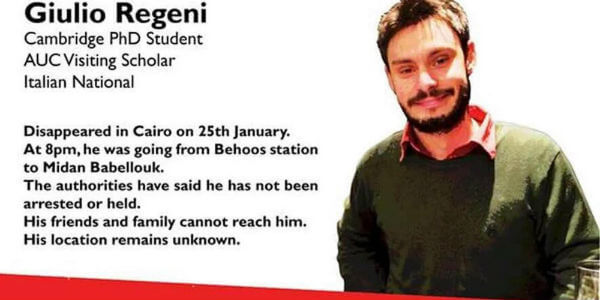
Who murdered Giulio Regeni?

GIULIO-REGENI

Alexander Stille writes: When six senior Italian detectives arrived in Cairo in early February, following the discovery of the brutally battered body of 28-year-old Italian PhD student Giulio Regeni, they faced long odds of solving the mystery of his disappearance and death. Egyptian officials had told reporters that Regeni had probably been hit by a car, but clear signs of torture on his body had raised an alarm in Rome.

The Egyptian authorities guaranteed “full cooperation”, but this was quickly revealed to be a hollow promise. The Italians were allowed to question witnesses – but only for a few minutes, after the Egyptian police had finished their own much longer interrogations, and with the Egyptian police still in the room. The Italians requested the video footage from the metro station where Regeni last used his mobile phone, but the Egyptians allowed several days to elapse, by which time the footage from the day of his disappearance had been taped over. They also refused to share the mobile phone records from the area around Regeni’s home, where he disappeared on 25 January, and the site where his body was found nine days later.

One of the Egyptian chief investigators in charge of the Regeni case, Major General Khaled Shalaby, who told the press that there were no signs of foul play, is a controversial figure. Convicted of kidnapping and torture over a decade ago, he escaped with a suspended sentence.

The Egyptians may well have hoped that the outside world, with no independent information, would have little choice but to accept their unsatisfying explanation for Regeni’s death. But in the digital age, getting away with murder has become more difficult. [Continue reading…]

Facebooktwittermail

‘Great Pacific garbage patch’ far bigger than imagined, aerial survey shows

The Guardian reports: The vast patch of garbage floating in the Pacific Ocean is far worse than previously thought, with an aerial survey finding a much larger mass of fishing nets, plastic containers and other discarded items than imagined.

A reconnaissance flight taken in a modified C-130 Hercules aircraft found a vast clump of mainly plastic waste at the northern edge of what is known as the “great Pacific garbage patch”, located between Hawaii and California.

The density of rubbish was several times higher than the Ocean Cleanup, a foundation part-funded by the Dutch government to rid the oceans of plastics, expected to find even at the heart of the patch, where most of the waste is concentrated.

“Normally when you do an aerial survey of dolphins or whales, you make a sighting and record it,” said Boyan Slat, the founder of the Ocean Cleanup.

“That was the plan for this survey. But then we opened the door and we saw the debris everywhere. Every half second you see something. So we had to take snapshots – it was impossible to record everything. It was bizarre to see that much garbage in what should be pristine ocean.” [Continue reading…]

Facebooktwittermail

Yahoo secretly scanned customer emails for U.S. intelligence

Reuters reports: Yahoo Inc last year secretly built a custom software program to search all of its customers’ incoming emails for specific information provided by U.S. intelligence officials, according to people familiar with the matter.

The company complied with a classified U.S. government demand, scanning hundreds of millions of Yahoo Mail accounts at the behest of the National Security Agency or FBI, said three former employees and a fourth person apprised of the events.

Some surveillance experts said this represents the first case to surface of a U.S. Internet company agreeing to an intelligence agency’s request by searching all arriving messages, as opposed to examining stored messages or scanning a small number of accounts in real time.

It is not known what information intelligence officials were looking for, only that they wanted Yahoo to search for a set of characters. That could mean a phrase in an email or an attachment, said the sources, who did not want to be identified.

Reuters was unable to determine what data Yahoo may have handed over, if any, and if intelligence officials had approached other email providers besides Yahoo with this kind of request.

According to two of the former employees, Yahoo Chief Executive Marissa Mayer’s decision to obey the directive roiled some senior executives and led to the June 2015 departure of Chief Information Security Officer Alex Stamos, who now holds the top security job at Facebook Inc. [Continue reading…]

The Wall Street Journal reports: Big technology companies, including Google, Microsoft Corp., Twitter Inc. and Facebook Inc. denied scanning incoming user emails on behalf of the U.S. government, following a report that Yahoo Inc. had built such a system. [Continue reading…]

Facebooktwittermail