Author Archives: News Sources

Republican elites surrender to Trump

Dana Milbank writes: Late Thursday night, National Review, the storied conservative magazine founded by William F. Buckley, published an issue denouncing Donald Trump.

“Trump is a philosophically unmoored political opportunist who would trash the broad conservative ideological consensus within the GOP in favor of a free-floating populism with strong-man overtones,” the editors wrote. “Donald Trump is a menace to American conservatism who would take the work of generations and trample it underfoot in behalf of a populism as heedless and crude as the Donald himself.”

The Republican National Committee reacted swiftly — immediately revoking the permission it had given National Review to host a Republican presidential debate next month. “Tonight, a top official with the RNC called me to say that National Review was being disinvited,” the magazine’s publisher wrote online. “The reason: Our ‘Against Trump’ editorial.”

That soft flapping sound you hear is the Grand Old Party waving the flag of surrender to Trump. Party elites — what’s left of the now-derided “establishment” — are acquiescing to the once inconceivable: that a xenophobic and bigoted showman is now the face of the Republican Party and of American conservatism.

In recent days, influential Republicans including Bob Dole, Iowa Gov. Terry Branstad, RNC Chairman Reince Priebus, Rupert Murdoch and, as my Post colleagues reported, Rudy Giuliani and Rep. Peter King (N.Y.) have made noises about being able to stomach Trump. Republican donors are trying to insinuate themselves in the billionaire’s orbit. Trump himself said Thursday: “I have received so many phone calls from people that you would call ‘establishment,’ from people — generally speaking, conservatives, Republicans — that want to come onto our team.”

The Wall Street Journal editorial page had long criticized Trump’s candidacy, publishing an editorial in July arguing that the conservative media who applaud Trump “are hurting the cause.” The editors opined: “If Donald Trump becomes the voice of conservatives, conservatism will implode along with him.”

A week ago, the Journal reversed course. “Mr. Trump is a better politician than we ever imagined, and he is becoming a better candidate,” the editorialists wrote, speculating that “he might possibly be able to appeal to a larger set of voters than he has so far.” [Continue reading…]


Facebooktwittermail

What does the return of mercenary armies mean for the world?

Sean McFate writes: It is a familiar story. A superpower goes to war and faces a stronger-than-expected insurgency in distant lands, yet has insufficient forces to counter it because of political and military constraints. The superpower decides to hire contractors, some of whom are armed, to support its war effort. The armed contractors prove to be both a blessing and a curse, providing vital security services to the campaign, yet at times killing innocent civilians, causing strategic setbacks, and damaging the superpower’s legitimacy. Without these contractors, the superpower could not wage the war. With them, it is more difficult to win.

The armed contractors in question are not in Iraq or Afghanistan but in northern Italy, and the year is not 2007 but 1377. The superpower is not the United States but the papacy under Pope Gregory XI, fighting the antipapal league led by the duchy of Milan. The tragic killing of civilians by armed contractors did not occur in Baghdad but in Cesena, 630 years earlier. The military companies employed were not DynCorp International, Triple Canopy or Blackwater, but the Company of the Star, the Company of the Hat and the White Company. Known as free companies, these for-profit warriors were organised as corporations, with a well-articulated hierarchy of subcommanders and administrative machinery that oversaw the fair distribution of loot according to employees’ contracts. CEO-like captains led these medieval military corporations.

The parallels between medieval and contemporary private military companies (PMCs) are strong. Today, the US and many others hire contractors to fulfil security-related contracts in the world’s most dangerous places. In the late Middle Ages, such men were called condottieri – literally, ‘contractors’ – who agreed to perform security services described in written contracts, or condotte. Both modern and medieval contractors were organised as companies, their services available to the highest or most powerful bidder for profit. Both filled their ranks with professional men of arms drawn from different countries and loyal primarily to the paycheck. Both have functioned as private armies, usually offering land-based combat skills rather than naval (or aerial) capabilities and deploying force in a military manner rather than as law enforcement or police.

Mercenaries are back. Once brandished as villainous outlaws, they are emerging from the shadows to once again become a mainstream instrument of world politics. The United Arab Emirates (UAE) has hired hundreds of Latin-American mercenaries to fight the Iranian-backed Houthis in Yemen. After years of struggling against Boko Haram, Nigeria finally employed mercenaries to do the job, and they did. Russia’s President Vladimir Putin has sent mercs to ‘liberate’ eastern Ukraine, a conflict that still simmers. Mercs are reportedly working in parts of Iraq. [Continue reading…]

Facebooktwittermail

ISIS targeting Europe for Paris-style attacks, says EU police chief

The Guardian reports: Islamic State is actively focusing its attention on conducting large-scale attacks in Europe similar to those last year in Paris, the head of the EU’s law enforcement agency has said.

Rob Wainwright, the head of Europol, the Hague-based organisation that coordinates EU policing efforts over terrorism and organised crime, said Isis had “developed a new combat-style capability to carry out a campaign of large-scale terrorist attacks on a global stage, with a particular focus in Europe”.

His comments, at a meeting of interior ministers in Amsterdam, came as France’s interior minister said Islamist terrorists had planned to attack another concert in Paris and carry out a mass killing in the streets of the capital.

Bernard Cazeneuve was defending the government’s decision to maintain a state of emergency imposed after the shootings and bombings across Paris on 13 November, which left 130 people dead, including 89 at the Bataclan concert hall. Isis claimed responsibility.

Cazeneuve said that since last spring the country’s intelligence services had foiled 11 terrorist attacks, some of which had been ordered by the Islamic State attackers behind the Paris atrocities. [Continue reading…]

Facebooktwittermail

What Donald Rumsfeld knew we didn’t know about the lack of evidence for WMD in Iraq

John Walcott writes: On September 9, 2002, as the George W. Bush administration was launching its campaign to invade Iraq, a classified report landed on the desk of the chairman of the Joint Chiefs of Staff. It came from Defense Secretary Donald Rumsfeld, and it carried an ominous note.

“Please take a look at this material as to what we don’t know about WMD,” Rumsfeld wrote to Air Force General Richard Myers. “It is big.”

The report was an inventory of what U.S. intelligence knew — or more importantly didn’t know — about Iraqi weapons of mass destruction. Its assessment was blunt: “We’ve struggled to estimate the unknowns. … We range from 0% to about 75% knowledge on various aspects of their program.”

Myers already knew about the report. The Joint Staff’s director for intelligence had prepared it, but Rumsfeld’s urgent tone said a great deal about how seriously the head of the Defense Department viewed the report’s potential to undermine the Bush administration’s case for war. But he never shared the eight-page report with key members of the administration such as then-Secretary of State Colin Powell or top officials at the CIA, according to multiple sources at the State Department, White House and CIA who agreed to speak on condition of anonymity. Instead, the report disappeared, and with it a potentially powerful counter-narrative to the administration’s argument that Saddam Hussein’s nuclear, chemical and biological weapons posed a grave threat to the U.S. and its allies, which was beginning to gain traction in major news outlets, led by the New York Times.

While the threat posed by a nuclear-armed Iraq was at the heart of the administration’s case for war, the JCS report conceded: “Our knowledge of the Iraqi (nuclear) weapons program is based largely — perhaps 90% — on analysis of imprecise intelligence.”

The rationale for the invasion has long since been discredited, but the JCS report, now declassified, which a former Bush administration official forwarded in December, nevertheless has implications for both sides in the 2016 presidential race, in particular the GOP candidates who are relying for foreign policy advice on some of the architects of the war, and the Democratic front-runner, who once again is coming under fire from her primary opponent for supporting the invasion. [Continue reading…]

Facebooktwittermail

More Syrian children die as Assad’s sieges intensify

The Telegraph reports: Fresh evidence has emerged of how starving Syrians are being forced to eat grass to survive as President Bashar al-Assad’s regime defies the UN to tighten sieges across Syria.

International aid agencies say that the regime is using humanitarian aid – which is supposed to be delivered freely under both international law and United Nations resolutions – as a bargaining chip.

Aid workers claim the crisis has now spread well beyond the town of Madaya, north west of Damascus, where photographs of emaciated children caused an international outcry earlier this month.

Omar Hakim, a doctor in Syrian capital, reported similar scenes of horror in the south-west suburb of Moadhamiya last week.
“Twelve people died last week, six of them children,” he told The Sunday Telegraph.

“There are 1,500 patients here suffering chronic diseases which require treatment or medicine which is not available. Six hundred children need breast-feeding but their mothers can’t feed them because they’re malnourished too.

“People are eating grass, and rice if it’s available. The aid which has been sent is not enough to keep people alive.”

Sieges have been used as a weapon since the start of the war, but the situation has worsened in recent weeks. [Continue reading…]

Facebooktwittermail

Five years on, the spirit of Tahrir Square has been all but crushed

By Lucia Ardovini, Lancaster University

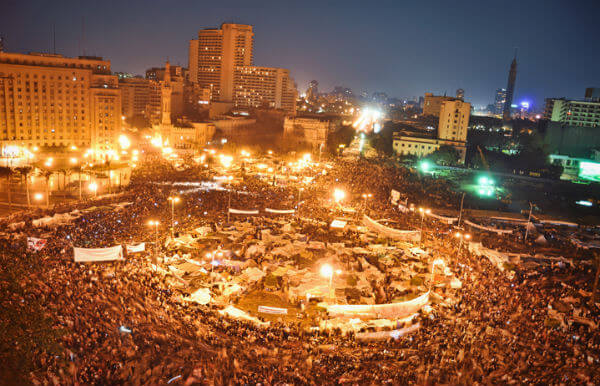
Five years ago, the chant “El‑sha’ab, yureed, isqat el‑nizam!” (“the people want the fall of the regime!“) resounded through the streets of Cairo, marking the start of a popular uprising that saw one of the region’s longest-standing dictators deposed in just 18 days.

The so-called Egyptian revolution of 2011, part of the wider trend of the Arab Springs or Arab Awakening, was seen by many as being as significant as the fall of the Berlin Wall because of its potential implications for both the country and the region. However, five years on, it seems as if little has changed in Egypt – and the country’s proud revolutionary spirit has been almost completely wiped out.

The demands made by Tahrir Square’s revolutionaries haven’t been met – and in some cases they have been downright betrayed.

The uprising was only in part triggered by the first spasm of the Arab Awakenings, Tunisia’s Jasmine Revolution. Rather, it was an outburst of popular grievances that had been building up for decades in a country with a long history of both military authoritarianism and “street politics”.

Hosni Mubarak’s regime was an exemplary case of durable authoritarianism, allowing its citizens just enough political space to keep direct threats to the regime at bay. But this admittedly very limited space nonetheless made the country’s population extremely competent with the practice of politics and dissent in the street. Essentially, a strong regime was deposed by an even stronger society.

Continue reading

Facebooktwittermail

Egypt’s myth of stability: Gross abuses don’t deliver security

Tahrir_Square

Nicholas Piachaud writes: Five years ago, human rights defender Ahmed Abdullah was among thousands of Egyptians who took to the streets for 18 days of mass protests in Cairo’s Tahrir Square, eventually forcing then-President Hosni Mubarak to step down and the security forces to retreat.

Today, Ahmed is on the run. He dodged arrest by the thinnest of margins on January 9, after plainclothes police in Cairo raided his regular coffee shop. The NGO which he chairs, the Egyptian Commission for Rights and Freedoms, had recently exposed a surge in enforced disappearances, which has seen hundreds vanish at the hands of state security forces over the last year alone.
He is not the only one whose activism has put him at risk. In recent weeks, security forces have been rounding up activists linked to protests and journalists critical of the government’s record.

Five years since the uprising that ousted Mubarak, Egypt is once more a police state. The country’s ubiquitous state security body, the National Security Agency, is firmly in charge. [Continue reading…]

Facebooktwittermail

Libyan parliament rejects UN-backed unity government

The Associated Press reports: Libya’s internationally recognized parliament on Monday rejected a U.N.-sponsored unity government and political agreement with rival authorities based in the capital, Tripoli, the media office said.

House of Representatives member Essa al-Areibi says 90 out of 140 members who attended Monday’s session rejected the unity Cabinet and 84 rejected the political agreement. Both were the result of months of negotiations, and were backed by some members of each faction.

The international community has been pushing the rivals to unite against the rising threat of Islamic militants, including an increasingly powerful Islamic State affiliate that has seized the central city of Sirte and launched attacks across the country. [Continue reading…]

Facebooktwittermail

Muslim leaders attend summit on protecting non-Muslims in their midst

Religion News Service reports: Hundreds of Muslim scholars will meet in Morocco next week to reassert the rights of non-Muslims living among them as Christians and other religious minorities flee extremism across the Middle East for safety and freedom elsewhere.

In these times, Muslims must affirm their tradition’s true teachings on tolerance, said Shaykh Hamza Yusuf, co-founder of Zaytuna College, the first Muslim liberal arts college in the U.S. The summit meeting, expected to attract more than 300 Muslim religious leaders, will hark back to the Charter of Medina, in which the Prophet Muhammad enumerated the rights of non-Muslims 1,400 years ago.

“The prophet was religiously persecuted, so he knew firsthand what it was to experience religious persecution,” said Yusuf, speaking on a pre-conference media call Thursday (Jan 21). “His religion ensured the rights of religious minorities,” and Islamic history reveals a generally strong record of tolerance. [Continue reading…]

Facebooktwittermail

People who deny climate science don’t put their money where their mouth is

By Stephan Lewandowsky, University of Bristol

At a news conference announcing that 2015 broke all previous heat records by a wide margin, one journalist started a question with “If this trend continues…” The response by the Director of NASA’s Goddard Institute for Space Studies, Gavin Schmidt, summed up the physics of climate change succinctly: “It’s not a question of if…”

Even if global emissions begin to decline, as now appears possible after the agreement signed in Paris last December, there is no reasonable scientific doubt that the upward trends in global temperature, sea levels, and extreme weather events will continue for quite some time.

Politically and ideologically motivated denial will nonetheless continue for a little while longer, until it ceases to be politically opportune.

So how does one deny that climate change is upon us and that 2015 was by far the hottest year on record? What misinformation will be disseminated to confuse the public?

Continue reading

Facebooktwittermail

Arab Spring: Five years on, writers look back

Writers from across the Arab world offer their reflections on the last five years. Robin Yassin-Kassab writes: Five years ago the Guardian asked me to evaluate the effects of the Tunisian uprising on the rest of the Arab world, and specifically Syria. I recognised the country was “by no means exempt from the pan-Arab crisis of unemployment, low wages and the stifling of civil society”, but nevertheless argued that “in the short to medium term, it seems highly unlikely that the Syrian regime will face a Tunisia-style challenge”.

That was published on 28 January 2011. On the same day a Syrian called Hasan Ali Akleh set himself alight in protest against the Assad regime in imitation of Mohamed Bouazizi’s self-immolation in Tunisia. Akleh’s act went largely unremarked, but on 17 February tradesmen at Hareeqa in Damascus responded to police brutality by gathering in their thousands to chant “The Syrian people won’t be humiliated”. This was unprecedented. Soon afterwards, the Deraa schoolboys were arrested and tortured for writing anti-regime graffiti. When their relatives protested on 18 March, and at least four were killed, the spiralling cycle of funerals, protests and gunfire was unleashed. In 2011, I wrote that Assad personally was popular, and so he remained until his 30 March speech to the ill-named People’s Assembly. Very many had suspended judgment until that moment, expecting an apology for the killings and an announcement of serious reforms. Instead, Assad threatened, indulged in conspiracy theories, and, worse, giggled repeatedly.

I underestimated the disastrous effects of Assad’s neo-liberal/crony-capitalist restructuring during the previous decade. I was soon to be wrong about many other things too. In April the regime made conciliatory gestures to Islamists and Kurds. At first I thought this showed how hopelessly out of touch it was – the protest movement at this stage was pan‑Syrian and non-sectarian. Then I understood its misinterpretation was deliberate. In the following years the regime would stick to reading the revolution through ethnic and sectarian lenses; and largely due to its own efforts, these eventually came to dominate the field. [Continue reading…]

Facebooktwittermail

On anniversary of Jan 25 uprising, Egypt’s rulers feel threatened by any possibility of dissent

Tahrir_Square

The New York Times reports: The normally invasive Egyptian authorities had long left Studio Emad Eddin alone, seeing no threat from a performance space that houses rehearsal studios and offers classes in set design and drama.

But this month, 18 plainclothes men from the Interior Ministry showed up with a warrant, asked about licenses and then confiscated equipment, including some speakers and a sound mixer, according to Nevine El Ibiary, one of the studio’s founders.

The search came within weeks of similar raids at several cultural venues and amid a vast security dragnet in downtown Cairo — part of an extraordinary effort by the government of President Abdel Fattah el-Sisi to prevent any protest commemorating the uprising that started on Jan. 25, 2011, and toppled President Hosni Mubarak.

The security response has been in keeping with the government’s reputation for repressing most kinds of dissent. But the scale of the clampdown has baffled many people here, as has the level of official alarm, from a government that has faced no challenge from large-scale protests in years. In word and deed, Mr. Sisi and other officials have treated even the possibility of demonstrations on the anniversary as a grave threat to the nation.

The sense of panic has been attributed to concerns that the public is losing patience with the government amid high unemployment, rising prices and a persistent militant insurgency that, among other things, has devastated Egypt’s tourism industry.

But those factors alone were not sufficient to explain the overheated response, analysts said. From the perspective of the security services, the date — Jan. 25 — was itself a danger, as a reminder of their catastrophic, if momentary, loss of control. [Continue reading…]

Facebooktwittermail

Egypt: A revolution devours its children

Lauren Bohn writes: It takes about 30 minutes to drive from the teeming Cairo neighborhood of Faisal to what locals call “El Sijn” — Arabic for “the prison.” There are many in Egypt, but everyone seems to know the prison: Tora Prison, opened in 1908. It has housed a diverse assortment of the country’s dissidents, businessmen, Islamists, and statesmen — including the ousted president Hosni Mubarak, who had ruled Egypt for nearly three decades before his regime fell in the uprising that began almost exactly five years ago.

Since then, the upheaval hasn’t stopped, and it’s as much personal as it is collective. The country saw its first-ever democratic elections; another wave of protest over the rule of Mohammed Morsi, the Islamist president those elections brought to power; a military coup, led by then-Army Chief Abdel Fattah el-Sisi; and a reinstatement, under now-President Sisi, of the kind of authoritarianism protesters risked their lives to escape five years ago. The crackdown has ensnared liberals and Islamists alike, leaving the prison as a burial chamber for the aspirations of the revolution, in all their wide variety.

Nourhan Hefzy has memorized the way there. The route winds through Faisal’s trash-strewn maze of narrow streets and past the more manicured fringes of Cairo, beyond the French School and the boutiques. It ends at a sepia-toned compound of cement in a bleak, brown desert. Somewhere inside that compound is her husband, Ahmed. He has been locked away there for the past two years.

“It’s been five years since we’ve toppled Mubarak and we’re back to square one,” Nourhan says. At 26, Ahmed was one of Egypt’s most prominent liberal activists, and remains a living symbol of the revolution: once vibrant and triumphant on Cairo’s streets, now languid and silenced behind bars. The young couple used to talk for hours about their plans to open a bookstore, maybe even start a publishing house dedicated to fostering freedom and democracy in a country with a severe deficit of both. Now their conversations are limited to a hurried, supervised 20 minutes every other week.

“It is worse than square one,” corrects Ahmed’s mother Fathia, who often accompanies her daughter-in-law on visits to El Sijn. For her, the journey to the prison evokes a more-distant past, after her father and almost all her male relatives were arrested decades ago for being members of the then-banned Islamist Muslim Brotherhood. The organization, whose political party was briefly in charge of Egypt’s government following Morsi’s ascent to the presidency, has once again been banned. But Fathia never thought her son — a staunch critic of the very group she and her husband have dedicated their lives to — would also end up behind bars. [Continue reading…]

Facebooktwittermail

Assad is dividing his enemies and counting on his ability to pick off one at a time

Joshua Landis and Steven Simon write: Three months ago, Assad’s army was beleaguered. A large confederation of jihadist and Islamist militias calling themselves the Victory Army had achieved something resembling unity. Built around Syria’s two strongest militias — al-Nusra, al Qaeda’s Syria franchise; and Ahrar al-Sham, the most powerful Salafi militia in the country — the Victory Army conquered two strategic northern cities, Idlib and Jisr al-Shughour, in quick succession this spring. These victories attracted many other militias into their orbit and promised success. The expulsion of regime forces from Jisr al-Shughour not only meant the independence of Idlib more generally but put Latakia, a regime stronghold, in serious jeopardy. The new resistance army seemed to overcome the opposition’s chronic fragmentation; it was also well armed and supported by the region’s Sunni states.

But Assad’s greatest advantage — a fragmented opposition divided into more than 1,000 constantly feuding militias — seems to be back. Recently, over 20 rebel militia leaders have been assassinated, most by a breakaway faction of the Victory Army. The militias that the United States trained and armed at great expense have been crushed, not by Assad but by other rebels.

Meanwhile, Russia’s advanced aircraft, helicopters, and tanks have been pounding the Victory Army for months. Russian aircrews fly close to 200 sorties a day, allowing Assad and his allies to go on the offensive in both the north and south of Syria. Ahrar al-Sham has agreed to go to talks in Geneva, an about-face, after snubbing the UN envoy Staffan de Mistura as an Assad lackey only months ago. Al Qaeda’s Syria leader pronounced those who head to Geneva guilty of “high treason,” a clear death threat but also an indicator of clear anxiety. Another sign of desperation was the call put out by the Victory Army to foreign fighters to come join their ranks. Non-jihadist members of the coalition were infuriated by this tactic, which would inevitably associate them with the self-proclaimed Islamic State (also known as ISIS), and withdrew from the coalition. Assad, in short, is dividing his enemies and counting on his ability to pick off one at a time. [Continue reading…]

Facebooktwittermail

Origins of the Syrian Democratic Forces

Aron Lund writes: The Syrian Democratic Forces, or SDF, is a coalition of Kurdish, Sunni Arab and Syriac Christian fighters, but is completely dominated by its Kurdish element, which is a powerful and well organized militia known as the Popular Defense Units, YPG, with an all-female branch called the Women’s Defense Units, or YPJ. These organizations, in turn, are Syrian front groups for the Kurdistan Workers’ Party or PKK. The other militias involved in the Syrian Democratic Forces are either long-standing PKK allies or proxies, such as the armed wing of the Syriac Union Party, or more recent allies drawn from the Sunni Arab tribal landscape in this part of Syria and from the remains of small Sunni Arab rebel groups crushed by the so-called Islamic State.

The coalition as a whole receives American air support for operations against Islamic State, as did the YPG/J before it. That started in the Battle of Kobane that began in autumn 2014, which was enormously successful — really the first major battlefield defeat inflicted on Islamic State. It has provided the template for US-PKK cooperation. In addition, the Pentagon has picked out a number of these little Arab groups that work under the SDF umbrella as favored recipients of arms and support. It terms them, collectively, the Syrian Arab Coalition, though no one else seems to use that name.

The idea is to use the SDF as an incubator to breed Sunni Arab militias able to take over where Kurdish territory ends and push deep into Islamic State’s heartland, which is in the Sunni Arab tribal region that connects Syria with Iraq. Relying on the Kurds in that region would create resentment among other Syrian and regional allies, and it would risk pushing locals into the arms of the jihadis. Also, it’s not obvious that the Kurds are interested in dying for U.S. interests that far away from their own home areas. They have many other priorities, chief among them to try to secure their population, to keep Turkey out of Syria and to link the Kurdish enclaves in Kobane and Efrin, which are separated by territory held by Islamic State and rival Turkey-backed Sunni Arab rebels north of Aleppo. In those battles in northwestern Syria, the SDF fighters seem to have received some level of Russian support, but they do not enjoy any U.S. backing – though they like to pretend they do, in order to sell their war on Turkey’s allies as part of the “War on Terror.” Of course, this has embarrassed the Pentagon in front of other American allies, but what can be done? All sides in Syria, including the United States, must balance between allies that do not fully share their own interests. [Continue reading…]

Facebooktwittermail

Drone strikes: The brand of detached warfare that Obama made his own

The Guardian reports: Faheem Qureshi’s uncles sat with their neighbors, chatting, cracking jokes and sipping tea, in their family’s lounge for male guests. Qureshi, almost 14, stood nearby, bored and restless, thinking about when he could go to the nearby playground where he and the other Ziraki village kids played badminton and cricket.

It had been a long day – Friday prayers, a food shopping errand at his mother’s behest, hosting – but also a happy occasion, as people stopped by to welcome an uncle home to North Waziristan, in tribal Pakistan, from a work excursion to the United Arab Emirates. Then he heard a sound like a plane taking off.

About two seconds later, the missile punched a hole through the lounge. Qureshi remembers feeling like his body was on fire. He ran outside, wanting to throw water on his face, but his priority was escape. The boy could not see.

This was the hidden civilian damage from the first drone strike Barack Obama ever ordered, on 23 January 2009, the inauguration of a counter-terrorism tactic likely to define Obama’s presidency in much of the Muslim world. It was the third day of his presidency. [Continue reading…]

Facebooktwittermail

SEC is criticized for lax enforcement of climate risk disclosure

The New York Times reports: As recently as 2011, shares in Peabody Energy, the world’s biggest private sector coal company, traded at the equivalent of $1,000. Today, they hover around $4 each. Over that time, investors who held the stock lost millions.

Peabody, like other coal companies, has been hammered as cheap natural gas erodes the demand for coal. But concerns about climate change are also an issue for the company as customers and investors turn away from fossil fuels.

Peabody saw this coming. Even as the company privately projected that coal demand would slump and prices would fall, it withheld this information from investors. Instead, Peabody said in filings with the Securities and Exchange Commission that it was not possible to know how changing attitudes toward climate change would affect its business.

Peabody’s double talk was revealed as part of a two-year investigation by the New York attorney general. In a settlement in November, Peabody agreed that it would disclose more about climate change risks in its regular filings with the S.E.C.

In theory, however, Peabody should have been making such disclosures all along. [Continue reading…]

Facebooktwittermail