Author Archives: News Sources

Ordinary Russians and Ukrainians have been betrayed by their leaders

o13-iconMikhail Shishkin has been acclaimed as Russia’s greatest living author. He writes: The internet has brought the war into every home. Thanks to live broadcasts, you are now a witness to and participant in the street battles in Kiev, the rallies in Crimea, and the arrests in Moscow.

As I write these words, a red-headed 18-year-old girl unfurls her banner – “No to war” – on Manezh Square near the Kremlin. A policeman walks up to her with a megaphone: “Disperse! Your action is unsanctioned.” She shouts back: “This war of yours is unsanctioned!”

The criminals in power have pulled off an unforgivable and base trick. They have set Russians and Ukrainians against one another, and made language not a means of understanding but a weapon of hate.

We truly are brother nations. My mother is Ukrainian, and my father is Russian. There are millions of such mixed families in both Ukraine and Russia. Where are you going to draw the line between one and the other? How are you going to cut the ties that bind?

How are going to divide up Gogol? Is he a Russian or a Ukrainian classic? We share him. We share our pride in him.

How are we going to divide up our shared shame and our shared grief – our appalling history? The annihilation of the peasantry in Russia and the Holodomor in Ukraine? There were Russians and Ukrainians among the victims and executioners. We have common enemies: ourselves.

Our terrible common past has a death grip on both nations and is not letting us move into the future.

The Maidan protests were stunning for the daring and courage of the people who came out on the square “for our freedom and yours.” Most striking of all was the solidarity. I was gripped by admiration and envy. Here the Ukrainians were able to rise up and resist; they were not about to be brought to their knees.

The Putin TV anchors used their propaganda news in every possible way to create an image of Maidan’s defender as the Ukrainian bumpkin from the joke: crafty, greedy, stupid, and prepared to sell himself to the devil or the west; it didn’t matter which, just so he’d have his lard. A country with state television of that calibre should die of shame.

This kind of condescending attitude toward Ukrainians and the Ukrainian language has been accepted in Russia from time immemorial. The “younger brother” was loved for his cheerfulness, humour, and self-deprecation, but he remained the younger brother, and that meant he had to obey his older brother, learn from him, and try to be like him. The last few months have changed the course of history and revealed entirely different Ukrainians to Russians. The “younger brother” has turned out to be more mature than the older. Ukrainians were able to tell their embezzling government, “Gang, get out!” But we weren’t. Naturally, I’m envious. [Continue reading…]


Facebooktwittermail

Freedom in Russian exists only in Ukraine

o13-iconTimothy Snyder writes: Last weekend Mikhail Khodorkovsky, the most famous of Russia’s political prisoners, spoke to tens of thousands of Ukrainians on the main square in Kiev, the Maidan. Khodorkovsky told them what they already knew: that Ukrainian citiznes from all walks of life, of all ethnicities, had suffered for and won their freedom in a revolution for dignity and decency.

What language did Khodorkovsky speak in Kiev? Russian, of course, his native language, and a language most Ukrainians speak. Most Ukrainians are bilingual and many Ukrainians in Kiev speak Russian rather than Ukrainian at home. Ukrainians are cosmopolitan in a way that most of us are not. Unfortunately, we reward them for it by not noticing that they are bilingual, dividing them into groups of Russian- and Ukrainian-speakers, drawing the conclusion that there are two nations instead of one — and thereby preparing ourselves for Putin’s war propaganda. [Continue reading…]

Facebooktwittermail

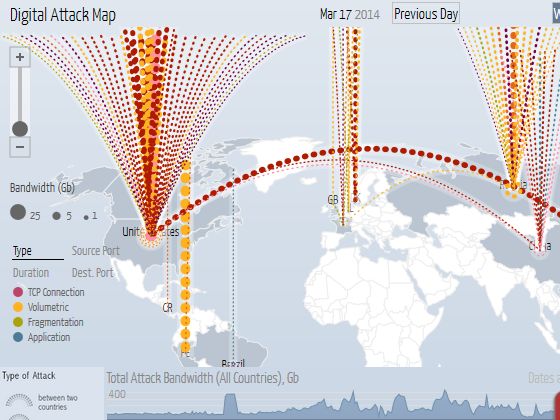
Can we trust an Internet that’s become a weapon of governments?

f13-iconMIT Technology Review: Security experts have been warning for some time that computer networks are not secure from intruders. But in 2013, we learned that the mayhem has become strategic. Governments now write computer viruses. And if they can’t, they can purchase them. A half-dozen boutique R&D houses, like Italy’s Hacking Team, develop computer vulnerabilities and openly market them to government attackers.

Criminals use common computer weaknesses to infect as many machines as possible. But governments assemble large research teams and spend millions patiently pursuing narrow objectives. ­Costin Raiu, who investigates such “advanced persistent threats” as director of research and analysis for anti-virus company Kaspersky Lab, says he logs on to his computer assuming he is not alone. “I operate under the principle that my computer is owned by at least three governments,” he says.

That is a threat mainstream technology companies are grappling with. The U.S. government circumvented Google’s security measures and secretly collected customer data. British spies scooped up millions of webcam images from Yahoo. In December, on Microsoft’s official blog, the company’s top lawyer, Brad Smith, said he had reason to view surreptitious “government snooping” as no different from criminal malware. Microsoft, along with Google and Yahoo, has responded by greatly widening its use of encryption (see “The Year of Encryption”).

“We’re living in a very interesting time, where companies are becoming unwilling pawns in cyberwarfare,” says Menny Barzilay, a former Israeli intelligence officer now working in IT security for the Bank Hapoalim Group, in Tel Aviv. In this new context, nobody can say where the responsibilities of a company may end and those of a nation might begin. Should a commercial bank be expected to expend resources to defend itself when its attacker is a country? “This is not a ‘maybe’ situation. This is happening right now,” says Barzilay. “And this is just the beginning.” [Continue reading…]

Facebooktwittermail

Industrial society heading for ‘irreversible collapse’

a13-iconAt The Guardian, Nafeez Ahmed writes: A new study sponsored by Nasa’s Goddard Space Flight Center has highlighted the prospect that global industrial civilisation could collapse in coming decades due to unsustainable resource exploitation and increasingly unequal wealth distribution.

Noting that warnings of ‘collapse’ are often seen to be fringe or controversial, the study attempts to make sense of compelling historical data showing that “the process of rise-and-collapse is actually a recurrent cycle found throughout history.” Cases of severe civilisational disruption due to “precipitous collapse – often lasting centuries – have been quite common.”

The research project is based on a new cross-disciplinary ‘Human And Nature DYnamical’ (HANDY) model, led by applied mathematician Safa Motesharri of the US National Science Foundation-supported National Socio-Environmental Synthesis Center, in association with a team of natural and social scientists. The study based on the HANDY model has been accepted for publication in the peer-reviewed Elsevier journal, Ecological Economics.

It finds that according to the historical record even advanced, complex civilisations are susceptible to collapse, raising questions about the sustainability of modern civilisation:

“The fall of the Roman Empire, and the equally (if not more) advanced Han, Mauryan, and Gupta Empires, as well as so many advanced Mesopotamian Empires, are all testimony to the fact that advanced, sophisticated, complex, and creative civilizations can be both fragile and impermanent.”

By investigating the human-nature dynamics of these past cases of collapse, the project identifies the most salient interrelated factors which explain civilisational decline, and which may help determine the risk of collapse today: namely, Population, Climate, Water, Agriculture, and Energy.

These factors can lead to collapse when they converge to generate two crucial social features: “the stretching of resources due to the strain placed on the ecological carrying capacity”; and “the economic stratification of society into Elites [rich] and Masses (or “Commoners”) [poor]” These social phenomena have played “a central role in the character or in the process of the collapse,” in all such cases over “the last five thousand years.” [Continue reading…]

The research paper, which is quite technical, can be read here: “A Minimal Model for Human and Nature Interaction.”

Facebooktwittermail

Former Church Committee members see need for new group to investigate NSA

n13-iconThreatpost: In a letter sent to President Obama and members of Congress, former members and staff of the Church Committee on intelligence said that the revelations of the NSA activities have caused “a crisis of public confidence” and encouraged the formation of a new committee to undertake “significant and public reexamination of intelligence community practices”.

Although it may seem like the NSA’s activities have only recently come under public scrutiny, the agency first was dragged into the light in 1975 when reports surfaced that for decades it had had secret agreements with telegram companies to get copies of Americans’ international communications. The Church committee, formally known as the Senate Select Committee to Study Governmental Operations with Respect to Intelligence Activities, was formed to investigate the NSA’s methods and produced a report that took the agency to task for overstepping its bounds and expanding programs well beyond their initial scope.

“We have seen a consistent pattern in which programs initiated with limited goals, such as preventing criminal violence or identifying foreign spies, were expanded to what witnesses characterized as ‘vacuum cleaners,’ sweeping in information about lawful activities of American citizens. The tendency of intelligence activities to expand beyond their initial scope is a theme, which runs through every aspect of our investigative findings,” the committee’s final report said.

In the letter sent Monday to Obama and Congress, several former advisers to and members of the Church committee, including the former chief counsel, said that the current situation involving the NSA bears striking resemblances to the one in 1975 and that the scope of what the NSA is doing today is orders of magnitude larger than what was happening nearly 40 years ago.

“The need for another thorough, independent, and public congressional investigation of intelligence activity practices that affect the rights of Americans is apparent. There is a crisis of public confidence. Misleading statements by agency officials to Congress, the courts, and the public have undermined public trust in the intelligence community and in the capacity for the branches of government to provide meaningful oversight,” the letter says.

Facebooktwittermail

The ties that bind the U.S. and Russian oil and gas industries together

a13-iconSteve Horn reports: In a long-awaited moment in a hotly contested zone currently occupied by the Russian military, Ukraine’s citizens living in the peninsula of Crimea voted overwhelmingly to become part of Russia.

Responding to the referendum, President Barack Obama and numerous U.S. officials rejected the results out of hand and the Obama Administration has confirmed he will authorize economic sanctions against high-ranking Russian officials.

“As I told President Putin yesterday, the referendum in Crimea was a clear violation of Ukrainian constitutions and international law and it will not be recognized by the international community,” Obama said in a press briefing. “Today I am announcing a series of measures that will continue to increase the cost on Russia and those responsible for what is happening in Ukraine.”

But even before the vote and issuing of sanctions, numerous key U.S. officials hyped the need to expedite U.S. oil and gas exports to fend off Europe’s reliance on importing Russia’s gas bounty. In short, gas obtained via hydraulic fracturing (“fracking”) is increasingly seen as a “geopolitical tool” for U.S. power-brokers, as The New York Times explained.

Perhaps responding to the repeated calls to use gas as a “diplomatic tool,” the U.S. Department of Energy (DOE) recently announced it will sell 5 million barrels of oil from the seldom-tapped Strategic Petroleum Reserve. Both the White House and DOE deny the decision had anything to do with the situation in Ukraine.

Yet even as some say we are witnessing the beginning of a “new cold war,” few have discussed the ties binding major U.S. oil and gas companies with Russian state oil and gas companies.

The ties that bind, as well as other real logistical and economic issues complicate the narrative of exports as an “energy weapon.”

The situation in Ukraine is a simple one at face value, at least from an energy perspective.

“Control of resources and dependence on other countries is a central theme connecting the longstanding tension between Russia and Ukraine and potential actions taken by the rest of the world as the crisis escalates,” ThinkProgress explained in a recent article. “Ukraine is overwhelmingly dependent on Russia for natural gas, relying on its neighbor for 60 to 70 percent of its natural gas needs.”

At the same time, Europe also largely depends on Ukraine as a key thoroughfare for imports of Russian gas via pipelines.

“The country is crossed by a network of Soviet-era pipelines that carry Russian natural gas to many European Union member states and beyond; more than a quarter of the EU’s total gas needs were met by Russian gas, and some 80% of it came via Ukrainian pipelines,” explained The Guardian.

Given the circumstances, weaning EU countries off Russian gas seems a no-brainer at face value. Which is why it’s important to use the brain and look beneath the surface.

The U.S. and Russian oil and gas industries can best be described as “frenemies.” Case in point: the tight-knit relationship between U.S. multinational petrochemical giant ExxonMobil and Russian state-owned multinational petrochemical giant Rosneft. [Continue reading…]

Facebooktwittermail

Sevastopol voters turned out in record numbers — not a single complaint was registered

Voter turnout in Sevastopol, Crimea, yesterday was a whopping 123%! It’s hard to understand why the referendum fell short of 100% support for joining Russia when there were so many “surplus” votes floating around.

But seriously, given that Tartars, who make up slightly more than 10% of the population were expected to boycott the vote, and a portion of the rest of Crimea’s pro-Ukrainian population probably did likewise, this “landslide” clearly had the assistance of Russian bulldozers.

What the outcome might have been of a free and fair (even though unconstitutional) vote with real choices for or against secession, we’ll never know.

The Associated Press reports: Final results of the referendum in Crimea show that 97 percent of voters have supported leaving Ukraine to join Russia, the head of the referendum election commission said Monday.

Mikhail Malyshev told a televised news conference that the final tally from Sunday’s vote was 96.8 percent in favor of splitting from Ukraine. He also said that the commission has not registered a single complaint about the vote.

The referendum was widely condemned by Western leaders who were planning to discuss economic sanctions to punish Russia on Monday. Ukraine’s new government in Kiev called the referendum a “circus” directed at gunpoint by Moscow.

But Valery Ryazantsev, head of Russia’s observer mission in Crimea and a lawmaker from the upper house of the Russian parliament, said Monday that the results are beyond dispute. He told the Interfax news agency that there are “absolutely no reasons to consider the vote results illegitimate.” [Continue reading…]

Facebooktwittermail

Putin’s imperial road to economic ruin

o13-iconSergei Guriev writes: Russia’s response to events in Ukraine has exceeded the worst expectations of those who were already questioning whether Putin is, as German Chancellor Angela Merkel put it, “in touch with reality.” The move to annex Crimea has reversed any soft-power benefit that Putin might have gained from the Sochi Olympics and the pardons he granted (as recently as December) to imprisoned opponents like Mikhail Khodorkovsky and the members of Pussy Riot.

The sacrifice of these gains suggests that the Crimea adventure was not part of long-considered plan. On the contrary, since the crisis began, Russia’s leaders have repeatedly contradicted their previous statements, backtracked, reversed decisions, and denied easily verifiable facts. All of this indicates that Russian political leaders have no strategy and do not foresee the consequences of their decisions. Even the Kremlin’s own supporters acknowledge that Putin “is improvising.”

It is also clear that the decisions to violate international law, despite the risk of economic isolation, were made in an ad hoc fashion by Putin’s innermost circle. For example, Valentina Matviyenko, the chairwoman of the Federation Council (the parliament’s upper house), announced that Russia would not send troops to Ukraine – just two days before she and the Council voted unanimously to authorize Putin to do precisely that. And Matviyenko is one of the 12 permanent members of Russia’s National Security Council, the supreme decision-making authority on such matters.

Regardless of whether the Kremlin is irrational or simply uninformed, its policy in Crimea sends an unmistakable signal to investors: Russia’s political leaders are impossible to predict. [Continue reading…]

Facebooktwittermail

U.S. steps up sanctions on Russian officials

n13-iconThe New York Times reports: The United States, working in coordination with Europe, imposed a new round of sanctions on prominent Russian officials on Monday as the showdown over Ukraine reached a new stage of confrontation between East and West.

President Obama signed an executive order freezing the assets and banning visas for a number of Russians deemed to be responsible for the seizing of Crimea or otherwise interfering in Ukrainian sovereignty. Among those targeted were several officials in President Vladimir V. Putin’s inner circle, and the White House threatened to go after more if Russia did not back down.

“We have fashioned these sanctions to impose costs on named individuals who wield influence in the Russian government and those responsible for the deteriorating situation in Ukraine,” the White House said in a statement. “We stand ready to use these authorities in a direct and targeted fashion as events warrant.”

In a conference call briefing reporters, a senior administration official who was not permitted to be named under the ground rules said, “These are by far the most comprehensive sanctions applied to Russia since the end of the Cold War — far and away so.” [Continue reading…]

Facebooktwittermail

Inequality in the U.S. — a divide as wide as separates Sweden from Iraq

f13-iconThe New York Times reports: Fairfax County, Va., and McDowell County, W.Va., are separated by 350 miles, about a half-day’s drive. Traveling west from Fairfax County, the gated communities and bland architecture of military contractors give way to exurbs, then to farmland and eventually to McDowell’s coal mines and the forested slopes of the Appalachians. Perhaps the greatest distance between the two counties is this: Fairfax is a place of the haves, and McDowell of the have-nots. Just outside of Washington, fat government contracts and a growing technology sector buoy the median household income in Fairfax County up to $107,000, one of the highest in the nation. McDowell, with the decline of coal, has little in the way of industry. Unemployment is high. Drug abuse is rampant. Median household income is about one-fifth that of Fairfax.

One of the starkest consequences of that divide is seen in the life expectancies of the people there. Residents of Fairfax County are among the longest-lived in the country: Men have an average life expectancy of 82 years and women, 85, about the same as in Sweden. In McDowell, the averages are 64 and 73, about the same as in Iraq. [Continue reading…]

Facebooktwittermail

How Target stood by as 40 million credit card numbers were stolen

f13-iconBloomberg Businessweek reports: The biggest retail hack in U.S. history wasn’t particularly inventive, nor did it appear destined for success. In the days prior to Thanksgiving 2013, someone installed malware in Target’s security and payments system designed to steal every credit card used at the company’s 1,797 U.S. stores. At the critical moment — when the Christmas gifts had been scanned and bagged and the cashier asked for a swipe — the malware would step in, capture the shopper’s credit card number, and store it on a Target server commandeered by the hackers.

It’s a measure of how common these crimes have become, and how conventional the hackers’ approach in this case, that Target was prepared for such an attack. Six months earlier the company began installing a $1.6 million malware detection tool made by the computer security firm FireEye, whose customers also include the CIA and the Pentagon. Target had a team of security specialists in Bangalore to monitor its computers around the clock. If Bangalore noticed anything suspicious, Target’s security operations center in Minneapolis would be notified.

On Saturday, Nov. 30, the hackers had set their traps and had just one thing to do before starting the attack: plan the data’s escape route. As they uploaded exfiltration malware to move stolen credit card numbers — first to staging points spread around the U.S. to cover their tracks, then into their computers in Russia — FireEye spotted them. Bangalore got an alert and flagged the security team in Minneapolis. And then …

Nothing happened.

For some reason, Minneapolis didn’t react to the sirens. Bloomberg Businessweek spoke to more than 10 former Target employees familiar with the company’s data security operation, as well as eight people with specific knowledge of the hack and its aftermath, including former employees, security researchers, and law enforcement officials. The story they tell is of an alert system, installed to protect the bond between retailer and customer, that worked beautifully. But then, Target stood by as 40 million credit card numbers — and 70 million addresses, phone numbers, and other pieces of personal information — gushed out of its mainframes. [Continue reading…]

Facebooktwittermail

Cyber-war: In deed and desire, Iran emerging as a major power

a13-iconChristian Science Monitor reports: As high-level international talks in Vienna over Iran’s nuclear program edged closer to a deal last fall, something curious happened – massive cyber-attacks that had hammered Wall Street bank websites repeatedly for about a year slowed to a near stop.

While banking industry officials were relieved, others wondered why those Iran-linked “distributed denial of service” attacks that had so regularly flooded bank websites with bogus Internet traffic were shut off like a faucet. One likely reason, say US experts on cyber-conflict: to reduce friction, at least temporarily, at the Vienna nuclear talks.

Yet, even as the “distributed denial of service” attacks abated for apparently diplomatic reasons, overall Iranian cyber-spying on US military and energy corporation networks has surged, these experts say.

Iran was fingered last fall, for instance, for infiltrating the US Navy Marine Corps Intranet. It then took the Navy nearly four months to root out the Iranian hackers infesting its largest unclassified computer network, the Wall Street Journal reported in February.

This litany of Iranian activity is evidence, say experts, that after years as a cyber also-ran, Iran is morphing swiftly into a major threat in the rapidly evolving era of cyber-conflict. [Continue reading…]

Facebooktwittermail

Promising to be the most transparent administration, Obama’s turns out to be the most secretive

n13-iconThe Associated Press reports: The Obama administration has a way to go to fulfill its promises from Day 1 to become the most transparent administration in history.

More often than ever, the administration censored government files or outright denied access to them last year under the U.S. Freedom of Information Act, cited more legal exceptions it said justified withholding materials and refused a record number of times to turn over files quickly that might be especially newsworthy, according to a new analysis of federal data by The Associated Press.

Most agencies also took longer to answer records requests.

The government’s own figures from 99 federal agencies covering six years show that halfway through its second term, the administration has made few meaningful improvements in the way it releases records. In category after category — except for reducing numbers of old requests and a slight increase in how often it waived copying fees — the government’s efforts to be more open about its activities last year were their worst since President Barack Obama took office.

In a year of intense public interest over the National Security Agency’s surveillance programs, the government cited national security to withhold information a record 8,496 times — a 57 percent increase over a year earlier and more than double Obama’s first year, when it cited that reason 3,658 times. The Defense Department, including the NSA, and the CIA accounted for nearly all those. The Agriculture Department’s Farm Service Agency cited national security six times, the Environmental Protection Agency did twice and the National Park Service once.

And five years after Obama directed agencies to less frequently invoke a “deliberative process” exception to withhold materials describing decision-making behind the scenes, the government did it anyway, a record 81,752 times. [Continue reading…]

Facebooktwittermail

Don’t put Syria aside, Brahimi says amid Ukraine crisis

n13-iconBloomberg reports: More than 350,000 people will have died in Syria’s civil war by next year if peace talks don’t restart, United Nations mediator Lakhdar Brahimi said in an effort to keep an international spotlight on the conflict.

“I told the Security Council that Syria cannot be placed on a back burner,” Brahimi told the UN General Assembly yesterday, according to a transcript. “A crisis of this magnitude needs the full attention of this organization.”

With the Security Council set to take up a resolution today on Russia’s move into Ukraine, Brahimi sought to underscore the continuing human and economic costs of Syria’s civil war, which entered its fourth year this week with more than 130,000 people killed. He said more than 300 Syrians flee their homes every hour. [Continue reading…]

Facebooktwittermail

CIA suspends chief of Iran operations over workplace issues

n13-iconThe Los Angeles Times reports: The CIA’s chief of Iran operations was placed on paid administrative leave and sent home from agency headquarters after an internal investigation found he had created an abusive and hostile work environment that put a crucial division in disarray, according to current and former officials.

Officers and analysts in the Iran operations division, which coordinates spying on Iran and its nuclear program, were informed at a meeting last week at CIA headquarters in Langley, Va., of the decision to suspend Jonathan Bank, a veteran officer and member of the senior intelligence service.

Three former officials said the Iran operations division was in open rebellion to Bank’s management style, with several key employees demanding transfers.

“Iran is one of most important targets, and the place was not functioning,” one of the former officials said.

In 2010, Bank was pulled out as CIA station chief in Islamabad after newspapers in Pakistan, India, England and elsewhere published his name in connection with a court case, and the agency said he had received death threats. U.S. officials believe Pakistan’s intelligence service leaked the name in a dispute over CIA drone attacks in the country’s tribal belt.

Bank, now 46, previously served at CIA stations in the Balkans, Moscow and Baghdad, former agency officials said. He also was a top assistant to James Pavitt, who from 1999 to 2004 headed the CIA’s operations arm, now known as the National Clandestine Service.

The former CIA officials spoke on condition of anonymity to discuss a personnel matter. Bank is technically undercover, but his name has been public since the 2010 incident. He did not respond to email messages requesting comment. [Continue reading…]

Facebooktwittermail

Navy Seals take over oil tanker seized by Libyan rebels

n13-iconThe Guardian reports: American Navy Seals have seized a North Korea-flagged tanker which had been loaded with crude oil at a rebel-held port in eastern Libya, the Pentagon said on Monday.

The operation to take control of the Morning Glory came a week after Libya failed to prevent the tanker from leaving the rebel-controlled eastern port of Es Sider loaded with an estimated $20m cargo, in a crisis that has brought the country to the brink of civil war.

“The Morning Glory is carrying a cargo of oil owned by the Libyan government’s National Oil Company,” said Pentagon spokesman John Kirby. “The ship and its cargo were illicitly obtained from the Libyan port of Es Sider.”

There were no casualties in the operation, which took place in international waters off the coast of Cyprus late on Sunday night. The raid was authorised by the US president, Barack Obama, after receiving a request for assistance from Tripoli. The Seals boarded the 21,000-tonne tanker using helicopters and fast boats from a warship, the USS Roosevelt.

The Pentagon said a US navy crew was now piloting the tanker towards an unnamed Libyan port where it will be handed to government control. [Continue reading…]

Facebooktwittermail