
Author Archives: News Sources

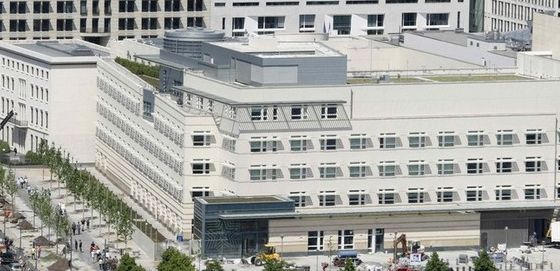
The U.S. embassy rooftop from which the NSA spies on the German government

window-like indentations on the roof of the US Embassy

Window-like indentations on the roof of the US Embassy are not glazed but rather veneered with 'dielectric' material and are painted to blend into the surrounding masonry. This material is permeable even by weak radio signals. Interception technology is allegedly located behind these radio-transparent screens.

Der Spiegel reports: A “top secret” classified NSA document from the year 2010 shows that a unit known as the “Special Collection Service” (SCS) is operational in Berlin, among other locations. It is an elite corps run in concert by the US intelligence agencies NSA and CIA.

The secret list reveals that its agents are active worldwide in around 80 locations, 19 of which are in Europe — cities such as Paris, Madrid, Rome, Prague and Geneva. The SCS maintains two bases in Germany, one in Berlin and another in Frankfurt. That alone is unusual. But in addition, both German bases are equipped at the highest level and staffed with active personnel.

The SCS teams predominantly work undercover in shielded areas of the American Embassy and Consulate, where they are officially accredited as diplomats and as such enjoy special privileges. Under diplomatic protection, they are able to look and listen unhindered. They just can’t get caught.

Wiretapping from an embassy is illegal in nearly every country. But that is precisely the task of the SCS, as is evidenced by another secret document. According to the document, the SCS operates its own sophisticated listening devices with which they can intercept virtually every popular method of communication: cellular signals, wireless networks and satellite communication.

The necessary equipment is usually installed on the upper floors of the embassy buildings or on rooftops where the technology is covered with screens or Potemkin-like structures that protect it from prying eyes.

That is apparently the case in Berlin, as well. SPIEGEL asked British investigative journalist Duncan Campbell to appraise the setup at the embassy. In 1976, Campbell uncovered the existence of the British intelligence service GCHQ. In his so-called “Echelon Report” in 1999, he described for the European Parliament the existence of the global surveillance network of the same name.

Campbell refers to window-like indentations on the roof of the US Embassy. They are not glazed but rather veneered with “dielectric” material and are painted to blend into the surrounding masonry. This material is permeable even by weak radio signals. The interception technology is located behind these radio-transparent screens, says Campbell. The offices of SCS agents would most likely be located in the same windowless attic.

This would correspond to internal NSA documents seen by SPIEGEL. They show, for example, an SCS office in another US embassy — a small windowless room full of cables with a work station of “signal processing racks” containing dozens of plug-in units for “signal analysis.”

On Friday, author and NSA expert James Bamford also visited SPIEGEL’s Berlin bureau, which is located on Pariser Platz diagonally opposite the US Embassy. “To me, it looks like NSA eavesdropping equipment is hidden behind there,” he said. “The covering seems to be made of the same material that the agency uses to shield larger systems.”

The Berlin-based security expert Andy Müller Maguhn was also consulted. “The location is ideal for intercepting mobile communications in Berlin’s government district,” he says, “be it technical surveillance of communication between cellphones and wireless cell towers or radio links that connect radio towers to the network.”

Apparently, SCS agents use the same technology all over the world. They can intercept cellphone signals while simultaneously locating people of interest. One antenna system used by the SCS is known by the affable code name “Einstein.”

When contacted by SPIEGEL, the NSA declined to comment on the matter.

Facebooktwittermail

The targeting of Chancellor Angela Merkel’s cellphone

Der Spiegel reports: There are strong indications that it was the SCS [the Special Collection Service jointly operated by the NSA and CIA] that targeted Chancellor Angela Merkel’s cellphone. This is suggested by a document that apparently comes from an NSA database in which the agency records its targets. This document, which SPIEGEL has seen, is what set the cellphone scandal in motion.

The document contains Merkel’s cellphone number. An inquiry to her team revealed that it is the number the chancellor uses mainly to communicate with party members, ministers and confidants, often by text message. The number is, in the language of the NSA, a “Selector Value.” The next two fields determine the format (“raw phone number”) and the “Subscriber,” identified as “GE Chancellor Merkel.”

In the next field, labeled “Ropi,” the NSA defines who is interested in the German chancellor: It is the department S2C32. “S” stands for “Signals Intelligence Directorate,” the NSA umbrella term for signal reconnaissance. “2” is the agency’s department for procurement and evaluation. C32 is the unit responsible for Europe, the “European States Branch.” So the order apparently came down from Europe specialists in charge of signal reconnaissance.

The time stamp is noteworthy. The order was transferred to the “National Sigint Requirements List,” the list of national intelligence targets, in 2002. That was the year Germany held closely watched parliamentary elections and Merkel battled Edmund Stoiber of Bavaria’s Christian Social Union to become the conservatives’ chancellor candidate. It was also the year the Iraq crisis began heating up. The document also lists status: “A” for active. This status was apparently valid a few weeks before President Obama’s Berlin visit in June 2013.

Finally, the document defines the units tasked with implementing the order: the “Target Office of Primary Interest”: “F666E.” “F6” is the NSA’s internal name for the global surveillance unit, the “Special Collection Service.”

Thus, the NSA would have targeted Merkel’s cellphone for more than a decade, first when she was just party chair, as well as later when she’d become chancellor. The record does not indicate what form of surveillance has taken place. Were all of her conversations recorded or just connection data? Were her movements also being recorded?

Facebooktwittermail

NSA oversight dismissed as ‘illusory’ as anger intensifies in Europe and beyond

The Guardian reports: The Obama administration’s international surveillance crisis deepened on Monday as representatives from a Latin American human rights panel told US diplomats that oversight of the programs was “illusory”.

Members of the Inter-American Commission on Human Rights, an arm of the Organization of American States, expressed frustration and dissatisfaction with the National Security Agency’s mass surveillance of foreign nationals – something the agency argues is both central to its existence and necessary to prevent terrorism.

“With a program of this scope, it’s obvious that any form of control becomes illusory when there’s hundreds of millions of communications that become monitored and surveilled,” said Felipe Gonzales, a commissioner and Chilean national.

“This is of concern to us because maybe the Inter-American Committee on Human Rights may become a target as well of surveillance,” said Rodrigo Escobar Gil, a commissioner and Colombian citizen.

Frank La Rue, the United Nations special rapporteur on the right to freedom of opinion and expression, told the commission that the right to privacy was “inextricably linked” to free expression.

“What is not permissible from a human rights point of view is that those that hold political power or those that are in security agencies or, even less, those in intelligence agencies decide by themselves, for themselves, what the scope of these surveillance activities are, or who will be targeted, or who will be blanked surveilled,” La Rue said.

While the US sent four representatives to the hearing, they offered no defence, rebuttal or elaboration about bulk surveillance, saying the October government shutdown prevented them from adequate preparation. “We are here to listen,” said deputy permanent representative Lawrence Gumbiner, who pledged to submit written responses within 30 days. [Continue reading…]

Facebooktwittermail

Spain warns U.S. of breakdown in trust after new NSA revelations

The Guardian reports: The Spanish government has warned the US that revelations of widespread spying by the National Security Agency could, if confirmed, “lead to a breakdown in the traditional trust” between the two countries.

The diplomatic row followed a report in Spain’s El Mundo newspaper on Monday, based on a leaked NSA document, claiming that the US had intercepted 60.5m phone calls in Spain between 10 December 2012 and 8 January this year.

In the latest revelations from the documents leaked by the US whistleblower Edward Snowden, El Mundo published an NSA graphic, entitled “Spain – last 30 days”, showing the daily flow of phone calls within Spain. On one day alone – 11 December 2012 – the NSA reportedly intercepted more than 3.5m phone calls. It appears that although the content of the calls was not monitored the serial and phone numbers of the handsets used, the locations, sim cards and the duration of the calls were. Emails and other social media were also monitored.

The White House has so far declined to comment on the El Mundo report. Spain, however, expressed its concern. José Manuel García Margallo, Spain’s foreign minister, warned of a breakdown in trust between Madrid and Washington at a press conference in Warsaw, where he was on an official visit. [Continue reading…]

Facebooktwittermail

Obama’s diplomatic deficit

The idea that heads of state can become bosom buddies is a bit contrived, yet the ability to develop friendly relationships with foreign counterparts would seem like a job requirement. It’s part of the job in which Barack Obama has displayed little interest.

Back in 2009 when Obama was a global celebrity, other world leaders eagerly jostled for opportunities to be photographed alongside the new political rock star. Obama’s response seems to suggest he didn’t anticipate that his presidency might last far longer than his popularity. Indeed, it even casts some doubt about whether he recognizes the value of making friends.

Gregor Peter Schmitz writes: Obama was scheduled to visit the Church of Our Lady cathedral in Dresden during a June 2009 whistle-stop visit to Germany. Diplomats from the German Foreign Ministry had painstakingly planned every last detail. They were looking forward to the photographs of Chancellor Angela Merkel with the US president in front of cheering crowds.

But the White House bristled. The president didn’t want to do that — that was the word in Washington. He reportedly placed little value on such photo ops, and he had to leave as quickly as possible, to get to an appearance at the Buchenwald concentration camp. The haggling went back and forth for weeks, and in the end the White House gave in, but only a little. Obama raced through Dresden. After their visit inside the church, Merkel had to shake hands with visitors by herself. The president had already disappeared.

On this day, at the latest, it must have dawned on diplomats that this US president was different from his predecessors. He was someone who did not attach value to diplomatic niceties nor to the sensitivities of his close friends, which he already had proven as a presidential candidate. At that time he put Chancellor Merkel in an awkward position by wanting to make a campaign speech in front of the Brandenburg Gate. This site was traditionally set aside for sitting presidents, which Obama also knew.

The Democrat, who prefers to spend his evenings with his family or alone in front of his computer, has made it no secret in Washington that he does not want to make new friends. That maxim especially applies to his foreign diplomacy. Unlike his predecessor George W. Bush, Obama is loved by the people of the world, but much less by their heads of government. On the heels of recent revelations that US spy agencies might have monitored Chancellor Merkel’s cell phone, the complaints about Merkel’s “lost friend” Obama are misplaced. Obama doesn’t want to be a friend.

During a recent visit by a European head of government to Washington, the atmosphere was described as frosty by those in the entourage from Europe. Obama didn’t find the time for even a little small talk, the sources said, and “it seemed to some like an appointment with a lawyer.” [Continue reading…]

Facebooktwittermail

Japan rejected NSA request for aid in tapping fiber-optic cables in 2011

Kyodo News International reports: The U.S. National Security Agency sounded out the Japanese government around 2011 for cooperation in wiretapping fiber-optic cables carrying phone and Internet data across the Asia-Pacific region, sources familiar with the matter said Saturday.

The agency’s overture was apparently aimed at gathering information on Beijing given that Japan is at the heart of optical cables that connect various parts of the region. But Japan rejected the request, citing legal restrictions and shortage of personnel in the tapping operations, the sources said.

The sources said the agency asked Japan if it could intercept personal information such as Internet and phone call data when communication data pass through Japan via cables connecting Japan, China and other parts of the region.

Facebooktwittermail

Obama’s tired of the Middle East — but is that a policy?

A New York Times report on a major reappraisal of President Obama’s approach to the Middle East tosses this sentence in close to the end:

After vigorous debate, the group decided to make the Middle East peace process a top priority — even after failing to broker an agreement during the administration’s first term — in part because Mr. Kerry had already thrown himself into the role of peacemaker.

Top priority? More like an afterthought.

The actual conclusion of the White House review — and note, this was a foreign policy review that didn’t actually involve the State Department (whose domain is what?) — was that the Middle East is very troublesome and the U.S. has no influence, so let’s just move on.

Each Saturday morning in July and August, Susan E. Rice, President Obama’s new national security adviser, gathered half a dozen aides in her corner office in the White House to plot America’s future in the Middle East. The policy review, a kind of midcourse correction, has set the United States on a new heading in the world’s most turbulent region.

At the United Nations last month, Mr. Obama laid out the priorities he has adopted as a result of the review. The United States, he declared, would focus on negotiating a nuclear deal with Iran, brokering peace between the Israelis and the Palestinians and mitigating the strife in Syria. Everything else would take a back seat.

That includes Egypt, which was once a central pillar of American foreign policy. Mr. Obama, who hailed the crowds on the streets of Cairo in 2011 and pledged to heed the cries for change across the region, made clear that there were limits to what the United States would do to nurture democracy, whether there, or in Bahrain, Libya, Tunisia or Yemen.

The president’s goal, said Ms. Rice, who discussed the review for the first time in an interview last week, is to avoid having events in the Middle East swallow his foreign policy agenda, as it had those of presidents before him.

“We can’t just be consumed 24/7 by one region, important as it is,” she said, adding, “He thought it was a good time to step back and reassess, in a very critical and kind of no-holds-barred way, how we conceive the region.”

Not only does the new approach have little in common with the “freedom agenda” of George W. Bush, but it is also a scaling back of the more expansive American role that Mr. Obama himself articulated two years ago, before the Arab Spring mutated into sectarian violence, extremism and brutal repression.

The blueprint drawn up on those summer weekends at the White House is a model of pragmatism — eschewing the use of force, except to respond to acts of aggression against the United States or its allies, disruption of oil supplies, terrorist networks or weapons of mass destruction. Tellingly, it does not designate the spread of democracy as a core interest. [Continue reading…]

A model of pragmatism? Or apathy.

Facebooktwittermail

On monsterphilia and Assad

Muhammad Idrees Ahmad writes: Earlier this month, the British street artist Banksy produced a video on Syria that attracted over five million viewers in three days. At a time of intensifying state repression, the target of Bansky’s satire was not the regime in Damascus but its opponents. By contrast, the most-watched video from the chemical attack in August, showing a traumatized young survivor, managed only half a million hits in over a month.

Six weeks after the attacks on Ghouta, the belt of densely populated suburbs of Damascus, that killed hundreds of civilians, regime forces have choked off food supplies to the targeted neighborhoods. Survivors of the chemical attack are now facing the threat of starvation. Children have been reduced to eating leaves; clerics have issued fatwas allowing people to eat cats and dogs.

The belated discovery of the Syrian conflict by “anti-imperialists” after the US government threatened war has inspired impassioned commentary. The strangulation of its vulnerable population has occasioned silence. But dog whistles from issue-surfing provocateurs like Banksy are unexceptional; they merit closer scrutiny when they come from respected essayists like David Bromwich.

In a recent front-page article for the London Review of Books, Bromwich identifies many rogues in the Syrian drama: Barack Obama, John Kerry, Saudi Arabia, Qatar, “the jihadists.” Conspicuously absent is Assad’s Baathist regime. Vladimir Putin is the closest Bromwich admits to a hero. The Syrian people are denied even a cameo.

When the Yale literature professor uses a tautology like “anti-government insurgency” to refer to Assad’s opponents, it is reasonable to assume intention. The word “government” conveys a certain benign authority; and when it is also said to be opposed by the universally reviled “jihadists,” then there is only one place a bien pensant reader can invest sympathy — and it’s not with the opposition. [Continue reading…]

Facebooktwittermail

19 Syria rebel groups reject Geneva talks

AFP reports: Nineteen Islamist groups fighting to topple President Bashar al-Assad have rejected outright a mooted US-Russian peace initiative for Syria dubbed Geneva 2, a statement said.

“We announce that the Geneva 2 conference is not, nor will it ever be our people’s choice or our revolution’s demand,” the groups said in a late Saturday statement read in an online video by Ahmad Eissa al-Sheikh, chief of the Suqur al-Sham chief.

“We consider it just another part of the conspiracy to throw our revolution off track and to abort it.”

The statement also warned that anyone who went to such talks would be committing “treason, and … would have to answer for it before our courts”.

The statement comes weeks after dozens of major rebel groups across Syria said the Western-backed opposition umbrella grouping the National Coalition had “failed”.

Facebooktwittermail

Iran will participate in upcoming Syria talks — if invited

CNN reports: Iran will take part in a conference intended to hash out a solution to the Syrian conflict before the end of the year — if it receives an invitation, an Iranian official said Saturday, according to state-run media.

“Iran will do its best to help solve the issue through dialogue between the Syrian parties,” said Foreign Minister Mohammad Javad Zarif, according to the Iranian news agency IRNA.

Speaking at a joint news conference with Lakhdar Brahimi, the U.N. special envoy on Syria, Zarif said Tehran would participate in the Geneva talks to help end the war through political means.

Brahimi arrived Saturday in Tehran with a delegation on his second trip to Iran since he was appointed to the U.N. mission, according to state-run Press TV. He is on a Middle East tour aimed at raising support for the planned meeting.

Facebooktwittermail

The information-gathering paradox

The New York Times reports: Consumer trust is a vital currency for every big Internet company, which helps to explain why the giants of Silicon Valley have gone to great lengths in recent months to show how hard they are fighting back against government surveillance. Companies have released transparency reports, many for the first time, enumerating how many times law enforcement agencies demand user data; their executives have issued blistering statements; and several firms, including Facebook and Google, have filed lawsuits in a bid to reveal more about secret government orders.

All the while, though, a central contradiction has become ever harder to conceal. The Internet industry, having nudged consumers to share heaps of information about themselves, has built a trove of personal data for government agencies to mine — erecting, perhaps unintentionally, what Alessandro Acquisti, a Carnegie Mellon University behavioral economist, calls “the de facto infrastructure of surveillance.”

Nearly five months after Edward J. Snowden, the former National Security Agency contractor, went public with classified documents detailing the agency’s widespread spying, the Internet industry has only sharpened its efforts to track users online, which it considers essential to profitability. Behaviorally targeted advertising is the principal revenue source for a host of online companies.

Earlier this month Google announced plans to feature users’ names, photos and posts to promote products in Web ads. Facebook recently expanded its search offerings and made it harder to hide from strangers trying to find you. Meanwhile, digital advertising networks are developing sophisticated new ways to track consumers on cellphones, gleaning intimate insights into who you are and what you like. And Twitter, which recently announced plans for a public offering, has partnered with a company that tracks whether ads on Twitter can influence what you buy offline.

Commercial surveillance has been booming in recent months. “It’s certainly striking to hear the companies’ use of fiery rhetoric to criticize mass collection of bulk data since they themselves are engaging in mass collection of bulk data,” said Woodrow Hartzog, who teaches privacy law at Samford University in Birmingham, Ala. “The N.S.A. targeting has done nothing to dampen the appetite of private entities for information.” [Continue reading…]

Facebooktwittermail

The decline of Wikipedia

Tom Simonite writes: The sixth most widely used website in the world is not run anything like the others in the top 10. It is not operated by a sophisticated corporation but by a leaderless collection of volunteers who generally work under pseudonyms and habitually bicker with each other. It rarely tries new things in the hope of luring visitors; in fact, it has changed little in a decade. And yet every month 10 billion pages are viewed on the English version of Wikipedia alone. When a major news event takes place, such as the Boston Marathon bombings, complex, widely sourced entries spring up within hours and evolve by the minute. Because there is no other free information source like it, many online services rely on Wikipedia. Look something up on Google or ask Siri a question on your iPhone, and you’ll often get back tidbits of information pulled from the encyclopedia and delivered as straight-up facts.

Yet Wikipedia and its stated ambition to “compile the sum of all human knowledge” are in trouble. The volunteer workforce that built the project’s flagship, the English-language Wikipedia — and must defend it against vandalism, hoaxes, and manipulation — has shrunk by more than a third since 2007 and is still shrinking. Those participants left seem incapable of fixing the flaws that keep Wikipedia from becoming a high-quality encyclopedia by any standard, including the project’s own. Among the significant problems that aren’t getting resolved is the site’s skewed coverage: its entries on Pokemon and female porn stars are comprehensive, but its pages on female novelists or places in sub-Saharan Africa are sketchy. Authoritative entries remain elusive. Of the 1,000 articles that the project’s own volunteers have tagged as forming the core of a good encyclopedia, most don’t earn even Wikipedia’s own middle-­ranking quality scores.

The main source of those problems is not mysterious. The loose collective running the site today, estimated to be 90 percent male, operates a crushing bureaucracy with an often abrasive atmosphere that deters newcomers who might increase participation in Wikipedia and broaden its coverage. [Continue reading…]

Facebooktwittermail

As Iraq seeks U.S. arms, bombs kill another 55

Reuters reports: A dozen bombings in Iraq killed 55 people on Sunday as the prime minister prepares to travel to Washington to seek President Barack Obama’s help in confronting a wave of sectarian violence fuelled by Syria’s civil war.

Killings, mostly blamed by the Shi’ite-led government on Sunni Islamists from al Qaeda, are running at daily rates not seen in five years and Nuri al-Maliki will ask Obama on Friday to speed up promised deliveries of drones and F-16 jets that he believes can help staunch the long desert border with Syria.

Iraq’s own security forces, trained and equipped by the U.S. troops who withdrew in late 2011 after a nine-year occupation, have been unable to prevent a surge in violence which has taken the civilian death toll so far this year to about 7,000. Sealing the Syrian border would only address part of the problem.

On Sunday, police reported 11 vehicles blowing up in mainly Shi’ite Muslim areas in and around Baghdad, killing 41 people in an apparently coordinated series of explosions typical of al Qaeda. A further 14 people were killed when a suicide bomber drove up to a line of soldiers waiting to collect their pay from a bank in the northern city of Mosul and detonated his car.

Facebooktwittermail

Confessions of an American drone operator

Matthew Power writes: From the darkness of a box in the Nevada desert, he watched as three men trudged down a dirt road in Afghanistan. The box was kept cold—precisely sixty-eight degrees—and the only light inside came from the glow of monitors. The air smelled spectrally of stale sweat and cigarette smoke. On his console, the image showed the midwinter landscape of eastern Afghanistan’s Kunar Province—a palette of browns and grays, fields cut to stubble, dark forests climbing the rocky foothills of the Hindu Kush. He zoomed the camera in on the suspected insurgents, each dressed in traditional shalwar kameez, long shirts and baggy pants. He knew nothing else about them: not their names, not their thoughts, not the thousand mundane and profound details of their lives.

He was told that they were carrying rifles on their shoulders, but for all he knew, they were shepherd’s staffs. Still, the directive from somewhere above, a mysterious chain of command that led straight to his headset, was clear: confirmed weapons. He switched from the visible spectrum—the muted grays and browns of “day-TV”—to the sharp contrast of infrared, and the insurgents’ heat signatures stood out ghostly white against the cool black earth. A safety observer loomed behind him to make sure the “weapon release” was by the book. A long verbal checklist, his targeting laser locked on the two men walking in front. A countdown—three…two…one…—then the flat delivery of the phrase “missile off the rail.” Seventy-five hundred miles away, a Hellfire flared to life, detached from its mount, and reached supersonic speed in seconds.

It was quiet in the dark, cold box in the desert, except for the low hum of machines.

He kept the targeting laser trained on the two lead men and stared so intently that each individual pixel stood out, a glowing pointillist dot abstracted from the image it was meant to form. Time became almost ductile, the seconds stretched and slowed in a strange electronic limbo. As he watched the men walk, the one who had fallen behind seemed to hear something and broke into a run to catch up with the other two. Then, bright and silent as a camera flash, the screen lit up with white flame.

Airman First Class Brandon Bryant stared at the scene, unblinking in the white-hot clarity of infrared. He recalls it even now, years later, burned into his memory like a photo negative: “The smoke clears, and there’s pieces of the two guys around the crater. And there’s this guy over here, and he’s missing his right leg above his knee. He’s holding it, and he’s rolling around, and the blood is squirting out of his leg, and it’s hitting the ground, and it’s hot. His blood is hot. But when it hits the ground, it starts to cool off; the pool cools fast. It took him a long time to die. I just watched him. I watched him become the same color as the ground he was lying on.”

That was Brandon Bryant’s first shot. It was early 2007, a few weeks after his twenty-first birthday, and Bryant was a remotely-piloted-aircraft sensor operator—a “sensor” for short—part of a U.S. Air Force squadron that flew Predator drones in the skies above Iraq and Afghanistan. Beginning in 2006, he worked in the windowless metal box of a Ground Control Station (GCS) at Nellis Air Force Base, a vast sprawl of tarmac and maintenance hangars at the edge of Las Vegas.

The airmen kept the control station dark so they could focus on controlling their MQ-1B Predators circling two miles above the Afghan countryside. Bryant sat in a padded cockpit chair. He had a wrestler’s compact build, a smooth-shaved head, and a piercing ice blue gaze frequently offset by a dimpled grin. As a sensor, his job was to work in tandem with the drone’s pilot, who sat in the chair next to him. While the pilot controlled the drone’s flight maneuvers, Bryant acted as the Predator’s eyes, focusing its array of cameras and aiming its targeting laser. When a Hellfire was launched, it was a joint operation: the pilot pulled a trigger, and Bryant was responsible for the missile’s “terminal guidance,” directing the high-explosive warhead by laser to its desired objective. Both men wore regulation green flight suits, an unironic Air Force nod to the continuity of military decorum in the age of drone warfare.

Since its inception, the drone program has been largely hidden, its operational details gathered piecemeal from heavily redacted classified reports or stage-managed media tours by military public-affairs flacks. Bryant is one of very few people with firsthand experience as an operator who has been willing to talk openly, to describe his experience from the inside. While Bryant considers leakers like Chelsea Manning and Edward Snowden heroes willing to sacrifice themselves for their principles, he’s cautious about discussing some of the details to which his top-secret clearance gave him access. Still, he is a curtain drawn back on the program that has killed thousands on our behalf. [Continue reading…]

Facebooktwittermail

The NSA is undermining the fight against terrorism

The Guardian reports: Germany and France are to spearhead a drive to try to force the Americans to agree new transatlantic rules on intelligence and security service behaviour in the wake of the Snowden revelations and allegations of mass US spying in France and tapping of the German chancellor Angela Merkel’s mobile phone.

At an EU summit in Brussels that was hijacked by the furore over the activities of the National Security Agency in the US and Britain’s GCHQ, the French president, François Hollande, also called for a new code of conduct agreed between national intelligence services in the EU, raising the question of whether Britain would opt to join in.

Shaken by this week’s revelations of NSA operations in France and Germany, EU leaders and Merkel in particular warned that the international fight against terrorism was being jeopardised by the perception that mass US surveillance was out of control.

The leaders “stressed that intelligence-gathering is a vital element in the fight against terrorism”, a summit statement said. “A lack of trust could prejudice the necessary co-operation in the field of intelligence-gathering.”

Merkel drove the point home: “We need trust among allies and partners. Such trust now has to be built anew … The United States of America and Europe face common challenges. We are allies. But such an alliance can only be built on trust.” [Continue reading…]

Facebooktwittermail

U.S. tells terror suspect it will use surveillance evidence, setting up possible legal challenge

The Washington Post reports: The Justice Department on Friday informed a terrorism suspect in Colorado that it intends to use evidence against him gathered through the government’s warrantless surveillance program, a move that will likely lead to a constitutional challenge to the law.

It is the first time the government has informed a criminal defendant that it intends to use “information obtained or derived from acquisition of foreign intelligence information conducted pursuant to the Foreign Intelligence Surveillance Act.”

It is important because the Supreme Court last term declined to consider the constitutionality of the law amended five years ago because it said those who brought a lawsuit against it could not prove they had been subject to its provisions.

With the filing Friday, “it’s the first time since 2008 when the act was signed into law that the government has acknowledged the use of surveillance derived from the law in a criminal prosecution,” said Jameel Jaffer, deputy legal director of the American Civil Liberties Union.

Jaffer, who argued the previous case at the Supreme Court, said it was a “big deal” that “will undoubtedly set up a constitutional challenge to it.” [Continue reading…]

Facebooktwittermail

Leaked memos reveal GCHQ efforts to keep mass surveillance secret

The Guardian reports: The UK intelligence agency GCHQ has repeatedly warned it fears a “damaging public debate” on the scale of its activities because it could lead to legal challenges against its mass-surveillance programmes, classified internal documents reveal.

Memos contained in the cache disclosed by the US whistleblower Edward Snowden detail the agency’s long fight against making intercept evidence admissible as evidence in criminal trials – a policy supported by all three major political parties, but ultimately defeated by the UK’s intelligence community.

Foremost among the reasons was a desire to minimise the potential for challenges against the agency’s large-scale interception programmes, rather than any intrinsic threat to security, the documents show. [Continue reading…]

Facebooktwittermail
