Author Archives: News Sources

Companies dodge core question on PRISM: who has access to data?

In its original report on a PowerPoint presentation revealing the existence of the NSA’s PRISM surveillance program, the Washington Post noted:

Government officials and the document itself made clear that the NSA regarded the identities of its private partners as PRISM’s most sensitive secret, fearing that the companies would withdraw from the program if exposed. “98 percent of PRISM production is based on Yahoo, Google and Microsoft; we need to make sure we don’t harm these sources,” the briefing’s author wrote in his speaker’s notes.

The Post yesterday reported:

[I]f the NSA asked for data from a company, it is likely only a few officials would know of the request — and those employees would be barred from disclosing that information.

Other technology experts said the government could be scooping up the data after it leaves a company’s servers and travels across Internet networks.

When traveling across those pipes, the data is often encrypted, and a company could fulfill a government request by handing over the encryption keys to that data, said Peter Eckersley, the technology projects director at the privacy advocacy group Electronic Frontier Foundation.

“The companies’ denials are all deniable denials because each one of them contains loopholes of various cleverness that don’t address how they might have a transform mechanism for large amounts of user data to the NSA,” he said.


Facebooktwittermail

The Patriot Act must not be used to violate the rights of law-abiding citizens

Senators Ron Wyden and Mark Udall write: In our capacity as members of the Senate select committee on intelligence, we have spent years examining the intelligence collection operations that have been secretly authorized under the USA Patriot Act. Based on this experience, we respectfully but firmly disagree with the way that this program has been described by senior administration officials.

After years of review, we believe statements that this very broad Patriot Act collection has been “a critical tool in protecting the nation” do not appear to hold up under close scrutiny. We remain unconvinced that the secret Patriot Act collection has actually provided any uniquely valuable intelligence. As far as we can see, all of the useful information that it has provided appears to have also been available through other collection methods that do not violate the privacy of law-abiding Americans in the way that the Patriot Act collection does. We hope that President Obama will probe the basis for these assertions, as we have.

We also disagree with the statement that the broad Patriot Act collection strikes the “right balance” between protecting American security and protecting Americans’ privacy. In our view, it does not. When Americans call their friends and family, whom they call, when they call, and where they call from is private information. We believe the large-scale collection of this information by the government has a very significant impact on Americans’ privacy, whether senior government officials recognize that fact or not.

Finally, we have long been concerned about the degree to which this collection has relied on “secret law”. Senior administration officials have stated on multiple occasions that the Patriot Act’s “business records” authority is “analogous to a grand jury subpoena”. And multiple senior officials have stated that US intelligence agencies do not collect information or dossiers on “millions of Americans”.

We appreciate the recent statement from the director of national intelligence, which declassified certain facts about this collection, including its breadth. Now that the fact of bulk collection has been declassified, we believe that more information about the scale of the collection, and specifically whether it involves the records of “millions of Americans” should be declassified as well.

The American people must be given the opportunity to evaluate the facts about this program and its broad scope for themselves, so that this debate can begin in earnest.

Facebooktwittermail

U.S. government invokes special privilege to stop scrutiny of data mining

The Guardian reports: The Obama administration is invoking an obscure legal privilege to avoid judicial scrutiny of its secret collection of the communications of potentially millions of Americans.

Civil liberties lawyers trying to hold the administration to account through the courts for its surveillance of phone calls and emails of American citizens have been repeatedly stymied by the government’s recourse to the “military and state secrets privilege”. The precedent, rarely used but devastating in its legal impact, allows the government to claim that it cannot be submitted to judicial oversight because to do so it would have to compromise national security.

The government has cited the privilege in two active lawsuits being heard by a federal court in the northern district of California – Virginia v Barack Obama et al, and Carolyn Jewel v the National Security Agency. In both cases, the Obama administration has called for the cases to be dismissed on the grounds that the government’s secret activities must remain secret.

The claim comes amid a billowing furore over US surveillance on the mass communications of Americans following disclosures by the Guardian of a massive NSA monitoring programme of Verizon phone records and internet communications.

The director of national intelligence, James Clapper, has written in court filings that “after careful and actual personal consideration of the matter, based upon my own knowledge and information obtained in the course of my official duties, I have determined that the disclosure of certain information would cause exceptionally grave damage to the national security of the United States. Thus, as to this information, I formally assert the state secrets privilege.”

The use of the privilege has been personally approved by President Obama and several of the administration’s most senior officials: in addition to Clapper, they include the director of the NSA Keith Alexander and Eric Holder, the attorney general. “The attorney general has personally reviewed and approved the government’s privilege assertion in these cases,” legal documents state.

In comments on Friday about the surveillance controversy, Obama insisted that the secret programmes were subjected “not only to congressional oversight but judicial oversight”. He said federal judges were “looking over our shoulders”.

But civil liberties lawyers say that the use of the privilege to shut down legal challenges was making a mockery of such “judicial oversight”. Though classified information was shown to judges in camera, the citing of the precedent in the name of national security cowed judges into submission. [Continue reading…]

Facebooktwittermail

Obama orders U.S. to draw up overseas target list for cyber-attacks

The Guardian reports: Barack Obama has ordered his senior national security and intelligence officials to draw up a list of potential overseas targets for US cyber-attacks, a top secret presidential directive obtained by the Guardian reveals.

The 18-page Presidential Policy Directive 20, issued in October last year but never published, states that what it calls Offensive Cyber Effects Operations (OCEO) “can offer unique and unconventional capabilities to advance US national objectives around the world with little or no warning to the adversary or target and with potential effects ranging from subtle to severely damaging”.

It says the government will “identify potential targets of national importance where OCEO can offer a favorable balance of effectiveness and risk as compared with other instruments of national power”.

The directive also contemplates the possible use of cyber actions inside the US, though it specifies that no such domestic operations can be conducted without the prior order of the president, except in cases of emergency.

The aim of the document was “to put in place tools and a framework to enable government to make decisions” on cyber actions, a senior administration official told the Guardian.

The administration published some declassified talking points from the directive in January 2013, but those did not mention the stepping up of America’s offensive capability and the drawing up of a target list.

Obama’s move to establish a potentially aggressive cyber warfare doctrine will heighten fears over the increasing militarization of the internet.

The directive’s publication comes as the president plans to confront his Chinese counterpart Xi Jinping at a summit in California on Friday over alleged Chinese attacks on western targets.

Even before the publication of the directive, Beijing had hit back against US criticism, with a senior official claiming to have “mountains of data” on American cyber-attacks he claimed were every bit as serious as those China was accused of having carried out against the US. [Continue reading…]

Facebooktwittermail

Clapper admits secret NSA surveillance program to access user data

The Guardian reports: The US has admitted using a secret system to mine the systems of the biggest technology companies to spy on millions of people’s online activity, overshadowing attempts by Barack Obama to force China to abandon its cyber-espionage program.

As concern mounted over the sweeping nature of US surveillance, the director of national intelligence, James Clapper, confirmed revelations by the Guardian that the National Security Agency uses companies such as Google, Facebook and Apple to obtain information that includes the content of emails and online files.

Coupled with the acknowledgement that authorities had undertaken a seven-year program to monitor the telephone calls of potentially millions of people in the US, it has become clear that the Obama administration has embraced and expanded the surveillance regime began under President Bush.

Clapper insisted that the internet surveillance program, known as Prism and disclosed by the Guardian and the Washington Post on Thursday, only covered communications with foreigners and did not target US citizens. “Information collected under this program is among the most important and valuable intelligence information we collect, and is used to protect our nation from a wide variety of threats,” Clapper said.

He acknowledged that Section 702 of the Foreign Intelligence Surveillance Act was being used to “facilitate the acquisition of foreign intelligence information”. [Continue reading…]

Facebooktwittermail

New York Times tones down scathing editorial

Politico: The New York Times editorial board has quietly changed the language in the most widely cited line from Thursday’s scathing editorial about the Obama administration’s surveillance of U.S. citizens.

The line — “The administration has now lost all credibility” — was changed Thursday night to read, “The administration has now lost all credibility on this issue.” No correction or explanatory note was appended.

“The change was for clarity’s sake,” Andrew Rosenthal, the Times editorial page editor, told POLITICO on Friday morning. “It was clear from the context of the editorial that the issue of credibility related to this subject and the final edit of the piece strengthened that point.”

It’s hardly surprising. The New York Times’s displays of courage are generally short-lived.

Did they get an angry phone call from the White House threatening to no longer feed officially-approved leaks to the paper’s reporters?

Facebooktwittermail

U.S. intelligence mining data from nine U.S. Internet companies in broad secret program

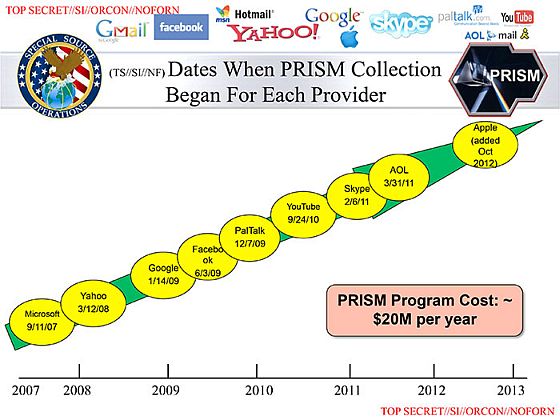
The PRISM Special Source Operations with trusted U.S. companies -- trusted, that is, by the NSA.

The Washington Post reports: The National Security Agency and the FBI are tapping directly into the central servers of nine leading U.S. Internet companies, extracting audio, video, photographs, e-mails, documents and connection logs that enable analysts to track a person’s movements and contacts over time.

The highly classified program, code-named PRISM, has not been disclosed publicly before. Its establishment in 2007 and six years of exponential growth took place beneath the surface of a roiling debate over the boundaries of surveillance and privacy. Even late last year, when critics of the foreign intelligence statute argued for changes, the only members of Congress who knew about PRISM were bound by oaths of office to hold their tongues.

An internal presentation on the Silicon Valley operation, intended for senior analysts in the NSA’s Signals Intelligence Directorate, described the new tool as the most prolific contributor to the President’s Daily Brief, which cited PRISM data in 1,477 articles last year. According to the briefing slides, obtained by The Washington Post, “NSA reporting increasingly relies on PRISM” as its leading source of raw material, accounting for nearly 1 in 7 intelligence reports.

That is a remarkable figure in an agency that measures annual intake in the trillions of communications. It is all the more striking because the NSA, whose lawful mission is foreign intelligence, is reaching deep inside the machinery of American companies that host hundreds of millions of American-held accounts on American soil.

The technology companies, which participate knowingly in PRISM operations, include most of the dominant global players of Silicon Valley. They are listed on a roster that bears their logos in order of entry into the program: “Microsoft, Yahoo, Google, Facebook, PalTalk, AOL, Skype, YouTube, Apple.” PalTalk, although much smaller, has hosted significant traffic during the Arab Spring and in the ongoing Syrian civil war. [Continue reading…]

Facebooktwittermail

New York Times: The Obama ‘administration has now lost all credibility’

A New York Times editorial says: Within hours of the disclosure that the federal authorities routinely collect data on phone calls Americans make, regardless of whether they have any bearing on a counterterrorism investigation, the Obama administration issued the same platitude it has offered every time President Obama has been caught overreaching in the use of his powers: Terrorists are a real menace and you should just trust us to deal with them because we have internal mechanisms (that we are not going to tell you about) to make sure we do not violate your rights.

Those reassurances have never been persuasive — whether on secret warrants to scoop up a news agency’s phone records or secret orders to kill an American suspected of terrorism — especially coming from a president who once promised transparency and accountability.

The administration has now lost all credibility. Mr. Obama is proving the truism that the executive will use any power it is given and very likely abuse it. That is one reason we have long argued that the Patriot Act, enacted in the heat of fear after the 9/11 attacks by members of Congress who mostly had not even read it, was reckless in its assignment of unnecessary and overbroad surveillance powers. [Continue reading…]

Facebooktwittermail

Anger swells after NSA phone records collection revelations

The Guardian reports: The scale of America’s surveillance state was laid bare on Thursday as senior politicians revealed that the US counter-terrorism effort had swept up swaths of personal data from the phone calls of millions of citizens for years.

After the revelation by the Guardian of a sweeping secret court order that authorised the FBI to seize all call records from a subsidiary of Verizon, the Obama administration sought to defuse mounting anger over what critics described as the broadest surveillance ruling ever issued.

A White House spokesman said that laws governing such orders “are something that have been in place for a number of years now” and were vital for protecting national security. Dianne Feinstein, the Democratic chairwoman of the Senate intelligence committee, said the Verizon court order had been in place for seven years. “People want the homeland kept safe,” Feinstein said.

But as the implications of the blanket approval for obtaining phone data reverberated around Washington and beyond, anger grew among other politicians.

Intelligence committee member Mark Udall, who has previously warned in broad terms about the scale of government snooping, said: “This sort of widescale surveillance should concern all of us and is the kind of government overreach I’ve said Americans would find shocking.” Former vice-president Al Gore described the “secret blanket surveillance” as “obscenely outrageous”. [Continue reading…]

Facebooktwittermail

Not the deep state but the streets pushing Erdoğan to change

Lale Kemal writes: A majority of Turks are now conscious of the fact that the mass protests that took place in this country in the past were masterminded by deep state elements so that they could hold on to their power at the expense of the elected governments.

Between 1960 and 2007, Turks witnessed bloody clashes that took place among leftist and rightist university students and massive demonstrations protesting against the governments in the periods prior to the three military coups as well as the three memorandums issued by the Turkish military that twice resulted in the fall of the government. The 29-year-old Kurdish uprising is a product of the bloody 1980 military coup, with the junta dealing a serious blow to democratic rights, which also deeply affected Kurds when they were banned from speaking their mother tongue even among themselves.

The current nationwide anti-government protests, however, are largely a product of people who are genuine in their demands in broader terms.

A peaceful, small-scale sit-in protest that started nine days ago in İstanbul’s Taksim Square against the demolition of the Gezi public park quickly turned into anti-government protests, reflecting people’s discontent. It escalated into some of the worst scenes of public disorder and police violence coupled with violence triggered by extreme groups seen in Turkey in recent years.

Today’s demonstrations are different from the previous deep-state organized ones since, among other things, they have brought together people from every segment of society. We understand this from the slogans being chanted by the demonstrators as well as the solidarity being displayed by the protesting crowds reflecting different ideologies that vary from moderate secularists and environmentalists to conservatives as well as gays and lesbians.

The driving force that united the protesters appears to be their anger against Prime Minister Recep Tayyip Erdoğan’s increased authoritarian behavior, treating the people as his subjects with arrogance and overconfidence. [Continue reading…]

Facebooktwittermail

Turkey finds that trouble knows no bounds

Hugh Pope writes: As instability undermines the Arab states established in the post-First World War map of the Middle East, a now vigorous Turkey, heir of the Ottoman Empire that was the main loser from that 20th century order, is taking a new look at the region.

‘Those borders are all false’, sniffed one of Turkey’s former top diplomats over dinner in February. Recep Tayyip Erdogan, the Turkish Prime Minister, says that Syria’s growing troubles since 2011 now amount to ‘an internal affair’ for Turkey, while in private officials talk breezily of Syria as ‘our former province’.

In the capital Ankara, a senior security official agreed that tumult in Syria over the past two years had vaporized much of the Cold War frontier of barbed wire and watch-towers. ‘The borders have become meaningless,’ he said.

In short, a major change is under way after decades in which Turkish policy was predicated on making the best of what it found in the Middle East.

This is not just a reaction to the catastrophic collapse of Syria into a failed state. In northern Iraq, Turkey is now moving firmly to cement a privileged energy, trade and security relationship with the Kurdistan Regional Government. ‘We warned the United States for 10 years, “you’re going to break up Iraq”. For this whole time we paid the price [of trying to hold Iraq together]’, the senior security official said. ‘Finally we saw the situation now that America is leaving, and said, “well, let’s turn this to our advantage”.’

Nobody in power in Ankara is talking of new annexations. But Turkey’s more opportunistic approach is rooted in the centuries during which it controlled most countries of what is the Sunni Muslim Arab world today, and a lingering grievance about how that empire was dismantled after the First World War ended in 1918.

Foreign Minister Ahmet Davutoglu often says that uprisings in the Arab world can be seen as ‘closing a century of parenthesis’ – shorthand for rebuilding links between former Ottoman lands, even though he denies the policy is ‘neo-Ottoman’. [Continue reading…]

Facebooktwittermail

Syrian rebels seize UN border post in Golan Heights

The New York Times reports: Rebels fighting the Syrian government on Thursday seized control of the only border crossing operated by United Nations peacekeeping forces along the Israeli-Syrian cease-fire line in the Golan Heights, according to the Israeli military and rebel forces. Israeli forces were placed on alert in the sensitive and disputed area as the violence of the civil war threatened to spill over into Israeli-held territory.

A few hours later the situation remained confused. Israeli media reports said that the Syrian government forces appeared to have retaken the Quneitra crossing and the Syrian state news agency SANA said that a unit of the government forces had “repelled terrorist groups” that had “tried” to take over Quneitra border crossing.

But Ahmad al-Basheer, a member of the local revolutionary committee in the Quneitra area who was reached by Skype, insisted that the crossing was still under the rebels’ control and that the entire province of Quneitra had been “liberated.”

“The regime won’t recapture this crossing even if we all have to die to thwart it,” he added.

As the fighting raged, the Israeli military declared the Israeli side of the crossing a closed military zone and ordered farmers to stay out of fields near the cease-fire line, apparently anticipating more conflict between Syrian government forces and the rebels.

Facebooktwittermail

Iran outmaneuvers U.S. in the Syrian proxy war

Vali Nasr writes: Syria’s uprising offered the possibility of a strategic defeat of Iran. In this scenario, Iran would be weakened by the collapse of Bashar al-Assad’s regime, its single Arab ally and a vital link to Lebanon’s Hezbollah militia. Isolated, Iran would become more vulnerable to international pressure to limit its nuclear program. And as Iran’s regional influence faded, those of its rivals — U.S. allies Turkey, Qatar and Saudi Arabia — would expand.

Instead, events in Syria are spinning in Iran’s favor. Assad’s regime is winning ground, the war has made Iran more comfortable in its nuclear pursuits, and Iran’s gains have embarrassed U.S. allies that support the Syrian uprising. What’s more, Iran has strengthened its relationship with Russia, which may prove to be the most important strategic consequence of the Syrian conflict, should the U.S. continue to sit it out.

Part of the U.S. calculation in declining to intervene has been the assumption that Assad would inevitably fall. The U.S., apparently, did not consider the implications of leaving the door open to a comeback by Assad. Reinforced by Hezbollah fighters and armed with Iranian and Russian weapons, the Syrian army broke through rebel lines in the central city of al-Qusair last week. The symbolic victory has dashed hopes for a quick end to the regime or a diplomatic resolution to the fighting.

Syria is now a proxy war, the outcome of which will determine the regional pecking order. In the Mideast, aura of power decides strategic advantage. Hezbollah’s prowess in Syria is a blow to Saudi Arabia, which has supported Hezbollah’s political opponents in Lebanon. The Syrian army’s gains are a setback to the Saudis, Qataris and Turks, all of whom have backed the rebels with money and weapons.

The U.S. has withheld lethal aid, not to mention military action. The Obama administration has eschewed intervention in Syria as a slippery slope to full-scale war, a costly repeat of the Iraq fiasco. In making this case, however, the administration sends a strong signal that it also would not go to war against Iran, despite President Barack Obama’s statement that no option is off the table when it comes to stopping Iran from acquiring nuclear weapons. When U.S. officials say their options for intervention are constrained by Syria’s air defense systems, they are also saying they fear Iran’s. [Continue reading…]

Facebooktwittermail

The U.S. has little interest in toppling Assad

Micah Zenko writes: Last week, the Daily Beast published an “exclusive” news story supported by comments from two anonymous administration officials: “Obama Asks Pentagon for Syria No-Fly Zone Plan.” The newsworthiness and hype surrounding such reporting was puzzling given that the military’s operational plans for a no-fly zone (NFZ) in Syria were completed many months ago and have been refined as new information has become available. Of course, versions of these plans have also been briefed in detail to the White House on multiple occasions. Soon after the Daily Beast story ran, Pentagon spokesperson Dave Lapan felt compelled to declare: “There is no new planning effort underway.” This failed effort to plant a story about White House interest in NFZ options for Syria is perhaps the most perfunctory effort ever to coerce a foreign leader — in this case, Bashar al-Assad, before the forthcoming diplomatic discussions in Geneva.

The Obama administration’s leaks should not be surprising — they are representative of the theatrical and half-hearted nature of America’s debate over military intervention in Syria. On March 27, 2011, just one week after a U.S.-led coalition began selectively enforcing an NFZ over Libya, then-Senator Joseph Lieberman endorsed a similar measure for Syria, in case Assad “turns his weapons on his people and begins to slaughter them, as Qaddafi did.” Over the subsequent 27 months, every plausible military tactic and mission has been exhaustively analyzed and deliberated by policymakers, active-duty and retired military officials, pundits (including myself), journalists, and others.

Civilian officials have requested a range of military options, the Pentagon’s planning process has responded, congressional committees have held multiple hearings, the media has covered the unfolding fighting in and around Syria, and interested commentators have offered their opinions.

Seven months ago, State Department spokesperson Victoria Nuland told reporters: “On the no-fly zone itself, you know that we’ve been saying for quite a while we continue to study whether that makes sense, how it might work.” As those “studies” have continued, the American people have been polled repeatedly to gauge their opinion — the latest two polls demonstrate that less than a quarter of Americans think the U.S. military should intervene in Syria.

At this point, it is safe to say that — short of definitive evidence of large-scale regime-directed chemical weapons use, or threats to Turkey, a U.S. treaty ally — it is highly unlikely that the United States will intervene militarily in Syria’s civil war. [Continue reading…]

Facebooktwittermail

Syrian rebels lose strategic town in boost for Assad

Reuters reports: Syrian government forces and their Lebanese Hezbollah allies seized control of the border town of Qusair on Wednesday, dealing a major defeat to rebel fighters battling to overthrow President Bashar al-Assad.

Two weeks of heavy fighting reduced many buildings to mounds of twisted concrete, whole blocks flattened by shelling, with glass and rubble littering the streets as tired but delighted Syrian soldiers gathered at the bullet-riddled clock tower.

“We will not hesitate to crush with an iron fist those who attack us. … Their fate is surrender or death,” the Syrian armed forces command said in statement. “We will continue our string of victories until we regain every inch of Syrian land.”

An opposition group from the town said more than 500 rebels had died in two weeks of fighting, with a further 1,000 wounded, leaving just 400 outgunned men struggling to hold onto the town.

Facing determined Hezbollah guerrillas from neighboring Lebanon, who swung the fight Assad’s way, the survivors decided to escape in the night through a corridor that the attackers said they had deliberately left open to encourage flight.

Facebooktwittermail

Erdogan has been warned

Sule Kulu writes: “History shows that if nations cannot manage to win all together, they are destined to lose all together,” declared Turkey’s prime minister, Recep Tayyip Erdogan, on the first anniversary of his 2007 re-election. “We defend freedom, justice, democracy and welfare for everybody.”

Back then, he promised that his Justice and Development Party, known by its Turkish initials, A.K.P., would embrace all sections of society regardless of political affiliation. He even thanked those who didn’t vote for him.

Five years later, Mr. Erdogan is facing growing criticism for disrespecting people’s lifestyles and interfering in their personal choices. His government has drafted and passed bills without public consultation. A law on restricting alcohol sales was passed on May 24 in Parliament via a last-minute amendment.

And then, two weeks later, again without public consultation, he began the demolition of a popular park as part of a controversial urban renewal plan for Taksim Square. The small-scale sit-in opposing the demolition morphed into mass nationwide public demonstrations after the police used excessive force against protesters.

How could a skilled politician as smart and experienced as Mr. Erdogan, who has been able to overcome a number of political crises in the past, including a threatened military coup in 2007, fail to see the bigger political picture?

In the past few days, Mr. Erdogan has claimed that those rallying against him were mobilized by the country’s opposition parties, especially the ultrasecular and ultranationalist bloc led by the Republican People’s Party (C.H.P.). He said the issue was not the park but a concerted political campaign against him by those who opposed his policies on partisan grounds. This was understandable given that his opponents have ignored the A.K.P.’s landmark achievements for the sake of partisanship in the past.

However, a quick look was enough to confirm that the opposition that took over Taksim last weekend was different. It was a largely nonpartisan movement made up of liberals, conservatives, independents and even likely A.K.P. voters. Their cause was later overshadowed by some violent groups, who dealt a serious blow to the public image of the protests through vandalism, looting and attacking women wearing head scarves. Yet the initial sit-in group, as well as those participating in the broader protests that followed, represented a broad cross section of society. [Continue reading…]

Facebooktwittermail