Author Archives: News Sources

It’s Palestinians who have the right to defend themselves

Seumas Milne writes: The way western politicians and media have pontificated about Israel’s onslaught on Gaza, you’d think it was facing an unprovoked attack from a well-armed foreign power. Israel had every “right to defend itself”, Barack Obama declared. “No country on earth would tolerate missiles raining down on its citizens from outside its borders.”

He was echoed by Britain’s foreign secretary, William Hague, who declared that the Palestinian Islamists of Hamas bore “principal responsibility” for Israel’s bombardment of the open-air prison that is the Gaza Strip. Meanwhile, most western media have echoed Israel’s claim that its assault is in retaliation for Hamas rocket attacks; the BBC speaks wearisomely of a conflict of “ancient hatreds”.

In fact, an examination of the sequence of events over the last month shows that Israel played the decisive role in the military escalation: from its attack on a Khartoum arms factory reportedly supplying arms to Hamas and the killing of 15 Palestinian fighters in late October, to the shooting of a mentally disabled Palestinian in early November, the killing of a 13 year-old in an Israeli incursion and, crucially, the assassination of the Hamas commander Ahmed Jabari last Wednesday during negotiations over a temporary truce.

Israel’s prime minister, Binyamin Netanyahu, had plenty of motivation to unleash a new round of bloodletting. There was the imminence of Israeli elections (military attacks on the Palestinians are par for the course before Israeli polls); the need to test Egypt’s new Muslim Brotherhood president, Mohamed Morsi, and pressure Hamas to bring other Palestinian guerrilla groups to heel; and the chance to destroy missile caches before any confrontation with Iran, and test Israel’s new Iron Dome anti-missile system.

So after six days of sustained assault by the world’s fourth largest military power on one of its most wretched and overcrowded territories, at least 130 Palestinians had been killed, an estimated half of them civilians, along with five Israelis. The goal, Israel’s interior minister, Eli Yeshai, insisted, had been to “send Gaza back to the middle ages”.

True, the bloodshed hasn’t so far been on the scale of Operation Cast Lead in 2008-9, which left 1,400 Palestinians dead in three weeks. But the issue isn’t just who started and escalated it, or even the grinding “disproportionality” of yet another Israeli military battering (even before last month’s flareups, 314 Palestinians had been killed since 2009, as against 20 Israelis).

It’s that to portray Israel as some kind of victim with every right to “defend itself” from attack from “outside its borders” is a grotesque inversion of reality. Israel has after all been in illegal occupation of both the West Bank and Gaza, where most of the population are the families of refugees who were driven out of what is now Israel in 1948, for the past 45 years.

People like to repeat this claim that Israel has the “fourth largest military power” in the world. I have no idea what if any metric that description is based on. In terms of military spending, Israel ranks #17. In terms of number of troops it ranks #30. But in terms of the Global Militarization Index, it ranks #1.

For the purposes of political rhetoric, maybe “most militarized nation on earth” should replace “fourth largest military power” — at least it has a factual basis.


Facebooktwittermail

Gaza Parkour Team — ‘there is hope in life’

The Gaza Parkour Team show off their moves during training on October 26. (Music: “Speaking in Tongues” by Hilltop Hoods.)

A few days ago as they continued their training in Khan Younis at the southern end of the Gaza Strip, Israeli bombs started to fall.

“We did this video to convey message to the world that we, despite all what is happening in the Gaza Strip killing and bombing and destruction of facilities there is hope in life.”

Facebooktwittermail

The sounds in Gaza City

Wasseem El Sarraj writes: The bombing started on al-Hijriyah (the first day of the Muslim New Year); I was off of work because of the associated national holidays and was looking forward to a four-day long weekend. I have since spent those four days trapped in my home, in Remal, Gaza, an affluent neighborhood inside Gaza City. I am fortunate to not be living in the border areas nor in one of the densely populated—and Hamas-affiliated—camps. None of this means I feel safe.

From the moment the bombing started I cursed the newly built shopping mall that towers over our house. Not only did it break all of Gaza’s lax zoning laws, but its owner was known to be a Hamas sympathizer: each day I have been afraid that it could be one of Israel’s bombing targets. Israel’s target list will be inspected and debated in the aftermath of this operation; at present it seems to be a mixture of rocket-launching sites, pre-identified militants, weapons caches, and then there are the “symbolic” targets. Each of which carries a different strategic calculation for Israel, but from where we sit, the symbolic targeting of government buildings is as baffling as the decision to fight homemade rockets with bombs dropped from F-16s. And all of these risk civilian casualties, the “collateral damage” that rolls much too easily off too many tongues.

In the early morning hours on Saturday, Jawazat, a large police compound just a few minutes away from my house, and next to my favorite pizzeria, was destroyed. A deceptive lull in violence followed, creating hours of silence and waiting during which we dared not venture out. I sat at home with my family, speculating about the possibility of a ceasefire agreement: our fears and our hopes revealed themselves as we began to think that our leaders might be close to reaching an agreement that would bring an end to this horror. Then, in an instant, four heart-stopping explosions, one after the other, shook our once untouchable house. As the deafening explosions subsided I tried to regain some composure; you want to be stoic when the children catch your gaze. But then I realized that it’s me who is the child; I am the one who is the war amateur. My half-brother, who is seven, and my step-brother, who is twelve, are the veterans in surviving wars, for in 2008 they survived Operation Cast Lead, Israel’s bombardment and invasion, whilst I was absent and secure in London. We were only on day three of Operation Pillar of Defense by this Saturday; my young siblings had already undergone all of this for twenty-eight days, thirty-one if you include this operation. [Continue reading…]

Facebooktwittermail

When will the economic blockade of Gaza end?

Robert Wright writes: President Obama and Bibi Netanyahu are on the same page when it comes to the justification for Israel’s bombardment of Gaza. Netanyahu: “No country in the world would agree to a situation in which its population lives under a constant missile threat.” Obama: “There’s no country on earth that would tolerate missiles raining down on its citizens from outside its borders.”

It’s true that if, say, Canada were lobbing missiles into the US, the US wouldn’t tolerate it. But here’s another thing the US wouldn’t tolerate: If Canada imposed a crippling economic blockade, denying America the import of essential goods and hugely restricting American exports. That would be taken as an act of war, and America would if necessary respond with force–by, perhaps, lobbing missiles into Canada.

This is the situation Gaza has faced for years: a crippling economic blockade imposed by Israel. Under international pressure, Israel has relaxed the import restrictions, but even so such basic things as cement, gravel, and steel are prohibited from entering Gaza. The rationale is that these items are “dual use” and could be put to military ends. But this logic doesn’t explain the most devastating part of the blockade–the severe restrictions on Gaza’s exports.

Gazans can’t export anything to anyone by sea or air, and there are extensive constraints on what they can export by land. They can’t even sell things to their fellow Palestinians in the West Bank. [Continue reading…]

Facebooktwittermail

Hamas and the need for Palestinian unity

Nathan Brown writes: Hamas has always boasted of its pragmatism. It continues to claim to be a “wasati” movement — the term means “centrist” and is used by Islamists who want to communicate their responsiveness to the interests of the public rather than their devotion to the strictest version of religious teachings. And it is clear that in the first few years after winning elections in Gaza in 2006, some Hamas leaders, confronted with intense regional pressure and a fiscal crisis, and the knowledge that they would have to face the Palestinian voters again in 2010, took initial steps in a more moderate direction.

Unfortunately, the elections they were anticipating were never held (and the primary culprits in that regard were President Mahmud Abbas who threatened constantly to use an utterly imaginary authority to dissolve the parliament and Western actors who supported him in those threats). When a Palestinian civil war erupted in June 2007, the governments in the West Bank and Gaza became more explicitly autocratic, to the detriment of Palestinians in both territories. Hardly anyone harbors expectations any longer of free elections: On those rare occasions when Hamas and the leaders of the West Bank have had half-hearted conversations about reuniting, elections haven’t been a meaningful part of the negotiations.

Any hopes since then that Hamas would moderate have been squandered. The changing regional environment after the Arab upheavals of 2011 seemed to offer brief hope that Hamas would reposition itself away from the “resistance” camp in the region and toward the camp of Islamist movements in North Africa that were dedicated to making political Islam the basis of a practicable governing system. That would have required taking reconciliation with Israel a bit more seriously, interpreting “resistance” a bit more flexibly to encompass popular mobilization more than armed action, and presenting a friendlier diplomatic face to the rest of the world. But the effort, led by Khalid Mish’al, was derailed by Hamas leaders who didn’t want to risk their hold on the government in Gaza.

There is a possible path forward out of this dreary political landscape. The most promising way to force Hamas to become more moderate is to force it to be more responsive to its own public. (As a leading Muslim Brotherhood parliamentarian in neighboring Egypt told me when I asked him whether Hamas would ever accept a two-state solution: “They will have to. Their people will make them.”) And the most promising way to ensure such responsiveness is to speed up the reconciliation between the governments in the West Bank and Gaza, so that those governments can agree to hold elections rather than jealously hold on to their own fiefdoms in a fit of paranoia. But that, in turn, will require that Israel and the international community show a greater willingness to countenance Palestinian reconciliation.

Facebooktwittermail

The wrong man for the CIA

Gregory D. Johnsen writes: With the resignation of David H. Petraeus, President Obama now has a chance to appoint a new C.I.A. director. Unfortunately, one of the leading candidates for the job is John O. Brennan, who is largely responsible for America’s current flawed counterterrorism strategy, which relies too heavily on drone strikes that frequently kill civilians and provide Al Qaeda with countless new recruits. Rather than keeping us safe, this strategy is putting the United States at greater risk.

For all of the Obama administration’s foreign policy successes — from ending the war in Iraq to killing Osama bin Laden — the most enduring policy legacy of the past four years may well turn out to be an approach to counterterrorism that American officials call the “Yemen model,” a mixture of drone strikes and Special Forces raids targeting Al Qaeda leaders.

Mr. Brennan is the president’s chief counterterrorism adviser and the architect of this model. In a recent speech, he claimed that there was “little evidence that these actions are generating widespread anti-American sentiment or recruits for A.Q.A.P.,” referring to Al Qaeda in the Arabian Peninsula.

Mr. Brennan’s assertion was either shockingly naïve or deliberately misleading. Testimonies from Qaeda fighters and interviews I and local journalists have conducted across Yemen attest to the centrality of civilian casualties in explaining Al Qaeda’s rapid growth there. The United States is killing women, children and members of key tribes. “Each time they kill a tribesman, they create more fighters for Al Qaeda,” one Yemeni explained to me over tea in Sana, the capital, last month. Another told CNN, after a failed strike, “I would not be surprised if a hundred tribesmen joined Al Qaeda as a result of the latest drone mistake.”

Rather than promote the author of a failing strategy, we need a C.I.A. director who will halt the agency’s creeping militarization and restore it to what it does best: collecting human intelligence. It is an intelligence agency, not a lightweight version of Joint Special Operations Command. And until America wins the intelligence war, missiles will continue to hit the wrong targets, kill too many civilians and drive young men into the waiting arms of our enemies. [Continue reading…]

Facebooktwittermail

Israel must negotiate with political Islam

Dr Mahmoud Ramhi

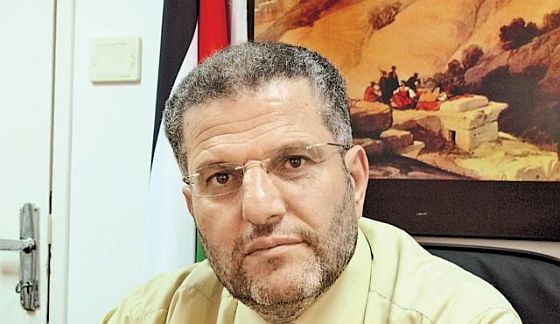
Amira Hass spoke to Dr. Mahmoud Ramhi, a Hamas member of the Palestinian Legislative Council and one of the most prominent Hamas representatives in the West Bank.

Ramhi, an anesthesiologist, was released four months ago from administrative detention after being in custody for two years. He has been arrested and tried several times for belonging to Hamas, and has been in Israeli jails for a total of eight years.

“When Israel assassinated Ahmed Jabari [the Hamas military chief killed Wednesday], it knew that he was involved in negotiations with the Egyptians over a tahadiyeh [lull],” said Ramhi. “Of course it was a loss for Hamas, but ultimately, it was a slap in the face to Egypt.”

Ramhi said Israeli leaders are shortsighted.

“I find that the Israeli leadership behaves foolishly,” he said. “It sees only as far as its election. It looks at the future of the election, but doesn’t look at the future of Israel? Israel has lost all its allies in the region.”

For instance, Israel “lost Turkey as a strategic ally with its own hands, in an attack on a civilian ship,” said Ramhi, referring to the 2010 Israeli naval raid of the Mavi Marmara. “Now it’s losing Egypt. And not because [Egyptian President Mohammed] Morsi, of the Muslim Brotherhood, is in power. In Jordan the protesters are already calling, not for a decrease in gas prices, but for the downfall of the king. Israel has lost its ties with the [Palestinian] Authority, and is now losing its deterrent power, with 4 million Israelis in the line of fire. One can rightly ask how they are to blame, but by the same token we must ask how the 1.5 million Palestinians in Gaza are to blame.”

Ramhi said Israel must recognize that the recent changes in the Arab world are benefiting the Muslim Brotherhood, of which Hamas is part.

“The United States,” said Ramhi, “is smarter than Israel. It is acting in line with its interests. It started moving a bit closer to the Muslim Brotherhood, not just on the Egyptian track, but also [closer] to us, here.”

The U.S. has given a green light to Palestinian Prime Minister Salam Fayyad to bring Hamas members into the Palestinian government in the West Bank, as long as the establishment of a unity government is delayed. This means that Hamas in the West Bank is recognized as a political Islamic movement, said Ramhi. He said the proposal is still being discussed, although Hamas officials have already said, at the meeing some three weeks ago, that they want at least a year in which Hamas supporters get their political rights back: detainees are released, Hamas members fired from their jobs for political reasons get their positions back, and political activity is allowed.

Israel must begin a dialogue with political Islam if it wants to survive, said Ramhi.

“If Israel wants to continue to exist in the region, it must open a channel of political dialogue with political Islam in the area, including Hamas,” he said. “The Israelis need a leadership that knows how to negotiate with others. That can deal with others, not with arrogance or a feeling of supremacy.”

Facebooktwittermail

If the world will not defend the Palestinians against Israel, we have the right to defend ourselves

Mousa Abu Marzook

Mousa Abu Marzook, Deputy Chairman of the Hamas Political Bureau, writes: The latest Israeli aggression on the Gaza Strip has prompted several European countries and the US to reaffirm their position of unwavering support for the aggressor. William Hague, Britain’s foreign secretary, Cathy Ashton, the EU high representative for foreign affairs, and Barack Obama, have all claimed that Hamas’s rockets were responsible for the crisis and that it is the right of Israel to defend its citizens. Had they checked the facts, they would have realised Israel started the attacks. The escalation started when an Israeli military incursion into Gaza on 8 November killed a Palestinian child. That was followed by other Israeli incursions and attacks, provoking a response by Palestinian factions.

Despite that, there were serious efforts to calm the situation and reach a truce. But clearly Israel had another agenda. By targeting Ahmed al-Jabari, leader of the al-Qassam Brigade, it sabotaged Egyptian efforts to conclude a truce between all Palestinian factions and the Israelis. This was confirmed by Egypt’s president on Saturday.

With the approach of the Israeli elections, the Israeli prime minister, Binyamin Netanyahu, wanted to trade with the blood of the Palestinians, especially after his alliance with the ultra-extremist Avigdor Lieberman failed to boost his popularity in the polls as he’d expected. This is not the first time the Israelis have launched a war for electoral gain. Shimon Peres did it to Lebanon in 1996 and the Olmert-Livni-Barak alliance did it to Gaza in 2008. What is important here is the immoral and short-sighted stance of the European and US governments; they have misconstrued the facts and displayed complete partiality in favour of the aggressor.

The western position has given political cover to the Israeli aggression and encouraged its leadership to continue their attacks. Thus, in the eyes of our people and those of the entire region, western countries are complicit. European governments, in contrast to their peoples whose majority support Palestinian rights, have demonstrated their double standards and hypocrisy again.

The human rights that Europe claims to defend all over the world are denied to the Palestinian people. European governments have done nothing while 1.7 million Gazans have been subjected for the past five years to an Israeli blockade – denying them food, water, medicine and even determining how many calories they should be allowed each day.

The right of people to resist occupation and confront aggression is guaranteed to all peoples; but if Palestinians seek to exercise this right it immediately becomes terrorism and for this they must be persecuted. [Continue reading…]

Facebooktwittermail

Hamas wants a fair deal — not just an end to this assault but an end to the siege of Gaza

The New York Times reports on ceasefire negotiations being brokered by the Egyptian government in Cairo. Israeli forces are poised to invade the Gaza Strip, yet in this report it is Hamas that is characterized as assuming an “aggressive stance” because it has the apparent audacity to be making some security demands — as though the only reasonable demand Hamas could make would be for Israel to suspend its current assault.

Hamas, badly outgunned on the battlefield, appeared to be trying in the talks to exploit its increased political clout with its ideological allies in Egypt’s new Islamist-led government. The group’s leaders, rejecting Israel’s call for an immediate end to the rocket attacks, have instead laid down sweeping demands that would put Hamas in a stronger position than when the conflict began: an end to Israel’s five-year-old embargo of the Gaza Strip, a pledge by Israel not to attack again and multinational guarantees that Israel would abide by its commitments.

Prime Minister Benjamin Netanyahu of Israel stuck to his demand that all rocket fire cease before the Israeli air campaign lets up, and Israeli tanks and troops remained lined up outside Gaza on Sunday. Tens of thousands of reserve troops had been called up. “The army is prepared to significantly expand the operation,” Mr. Netanyahu said at the start of a cabinet meeting.

Reda Fahmy, a member of Egypt’s upper house of Parliament and of the nation’s dominant Islamist party, who is following the talks, said Hamas’s position was just as unequivocal. “Hamas has one clear and specific demand: for the siege to be completely lifted from Gaza” he said. “It’s not reasonable that every now and then Israel decides to level Gaza to the ground, and then we decide to sit down and talk about it after it is done. On the Israeli part, they want to stop the missiles from one side. How is that?”

He added: “If they stop the aircraft from shooting, Hamas will then stop its missiles. But violence couldn’t be stopped from one side.”

Hamas’s aggressive stance in the cease-fire talks is the first test of the group’s belief that the Arab Spring and the rise in Islamist influence around the region have strengthened its political hand, both against Israel and against Hamas’s Palestinian rivals, who now control the West Bank with Western backing.

It also puts intense new pressure on President Mohamed Morsi of Egypt, a former leader of the Muslim Brotherhood who was known for his fiery speeches defending Hamas and denouncing Israel. Mr. Morsi must now balance the conflicting demands of an Egyptian public that is deeply sympathetic to Hamas and the Palestinian cause against Western pleadings to help broker a peace and Egypt’s urgent need for regional stability to help revive its moribund economy.

Facebooktwittermail

Israel ready to invade Gaza Strip if cease-fire efforts fail

Bloomberg reports: Israeli ground forces are poised to invade the Gaza Strip for the first time in almost four years amid efforts by Egypt and Turkey to help end exchanges of fire that have killed 96 Palestinians and three Israelis.

The decision whether to expand the Gaza operation or reach a cease-fire agreement “is rapidly approaching, and is a matter of hours, not even days,” Israeli Finance Minister Yuval Steinitz said in an interview today on Army Radio.

Air-raid sirens sounded twice in Tel Aviv yesterday as four rockets were intercepted by Israel’s Iron Dome missile-defense system. A rocket was fired at Jerusalem on Nov. 16, the first such attack in decades. At least 1,100 missiles, rockets and mortars have been fired at Israel since Nov. 14, according to the Israel Defense Forces. About 15,000 have been launched from Gaza in the past 11 years.

The escalating conflict between Israel and the Islamist Hamas movement, which controls the Gaza Strip, threatens a region still unbalanced after a wave of popular uprisings last year. Hamas is considered a terrorist group by Israel, the U.S. and the European Union.

Hamas is “mildly optimistic” about efforts to broker a cease-fire with Israel, Nabil Shaath, a senior adviser to Palestinian Authority President Mahmoud Abbas, said today in an interview. “They think negotiations are going seriously, but it’s difficult to predict when that will come to fruition,” he said, speaking in the north Sinai town of el-Arish.

Facebooktwittermail

Israeli air strikes inflict bitter toll on Gaza children

The Guardian reports: At least 11 members of one family, including five women and four children, were killed when Israel bombed a house in Gaza City on Sunday as the five-day-old war claimed more civilian lives with no sign of a let-up in the intense bombardment.

The air strike flattened the home of the Dalou family in the Sheikh Radwan district of Gaza City, causing the biggest death toll in a single incident since the offensive began last Wednesday.

On Monday morning the Israeli defence force appeared to admit the family had been killed by mistake. The Haaretz website quoted the army as saying their house was either incorrectly pinpointed or a missile malfunctioned.

Elsewhere in the city early Monday an air strike levelled two houses belonging to a single family, killing two children and two adults and injuring 42 people, including children, said Gaza heath official Ashraf al-Kidra. Rescue workers were frantically searching for 12 to 15 members of the Azzam family under the rubble. Shortly afterwards, Israeli aircraft bombarded the remains of the former national security compound in Gaza City. Al-Kidra said flying shrapnel killed one child and wounded others living nearby.

After the Dalou family home was destroyed, the bodies of the children were pulled from the rubble and taken to the morgue at Shifa hospital. The dead also included an 80-year-old woman.

Ismael Haniyeh, the Hamas prime minister, described the deaths as an “ugly massacre” and the Hamas military wing, al-Qassam Brigades, said: “The massacre of the Dalou family will not pass without punishment.”

Diggers at the scene of the explosion were scooping rubble from flattened buildings as rescuers tried to locate survivors.

Witnesses said there were chaotic scenes as the dead and injured were brought to the Shifa hospital, which has been on emergency footing since the start of Operation Pillar of Defence.

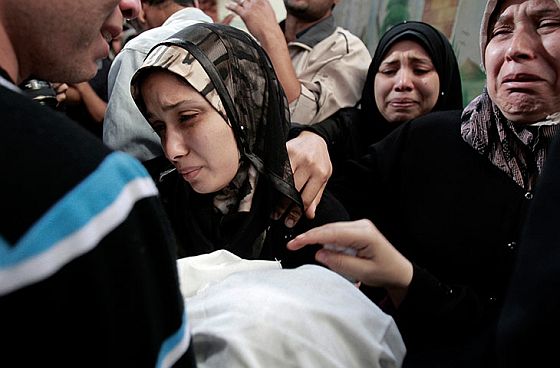
The bodies of four young children lay on two metal trays in the morgue, covered in dust and blood. A crowd of onlookers outside became increasingly distressed as the body of the children’s mother was wheeled in, covered in blankets.

The strike was originally thought to have been aimed at a Hamas official, Mohamed Dalou.

In all, 84 Palestinians, about half of them civilians, have been killed in the five-day onslaught and 720 have been wounded. Three Israeli civilians have died from Palestinian rocket fire and dozens have been wounded.

Facebooktwittermail

An American rabbi’s outrage at Israel’s assault on Gaza

The parents of an 11-month-old child, Omar Misharawi, killed in an Israeli strike hold his body at his funeral in Gaza City.

Rabbi Brant Rosen writes: Israel’s military assault on Gaza in 2008-09 represented an important turning point in my own relationship with Israel. I recall experiencing a new and previously unfamiliar feeling of anguish as Israel bombarded the people living in that tiny, besieged strip of land over and over, day after day after day. While I certainly felt a sense of tribal loyalty to the Israelis who withstood Qassam rocket fire from Gaza, I felt a newfound sense of concern and solidarity with Gazans who I believed were experiencing nothing short of oppression during this massive military onslaught.

And now it’s happening again. Only this time I don’t think the term “anguish” quite fits my mindset. Now it’s something much closer to rage.

It’s happening again. Once again 1.7 million people, mostly refugees, who have been living in what amounts to the world’s largest open air prison, are being subjected to a massive military assault at the hands of the world’s most militarized nation, using mostly US-made weapons. And our President is not only looking on – he is defending Israel’s onslaught by saying it has a right to “self-defense in light of the barrage of rocket attacks being launched from Gaza against Israeli civilians.”

Let’s be clear: this tragedy didn’t start with the Qassams. It didn’t start with the election of Hamas. And it didn’t start with the “instability” that followed Israel’s withdrawal from Gaza.

No, this is just the latest chapter of a much longer saga that began in 1947-48, when scores of Palestinians were ethnically cleansed from their cities and villages in the coastal plain and lower Galilee and warehoused in a tiny strip of land on the edge of the Mediterranean. [Continue reading…]

Facebooktwittermail

Gilad Sharon: ‘Flatten all of Gaza’

Gilad Sharon

In the Jerusalem Post, Gilad Sharon, son of former Israeli prime minister Ariel Sharon, writes: Why do our citizens have to live with rocket fire from Gaza while we fight with our hands tied? Why are the citizens of Gaza immune? If the Syrians were to open fire on our towns, would we not attack Damascus? If the Cubans were to fire at Miami, wouldn’t Havana suffer the consequences? That’s what’s called “deterrence” – if you shoot at me, I’ll shoot at you. There is no justification for the State of Gaza being able to shoot at our towns with impunity. We need to flatten entire neighborhoods in Gaza. Flatten all of Gaza. The Americans didn’t stop with Hiroshima – the Japanese weren’t surrendering fast enough, so they hit Nagasaki, too.

There should be no electricity in Gaza, no gasoline or moving vehicles, nothing. Then they’d really call for a ceasefire.

Were this to happen, the images from Gaza might be unpleasant – but victory would be swift, and the lives of our soldiers and civilians spared.

If the government isn’t prepared to go all the way on this, it will mean reoccupying the entire Gaza Strip. Not a few neighborhoods in the suburbs, as with Cast Lead, but the entire Strip, like in Defensive Shield, so that rockets can no longer be fired.

There is no middle path here – either the Gazans and their infrastructure are made to pay the price, or we reoccupy the entire Gaza Strip. Otherwise there will be no decisive victory. And we’re running out of time – we must achieve victory quickly. The Netanyahu government is on a short international leash. Soon the pressure will start – and a million civilians can’t live under fire for long. This needs to end quickly – with a bang, not a whimper.

Facebooktwittermail

Bradley Manning deserves Americans’ support for military whistleblowing

Desmond Tutu, Mairead Corrigan-Maguire and Adolfo Pérez Esquivel write: Last week, PFC Bradley Manning offered to accept responsibility for releasing classified documents as an act of conscience – not as charged by the US military. As people who have worked for decades against the increased militarization of societies and for international cooperation to end war, we have been deeply dismayed by his treatment. The military under the Obama administration has displayed a desire to over-prosecute whistleblowing with life-in-prison charges including espionage and “aiding the enemy”, a disturbing decision which is no doubt intended to set an example.

We have dedicated our lives to working for peace because we have seen many faces of armed conflict and violence, and we understand that no matter the cause of war, civilians always bear the brunt of the cost. With today’s advanced military technology and the continued ability of business and political elites to filter what information is made public, there exists a great barrier to many citizens being fully aware of the realities and consequences of conflicts in which their country is engaged.

Responsible governance requires fully informed citizens who can question their leadership. For those citizens worldwide who do not have direct, intimate knowledge of war, yet are still affected by rising international tensions and failing economies, WikiLeaks releases attributed to Bradley Manning have provided unparalleled access to important facts.

Revealing covert crimes in Iraq and Afghanistan and corporations’ pervasive influence in governance, this window into the realities of modern international relations has changed the world for the better. While some of these documents may demonstrate how much work lies ahead in terms of securing international peace and justice, they also highlight the potential of the internet as a forum for citizens to participate more directly in civic discussion and creative government accountability projects. [Continue reading…]

Facebooktwittermail

How Obama has failed his own supporters

In “An open letter to the President from a bereaved sister,” Abby Okrent writes:

Dear Mr. President,

My younger brother was an early believer in you. He worked for your Senate campaign. At the age of 25, he ran the GOTV campaign in North Carolina, delivering an improbable victory for you in a Southern state that helped give you your first term. This year, slightly less bright-eyed but nonetheless a believer, he was working on your campaign again when he died suddenly, a brilliant, energetic 29 year old, dead in his tracks. You know this. You called my parents. Your campaign, to my greatest appreciation and respect, brought grief counselors for his coworkers, dedicated a corner of the office and much of your fundraising efforts to him, and bussed his coworkers to join the hundreds of others at his funeral.

You may not know that after his sudden passing, many of his friends quit their jobs, moved, changed their lives to continue working on your campaign in his memory. One of these friends ran your GOTV effort in Ohio, delivering a close swing state that resulted in the race being called for you early. My mom and I joined these efforts in Ohio, door-knocking until right before the polls closed, pounding the pavement in Alex’s memory and in hopes of your next presidency. Despite my disappointment in some of your stances, I proudly kept my Ohio for Obama sticker on my jacket.

Until yesterday. Mr. President, when the bombs began raining on Gaza again and you reiterated Israel’s “right to defend itself”, I took that sticker off my jacket. Later, you called Prime Minister Netanyahu and asked him to “use restraint,” as though he were a glutton at a feast, rather than an elected official of a powerful military nation, using your own country’s weaponry to engage in a one-sided assault. Mr. President, you are the most powerful man in the world. You do not need to politely request anything of Mr. Netanyahu; you can stop him by ending U.S. military aid to Israel until Israel complies with international and U.S. law. Mr. Netanyahu and his right-wing allies in the U.S. actively campaigned against your re-election, assuming that Governor Romney would be better positioned to give them carte blanche to violate Palestinian human rights and start regional wars. It is not to them that you now need to prove your allegiance, but to we the people who knocked doors for you, who made phone calls for you, who died getting you this 4 years more of opportunity. [Continue reading…]

Facebooktwittermail