Archbishop Desmond Tutu: A person with Ubuntu is open and available to others, affirming of others, does not feel threatened that others are able and good, for he or she has a proper self-assurance that comes from knowing that he or she belongs in a greater whole and is diminished when others are humiliated or diminished, when others are tortured or oppressed.
One of the sayings in our country is Ubuntu – the essence of being human. Ubuntu speaks particularly about the fact that you can’t exist as a human being in isolation. It speaks about our interconnectedness. You can’t be human all by yourself, and when you have this quality – Ubuntu – you are known for your generosity.
We think of ourselves far too frequently as just individuals, separated from one another, whereas you are connected and what you do affects the whole world. When you do well, it spreads out; it is for the whole of humanity.
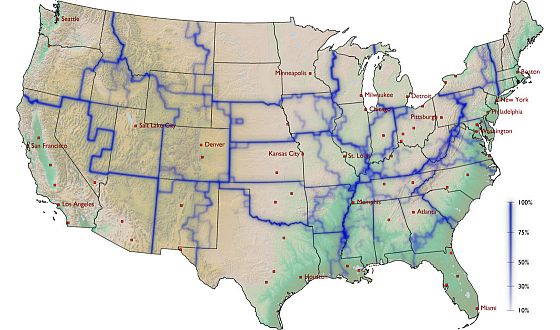
Robert Krulwich writes: Look at the center of this map, at the little red dot that marks Kansas City. Technically, Kansas City is at the edge of Missouri, but here on this map it’s in the upper middle section of a bigger space with strong blue borders. We don’t have a name for this bigger space yet, but soon we will.
I would call it, for the moment, “The Part Of America Kansas City Hangs With” because that’s what this map is saying. It’s a new, intriguing way to see our country. This one was built by tracking dollar bill circulation. There’ve been similar maps built from phone call data. The idea here is to show America not as 50 states, but as regions where people do stuff together. In other words, a “Whom Do You Hang With?” map.
Here’s the notion. A few years ago, Dirk Brockmann, a theoretical physicist from Germany, was visiting his American friend Dennis, and they got talking about population mobility. Dirk knew Americans move around a lot, but he wondered how to capture where they go, who they talk to. His friend said, “Have you ever heard of Where’s George? Dirk hadn’t.
It’s a website that tracks the movement of dollar bills. Thousands of people participate. All you do is take a bill out of your wallet, type the denomination, serial number, the date and your zip code onto the Where’s George? site, and then, with a pen or a stamp, deface the bill with the words “WheresGeorge.com.” After which (and this is key), you spend it. So now your bill is moving from business to business, person to person, and if and when another Where’s George volunteer discovers it, she or he will note where, note when and spend it again. Since dollar bills pass between people, Dennis suggested why not us the “Where’s George?” data to get a sense of where people go, and, just as interesting, where they don’t go?
That’s what Dirk did. After checking 1,033,095 reports (describing the movement of 464,670 bills), he came up with this map. [Continue reading…]

John Gray writes: A resolute independence has shaped James Lovelock’s life as a scientist. On the occasions over the past decade or so when I visited him at his home in a remote and wooded part of Devon to discuss his work and share our thoughts, I found him equipped with a mass of books and papers and a small outhouse where he was able to perform experiments and devise the inventions that have supported him through much of his long career. That is all he needed to carry on his work as an independent scientist. Small but sturdily built, often laughing, animated and highly sociable, he is, at the age of 93, far from being any kind of recluse. But he has always resisted every kind of groupthink, and followed his own line of inquiry.
At certain points in his life Lovelock worked in large organisations. In 1941, he took up a post as a junior scientist at the National In – stitute for Medical Research, an offshoot of the Medical Research Council, and in 1961 he was invited to America to join a group of scientists interested in exploring the moon who were based at the National Aeronautics and Space Administration (Nasa). It was during his time at Nasa that Lovelock had the first inklings of what would become the Gaia theory – according to which the earth is a planet that behaves like a living being, controlling its surface and atmosphere to keep the environment hospitable to life. He has since worked closely with other scientists, including his former doctoral student Andrew Watson, who is now a professor of environmental science, and the late American microbiologist Lynn Margulis, in developing the theory.
Lovelock has always cherished the freedom to follow his own ideas and stood aside from institutions in which science is conducted as a vast collective enterprise. Partly this is an expression of his ingrained individualism, but it also reflects his radically empiricist view of science as a direct engagement with the world and his abiding mistrust of consensual thinking. In these and other respects, he has more in common with thinkers such as Darwin and Einstein, who were able to transform our view of the world because they did not work under any kind of external direction, than he does with most of the scientists who are at work today. [Continue reading…]
Bristol University: New research has questioned the reliability of neuroscience studies, saying that conclusions could be misleading due to small sample sizes.
A team led by academics from the University of Bristol reviewed 48 articles on neuroscience meta-analysis which were published in 2011 and concluded that most had an average power of around 20 per cent – a finding which means the chance of the average study discovering the effect being investigated is only one in five.
The paper, being published in Nature Reviews Neuroscience today [10 April], reveals that small, low-powered studies are ‘endemic’ in neuroscience, producing unreliable research which is inefficient and wasteful.
It focuses on how low statistical power – caused by low sample size of studies, small effects being investigated, or both – can be misleading and produce more false scientific claims than high-powered studies.
It also illustrates how low power reduces a study’s ability to detect any effects and shows that when discoveries are claimed, they are more likely to be false or misleading.
BBC News reports: Listening to new music is rewarding for the brain, a study suggests.
Using MRI scans, a Canadian team of scientists found that areas in the reward centre of the brain became active when people heard a song for the first time.
The more the listener enjoyed what they were hearing, the stronger the connections were in the region of the brain called the nucleus accumbens.
The study is published in the journal Science.
Dr Valorie Salimpoor, from the Rotman Research Institute, in Toronto, told the BBC’s Science in Action programme: “We know that the nucleus accumbens is involved with reward.
“But music is abstract: It’s not like you are really hungry and you are about to get a piece of food and you are really excited about it because you are going to eat it – or the same thing applies to sex or money – that’s when you would normally see activity in the nucleus accumbens.
“But what’s cool is that you’re anticipating and getting excited over something entirely abstract – and that’s the next sound that is coming up.” [Continue reading…]
America can make very few claims to have made lasting contributions to global culture that are quintessentially American. But nothing is more American than jazz.
It’s ironic then that nowadays nowhere has a more vibrant jazz scene than Norway — thanks in part to a very un-American concept: public funding.
NPR: Did you hear about the Italian gallery owner who burned his gallery’s paintings last year — with the cooperation of the painters? It was a sort of desperate smoke signal to his government; a means of protesting funding cuts. If there haven’t been similar protests in the U.S. lately, it could be because we’re used to declining arts funding.
In today’s strained environment for arts support, the funding wonderland of Norway can incite jealousy. Yes, Norway is an oil-rich country; it also allots a respectable percentage of its oil wealth to pioneering art, making it a model for exactly what well-spent money for the arts can engender.
Especially in jazz. Public support has helped the country’s improvised-music scene expand from a handful of artists in the late ’60s to a thriving network of recording, performing and educational opportunities today. It’s not perfect, of course; I’ll address some chinks in Norway’s funding armor. But the country’s improvised music flourishes largely on public support. [Continue reading…]
And for those unfamiliar with Norwegian jazz, here’s a sampling of work by some of its leading figures:
Arve Henriksen — ‘Hyperborean’
Jaga Jazzist — ‘Toccata’
Bugge Wesseltoft — ‘Singing’
Nils Petter Molvaer — ‘Hover’

Georgia State University: Humans’ closest animal relatives, chimpanzees, have the ability to “think about thinking” – what is called “metacognition,” according to new research by scientists at Georgia State University and the University at Buffalo.
Michael J. Beran and Bonnie M. Perdue of the Georgia State Language Research Center (LRC) and J. David Smith of the University at Buffalo conducted the research, published in the journal Psychological Science of the Association for Psychological Science.
“The demonstration of metacognition in nonhuman primates has important implications regarding the emergence of self-reflective mind during humans’ cognitive evolution,” the research team noted.
Metacognition is the ability to recognize one’s own cognitive states. For example, a game show contestant must make the decision to “phone a friend” or risk it all, dependent on how confident he or she is in knowing the answer.
“There has been an intense debate in the scientific literature in recent years over whether metacognition is unique to humans,” Beran said.
Chimpanzees at Georgia State’s LRC have been trained to use a language-like system of symbols to name things, giving researchers a unique way to query animals about their states of knowing or not knowing.
In the experiment, researchers tested the chimpanzees on a task that required them to use symbols to name what food was hidden in a location. If a piece of banana was hidden, the chimpanzees would report that fact and gain the food by touching the symbol for banana on their symbol keyboards.
But then, the researchers provided chimpanzees either with complete or incomplete information about the identity of the food rewards.
In some cases, the chimpanzees had already seen what item was available in the hidden location and could immediately name it by touching the correct symbol without going to look at the item in the hidden location to see what it was.
In other cases, the chimpanzees could not know what food item was in the hidden location, because either they had not seen any food yet on that trial, or because even if they had seen a food item, it may not have been the one moved to the hidden location.
In those cases, they should have first gone to look in the hidden location before trying to name any food.
In the end, chimpanzees named items immediately and directly when they knew what was there, but they sought out more information before naming when they did not already know.
The research team said, “This pattern of behavior reflects a controlled information-seeking capacity that serves to support intelligent responding, and it strongly suggests that our closest living relative has metacognitive abilities closely related to those of humans.”
The research was supported in part by the National Institutes of Health and the National Science Foundation.