You, hear me! Give this fire to that old man. Pull the black worm off the bark and give it to the mother. And no spitting in the ashes!
It’s an odd little speech but if it were spoken clearly to a band of hunter-gatherers in the Caucasus 15,000 years ago, there’s a good chance the listeners would know what you were saying. That’s because all the nouns, verbs, adjectives and adverbs in the four sentences are words that have descended largely unchanged from a language that died out as the glaciers were retreating at the end of the last Ice Age.
The traditional view is that words can’t survive for more than 8000 to 9000 years. Evolution, linguistic “weathering” and the adoption of replacements from other languages eventually drive ancient words to extinction, just like the dinosaurs of the Jurassic era.
But new research suggests a few words survive twice as long. Their existence suggests there was a “proto-Eurasiatic” language that was the common ancestor of about 700 languages used today – and many others that have died out over the centuries.
The descendant tongues are spoken from the Arctic to the southern tip of India. Their speakers are as apparently different as the Uighurs of western China and the Scots of the Outer Hebrides. [Continue reading…]
This lecture was given at the Woodrow Wilson Center on September 18, 2008, to accompany the publication of The Dominant Animal: Human Evolution and the Environment.
A new study, published in the journal Nature Communications, provides the first detailed genetic history of Europe.
National Geographic reports: Rather than a single or a few migration events, Europe was occupied several times, in waves, by different groups, from different directions and at different times.
The first modern humans to reach Europe arrived from Africa 35,000 to 40,000 years ago. By about 30,000 years ago, they were widespread throughout the area while their close cousins, the Neanderthals, disappeared. Hardly any of these early hunter-gatherers carried the H haplogroup in their DNA.
About 7,500 years ago during the early Neolithic period, another wave of humans expanded into Europe, this time from the Middle East. They carried in their genes a variant of the H haplogroup, and in their minds knowledge of how to grow and raise crops.
Archeologists call these first Central European farmers the linear pottery culture (LBK) — so named because their pottery often had linear decorations.
The genetic evidence shows that the appearance of the LBK farmers and their unique H haplogroups coincided with a dramatic reduction of the U haplogroup—the dominant haplogroup among the hunter-gatherers living in Europe at that time.
The findings settle a longstanding debate among archaeologists, said Wells, who is also a National Geographic explorer-in-residence.
Archaeology alone can’t determine whether cultural movements — such as a new style of pottery or, in this case, farming—were accompanied by the movements of people, Wells said in an email.
“In this study we show that changes in the European archaeological record are accompanied by genetic changes, suggesting that cultural shifts were accompanied by the migration of people and their DNA.”
The LBK group and its descendants were very successful and spread quickly across Europe. “They became the first pan-European culture, if you like,” Cooper said.
Given their success, it would be natural to assume that members of the LBK culture were significant genetic ancestors of many modern Europeans.
But the team’s genetic analysis revealed a surprise: About 6,500 years ago in the mid-Neolithic, the LBK culture was itself displaced. Their haplogroup H types suddenly became very rare, and they were subsequently replaced by populations bearing a different set of haplogroup H variations. [Continue reading…]
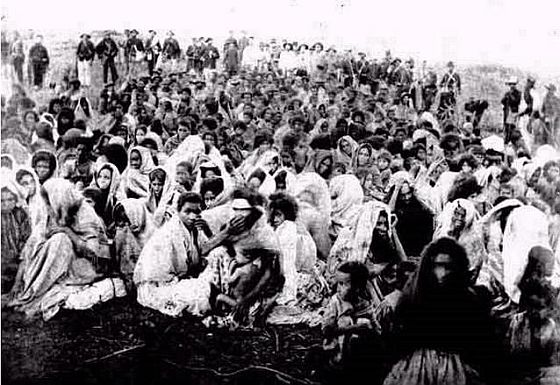
Jacob Mikanowski writes: Canudos, the holy city. From the hills it had looked like a mirage. Fifty-two hundred mud huts and a handful of white-washed churches spread along a bend in the Vasa-Barris, where a few years before there had been only a ruined farmhouse and an old well. The walls of the houses were the same shade as the parched earth on which they stood, so you could barely see the town until you were already in it. For the last ten months of the city’s life, it been bombarded by a full division of the Brazilian Army. Thousands of its defenders — the half-cowboy, half-bandit jagunços — were dead. They had been shelled by artillery from the mountains and gunned down by machine guns on the plains. When the fighting moved into the city itself, they fought house to house and door to door, using piles of corpses as barricades. Their leader was dead. Dysentery claimed him in the night. Hundreds had died in the weeks since. The end was at hand. On October 5, 1897 the Army made its final assault on the town. They found four combatants left in the trenches: two adults, an old man, and a child. They died where they stood. Canudos was no more.
Euclides da Cunha, an engineer and journalist embedded with the troops, nicknamed Canudos the “mud-walled Jerusalem,” but to the people who lived there, it was Belo Monte, the beautiful hill. When the soldiers of the Brazilian Republic finally took the city, they burnt every house, one by one, and pulled down all the spires. Then they cut the throats of all the male prisoners, including the children, and sold the women and girls to the brothels on the coast.
Finally, they dug up the body of Antonio Conselheiro, Antonio the Counselor, maybe to make sure the Messiah of the Brazilian backlands was dead. They cut off his head and sent it to Salvador, where it was met by a jubilant crowd. Doctors studied the skull for abnormalities, after which it was placed in a museum.
The photograph above shows prisoners from Canudos. It might be the first photograph of refugees, ever. It was taken just before the end of the siege by Flavio de Barros, a journalist embedded with the Brazilian Army. Barros’ equipment wasn’t very good. His pictures are scratched, damaged, and blown out by the force of the tropical sun. In this photo, the blurriness comes from the slow exposure time. Inadvertently, he caught the adults’ restlessness, the fidgeting of the children. We can’t know for sure if they are aware of what’s coming, but it’s a safe bet that they’re afraid.
The apocalypse they had been promised was different. It was supposed to be an end to poverty, an end to hunger, an end to drought, an end to property and rank. They were going to inherit the earth. For a time, it had even felt as if they had.
Canudos came into being because of a dream. It was a dream of utopia and a dream of escape. It was an ancient dream: the earthly Jerusalem, the heavenly city. And in the 1890s, it was shared by the dispossessed and marginalized the world over: by the inhabitants of Canudos in the drought-raved backlands of Brazil, by the anti-foreign Boxers in northern China, by the half-ecstatic, half-despairing practitioners of the Ghost Dance in the American West. All of them, in their separate ways, were searching for space and the means to remake the world over in their image. [Continue reading…]

Haider Javed Warraich writes: Physicians are thought to be the harbingers of bad tidings, the people who use cold words like “prognosis.” But studies show that they are just as capable of emotions as their patients are. According to a study published in 2000 in the British medical journal BMJ, about two-thirds of doctors overestimate the survival of terminally ill patients.
A study of cancer patients and their doctors in the Annals of Internal Medicine a year later found that many doctors didn’t quite tell patients the truth about their prognosis. Doctors were up front about their patients’ estimated survival 37 percent of the time; refused to give any estimate 23 percent of the time; and told patients something else 40 percent of the time. Around 70 percent of the discrepant estimates were overly optimistic.
This optimism is far from harmless. It drives doctors to endorse treatments that most likely won’t save patients’ lives, but may cause them unnecessary suffering and inch their families toward medical bankruptcy.
One source of this optimism is pop culture, which frequently depicts heroic recoveries from seemingly life-threatening situations. Another is the medical school experience. What motivates weary medical students is the hope that one day interventions they perform will save lives, heal families and enact cosmic good.
Later, our judgment becomes clouded as we build relationships with patients, share their fears and anxieties, cherish their small victories and celebrations and hope that there may still be a way, however unlikely, they can make it to their grandson’s bar mitzvah.
And yet studies have shown that patients almost universally prefer to be told the truth. If physicians cannot deliver the hard facts, not only do they deprive their patients of crucial information, but they also delay the conversation about introducing palliative care.
Modern palliative care originated in response to the proliferation of new treatments and resuscitation technologies. Keeping a patient “alive” became easier. And yet the definition of “alive” suffered — with quality of life frequently being usurped by length of life. [Continue reading…]
Adrian Raine writes: The scientific study of crime got its start on a cold, gray November morning in 1871, on the east coast of Italy. Cesare Lombroso, a psychiatrist and prison doctor at an asylum for the criminally insane, was performing a routine autopsy on an infamous Calabrian brigand named Giuseppe Villella. Lombroso found an unusual indentation at the base of Villella’s skull. From this singular observation, he would go on to become the founding father of modern criminology.
Lombroso’s controversial theory had two key points: that crime originated in large measure from deformities of the brain and that criminals were an evolutionary throwback to more primitive species. Criminals, he believed, could be identified on the basis of physical characteristics, such as a large jaw and a sloping forehead. Based on his measurements of such traits, Lombroso created an evolutionary hierarchy, with Northern Italians and Jews at the top and Southern Italians (like Villella), along with Bolivians and Peruvians, at the bottom.
These beliefs, based partly on pseudoscientific phrenological theories about the shape and size of the human head, flourished throughout Europe in the late 19th and early 20th centuries. Lombroso was Jewish and a celebrated intellectual in his day, but the theory he spawned turned out to be socially and scientifically disastrous, not least by encouraging early-20th-century ideas about which human beings were and were not fit to reproduce—or to live at all.
The racial side of Lombroso’s theory fell into justifiable disrepute after the horrors of World War II, but his emphasis on physiology and brain traits has proved to be prescient. Modern-day scientists have now developed a far more compelling argument for the genetic and neurological components of criminal behavior. They have uncovered, quite literally, the anatomy of violence, at a time when many of us are preoccupied by the persistence of violent outrages in our midst.
The field of neurocriminology—using neuroscience to understand and prevent crime—is revolutionizing our understanding of what drives “bad” behavior. More than 100 studies of twins and adopted children have confirmed that about half of the variance in aggressive and antisocial behavior can be attributed to genetics. Other research has begun to pinpoint which specific genes promote such behavior.
Brain-imaging techniques are identifying physical deformations and functional abnormalities that predispose some individuals to violence. In one recent study, brain scans correctly predicted which inmates in a New Mexico prison were most likely to commit another crime after release. Nor is the story exclusively genetic: A poor environment can change the early brain and make for antisocial behavior later in life.
Most people are still deeply uncomfortable with the implications of neurocriminology. Conservatives worry that acknowledging biological risk factors for violence will result in a society that takes a soft approach to crime, holding no one accountable for his or her actions. Liberals abhor the potential use of biology to stigmatize ostensibly innocent individuals. Both sides fear any seeming effort to erode the idea of human agency and free will. [Continue reading…]