Author Archives: Attention to the Unseen

Sharing is human

Maria Konnikova writes: Last week, Facebook made its largest ever acquisition: Instagram, the popular photo-sharing service that lets you snap, filter and send with the click of a button. While the fit seems to make sense – a major reason to use Facebook is to share photos; the more photos you share the more time you spend on the site; the more time you spend, the happier the advertisers – the $1bn price tag raised many an eyebrow.

But should the price come as a surprise or is the purchase perhaps a visionary move? In making its offer for Instagram, Facebook had, I think, recognised the ever-growing importance of one little impulse that is awfully hard to resist: the urge to share.

That irresistible impulse to post, to tweet, to “like” has evolutionary roots that far precede the advent of social media. Consider something that’s known as the “communal sharing” norm. In an environment of scarce resources (ie, the one that prevailed for most of our history), every existing resource has to be shared with others. In this environment, what I find out isn’t my exclusive prerogative – it’s actually common property, in case it can be beneficial to someone else. There’s a bear in that cave; these berries may kill you; I found a stream of water in that direction. All important information to pass on and the quicker the better. After all, the bear may wake up or the berries may end up in someone’s mouth before we’ve had a chance to share our wisdom.

The facts may have changed, but the immediacy seems just as real now. It’s hard to shake off the feeling that people are somehow missing out or worse off if we don’t communicate what we’ve seen – and communicate it at once. Is it really so far from: “There’s a bear in the cave” to: “Look at that adorable bear playing with the berries in that YouTube video”? We don’t just passively take in information. We want actively to pass it on to others. We share emotions; we share thoughts; we share opinions; we share objects. We share because we’re happy, angry, perplexed, upset. Or experiencing any strong emotion.

Facebooktwittermail

Gorillas made me do it

Max Rivlin-Nadler writes: You walk into an elevator and push the button for your desired floor. The button lights up. The elevator stops at the next floor and another person enters. He or she pushes the same button that’s already lit up.

According to Dario Maestripieri’s new book, “Games Primates Play,” that elevator ride represents a game of dominance — similar to those exhibited by other primates. The University of Chicago professor argues that our social relationships have analogs in nature, especially within groups of primates. While we may not go up and grab our supervisor’s genitals as a sign of respect, we engage in similar acts that help us figure out where we fit in groups.

By exploring our social lives through the lens of an evolutionary biologist, Maestripieri breaks down the most routine of social interactions into deeply embedded behaviors from our genetic forebears. Just like humans, other primates grapple with questions of dominance, reciprocation, nepotism and fidelity. He demonstrates how his own life, the lives of celebrities, and corporate success strategies all derive from a single, primal need to find our place in a group.

Salon spoke with Maestripieri about the primal instincts we exhibit in our emails, whether altruism exists, how nepotism is natural, and why it matters to study our everyday nature. [Continue reading…]

Facebooktwittermail

Why trees matter

Jim Robbins writes: Trees are on the front lines of our changing climate. And when the oldest trees in the world suddenly start dying, it’s time to pay attention.

North America’s ancient alpine bristlecone forests are falling victim to a voracious beetle and an Asian fungus. In Texas, a prolonged drought killed more than five million urban shade trees last year and an additional half-billion trees in parks and forests. In the Amazon, two severe droughts have killed billions more.

The common factor has been hotter, drier weather.

We have underestimated the importance of trees. They are not merely pleasant sources of shade but a potentially major answer to some of our most pressing environmental problems. We take them for granted, but they are a near miracle. In a bit of natural alchemy called photosynthesis, for example, trees turn one of the seemingly most insubstantial things of all — sunlight — into food for insects, wildlife and people, and use it to create shade, beauty and wood for fuel, furniture and homes.

For all of that, the unbroken forest that once covered much of the continent is now shot through with holes.

Humans have cut down the biggest and best trees and left the runts behind. What does that mean for the genetic fitness of our forests? No one knows for sure, for trees and forests are poorly understood on almost all levels. “It’s embarrassing how little we know,” one eminent redwood researcher told me.

What we do know, however, suggests that what trees do is essential though often not obvious. Decades ago, Katsuhiko Matsunaga, a marine chemist at Hokkaido University in Japan, discovered that when tree leaves decompose, they leach acids into the ocean that help fertilize plankton. When plankton thrive, so does the rest of the food chain. In a campaign called Forests Are Lovers of the Sea, fishermen have replanted forests along coasts and rivers to bring back fish and oyster stocks. And they have returned. [Continue reading…]

Facebooktwittermail

How Facebook is poisoning human relationships

Stephen Marche writes: Yvette Vickers, a former Playboy playmate and B-movie star, best known for her role in Attack of the 50 Foot Woman, would have been 83 last August, but nobody knows exactly how old she was when she died. According to the Los Angeles coroner’s report, she lay dead for the better part of a year before a neighbor and fellow actress, a woman named Susan Savage, noticed cobwebs and yellowing letters in her mailbox, reached through a broken window to unlock the door, and pushed her way through the piles of junk mail and mounds of clothing that barricaded the house. Upstairs, she found Vickers’s body, mummified, near a heater that was still running. Her computer was on too, its glow permeating the empty space.

The Los Angeles Times posted a story headlined “Mummified Body of Former Playboy Playmate Yvette Vickers Found in Her Benedict Canyon Home,” which quickly went viral. Within two weeks, by Technorati’s count, Vickers’s lonesome death was already the subject of 16,057 Facebook posts and 881 tweets. She had long been a horror-movie icon, a symbol of Hollywood’s capacity to exploit our most basic fears in the silliest ways; now she was an icon of a new and different kind of horror: our growing fear of loneliness. Certainly she received much more attention in death than she did in the final years of her life. With no children, no religious group, and no immediate social circle of any kind, she had begun, as an elderly woman, to look elsewhere for companionship. Savage later told Los Angeles magazine that she had searched Vickers’s phone bills for clues about the life that led to such an end. In the months before her grotesque death, Vickers had made calls not to friends or family but to distant fans who had found her through fan conventions and Internet sites.

Vickers’s web of connections had grown broader but shallower, as has happened for many of us. We are living in an isolation that would have been unimaginable to our ancestors, and yet we have never been more accessible. Over the past three decades, technology has delivered to us a world in which we need not be out of contact for a fraction of a moment. In 2010, at a cost of $300 million, 800 miles of fiber-optic cable was laid between the Chicago Mercantile Exchange and the New York Stock Exchange to shave three milliseconds off trading times. Yet within this world of instant and absolute communication, unbounded by limits of time or space, we suffer from unprecedented alienation. We have never been more detached from one another, or lonelier. In a world consumed by ever more novel modes of socializing, we have less and less actual society. We live in an accelerating contradiction: the more connected we become, the lonelier we are. We were promised a global village; instead we inhabit the drab cul-de-sacs and endless freeways of a vast suburb of information.

At the forefront of all this unexpectedly lonely interactivity is Facebook, with 845 million users and $3.7 billion in revenue last year. The company hopes to raise $5 billion in an initial public offering later this spring, which will make it by far the largest Internet IPO in history. Some recent estimates put the company’s potential value at $100 billion, which would make it larger than the global coffee industry — one addiction preparing to surpass the other. Facebook’s scale and reach are hard to comprehend: last summer, Facebook became, by some counts, the first Web site to receive 1 trillion page views in a month. In the last three months of 2011, users generated an average of 2.7 billion “likes” and comments every day. On whatever scale you care to judge Facebook — as a company, as a culture, as a country — it is vast beyond imagination.

Despite its immense popularity, or more likely because of it, Facebook has, from the beginning, been under something of a cloud of suspicion. The depiction of Mark Zuckerberg, in The Social Network, as a bastard with symptoms of Asperger’s syndrome, was nonsense. But it felt true. It felt true to Facebook, if not to Zuckerberg. The film’s most indelible scene, the one that may well have earned it an Oscar, was the final, silent shot of an anomic Zuckerberg sending out a friend request to his ex-girlfriend, then waiting and clicking and waiting and clicking — a moment of superconnected loneliness preserved in amber. We have all been in that scene: transfixed by the glare of a screen, hungering for response.

When you sign up for Google+ and set up your Friends circle, the program specifies that you should include only “your real friends, the ones you feel comfortable sharing private details with.” That one little phrase, Your real friends — so quaint, so charmingly mothering — perfectly encapsulates the anxieties that social media have produced: the fears that Facebook is interfering with our real friendships, distancing us from each other, making us lonelier; and that social networking might be spreading the very isolation it seemed designed to conquer. [Continue reading…]

Facebooktwittermail

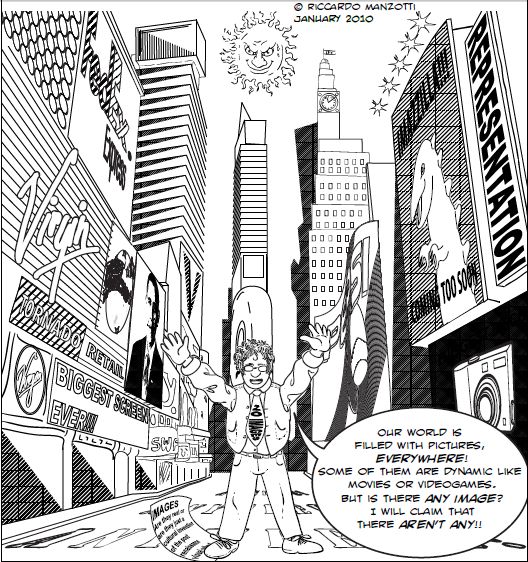
There are no images

Tim Parks writes: “There are no images.” This was the first time I noticed Riccardo Manzotti. It was a conference on art and neuroscience. Someone had spoken about the images we keep in our minds. Manzotti seemed agitated. The girl sitting next to me explained that he built robots, was a genius. “There are no images and no representations in our minds,” he insisted. “Our visual experience of the world is a continuum between see-er and seen united in a shared process of seeing.”

I was curious, if only because, as a novelist I’d always supposed I was dealing in images, imagery. This stuff might have implications. So we had a beer together.

Manzotti has a degree in engineering and another in philosophy. He teaches in the psychology department at IULM University, Milan. The move from engineering to philosophy was prompted by conceptual problems he’d run into when first seeking to build robots. What does it mean that a subject sees an object? “People say the robot stores images of the world through its video camera. It doesn’t, it stores digital data. It has no images.”

Manzotti is what they call a radical externalist: for him consciousness is not safely confined within a brain whose neurons select and store information received from a separate world, appropriating, segmenting, and manipulating various forms of input. Instead, he offers a model he calls Spread Mind: consciousness is a process shared between various otherwise distinct processes which, for convenience’s sake we have separated out and stabilized in the words subject and object. Language, or at least our modern language, thus encourages a false account of experience.

His favorite example is the rainbow. For the rainbow experience to happen we need sunshine, raindrops, and a spectator. It is not that the sun and the raindrops cease to exist if there is no one there to see them. Manzotti is not a Bishop Berkeley. But unless someone is present at a particular point no colored arch can appear. The rainbow is hence a process requiring various elements, one of which happens to be an instrument of sense perception. It doesn’t exist whole and separate in the world nor does it exist as an acquired image in the head separated from what is perceived (the view held by the “internalists” who account for the majority of neuroscientists); rather, consciousness is spread between sunlight, raindrops, and visual cortex, creating a unique, transitory new whole, the rainbow experience. Or again: the viewer doesn’t see the world; he is part of a world process. [Continue reading…]

Facebooktwittermail

Yet another study links insecticide to bee losses

Science News reports: A pair of recent papers indicted neonicotinoids, a widely used class of insecticides, for contributing to a catastrophic decline of honeybees, especially since 2006. Hives across North America have been hammered, many by a particularly mysterious syndrome known as colony collapse disorder, or CCD. Now an additional field trial strengthens even more the case arguing that these pollinators have been poisoned by these chemicals.

This latest research also points to a potentially novel source of the chemicals: corn syrup.

CCD tends to occur in winter or early spring, often when bees begin their first foraging trips of the year. In affected colonies, bees leave but fail to come home, despite their hives having adequate food. One suspicion, which is supported by studies released March 29, is that pesticides or some other poison might impair a forager’s memory or behavior.

But Chensheng Lu, an environmental scientist at the Harvard School of Public Health in Boston, was puzzled as to when and where the critical exposures occured. After all, affected bees were disappearing after months without exposure to toxic agents outside the hive. Lu now argues that bees can undergo a chronic poisoning if their hives’ honey was tainted by insecticides that the pollinators encountered months earlier.

During winter, he charges, what looks just like colony collapse disorder largely emptied 15 of his team’s 16 test hives in central Massachusetts. Each had been exposed experimentally for 13 weeks during the summer to low doses of imidacloprid. Growers rely on this and related neonicotinoid insecticides to protect their crops.

Facebooktwittermail

In meditative mindfulness, Rep. Tim Ryan sees a cure for many American ills

The Washington Post reports: Rep. Tim Ryan (D) is a five-term incumbent from the heartland. His Ohio district includes Youngstown and Warren and part of Akron and smaller places. He’s 38, Catholic, single. He was a star quarterback in high school. He lives a few houses down from his childhood home in Niles. He’s won three of his five elections with about 75 percent of the vote.

So when he starts talking about his life-changing moment after the 2008 race, you’re not expecting him to lean forward at the lunch table and tell you, with great sincerity, that this little story of American politics is about (a) a raisin and (b) nothing else.

“You hold this one raisin right up to your mouth, but you don’t put it in, and after a moment your mouth starts to water,” he says, describing an exercise during a five-day retreat into the meditative technique of mindfulness, developed from centuries of Buddhist practice. “The teaching point is that your body responds to things outside of it, that there’s a mind-body connection. It links to how we take on situations and how this results in a great deal of stress.”

For Ryan, the raisin was the beginning of a transformation. The retreat, conducted by Jon Kabat-Zinn, founder of the Stress Reduction Clinic at the University of Massachusetts Medical School, led Ryan on a search into how the practice of mindfulness — sitting in silence, losing oneself in the present moment — could be a tonic for what ails the body politic.

In “A Mindful Nation,” published last week, Ryan details his travels across the country, to schools and companies and research facilities, documenting how mindfulness is relieving stress, improving performance and showing potential to reduce health-care costs. It is a prescription, he says, that can help the nation better deal with the constant barrage of information that the Internet age delivers.

“I think when you realize that U.S. Marines are using this that it’s already in the mainstream of our culture,” he says. “It’s a real technique that has real usefulness that has been scientifically documented. . . . Why wouldn’t we have this as part of our health-care program to prevent high levels of stress that cause heart disease and ulcers and Type 2 diabetes and everything else?”

Facebooktwittermail

What did J.D. Salinger, Leo Tolstoy, and Sarah Bernhardt have in common?

A L Bardach writes: By the late 1960s, the most famous writer in America had become a recluse, having forsaken his dazzling career. Nevertheless, J.D. Salinger often came to Manhattan, staying at his parents’ sprawling apartment on Park Avenue and 91st Street. While he no longer visited with his editors at “The New Yorker,” he was keen to spend time with his spiritual teacher, Swami Nikhilananda, the founder of the Ramakrishna-Vivekananda Center, located, then as now, in a townhouse just three blocks away, at 17 East 94th Street.

Though the iconic author of “The Catcher in the Rye” and “Franny and Zooey” published his last story in 1965, he did not stop writing. From the early 1950s onward, he maintained a lively correspondence with several Vedanta monks and fellow devotees.

After all, the central, guiding light of Salinger’s spiritual quest was the teachings of Vivekananda, the Calcutta-born monk who popularized Vedanta and yoga in the West at the end of the 19th century.

These days yoga is offered up in classes and studios that have become as ubiquitous as Starbucks. Vivekananda would have been puzzled, if not somewhat alarmed. “As soon as I think of myself as a little body,” he warned, “I want to preserve it, protect it, to keep it nice, at the expense of other bodies. Then you and I become separate.” For Vivekananda, who established the first ever Vedanta Center, in Manhattan in 1896, yoga meant just one thing: “the realization of God.”

After an initial dalliance in the late 1940s with Zen—a spiritual path without a God—Salinger discovered Vedanta, which he found infinitely more consoling. “Unlike Zen,” Salinger’s biographer, Kenneth Slawenski, points out, “Vedanta offered a path to a personal relationship with God…[and] a promise that he could obtain a cure for his depression….and find God, and through God, peace.”

Finding peace would, however, be a lifelong battle. In 1975, Salinger wrote to another monk at the New York City center about his own daily struggle, citing a text of the eighth-century Indian mystic Shankara as a cautionary tale: “In the forest-tract of sense pleasures there prowls a huge tiger called the mind. Let good people who have a longing for Liberation never go there.” Salinger wrote, “I suspect that nothing is truer than that,” confessing despondently, “and yet I allow myself to be mauled by that old tiger almost every wakeful minute of my life.”

It was his daily mauling by the “huge tiger” and his dreaded depressions that led Salinger to abandon his literary ambitions in favor of spiritual ones. Salinger—who appears to have had a nervous breakdown of sorts upon his return from the gruesome front lines of World War II—subscribed to Vivekananda’s view of the mind as a drunken monkey who is stung by a scorpion and then consumed by a demon. At the same time, Vivekananda promised hope and solace—writing that the “same mind, when subdued and controlled, becomes a most trusted friend and helper, guaranteeing peace and happiness.” It was precisely the consolation that Salinger so desperately sought. And by 1965 he was ready to renounce his once gritty pursuit of literary celebrity.

Although all but forgotten by America’s 20 million would-be yoginis, clad in their finest Lululemon, Vivekananda was the Bengali monk who introduced the word “yoga” into the national conversation. In 1893, outfitted in a red, flowing turban and yellow robes belted by a scarlet sash, he had delivered a show-stopping speech in Chicago. The event was the tony Parliament of Religions, which had been convened as a spiritual complement to the World’s Fair, showcasing the industrial and technological achievements of the age.

On its opening day, September 11, Vivekananda, who appeared to be meditating onstage, was summoned to speak and did so without notes. “Sisters and Brothers of America,” he began, in a sonorous voice tinged with “a delightful slight Irish brogue,” according to one listener, attributable to his Trinity College–educated professor in India. “It fills my heart with joy unspeakable…”

Then something unprecedented happened, presaging the phenomenon decades later that greeted the Beatles (one of whom, George Harrison, would become a lifelong Vivekananda devotee). The previously sedate crowd of 4,000-plus attendees rose to their feet and wildly cheered the visiting monk, who, having never before addressed a large gathering, was as shocked as his audience. “I thank you in the name of the most ancient order of monks in the world,” he responded, flushed with emotion. “I thank you in the name of the mother of religions, and I thank you in the name of millions and millions of Hindu people of all classes and sects.”

Annie Besant, a British Theosophist and a conference delegate, described Vivekananda’s impact, writing that he was “a striking figure, clad in yellow and orange, shining like the sun of India in the midst of the heavy atmosphere of Chicago…a lion head, piercing eyes, mobile lips, movements swift and abrupt.” The Parliament, she said, was “enraptured; the huge multitude hung upon his words.” When he was done, the convocation rose again and cheered him even more thunderously. Another delegate described “scores of women walking over the benches to get near to him,” prompting one wag to crack wise that if the 30-year-old Vivekananda “can resist that onslaught, [he is] indeed a god.”

“No doubt the vast majority of those present hardly knew why they had been so powerfully moved,” Christopher Isherwood wrote a half century later, surmising that a “strange kind of subconscious telepathy” had infected the hall, beginning with Vivekananda’s first words, which have resonated, for some, long after. Asked about the origins of “My Sweet Lord,” George Harrison replied that “the song really came from Swami Vivekananda, who said, ‘If there is a God, we must see him. And if there is a soul, we must perceive it.’ ”

The teachings of Vedanta are rooted in the Vedas, ancient scriptures going back several thousand years that also inform Buddhism, Hinduism and Jainism. The Vedic texts of the Upanishads enshrine a core belief that God is within and without—that the divine is everywhere. The Bhagavad Gita (Song of God) is another sacred text or gospel, whereas Hinduism is actually a coinage popularized by Vivekananda to describe a faith of diverse and myriad beliefs.
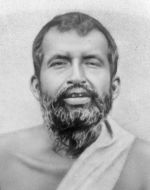
Ramakrishna

Vivekananda’s genius was to simplify Vedantic thought to a few accessible teachings that Westerners found irresistible. God was not the capricious tyrant in the heavens avowed by Bible-thumpers, but rather a power that resided in the human heart. “Each soul is potentially divine,” he promised. “The goal is to manifest that divinity within by controlling nature, external and internal.” And to close the deal for the fence-sitters, he punched up Vedanta’s embrace of other faiths and their prophets. Christ and Buddha were incarnations of the divine, he said, no less than Krishna and his own teacher, Ramakrishna. [Continue reading…]

Facebooktwittermail

Christof Koch on free will, the singularity, and the quest to crack consciousness

John Horgan talks to Christof Koch about his latest book, Consciousness: Confessions of a Romantic Reductionist.

Horgan: You seem to have written your latest book in an attempt to achieve catharsis. Did it work?

Koch: Yes, it did help me resolve a long-brewing conflict between my Catholic upbringing and faith on the one hand and my scientific view of the world on the other. And writing the book also helped me deal with a more personal crisis.

Horgan: Your late friend and colleague Francis Crick once told me that free will was an illusion. Do you share this pessimistic view?

Koch: Well, Francis was right in that the standard conception of free will, that has the soul hovering above the brain and making it “freely” decide this way or that, is an illusion. It simply does not work at the conceptual or empirical level However, more subtle readings of free will remain, as I discuss in my book. Yet we are all less free than we like to believe. What remains, though, is that I am the principal actor in my life, so I better take responsibility for my actions.

Horgan: Do you think consciousness will ever be really, totally, explained? Could the “mysterians” [who propose that consciousness is not scientifically solvable] turn out to be right?

Koch: There is no law that states that all phenomena will have an explanation that humans can apprehend or understand. But my gut feelings—based on the past several centuries of progressively ever more successful explanations of the natural world—is that there will be better and better answers to the puzzle of our existence. We are not condemned to wander forever in some sort of epistemological fog. We will know. We will understand consciousness.

Horgan: Can you tell my readers, briefly, what Integrated Information Theory is and why you think it may be the key to consciousness?

Koch: The Integrated Information Theory of consciousness of Giulio Tononi is a general and quantitative way to approach the problem of consciousness. Ultimately, science needs to explain why some systems—a healthy and awake human brain, for example—give rise to conscious sensations, to experience, while other biological networks—the immune system, for example—do not. We also need to answer questions about consciousness in severely injured brain patients, in new-born babies, in a fetus, in dogs and cats, frogs, bees and flies and in artificial creatures, in iPhones and the internet. And only an information-theoretical account of consciousness is rich and powerful enough to be able to answer those sorts of questions in a meaningful and empirically accessible manner.

This is a clip from an interview — the whole interview is worth watching.

Facebooktwittermail