Author Archives: Paul Woodward

Deadly attack by Taliban tests new strategy

Deadly attack by Taliban tests new strategy

US commanders had been planning since late last year to abandon the small combat outpost in mountainous eastern Afghanistan where eight U.S. soldiers died Saturday in a fierce insurgent assault.

The pullout, part of a strategy of withdrawing from sparsely populated areas where the United States lacks the troops to expel Taliban forces and to support the local Afghan government, has been repeatedly delayed by a shortage of cargo helicopters, Afghan politics and military bureaucracy, U.S. military officials said.

The attack began in the early morning hours. Taliban-linked militiamen struck from the high ground using rifles, grenades and rockets against the outpost, a cluster of stone buildings set in a small Hindu Kush valley that has been manned by 140 U.S. and Afghan forces. By the end of a day-long siege, eight Americans and two Afghan security officers were dead, marking the highest toll for U.S. forces in over a year.

The deaths brought into stark relief the dilemma the Obama administration faces in Afghanistan. Without more soldiers and supplies, the Taliban and allied insurgents are gaining ground, but committing more forces could sink the country deeper into an increasingly deadly and unpopular war. [continued…]

‘Almost a lost cause’

Nine U.S. soldiers were killed and 27 were wounded during the July 13, 2008, attack, which raged for several hours and was one of the bloodiest of the Afghan war. Among the dead was [1st Lt. Jonathan] Brostrom.

In recent months, the battle of Wanat has come to symbolize the U.S. military’s missteps in Afghanistan. It has provoked Brostrom’s father to question why Jonathan died and whether senior Army officers — including a former colleague and close friend — made careless mistakes that left the platoon vulnerable. It has triggered three investigations, the latest initiated last week by Adm. Mike Mullen, the chairman of the Joint Chiefs of Staff.

And it has helped drive a broader reassessment of war strategy among top commanders in Afghanistan, who have begun to pull U.S. troops out of remote villages where some of the heaviest fighting has occurred. Senior military leaders have concluded that they lack the forces to wrest these Taliban strongholds away from the enemy and are instead focusing on more populated and less violent areas. [continued…]

McChrystal faulted on troop statements

National security adviser James L. Jones suggested Sunday that the public campaign being conducted by the U.S. commander in Afghanistan on behalf of his war strategy is complicating the internal White House review underway, saying that “it is better for military advice to come up through the chain of command.”

Gen. Stanley A. McChrystal, who commands the 100,000 U.S. and international forces in Afghanistan, warned bluntly last week in a London speech that a strategy for defeating the Taliban that is narrower than the one he is advocating would be ineffective and “short-sighted.” The comments effectively rejected a policy option that senior White House officials, including Vice President Biden, are considering nearly eight years after the U.S. invasion. [continued…]

The distance between ‘we must’ and ‘we can’

Over the next few weeks, Barack Obama must make the most difficult decision of his presidency to date: whether or not to send up to 40,000 more troops to Afghanistan, as his commanding general there, Gen. Stanley A. McChrystal, has reportedly proposed.

This summer, Mr. Obama described the effort in Afghanistan as “a war of necessity.” In such a war, you do whatever you need to do to win. But now, as criticism mounts from those who argue that the war in Afghanistan cannot, in fact, be won with more troops and a better strategy, the president is having second thoughts.

A war of necessity is presumably one that is “fundamental to the defense of our people,” as Mr. Obama has said about Afghanistan. But if such a war is unwinnable, then perhaps you must reconsider your sense of its necessity and choose a more modest policy instead. [continued…]

Facebooktwittermail

Iran’s diplomatic dexterity

Iran’s diplomatic dexterity

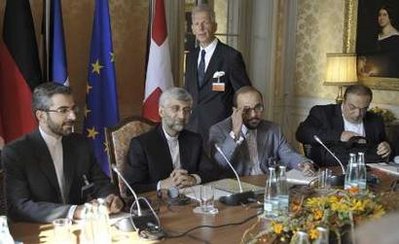
The Geneva talks with Iran have been presented as a diplomatic victory and vindication of President Obama’s commitment to engagement. As Juan Cole wrote: “Barack Obama pwned Bush-Cheney in one day, and got more concessions from Iran in 7 1/2 hours than the former administration got in 8 years of saber-rattling.”

But as many commentators have been quick to describe this as a success for the administration, the role Iran played in making this happen has been largely overlooked.

The breakthrough came during talks on Thursday — or so the narrative runs.

Except, the terms of a key portion of the agreement — a deal for replenishing the fuel supply for a reactor in Tehran that produces medical isotopes — were announced the day before by President Mahmoud Ahmadinejad.

“As I said in New York, we need 19.75 percent-enriched uranium. We said that, and we propose to buy it from anybody who is ready to sell it to us. We are ready to give 3.5 percent-enriched uranium and then they can enrich it more and deliver to us 19.75 percent-enriched uranium,” Ahamdinejad was quoted by ISNA news agency as saying.

In an interview with Newsweek during his trip to New York to attend the UN General Assembly in late September, Ahmadinejad said:

“We simply don’t have the capacity to enrich at 20 percent for medicinal purposes, of the sort that we have in mind, at this stage. It’s only at 3.5 percent. We had been buying this material in the past, but not from the U.S. government. We can buy it from the United States. It doesn’t really matter who we buy it from, so we are open to it. But this does not affect the fuel cycle. But still, it seems to me a nice opening, a nice window to look through.”

A State Department background briefing given on the day of the Geneva talks confirmed:

“Iran came to the IAEA a few months ago with the request to replace this supply [for the Tehran reactor]. The IAEA consulted us and some others, some other members, and to make a long story short the United States and Russia joined together in a proposal to the IAEA which the IAEA subsequently conveyed as a response to the Iranians, to use Iran’s own LEU stockpile as the basis, as the feedstock for the reactor fuel that’s required.”

The crucial component in this deal was obviously that Iran would provide the feedstock, but as Ahmadinejad made clear on Wednesday, Iran’s decision to do that had already been made before discussions began in Geneva.

Still, the perception remains that the earlier revelations about the Fordo facility outside Qom meant that the Iranians had been diplomatically cornered.

Maybe so. But whether that’s the case may hinge on questions that remain unanswered: How and when did Iran discover that the existence of the facility was no longer secret? For that matter, is it realistic to think that the Iranians would ever have thought that this or any other construction project of such a type could progress without receiving careful and virtually constant scrutiny by America’s ever-watchful eyes in the sky? This after all is the kind of intelligence in which the US retains unparalleled prowess.

Facebooktwittermail

Report says Iran has data to make a nuclear bomb

Report says Iran has data to make a nuclear bomb

Senior staff members of the United Nations nuclear agency have concluded in a confidential analysis that Iran has acquired “sufficient information to be able to design and produce a workable” atom bomb.

The report by experts in the International Atomic Energy Agency stresses in its introduction that its conclusions are tentative and subject to further confirmation of the evidence, which it says came from intelligence agencies and its own investigations.

But the report’s conclusions, described by senior European officials, go well beyond the public positions taken by several governments, including the United States.

Two years ago, American intelligence agencies published a detailed report concluding that Tehran halted its efforts to design a nuclear weapon in 2003. But in recent months, Britain has joined France, Germany and Israel in disputing that conclusion, saying the work has been resumed.

A senior American official said last week that the United States was now re-evaluating its 2007 conclusions. [continued…]

Editor’s Comment — The New York Times is at it again: putting on quite a convincing performance as a clandestine operation that acts at the behest of governments and intelligence agencies.

Ah, but the Times is simply a messenger, relaying important information provided by “a senior European official’ who wanted to make public the contents of a so-far unpublished and incomplete IAEA report.

The political agenda here seems transparent. A report whose existence has been debated for weeks now becomes front-page news, right at the moment that delicate negotiations have only just begun.

Is this coming out now in order to add an increased sense of urgency to the diplomatic effort? I don’t think so. On the contrary, it’s about undermining that effort and the work of the IAEA.

Comments by the IAEA’s director-general, Mohamed ElBaradei, published in an interview with The Hindu seem particularly relevant here:

I have been making it very clear that with regard to these alleged studies, we have not seen any use of nuclear material, we have not received any information that Iran has manufactured any part of a nuclear weapon or component. That’s why I say, to present the Iran threat as imminent is hype.

Q: In a sense, this one outstanding issue is far less serious than the issues which prompted Iran’s referral to the Security Council!

It is a serious concern but I am not going to panic, to say it is an imminent threat that we are going to wake up and see Iran with nuclear weapons. Our job is to make sure we do not overstate or understate a case. There are enough people around to use or abuse what we say. The judgment call is very difficult, but based on what we have seen so far — we are concerned, we need to clarify this issue, we need to build confidence in the peaceful nature of Iran’s programme, we need Iran to adhere to the Additional Protocol because that will help me build confidence. But I am not going to sound an alarm and say that Iran is on the verge of developing nuclear weapons.

Facebooktwittermail

Israel names Russians helping Iran build nuclear bomb

Israel names Russians helping Iran build nuclear bomb

The West says the plant [near Qom] is tailor-made for a secret weapons programme and proves Iran’s claim that its nuclear programme is intended only for peaceful purposes is a lie. The plant is designed to hold 3,000 centrifuges — enough to produce the material needed for one bomb a year.

Iran’s conduct over the next few weeks will determine whether the West continues its new dialogue or is compelled to increase pressure with tougher United Nations and other sanctions.

Ephraim Sneh, a former Israeli deputy defence minister, warned that time was running out for action to stop the programme. “If no crippling sanctions are introduced by Christmas, Israel will strike,” he said. “If we are left alone, we will act alone.” [continued…]

Editor’s CommentThe Sunday Times has amazing intelligence sources!

Not a single IAEA inspector has set foot in the Fordo facility or seen its plans and yet we know that it is “tailor-made for a secret weapons programme”.

Right! I suppose you can argue the fact that it’s a deeply concealed structure makes it “tailor-made” for such a purpose, but that would seem to be a case of inferring that something is certain because it is unknown.

That might be so in the mind of a Sunday Times reporter, but I for one, have yet to observe such a quasi-mystical correspondence between the known and the unknown.

As for yet another Israeli threat — I’m sorry, but the more often they are made, the more implausible they become, at least to me.

The military option: Could they do it?

The U.S. military is developing technologies, including a new generation of “bunker-busting” bombs, that could destroy facilities like the one near Qom.

But there are doubts about the effectiveness of those weapons, prompting current and former U.S. officials to say that a military effort aimed at crippling Iran’s nuclear program would require dozens of missile strikes and possibly even the insertion of U.S. troops.

“If you’re going to have an effective campaign to go in and throw [Iran’s nuclear program] back years, you’re talking about a massive, massive effort,” said a former senior U.S. intelligence official who was involved in examining such scenarios.

“This is not an Iraqi reactor or a Syrian reactor,” the official said, referring to Israel’s strikes in 1981 and 2007, respectively, on above-ground nuclear facilities in those countries. “This is a different game.”

The official and others spoke on condition of anonymity when discussing millitary planning.

President Obama said shortly after taking office that he was prepared to use “all elements of American power to prevent Iran from developing a nuclear weapon.” Last week, he reiterated that he would not “rule out any options when it comes to U.S. security interests.”

The increasingly difficult nature of upholding that pledge through military strikes, however, became clearer last week when U.S. officials described the newest Iranian site, believed to be a uranium enrichment which plant which could furnish fissile material for a bomb. [continued…]

Facebooktwittermail

Iran’s brilliant chessmanship

Brilliant chessmanship

ike back-winding in a sailing race, Iran has gotten ahead of the United States and its allies that met for the nuclear talks in Geneva Thursday. Iran pulled a rabbit out of the diplomatic hat in the form of a self-disclosure to the International Atomic Energy Agency about a second uranium-enrichment plant in Qom.

On the surface, President Obama and other leaders of the G-20 group of major economic countries meeting recently in Pittsburgh seized on this revelation to mount timely new pressure on Iran. Mr. Obama went so far as claiming that the Qom site’s “configuration” indicates it is for military purposes. Iran’s initiative seemed to have all but backfired on it, as manna from heaven for the “P5 + 1” nations – permanent U.N. Security Council members Britain, France, Russia, China and the U.S. plus Germany – that are pondering fresh sanctions on Iran in case the Geneva talk fails.

Yet Secretary of State Hillary Rodham Clinton’s air of certainty – that the disclosure about the “hidden site” will add to the pressure on Iranians at the talk to “come out clean” on their nuclear program – may prove premature. More than anything, this is leverage for Iran to the detriment of Western strategy, for several reasons. [continued…]

Facebooktwittermail

What I saw at the Afghan election

What I saw at the Afghan election

Before firing me last week from my post as his deputy special representative in Afghanistan, U.N. Secretary General Ban Ki-moon conveyed one last instruction: Do not talk to the press. In effect, I was being told to remain a team player after being thrown off the team. Nonetheless, I agreed.

As my differences with my boss, Norwegian diplomat Kai Eide, had already been well publicized (through no fault of either of us), I asked only that the statement announcing my dismissal reflect the real reasons. Alain LeRoy, the head of U.N. peacekeeping and my immediate superior in New York, proposed that the United Nations say I was being recalled over a “disagreement as to how the United Nations Assistance Mission in Afghanistan (UNAMA) would respond to electoral fraud.” Although this was not entirely accurate — the dispute was really about whether the U.N. mission would respond to the massive electoral fraud — I agreed.

Instead, the United Nations announced my recall as occurring “in the best interests of the mission,” and U.N. press officials told reporters on background that my firing was necessitated by a “personality clash” with Eide, a friend of 15 years who had introduced me to my future wife.

I might have tolerated even this last act of dishonesty in a dispute dating back many months if the stakes were not so high. For weeks, Eide had been denying or playing down the fraud in Afghanistan’s recent presidential election, telling me he was concerned that even discussing the fraud might inflame tensions in the country. But in my view, the fraud was a fact that the United Nations had to acknowledge or risk losing its credibility with the many Afghans who did not support President Hamid Karzai. [continued…]

Facebooktwittermail

Real progress with Iran

Real progress with Iran

The Geneva nuclear talks were just baby steps along a long and perilous path. Still, this was a historic moment after 30 years of mutual recriminations and hyperbole.

If you have any doubt that the Geneva meetings with Iran were surprisingly productive, just go back and look at the commentary the day before they began. Even allowing for the fact that the United States and its negotiating partners (the five permanent members of the United Nations Security Council plus Germany–the P5+1–plus European Union negotiator Javier Solana) were trying to lower expectations to the political equivalent of absolute zero, it was still difficult to find anyone who anticipated anything like real progress. Yet that is what happened.

Iran had issued a bland five-page document that scarcely mentioned the nuclear issue. They insisted that the newly discovered Qom enrichment site was not only perfectly legal but utterly routine. They let it be known that they had no intention of discussing their own nuclear program in these talks. Yet, from the accounts we have so far, it appears that Iran came prepared to make concessions about Qom, permitting IAEA inspections to begin within the next two weeks or so. As for their nuclear program, almost nothing else seems to have been discussed. [continued…]

Facebooktwittermail

Palestinians cry ‘blackmail’ over Israel phone service threat

Palestinians cry ‘blackmail’ over Israel phone service threat

Israel is threatening to kill off a crucial West Bank economic project unless the Palestinian Authority withdraws a request to the International Criminal Court to investigate alleged Israeli crimes during last winter’s Gaza war.

Shalom Kital, an aide to defence minister Ehud Barak, said today that Israel will not release a share of the radio spectrum that has long been sought by the Palestinian Authority to enable the launch of a second mobile telecommunications company unless the PA drops its efforts to put Israeli soldiers and officers in the dock over the Israeli operation.

“It’s a condition. We are saying to the Palestinians that ‘if you want a normal life and are trying to embark on a new way, you must stop your incitement,” Mr. Kital said. “We are helping the Palestinian economy but one thing we ask them is to stop with these embarrassing charges.”

As long as the Wataniya Mobile company is unable to begin its operations, communications costs are likely to remain inordinately high for Palestinian businesses and individuals. But thwarting the company benefits four unauthorized Israeli operators who make sizeable profits in the Palestinian market using infrastructure they have set up in the illegal Israeli settlements across the West Bank. [continued…]

Facebooktwittermail

Report cites firefight as lesson on Afghan war

Report cites firefight as lesson on Afghan war

The paratroopers of Chosen Company had plenty to worry about as they began digging in at their new outpost on the fringe of a hostile frontier village in eastern Afghanistan.

Intelligence reports were warning of militants massing in the area. As the paratroopers looked around, the only villagers they could see were men of fighting age idling in the bazaar. There were no women and children, and some houses looked abandoned. Through their night scopes they could see furtive figures on the surrounding mountainsides.

A few days later, they were almost overrun by 200 insurgents.

That firefight, a debacle that cost nine American lives in July 2008, has become the new template for how not to win in Afghanistan. The calamity and its roots have been described in bitter, painstaking detail in an unreleased Army history, a devastating narrative that has begun to circulate in an initial form even as the military opened a formal review this week of decisions made up and down the chain of command.

The 248-page draft history, obtained by The New York Times, helps explain why the new commander in Afghanistan, Gen. Stanley A. McChrystal, is pressing so hard for a full-fledged commitment to a style of counterinsurgency that rests on winning over the people of Afghanistan even more than killing militants. The military has already incorporated lessons from the battle in the new doctrine for war in Afghanistan.

The history offers stark examples of shortcomings in the unit’s preparation, the style of combat it adopted, its access to intelligence, its disdain for the locals — in short, plenty of blame to go around. [continued…]

Residents of Afghanistan’s Shomali Plain deeply conflicted over presence of U.S. troops

The last time Taliban forces swept across the Shomali Plain, they left behind a wasteland of scorched vineyards and decapitated fruit trees that farmers have spent the past eight years nursing back to life.

Now, the inhabitants of this fertile region north of Kabul are fearful that the whirlwind will come again, destroying their hopes and hard work. Yet they are deeply conflicted about whether American and NATO troops should remain here to defend them, or whether the Western forces are exacerbating problems that Afghans should settle among themselves.

These growing concerns echo the urgent debate taking place in Washington, where policymakers are sharply divided on whether to commit more troops to Afghanistan or pull them out, as well as on how to define the mission — as an effort to shore up Afghanistan’s troubled democracy or to focus more narrowly on killing Taliban and al-Qaeda fighters.

“If the foreigners leave, one man will just set fire to the next man’s house,” said Mirza Mahmad, 50, who was playing marbles with his grandson in this central Shomali town. “When I was a soldier, we defeated the Russians with old clothes and borrowed bullets, and they got stuck in the mud of Afghanistan. We need the Americans, but if they don’t win the trust of the people, they will get stuck here in the mud forever.” [continued…]

Facebooktwittermail

Mahmoud Ahmadinejad revealed to have Jewish past

Mahmoud Ahmadinejad revealed to have Jewish past

Mahmoud Ahmadinejad’s vitriolic attacks on the Jewish world hide an astonishing secret, evidence uncovered by The Daily Telegraph shows.

A photograph of the Iranian president holding up his identity card during elections in March 2008 clearly shows his family has Jewish roots.

A close-up of the document reveals he was previously known as Sabourjian – a Jewish name meaning cloth weaver.

The short note scrawled on the card suggests his family changed its name to Ahmadinejad when they converted to embrace Islam after his birth. [continued…]

Facebooktwittermail

Swat Valley civilians turn to arms as uneasy peace takes hold

Swat Valley civilians turn to arms as uneasy peace takes hold

Dr Naeem Khan was taking no chances. Walking through streets once filled with Taliban gunmen, the amiable country doctor looked ready for battle – an AK-47 in his hand, ammunition across his chest, and a chunky dagger tucked into his pocket.

He patted his weapon fondly. “This has become part of our everyday life now, like lunch and dinner,” he said as he entered the small hospital where he works.

In his surgery Khan pulled a stethoscope from a drawer and turned to his first patient of the day, a burka-clad mother bearing a sick infant. His gun remained tucked under the desk.

Thousands of civilians are joining village militias in Pakistan’s Swat valley as a precarious peace takes root in the former Taliban stronghold after a four-month army operation. [continued…]

Facebooktwittermail

Obama pwns Bush-Cheney on Iran

Obama pwns Bush-Cheney on Iran

For 8 years, Bush-Cheney practiced what I call “belligerent Ostrichism” toward Iran. They refused to talk to Tehran. They wanted to ratchet up sanctions on it. Bush sent 2 aircraft carriers to the Gulf to menace Iran. Bush’s spokesmen professed themselves afraid of Iran’s unarmed little speedboats in the Gulf. Aside from issuing threats to attack and destroy Iran the way they did Iraq, Bush-Cheney had nothing else to say on the matter. During the 8 years, Iran went from being able to enrich to .2% to being able to enrich to 3.8%, and increased its stock of centrifuges significantly. Bush-Cheney gesticulated and grimaced and fainted away at the horror of it all, but they accomplished diddly-squat.

Barack Obama pwned Bush-Cheney in one day, and got more concessions from Iran in 7 1/2 hours than the former administration got in 8 years of saber-rattling. [continued…]

Editor’s Comment — A State Department background briefing provides more details on the lead up to the agreement and how it will be implemented:

During the plenary and on the margins and during our sidebar discussion… we discussed the question of the Tehran research reactor. And maybe a little background would be helpful. This is a research reactor which has been in operation in Tehran for decades, producing medical isotopes under strict IAEA safeguards. The last supply of fuel for this reactor, which is at roughly 19.75 percent LEU, was supplied by the Argentine government in the early 1990s and it’s going to run out in roughly the next year, year and a half.

Iran came to the IAEA a few months ago with the request to replace this supply. The IAEA consulted us and some others, some other members, and to make a long story short the United States and Russia joined together in a proposal to the IAEA which the IAEA subsequently conveyed as a response to the Iranians, to use Iran’s own LEU stockpile as the basis, as the feedstock for the reactor fuel that’s required.

This would then entail taking its LEU, which is enriched to about 3.5 percent, enriching it up to 19.75 percent in Russia, which the Russians have now publicly confirmed that they’re prepared to do, and then fabricating that into fuel assemblies which can be used at this safeguarded reactor, and the French have now confirmed their willingness to play that last role. Those are the basic details involved in the proposal. The potential advantage of this, if it’s implemented, is that it would significantly reduce Iran’s LEU stockpile which itself is a source of anxiety in the Middle East and elsewhere.

During our talks today the Iranians agreed to accept this proposal in principle, and there’s to be a meeting in Vienna on the 18th of October, led by IAEA experts, to try to work out the details.

So again, at least in our view, the research reactor proposal made by the IAEA would be a positive interim step to help build confidence so that we’d have more diplomatic space to pursue Iran’s compliance with its obligations under the Security Council Resolutions, the NPT and the IAEA, and to tackle the more fundamental question of Iran’s nuclear program.

Facebooktwittermail

Palestinians quislings halt push on Goldstone report

Palestinians quislings halt push on Goldstone report

In a startling shift, the Palestinian delegation to the United Nations Human Rights Council dropped its efforts to forward a report accusing Israel of possible war crimes to the Security Council, under pressure from the United States, diplomats said Thursday.

The Americans argued that pushing the report now would derail the Middle East peace process that they are trying to revive, diplomats said.

“We don’t want to create an obstacle for them,” Ibrahim Khraishi, the Palestinian ambassador to the United Nations in Geneva, said by telephone from Geneva, where the Human Rights Council is based. “We want to get a strong resolution to deal with the report in a good manner to get a benefit from it.”

The report — produced by a panel of investigators led by an internationally respected jurist, Richard Goldstone — found extensive evidence that both Israel and Palestinian militant groups took actions amounting to war crimes during the Gaza war last winter. Israel says that it acted only to halt missile fire from Gaza that terrorized Israeli civilians. [continued…]

Abbas helps Israel bury its crimes in Gaza

Just when it seemed that the Ramallah Palestinian Authority (PA) and its leader Mahmoud Abbas could not sink any lower in their complicity with Israel’s occupation of the West Bank and the murderous blockade of Gaza, Ramallah has dealt a further stunning blow to the Palestinian people.

The Abbas delegation to the United Nations in Geneva (officially representing the moribund Palestine Liberation Organization) abandoned a resolution requesting the Human Rights Council to forward Judge Richard Goldstone’s report on war crimes in Gaza to the UN Security Council for further action. Although the PA acted under US pressure, there are strong indications that the commercial interests of Palestinian and Gulf businessmen closely linked to Abbas also played a part.

The 575-page Goldstone report documents evidence of shocking Israeli war crimes and crimes against humanity during last winter’s assault on the Gaza Strip which killed 1,400 Palestinians, the vast majority noncombatants and hundreds of them children. The report also accuses the Palestinian resistance movement Hamas of war crimes for firing rockets into Israel that killed three civilians. [continued…]

Goldstone’s Gaza probe did Israel a favor

Israel should thank Judge Richard Goldstone and his commission’s important report. After subjecting him to useless, automatic mudslinging, Israel suddenly realized that it should finally investigate the events of Operation Cast Lead. Why? What happened? The ground has started to tremble under the feet of a number of Israeli statesmen and officers.

That, it turns out, is the only way to teach us a lesson. Goldstone held up a mirror to us; we tried to smash it, as is our wont, but this time, as opposed to earlier reports, smashing it did not work. Suddenly it was reported (and denied) that Defense Minister Ehud Barak has asked former Supreme Court president Aharon Barak to head an investigative committee, suddenly the head of Military Intelligence is calling for the adoption of the “ethics code” composed by Prof. Asa Kasher, and suddenly Prime Minister Benjamin Netanyahu called an urgent meeting to discuss establishing an investigative committee.

What happened? Again, it turns out, everything is personal. It is also too little, too late: An “investigative committee” is not enough, nor is the ethics code written by Kasher, who told Maariv a few days ago that the Gazan doctor Ezzeldeen Abu al-Aish was responsible for the deaths of his daughters. And yet it’s good the ground has started to quake under our feet. [continued…]

Facebooktwittermail

Obama agrees to keep Israel’s nukes secret

Obama agrees to keep Israel’s nukes secret

President Obama has reaffirmed a 4-decade-old secret understanding that has allowed Israel to keep a nuclear arsenal without opening it to international inspections, three officials familiar with the understanding said.

The officials, who spoke on the condition that they not be named because they were discussing private conversations, said Mr. Obama pledged to maintain the agreement when he first hosted Israeli Prime Minister Benjamin Netanyahu at the White House in May.

Under the understanding, the U.S. has not pressured Israel to disclose its nuclear weapons or to sign the nuclear Non-Proliferation Treaty (NPT), which could require Israel to give up its estimated several hundred nuclear bombs. [continued…]

Facebooktwittermail

White House eyeing narrower Afghan war effort

White House eyeing narrower war effort

Senior White House officials have begun to make the case for a policy shift in Afghanistan that would send few, if any, new combat troops to the country and instead focus on faster military training of Afghan forces, continued assassinations of al-Qaeda leaders and support for the government of neighboring Pakistan in its fight against the Taliban.

In a three-hour meeting Wednesday at the White House, senior advisers challenged some of the key assumptions in Gen. Stanley A. McChrystal’s blunt assessment of the nearly eight-year-old war, which President Obama has said is being fought to destroy al-Qaeda and its allies in Afghanistan and the ungoverned border areas of Pakistan.

McChrystal, commander of the 100,000 NATO and U.S. forces in Afghanistan, has asked Obama to quickly endorse his call for a change in military strategy and approve the additional resources he needs to retake the initiative from the resurgent Taliban. [continued…]

McChrystal rejects scaling down Afghan military aims

The top American commander in Afghanistan, Gen. Stanley A. McChrystal, used a speech here on Thursday to reject calls for the war effort to be scaled down from defeating the Taliban insurgency to a narrower focus on hunting down Al Qaeda, an option suggested by Vice President Joseph R. Biden Jr. as part of the current White House strategy review.

After his first 100 days in command in Kabul, General McChrystal chose an audience of military specialists at London’s Institute for Strategic Studies as a platform for a public airing of the confidential assessment of the war he delivered to the Pentagon in late August, parts of which were leaked to news organizations. General McChrystal, 55, did not mention Mr. Biden or his advocacy of a scaled-down war effort during his London speech, and referred only obliquely to the debate within the Obama administration on whether to escalate the American commitment in Afghanistan by accepting his request for up to 40,000 more American troops on top of the 68,000 already deployed there or en route.

But he used the London session for a rebuttal of the idea of a more narrowly focused war. When a questioner asked him whether he would support scaling back the American military presence over the next 18 months by relinquishing the battle with the Taliban and focusing on tracking down Al Qaeda, sparing ground troops by hunting Qaeda extremists and their leaders with missiles from remotely piloted aircraft, he replied: “The short answer is: no.” [continued…]

Facebooktwittermail

Video of Gilad Shalit

Video of Gilad Shalit

Transcript of statement translated into English from Hebrew: I am Gilad, son of Aviva and Noam Shalit, brother of Hadas and Yoel, who lives in Mitzpe Hila. My identification number is 300097029. Today is Monday, September 14, 2009. As you can see, I am holding in my hand today’s edition of the newspaper Palestine, September 14, 2009, published in Gaza.

(Close-up of newspaper so the date becomes clearly discernable)

I read newspapers in search of information about me. I hope to find some kind of information indicating that my release and return home is imminent. I have been waiting and hoping for a long time for the day that I am released.

I hope that the current administration, headed by Benjamin Netanyahu won’t waste this opportunity to achieve a deal, and as a result I will finally be able to realize my dream and be released.

I want to send my regards to my family and to tell them that I love them and miss them very much, and pray for the day that I will see them again.

Dad, Yoel and Hadas, do you remember the day you came to visit me at my base in the Golan Heights, on December 31, 2005, which, if I’m not mistaken, is known as Revaiyah Bet?

We took a tour around the base and you took my picture atop the Merkava tank, and on one of the old tanks at the entrance to the base. We then went to a restaurant in one of the Druze villages, and on the way, we took each other’s pictures on the side of the road with the snow capped Hermon Mountain as our backdrop.

I want to tell you that I feel well, in terms of health, and the Mujahideen, of the Iz al-Din al-Qassam Brigades, are treating me wonderfully. Thank you very much, and goodbye.

(Shalit stands up briefly and video ends)

Transcript from Haaretz.

Facebooktwittermail

It’s bomb, bomb, bomb Iran time

It’s bomb, bomb, bomb Iran time

The United States and Western “bomb, bomb, bomb Iran” crowd – hysteria running at fever pitch ahead of Thursday’s multilateral nuclear talks in Geneva – could do worse than have a word with Brazilian President Luis Inacio Lula da Silva.

Lula actually talked to Iranian President Mahmud Ahmadinejad face-to-face for over an hour on the sidelines of the United Nations General Assembly last week. He invited Ahmadinejad to visit Brazil in November. About the meeting, he went straight to the point, “What I wish for Iran is what I always wanted for Brazil – a peaceful, civilian nuclear program.”

Lula is an island of common sense in an ocean of hysteria. French President Nicolas Sarkozy publicly gave a December deadline for Iran not to make a “tragic mistake”, as in provoking Armageddon. Italian Foreign Minister Franco Frattini reiterated the Group of Eight was giving Iran only three more months.

United States President Barack Obama – now running three wars (Iraq and the AfPak combo) – demanded that Iran (which is not at war with anybody) demonstrate “its peaceful intentions or be held accountable to international standards and international law”.

Israeli Prime Minister Benjamin “Bibi” Netanyahu announced to the UN, “the greatest threat facing the world today is the marriage between religious fundamentalism and the weapons of mass destruction”. Impervious to irony, Netanyahu obviously forgot that Iran – like Iraq in 2003 – has no weapons of mass destruction (WMDs), according to the International Atomic Energy Agency (IAEA). Israel not only has WMDs, but still refuses to sign the nuclear Non-Proliferation Treaty (NPT) or allow its weapons to be inspected, as Turkish Prime Minister Recep Tayyip Erdogan rushed to clarify. As for religious fundamentalism, Zionism is more than a match to Iran’s Shi’itism. [continued…]

Iranian opposition warns against stricter sanctions

As the United States and its allies consider further sanctions against Iran over its nuclear program, opponents of President Mahmoud Ahmadinejad fear that such punishment could have unintended consequences, strengthening the government’s hand against domestic dissent and triggering an even harsher crackdown on political foes.

On the eve of talks Thursday in Geneva between representatives of Iran and six world powers, Iranian opposition leaders, politicians and analysts warned that new financial or other penalties would hurt ordinary Iranians rather than change the government’s behavior.

Opposition leaders have denounced what they view as Ahmadinejad’s antagonistic foreign policy, but they are in no position to criticize the previously undisclosed construction near Qom of a second uranium-enrichment plant — the latest bone of contention between Iran and the West — for fear of being targeted as traitors to a national cause: the pursuit of nuclear energy and technological advancement. [continued…]

Poll: U.S. Jews back Iran strike, denominations split on Obama

A new survey shows that a majority of American Jews would support a U.S. military strike on Iran to prevent it from developing nuclear weapons — a significant increase from a year ago.

Fifty-six percent of American Jews would support the “United States taking military action against Iran to prevent it from developing nuclear weapons,” according to the American Jewish Committee’s 2009 Annual Survey of Jewish Opinion. That’s an increase of 14 percentage points from the AJC survey taken in the fall of 2008. In addition, 66 percent of those surveyed said they would back an Israeli strike on Iran.

The survey of 800 self-identifying Jewish respondents, interviewed between Aug. 30 and Sept. 17, comes as a wide swath of Jewish organizations are rallying support in the Jewish community and elsewhere for increased economic and diplomatic pressure on Iran — in particular tough sanctions targeting Iran’s importation and production of refined petroleum. With a margin of error of plus or minus three percent, the poll would appear to undercut the claims of some who charge that Jewish organizations are out of step with the Jewish public in pushing for pressure on Iran. [continued…]

Possibility of a Nuclear-Armed Iran Alarms Arabs Danger of regional instability alarms Iran’s neighbors

As the West raises the pressure on Iran over its nuclear program, Arab governments, especially the small, oil-rich nations in the Persian Gulf, are growing increasingly anxious. But they are concerned not only with the prospect of a nuclear-armed Iran but also with the more immediate threat that Iran will destabilize the region if the West presses too hard, according to diplomats, regional analysts and former government officials.

On Thursday, Iran will meet with six world powers to discuss a variety of issues in what will be the first direct talks between Washington and Tehran since the 1979 Iranian revolution. Iran would appear to enter the discussions weakened by a bitter political dispute at home and by the recent revelation of a second, secret, nuclear enrichment plant being built near Qum.

But instead of showing contrition, Iran test-fired missiles — an example of the kind of behavior that has caused apprehension among some of its Arab neighbors. The cause and effect of conflict between Iran and the West is never experienced in Washington or London but instead plays out here, in the Middle East, where Iran has committed allies like Hezbollah in Lebanon and Hamas in Gaza.

“If the West puts pressure on Iran, regardless of the means of this pressure, additional pressure, increased pressure, do you think the Iranians will retaliate or stand idly by and wait for their fate to fall on their head?” said Ambassador Hossam Zaki, spokesman for Egypt’s Foreign Ministry. “The most likely answer is they will retaliate. Where do you think they will retaliate?” [continued…]

U.S. opens door to bilateral talks with Iranians

The United States hopes to launch a process here Thursday that could rein in Tehran’s nuclear ambitions and possibly reorient Iran’s role in the world, though U.S. officials are skeptical that Tehran will act decisively when its diplomats sit down for long-awaited discussions with world powers.

U.S. officials signaled Wednesday that they will seek a rare bilateral meeting with Iranian diplomats during the discussions. The talks between Iran and major powers, expected to last through the day, have been structured to allow for both group meetings and informal, bilateral sessions with Iran; a senior administration official said the latter would be “an opportunity to reinforce the main concerns we will be emphasizing in the meeting.” He spoke on the condition of anonymity because of the diplomatic sensitivity ahead of the talks.

President Obama has sought to make engagement with the Islamic republic and other antagonistic nations a central part of his foreign policy, but until now Iran has spurned his efforts. Nevertheless, the talks could be the most substantial and in-depth conversation between the United States and Iran since relations were severed after the Iranian revolution 30 years ago. The chief U.S. negotiator, Undersecretary of State William J. Burns, is a career diplomat who joined in similar major-power talks in July of last year, in the final months of the Bush administration, but was barely permitted to speak under rules set by the White House. [continued…]

As U.S. plots Iran strategy, envoy’s visit hints at a thaw

As the United States and Iran prepared for critical talks over Tehran’s nuclear program, the Iranian foreign minister arrived quietly in Washington on Wednesday to visit the unofficial embassy here, the first visit to the capital by an Iranian of that rank in a decade.

While there were no plans for the minister, Manouchehr Mottaki, to meet with any American officials, his curiously timed visit, which was approved by the Obama administration, may help thaw the atmosphere as the administration puts its policy of engagement with Iran to the test.

The State Department said Mr. Mottaki asked for permission to visit the staff at Iran’s interest section, a diplomatic outpost Iran maintains in the Pakistani Embassy, since it does not have relations with the United States. The last time an Iranian foreign minister was permitted to make such a visit was in the late 1990s, during the Clinton administration. [continued…]

Facebooktwittermail

Iran and the pipelineistan opera

Iran and the pipelineistan opera

Oil and natural gas prices may be relatively low right now, but don’t be fooled. The New Great Game of the twenty-first century is always over energy and it’s taking place on an immense chessboard called Eurasia. Its squares are defined by the networks of pipelines being laid across the oil heartlands of the planet. Call it Pipelineistan. If, in Asia, the stakes in this game are already impossibly high, the same applies to the “Euro” part of the great Eurasian landmass — the richest industrial area on the planet. Think of this as the real political thriller of our time.

The movie of the week in Brussels is: When NATO Meets Pipelineistan. Though you won’t find it in any headlines, at virtually every recent NATO summit Washington has been maneuvering to involve reluctant Europeans ever more deeply in the business of protecting Pipelineistan. This is already happening, of course, in Afghanistan, where a promised pipeline from Turkmenistan to Pakistan and India, the TAPI pipeline, has not even been built. And it’s about to happen at the borders of Europe, again around pipelines that have not yet been built.

If you had to put that Euro part of Pipelineistan into a formula, you might do so this way: Nabucco (pushed by the U.S.) versus South Stream (pushed by Russia). Be patient. You’ll understand in a moment.

At the most basic level, it’s a matter of the West yet again trying, in the energy sphere, to bypass Russia. For this to happen, however — and it wouldn’t hurt if you opened the nearest atlas for a moment — Europe desperately needs to get a handle on Central Asian energy resources, which is easy to say but has proven surprisingly hard to do. No wonder the NATO Secretary General’s special representative, Robert Simmons, has been logging massive frequent-flyer miles to Central Asia over these last few years. [continued…]

Facebooktwittermail