Author Archives: Paul Woodward

Israel appeals for solidarity among international war criminals

Israel appeals for solidarity among international war criminals

Israeli officials on Sunday criticized the British Ambassador to the United Nations John Sawers for backing a controversial United Nations report into Israel’s conflict with Hamas in Gaza last winter, saying that such support could backfire when Britain tries to conduct its own war on terror.

The investigation into the three-week conflict, sparked by rocket fire from Gaza on Israel’s southern communities, was headed by South African judge Richard Goldstone. Israel has dismissed the report as one-sided, while the U.S. is believed to have pressed Palestinian President Mahmoud Abbas to refrain from supporting its findings.

Sawers told Israel’s Army Radio on Sunday morning that he supports the findings of the Goldstone commission, and called for both Israel and the Palestinians to investigate its conclusions.

“London is waging its own war against terror, and they might find themselves with their hands tied if they back Goldstone’s recommendations,” the Israeli officials said. [continued…]

Hundreds of war crimes lawsuits filed against Israelis

Almost 1,000 lawsuits alleging war crimes by Israeli ministers and military personnel have now been filed around the world, Israel has admitted.

And the situation could become immeasurably worse for Israel’s politicians and soldiers as efforts continue to have the Goldstone report, which accuses Israel and Hamas of crimes against humanity during last winter’s Gaza Strip invasion, raised at the United Nations.

Last week, Moshe Yaalon, one of four deputies to Benjamin Netanyahu, the prime minister, cancelled a planned fundraising trip to Britain because he feared arrest on war-crimes warrants issued by human rights and pro-Palestinian groups.

The week before, the defence minister, Ehud Barak, only avoided arrest on a visit to the British Labour Party conference in Brighton after a court ruled that he had diplomatic immunity.

Israelis travelling without such diplomatic protection now face the possibility of arrest in many countries across the globe, including Norway, New Zealand, the United Kingdom, Holland and Canada.

Human rights lawyers are using the principle of universal jurisdiction in international law to file suits worldwide for war crimes, genocide, torture and crimes against humanity.

According to Avigdor Lieberman, Israel’s foreign minister and a hardline nationalist, the estimated 964 international lawsuits now outstanding represent “a campaign to delegitimise Israel”. [continued…]

Turkey bans Israel from international air force drill

Turkey announced on Sunday the cancellation of an international air force drill at one of the country’s air force bases, which was to include Israeli jets.

Turkish Prime Minister Recep Tayyip Erdogan has been under pressure recently to exclude Israel from the drill, on the grounds that Israel should not be allowed to participate while its planes are bombing the Gaza Strip

Turkey, a secular country ruled by an Islamic-oriented party, had long been Israel’s best friend in the Muslim world. But ties have cooled sharply over Turkish Prime Minister Recep Tayyip Erdogan’s sharp criticism of Israel’s winter war in the Gaza Strip, especially in light of a televised fracas between President Shimon Peres and Erdogan at the Davos Conference this past January. [continued…]


Facebooktwittermail

The pieces are in place, but no one wants an intifada

The pieces are in place, but no one wants an intifada

Nowhere is Israel’s defiance of Mr Obama’s demand for a settlement freeze more dangerous than in Jerusalem, and it is activists inside Israel (particularly Raed Salah of the Islamic Movement of the North) who are rallying opposition to what they see as Israeli efforts to take over the Muslim holy sites (although Israel insists it has no intention of doing so). And there are elements on the Israeli side who have an interest in sabotaging any new peace initiatives by provoking confrontation in Jerusalem. A single protest turning violent could start a firestorm across the Middle East.

With Gaza under siege, much of it still rubble because Israel’s blockade has prevented construction materials from entering the territory, the potential for a new outbreak is higher still.

Despite the similarities with 2000, however, it’s worth remembering the adage that you never step into the same river twice. There are also differences: the Palestinian population is battered, and could not easily sustain another round of confrontation. Its leadership is more fractured than ever, with no Arafat figure capable of uniting even the disparate factions of Fatah, while the motives of Hamas are complex: it has been gaining steadily on the diplomatic front during the calm in Gaza over the past 10 months, and from its indirect negotiations with Israel over ceasefires and prisoner exchanges. Gazans expect them to deliver real improvements to their lives, not another pummelling by Israel. [continued…]

Facebooktwittermail

Obama has betrayed mission to forge Mideast peace

Obama has betrayed mission to forge Mideast peace

What has the new Nobel laureate done so far in our region? Mitchell Shmitchell, a bitter and lost struggle over settlement expansion, a bizarre struggle against the Goldstone report, a disgraceful silence about the Gaza siege, and the ultimate proof that there’s nothing new under the Middle Eastern sun. It’s not Obama who “can,” it’s Israel. Israel can twist the arms of any president. You don’t want to freeze the settlements? Okay, never mind. You don’t want to take responsibility for the crimes in Gaza? Okay, never mind. You don’t want to end the occupation? Okay, never mind. This is not the conduct of a Nobel laureate and president.

A consolation prize: Perhaps the Nobel will serve as a catalyst, a kind of alarm clock ringing to wake the laureate in the final minute. Unlike in Afghanistan and Iraq, in this region he will not need to shed American blood to secure peace. It’s enough to show political determination, apply pressure and use Israel’s isolation and dependency for the cause of peace. Israel needs a friend to save it from itself.

Obama now needs to choose whether to join the laureates-in-vain – from Henry Kissinger to Yitzhak Rabin, Shimon Peres and Yasser Arafat – or join the great ones, like Martin Luther King, Jr., Nelson Mandela, Mikhail Gorbachev, Aung San Suu Kyi and Mother Teresa. It’s true, no one has ever won the prize twice (except the International Committee of the Red Cross), but no one has won it on a down payment, either. If Obama brings peace to the Middle East, perhaps Oslo will change its ways once more and grant him the Nobel again – once as a down payment, once by right. Congratulations, Mr. President, now it’s time to settle your debt. [continued…]

Obama, man of peace? No, just a Nobel prize of a mistake

Isn’t there anyone in the White House to remind Mr Obama that the Israelis have never obliged a US president who asked for an end to the building of colonies for Jews – and Jews only – on Arab land? Bill Clinton demanded this – it was written into the Oslo accords – and the Israelis ignored him. George W Bush demanded an end to the fighting in Jenin nine years ago. The Israelis ignored him. Mr Obama demands a total end to all settlement construction. “They just don’t get it, do they?” an Israeli minister – apparently Prime Minister Benjamin Netanyahu – was reported to have said when the US Secretary of State, Hillary Clinton, reiterated her president’s words. That’s what Avigdor Lieberman, Israel’s crackpot foreign minister – he’s not as much a crackpot as Mahmoud Ahmadinejad, but he’s getting close – said again on Thursday. “Whoever says it’s possible to reach in the coming years a comprehensive agreement,” he announced before meeting Mr Obama’s benighted and elderly envoy George Mitchell, “… simply doesn’t understand the reality.”

Across Arabia, needless to say, the Arab potentates continue to shake with fear in their golden minarets. That great Lebanese journalist Samir Kassir – murdered in 2005, quite possibly by Mr Obama’s new-found Syrian chums – put it well in one of his last essays. “Undeterred by Egypt since Sadat’s peace,” he wrote, “convinced of America’s unfailing support, guaranteed moral impunity by Europe’s bad conscience, and backed by a nuclear arsenal that was acquired with the help of Western powers, and that keeps growing without exciting any comment from the international community, Israel can literally do anything it wants, or is prompted to do by its leaders’ fantasies of domination.” [continued…]

Facebooktwittermail

A dogged Taliban chief rebounds, vexing U.S.

A dogged Taliban chief rebounds, vexing U.S.

In late 2001, Mullah Muhammad Omar’s prospects seemed utterly bleak. The ill-educated, one-eyed leader of the Taliban had fled on a motorbike after his fighters were swiftly routed by the Americans invading Afghanistan.

Much of the world celebrated his ouster, and Afghans cheered the return of girls’ education, music and ordinary pleasures outlawed by the grim fundamentalist government.

Eight years later, Mullah Omar leads an insurgency that has gained steady ground in much of Afghanistan against much better equipped American and NATO forces. Far from a historical footnote, he represents a vexing security challenge for the Obama administration, one that has consumed the president’s advisers, divided Democrats and left many Americans frustrated.

“This is an amazing story,” said Bruce Riedel, a former Central Intelligence Agency officer who coordinated the Obama administration’s initial review of Afghanistan policy in the spring. “He’s a semiliterate individual who has met with no more than a handful of non-Muslims in his entire life. And he’s staged one of the most remarkable military comebacks in modern history.” [continued…]

Facebooktwittermail

More questions about hijacked ship, Arctic Sea

More questions about hijacked ship, Arctic Sea

The eight men who were said to have commandeered a cargo ship in the Baltic Sea in July were locked up weeks ago. They were declared pirates, hunted down by the Russian Navy, captured without a fight and marched before television cameras to a Moscow jail.

But the swashbuckling tale, rather than ending there, has instead grown more mysterious.

What exactly befell the ship, called the Arctic Sea, is still largely unknown. In fact, nearly eight weeks after it was supposedly liberated by the Russian Navy, the ship is said to remain at sea under military control and has yet to make port for needed repairs. Four members of the ship’s crew have not been able to leave, despite repeated calls by their families for their release.

A dearth of official information has intensified the mystery surrounding the ship, whose travails have whipped up relentless speculation since it lost contact off the coast of Portugal in late July.

And as if the situation were not grounds enough for conspiracy theories, a bizarre detail has emerged: after seizing the ship, the hijackers sought to change its name by painting a new one on its hull, Russian officials said. The new name happened to be one that was already registered to a North Korean ship. [continued…]

Facebooktwittermail

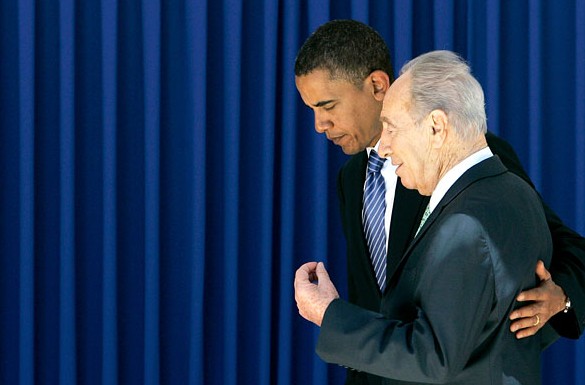
Barack Obama to follow in Shimon Peres’ footsteps

Barack Obama to follow in Shimon Peres’ footsteps

“Very few leaders if at all were able to change the mood of the entire world in such a short while with such profound impact. You provided the entire humanity with fresh hope, with intellectual determination, and a feeling that there is a lord in heaven and believers on earth.

“Under your leadership, peace became a real and original agenda. And from Jerusalem, I am sure all the bells of engagement and understanding will ring again. You gave us a license to dream and act in a noble direction.” Nobel Peace Prize laureate and President of Israel, Shimon Peres.

_____

It’s important not to rush to judgment on Obama — unless the judgment is glowing, then it’s full steam ahead.

If the so-called “reality-based community” still existed, then the very same people who have been suggesting that Obama critics hold their fire should now be insisting the Nobel committee jumped the gun.

Unfortunately that isn’t happening as much as it should. Why? Obama loyalists feel personally embattled. The impulse to grasp on to this fleeting object of relief is for some, irresistible. It’s a quick salve to those whose own unflinching loyalties portend humiliations that lurk down the road.

Realists can’t indefinitely remain true believers. True believers eventually abandon realism.

European Commission President Jose Manuel Barroso said: “The award of the prize to President Obama, leader of the most significant military power in the world, at the beginning of his mandate, is a reflection of the hopes he has raised globally with his vision of a world without nuclear weapons.”

There’s a note of realism there — this is about hopes raised, not accomplishments. The problem is, hope can only be raised so far and for so long. It’s power and durability depends on a strengthening conviction that hope is on a trajectory that leads to actuality. The longer that trajectory remains unclear, the more likely it will be that hope has instead provided the foundation for disappointment, cynicism and bitterness.

Obama traded on hope as a path to power but now he has the power he has to dispense with a large measure of hope. Governance is about deliverables.

It’s not surprising that the Nobel Peace Prize committee have chosen to endorse Obama’s nuclear disarmament initiative. But whether that goal has actually raised hopes globally is something I’m skeptical about. Disarmament is on Obama’s wish-list, but since — in the name of realism — he warned that this might not be accomplished in his lifetime, and since a goal is a dream with a deadline, thus far Obama has merely inspired hope in a dream. Ronald Reagan had that dream too.

Is there a sliver of a silver lining here? Maybe. It’s possible that the Nobel Peace-Prize winning president might feel inhibited from using the Pentagon’s newly-ordered 30,000lb Massive Ordnance Penetrator for destroying nuclear facilities in Iran. On the other hand, he might be persuaded that the destruction of Iran’s nuclear program is a necessary step on the path to nuclear disarmament.

* * *

A few other responses.

Mickey Kraus:

Turn it down! Politely decline. Say he’s honored but he hasn’t had the time yet to accomplish what he wants to accomplish. Result: He gets at least the same amount of glory–and helps solve his narcissism problem and his Fred Armisen (‘What’s he done?’) problem, demonstrating that he’s uncomfortable with his reputation as a man overcelebrated for his potential long before he’s started to realize it. … Plus he doesn’t have to waste time, during a fairly crucial period, working on yet another grand speech. … And the downside is … what? That the Nobel Committee feels dissed? … P.S.: It’s not as if Congress is going to think, well, he’s won the Nobel Peace Prize so let’s pass health care reform. But the possibility for a Nobel backlash seems non-farfetched.

The Taliban:

Taliban spokesman Zabihullah Mujahid said it was absurd to give a peace award to a man who had sent 21,000 extra troops to Afghanistan to escalate a war.

“The Nobel prize for peace? Obama should have won the ‘Nobel Prize for escalating violence and killing civilians’,” he told Reuters by telephone from an undisclosed location.

“When Obama replaced President Bush, the Afghan people thought that he would not follow in Bush’s footsteps. Unfortunately, Obama actually even went one step further.”

Gideon Rachman:

The prize is clearly an award of huge significance, awarded after only the deepest reflection, and won only by demi-Gods.

Maria Farrell:

President Obama has changed how the world feels about America. He’s lifted the planet’s mood. This guy is global Prozac.

Facebooktwittermail

Our exclusive right to self-defense

Our exclusive right to self-defense

Virtually all of Israel is now speaking in one voice against the Goldstone report, against any attempt to blame us over the war in Gaza. We’ve honed our message to a sharp point and, inspired by Prime Minister Binyamin Netanyahu’s performance at the UN, we’re delivering it with just the right tone of outrage:

How dare anyone deny us the right to self-defense! How dare anyone deny us the right to fight back against terrorism!

Very nice. Puts everyone else on the defensive. The right to self-defense is up there with motherhood and apple pie – who’s going to come out against it, especially for us, for Israel, for the Jews, for the people of the Holocaust?

The right to self-defense – perfect.

But I’d like to ask: Do the Palestinians also have the right to self-defense?

We probably wouldn’t admit it out loud, but in our heads we would say – again, in one voice – “No!”

This is the Israeli notion of a fair deal: We’re entitled to do whatever the hell we want to the Palestinians because, by definition, whatever we do to them is self-defense. They, however, are not entitled to lift a finger against us because, by definition, whatever they do to us is terrorism. [continued…]

Facebooktwittermail

Give peace a chance, says Mitchell. Fat chance, says Lieberman.

No chance of peace for years, says Israel’s Foreign Minister

There is no chance of an early solution to the Israeli-Palestinian conflict and people must “learn to live with it”, the Israeli Foreign Minister warned yesterday.

“Anyone who says that within the next few years an agreement can be reached ending the conflict… simply doesn’t understand the situation and spreads delusions, ultimately leading to disappointments and an all-out confrontation here,” Avigdor Lieberman said in a radio interview.

He added: “I am going to say very clearly: there are conflicts that have not been completely solved and people have learnt to live with it, like Cyprus.”

Mr Lieberman, the head of the far-right Yisrael Beitenu party, suggested that a long-term, interim deal with the Palestinians could ensure prosperity, security and stability, but tougher questions should be left until later.

“We have to be realistic,” he said. “We will not be able to reach agreement on core and emotional subjects like Jerusalem and the right of return of Palestinian refugees.” [continued…]

Palestinians change course on UN report

The Palestinian leadership has quickly backtracked in its approach to a U.N. report accusing Israel of possible war crimes in Gaza, in what its top diplomat acknowledged Thursday is erupting into a “clear crisis” for its people. [continued…]

UN Security Council to discuss Gaza report next week

A divided U.N. Security Council will meet next week at the request of Arab countries to discuss a U.N. report on war crimes committed by both Palestinian militants and Israel’s army during last December’s conflict in the Gaza Strip.

The Security Council’s monthly meeting on the Middle East was scheduled for October 20, but after a request from council member Libya that some western diplomat’s characterized as a bit of a “surprise”, the 15-member body agreed in closed consultations Wednesday to move up its session to October 14. [continued…]

After Goldstone, Hamas faces fateful choice

Naming collaboration — even treason — for what it is has always been a painful taboo among Palestinians, as for all occupied peoples. It took the French decades after World War II to begin to speak openly about the extent of collaboration that took place with the Nazi-backed Vichy government. Abbas and his militias — who for a long time have been armed and trained by Israel, the United States and so-called “moderate” Arab states to wage war against the Palestinian resistance — have relied on this taboo to carry out their activities with increasing brazenness and brutality. But the taboo no longer affords protection, as calls for Abbas’ removal and even trial issued from Palestinian organizations all over the world.

Hamas too seems to have been taken by surprise at the strength of reaction. Hamas leaders were critical of Abbas’ withdrawal of the Goldstone resolution, but initially this was notably muted. Early on, Khaled Meshal, the movement’s overall leader, insisted that despite the Goldstone fiasco, Hamas would proceed with Egyptian-mediated reconciliation talks with Fatah and smaller factions scheduled for later in the month, stating that reaching a power-sharing deal remained a “national interest.”

As the tremors continued, however, Hamas leaders escalated their rhetoric — seemingly following, not leading, public opinion. Mahmoud Zahar, a prominent Hamas leader in the Gaza Strip, labeled Abbas a “traitor” and urged that he be stripped of his Palestinian nationality. Prime Minister Ismail Haniyeh, speaking before a hastily convened session of the Palestinian Legislative Council, said Abbas was personally responsible for the “crime” committed in Geneva, and a senior officer from the Hamas-controlled Gaza police force held a press conference to announce that Abbas and his associates would be subject to arrest if they set foot in Gaza. [continued…]

Netanyahu, the tunnels opener

Last week, an incident that could have set the entire Middle East on fire was prevented. Netanyahu’s secret plan to visit a disputed tunnel in the East Jerusalem Palestinian neighborhood of Silwan, at the site known as Ir David (the City of David), was canceled, probably with some international intervention. Am I exaggerating the danger? No. Judging from past experience, provocations in Jerusalem never end well, and with the tensions in Jerusalem clearly rising in recent weeks, the potential for an explosion is very real. [continued…]

Israel considers recalling its ambassador to Sweden

Israel is considering recalling its ambassador to Stockholm in light of Swedish Foreign Minister Carl Bildt’s remarks in support of a UN report claiming war crimes were committed by both sides during the Israel-Hamas Gaza conflict.

Bildt told reporters in Stockholm Thursday that South African jurist Richard Goldstone, who headed the investigation into the war, is a person with “high credibility” and “high integrity” and that his report carries weight.

Deputy Foreign Minister Danny Ayalon called to re-examine Israel’s relations with Sweden. [continued…]

Facebooktwittermail

Afghan war debate now leans to focus on Al Qaeda

Afghan war debate now leans to focus on Al Qaeda

President Obama’s national security team is moving to reframe its war strategy by emphasizing the campaign against Al Qaeda in Pakistan while arguing that the Taliban in Afghanistan do not pose a direct threat to the United States, officials said Wednesday.

As Mr. Obama met with advisers for three hours to discuss Pakistan, the White House said he had not decided whether to approve a proposed troop buildup in Afghanistan. But the shift in thinking, outlined by senior administration officials on Wednesday, suggests that the president has been presented with an approach that would not require all of the additional troops that his commanding general in the region has requested.

It remains unclear whether everyone in Mr. Obama’s war cabinet fully accepts this view. While Vice President Joseph R. Biden Jr. has argued for months against increasing troops in Afghanistan because Pakistan was the greater priority, Secretary of State Hillary Rodham Clinton and Defense Secretary Robert M. Gates have both warned that the Taliban remain linked to Al Qaeda and would give their fighters havens again if the Taliban regained control of all or large parts of Afghanistan, making it a mistake to think of them as separate problems. [continued…]

Afghan Taliban say they pose no threat to the West

The Afghan Taliban pose no threat to the West but will continue their fight against occupying foreign forces, they said on Wednesday, the eighth anniversary of the U.S.-led invasion that removed them from power.

U.S.-led forces with the help of Afghan groups overthrew the Taliban government during a five week battle which started on October 7, 2001, after the militants refused to hand over al Qaeda leaders wanted by Washington for the September 11 attacks on America.

“We had and have no plan of harming countries of the world, including those in Europe … our goal is the independence of the country and the building of an Islamic state,” the Taliban said in a statement on the group’s website www.shahamat.org. [continued…]

War of the worlds

An unremarkable paragraph in a piece in my hometown paper recently caught my eye. It was headlined “White House Believes Karzai Will Be Re-elected,” but in mid-report Helene Cooper and Mark Landler of the New York Times turned to Afghan War commander General Stanley McChrystal’s “redeployment option.” Here’s the humdrum paragraph in question: “The redeployment option calls for moving troops from sparsely populated and lawless areas of the countryside to urban areas, including Kandahar and Kabul. Many rural areas ‘would be better left to Predators,’ said an administration official, referring to drone aircraft.”

In other words, the United States may now be represented in the Afghan countryside, as it already is in the tribal areas on the Pakistani side of the border, mainly by Predators and their even more powerful cousins, Reapers, unmanned aerial vehicles with names straight out of a sci-fi film about implacable aliens. If you happen to be an Afghan villager in some underpopulated part of that country where the U.S. has set up small bases — two of which were almost overrun recently — they will be gone and “America” will instead be soaring overhead. We’re talking about planes without human beings in them tirelessly scanning the ground with their cameras for up to 22 hours at a stretch. Launched from Afghanistan but flown by pilots thousands of miles away in the American West, they are armed with two to four Hellfire missiles or the equivalent in 500-pound bombs. [continued…]

Facebooktwittermail

Iran: Can the U.S. take ‘yes, but’ for an answer?

Iran: Can the U.S. take ‘yes, but’ for an answer?

The U.S. and its allies had sought to prevent Iran from achieving a “breakout” capacity — i.e., assembling sufficient civilian nuclear infrastructure to allow it to move relatively quickly to build a bomb should it choose to break out of the NPT, in the manner that a country like Japan is capable of doing. That goal required Iran to give up exercising its right to enrich uranium. There’s no sign of Iran moving in that direction, but if it shows new flexibility in negotiating further safeguards against weaponization of its nuclear output, that will create a new dilemma for the Obama Administration: whether or not the U.S. and its allies, particularly Israel, can live with an outcome that leaves Iran with “threshold” capacity, even under greater safeguards.

While under attack in a Senate subcommittee from Republicans who are skeptical over the Geneva talks, Deputy Secretary of State Jim Steinberg suggested on Tuesday, according to CNN, that “one reason for the Obama Administration’s engagement toward Iran was to secure international support for sanctions if Iran continued to defy international demands.” The argument works if Iran stonewalls; but if it offers counterproposals deemed reasonable by China, Russia and some Europeans, winning support for further sanctions would become even harder. And that’s a game the Iranians may be ready to play, by refusing to give up uranium enrichment but at the same time showing new openness to measures aimed at strengthening international confidence in the peaceful intent of its nuclear program. Tehran is far more likely to tailor its positions to what will be acceptable to Russia, China and some of the Europeans than it is to heed the demands put forward by the U.S. and its key allies. [continued…]

CIA knew about Iran’s secret nuclear plant long before disclosure

In an interesting reversal of roles from the Bush era, the Europeans were pushing for the plant to be outed at once, while the U.S. was more cautious. “The Americans seem to have become more patient as their dossier on Iran has gotten fuller, while the Europeans are getting more anxious about taking care of this matter as they’ve learned more,” says Jacquard.

From then on, the challenge was to keep the information secret. Panetta said he ordered the presentation to be readied “in the event that that information leaked out or that [the Obama Administration] wanted to present it to the International Atomic Energy Agency.” British, French and Israeli intelligence agencies were involved in creating the presentation, he added.

U.S. officials believe that it was only when Iran found out that its cover had been blown that it chose to own up to the plant’s existence — although how it might have learned of Washington’s discovery remains unclear. On the eve of the U.N. General Assembly last month, the Iranians sent the IAEA a terse note, acknowledging the presence of the Qum facility. The next day, Panetta dispatched a team to the IAEA’s headquarters in Vienna to make the presentation. [continued…]

Is the U.S. preparing to bomb Iran?

The notification says simply, “The Department has an Urgent Operational Need (UON) for the capability to strike hard and deeply buried targets in high threat environments. The MOP is the weapon of choice to meet the requirements of the UON.” It further states that the request is endorsed by Pacific Command (which has responsibility over North Korea) and Central Command (which has responsibility over Iran).

The request was quietly approved. On Friday, McDonnell Douglas was awarded a $51.9 million contract to provide “Massive Penetrator Ordnance Integration” on B-2 aircraft.

This is not the kind of weapon that would be particularly useful in Iraq or Afghanistan, but it is ideally suited to hit deeply buried nuclear facilities such as Natanz or Qom in Iran. [continued…]

Iran blames U.S. in disappearance of scientist

Iran’s foreign minister on Wednesday accused the United States of being involved in the disappearance of an Iranian scientist with alleged links to Iran’s nuclear program.

The charge comes less than a week after Iran reached tentative accords with the United States and other major powers on addressing questions about its nuclear ambitions, including letting international inspectors visit its newly disclosed uranium-enrichment site near Qom. The charge also comes as the United States has raised questions about Americans being held in Iran.

The scientist, Shahram Amiri, vanished during a pilgrimage to Saudi Arabia four months ago; Iran previously called on Saudi Arabia to help locate him. He is a researcher at Malek Ashtar University, which is connected to Iran’s Revolutionary Guard Corps and was listed by the European Union last year as an entity linked to Iran’s nuclear activities or weapon delivery systems. [continued…]

Iran plans to cut subsidised gasoline quota

Iran plans to nearly halve the amount of gasoline that motorists can buy at a heavily subsidised price, state television reported on Thursday, in what could be a politically controversial proposal.

It quoted Oil Minister Massoud Mirkazemi as saying that under the plan, to be considered by parliament next week, the quota of subsidised gasoline would be reduced to 55 litres per month from 100 litres now.

The proposal comes as the United States and its European allies explore ways of targeting fuel imports into Iran if it continues to press on with its nuclear programme. [continued…]

Facebooktwittermail

After six years, ‘we’re worthless’

After six years, ‘we’re worthless’

Weeks after the U.S.-led invasion of Iraq in the spring of 2003, as parts of the capital were still smoldering, American soldiers and diplomats turned to men like Hassan Shama and Omar Rahman Rahmani in their quest to plant the seeds of representative democracy.

In Baghdad, Iraq’s capital, they held impromptu neighborhood caucuses to appoint district and neighborhood advisory councils. The local government bodies were given no official charter, lawmaking power or public budget. In the years that followed, as the capital became a bloody battleground and the country descended into near-anarchy, council members were among the U.S. military’s staunchest allies. They provided information about extremists, offered insight into Iraqi society and gave American-imposed security measures a veneer of Iraqi legitimacy.

As U.S. troops have sharply disengaged from Baghdad in recent months, local representatives say they are feeling powerless and abandoned. The Iraqi government has taken no steps to hold elections for the councils, and the Baghdad provincial council is culling them of members it deems unqualified or unfit for service.

The looming demise of the local councils — at least as the Americans established them — is an ominous sign of the brand of democracy that is likely to reign in Iraq as the Americans depart, council members say. They worry that constituents will no longer have grass-roots representation and that power will become far more centralized in the hands of a few. [continued…]

Facebooktwittermail

Obama’s Middle East mess

Obama’s Middle East mess

As Abbas falls, have no doubt that he got pushed by an inept administration that similarly gets weak-kneed whenever it feels pressure from either the Israel lobby or the Israeli government.

Yesterday, State Department spokesman, Ian Kelly, was asked: “What role specifically did the United States play in pressuring the Palestinian Authority to make that decision [to shelve the Goldstone report]?

Kelly, squirming like an eel, responded:

Well, I don’t know if I would accept your characterization of pressuring. I think that we recognized that we had serious concerns with the recommendations and some of the allegations. We felt very strongly that while these investigations should be investigated and addressed, that we thought on the one hand that Israel had the kind of institutions that could address these allegations. And of course, we urged Israel to address these very serious allegations.

But I think we had a broader concern that we didn’t want the report to distract us from our ultimate goal, which was to address the root causes of the tragic events of last January, and that’s the lack of a regional and lasting peace between the two parties – between the Israelis and the Palestinians. So we were concerned that we stay focused on that ultimate goal.

And we are not saying that the allegations in the report – we’re not saying that they should be ignored. We simply do not want the report itself to become any kind of impediment to this ultimate goal. We appreciate the seriousness with which the Palestinians approach this very, very difficult issue, and we respect this decision to defer discussion of the report to a later date for the reasons that I just stated – that we want to make sure that we stay focused on the ultimate goal here.

(Goldstone discussion begins at 6 minutes 55 seconds.)

What kind of tortured logic is this? On the one hand war crimes committed in Gaza are somehow extraneous to an understanding of the root causes of the conflict, yet the root cause of the conflict is conflict itself?

The administration needs to make up its mind: Either this conflict is all about violence, in which case Israeli violence can’t be ruled out of the equation. Or, the violence is merely symptomatic of underlying political injustices and a natural outcome of addressing those injustices will be a long sought peace. Take your pick.

Of course, the true sentiment that few American officials are crass enough to utter, yet apparently everyone believes, is that when Israelis kill hundreds of Palestinians they really don’t intend to kill any (“we shoot and we cry”), yet when Palestinians kill a dozen Israelis they merely fall short of accomplishing their genocidal intentions.

* * *

After taking stabs at solving the Middle East conflict, engaging Iran, bringing about global nuclear disarmament, healing the rift between Muslims and the West, shoring up the global financial system, tackling climate change and reforming America’s health care system, there are strong indications that Obama came into office intoxicated by his image as a world savior.

Even so, his cool created the impression that he might actually be impervious to the influence of adulation, but even though some of us thought he had risen above the massive projections that were being imposed on him, the evidence is that to some extent he got sucked into the myth that had been created around him.

To see Obama now as either a tragic figure or as the victim of circumstances essentially absolves him of responsibility for his own actions.

I don’t think it’s premature to be conducting an autopsy on Obama’s Middle East initiative and the first question to ask is this: Did he manage to cross the most minimal threshold for a defensible approach? That is, can he claim at least to have done no harm?

Unfortunately, the harm appears grossly evident and it hinges on his choice to raise expectations across the region and then allow those expectations to founder. Expectations dashed are much more destructive than expectations never formed. (George Bush never disappointed anyone because no one took his promises seriously. In office and life he mastered the art of setting a low bar.)

So, could Obama have entered the situation differently and put himself in a better position to at least live up to the Hippocratic oath (which, incidentally, all politicians should be forced to take)?

He could have acknowledged that he had on his plate more than any human president could address (“sorry folks, I’m not the Messiah”) and he could in his first days in office have said something like this:

“The Middle East conflict is a wound to which no easy remedy can be applied. I do not come into office claiming to have any greater powers than all of my predecessors who struggled with limited success to deal with this issue.

“I do know this, however: setting aside the many intractable political issues, there is right now a humanitarian crisis in Gaza. We haven’t had time to assess the scope of this crisis but having appointed George Mitchell as my Middle East peace envoy, I’ve asked him to put the crisis in Gaza at the top of his agenda. In the next few days he will be visiting the area to assess which needs must most urgently addressed.”

At that point, the Israel Lobby’s wheels would have started spinning frantically. But how do you conduct a campaign focused on preventing Mitchell going to Gaza and addressing a humanitarian crisis?

No doubt, phones in the White House and the State Department would have been ringing off the hook as Abe Foxman and other Jewish community leaders and Israeli officials objected, saying that such a move would not be “helpful”. But seriously, how do you conduct a public campaign whose direct aim is to prevent help reaching tens of thousands of people whose homes had been flattened?

What happened in reality? Obama and Mitchell made the choice of staying out of Gaza. Neither of them had a gun pointed at his head.

Obama had the opportunity to craft a policy that grew modestly and organically from the facts on the ground. A combination of fear, arrogance and perhaps lack of political imagination, led him to pass up that opportunity.

Facebooktwittermail

Abbas may reverse Goldstone report stance

Abbas may reverse Goldstone report stance

Palestinian Authority president Mahmud Abbas was on Tuesday “seriously studying” the possibility of asking that a UN Gaza war report be passed on to the Security Council, a senior official said.

“President Abbas is seriously studying the possibility of asking the Arab and Islamic bloc to officially take the Goldstone report to international bodies, including the UN General Assembly and the Security Council,” chief Palestinian negotiator Saeb Erakat said in a phone call from Amman.

The move appeared to mark a change in position, as the Palestinian delegation on Friday backed a move at the UN Human Rights Council to defer a vote on whether the report should be passed on. [continued…]

Israel vs. human rights

In his speech to the United Nations General Assembly, Israeli Prime Minister Benjamin Netanyahu vigorously took up the country’s latest strategy for responding to allegations of human rights abuses: kill the messenger. He denounced a recent report by the UN’s Human Rights Council that had accused Israel of possible crimes against humanity during its assault on Gaza last winter, calling it a “travesty,” a “farce” and a “perversion.” The Hamas terrorists Israel was up against had committed acts akin in history only to the Nazi blitz of British civilians during World War II, Netanyahu asserted. Indeed, in denying a nation’s right to resist attack, the report sought to undermine Israel’s “legitimacy.”

The head of the UN Fact-Finding Mission on the Gaza Conflict, Judge Richard Goldstone, was “upset” by the speech. “It is disingenuous, to put it lightly, what Netanyahu said,” he told The Nation. “The idea that this is aimed at delegitimating the state of Israel–that is the last thing I would want to do.” Goldstone, a Jew and a Zionist, said that Israel’s leaders were behaving contemptuously, “ignoring the specific allegations and simply launching a broadside.” [continued…]

Thousands call on Turkey to protect Al-Aqsa mosque from Israel

Turkish civil society organizations and thousands of people on Monday protested Israeli invasion of Al-Aqsa Mosque and other Jewish provocations in Taksim Square, calling on Turkey to act against the destruction policy.

Started at 17 pm, people from different disticts of Istanbul attended the protest, as well as people from different cities.

Gathered in Taksim Square walked through Galatasaray High School on Istiklal Street, protesters shouted slogans in solidarity with Palestinians to condemn Israeli actions.

The group then burned the Israeli flags. [continued…]

Facebooktwittermail

Rory Stewart on Obama’s approach to the war in Afghanistan

Rory Stewart interviewed on Bill Moyers Journal

LYNN SHERR: You’ve met with Secretary Clinton?

RORY STEWART: Sure.

LYNN SHERR: You’ve met with Special Envoy Richard Holbrooke?

RORY STEWART: Sure.

LYNN SHERR: What do you tell them?

RORY STEWART: Again, my message is: focus on what we can do. We don’t have a moral obligation to do what we can’t. People can get very fixed by saying, “But surely you’re not saying we ought to do nothing? Surely you’re not saying we ought to allow the Taliban to do this or that?” And I just keep saying “ought” implies “can”– you don’t have a moral obligation to do what you can’t do.

LYNN SHERR: How is your advice taken?

RORY STEWART: I think what I see at the moment is that people are polite, because they imagine maybe I have some experience with Afghanistan. But I’m one of a broad community of people — we have nine people working in my center at Harvard who’ve worked there for 20 or 30 years and the problem we all have is that if the Administration has for some reason already decided that they’re going to increase troops, they’re going to do a counterinsurgency campaign, it’s very difficult for them to take on board people coming back and saying, “Look, actually, I don’t think this is going to work. It’s a great idea. I can see why you want to do it. But by trying to do the impossible, you may end up doing nothing. I’d like to present an alternative strategy, which is lighter, more intelligent, and may end up actually achieving something.”

LYNN SHERR: And again, their reaction? They listen politely, you say?

RORY STEWART: They listen politely, but in the end, of course, basically the policy decision is made. What they would like is little advice on some small bit. I mean, the analogy that one of my colleagues used recently is this: it’s as though they come to you and they say, “We’re planning to drive our car off a cliff. Do we wear a seatbelt or not?” And we say, “Don’t drive your car off the cliff.” And they say, “No, no, no. That decision’s already made. The question is should we wear our seatbelts?” And you say, “Why by all means wear a seatbelt.” And they say, “Okay, we consulted with policy expert, Rory Stewart,” et cetera. [continued…]

Facebooktwittermail

Does Iran have data to build a nuclear bomb? No, says US

Does Iran have data to build a nuclear bomb? No, says US.

A senior US security official Sunday disagreed with the assessment that Iran now knows how to make a nuclear bomb.

According to the Sunday New York Times, a secret International Atomic Energy Agency (IAEA) report says that Iran has “sufficient information to be able to design and produce a workable” atom bomb.

US National Security Adviser James Jones, however, disputed the IAEA’s findings. Asked on CNN’s “State of the Union” if Iran has the data to make a nuclear bomb, he said: “No, we stand by the reports that we’ve put out.” [continued…]

Lawmakers vow swift action over Iran’s alleged nuclear inroads

US lawmakers on Sunday vowed quick action against Iran following a report that weapons experts believe Tehran has the know-how to build an atomic bomb — even as a senior US official downplayed the news article.

A chorus of congressional voices, both Republican and Democratic, urged tough action against Tehran following a New York Times report that the International Atomic Energy Agency (IAEA) has determined Iran now has “sufficient information” to build a nuclear weapon.

US lawmakers said the revelation warranted an immediate and severe response. [continued…]

Ahmadinejad has no Jewish roots

In June 2005, Mahmoud Ahmadinejad’s meteoric rise from mayor of Tehran to president of one of the most influential countries in the Middle East took everyone by surprise. One of the main reasons for the astonishment was that so little was known about him.

One recently published claim about his background comes from an article in the Daily Telegraph. Entitled “Mahmoud Ahmadinejad revealed to have Jewish past”, it claims that his family converted to Islam after his birth. The claim is based on a number of arguments, a key one being that his previous surname was Sabourjian which “derives from weaver of the sabour, the name for the Jewish tallit shawl in Persia”.

Professor David Yeroshalmi, author of The Jews of Iran in the 19th century and an expert on Iranian Jewish communities, disputes the validity of this argument. “There is no such meaning for the word ‘sabour’ in any of the Persian Jewish dialects, nor does it mean Jewish prayer shawl in Persian. Also, the name Sabourjian is not a well-known Jewish name,” he stated in a recent interview. In fact, Iranian Jews use the Hebrew word “tzitzit” to describe the Jewish prayer shawl. Yeroshalmi, a scholar at Tel Aviv University’s Center for Iranian Studies, also went on to dispute the article’s findings that the “-jian” ending to the name specifically showed the family had been practising Jews. “This ending is in no way sufficient to judge whether someone has a Jewish background. Many Muslim surnames have the same ending,” he stated. [continued…]

Facebooktwittermail

The demise of the dollar

The demise of the dollar

n the most profound financial change in recent Middle East history, Gulf Arabs are planning – along with China, Russia, Japan and France – to end dollar dealings for oil, moving instead to a basket of currencies including the Japanese yen and Chinese yuan, the euro, gold and a new, unified currency planned for nations in the Gulf Co-operation Council, including Saudi Arabia, Abu Dhabi, Kuwait and Qatar.

Secret meetings have already been held by finance ministers and central bank governors in Russia, China, Japan and Brazil to work on the scheme, which will mean that oil will no longer be priced in dollars.

The plans, confirmed to The Independent by both Gulf Arab and Chinese banking sources in Hong Kong, may help to explain the sudden rise in gold prices, but it also augurs an extraordinary transition from dollar markets within nine years.

The Americans, who are aware the meetings have taken place – although they have not discovered the details – are sure to fight this international cabal which will include hitherto loyal allies Japan and the Gulf Arabs. Against the background to these currency meetings, Sun Bigan, China’s former special envoy to the Middle East, has warned there is a risk of deepening divisions between China and the US over influence and oil in the Middle East. “Bilateral quarrels and clashes are unavoidable,” he told the Asia and Africa Review. “We cannot lower vigilance against hostility in the Middle East over energy interests and security.” [continued…]

Facebooktwittermail

Hamas, not Abbas, is the Palestinians’ real leader

Hamas, not Abbas, is the Palestinians’ real leader

In a single phone call to his man in Geneva, Mahmoud Abbas has demonstrated his disregard for popular action, and his lack of faith in its accumulative power and the place of mass movements in processes of change.

For nine months, thousands of people – Palestinians, their supporters abroad and Israeli anti-occupation activists – toiled to ensure that the legacy of Israel’s military offensive against Gaza would not be consigned to the garbage bin of occupying nations obsessed with their feelings of superiority.

Thanks to the Goldstone report, even in Israel voices began to stammer about the need for an independent inquiry into the assault. But shortly after Abbas was visited by the American consul-general on Thursday, the leader of the Palestine Liberation Organization got on the phone to instruct his representative on the United Nations Human Rights Council to ask his colleagues to postpone the vote on the adoption of the report’s conclusions.

Heavy American pressure and the resumption of peace negotiations were the reasons for Abbas’ move, it was said. Palestinian spokespeople spun various versions over the weekend in an attempt to make the move kosher, explaining that it was not a cancelation but a six-month postponement that Abbas was seeking.

Will the American and European representatives in Geneva support the adoption of the report in six months’ time? Will Israel heed international law in the coming months, stop building in the settlements and announce immediate negotiations on their dismantlement and the establishment of a Palestinian state in the occupied territories? Is this what adoption of the report would have endangered? Of course not. [continued…]

Editor’s Comment — The White House, having initially promised American Jewish community leaders that the Goldstone report could be assured a quiet death (it would reach a “natural conclusion” in the UN Human Rights Council and move no further), then opted for a different choice: half-life might cause fewer political ruptures than sudden death. All that was required was the Mahmoud Abbas be obliging enough to do the administration’s dirty work and get the report shelved. Obama could then maintain his serenity and keep the peace process moving forward.

What kind of imbecile thought that was a plan that would work?

* * *

Yesterday, the jailed Tanzim leader and Fatah Central Committee member Marwan Barghouti said: “whoever thinks it’s possible to make peace with the current Israeli government is being delusional.”

He also suggested that the circumstances which led to the Al-Aqsa Intifada still prevail and called on Palestinians to conduct a “peaceful resistance” campaign.

That’s something Obama and Mitchell might pause to consider.

Hamas accuses Abbas of treason for ‘justifying’ Gaza war

Hamas leaders on Monday warned that President Mahmoud Abbas’ decision to delay action on a United Nations report criticizing Israel’s offensive in the Gaza Strip was in essence a “justification” of the war and encouragement of occupation.

The report, by Justice Richard Goldstone, criticized both Israel and the Palestinians for the war in January 2008. Last week the Palestinian delegation to the UN Human Rights Council dropped its support for an immediate vote on the report.

Speaking to Gaza lawmakers, Hamas Prime Minister Ismail Haniyeh accused Abbas of having “justified” the war by agreeing to defer a UN vote that would have condemned Israel’s failure to cooperate with the war crimes investigation led by South African judge Richard Goldstone. [continued…]

Palestinians, U.S. Jews spar over ‘Judaizing’ Jerusalem

The Western-backed Palestinian Authority on Monday urged the world to “force [Israel] to put off its attempts to take over Jerusalem and Judaize it,” prompting Orthodox Jews in the United States to vow never to give up their historical right to the ancient city.

The Palestinian cabinet, issuing a strong statement after a meeting in the West Bank town of Ramallah, condemned what it called a plan by Jews to “perform religious rituals” in the Temple Mount compound which contains the al-Aqsa mosque, Islam’s third holiest site.

It also pledged “to confront Israel,” as Israeli security forces clashed with Arab protesters for a second day in the Jerusalem area. In response, the leading body of Orthodox Jews in America condemned the Palestinian Authority and the violence exhibited by Palestinian protesters. [continued…]

In Jerusalem, clashes over Temple Mount, Al Aqsa Mosque

Israeli police shut down access to key Muslim holy sites in Jerusalem’s Old City on Sunday, spurring Palestinian protesters to throw rocks and bottles in protest – marking the second consecutive Sunday of disturbances near the city’s overlapping points of prayer for Jews and Muslims.

Clashes broke out in reaction to Israel’s closure of the entrances to the Dome of the Rock and the Al Aqsa Mosque, Islam’s third-holiest site. About 150 Palestinians who gathered for a prayer service near the city’s Lion’s Gate on Sunday morning hurled rocks and bottles at Israeli police, who fired tear gas in attempt to disperse the crowd. Palestinian officials said nine people were treated for light injuries, primarily tear gas inhalation. Israel said two of its policeman were sent to hospitals after being injured by rocks and bottles.

An Israeli police spokesman said that the decision to close the site was made following calls in various Palestinian media on Saturday night to march on the Haram el-Sharif (The Noble Sanctuary), as it is called in Arabic – referred to by Israelis as the Temple Mount. Several Islamic groups claim that an Israeli archeological dig below the site is endangering Al Aqsa and that it will soon collapse, a claim Israel denies. [continued…]

Facebooktwittermail

Israel minister feared UK arrest

Israel minister feared UK arrest

Israeli minister and former military chief Moshe Yaalon cancelled a UK visit because of fears of arrest for alleged war crimes, his office says.

Pro-Palestinian groups in Britain want Mr Yaalon to face trial over the 2002 killing of a Gaza militant, in which 14 others also died.

Mr Yaalon took legal advice and wanted “to avoid playing into the hands of anti-Israel propaganda”, an aide said. [continued…]

Facebooktwittermail