Author Archives: Paul Woodward

NEWS & VIEWS ROUNDUP: July 7

Rafsanjani’s party dismisses vote results

A day after commanders of the Revolutionary Guard warned there was no middle ground in the dispute over the reelection of President Mahmoud Ahmadinejad, the political party of one of Iran’s most powerful clerics Monday defiantly issued a statement dismissing the vote.

The statement by the Kargozaran party all but cleared away weeks of ambiguity about the stance of the cleric, Ayatollah Ali Akbar Hashemi Rafsanjani.

Rafsanjani, who heads two government councils that oversee the supreme leader and mediate disputes between branches, openly backed presidential candidate Mir-Hossein Mousavi. [continued…]

Obama must be firm on foreign policy

Just a few months into his presidency, Mr Obama’s policy of engagement with Iran has also been all but wrecked by the violent crackdown in that country. His advisers once day-dreamed about a dramatic presidential trip to Tehran, a speech before cheering students, a disarming smile for Mr Ahmadi-Nejad. All of that is unthinkable now. Instead, Mr Obama is left having to cope with a wounded and aggressive Iranian government, intent on pressing ahead with its nuclear programme. The US president will now have to fend off the “bomb Iran” lobby – but without being able to point to a plausible diplomatic alternative.

The policy of American engagement with Russia is going only a little better. Agreements on arms control and transit routes to Afghanistan cannot extinguish the still smouldering antagonisms created by last year’s Georgia war.

Above all Mr Obama is getting nothing on the issue he placed at the centre of his drive for a rapprochement with Russia: Iran.

Mr Obama’s problems with Iran and Russia are merging into a single, nasty mess. The president had seen an improved relationship with Russia as the key to solving Iran. The idea was that the newly friendly Russians would help to talk their Iranian neighbours into a nuclear deal. If that did not work, Russia would help to tighten sanctions on Iran. Without the Kremlin there can be no new United Nations sanctions on Iran (that pesky Russian veto). A package of western sanctions that does not include Russia would be too full of holes to put real pressure on Iran. [continued…]

Obama: No green light for Israel to attack Iran

The United States is “absolutely not” giving Israel a green light to attack Iran, U.S. President Barack Obama told CNN Tuesday.

“We have said directly to the Israelis that it is important to try and resolve this in an international setting in a way that does not create major conflict in the Middle East,” Obama said, referring to Iran’s nuclear ambitions. [continued…]

Israel declines to ask U.S. to OK Iran attack

Prime Minister Benjamin Netanyahu and his top deputies have not formally asked for U.S. aid or permission for possible military strikes on Iran’s nuclear program, fearing the White House would not approve, two Israeli officials said.

One senior Israeli official, who requested anonymity because of the sensitivity of the subject, told The Washington Times that Mr. Netanyahu determined that “it made no sense” to press the matter after the negative response President Bush gave Mr. Netanyahu’s predecessor, Ehud Olmert, when he asked early last year for U.S. aid for possible military strikes on Iran. [continued…]

No change in Iran policy, White House insists

As White House and Office of the Vice President aides formed a united front against widespread media speculation about a change in policy signaled by Vice President Joseph Biden’s statement on a Sunday news show that Israel is a “sovereign nation” that could “determine for itself” how to deal with threats from Iran, analysts said that Israel may be wary of any such green light in any case.

In e-mails and phone calls today, administration officials insisted that Biden’s comments were neither a signal of any change in policy, nor any sort of freelancing. Asked if Biden’s remarks might have been part of an intentional messaging campaign to step up pressure on Iran to negotiate over its nuclear program, officials gave an emphatic “no.” But for all that, the remarks were widely seen both in Washington and abroad as a message intended less for Jerusalem than for Tehran.

Israel’s “biggest nightmare” is that one day the U.S. government “‘would call it and say ‘OK guys, take care of it,'” said Tel Aviv University Iran expert David Menashri in a call Monday arranged by the Israeli Policy Forum, a U.S. nonprofit organization that supports a two-state solution to the Israeli-Palestinian conflict. [continued…]

Minister calls for Jewish takeover of Palestinian areas in Israel

Israel’s housing minister called for strict segregation between the country’s Jewish and Arab populations last week as he unveiled plans to move large numbers of fundamentalist religious Jews to Israel’s north to prevent what he described as an “Arab takeover” of the region.

Ariel Atias said he considered it a “national mission” to bring ultra-Orthodox Jews — or Haredim, distinctive for their formal black and white clothing — into Arab areas, and announced that he would also create the north’s first exclusively Haredi town.

The new settlement drive, according to Atias, is intended to revive previous failed efforts by the state to “Judaize,” or create a Jewish majority in, the country’s heavily Arab north.

Analysts say the announcement is a disturbing indication that the Haredim, who have traditionally been hostile to Zionism because of their strict reading of the Bible, are rapidly being recruited to the Judaization project in both Israel and the Occupied Palestinian Territories (OPT). [continued…]

Facebooktwittermail

EDITORIAL: Does Joe Biden want Israel to attack Iran?

Does Joe Biden want Israel to attack Iran?

Or, let’s phrase the question another way: is Joe Biden stupid?

He might speak a bit more freely than politicians are supposed to in this day and age, but I don’t think Biden is stupid. And I don’t think he gave Israel a green light to attack Iran. This is the part of his interview with George Stephanopoulos aired yesterday where the issue came up:

George Stephanopoulos: [The Israeli] Prime Minister Netanyahu has made it pretty clear that he agreed with President Obama to give until the end of the year for this whole process of engagement to work. After that, he’s prepared to make matters into his own hands.

Is that the right approach?

Joe Biden: Look, Israel can determine for itself – it’s a sovereign nation – what’s in their interest and what they decide to do relative to Iran and anyone else.

Stephanopoulos: Whether we agree or not?

Biden: Whether we agree or not. They’re entitled to do that. Any sovereign nation is entitled to do that. But there is no pressure from any nation that’s going to alter our behaviour as to how to proceed.

What we believe is in the national interest of the United States, which we, coincidentally, believe is also in the interest of Israel and the whole world. And so there are separate issues.

If the Netanyahu government decides to take a course of action different than the one being pursued now, that is their sovereign right to do that. That is not our choice.

Stephanopoulos: But just to be clear here, if the Israelis decide Iran is an existential threat, they have to take out the nuclear programme, militarily the United States will not stand in the way?

Biden: Look, we cannot dictate to another sovereign nation what they can and cannot do when they make a determination, if they make a determination that they’re existentially threatened and their survival is threatened by another country.

Stephanopoulos: You say we can’t dictate, but we can, if we choose to, deny over-flight rights here in Iraq. We can stand in the way of a military strike.

Biden: I’m not going to speculate, George, on those issues, other than to say Israel has a right to determine what’s in its interests, and we have a right and we will determine what’s in our interests.

Earlier in the interview, Biden had reiterated that the US along with the other members of the permanent five plus one, Britain, China, France, and Russia, plus Germany, remain prepared to sit down and negotiate with Iran on its nuclear programme. Indeed, he went so far as to suggest that if Iran is willing to respond to the offer of engagement then this means that the regime has begun to change course and that “the protesters probably had some impact on the behavior of an administration that they don’t like at all.”

When pressed on whether the policy of engagement should now be put on hold, Biden insisted that the invitation was still out there and that “we have to wait to see how this sort of settles out.”

So what’s going on here? Biden wants to tell the Iranians we’re still ready to talk and at the same time he wants to tell the Israelis its OK if you go ahead and bomb Iran — we won’t get in your way?

Contrary to what the headlines suggest, the message I believe that Biden really wanted to drive home was that the administration remains committed to its policy of engagement.

When asked whether the US would modify its approach in response to choices Israel makes he said it would not. He said: “there is no pressure from any nation that’s going to alter our behavior as to how to proceed.”

By focusing on national sovereignty and Israel’s right to determine its own choices he was pointing to the fact that Israel and the US do not operate in tandem. And at a moment when Iran has been the focus of global condemnation he did not want it to appear that the US dictates what Israel can or cannot do.

If the Israeli government acts in a way that conflicts with America’s national interest then it should do so with the foreknowledge that this administration has already made it increasingly clear that it will not support Israel’s national interests at the expense of America’s national interest. Israel will no longer be treated like a rambunctious teenager that is given extra latitude by doting parents.

That’s a tough message — but it doesn’t readily reduce itself to a sensational headline.

Still skeptical about my interpretation? Well let’s consider another aspect of the conventional wisdom: Israel’s eagerness to strike Iran.

There has been no shortage of declarations by Israel’s hawkish leaders that would lead one to conclude that the only thing standing in the way of an attack was Washington. Hence, once provided with the requisite green light there would be nothing else holding Israel back. Indeed, with Obama’s policy of engagement now being viewed doubtfully by elements within most political camps, it might well appear that it’s no longer a question of if but simply when an attack will be launched.

But consider: isn’t this perception of Israeli-US power dynamics exactly the one that the Israelis would want sustained? On the one hand it perpetuates the image of Israel as lacking few internal inhibitions on its own use of military power. At the same time it maintains the expectation that whenever Israel launches an attack or starts a war it does so with American consent and collusion.

The one thing that Israel does not want unmasked is its own uncertainty: the fact that — all the bellicose rhetoric notwithstanding — it does not actually know whether it could effectively execute the military operation, nor is it confident that operational success would not also yield a strategic disaster.

John Bolton might be confident, but the confidence of a neocon sitting in Washington probably provides little comfort to anyone in Tel Aviv.

Facebooktwittermail

NEWS & VIEWS ROUNDUP: July 6

Attack on Iran would be ‘very destabilizing’ — US military chief

A US military strike on Iran’s nuclear facilities would be “very destabilizing,” top US military commander Admiral Mike Mullen said Sunday, warning that any attack could have serious “unintended consequences.”

“I’ve been one who has been concerned about a strike on Iran for some time, because it could be very destabilizing, and it is the unintended consequences of that which aren’t predictable,” the chairman of the US Joint Chiefs of Staff told the Fox News Sunday television program. [continued…]

Saudi air space is ‘not open’ for attack on Iran

Saudi analysts have rejected media reports that the kingdom has given permission to Israel to use its air space for an attack on Iran’s nuclear facilities.

The Sunday Times reported yesterday that the head of Mossad, Israel’s overseas intelligence service, has assured Benjamin Netanyahu, the prime minister, that Saudi Arabia would turn a blind eye to Israeli jets flying over the kingdom during any future raid on Iran’s nuclear sites.

Jamal Khashoggi, an expert on Saudi foreign policy and editor-in-chief of Al Watan newspaper, said the report was false and was another attempt to provoke the country into revealing its plans towards Iran. [continued…]

Mousavi reportedly will launch political party in Iran

The top figure of Iran’s nascent political reform movement, opposition presidential candidate Mir-Hossein Mousavi, will launch a political party to pursue his goals, a reformist newspaper reported Sunday.

Iranian officials, meanwhile, released a jailed European journalist and the lawyer of an imprisoned employee of the British Embassy in Tehran said he was confident that his client’s case would be resolved.

Beleaguered President Mahmoud Ahmadinejad reiterated calls for a live “debate” with President Obama late Saturday in a possible sign Iran was seeking to ease diplomatic strains over his disputed reelection and its violent aftermath. [continued…]

Earn our trust or go, Afghan villagers tell Marines

The mullah’s message was blunt. We don’t trust you and if you don’t earn our trust, our first meeting will be our last.

With that, he stood abruptly and walked out of his first “shura,” or council meeting, with U.S. Marines.

U.S. forces who have moved deep into formerly Taliban-controlled territory in southern Afghanistan this week say they are here to stay and will not leave until they have improved the lives of ordinary people.

But locals — used to seeing NATO troops come through to fight but fail to follow through on promises of development — may not be won over easily. [continued…]

Obama’s strategic blind spot

Are there not other alternatives than sending our armies to chew barbed wire in Flanders?” During the bitter winter of 1914-15, the first lord of the Admiralty posed this urgent question to Britain’s prime minister.

The eighth anniversary of 9/11, now fast approaching, invites attention to a similar question: Are there not other alternatives than sending our armies to choke on the dust of Iraq and Afghanistan?

Back in December 1914, the Admiralty’s impatient first lord was Winston Churchill, appalled by the slaughter on the Western Front. Intent on breaking the stalemate, Churchill became a font of ideas. Mired in Flanders? Then launch an amphibious assault against the Dardanelles, he urged. Were German machine guns cutting down British Tommies venturing into no man’s land? Then support the infantry with tanks.

Yet Churchill’s innovations failed to deliver a quick resolution. Instead, they prolonged the war and drove up its cost. When the guns finally fell silent in November 1918, “victory” left Britain economically and spiritually depleted. Revolution wracked much of Europe. And the seeds of totalitarianism had been planted, producing in their maturity an even more horrendous war. Some victory. [continued…]

America searches for means of influence in Iraq

Behind the high walls of the American Embassy here, diplomats are casting about to find a new formula to influence politics in Iraq.

With most troops now on large bases outside the cities, America’s day-to-day involvement in Iraqi life has vanished. The decisions, big and small, that American commanders made are now largely being made by Iraqis; American soldiers no longer have daily contact with tribal sheiks, mayors, insurgents and shopkeepers — a change welcomed by the majority of Iraqis.

Although President Obama has made it clear that his strategic priority is the war in Afghanistan, Vice President Joseph R. Biden Jr. arrived in Baghdad last week to emphasize that America still cared about Iraq. [continued…]

Iraqis say reconciliation is an internal matter

Iraq welcomes Vice President Joseph Biden’s encouraging words about America’s commitment to Iraq, but government spokesman Ali al-Dabbagh said Saturday that political reconciliation is an internal matter best handled by Iraqis.

Mr. Biden arrived in Iraq on Thursday to visit troops for the July 4 holiday and to also urge Iraq’s political, ethnic and sectarian factions to make more progress on divisive issues. The Obama administration recently announced that Mr. Biden would overseeing Iraq policy for the U.S. government, part of which included encouraging more political progress from Iraq’s leaders.

“Any party that is not Iraqi will not add to the success of this issue,” Mr. Dabbagh said of political progress. [continued…]

The blue velvet hills of my youth have been destroyed

I can remember the appearance of the hills around Ramallah in 1979, before any Jewish settlement came to be established there. In the spring of that year I walked north from Ramallah, where I live, to the nearby village of A’yn Qenya and up the pine-forested hill. A gazelle leapt ahead of me. When I reached the top I could see hills spread below me like crumpled blue velvet, with the hamlets of Janiya and Deir Ammar huddled between its folds. On top of the highest hill in the distance stood the village of Ras Karkar with its centuries-old citadel that dominated the area during Ottoman times. I had been following the worrying developments of extensive settlement-building elsewhere in the West Bank and wondered how long it would be before these hills came under the merciless blades of the Israeli bulldozers. I didn’t have to wait long. A year later the top of the hill was lopped off and the settlement of Dolev, then a cluster of red-tiled Swiss-style chalets, was established.

Now, more than 25 years later, Dolev has expanded and taken over the hills to its north for vineyards. Numerous highways for the exclusive use of its Jewish settlers connect it to the many other settlements in the area and to Israel’s coastline. Those settlers travelling to and from Israeli cities where they work can only see road signs indicating other Jewish settlements. They encounter no Palestinian traffic on the roads nor do they see any Palestinian villages. No wonder then that I was once stopped by an armed settler and interrogated as to why I was taking a walk in his hills. When I asked him what right he had to be there, he answered: “I live here.” He then pointedly added: “Unlike you, I really live here.”

Not a single year has passed since Israel acquired the territories in 1967 in which Jewish settlements were not built. Had it pursued peace as assiduously, surely it would have achieved it by now. [continued…]

Why don’t Russian-speaking Jews trust Obama?

In the past two weeks, in advance of U.S. President Barack Obama’s visit to Russia, chapters of the Bible have become hot current events items in the Russian-language media in Israel. This is not necessarily a matter of an increasing link to the Jewish sources, but rather the use of verses found relevant to eroding the American president’s legitimacy.

The Torah portion “Noah” has become particularly popular, and especially his son Ham. This Ham – whose name in Russian also means a very crude person – was punished in the Bible by having his skin turn black, with all his descendants doomed to be blacks destined for a life of slavery. Another very popular text lately is a verse from Proverbs: “Under three things the earth trembles, under four it cannot bear up.” The first of the heralds of evil, according to the verse, is “a slave who becomes king.”

Each of these chapters is important in itself, but the real sparks are created by the connection between the two: Ham the black man who is doomed to eternal slavery and brings suffering to the world when a black slave becomes king – or in this case, ascends the throne of the presidency of the United States. [continued…]

Facebooktwittermail

NEWS & VIEWS ROUNDUP & EDITOR’S COMMENTS: July 5

Saudis give nod to Israeli raid on Iran

The head of Mossad, Israel’s overseas intelligence service, has assured Benjamin Netanyahu, its prime minister, that Saudi Arabia would turn a blind eye to Israeli jets flying over the kingdom during any future raid on Iran’s nuclear sites.

Earlier this year Meir Dagan, Mossad’s director since 2002, held secret talks with Saudi officials to discuss the possibility.

The Israeli press has already carried unconfirmed reports that high-ranking officials, including Ehud Olmert, the former prime minister, held meetings with Saudi colleagues. The reports were denied by Saudi officials.

“The Saudis have tacitly agreed to the Israeli air force flying through their airspace on a mission which is supposed to be in the common interests of both Israel and Saudi Arabia,” a diplomatic source said last week. [continued…]

Editor’s Comment — Let’s suppose that the Sunday Times reporter and former Israeli military intelligence officer, Uzi Mahnaimi, broke a major story here. What are we to understand? That Israel secretly clinched a crucial deal with the Saudis and then thought this would be a great way of applying pressure on Iran if leaked to the media?

I don’t know — I suppose this could all be part of a clever campaign to keep the Iranians guessing. Maybe this “tacit agreement” is a kind of don’t-ask-don’t-tell and the Israelis feel confident that the Saudis will maintain an absolute silence. I’m inclined to believe, however, that if the Israelis really did have a secret understanding with the Saudis on this, this would be the most closely guarded secret imagineanable. We wouldn’t be getting a preview through one of Rupert Murdoch’s newspapers.

Iranian details alleged fraud

Mir Hossein Mousavi, the leading opposition candidate in last month’s disputed election, released documents Saturday detailing a campaign of alleged fraud by supporters of President Mahmoud Ahmadinejad that assured his reelection, while an adviser to Iran’s supreme leader accused Mousavi of treason.

Hossein Shariatmadari, a special adviser to Ayatollah Ali Khamenei, accused Mousavi of being a “foreign agent” working for the United States and a member of a “fifth column” determined to topple Iran’s Islamic system of governance. The accusation of treason was the highest and most direct issued by an Iranian official since the June 12 election.

Many in Iran say that government forces are laying the groundwork for arresting Mousavi, who has not been seen in public in more than a week.

In a 24-page document posted on his Web site, Mousavi’s special committee studying election fraud accused influential Ahmadinejad supporters of handing out cash bonuses and food, increasing wages, printing millions of extra ballots and other acts in the run-up to the vote. [continued…]

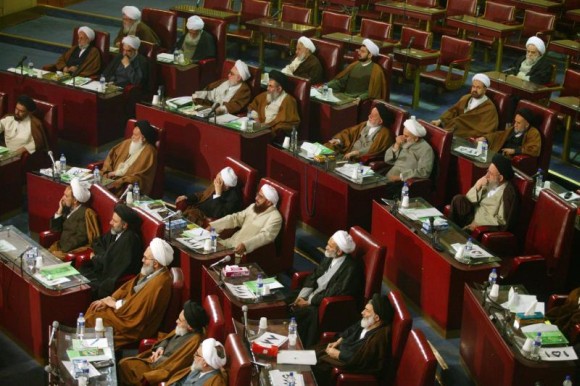
Leading clerics defy ayatollah on disputed Iran election

The most important group of religious leaders in Iran called the disputed presidential election and the new government illegitimate on Saturday, an act of defiance against the country’s supreme leader and the most public sign of a major split in the country’s clerical establishment.

A statement by the group, the Association of Researchers and Teachers of Qum, represents a significant, if so far symbolic, setback for the government and especially the authority of the supreme leader, Ayatollah Ali Khamenei, whose word is supposed to be final. The government has tried to paint the opposition and its top presidential candidate, Mir Hussein Moussavi, as criminals and traitors, a strategy that now becomes more difficult — if not impossible.

“This crack in the clerical establishment, and the fact they are siding with the people and Moussavi, in my view is the most historic crack in the 30 years of the Islamic republic,” said Abbas Milani, director of the Iranian Studies Program at Stanford University. “Remember, they are going against an election verified and sanctified by Khamenei.” [continued…]

Al Jazeera English launches in first major US cable market

The English-language cousin of the Qatar based news channel Al Jazeera launched yesterday in the Washington D.C. area after signing its first major U.S. cable deal with non-commercial MHz Networks last week.

The MHz deal means 2.3 million subscribers will now have access to the channel, adding to the 140 million households currently receiving Al Jazeera English worldwide.

Al Jazeera English is available in 40 countries, including Israel, but it’s the first time Al Jazeera English (AJE) has entered such a large US market, generally acknowledged as the world’s most important English-language cable market.

Previously, AJE had been available only in two U.S. markets – Burlington, Vermont and Toledo, Ohio, and cable networks in the U.S. had historically refused to carry the channel because of its association with Al Jazeera’s Arabic language news channel. [continued…]

Editor’s Comment — Great news that America’s Berlin Wall for the media is starting to crumble — though needless to say, there’s nothing to read about this in the US media. Are all the TV producers and news editors praying that if they keep quiet enough, Al Jazeera will die a quiet death in DC and never threaten the myopia and complacency that allows American journalism to operate so smoothly?

For those who contemptuously view AJE is some kind of news upstart that doesn’t need to be viewed too seriously, it’s worth noting that they already have 69 news bureaus around the world — more than the BBC or CNN! And they’re just about to add ten more.

Iran: on both sides the hawks circle, spoiling for a fight

The furore over Iran’s election has imperilled prospects for a diplomatic engagement between Tehran and Washington, on both sides of the equation. And as long as the White House remains under pressure from hawks in Washington and Israel to force an end to Iran’s uranium enrichment programme by any means possible, the weakening of prospects for diplomatic engagement raises the risk of war.

Barack Obama, to his credit, largely rebuffed calls to talk tough on Iran, recognising that empty rhetoric would only assuage feelings of impotence in the US while making things worse for the Iranian opposition. He maintained a realist’s disciplined focus on the key issues in the US-Iranian relationship: those where he may be in a position to influence the outcome, unlike the fate of the Iranian opposition, about which he can do little. Regardless of who wins Iran’s power struggle, Mr Obama will have to deal with them, first and foremost on the nuclear issue. [continued…]

Iran’s green wave

Just before midnight on a Friday evening a week before Iran’s much-disputed June 12 election, the initial tremors of the earthquake that has shaken the country to its core were palpable deep in south Tehran, a gritty, working-class section of the city with a reputation for being a stronghold of President Mahmoud Ahmadinejad.

Past shuttered shops and empty, debris-strewn sidewalks, a late-night stream of cars, trucks and motorcycles, engines revving, horns honking, roared along the wide boulevard. From open car windows emerged shouts and cheers, raised fists and hands brandishing posters of opposition contender Mir-Hossein Moussavi’s bearded, smiling visage. In the traffic ahead of us, a ramshackle open-air panel truck transported at least two dozen Ahmadinejad supporters clad in T-shirts, jeering at their opponents. As I traveled north from sprawling Imam Khomeini Square up to Ferdowsi Square and on the miles-long Vali Asr Street, the scene was similar. In a country not known for street politics, the tableau was stunning. My Iranian companion, an older man with years of experience in his country’s affairs, smiled and shook his head. “This is something new,” he said. [continued…]

Iran’s Ahmadinejad faces diplomatic isolation

Iranian President Mahmoud Ahmadinejad can in one instant appear the diplomatic equivalent of damaged goods and in the next a confident leader whose bellicose speeches leave the West wondering how to deal with him and his perplexing nation now that he’s won a much-disputed reelection.

Russian President Dmitry Medvedev publicly greeted Ahmadinejad at a recent meeting of the Shanghai Cooperation Organization, but did not grant him a private meeting as he had the leaders of Pakistan and Afghanistan. In Belarus, the Iranian leader was met not by President Alexander Lukashenko, but by the speaker of the upper house of parliament. [continued…]

Nuclear watchdog IAEA elects Japanese diplomat as its leader

After a months-long deadlock and half a dozen inconclusive votes, the world’s atomic energy watchdog on Thursday elected as its leader a Japanese diplomat described as colorless by foes and competent by allies.

Yukiya Amano, formerly Japan’s envoy to the International Atomic Energy Agency, or IAEA, will serve as director-general of the United Nations agency when Mohamed ElBaradei, an outspoken Egyptian diplomat, retires this year. [continued…]

A mother’s lament

If Newsweek correspondent Maziar Bahari were not being held in a Tehran prison without formal charges, without access to a lawyer, without being allowed to see even his mother, there would be no one better to tell the story of an Iranian like him and the tragedies that his family has suffered in the last few years.

“I don’t know when these terrible things are going to stop happening,” 83-year-old Molouk Bahari said, amazed, angry, and agonizing after Maziar was arrested at the family home in Tehran early on the morning of June 21. He is the last real emotional support left in her life. “He was doing nothing wrong. He was doing his job,” she said. “There is no reason for him to be held like this.” [continued…]

‘Iran trial’ for UK embassy staff

Some UK embassy staff detained in Tehran and accused of inciting protests after disputed elections will face trial, a top Iranian cleric says.

Guardians Council chief Ahmad Jannati said: “Naturally they will be put on trial, they have made confessions.” [continued…]

Trying to find a new road to his lost home

Most people, even in the Palestinian territories and in Israel, had never heard of Khaled Meshaal until Israeli Mossad agents attempted to assassinate him in Jordan one day in September, 1997.

The agents, bearing falsified Canadian passports, bungled the job and created an international incident. Outraged that the attack was carried out on his soil, King Hussein of Jordan responded by demanding, among other things, that Israel supply the antidote to the poison they had used.

In the aftermath, the world focused on the man at the centre of all the attention, who was then a senior figure in the militant Palestinian Hamas movement and is now at its helm.

Few Palestinians even today have met Mr. Meshaal, because he has lived outside the territory where he was born for 42 of his 53 years. But they are seeing more of him on television now, talking with Israel about a truce after the recent Gaza invasion, talking with the rival Palestinian Fatah party about reconciliation and – as of last week – talking to the Arab world about the future of the peace process. [continued…]

Facebooktwittermail

NEWS & VIEWS ROUNDUP & EDITOR’S COMMENT: July 2

Time for an Israeli strike?

With Iran’s hard-line mullahs and the Islamic Revolutionary Guard Corps unmistakably back in control, Israel’s decision of whether to use military force against Tehran’s nuclear weapons program is more urgent than ever.

Iran’s nuclear threat was never in doubt during its presidential campaign, but the post-election resistance raised the possibility of some sort of regime change. That prospect seems lost for the near future or for at least as long as it will take Iran to finalize a deliverable nuclear weapons capability.

Accordingly, with no other timely option, the already compelling logic for an Israeli strike is nearly inexorable. Israel is undoubtedly ratcheting forward its decision-making process. President Obama is almost certainly not. [continued…]

Editor’s Comment — As John Bolton watched events unfold in Iran over the last three weeks, one thought couldn’t escape his mind — in fact it’s the only thought that seems to inhabit his mind: now’s a good time to bomb Iran.

What he somehow managed to miss was that perceptions of Iran have not only changed around the rest of the world but also inside Iran-fearful Israel. As Zvi Bar’el wrote in Haaretz recently in an article ironically headlined “Which Iran would Israel bomb?“:

Suddenly, there appears to be an Iranian people. Not just nuclear technology, extremist ayatollahs, the Holocaust-denying Ahmadinejad, and an axis of evil. All of a sudden, the ears need to be conditioned to hear other names: “‘Mousawi’ or ‘Mousavi,’ how is it pronounced exactly?”; Mehdi Karroubi; Khamenei (“It’s not ‘Khomeini’?”). Reports from Iranian bloggers fill the pages of the Hebrew press. Iranian commentators – in contrast to Iranian-affairs commentators – are now the leading pundits. The hot Internet connection with Radio Ran (the Persian-language radio station in Israel) is the latest gimmick. And most interesting and important is that the commentary on what is taking place in Iran is not being brought to the public by senior intelligence officers, but via images transmitted by television.

Israel is now gaining a more intimate, accurate familiarity with the Iranian public. The demonstrations have made quite clear that there is not one Iran or even two, but rather a number of Irans. There is the Iran that belongs to those who screamed, “Death to America and to Israel,” and there is the Iran that screams, “Down with the dictator.”

So for Israelis Iran has evolved beyond pure nemesis.

Even so, let’s humor Bolton’s imagination a little and suppose that the Israeli strike he’s picturing goes stunningly well and Iran’s nuclear program is crippled with minimal loss of life. What happens then inside Iran? How much traction is Bolton’s public diplomacy campaign going to get — that is, the message that the bombs were aimed at the regime, not the people?

The answer is simple: the regime will have its own public diplomacy campaign. Do you support your nation or are you in sympathy with the Zionist-entity and its American supporters?

An are-you-for-us-or-against-us? campaign worked well enough for George Bush and Dick Cheney, even though those of us who rejected their rallying cry had little fear of being jailed, beaten up or shot for simply protesting. For Ayatollah Khamenei and Mahmoud Ahmadinejad, equipped as they are with crude but effective means to enforce the same message, its acceptance — heartfelt or otherwise — is sure to be near universal. The Iranian government will be rewarded by spectacular displays of national solidarity. The rifts that are now open wide will not be healed but they will most effectively be buried.

Whether an Israeli strike would be successful in crippling Iran’s nuclear program is debatable; that it would profoundly undermine Iran’s reformist movement should be beyond question.

And then there’s another small detail that Bolton forgot to mention: Is an Israeli government that regards itself as being under “withering pressure” and is “being driven to its knees” by the Obama administration on the issue of settlements, about to turn around and bomb Iran? Not unless it gets a green light from the White House. And that’s the one thing Bolton is realistic enough to understand is not about to happen.

Israel’s ready to bomb Iran? Only in your dreams Mr Bolton.

The irresistible illusion

We are accustomed to seeing Afghans through bars, or smeared windows, or the sight of a rifle: turbaned men carrying rockets, praying in unison, or lying in pools of blood; boys squabbling in an empty swimming-pool; women in burn wards, or begging in burqas. Kabul is a South Asian city of millions. Bollywood music blares out in its crowded spice markets and flower gardens, but it seems that images conveying colour and humour are reserved for Rajasthan.

Barack Obama, in a recent speech, set out our fears. The Afghan government

is undermined by corruption and has difficulty delivering basic services to its people. The economy is undercut by a booming narcotics trade that encourages criminality and funds the insurgency . . . If the Afghan government falls to the Taliban – or allows al-Qaida to go unchallenged – that country will again be a base for terrorists who want to kill as many of our people as they possibly can . . . For the Afghan people, a return to Taliban rule would condemn their country to brutal governance, international isolation, a paralysed economy, and the denial of basic human rights to the Afghan people – especially women and girls. The return in force of al-Qaida terrorists who would accompany the core Taliban leadership would cast Afghanistan under the shadow of perpetual violence.

When we are not presented with a dystopian vision, we are encouraged to be implausibly optimistic. ‘There can be only one winner: democracy and a strong Afghan state,’ Gordon Brown predicted in his most recent speech on the subject. Obama and Brown rely on a hypnotising policy language which can – and perhaps will – be applied as easily to Somalia or Yemen as Afghanistan. It misleads us in several respects simultaneously: minimising differences between cultures, exaggerating our fears, aggrandising our ambitions, inflating a sense of moral obligations and power, and confusing our goals. All these attitudes are aspects of a single worldview and create an almost irresistible illusion.

It conjures nightmares of ‘failed states’ and ‘global extremism’, offers the remedies of ‘state-building’ and ‘counter-insurgency’, and promises a final dream of ‘legitimate, accountable governance’. The path is broad enough to include Scandinavian humanitarians and American special forces; general enough to be applied to Botswana as easily as to Afghanistan; sinuous and sophisticated enough to draw in policymakers; suggestive enough of crude moral imperatives to attract the Daily Mail; and almost too abstract to be defined or refuted. [continued…]

Pakistan plays dangerous double game

The assassin struck shortly after morning prayers, storming into a room at the compound where Qari Zainuddin was staying and opening up with a volley of fire. The militant leader was rushed to a nearby hospital but declared dead. Meanwhile, the gunman – apparently dispatched by Taliban leader Baitullah Mehsud – escaped in a waiting car.

The following day, in a cemetery of Muslim and Christian graves encircled by fields of maize, the 26-year-old, who in recent months had pitched himself against Mr Mehsud, was buried. The militant leader’s funeral was notable for two things. Firstly the town was filled with checkposts manned by both Taliban and Pakistani security personnel. Secondly, when the dead man’s brother, Misabhuddin, vowed to reporters that he would take revenge against Mr Mehsud, he also let slip something else. “Jihad against America and its allies in Afghanistan will continue as well,” he said.

The killing last week of Mr Zainuddin, who had been staying in a compound provided by the country’s ISI security agency, has opened a window on a complicated, controversial and perilous element of the battle against militants inside Pakistan. Mr Zainuddin, himself a Taliban leader who supported al-Qa’ida and jihad against Western troops in Afghanistan, had recently been recruited by the Pakistani authorities to join their battle to kill Baitullah Mehsud, who has emerged as the country’s deadliest militant. In essence, Islamabad is recruiting anti-American fighters to bolster a joint US-Pakistani operation.

The arrangement underlines the competing strategic priorities in the region for Pakistan and the US, even as their leaders opt in public for the language of common interests and shared enemies. “Pakistan just wants to concentrate on the Pakistani Taliban. They do not want to go after the Afghan Taliban,” said Giles Dorronosoro, a regional expert at the Carnegie Endowment. “The US wants to put the Pakistan-Afghanistan border under control. They have totally different goals. And the issue is not resolvable.” [continued…]

Growing gulf between U.S. and Israeli Jews on Obama

He swept to power with the support of 78% of American Jews. But has Barack Obama become the bane of Israeli Jews?

A gulf between American and Israeli Jews was evident even before Obama moved into the White House. Just a third of Israelis would have endorsed him had they been allowed to vote, polling indicated, while almost half would have chosen John McCain.

In recent weeks, several public opinion surveys have suggested that Obama’s popularity has dropped far below this already low point. A Jerusalem Post-commissioned poll released on June 19 reported that only 6% of Jewish Israelis consider his views pro-Israel.

To Rafi Smith, head of the polling firm that conducted the survey, it is clear what is happening. Israelis, he said, see Obama “as the opposite of George Bush, who was perceived as the biggest friend of Israel. Obama is seen as a 180-degree turn.” [continued…]

Hussein pointed to Iranian threat

Saddam Hussein told an FBI interviewer before he was hanged that he allowed the world to believe he had weapons of mass destruction because he was worried about appearing weak to Iran, according to declassified accounts of the interviews released yesterday. The former Iraqi president also denounced Osama bin Laden as “a zealot” and said he had no dealings with al-Qaeda.

Hussein, in fact, said he felt so vulnerable to the perceived threat from “fanatic” leaders in Tehran that he would have been prepared to seek a “security agreement with the United States to protect [Iraq] from threats in the region.”

Former president George W. Bush ordered the invasion of Iraq six years ago on the grounds that Hussein possessed weapons of mass destruction and posed a threat to international security. Administration officials at the time also strongly suggested Iraq had significant links to al-Qaeda, which carried out the Sept. 11, 2001, attacks on the United States. [continued…]

How to deal with America’s empire of bases

The U.S. Empire of Bases — at $102 billion a year already the world’s costliest military enterprise — just got a good deal more expensive. As a start, on May 27th, we learned that the State Department will build a new “embassy” in Islamabad, Pakistan, which at $736 million will be the second priciest ever constructed, only $4 million less, if cost overruns don’t occur, than the Vatican-City-sized one the Bush administration put up in Baghdad. The State Department was also reportedly planning to buy the five-star Pearl Continental Hotel (complete with pool) in Peshawar, near the border with Afghanistan, to use as a consulate and living quarters for its staff there.

Unfortunately for such plans, on June 9th Pakistani militants rammed a truck filled with explosives into the hotel, killing 18 occupants, wounding at least 55, and collapsing one entire wing of the structure. There has been no news since about whether the State Department is still going ahead with the purchase.

Whatever the costs turn out to be, they will not be included in our already bloated military budget, even though none of these structures is designed to be a true embassy — a place, that is, where local people come for visas and American officials represent the commercial and diplomatic interests of their country. Instead these so-called embassies will actually be walled compounds, akin to medieval fortresses, where American spies, soldiers, intelligence officials, and diplomats try to keep an eye on hostile populations in a region at war. One can predict with certainty that they will house a large contingent of Marines and include roof-top helicopter pads for quick get-aways. [continued…]

Facebooktwittermail

NEWS & VIEWS ROUNDUP: July 1

Opposition leaders court arrest by defying ‘unlawful Iranian regime’

Three of Iran’s most prominent opposition leaders flagrantly courted arrest yesterday by denouncing President Ahmadinejad’s Government as illegitimate, one day after the regime said that it would tolerate no more challenges to the election result.

Mir Hossein Mousavi, the former Prime Minister who lost the election, said that the suppression of dissent was tantamount to a coup. “It’s not yet too late,” he declared on his website. “It is our historical responsibility to continue our protests to defend the rights of the people . . . and prevent the blood spilt by hundreds of thousands of martyrs from leading to a police state.”

Ayatollah Mohammed Khatami, 65, a popular former President, accused the regime of mounting a “velvet revolution against the people and democracy” and called the security crackdown “poisonous”.

Mehdi Karroubi, 72, another defeated presidential candidate, said that “visible and invisible forces blocked any change in the executive power”. He added: “I will continue the fight under any circumstances and using every means.” The regime responded by shutting down his newspaper. [continued…]

Mousavi to disclose tell-all documents

As the Iranian opposition continues to express skepticism about the election result, defeated candidate Mir-Hossein Mousavi says he will present documents that prove electoral fraud.

Mousavi, who has rejected the result of Iran’s presidential election as fraudulent, said on Wednesday that a number of Iranian scholars are set to form a committee to preserve the vote of the people.

The committee aims to “make public documents proving fraud and irregularities in the election,” Mousavi said in his latest statement issued on Wednesday. [continued…]

Time for Obama to make a course correction

Demonstrations may have disappeared from Tehran’s streets of shame, but Iranian acceptance is at an all-time low. The government is now illegitimate. Power has been usurped. The equation has changed.

I think Mahmoudi’s right. Khamenei and Ahmadinejad may begin to unclench their fist, as isolation and sullen defiance grow, in a bid to deliver what they would not allow the reformists to initiate: détente with America.

Obama must leave them dangling for the foreseeable future. He should refrain indefinitely from talk of engagement.

To do otherwise would be to betray millions of Iranians who have been defrauded and have risked their lives to have their votes count. To do otherwise would be to allow Khamenei to gloat that, in the end, what the United States respects is force. To do otherwise would be to embrace the usurpers.

The slow arc of moral justice is fine but Iran is gripped by the fierce urgency of now. Obama, the realist on whom idealism is projected, is obliged to make a course correction. [continued…]

Europe weighs pulling envoys from Tehran

Iran risked diplomatic isolation from the European Union, as European officials discussed whether to withdraw the ambassadors of all 27 member nations in a dispute over the detention of the British Embassy’s Iranian personnel.

European diplomats said Wednesday that they had made no formal decision to order their envoys home, but that the measure was an option as the European Union — Iran’s biggest trading partner — tried to work out how to defuse the dispute in a way that would shield other embassies in Tehran from similar action.

Withdrawing all 27 ambassadors would be a rare and unusually forceful display of European anger at Iran’s crackdown on dissent after the June 12 presidential election, and several diplomats said the European Union would prefer to avoid such a move. [continued…]

Witness to Neda’s death to be prosecuted

Fars News Agency in Persian on 1 July 2009 reports that the commander of the Law Enforcement Force said: Arash Hejazi who as the witness of the murder of Neda Aqa-Soltan has created uproar is being prosecuted by the International Police (Interpol).

Speaking to a gathering of reporters, General Esma’il Ahmadi-Moqaddam added: Arash Hejazi is being prosecuted by the Ministry of Intelligence and Interpol forces.

He stressed: The murder of Neda Aqa-Soltan is a scenario which has no links to Tehran’s riots.

Arash Hejazi, the doctor who was present at Neda Aqa-Soltan’s murder scene, has held certain sensational interviews with foreign media on this murder case after departing the country. [continued…]

Facebooktwittermail

NEWS & VIEWS ROUNDUP: June 30

Neda in Palestine, sentenced to die alone

For over a week, major American news outlets have broadcast on a virtual loop the video of the killing of Neda Agha-Soltan, an unarmed 26-year-old Iranian woman, by Iranian security services. The poignant footage of Neda dying before a throng of grief-stricken bystanders crystallized the vulnerability experienced by the millions of demonstrators who have filled cities across Iran to confront authoritarian forces determined to suppress their voice through brutal means. When the mainstream American press chose to broadcast the graphic video — as moving as the footage is, it is difficult to watch — it made a commendable decision that nonetheless highlighted its hypocritical attitude towards Palestinians who resist Israeli occupation on a daily basis, and who often meet the same fate as Neda. [continued…]

Israel’s man of conscience

My name is Ezra Nawi. I am a Jewish citizen of Israel.

I will be sentenced on the first of July after being found guilty of assaulting two police officers in 2007 while struggling against the demolition of a Palestinian house in Um El Hir, located in the southern part of the West Bank.

Of course the policemen who accused me of assaulting them are lying. Indeed, lying has become common within the Israeli police force, military and among the Jewish settlers.

After close to 140,000 letters were sent to Israeli officials in support of my activities in the occupied West Bank, the Ministry of Justice responded that I “provoke local residents.”

This response reflects the culture of deceit that has taken over all official discourse relating to the Occupied Palestinian Territories.

After all, was I the one who poisoned and destroyed Palestinian water wells?

Was I the one who beat young Palestinian children?

Did I hit the elderly?

Did I poison the Palestinian residents’ sheep?

Did I demolish homes and destroy tractors?

Did I block roads and restrict movement?

Was I the one who prevented people from connecting their homes to running water and electricity?

Did I forbid Palestinians from building homes? [continued…]

The settlers defying Obama

At first glance, the dusty dunes of the South Hebron hills appear splendidly frozen in time. Small encampments of nomadic farmers are dotted across the landscape, sparse groves of olive and fruit trees surrounding the ramshackle tents huddled together in their midst. Flocks of sheep and goats graze on the scrubby foliage under the watchful eye of teenaged shepherds; the silence of the plains is breathtaking, the only noise an occasional cautionary bark from the villagers’ ever-vigilant guard dogs.

But the glorious isolation in which the rural communities seem to dwell is an illusory facade. A closer look at the way their camps are arranged reveals the true picture of modern life on the land they’ve tended for generations. Soldiers stand guard in pairs at strategic spots on the hillside, enforcing the no-entry zones surrounding the rash of settlements spread across the region, the mini-towns growing bigger by the month, swallowing up more and more of the Palestinians’ land in the zero-sum game eternally stacked in the settlers’ favour. [continued…]

Israel’s settlements are on shaky ground

The debate over Israeli settlements in the occupied Palestinian territories is often framed in terms of whether they should be “frozen” or allowed to grow “naturally.” But that is akin to asking whether a thief should be allowed merely to keep his ill-gotten gains or steal some more. It misses the most fundamental point: Under international law, all settlements on occupied territory are unlawful. And there is only one remedy: Israel should dismantle them, relocate the settlers within its recognized 1967 borders and compensate Palestinians for the losses the settlements have caused.

Removing the settlements is mandated by the laws of the Geneva Convention, which state that military occupations are to be a temporary state of affairs and prohibit occupying powers from moving their populations into conquered territory. The intent is to foreclose an occupying power from later citing its population as “facts on the ground” to claim the territory, something Israel has done in East Jerusalem and appears to want to do with much of the West Bank. [continued…]

Israel OKs West Bank construction

Israel said Monday it authorized the construction of 50 new residential units in a West Bank settlement, defying rising pressure from the U.S. and the international community for a building freeze in territory claimed by the Palestinians as part of a future state.

The expansion of Adam, a settlement near Jerusalem surrounded by three Palestinian villages, is part of a defense ministry plan to relocate 300 residents of the unauthorized hilltop outpost of Migron. [continued…]

Iran: The whole world is watching

Four decades ago, when police and national guardsmen attacked protestors at the Democratic National Convention in Chicago, the protesters shouted, “The whole world is watching.”

However arresting those images were, they could not possibly compare to the flood in recent weeks of YouTube videos, Flickr photos, Twitter tweets, Facebook pages, and blogs dedicated to events in Iran. Today, the world is not only watching — in an important way it is participating, as observers dig down for their own raw footage, reporting, and analysis pouring out of Iran.

It is easy to be swept up by all of these images coming out of Iran and think that the days of dictatorship — in Iran and the rest of the world — are numbered. Overnight, normally innocuous social networking tools swiftly turned political, and local events found international audiences mere instants after they occur.

That prompted Verizon’s CEO, Ivan Seidenberg, to exult on the Charlie Rose Show this week that Iran’s efforts to manage public sentiments via restricting Internet access was a losing proposition. “The power of the people will override that without any question,” he said. “And it’ll happen sooner than they think, because the technology is just too pervasive.”

If only that were true. The way the outside world sees Iranian protests is markedly different from the way Iranians themselves do, and the government is increasingly asserting its authority over the information space in the country. While many in the West see a potential revolution in Technicolor, the green banners of opposition activists from the election campaign are quickly fading to black. [continued…]

Why do Arabs not revolt?

The stark contrast between the street demonstrations in Iran in the past two weeks and the absence of any such popular revolts in the Arab world during the past half-century is more than just fascinating in terms of political anthropology. A major question that hangs over the Arab world like a ton of bricks is: Why do the top-heavy, non-democratic political control and governance systems of the Arab world persist without any significant popular opposition or public challenge?

The events in Iran — the second major popular rebellion in the past 30 years — accentuate the relative quiescence in the Arab world, but this is not for lack of grievances among Arabs. The same pressures and indignities that annoy many Iranians and push them to openly challenge their rulers are prevalent throughout much of the Arab world: [continued…]

Facebooktwittermail

Pepe Escobar: Requiem for a revolution


More at The Real News

Requiem for a revolution

If this military dictatorship of the mullahtariat continues to appease its working-class support base with a little redistribution of oil revenues, they can stay in power for a long time.

The West may try to boycott them – but not Russia and China, as both made it clear in no time. Both are the driving force of the Shanghai Cooperation Organization (SCO), of which Iran is an observer and sooner, rather than later, will be a member. Iran’s oil and gas are absolutely crucial to Europe – not to mention Asia. Nobody’s going to embargo Iran’s oil exports. So the military dictatorship of the mullahtariat will be able to repress and suppress whatever comes its way, using or not using Shi’ite eschatology to justify it.

There are echoes of the former Soviet Union in all of this. But what happened in the streets is more like Prague 1968 – and not the turbulence before the death of communism in 1989. In the end, the revolution was not YouTubed and Twittered simply because there was no revolution. The army – the IRGC – didn’t support the people. And the bazaari merchants and the oil and gas industry workers didn’t go on strike.

People were angry because they felt their vote had been stolen: there was nothing ideological about that. When they took to the streets they made clear that they wanted a better economy, less unemployment, a less stifling regime, a little more freedom of speech and of dress for women, less fiery rhetoric from Ahmadinejad, in sum, a better life. But on the other side of the spectrum there were the millions of pious Basiji – who are very happy with the meager and shabby existence the revolution grants them and who remain deeply, deeply alienated from Western culture.

This doesn’t mean this was a Gucci, YouTube, Twitter uprising of the petit-bourgeoisie. It’s easy to fall into this temptation as the people in the streets of Tehran were supported by the West en masse. But to believe that Iran’s national interest and the aspirations of the excluded Iranian masses will be defended by this new military dictatorship of the mullahtariat is to completely miss the point. [continued…]

Facebooktwittermail

NEWS & VIEWS ROUNDUP: June 29

Is Khamenei controlled by the Revolutionary Guards?

There are many different ways to look at the developments in Iran. One perspective that seems to have been ignored is what I regard as the cardinal role of the Revolutionary Guards.

Over the 20 years that Ayatollah Khamenei has been the rahbar, or leader, he has allied himself ever more closely with the Revolutionary Guards—to such an extent that it is no longer apparent to me who is leading and who is following. The Revolutionary Guards have been granted extraordinary influence over all functions of the Islamic republic—military, political, economic, and even Islamic. Technically, they take their orders from the leader, but has he ever dared to contradict them? On the contrary, he seems always to court them by granting them ever-greater influence and responsibilities. [continued…]

Iran Revolutionary Guards amass power while backing Ahmadinejad

The 125,000-strong Guards Corps was created by Iran’s clerical rulers after the 1979 Islamic Revolution. Its influence has grown under Ahmadinejad, himself a guards veteran, said Michael Eisenstadt, a senior analyst at the Washington Institute for Near East Policy.

Eight of the 21 posts in the president’s cabinet are held by former members, according to Ali Alfoneh, an analyst at Washington’s American Enterprise Institute. Among them are Interior Minister Sadeq Mahsouli, whose agency ran the election, and Defense Minister Mostafa Mohammad-Najjar.

Another five places are occupied by past Basij commanders. The state broadcasting arm is headed by Ezzatollah Zarghami, a former guard. At least one-third of Iran’s parliament members are former guards, according to Nader.

Under Ahmadinejad’s predecessor, Mohammad Khatami, 65, only three ministers had belonged to the guards or Basij. [continued…]

The Islamic Revolution faces the classic dilemma of all revolutions

Between 1979, the year of the Islamic revolution, and 1999, Iran’s population doubled to 65 million, two-thirds of them under 25 years of age. Those young Iranians had no direct experience or memory of the pre-Islamic regime of the Shah — its inequities and injustices, and its subservient relationship with Washington. Therefore, their commitment to the Islamic regime was less than total. Moreover, the post-revolutionary educational system had proven inadequate when it came to socializing them the way the republic’s religious leaders wanted.

During those two decades, Iran’s student body increased almost threefold, to 19 million. The overall literacy rate jumped from 58% to 82%, with the figure for females — 28% in 1979 — tripling. There was a remarkable upsurge in the enrollment of women in universities. Nationally, their share of university student bodies shot up to 60%. At prestigious Tehran University, they were a majority in all faculties, including science and law.

The total of university graduates, which stood at 430,000 in 1979, grew nine-fold in those years. As elsewhere in the world, university students and graduates would become a vital engine for change. [continued…]

Khamenei uses the Cheney torture methods

With the distressing news of so many democracy activists being rounded up by the Iranian regime, the specter of torture for false confessions emerges. The confessions “prove” that the demonstrations were entirely a function of a foreign plot. And, more to the point, the torture techniques include those adopted and championed by the neocon right in the US. Among the Cheney techniques that are used by the Khemenai regime are sleep deprivation, forced nudity, beatings, solitary confinement, and stress positions. [continued…]

Torture in Iran – 60 Minutes, April 9, 2009

Will Iran take the heat off Israel over settlements?

Iran has now forced its way back to the top of the White House agenda, as a result of Tehran’s violent crackdown on its own citizens protesting claims of election fraud. The domestic political pressure on the Administration to take a tougher stand against Iran’s regime may actually help Netanyahu resist pressure for a settlement freeze. After all, the President may find it difficult, in Washington, to muster pressure on Israel over settlements at a moment when he’s being berated for speaking too softly on Tehran’s crackdown. Members of Congress are now proposing new sanctions legislation and even demanding hearings on U.S. policy toward Tehran. And that’s exactly the conversation that Netanyahu wants dominating the nation’s capital. [continued…]

Israel May Shift an infinitely short distance on settlements freeze amid broader effort

Israel would be open to a complete freeze of settlement building in the West Bank for three to six months as part of a broad Middle East peace endeavor that included a Palestinian agreement to negotiate an end to the conflict and confidence-building steps by major Arab nations, senior Israeli officials said Sunday.[…]

The officials who spoke of the prospect of a temporary freeze said the issue was explosive in Israel, so they were not prepared to have their names publicly associated with the idea at this stage. But they spoke with clear authority. They calculated that about 2,000 buildings were going up in West Bank settlements now and said that they would be completed under their proposal, but nothing new would start. They also said that if broader peace efforts came to naught, the building would start up again. [continued…]

Editor’s Comment — There comes a point where clear language has been so thoroughly and persistently abused and avoided that the only means left for communication are non-verbal. If Barak is actually on his way to Washington with this as his offer, then the White House should turn the humiliation dial up a few more more notches from the recently canceled meeting between Netanyahu and Mitchell in Paris. At that point the Israelis were told there was no point sending Mitchell until Netanyahu had “finished his homework” on halting settlements. This time around perhaps Barak’s meeting should be canceled while he’s midway across the Atlantic.

What a freeze can’t do

[Rahm] Emanuel’s view is that settlements are not a security issue for Israel but a domestic political problem. According to a senior White House official, Emanuel has argued that if the Israelis insist on expanding settlements, “You’re doing it on your own dime. We don’t want our credibility to be compromised as you work out your domestic politics. We’re not going to pay for that one.”

What has surprised the Israelis, says the White House official, is that “for umpteen years, they’ve been trained to hear one thing from America on settlements but see us do another. It takes some adjustment.”

The White House believes that if it comes to a showdown, Netanyahu will compromise. His coalition government, the administration reasons, is too weak to sustain an open break with its key ally, the United States. If Netanyahu defies the United States, his coalition will splinter. The administration is already talking with Ehud Barak, the Labor Party leader and defense minister, who might form a new government if Netanyahu falls.

It’s a hardheaded strategy, but it has one big flaw: The Obama team is assuming that if it can pressure Israel into a real settlements freeze, the Arabs will respond with meaningful moves toward normalization of relations — which will give Israel some tangible benefits for its concessions. But that hope appears to be misplaced. [continued…]

Walking miles in Palestinian feet

What is a world where you cannot go for a walk, cannot assemble to read and discuss literature in public, cannot be certain of visiting your grandmother in a neighboring city? What is a world where you cannot lose your temper, cannot laugh in the wrong place? (Imagine, if you will, living your entire life in the security line at the airport, on a bad day.) For us, the French and British consulates opened their doors; but they can’t always do so for the Palestinians. [continued…]

Gaza residents ‘live in despair’

The International Committee of the Red Cross has described the 1.5 million Palestinians living in Gaza as people “trapped in despair”.

In a report, it said that a main cause was the continuing Israeli blockade.

The report comes six months after the end of Israel’s military offensive in Gaza in which at least 1,100 Palestinians died. [continued…]

Facebooktwittermail

Ayatollah Taleghani’s prescient warning

Ayatollah Taleghani’s warning about the return of despots

“If things go the way they are, despots will rule over us. If we don’t appreciate this free and peaceful environment and create an environment of trickery, an environment full of suffering and chaos, just like the Koran mentions, the result will be the appearance of despots…”

Ayatollah Taleghani was one of the leaders of the Islamic revolution. He died in September 1979, a few months after the fall of the Shah.

Facebooktwittermail

NEWS & VIEWS ROUNDUP: June 27

What will be the legacy of the Green Revolution?

Exiled opposition groups, whose political agenda sharply differs from that of the protesters in Iran — indeed, many of these groups urged people not to vote in the elections — have sought to fill the vacuum left by a beheaded and directionless indigenous movement. Though the outrage of these exiled groups against the Iranian government’s brutal violence is genuine, their efforts to impose themselves on the political scene have caused great frustration among opposition elements inside Iran. At a time when the movement in Iran is paralyzed, efforts by exiled groups — groups that scorned the protesters only weeks ago for choosing to participate in the elections — to fill the leadership vacuum are viewed as nothing less than a maneuver to hijack the movement.

This is playing right into the hands of the Ahmadinejad government, precisely because it would weaken, if not eliminate, the indigenous movement’s trump card: its ability to attract the Iranian swing-voters back to its side. If the exiled opposition groups and their neo-conservative backers in the United States prevail in aiding the Ahmadinejad government, what started out as the largest Iranian mass movement since 1979 may end up as little more than the student demonstrations of 1999. Which is to say, an instance of hopes raised, then dashed. [continued…]

Mousavi reportedly under house arrest

The government crackdown in Iran has moved so quickly and brutally the protests have been forced into near silence.

The Web site gooya.com reports that opposition leader Mir Hossein Mousavi is under house arrest, although that claim could not be verified.

The well-known Iranian filmmaker Moshen Makhmalbaf, who has become an unofficial spokesman for Mousavi outside of Iran, told ABC News that Mousavi is being highly controlled and is limited in whom he can meet with and where he can go.

On his Facebook page Mousavi, who analysts say is under intense pressure, posted a message in Farsi, English and French telling his followers: “All my communication with the people and you has been cut off, and people’s peaceful objections are being crushed.”

He also urged his supporters to protest using only “legal channels” and to remain “faithful to the sacred system of the Islamic Republic.” [continued…]

Night raids terrorize civilians

A middle-aged resident from Vanak neighborhood gave Human Rights Watch an overview of his participation each day in the protests. He explained that by June 22, virtually the only form of protest still available to him wasto shout slogans from his rooftop at night. But then the Basiji came to attackhis neighborhood.

“On June 22, while we were shouting ‘Allahu Akbar’ from the rooftops, the only form of protests we could still undertake, the Basiji entered our neighborhood and started firing live rounds into the air, in the direction of the buildings from which they believe the shouting of ‘Allahu Akbar’ is coming from. I didn’t see any rounds hitting our buildings. Shortly thereafter, my cousin arrived at our apartment. He was very shaken. The Basijis had entered their house in Yousef Abad neighborhood,and they had destroyed their doors and destroyed cars in the street.

“There are many things happening that aren’t being reported [in the media]. In every neighborhood of Tehran, people are talking about how the Basijis and other security services are coming into their houses and are terrorizing people for shouting ‘Allahu Akbar’ from the rooftops, and for congregating.” [continued…]

Role of women in Iran protest kindles hope

Over the past two weeks, Marcelle George has watched with amazement as legions of Iranian women, most wearing black, full-length Islamic garments, defiantly protested Iran’s leadership.

Even in her native Egypt, where some opposition to the government is permitted, most women would never dare cross that line.

“To actually see Iranian women fight for their rights is inspiring,” said George, a college student in jeans and a long-sleeve blouse. “I never imagined that it could happen there.” [continued…]

U.S. grants support Iranian dissidents

The Obama administration is moving forward with plans to fund groups that support Iranian dissidents, records and interviews show, continuing a program that became controversial when it was expanded by President Bush.

The U.S. Agency for International Development (USAID), which reports to the secretary of state, has for the last year been soliciting applications for $20 million in grants to “promote democracy, human rights, and the rule of law in Iran,” according to documents on the agency’s website. The final deadline for grant applications is June 30.

U.S. efforts to support Iranian opposition groups have been criticized in recent years as veiled attempts to promote “regime change,” said Trita Parsi, president of the National Iranian American Council, the largest Iranian-American advocacy group. The grants enable Iran’s rulers to paint opponents as tools of the United States, he said. [continued…]

What will happen when U.S. combat troops withdraw?

So, is all hell about to break loose in Iraq?

By June 30, all U.S. combat troops are scheduled—in fact, they’re required—to be withdrawn from all of Iraq’s cities, towns, and villages.

Many Americans and Iraqis fear that the progress achieved in the last couple of years—the dramatic reduction of violence and casualties, the growing sense of security in areas that were once soaking with dread and bloodshed—will be eroded and reversed, perhaps completely.

The rise in spectacular suicide bombings in the last few weeks—as U.S. soldiers have stepped up their retreat to large bases in the outskirts—is widely seen as the shape of things to come. [continued…]

Facebooktwittermail

NEWS & VIEWS ROUNDUP & EDITOR’S COMMENTS: June 26

The revolution will not be digitized


What happened in Baharestan Square on Wednesday? According to a woman who called in to CNN, Iranian security forces unleashed unimaginable brutality upon a few hundred protesters gathered in central Tehran. “They beat a woman so savagely that she was drenched in blood, and her husband, who was watching the scene, he just fainted,” the anonymous caller screamed into the phone. “This was—this was exactly a massacre. You should stop this. You should stop this. You should help the people of Iran who demand freedom. You should help us.”

Clips of the phone call ricocheted across the Web and cable TV. The message was corroborated on Twitter, where a post by @persiankiwi brought horrific news from Baharestan Square: “we saw militia with axe choping ppl like meat – blood everywhere – like butcher – Allah Akbar.”* News organizations around the world told of a brutal crackdown—Iran’s Tiananmen. But at the same time, other reports suggested the rally was a far tamer encounter. A reader on the New York Times’ Lede blog wrote in to say that the protest had been cleared by security forces with minimal violence. The blog of the National Iranian American Council, which has been closely following all the news out of Tehran, published a report from a “trusted source” who said that while the rally was “tense,” it didn’t match the CNN caller’s account. “The moment we stood in one place, they would break us up,” the source wrote. “I saw many people get blindfolded and arrested, however it wasn’t a massacre.”

Over the last couple of weeks, those who believe in the transformative powers of technology have pointed to Iran as a test case—one of the first repressive regimes to meet its match in social media, the first revolution powered by Twitter. Even in the early days of the protest, that story line seemed more hopeful than true, as Slate’s Jack Shafer, among many others, pointed out. Since last week, though, when the state began to systematically clamp down on journalists and all communications networks leading out of the country, hope has become much harder to sustain. The conflicting accounts about what happened at Baharestan Square are evidence that Iran’s media crackdown is working. The big story in Iran is confusion—on a daily basis, there are more questions than answers about what’s really happening, about who’s winning and losing, about what comes next. The surprise isn’t that technology has given protesters a new voice. It’s that, despite all the tech, they’ve been effectively silenced. [continued…]

How quarreling Ayatullahs affect Iran’s crisis

One leading conservative ayatullah declared, during Friday prayers at Tehran University, that people protesting Iran’s election are waging war on God. Ayatullah Ahmad Khatami demanded that those calling for demonstrations be “ruthlessly and savagely” punished. Yet, just a day earlier, one of the country’s most senior mullahs, Grand Ayatullah Hussein-Ali Montazeri — a longtime liberal critic of the regime — branded the authorities’ response to the electtion protests un-Islamic. And a second leading conservative theologian, Grand Ayatollah Nasser Makarem-Shirazi, called for the dispute over the election to be resolved through “national conciliation.”

To an outside world accustomed to viewing Iranian politics as a conclave of like-minded mullahs, the current turmoil within Iran’s political and religious establishment defies explanation. The conflict between two regime insiders, President Mahmoud Ahmadinejad and his challenger Mir-Hossein Mousavi, has created the most profound political crisis in the Islamic Republic’s 30-year history. Both men proclaim their fealty to the ideals of the 1979 Islamic revolution; both claim the backing of senior clergy; and both appeal to Iranians’ sense of Shia justice to rally support.

The fact that such discord is possible among factions who all claim allegiance to the principle of guidance by the clergy is rooted in the distinct nature of Shi’ite Islam. Shi’ism differs from the Sunni tradition in a handful of important ways — not only in its belief in who was the legitimate heir to the Prophet Muhammad’s leadership of the community of the faithful after his death, but also in its attitudes toward political authority and devotion. But one of the most important differences is the Shi’ite tradition’s unique practice of ijtihad — the use of independent reasoning to pass new religious rulings. While Sunni Islam effectively abandoned ijtihad in the tenth century, the practice remained an essential core of Shi’ism. The result is that virtually every aspect of Shi’a doctrine, from the principle of clerical rule to minute matters of religious observance, is open to differing interpretation, and has been debated throughout history. [continued…]

A deal to save Iran?

Reliable sources in Iran are suggesting that a possible compromise to put an end to the violent uprising that has rocked Iran for the past two weeks may be in the works. I have previously reported that the second most powerful man in Iran, Ayatollah Hashemi Rafsanjani, the head of the Assembly of Experts (the body with the power to choose and dismiss the supreme leader) is in the city of Qom—the country’s religious center—trying to rally enough votes from his fellow assembly members to remove the current supreme leader, Ayatollah Ali Khamenei from power. News out of Iran suggests that he may be succeeding. At the very least, it seems he may have gained enough support from the clerical establishment to force a compromise from Khamenei, one that would entail a runoff election between Mahmoud Ahmadinejad and his main reformist rival Mir Hossein Mousavi. [continued…]

Editor’s Comment — The rumor that the Assembly of Experts might play a decisive role in forging a compromise or even unseating Khamenei has been floating around for some time.

Ahmad Ghabel, an exiled dissident, scoffs at the suggestion:

…do really think that members of the Council of Experts, who have had to pass through the extreme filter of the Guardian Council, particularly the exceptionally harsh filtering that is exercised in case of the Council of Experts, have the ability or courage to question the competence of the supreme leader? Given how brutally they [the coup makers] have been able to crackdown on everyone under current circumstances, with such a high turnout in the elections, what do you expect from a few senile men without any serious public backing?

Mir-Hossein Mousavi slams Iran’s leaders

After days of relative quiet, the candidate defeated in Iran’s disputed presidential election launched a broadside Thursday against the nation’s leadership, an indication that the country’s political rift is far from over.

In his statement, Mir-Hossein Mousavi issued a rare attack on supreme leader Ayatollah Ali Khamenei, accusing him of not acting in the interests of the country, and said Iran had suffered a dramatic change for the worse. [continued…]

NSC names Ross senior director

The White House sought for the first time Thursday to answer basic questions about a key player in President Barack Obama’s approach to what the administration is calling the “Central Region” of foreign policy, a vast tract of the globe spanning from Pakistan to Israel.

The National Security Council announced that Dennis Ross would serve as its senior director, and as a special assistant to the president, with responsibility for developing a coherent strategy across a region whose dynamics have been scrambled by the violent aftermath of a contested election in Iran.

Some of Ross’s more hawkish allies suggested that his arrival at the White House implied a rightward turn for the administration, but several government officials suggested that the shift is more subtle, and that Ross’s main addition will be a clearer sense that the broad region’s many problems are deeply connected. [continued…]

Editor’s Comment — An earlier report by Time said: “With his proximity to the President, Ross will probably supersede special envoy George Mitchell as the most powerful voice in the Administration on Middle East peace talks.”

Politico‘s sources indicate otherwise, saying that Mitchell’s stance on pressuring Israel will continue to “hold sway.” “Mitchell’s much closer to the president on the subject matter than Dennis is,” the White House official said.

Want to stop Israeli settlements? Start with Americans

This month, both at Cairo University and from the Oval Office, President Obama has called on the Israeli government to stop the expansion of settlements in the occupied Palestinian territories. He should send the same message to the Americans who are funding and fueling them.

There are more than 450,000 settlers in the West Bank and East Jerusalem, according to Peace Now, an Israeli organization that opposes the settlements. Some of them are Americans. And some of the most influential, militant figures in the settler movement have been Americans, too. Among them were Baruch Goldstein, the doctor from Brooklyn who fired 100 shots at worshiping Muslims in Hebron in 1994, killing 29; Rabbi Meir Kahane, the founder of the Kach party, which was banned in Israel in 1988 on the grounds that it was racist; and convicted terrorist Era Rapaport, a member of the Land Redemption Fund, which coordinates the acquisition of Palestinian land in areas targeted for settlement expansion.

Before the settlers were removed from Gaza in 2005, I visited a group of them while shooting my last film. Some of the settlements’ most passionate advocates spoke about their deep roots in the Gaza Strip even though they were actually Americans. Years earlier, while working as a human rights advocate, I had received reports from colleagues who had been threatened or physically attacked by young settlers as they tried to protect Palestinian farmers during harvest. The attackers often included North American Jews, my colleagues said. [continued…]

Palestinian violence overstated, Jewish violence understated

The Israel Project hired pollster Stanley Greenberg to test American opinion on the Middle East conflict — and got a big surprise. In September 2008, 69% of Americans called themselves pro-Israel. Now, it’s only 49%. In September, the same 69% wanted the U.S. to side with Israel; now, only 44%.

How to explain this dramatic shift? Greenberg himself suggested the answer years ago when he pointed out that, in politics, “a narrative is the key to everything.” Last year the old narrative about the Middle East conflict was still dominant: Israel is an innocent victim, doing only what it must do to defend itself against the Palestinians. Today, that narrative is beginning to lose its grip on Americans.

Well, to be more precise, the first part of the old narrative is eroding. Nearly half the American public seems unsure that Israel is still the good guy in the Middle East showdown. But the popular image of the Palestinians as the violent bad guy is apparently as potent as ever. The number of Americans who say they support Palestine remains unchanged from last September, a mere 7%. And only 5% want the U.S. government to take such a position. [continued…]

Arab activists watch Iran and wonder: ‘why not us?’

Mohamed Sharkawy bears the scars of his devotion to Egypt’s democracy movement. He has endured beatings in a Cairo police station, he said, and last year spent more than two weeks in an insect-ridden jail for organizing a protest.

But watching tens of thousands of Iranians take to the streets of Tehran this month, the 27-year-old pro-democracy activist has grown disillusioned. In 10 days, he said, the Iranians have achieved far more than his movement has ever accomplished in Egypt.

“We sacrificed a lot, but we have gotten nowhere,” Sharkawy said. [continued…]

Secret voices of the new Iran

For reasons best not explained, I’ve come to know a former member of the Revolutionary Guards really well.

He’s done some pretty dreadful things in his life, from attacking women in the streets for not wearing the full Islamic gear to fighting alongside Islamic revolutionaries in countries abroad.

And yet now, in the tumult that has gripped Iran since its elections last week, he’s had a change of heart.

He’s become a backer of Mir Hossein Mousavi, the reformist candidate who alleges fraud in the elections. He’s saved up the money to send his son to a private school abroad, and he loathes President Ahmadinejad.

He’s not the only one. [continued…]

Iranians pay respects at Neda Agha-Soltan’s grave

Security was tight around the bare grave of Neda Agha-Soltan on Thursday. Militiamen and police stood nearby, witnesses said, and it was difficult for visitors to hold a conversation within sight and hearing of the glaring officers.

But the visitors come nonetheless to pay their respects to Agha-Soltan, who was fatally shot by an unknown assailant during the protests Saturday over Iran’s disputed presidential election. Her dying moments were captured in a video that made its way onto the Internet and the international airwaves.

“I read the news on the Web, and I saw the picture of the grave,” said one man, hovering near the burial site. “I figured out the location of the grave and came.” [continued…]

Rare show of unity by Lebanese politicians

Lebanon took the first step yesterday towards forming a new cabinet with the re-election of Nabih Berri to his fifth term as speaker of the parliament in a vote that showed widespread political support for the opposition figure from the majority.

Mr Berri and his Amal Movement played a large role in the opposition’s unsuccessful attempt to unseat the majority in elections this month, but his close ties to some majority parties – not to mention a dearth of alternatives acceptable to Lebanon’s Shiite community – all but ensured his re-election. Under an unofficial tradition that divvies up power among Lebanon’s various confessions, the speaker must be a Shiite Muslim, while the president is Christian and prime minister a Sunni.

Mr Berri saw some opposition from Christian parties in the majority, who argued that his role in the political battles that paralysed the most recent parliament should exclude him from returning, but with the endorsement of Saad Hariri, the Future Movement MP and the man many expect to be named prime minister tomorrow, he was able to win 90 of 128 votes. A total of 28 MPs from the Christian majority parties refused to vote in the election, only offering blank ballots. [continued…]

Facebooktwittermail

NEWS & VIEWS ROUNDUP: June 25

Burning silence in Iran

Silence seems to have rolled over Iran’s burning landscape, not because the situation has calmed, but because we know it less and less. Reporters have been banned, communications slowed, and civic organizations that might aggregate information in ordinary times have ceased to function. One exile who usually has an inside line to events unfolding in his country complained to me yesterday that he knows nothing, because all of his friends have been arrested. A normally outspoken analyst inside Iran told me that, as much as he would love to talk, he was in hiding, having been threatened by the office of Tehran’s chief prosecutor. But over here, the conversation must go on, and it has adopted a new, increasingly speculative, trope. The struggle in Iran, we are hearing, really comes down to a fight among the élites inside the power structure.

It is clearly true that Iran’s élites are disunited, but to place great emphasis on this fact is misleading. Factional differences have riven the Iranian political establishment since the Islamic Revolution itself, and sometimes quite dramatically, as during the presidency of Mohammad Khatami, from 1997 through 2005. As for Rafsanjani, about whose possible role much has been made, he has been a rival of Ahmadinejad since losing the presidency to him in 2005; this has increasingly driven him toward the reformist camp, where he has been accepted only partially and reluctantly. None of these cleavages are new. In a country that does not tolerate political parties or associations in its civil society, the contest for power, and over the future of the political system, has been largely confined to the establishment itself. Khamenei has spent much of his twenty years in power checkmating his rivals inside the system and discrediting them with their supporters outside the system. [continued…]

Iran opposition leader blasts rulers; 70 professors arrested

Iran’s leading opposition figurehead, Mir-Hossein Mousavi, launched a lengthy broadside against the Iranian leadership and state-owned media in comments published today on his website as authorities arrested 70 university professors who had met with him.

The former prime minister, in comments apparently delivered Wednesday to the arrested social scientists and posted on one of his websites today, accused Iran’s supreme leader of not acting in the interests of the country and said a dramatic change for the worse had taken place in the country. [continued…]

Ahmadinejad assails Obama as opposition urges defiance

As Iran’s embattled opposition leader said he would “not back down for a second” in challenging the disputed elections, President Mahmoud Ahmadinejad told President Obama on Thursday to avoid interfering in Iran’s affairs and demanded an apology from the American leader for purportedly striking the same critical tones as his predecessor, George W. Bush.

The sharp words offered no prospect of eased tensions between Washington and Tehran at a time of profound differences over issues such as Iran’s nuclear program and its support for Hezbollah in Lebanon and Hamas in Gaza, which the United States calls terrorist organizations.

Mr. Ahmadinejad’s comments, quoted on the semi-official Fars news agency, came as at least three Iranian newspapers reported that only 105 of 290 members of the Iranian Parliament invited to a victory party for him Wednesday night actually attended the event, suggesting a deep divide within the political elite over the election and its aftermath. [continued…]

Neda Soltan’s family ‘forced out of home’ by Iranian authorities

The Iranian authorities have ordered the family of Neda Agha Soltan out of their Tehran home after shocking images of her death were circulated around the world.

Neighbours said that her family no longer lives in the four-floor apartment building on Meshkini Street, in eastern Tehran, having been forced to move since she was killed. The police did not hand the body back to her family, her funeral was cancelled, she was buried without letting her family know and the government banned mourning ceremonies at mosques, the neighbours said.

“We just know that they [the family] were forced to leave their flat,” a neighbour said. The Guardian was unable to contact the family directly to confirm if they had been forced to leave. [continued…]

Behind the protests, social upheaval in Iran

In essence, the more Nedas the Basij silence the more difficult it will be for them to maintain their monopoly over the symbolism of martyrdom. At this critical juncture of history, I am reminded of my own father, executed at the notorious Evin prison in 1982. Regarded by many as a martyr, I wonder how he would have reacted to the fallen men and women, who gave up their lives for what he also sacrificed his life for: freedom from tyranny. [continued…]

Tehran dwellers enter twilight zone

Many universities postponed exams and some came under brutal assault by the basij . But most businesses stayed open, though the days became shorter, as people rushed home before the scheduled start of opposition protests, anxious about the crackdown that would follow.

“Life is not normal any more, I’m afraid to go out after 6pm,” says Atousa, a 38-year-old electronic engineer. “I don’t take my daughter out as much and I don’t want her to see so many police in the streets,” she adds.

“I feel disappointed and depressed. I don’t want an unstable country . . . but I cannot tolerate the continuation of this government.” [continued…]

In Iran, family members wait and worry outside Evin Prison

The mothers and fathers, aunts and uncles, brothers and sisters wait.

They sip tea, amble around, look at their watches and stare at the posted lists of names, about 700 or 800 of them.

They arrived early outside Evin Prison, the notorious complex of buildings in northern Tehran where most of the Iranians arrested in the recent unrest have been locked up. [continued…]

Iran supreme leader’s son seen as power broker with big ambitions

There are few anecdotes about him, and pictures, at least ones that have appeared in public, are scarce. But Mojtaba Khamenei, the son of Iran’s supreme leader, wields considerable power and is a key figure in orchestrating the crackdown against anti-government protesters, analysts say.

The younger Khamenei operates tucked behind an elaborate security structure, an overlapping world that stretches from Iran’s Revolutionary Guard corps to the motorcycle-riding Basiji militiamen.

Analysts and former dissidents describe him as the gatekeeper for his father, Ayatollah Ali Khamenei, a reclusive son whose political instincts were sharpened in a post-revolutionary Iran where affiliations with security and intelligence services were just as important as Islamic ideology. [continued…]

Israeli activist on West Bank says, I identify with Tehran protesters trying to change their country

There is a minority in Israel that is willing to risk life and limb to stand up to the occupation at its core. Multiple times a week, groups of Israelis venture through checkpoints into the West Bank in order to meet with Palestinian counterparts and help them maintain the basic necessities of livelihood and hold on to what little land they still legally own. We are continually attacked by settlers and harassed by Israeli authorities, which try to restrict our efforts and often use excessive force. Despite the constant obstacles and fear of arrest, court dates and injury, we continue to fight the occupation with nonviolence.

As an Israeli actively contesting the overt and covert policies of my government, I have been struck with a feeling of familiarity and identification with the events that have been unfolding in Iran. The images of young people flooding the streets, confronting the authorities and standing up for the rule of law is similar to the Israelis who confront the Israel Defense Forces in the West Bank. I see students in Tehran, of the same age as myself, using twitter and blogs to communicate information from the ground in the face of great censorship. I have been watching the YouTube videos from the front line and it conjures up the same feelings as the videos that we are making in the West Bank. It is a different situation in Tehran but one cannot ignore the common determination to challenge governmental policies, take risks and get the word out. In both countries, the only way to do that is to make your presence known in the most corporeal way. [continued…]

Open letter of support to the demonstrators in Iran

Needless to say it is up to the people of Iran to determine their own political course. Foreign observers inspired by the courage of those demonstrating in Iran this past week are nevertheless entitled to point out that a government which claims to represent the will of its people can only do so if it respects the most basic preconditions for the determination of such a will: the freedom of the people to assemble, unhindered, as an inclusive collective force; the capacity of the people, without restrictions on debate or access to information, to deliberate, decide and implement a shared course of action.

Years of foreign-sponsored ‘democracy promotion’ in various parts of the world have helped to spread a well-founded scepticism about civic movements which claim some sort of direct democratic legitimacy. But the principle itself remains as clear as ever: only the people themselves can determine the value of such claims. We the undersigned call on the government of Iran to take no action that might discourage such determination. [continued…]

Baghdad bombing kills at least 78, injures 145

A bomb in a sprawling Shiite Muslim neighborhood of Baghdad killed at least 78 people Wednesday and wounded 145, highlighting the danger of Iraq slipping back into violence after the deadline for U.S. combat troops to leave its cities — now less than a week away.

It was unclear who was responsible for the bomb, which was hidden in a motorcycle with a vegetable cart attached. Some blamed Sunni Muslim insurgents with Al Qaeda in Iraq or remnants of Saddam Hussein’s Baath Party, but others raised the possibility that the bombing was the result of disputes among Shiite factions. [continued…]

Stand firm on settlements

Rightly or wrongly, Obama has made the settlement issue a test of his credibility, and if he backs down then all the progress he has made will wash away instantly. That makes this a pivotal moment, whether or not an Obama administration focused on Iran wants it to be one. Most Palestinians, with their well-earned skepticism of American policy, expect Obama to back down. Most Israelis probably do as well. And that would be tragic, because without much publicity Obama’s pressure has already started generating some important results on the ground — not just Netanyahu’s carefully hedged uttering of an emasculated two state formula, but the significant easing of checkpoints and roadblocks in the West Bank, the lifting of some of the more ludicrous parts of the blockade of Gaza, the release of Hamas prisoners (including its Parliamentarians) by both the Palestinian Authority and Israel, and reports that the Egyptians are planning an unveiling of a Hamas-Fatah unity government agreement on July 7. [continued…]

Palestinian groups round up rivals

On June 14, Fatah and Hamas, the estranged main Palestinian factions, seemingly moved a step closer to reconciliation when representatives met in Ramallah and Gaza City and agreed to begin releasing prisoners held by both sides.

But 10 days later, with a security sweep in the West Bank that netted more than 100 Hamas members, and the closing of a Gaza newspaper and the arrest of its editor, the rivals appear instead to have taken two strides backward.

These developments do not bode well for a happy conclusion to the Egyptian-mediated unity talks, for which exasperated Egyptian officials have set a July 7 deadline. Officials from both factions, as well as independent observers, agree that successful intra-Palestinian reconciliation cannot be achieved if the prisoner issue is not successfully resolved. [continued…]

Facebooktwittermail

NEWS & VIEWS ROUNDUP: June 24

Bet on Neda’s side

We are watching the first innings of what will be a long game in Iran. President Obama has recognized that with his gradually escalating rhetoric. Yesterday, he was using powerful language to describe the “timeless dignity” of the protesters and the “heartbreaking” images of Neda. He suggested that the mullahs cannot win a war of repression against their own people. “In 2009, no iron fist is strong enough to shut off the world from bearing witness to peaceful protests,” he said.

Behind Obama’s cool but confident talk is a judgment that, as one senior White House official puts it, the mullahs “can’t put the genie back in the bottle.” The official explained: “Iran will never be the same again. You don’t have to know how this will end to know that. The regime has been challenged. They are now back on their heels.”

A weakened Iran may seek the validation and legitimacy that would come from negotiations with the United States, presenting a diplomatic dilemma for Obama. Several American officials have told me that before the June 12 election, Tehran signaled Washington that it was ready for talks. Obama has tried to keep this door open, stressing at his news conference yesterday: “We have provided a path whereby Iran can reach out to the international community, engage and become part of international norms.” But as long as the Basijs are clubbing and shooting protesters in the streets, negotiation will be a nonstarter.

As the mullahs’ grip on power weakens, there are new opportunities to peel away some of their allies. The United States is moving quickly to normalize relations with Syria, and there’s talk of working with the Saudis to draw elements of the radical Palestinian group Hamas away from its Iranian patrons, toward a coalition government that would be prepared to negotiate with Israel. Observes a White House official: “Iran’s allies in the region have to be wondering, ‘Why should we hitch our wagon to their starship?’ ” [continued…]

The Arabs’ forlorn envy of Iranians

Most Arab governments dislike the current Iranian regime, so you would think they would be pleased to see it toppled, or tempered by its own people. Yet, if such change were to occur through street demonstrations choreographed via a web of digital communications, whispered messages, and rooftop religious chants in the middle of the night, Arab leaders of autocratic regimes would be unhappy — because they would sense their own vulnerability to similar mass political challenges. The fact is not lost on anyone that the Iranian regime effectively withstood and defied American-Israeli-European-UN pressure, threats and sanctions for years, but found itself much more vulnerable to the spontaneous rebellion of many of its own citizens who felt degraded by the falsification of election results by the government. [continued…]

Iran’s crisis: The opposition weighs its options

Despite fantasies of insurrection in some of the more fevered Western media assessments of the confrontation, the balance of forces appears to militate against a knockout blow by either side. U.S.-based Iran scholar Farideh Farhi, speaking to the Council on Foreign Relations, stressed that Ahmadinejad and the Supreme leader may not have the majority of the people behind them, “but they do have support. They also have the resources of the state — both financial and military. So that makes them quite robust.”

At the same time, Farhi notes, the opposition coalition includes some very powerful figures from within the regime, who together command the support of a large section of the population. Thus, she warns, “To assume that this will lead ultimately to a victory of one over the other is unrealistic as well as dangerous because it may come at the cost of tremendous violence.” More likely, she argues, is the pursuit of some sort of compromise that allows the regime to back down to some extent, without necessarily surrendering. [continued…]

The end of the beginning

Iran’s 1979 revolution took a full year to gestate. The uprising of 2009 has now ended its first phase. But the volatility ushered in by the June 12 ballot-box putsch of Iran’s New Right is certain to endure over the coming year. The Islamic Republic has been weakened.

During one of the violent clashes here in recent days, I saw a member of the riot police confront a protester holding a cell phone. “Don’t take a photograph of me!” he yelled at the young man.

“Why?” the man shouted back. “You’re not naked.”

But the Islamic Republic is. Everyone knows where everyone stands; it isn’t pretty. All the fudge that allowed a modern society to coexist with a theocracy inspired by an imam occulted in the 9th century has been swept away, leaving two Irans at war. [continued…]

Diplomatic relations begin to show strain

Iran’s Nobel laureate, Shirin Ebadi, called on European countries to refrain from holding talks with Iran until it ends violence against protesters and fresh elections are held.

The call came as Iran’s relations with Europe soured considerably yesterday.

“I don’t believe in economic sanctions because they will hurt the people, not the government,” Ms Ebadi told the BBC Persian television. “I believe in political sanctions. European countries can reduce their relations with Iran to charge d’ affaires level.” [continued…]

Clerics join Iran’s anti-government protests

A photo showing Iranian clerics prominently participating in an anti-government protest speaks volumes about the new face of Iran’s opposition movement.

In a blatant act of defiance, a group of Mullahs took to the streets of Tehran, to protest election results that returned incumbent President Mahmoud Ahmadinejad to power. [continued…]

The “Neda video,” torture, and the truth-revealing power of images

The single most significant event in shaping worldwide revulsion towards the violence of the Iranian government has been the video of the young Iranian woman bleeding to death, the so-called “Neda video.” Like so many iconic visual images before it — from My Lai, fire hoses and dogs unleashed at civil rights protesters, Abu Ghraib — that single image has done more than the tens of thousands of words to dramatize the violence and underscore the brutality of the state response.

For the last question at his press conference yesterday, Obama was asked by CNN’s Suzanne Malveaux about his reaction to that video and to reports that Iranians are refraining from protesting due to fear of such violence. As Obama was answering — attesting to how “heartbreaking” he found the video; how “anybody who sees it knows that there’s something fundamentally unjust” about the violence; and paying homage to “certain international norms of freedom of speech, freedom of expression” — Helen Thomas, who hadn’t been called on, interrupted to ask Obama to reconcile those statements about the Iranian images with his efforts at home to suppress America’s own torture photos (“Then why won’t you allow the photos –“). [continued…]

U.S. remains firm on settlements

The ongoing dispute between Prime Minister Netanyahu and the US administration over construction in the settlements resulted in the cancellation of the meeting that had been scheduled to be held tomorrow in Paris between the prime minister and US special envoy George Mitchell.

Yitzhak Molcho, the prime minister’s special adviser, held secret talks this past weekend with senior US officials in Washington in an attempt to bridge the gaps that have had such an inimical impact on Israeli-American relations. Molcho’s interlocutors in Washington said once again that the United States was opposed to continued construction in the settlements and in the settlement blocs, even if the rationale for that construction was to meet the needs of “natural growth.”

Given that situation, Molcho and his American interlocutors agreed that there was no point holding a meeting between Mitchell and Netanyahu, and that talks needed to be pursued in an attempt to find a compromise solution.

A high-ranking political source said that the White House sent Netanyahu the following stern message: “Once you’ve finished the homework we gave you on stopping construction in the settlements, let us know. Until then, there’s no point in having Mitchell fly to Paris to meet you.” [continued…]

Barak authorizes construction of 300 new homes in West Bank

Defense Minister Ehud Barak has authorized the building of 300 new homes in the West Bank, defying U.S. calls for a halt to settlement growth.

Activists for Bimkom association, which works for justice and human rights in planning and knows a thing or two about the situation in the territories, have discovered that Barak recently authorized the Civil Administration to submit a plan for the construction of 300 housing units in the unauthorized outpost of Givat Habrecha, near the community of Talmon. [continued…]

Netanyahu: Settlements debate is a waste of time

Prime Minister Benjamin Netanyahu said on Tuesday that international “arguing” over Israel’s stance on settlements was impeding progress on the Middle East peace progress.

In an interview with Italy’s RAI TV, Netanyahu insisted that settlement activity in East Jerusalem and the West Bank must be viewed as separate issues, as Jerusalem is an inseparable part of Israel.

He also said that Israel has been forthcoming with its intentions to halt construction while still allowing for natural growth in existing communities, which he called “an equitable position which reflexes our willingness to enter immediately in peace negotiations and get on with peace.” [continued…]

Ross’s expanded portfolio riles Iraq, Middle East teams

The Cable has learned that deputy national security advisor Thomas Donilon, among others, is positioning Ross to assume an uber-senior NSC position overseeing Iran, Iraq, and the Middle East. The Iraq portfolio formerly assigned to holdover war czar Lt. Gen. Douglas Lute will be shifted to Ross, leaving Lute to focus on Afghanistan and Pakistan. Puneet Talwar, the NSC’s senior director for the Persian Gulf, Iraq, and Iran, will report to Ross, as will Daniel Shapiro, the NSC’s senior director for the Middle East and North Africa.

Under the new NSC structure, there will be no dedicated senior director for Iraq and there will be only two or three directors for Iraq, reporting to Talwar.

In January, when the new administration took office, Lute supervised two senior directors just for Iraq and six Iraq directors. Over the past few months, the size of the group has been reduced, and it now appears it will be further downsized as the Iraq portfolio shifts from Lute to Ross.

Sources worry that with the drop in manpower, and with Talwar and Ross both more focused on Iran, Iraq policy will suffer at a delicate transition time when Washington plans to draw down combat forces over the coming year. [continued…]

Israel frees a top Hamas figure

Israel freed the most senior Hamas leader in its prisons Tuesday after prosecutors failed to persuade a military court to prolong his three-year sentence.

The release of Aziz Dweik, speaker of the Palestinian Authority parliament, fed speculation that Israel was on the verge of a deal to secure the return of a captured soldier in exchange for hundreds of Hamas prisoners. Such a swap has been the aim of sporadic negotiations mediated by Egypt, but Israeli and Hamas officials said they had no information about a breakthrough. [continued…]

U.S. drone strike said to kill 60 in Pakistan

An airstrike believed to have been carried out by a United States drone killed at least 60 people at a funeral for a Taliban fighter in South Waziristan on Tuesday, residents of the area and local news reports said.

Details of the attack, which occurred in Makeen, remained unclear, but the reported death toll was exceptionally high. If the reports are indeed accurate and if the attack was carried out by a drone, the strike could be the deadliest since the United States began using the aircraft to fire remotely guided missiles at members of the Taliban and Al Qaeda in the tribal areas of Pakistan. The United States carried out 22 previous drone strikes this year, as the Obama administration has intensified a policy inherited from the Bush administration.

Before the attack on Tuesday, the Pakistani Army and Air Force had begun operations in South Waziristan against the forces of the Pakistani Taliban leader, Baitullah Mehsud. The group’s suicide bombings in major cities have terrorized Pakistanis for years. [continued…]

Documents back Saudi link to extremists

Documents gathered by lawyers for the families of Sept. 11 victims provide new evidence of extensive financial support for Al Qaeda and other extremist groups by members of the Saudi royal family, but the material may never find its way into court because of legal and diplomatic obstacles.

The case has put the Obama administration in the middle of a political and legal dispute, with the Justice Department siding with the Saudis in court last month in seeking to kill further legal action. Adding to the intrigue, classified American intelligence documents related to Saudi finances were leaked anonymously to lawyers for the families. The Justice Department had the lawyers’ copies destroyed and now wants to prevent a judge from even looking at the material.

The Saudis and their defenders in Washington have long denied links to terrorists, and they have mounted an aggressive and, so far, successful campaign to beat back the allegations in federal court based on a claim of sovereign immunity. [continued…]

Facebooktwittermail

IRAN’S INTIFADA

Iran’s intifada: Symbols are not enough to win this battle

You don’t overthrow Islamic revolutions with car headlights. And definitely not with candles. Peaceful protest might have served Gandhi well, but the Supreme Leader’s Iran is not going to worry about a few thousand demonstrators on the streets, even if they do cry “Allahu Akbar” from their rooftops every night.

This chorus to God emanated from the rooftops of Kandahar every night after the Soviet invasion of Afghanistan in 1979 – I heard it myself in Kandahar and I heard it last week over the rooftops of Tehran – but it no more stopped the Russians in their tracks than it is going to stop the Basiji or Revolutionary Guards. Symbols are not enough.

Yesterday, the Revolutionary Guards – as unelected as they are unrepresentative of today’s massed youth of Iran – uttered their disgraceful threat to deal with “rioters” in “a revolutionary way”.

Everyone in Iran, even those too young to remember the 1988 slaughter of the regime’s opponents – when tens of thousands were hanged like thrushes on mass gallows – knows what this means.

Unleashing a rabble of armed government forces on to the streets and claiming that all whom they shoot are “terrorists” is an almost copy-cat perfect version of the Israeli army’s public reaction to the Palestinian intifada. If stone-throwing demonstrators are shot dead, then it is their own fault, they are breaking the law and they are working for foreign powers. [continued…]

Editor’s Comment — Many of the equations Fisk is making here are off target. The basij may be as brutal as the IDF, yet as we have witnessed on several occasions, when their adversaries have been injured the demonstrators are willing to assist their fellow Iranians. Likewise, to point out that the Soviets were unmoved by the cries of “Allahu Akbar” from the rooftops of Kandahar does not imply that Khamenei and the Revolutionary Guard are similarly impervious to the calls from what for them — unlike the Soviets — are fellow Muslims.

Where Fisk is absolutely on target is to label this uprising an intifada — an awakening.

GOP/AIPAC will attempt to pressure Iran via loan program

A Republican effort on Tuesday to cut off U.S. loans to some companies doing business with Iran will bring Congress deeper into the fray over the U.S. response to the Iranian elections.

The amendment to the draft fiscal 2010 State and foreign operations appropriations bill will give members their first chance to vote on binding Iran policy since that country’s presidential election June 12.

Rep. Mark Steven Kirk , R-Ill., said the amendment was aimed at Reliance Industries, a large energy company based in India that reportedly has provided Iran with as much as a third of its refined petroleum. He will offer the measure when the House Appropriations Committee takes up the draft bill on Tuesday…

Kirk worked Monday with Nita M. Lowey , D-N.Y., chairwoman of the State-Foreign Operations Appropriations Subcommittee, to draft language they both could support. Final details were unclear, but Kirk aims to block the U.S. Export-Import Bank from extending loan guarantees to companies that supply gasoline to Iran.

Although Iran is a large exporter of oil, it lacks refining capacity and must import as much as 40 percent of its gasoline, a situation those arguing for tougher sanctions have sought to exploit.

“As they’re shooting kids in Tehran, this is not the time to provide taxpayer funding for a facility helping [Iranian President Mahmoud] Ahmadinejad ease his gas shortage problem,” Kirk said.

The Export-Import Bank provides loan guarantees for companies overseas to buy U.S. goods and services. The bank has provided Reliance with two loan guarantees totaling $900 million, including a $500 million guarantee to build the world’s sixth-largest refinery in Jamnagar, India.

Kirk said the company’s role in providing a large share of Iran’s refined petroleum makes it a target. “We think it would be good for Reliance just to choose not to do business with Iran,” he said.

Opponents say the language would do little to block gasoline imports and would end up hurting both America’s image in Iran and U.S. companies that would be penalized by the measure. Bechtel Corp. and Dow Global Technologies are involved in the refinery’s construction.

“It struck me as a little strange that we’re going to hamstring American companies in the middle of the worst recession in decades,” said Patrick Disney, legislative director at the National Iranian American Council.

The funds for the Jamnagar project have already been disbursed, but if the amendment is retroactive it could apply to that and other past transactions and potentially undermine confidence in the Export-Import Bank, critics say.

The new refinery would not provide gasoline to Iran, according to the bank, but Kirk waved that issue aside. “I think nuances like that fall on deaf ears as the situation has come apart in Iran,” he said.

He offered another reason to back his plan: “Our amendment is a go because AIPAC supports it,” he said, referring to the American Israel Public Affairs Committee, a leading pro-Israel lobby. [continued…]

Editor’s Comment — The Jewish Telegraph Agency was quick to point out that “sanctions are even being endorsed by demonstrators in Iran.” How many such demonstrators there are is unclear. Interestingly, CNN succeeded in hooking up with one pro-Israel demonstrator in Tehran whose concern right now is that Iran’s nuclear program be halted. The only thing he didn’t say was, “Bring back the Shah.”

Rafsanjani poised to outflank Supreme Leader Khamenei

Looking past their fiery rhetoric and apparent determination to cling to power using all available means, Iran’s hardliners are not a confident bunch. While hardliners still believe they possess enough force to stifle popular protests, they are worried that they are losing a behind-the-scenes battle within Iran’s religious establishment.

A source familiar with the thinking of decision-makers in state agencies that have strong ties to Supreme Leader Ayatollah Ali Khamenei said there is a sense among hardliners that a shoe is about to drop. Ali Akbar Hashemi Rafsanjani — Iran’s savviest political operator and an arch-enemy of Ayatollah Khamenei’s — has kept out of the public spotlight since the rigged June 12 presidential election triggered the political crisis. The widespread belief is that Rafsanjani has been in the holy city of Qom, working to assemble a religious and political coalition to topple the supreme leader and President Mahmoud Ahmadinejad.

“There is great apprehension among people in the supreme leader’s [camp] about what Rafsanjani may pull,” said a source in Tehran who is familiar with hardliner thinking. “They [the supreme leader and his supporters] are much more concerned about Rafsanjani than the mass movement on the streets.”

Ayatollah Khamenei now has a very big image problem among influential Shi’a clergymen. Over the course of the political crisis, stretching back to the days leading up to the election, Rafsanjani has succeeded in knocking the supreme leader off his pedestal by revealing Ayatollah Khamenei to be a political partisan rather than an above-the-fray spiritual leader. In other words, the supreme leader has become a divider, not a uniter. [continued…]

Obama assails Iran for violent response to protests

President Obama condemned Iran’s aggressive response to the mass protests that have swept the country after its contested elections, saying that the United States and the international community “have been appalled and outraged” by the violence against peaceful demonstrators.

“I’ve made it clear that the United States respects the sovereignty of Iran,” he said. “But we must also bear witness to the courage and the dignity of the Iranian people, and we deplore the violence against innocent civilians anywhere that it takes place.”

He also said that comments by Iranian officials blaming the United States, Britain and other Western nations for inciting the protests were “patently false” and a “tired strategy to use other countries as scapegoats” that will not work. “Those who stand up for justice are always on the right side of history,” he said. [continued…]

Mojtaba Khamenei: gatekeeper to Iran’s supreme leader

Iran’s supreme leader’s second son, Mojtaba Khamenei, has emerged as one of the driving forces behind the ­government’s crackdown, diplomats and observers said .

Mojtaba is an ally of Mahmoud Ahmadinejad, the disputed president, and was credited with winning his father’s endorsement for the then Tehran mayor in the 2005 elections, leading to Ahmadinejad’s shock second round victory.

Mojtaba is an austere figure, ­generally seen as more hardline than his father and has become a gatekeeper for access to the beit-e-rahbari, the supreme leader’s home, and the supreme leader himself. [continued…]

Iran’s children of tomorrow

They are known mockingly as the “Joojeh Basiji” — the “chicken Basiji.” These are the militia scarcely old enough to manage more than a feeble beard. Teenagers, brainwashed from early childhood, they have been ferried into the capital in large numbers, given a club and a shield and a helmet and told to go to work.

I saw them throughout downtown Tehran on Sunday, seated in the back of grey pick-ups. I saw them, sporting sleeveless camouflage vests, in clusters on corners, leaning on trees, even lolling shoeless on the grass in the central island of Revolution Square.

They were far from alone in a city in military lockdown. Elite riot police with thigh-length black leg guards, helmeted Revolutionary Guards in green uniforms and rifle-touting snipers composed a panoply of menace. The message to protesters was clear: Gather at your peril. [continued…]

Democracy, made in Iran

Despite efforts by Iran’s leaders to keep photographers off the streets during post-election protests this month, many vivid images have emerged. The one posted here, above, is the one I found most chilling, poignant and evocative.

By now, many outsiders can identify the man whose picture is on the right-hand side of this protest sign. He is Mir Hossein Mousavi, the reported loser in this month’s presidential election. The elderly gentleman in the other picture is unfamiliar to most non-Iranians. He and his fate, however, lie at the historical root of the protests now shaking Iran.

The picture shows a pensive, sad-looking man with what one of his contemporaries called “droopy basset-hound eyes and high patrician forehead”. He does not look like a man whose fate would continue to influence the world decades after his death. But this was Muhammad Mossadeq, the most fervent advocate of democracy ever to emerge in his ancient land.

Above the twinned pictures of Mossadeq and Mousavi on this protest poster are the words “We won’t let history repeat itself.” Centuries of intervention, humiliation and subjugation at the hand of foreign powers have decisively shaped Iran’s collective psyche. The most famous victim of this intervention – and also the most vivid symbol of Iran’s long struggle for democracy – is Mossadeq. Whenever Iranians assert their desire to shape their own fate, his image appears. [continued…]

Family, friends mourn ‘Neda,’ Iranian woman who died on video

The first word came from abroad. An aunt in the United States called her Saturday in a panic. “Don’t go out into the streets, Golshad,” she told her. “They’re killing people.”

The relative proceeded to describe a video, airing on exile television channels that are jammed in Iran, in which a young woman is shown bleeding to death as her companion calls out, “Neda! Neda!”

A dark foreboding swept over Golshad, who asked that her real name not be published. She began calling the cellphone and home numbers of her friend Neda Agha-Soltan — who had gone to the chaotic demonstration with a group of friends — but Neda didn’t answer.

At midnight, as the city continued to smolder, Golshad drove to the Agha-Soltan residence in the Tehran Pars section in the eastern part of the capital.

As she heard the cries and wails and praising of God reverberating from the house, she crumpled, knowing that her worst fears were true. [continued…]

Facebooktwittermail

“Neda wanted freedom and freedom for all” – updated

“Neda wanted freedom and freedom for all”

(Translation provided by Huffington Post readers.)

Caspian Makan, Neda Agha-Setan‘s fiancee, was interviewed by BBC Persia, noting that Neda would have turned 27 this year. “Neda’s goal was not Mousavi or Ahmadinejad, it was her country and was important for her to fight for this goal. She had said many times that if she had lost her life or been shot in the heart, which indeed what happened, it was important for her to continue in this path,” he said.

Considering her young age she has taught a lesson to us all.

About the day of the incident, Mr. Makan said: “When the clashes were occurring, Neda was far away from the demonstrations, she was in one of the side alleys near Amir Abad. Thirsty and tired or being cooped up for about an hour in the car in heavy traffic with her music instructor, she finally gets out of the car and, based on the pictures sent in by the people, armed forces in civilian clothes and the Basiji targeted and shot her in the heart.”

“It was over in a matter of minutes, the Shariati Hospital was nearby, the people around her tried to bring her to the emergency room by car, but before that could even happen she died in her instructor’s arms.”

Mr. Makan added: “We got her body back finally yesterday with some diffculties. Of course, her body was not at the Tehran Coroner but at a one outside of Tehran. The medical examiners
wanted parts of her body, including a portion of her femoral bone but the chief medical examiner would not say why and no explanations were ever given.”

“Finally the family consented just so they could get her body back as soon as possible, since just this issue could have resulted in delaying the reception of the body. We buried the body in a small area in the Zahra Cemetery in the late afternoon of 31 Khordad [June 21]. Also, they had brought in other people who had been killed in the protests so it seemed that the whole event was scheduled to be such.”

About payment for releasing the remains, Mr. Makan had this to say: “No specific amount has been paid at this time, although hospitals, clinics, surgeons and medical examiners have been ordered by the Iranian security services, based on various orders, not to list ‘bullet wound’ as the cause of death on the death certificate in order to prevent the families from filing international complaints in the future. I haven’t seen the release notice of Neda’s remains yet, but I will obtain it from her father in the coming days.”

Mr. Makan regarding government ban of memorial service for Neda Agha Setan said: “We were going to hold her memorial Monday 1st of Tir [June 22] at 2:30 PM at a mosque at Sharyati street north of Seyed Khandan. But Basijis and mosque officials refused our request for her memorial service so to avoid further public confrontation and instability. They knew that Neda was an died innocently, and people in Iran and the international community are informed of that fact. So they decided to avoid a situation where a mass rally would take place. In any way, we do not have permission for a memorial service for now.”

However, many eye witnesses told BBC Persia that a large gathering took place with the intention of performing a memorial service at Al Reza Mosque at Nilofar square in Tehran. But the security forces intervened by throwing people out of the mosque and intervening with the service.

Mr. Makan also commented on fake pictures of videos claiming to be Neda at various sites:”I was looking at some sites including ‘iReport’. There was a picture of a young woman with green signs from previous calm demonstrations and had claimed it was Neda before being shot. These pictures have no relation to the event. It seems that Mr. Mousavi’s supporters are trying to portray Neda as one of his supporters. This is not so. Neda was incredibly close to me and she was never supportive of either two groups. Neda wanted freedom and freedom for all.”

BBC Farsi tried to contact Neda Agha-Sultan’s other family members but was told by a close relative of hers that, for reasons of their own, the Agha Sultan family could grant an interview.

Facebooktwittermail

Iran update – June 22

Almost half Assembly of Experts want election annulled

Forty senior clerics want election results annulled. The intense infighting among Iran’s clerical establishment appeared to play out in new dramatic fashion on Monday. Via reader Art, the news site Peiknet reported that Ayatollah Rafsanjani has a letter signed by 40 members of the powerful 86-member Assembly of Experts calling for the annulment of the recent presidential election results. [continued…]

Iranian clerics seek supreme leader alternative

Members of the assembly [of experts] are reportedly considering forming a collective ruling body and scrapping the model of Ayatollah Khomeini as a way out of the civil crisis that has engulfed Tehran in a series of protests,

The discussions have taken place in a series of secret meetings convened in the holy city of Qom and included Jawad al-Shahristani, the supreme representative of Ayatollah Ali al-Sistani, who is the foremost Shiite leader in Iraq.

An option being considered is the resignation of Mahmoud Ahmadinejad as Iran’s president following condemnation by the United States and other European nations for violence and human rights violations against unarmed protestors. [continued…]

Iranian Revolutionary Guards issue warning as vote errors are admitted

Hours after a warning from the powerful Revolutionary Guard not to return to the streets, about a thousand protesters defiantly gathered in central Tehran on Monday and were quickly dispersed in an overwhelming show of force by police who used clubs and tear gas.

The protesters, far fewer than the numbers who attended mass rallies last week, turned out despite the warning, on the Guards’ Web site, that they would face a “revolutionary confrontation” if they continued to challenge the results of the June 12 election and their country’s supreme leader, who has pronounced the ballot to be fair.

Even so, Iran’s most senior panel of election monitors, in the most sweeping acknowledgment that election was flawed, said Monday that the number of votes cast in 50 cities exceeded the actual number of voters, according to a state television report. [continued…]

Mousavi’s new revolutionary manifesto

Although [Mousavi] denounces the “lies and fraud” of the leadership, particularly in the recent election, he views the fraudulent election as only as the symptom of something far more serious. He describes a revolution gone wrong, a revolution that was originally based on attention to the voice of the people but has resulted in “forcing an unwanted government on the nation.”

This moment is “a turning point,” he says, and he defines the movement that is forming around him as having a “historical mission” to accomplish nothing less than “renewing the life of the nation” according to its own ideals.

He acknowledges, interestingly, that his own voice at the beginning was less “eloquent” than he would have wished and that the people were ahead of him in turning the movement green. But now he accepts the “burden of duty put on our shoulders by the destiny of generations and ages.” [continued…]

Theocracy and its discontents

We are watching the fall of Islamic theocracy in Iran. I don’t mean by this that the Iranian regime is about to collapse. It may—I certainly hope it will—but repressive regimes can stick around for a long time. We are watching the failure of the ideology that lay at the basis of the Iranian government. The regime’s founder, Ayatollah Ruhollah Khomeini, laid out his special interpretation of political Islam in a series of lectures in 1970. In this interpretation of Shia Islam, Islamic jurists were presumed to have divinely ordained powers to rule as guardians of the society, supreme arbiters not only on matters of morality, but politics as well. When Khomeini established the Islamic Republic of Iran, this idea, velayat-e faqih, rule by the Supreme Jurist, was at its heart. Last week that ideology suffered a fatal blow.

When the current Supreme Leader, Ayatollah Ali Khamenei, declared the election of Mahmoud Ahmadinejad a “divine assessment,” he was using the key weapon of velayat-e faqih, divine sanction. Millions of Iranians didn’t buy it, convinced that their votes—one of the key secular rights allowed them under Iran’s religious system—had been stolen. Soon Khamenei was forced to accept the need for an inquiry into the election. The Guardian Council, Iran’s supreme constitutional body, promised to investigate, meet with the candidates and recount some votes. Khamenei has realized that the regime’s existence is at stake and has now hardened his position, but that cannot put things back together. It has become clear that in Iran today, legitimacy does not flow from divine authority but from popular will. For three decades, the Iranian regime has wielded its power through its religious standing, effectively excommunicating those who defied it. This no longer works—and the mullahs know it. For millions, perhaps the majority of Iranians, the regime has lost its legitimacy. [continued…]

The Supreme Leader

Again and again over the past year, and against the advice of many of his own supporters, Khamenei has linked his own fate to Ahmadinejad’s. Last August, according to Rooz Online journalist Hossein Bastani, who is now living in France, the Supreme Leader met with Ahmadinejad’s cabinet and sang the praises of the president in no uncertain terms. Ahmadinejad, he said, did not apologize for Iran’s actions or go on the defensive; he took the offensive, and that made him better than his two immediate predecessors. About a month before the election, in a trip through the Kurdish areas of the country, Khamenei said flatly that he favored the kind of candidate who fights superpowers, lives simply and is fearless. He didn’t name Ahmadinejad, but he might as well have been reading talking points from his campaign. “From then on,” says a reformist politician who was close to Khamenei in the past, “the election was not about Ahmadinejad and Mousavi anymore. It was a referendum about the legitimacy of Mr. Khamenei’s rule. He brought on the situation we are in now.”

The treacherous crosscurrents inside the regime are fed by the pressure from the street but date back long before many of today’s protesters were born. An old photograph of Khamenei as a young seminarian shows a beardless youth in a turban who already wears thick glasses; behind them, the expression in his eyes is of a boy looking inward, lost in thought. A photograph of his fellow seminarian Ali Akbar Hashemi Rafsanjani from that same period in the 1950s suggests, beneath the white turban, a Type A personality who might, in an American context, be running for class president. Both of those young men committed themselves to making revolution as followers of Ayatollah Khomeini in Qum before his exile, and as activists inside the country—and often inside its jails—after Khomeini had been forced to leave. The relationships that took shape among the young mullahs then have continued to shape Iranian politics ever since Khomeini’s revolution triumphed in 1979. Through the bloody consolidation of power, and the eight-year war against Iraq, they shored up their positions, sometimes in competition, sometimes in support of each other. The aging Khomeini continued, truly, to be the Supreme Leader to whom all turned for approval. And he rewarded fealty. “The revolution will be alive as long as Mr. Hashemi [Rafsanjani] is alive,” said the Imam. And, “I’ve raised Mr. Khamenei myself.” [continued…]

The evolution of Iran’s revolution

For a century, Iranians have been political trailblazers in the 57-nation Islamic bloc. During the 1905-1911 Constitutional Revolution, a powerful coalition of intelligentsia, bazaar merchants and clergy forced the Qajar dynasty to accept a constitution and Iran’s first parliament. In 1953, the democratically elected National Front coalition of four parties led by Prime Minister Mohammed Mossadegh pushed constitutional democracy and forced the last Pahlavi shah to flee to Rome — until U.S. and British intelligence orchestrated a coup that put him back on the Peacock Throne. And in 1979, yet another coalition of bazaaris, clergy and intellectuals mobilized the streets to end dynastic rule that had prevailed for about 2,500 years.

So the angry energy unleashed this week from the northern Caspian coast to southern Shiraz is the natural sequel, spurred on by 21st century technology and the Internet. Each of the first three phases left indelible imprints on Iranian politics. The fourth will too.

The 1999 student protests failed because they involved only one sector of society; it was a body without a head or a strategy. But the current green-swathed uprising involves an emerging coalition that includes students and sanctions-strapped businessmen, taxi drivers and former presidents, civil servants and members of the national soccer team. [continued…]

Krauthammer’s projections

Charles Krauthammer’s most recent column on Iran offers a concise distillation of neoconservative pathologies about the Middle East, and a demonstration of why the Iranian protesters’ self-proclaimed best friends in the U.S. may prove to be their worst enemies. In the course of excoriating Barack Obama for his alleged abandonment of the protesters, Krauthammer displays a deep indifference to the actual wishes and needs of the protesters that is extremely common among those pushing for more robust American interference in the Iranian crisis.

“The demonstrators,” Krauthammer informs us, “are fighting on their own, but they await just a word that America is on their side.” As it happens, Obama has offered many words of support for the protesters’ right to peaceful demonstration, but has stopped short of the full-throated denunciation of Khamenei and Ahmadinejad that Krauthammer evidently wants. Regardless, what is striking about Krauthammer’s assertion is that he does not deem it necessary to offer a shred of evidence to support it. He simply takes for granted, in the face of a fair amount of evidence to the contrary, that Iranians want a more aggressive U.S. intervention into the crisis. In this respect Krauthammer is representative of right-wing commentary on the Iran situation, which has been primarily concerned with striking the requisite “Churchillian” and “Reaganite” poses while displaying a remarkable disinterest in what actual Iranians might want or think. After all, why let the wishes of our intended beneficiaries get in the way of a fine opportunity for self-congratulatory moral posturing? [continued…]

Facebooktwittermail

“… the settlements will never go, and yet almost everyone likes to pretend otherwise…”

Fictions on the ground

Israel needs “settlements.” They are intrinsic to the image it has long sought to convey to overseas admirers and fund-raisers: a struggling little country securing its rightful place in a hostile environment by the hard moral work of land clearance, irrigation, agrarian self-sufficiency, industrious productivity, legitimate self-defense and the building of Jewish communities. But this neo-collectivist frontier narrative rings false in modern, high-tech Israel. And so the settler myth has been transposed somewhere else — to the Palestinian lands seized in war in 1967 and occupied illegally ever since.

It is thus not by chance that the international press is encouraged to speak and write of Jewish “settlers” and “settlements” in the West Bank. But this image is profoundly misleading. The largest of these controversial communities in geographic terms is Maale Adumim. It has a population in excess of 35,000, demographically comparable to Montclair, N.J., or Winchester, England. What is most striking, however, about Maale Adumim is its territorial extent. This “settlement” comprises more than 30 square miles — making it one and a half times the size of Manhattan and nearly half as big as the borough and city of Manchester, England. Some “settlement.”

There are about 120 official Israeli settlements in the occupied territories of the West Bank. In addition, there are “unofficial” settlements whose number is estimated variously from 80 to 100. Under international law, there is no difference between these two categories; both are contraventions of Article 47 of the Fourth Geneva Convention, which explicitly prohibits the annexation of land consequent to the use of force, a principle re-stated in Article 2(4) of the United Nations Charter. [continued…]

Facebooktwittermail