President Bush deflected a secret request by Israel last year for specialized bunker-busting bombs it wanted for an attack on Iran’s main nuclear complex and told the Israelis that he had authorized new covert action intended to sabotage Iran’s suspected effort to develop nuclear weapons, according to senior American and foreign officials.
White House officials never conclusively determined whether Israel had decided to go ahead with the strike before the United States protested, or whether Prime Minister Ehud Olmert of Israel was trying to goad the White House into more decisive action before Mr. Bush left office. But the Bush administration was particularly alarmed by an Israeli request to fly over Iraq to reach Iran’s major nuclear complex at Natanz, where the country’s only known uranium enrichment plant is located.
The White House denied that request outright, American officials said, and the Israelis backed off their plans, at least temporarily. But the tense exchanges also prompted the White House to step up intelligence-sharing with Israel and brief Israeli officials on new American efforts to subtly sabotage Iran’s nuclear infrastructure, a major covert program that Mr. Bush is about to hand off to President-elect Barack Obama. [continued…]
Editor’s Comment — This report raises a host of questions but perhaps the most pressing one is this: Have the New York Times and its reporter, David Sanger, knowingly or unwittingly made themselves instruments in promoting an agenda by the CIA, elements inside the agency, the US government and/or the Israeli government?
To publicize the covert program described in this report would seem to be a way of forcing Obama’s hand as his administration attempts to lay the groundwork for a diplomatic approach to Iran. If George Bush thwarted Israel’s aim of bombing Iran’s nuclear facilities in 2008, is Israel now attempting to undermine any diplomatic initiative in 2009?
Israel will never turn armed might into strategic security. If need be, it could win a war against all its enemies combined. But if it wants peace it must face the decision it has avoided for 40 years: withdrawal from the occupied Palestinian territories. Military victories and land grabs are futile. Security will come only with political resolution.
As it happens, these are not my sentiments, though I certainly share them. They were among some valedictory reflections offered by Ehud Olmert, Israel’s outgoing prime minister, when he announced his resignation last September.
Israel, Mr Olmert volunteered during an interview with the Yedioth Ahronoth newspaper, had long looked to its military for answers. But, through all the country’s many wars had the generals learnt “a single thing”? Tanks, controlling territory, holding this or that hill – “these things are worthless”. Security lay in peace with its neighbours.
The moment had come for someone to break the spell. Save for negotiated land swaps, Israel had to hand back the West Bank to the Palestinians and to share control of Jerusalem. Peace with Syria was possible only with the return of the Golan Heights. “What I am saying here has never been said by a leader of Israel. But the time has come to say these things.”
He was right. Now, fast forward three months and the same Mr Olmert, serving out the last few weeks of his premiership, has sent Israel’s military to war against Hamas. The humanitarian tragedy in Gaza, we must conclude, is mirrored by a political tragedy in Israel. Even the authors of the latest invasion understand in their hearts its hopelessness. [continued…]
… the bulk of the western media would have us believe that the cause of this war is Hamas’s firing of mostly home-made rockets into Israel – which no state could tolerate without retaliation. In this myopic fantasy land, there is no 61-year national dispossession, no refugee camps, no occupations, no siege, no multiple Israeli violations of UN security council resolutions and the Geneva conventions, no illegal wall, no routine assassinations, no prisoners and no West Bank.
Nor would you have much sense that – as Akiva Eldar, the Israeli Ha’aretz columnist, wrote this week – “Gaza is still, practically and according to international law, occupied territory”, and part of one political entity with the occupied West Bank. Or that the US, Britain and the EU, while paying lip service to ceasefire calls, prepared the ground for this barbarity with money, arms and diplomatic support as hope of a viable two-state solution has disintegrated before our eyes.
Pressure now has to be brought to bear not only on Israel, but on those governments that support it – including Britain’s. That’s why the call by Nick Clegg, the Liberal Democrat leader, for an arms embargo on Israel and the suspension of the EU’s new cooperation agreement with Israel – the first mainstream party leader to do so – is so significant. David Miliband, the foreign secretary, calls it naive. In reality, the naivety lies in imagining that the west can continue to underwrite the injustice and bloodshed inflicted with no respite on the Palestinian people, without paying a price for it. [continued…]
This war, perhaps more than its predecessors, is exposing the true deep veins of Israeli society. Racism and hatred are rearing their heads, as is the impulse for revenge and the thirst for blood. The “inclination of the commander” in the Israel Defense Forces is now “to kill as many as possible,” as the military correspondents on television describe it. And even if the reference is to Hamas fighters, this inclination is still chilling.
The unbridled aggression and brutality are justified as “exercising caution”: the frightening balance of blood – about 100 Palestinian dead for every Israeli killed, isn’t raising any questions, as if we’ve decided that their blood is worth one hundred times less than ours, in acknowledgement of our inherent racism.
Rightists, nationalists, chauvinists and militarists are the only legitimate bon ton in town. Don’t bother us about humaneness and compassion. Only at the edges of the camp can a voice of protest be heard – illegitimate, ostracized and ignored by media coverage – from a small but brave group of Jews and Arabs.
Alongside all this, rings another voice, perhaps the worst of all. This is the voice of the righteous and the hypocritical. My colleague, Ari Shavit, seems to be their eloquent spokesman. This week, Shavit wrote here (“Israel must double, triple, quadruple its medical aid to Gaza,” Haaretz, January 7): “The Israeli offensive in Gaza is justified … Only an immediate and generous humanitarian initiative will prove that even during the brutal warfare that has been forced on us, we remember that there are human beings on the other side.” [continued…]
Around two weeks after the start of fighting in Gaza, there are only vague reports on Israel’s success in damaging Hamas’ terrorist infrastructure. On the other hand, statistics on the harm done to civilians accumulate. More than 800 Palestinians have been killed and around 3,000 have been wounded, an overwhelming majority of them from air strikes. According to UN figures, half of those killed are civilians, and half of the civilians killed are women and children.
Alongside reports on the number of dead and injured are reports of doctors being denied entry, the inability of aid groups to reach refugees and give them food, and a serious shortage of medicine and supplies. Blame does not rest with the Israel Defense Forces for all these issues. Hamas and other Palestinian organizations deliberately fired at a food convoy heading to Gaza because it sought to enter the Strip through a different crossing than what Hamas had desired. Hamas also liquidates its adversaries at home and is not ready to adopt the Egyptian cease-fire initiative. But these cannot serve as a pretext for a cruel, all-out war against 1.5 million Palestinian civilians. [continued…]
A majority of the Jewish public in Israel opposes a ceasefire in Gaza without kidnapped soldier Gilad Shalit’s release, according to the monthly War and Peace Index poll conducted about a week and a half after the start of Operation Cast Lead.
Beyond the decisive support for the Israel Defense Forces’ operation, the public also backs the raid’s continuation even if Hamas holds fire under certain conditions.
The respondents were asked, “If a ceasefire agreement with Hamas could be reached, but without including Gilad Shalit’s release, do you believe Israel should or should not sign such an agreement?” About 76.5% gave a negative answer, while only 17.5% responded positively.
Asked whether Israel should or should not halt its military activity in the Strip if Hamas is ready to stop firing on southern communities in exchange for the opening of the crossings, 80% responded negatively. In other words, the majority of the public believes Israel should not halt its operation even if Hamas accepts such an offer. [continued…]
The deputy head of Hamas’ politburo Moussa Abu Marzuk has said that his Palestinian Islamist group no longer cares whether or not kidnapped Israeli soldier Gilad Shalit has been wounded, the Lebanese daily Al-Hayat reported Sunday.
“Shalit may have been wounded, and he may not have been,” the paper quoted Abu Marzuk as saying. “The subject no longer interests us.” [continued…]
The U.S. military has sought to hire a merchant ship to deliver ammunition to Israel this month, tender documents show, but the Pentagon said the shipment was not linked to the conflict in the Gaza Strip.
A Pentagon spokesman said the ammunition was for a U.S. stockpile in Israel. The U.S. military pre-positions stockpiles in some countries in case it needs supplies at short notice.
In the tender documents, the U.S. Navy’s Military Sealift Command (MSC) said the ship was to carry 325 standard 20-foot containers of what is listed as “ammunition” on two separate journeys from the Greek port of Astakos to the Israeli port of Ashdod in mid-to-late January. [continued…]
After Israel’s killings in Gaza, after the images and outrage, have come the inevitable stern warnings about culpability for war crimes.
In the aftermath of Monday’s Israeli shelling of a building full of members of the Saimouni clan in Zeitoun, killing 30, the call by Navi Pellay, the UN’s Human Rights Commissioner, for an independent investigation into whether war crimes had been committed came not a moment too soon.
This was not the only incident that inspired outrage. After the Israeli Defence Forces targeted a school –run by the UN refugee agency UNRWA – that was crowded with those fleeing the violence, there were claims that the attack was a crime against humanity. [continued…]
A plan to create a new foothold in Gaza for the Palestinian Authority and to bring in international monitors was being drawn up by diplomats yesterday as a UN ceasefire call was dismissed by both sides.
The plan would allow a return of the authority, led by the secular Fatah faction, to the territory 18 months after it was expelled by the Islamist Hamas. Diplomats are considering taking a triangle at the southern end of Gaza, including the Rafah crossing to Egypt and the Kerem Shalom crossing to Israel, to be policed by Turkish and French military monitors to stop arms smuggling into Gaza.
The zone would nominally be controlled by the authority, the internationally recognised Government. Such a plan would allow the crossings to reopen for the first time since Hamas seized power in Gaza in June 2007. [continued…]
The United Nations’ most senior human rights official said last night that the Israeli military may have committed war crimes in Gaza. The warning came as Israeli troops pressed on with the deadly offensive in defiance of a UN security council resolution calling for a ceasefire.
Navi Pillay, the UN high commissioner for human rights, has called for “credible, independent and transparent” investigations into possible violations of humanitarian law, and singled out an incident this week in Zeitoun, south-east of Gaza City, where up to 30 Palestinians in one house were killed by Israeli shelling.
Pillay, a former international criminal court judge from South Africa, told the BBC the incident “appears to have all the elements of war crimes”. [continued…]
When the first accounts emerged this week of what the Israeli armed forces did to the extended Samouni clan in Gaza they were initially lost in an already crowded chorus of civilian suffering.
But as more survivors surfaced to give largely consistent testimony the horrific realisation emerged what happened to the Samouni family could constitute war crimes by Israel.
Israel is barring foreign journalists from Gaza so it is difficult to verify completely the survivors’ accounts about an incident that left up to 70 civilians dead.
They contain allegations that Israeli forces shelled a building where they had previously put a large number of civilians, killed a child in cold blood, used human shields and failed to provide proper treatment to survivors. [continued…]
Israel’s current assault on the Gaza Strip cannot be justified by self-defense. Rather, it involves serious violations of international law, including war crimes. Senior Israeli political and military leaders may bear personal liability for their offenses, and they could be prosecuted by an international tribunal, or by nations practicing universal jurisdiction over grave international crimes. Hamas fighters have also violated the laws of warfare, but their misdeeds do not justify Israel’s acts.
The United Nations charter preserved the customary right of a state to retaliate against an “armed attack” from another state. The right has evolved to cover nonstate actors operating beyond the borders of the state claiming self-defense, and arguably would apply to Hamas. However, an armed attack involves serious violations of the peace. Minor border skirmishes are common, and if all were considered armed attacks, states could easily exploit them — as surrounding facts are often murky and unverifiable — to launch wars of aggression. That is exactly what Israel seems to be currently attempting. [continued…]
A plan to create a new foothold in Gaza for the Palestinian Authority and to bring in international monitors was being drawn up by diplomats yesterday as a UN ceasefire call was dismissed by both sides.
The plan would allow a return of the authority, led by the secular Fatah faction, to the territory 18 months after it was expelled by the Islamist Hamas. Diplomats are considering taking a triangle at the southern end of Gaza, including the Rafah crossing to Egypt and the Kerem Shalom crossing to Israel, to be policed by Turkish and French military monitors to stop arms smuggling into Gaza.
The zone would nominally be controlled by the authority, the internationally recognised Government. Such a plan would allow the crossings to reopen for the first time since Hamas seized power in Gaza in June 2007. [continued…]
On Friday, as Israeli forces continued a two-week-old offensive against Hamas, the armed Islamist movement that controls Gaza, scores of Egyptian doctors emerged from their union building in downtown Cairo. They clutched posters reading “Gaza Is Dying” and banners demanding the opening of the Rafah border crossing. One demonstrator held a baby doll, symbolizing a Palestinian child, in a white sheet covered with fake blood.
Black-clad riot police stood before them, grim-faced in their black helmets. Brandishing clubs, they blocked the protesters from entering the street.
“O Hamas, O Hamas, you are for all the people. We are behind you,” the protesters chanted. Then they went after Mubarak.
“O Mubarak, Mubarak, make a decision. Open the crossing. Remove the siege,” they chanted. “O Mubarak, Mubarak. Are you with us or against us?” [continued…]
Major Gen Uzi Dayan, the former Chairman of the Israeli National Security Council, said Israel’s real goal should be to surround the Gaza Strip and “dismantle” the Hamas regime.
Asked who would run Gaza in its place, Gen Dayan said this was none of Israel’s business.
“I prefer a vacuum to what is there now,” he told me.
Gen Dayan was giving his own view, not the official Israeli position, but as Israeli troops press home their campaign inside the Gaza Strip, and diplomacy fails to bring the conflict to an end, some are wondering whether Israel really knows where it is heading. [continued…]
Throughout the two-week bombardment of the Gaza Strip most journalists have been kept out by the Israeli government on the pretext of security. And the Israelis are pleased with the results.
Foreign journalists have been forced to report without getting to the detail of what is going on. That meant, at least in the early days of the bombardment, that reporters who would have been in Gaza were instead reporting from Israeli towns and cities under fire from Hamas, and Israeli officials found it easier to get themselves in front of a television camera.
An Israeli official told me they were delighted at a BBC TV correspondent broadcasting from Ashkelon in a flak jacket, reinforcing the impression that the Israeli city is a war zone when there is more chance of being hit by a car than a rocket. The notable exception is al-Jazeera TV, which has a bureau in Gaza City and has been broadcasting live from there. [continued…]
As Israel’s offensive in Gaza enters its third week, the Jewish state appears to be rapidly losing the public relations war abroad as criticism from United Nations officials and humanitarian agencies has mounted amid the constant stream of pictures of dead and wounded women and children.
Israeli strikes on UN convoys and schools sheltering hundreds of Palestinians who fled their homes, as well allegations that Israeli troops prevented medical workers from retrieving dead and injured Palestinians, have increasingly called into question Israel’s conduct of the war. [continued…]
A majority of the Jewish public in Israel opposes a ceasefire in Gaza without kidnapped soldier Gilad Shalit’s release, according to the monthly War and Peace Index poll conducted about a week and a half after the start of Operation Cast Lead.
Beyond the decisive support for the Israel Defense Forces’ operation, the public also backs the raid’s continuation even if Hamas holds fire under certain conditions.
The respondents were asked, “If a ceasefire agreement with Hamas could be reached, but without including Gilad Shalit’s release, do you believe Israel should or should not sign such an agreement?” About 76.5% gave a negative answer, while only 17.5% responded positively. [continued…]
Talking to Hamas By Paul Woodward, War in Context, January 9, 2009
A report in The Guardian currently receiving wide attention in the blogosphere says:
The incoming Obama administration is prepared to abandon George Bush’s doctrine of isolating Hamas by establishing a channel to the Islamist organisation, sources close to the transition team say.
Firstly, in the interests of full disclosure I should mention that as well as running this site, I am involved in Conflicts Forum, an organization that seeks to promote an engagement between Western governments and major movements in political Islam such as Hamas.
Secondly, in The Guardian‘s headline “exclusive” I would pay particular attention to one word in the opening sentence: “close.” Washington is full of people who can reasonably claim to be “close” to the transition team.
Thirdly, there have been conflicting reports on who Obama will pick as his Middle East envoy. CBS’s Marc Ambinder said he had word that Richard Haass would get the position. Ambinder later said, “Perhaps I was premature about Haass. But maybe not… stay tuned.” Other reports say that Dennis Ross will get rolled out as a prize piece of Clinton memorabilia and serve as Obama’s “dead-hand on the wheel” (Augustus Norton‘s choice phrase).
Fourthly, the likelihood of The Guardian‘s prediction turning out to be true may well hinge on who gets this key appointment.
Fifth, the fact that The Guardian ran with its weakly-sourced report could well have the effect of turning this into a self-unfulfilling prophesy.
Journalists who like to imagine that a reporter can somehow insulate himself or herself from the risk that they affect the thing they are reporting about, are deluding themselves. In this day and age, media coverage is inextricably bound together with the events being reported.
The editors of The Guardian might pause to consider whether a thinly-sourced “exclusive” that might promise a one-day spike in web site traffic was really worth running if it actually ended up serving to obstruct a delicate political process that is more likely to happen, the less we currently read about it.
When the neocons start issuing desperate appeals to Israel – don’t stop fighting now – it becomes obvious the war is close to its predictably inconclusive end.
Even the Bush administration, loyal deliverer of Security Council vetoes could not turn back a wave of international pressure last night in New York. By abstaining from the ceasefire resolution last night essentially told Israel, we’re here for you, but we can’t give you any more cover.
Even Israel’s well-oiled media campaign is losing its wheels.
After more than 40 civilians died in a UN school in the Jabalya refugee camp, Israel has now retracted its claim that it was responding to fire from Hamas. “The IDF admitted in that briefing that the attack on the UN site was unintentional,” UNRWA spokesman Chris Gunness told Haaretz.
Pointing to the likelihood that by the end of this war, Israel will have accomplished nothing — at a tremendous price — an editorial in Haaretz said:
Substantive gaps are emerging between Livni, on the one hand, and Barak and Olmert on the other. The latter two want to reach, with the help of Egypt and the United States, an agreement that will secure calm for some time in the south and prevent Hamas from getting stronger in the Gaza Strip. In other words, they will make do with a calm similar to the one that existed on the eve of Operation Cast Lead. Livni insists that a deal should not be allowed to be interpreted as recognition of Hamas. She is concerned that returning to the framework of the lull, which allowed Hamas to arm itself, could restore the group’s military advantage, and she would support a unilateral withdrawal from the Strip, without an agreement, with the understanding that any attempt to attack Israel will be met with severity.
The two positions are reasonable and backed by good arguments, but the conclusion of both is the same: The fighting needs to stop now and the IDF should exit Gaza immediately. After all, while they are debating, the pressure from within and from without is growing. The head of Military Intelligence said yesterday that the IDF is fighting in Gaza in areas that “are crowded and full of traps, between schools and mosques.”
By this he bolstered the assumption, which appears to be self evident, that the more the forces advance, the more complicated the situation will become, fraught with dangers, for both the military and civilians.
Israel needs instead to abandon its military concept of deterrence in favor of a more pragmatic political one. What could deter Hamas is the fear that by using violence it will lose support among its people.
How to create this? It is worth remembering that Israel launched its operation after the breakdown of a cease-fire that had held, reasonably well, for several months. Each side accused the other of breaching it, both with some justification. Instead of trying to re-establish the cease-fire, Israel’s leaders, driven by the need to bolster their ratings ahead of an election in February, decided to try to strike a decisive blow against Hamas.
What Israel should do now is work for a cease-fire on terms that allow both sides to save some face. It should then do something it has done far too little of in the past: improve Gazans’ living conditions significantly. The aim should be to construct a long-lived state of calm in which Hamas has more to lose by breaching the cease-fire than by sticking to it.
In the longer term Israel will have to accept that Hamas is no fringe movement that can be rooted out and destroyed, but a central part of Palestinian society. This will be the hard part, not least because of the opposition from Hamas’ secularist Palestinian rivals, Fatah.
But even though Hamas’s stated goal is Israel’s destruction, it has said many times that it would accept a truce extending decades. Some former Israeli security chiefs argue that such an accommodation – a peace treaty in all but name – would eventually oblige Hamas to accept Israel’s existence, or else lose its own base of support. It is a gamble, certainly. But the alternative is more innocent lives lost, more extremism and ultimately more trouble for Israel.
Repeating behaviors that have produced catastrophic failures and expecting a different result is insane; and when a person’s psychotic behavior puts himself those around him in immediate physical danger, the responsibility of those who claim to be his friends is to restrain him. But even as Waltz With Bashir shows in multiplexes across the world as a grim reminder of the precedent for Israel’s brutal march of folly in Gaza, the U.S. (and the editors of the New York Times and Washington Post) insist that there is a sanity and rationality to sending one of the world’s most powerful armies into a giant refugee camp to rend the flesh and crush the bones of those who stand in its way — whether in defiance or by being unlucky enough to have been born of the wrong tribe and be huddling in the wrong place. By fighting its way to their citadel, they would have us believe, Israel can destroy Hamas and usher in a golden age of peace. Or, to borrow from the casual callousness of Condi Rice during the last such display of futile brutality, we are witnessing, again, the “birth pangs of a new Middle East.” Israel failed in 2006, just as in 2002 and 1982. This time, they tell us, will be different.
And then the horror unfolds, as it always does — the hundreds of civilians butchered as they cowered in what they were told were places of safety, mocking the Israel’s torrent of self congratulation over its restraint and its brilliant intelligence — and the hopelessly out-gunned enemy manages to survive, as he does every time. And by surviving, grows stronger politically. No matter how many are killed, the leaders targeted by Israel’s military are endlessly regenerated in the fertile soil of grievance and resentment born of the circumstances Israel has created. Circumstances it has created, but which it, and its most fervent backers refuse to acknowledge, much less redress. [continued…]
The Israeli commentator Aluf Benn has a name for the moment at which a “good” war goes bad. He calls it the “euphoria point”.
Answering his own question on what turns a bold military operation into a depressing war of attrition, he defines the moment thus: “Rapid success at the start of a campaign boosts the leaders’ spirits and encourages them to continue the fighting ‘until victory is achieved’ … [They] scornfully reject proposals for ceasefires … the enemy regroups … What began as a walk in the park ends in pointless attrition, or even in searing defeat.” [continued…]
At midnight Friday, according to Hamas’ interpretation of the Palestinian constitution, the tenure of Mahmoud Abbas as President of the Palestinian Authority comes to an end.
The confrontation in the Gaza Strip has granted Israel the opportunity to decide whether Abbas will lose his legitimacy before some of his nation, or will secure continued Fatah rule in the West Bank.
The decision to adopt the Egyptian-French-American compromise may bring an end to the fighting in the Strip and create the conditions for the resumption of the peace process. A decision to reject it may, instead of causing the collapse of Hamas rule in Gaza, bring about the crash of Abbas’ rule in the West Bank. And that will, by extension, destroy the road map. [continued…]
The Israeli military action in Gaza raises both moral questions and strategic ones. The moral issues are more complex than partisans on either side are prepared to admit. Not so the strategic issues: here the verdict is clear. Israel’s return to Gaza constitutes a tacit admission of strategic failure now stretching back four decades. As Barack Obama prepares to take office, that record of failure deserves careful consideration.
However deeply the Israeli army penetrates into Gaza and however long it stays, this much is certain: Operation Cast Lead will not put an end to violence between Israelis and Palestinians. No matter what this particular round of fighting may achieve, the conflict will continue. Indeed, the punishment inflicted on the residents of Gaza all but ensures its perpetuation.
Ever since it seized Gaza and the West Bank at the time of the 1967 War, Israel has assumed that allowing Palestinians to freely exercise their right of self-determination is incompatible with Israeli security. With expulsion infeasible and absorption unacceptable, a succession of Israeli governments set out to dictate the conditions under which Palestinians would live. This effort provoked intense resistance, manifested in a bloody chronicle of uprisings, incursions, invasions, and tit-for-tat retaliation. As the costs of occupation mounted, Israel began searching for ways to shed its Palestinian problem altogether, either through negotiation (the so-called peace process) or through unilateral action (partition). Here again, success proved elusive. [continued…]
Nearly everything you’ve been led to believe about Gaza is wrong. Below are a few essential points that seem to be missing from the conversation, much of which has taken place in the press, about Israel’s attack on the Gaza Strip. [continued…]
“We had no choice,” has become Israel’s national mantra.
But to say “we had no choice,” is to say our actions are not the fruit of our intentions. We are now the instrument of the will of others. Hamas made us do this.
There would be more moral clarity in simply declaring that Israel is a mighty power that has no compunction about the effects of its ruthless efforts to crush its enemies.
Instead, Israel wants to have it both ways: to demonstrate its might even while portraying itself as a helpless victim.
From Avi Shlaim we learn that this moral two-step actually has a name in Hebrew: bokhim ve-yorim. It means “crying and shooting.”
As always, mighty Israel claims to be the victim of Palestinian aggression but the sheer asymmetry of power between the two sides leaves little room for doubt as to who is the real victim. This is indeed a conflict between David and Goliath but the Biblical image has been inverted – a small and defenceless Palestinian David faces a heavily armed, merciless and overbearing Israeli Goliath. The resort to brute military force is accompanied, as always, by the shrill rhetoric of victimhood and a farrago of self-pity overlaid with self-righteousness. In Hebrew this is known as the syndrome of bokhim ve-yorim, “crying and shooting”.
In one of the latest examples of Israel’s abnigation of responsibility for its own actions, we learn that several children have spent the last few days starving as they huddle next to the bodies of their dead mothers. The Washington Post reports:
The International Committee of the Red Cross said Thursday that it had found at least 15 bodies and several children — emaciated but alive — in a row of shattered houses in the Gaza Strip and accused the Israeli military of preventing ambulances from reaching the site for four days.
Red Cross officials said rescue crews had received specific reports of casualties in the houses and had been trying since Saturday to send ambulances to the area, located in Zaytoun, a neighborhood south of Gaza City. They said the Israeli military did not grant permission until Wednesday afternoon.
In an unusual public statement issued by its Geneva headquarters, the Red Cross called the episode “unacceptable” and said the Israeli military had “failed to meet its obligation under international humanitarian law to care for and evacuate the wounded.”
When rescue workers from the Red Cross and the Palestinian Red Crescent arrived at the site, they found 12 corpses lying on mattresses in one home, along with four young children lying next to their dead mothers, the Red Cross said. The children were too weak to stand and were rushed to a hospital, the agency said.
This is what happens when a military force, its commanders, its government and the population cheering on this war believes that it has “no choice.”
This is the twilight zone of moral paralysis in which evil takes on the disguise of “necessity.”
Pope Benedict’s point man for justice and peace issues on Wednesday issued the Vatican’s toughest criticism of Israel since the latest Mideast crisis began, calling Gaza a “big concentration camp.”
Cardinal Renato Martino, president of the Vatican’s Council for Justice and Peace, made his comments in an interview in the Italian online newspaper Il Sussidiario.net.
“Defenceless populations are always the ones who pay. Look at the conditions in Gaza: more and more, it resembles a big concentration camp,” Martino, whose informal title is Vatican “justice minister,” was quoted as saying. [continued…]
Israel’s three top cabinet ministers cannot agree on the best way to end the military operation in the Gaza Strip. Prime Minister Ehud Olmert and Defense Minister Ehud Barak want to reach a deal, with the help of the United States and Egypt, that will guarantee long-term quiet in the south and keep Hamas from getting stronger. Foreign Minister Tzipi Livni prefers to end the operation now, without an agreement.
Meanwhile, Barak ordered the Israel Defense Forces yesterday to get ready for a significant expansion of its activities in Gaza, which would focus on bringing reserve forces into the enclave. The preparations for the next phase of Operation Cast Lead are underway as the government considers Egyptian President Hosni Mubarak’s cease-fire proposal.
The decision about whether to expand the Gaza operation will be made over the next few days, political sources in Jerusalem said. In the meantime, the political-security cabinet decided yesterday that military activity will remain at its current level and humanitarian aid to Gaza residents will be expanded. [continued…]
When thousands of heavily armed Israeli soldiers poured into the Gaza Strip on Saturday night, Hamas pulled back.
Rather than stand and fight against the Middle East’s strongest army, the Islamist movement opted for a tactical withdrawal, with its fighters melting away into the strip’s sprawling cities and refugee camps, according to Gaza residents and Israeli military analysts and officers.
Now, Hamas appears to be daring the Israeli troops to follow.
“They’re hitting here and there with antitank missiles and mortars. Overall, though, they’re not confronting the Israeli presence in Gaza,” said retired Gen. Amnon Lipkin-Shahak, former chief of staff of the Israel Defense Forces. “They’re challenging the Israeli military to enter the built-up areas.” [continued…]
Editor’s Comment — No doubt the IDF would like its opponents to come out into the open and present themselves as easy targets. But as Hamas is denounced for using “human shields” it is likewise following the classic Maoist principle of guerilla warfare: The enemy advances, we retreat; the enemy camps, we harass; the enemy tires, we attack; the enemy retreats, we pursue. And lest we forget — this is a defensive form of warfare; it really only works for those defending their own turf.
Israel has killed and wounded almost four thousand men, women and children so far in its assault on Gaza; it has entombed whole families together in the ruins of their homes. As I write these words, news is breaking that Israeli bombs have killed at least 40 civilians huddling in a UN school which they mistakenly thought would be safer than the homes from which Israel’s relentless barrage—and its deliberately terrorizing “warning” leaflets and prerecorded phone calls—had already driven them. (I still have one of the leaflets the Israelis dropped on besieged Beirut in 1982 and the language is exactly the same—“flee, flee for your lives!”). Mosques, schools, houses, apartment buildings, have all been brought down on the heads of those inside.
All this death and destruction comes supposedly in retaliation for rocket attacks that had not inflicted a single fatality inside Israel in over a year. What happened to “an eye for an eye?”
As horrific as the toll of dead and injured already is, the scale of Israel’s bombing, and its targeting of ambulances and medical and rescue crews—several doctors and paramedics have been killed or wounded so far—means that the true totals are actually unknown. Countless numbers of victims have bled to death in the streets or in the ruins of their smashed homes. Calls for help aren’t getting through Gaza’s phone networks, battered to pieces along with the rest of the civilian infrastructure—its water, sewage, electricity systems, all already crumbling as a result of the years of siege. The victims that are evacuated—as often, these days, in civilian cars as in the remaining ambulances—make it to hospitals that are overwhelmed; many will die that might have otherwise been saved. [continued…]
At least three rockets fired from Lebanon exploded in northern Israel today in the first such attack since Israel launched an assault in the Hamas-ruled Gaza Strip nearly two weeks ago.
Israel fired artillery shells into Lebanon to retaliate for the rockets, which landed after daybreak around the town of Nahariya. Israeli medical workers said one of the rockets from Lebanon caused light shrapnel wounds to two women in a home for the elderly.
The Israeli military had been on alert for rocket attacks by Lebanon’s Hezbollah militia, a Hamas ally, since starting the Gaza offensive Dec. 27. Police said the rockets were Katyushas, the kind Hezbollah used during its 34-day war with Israel in mid-2006.
No group claimed responsibility for today’s rocket attacks. Small Palestinian groups unaffiliated with Hezbollah also possess Katyushas. [continued…]
Editor’s Comment — Is this the opening of the infamous “second front”? Highly improbable, I would say. Most likely a few guys who couldn’t stand it any more. In a somewhat meaningless act of defiance, they decided they would try and rattle Israeli nerves, though as a result there are probably now as many jangling nerves in Beirut as there are south of the border.
I know from personal involvement that the devastating invasion of Gaza by Israel could easily have been avoided.
After visiting Sderot last April and seeing the serious psychological damage caused by the rockets that had fallen in that area, my wife, Rosalynn, and I declared their launching from Gaza to be inexcusable and an act of terrorism. Although casualties were rare (three deaths in seven years), the town was traumatized by the unpredictable explosions. About 3,000 residents had moved to other communities, and the streets, playgrounds and shopping centers were almost empty. Mayor Eli Moyal assembled a group of citizens in his office to meet us and complained that the government of Israel was not stopping the rockets, either through diplomacy or military action.
Knowing that we would soon be seeing Hamas leaders from Gaza and also in Damascus, we promised to assess prospects for a cease-fire. From Egyptian intelligence chief Omar Suleiman, who was negotiating between the Israelis and Hamas, we learned that there was a fundamental difference between the two sides. Hamas wanted a comprehensive cease-fire in both the West Bank and Gaza, and the Israelis refused to discuss anything other than Gaza.
We knew that the 1.5 million inhabitants of Gaza were being starved, as the U.N. special rapporteur on the right to food had found that acute malnutrition in Gaza was on the same scale as in the poorest nations in the southern Sahara, with more than half of all Palestinian families eating only one meal a day. [continued…]
Dennis Ross, a former top diplomat for the George H W Bush and Clinton administrations, will become the Obama administration’s top envoy on the Middle East, an internal email from Mr Ross’s current employer has revealed.
Mr Ross, who previously served as the US envoy for the Israeli-Palestinian conflict, is set to take a wider role as Hillary Clinton’s top adviser for the Middle East as a whole. Ms Clinton herself is due to appear before the Senate Foreign Relations Committee for her confirmation hearing for Secretary of State next Tuesday. [continued…]
Editor’s Comment — As Augustus Norton said: “Dennis Ross who was a dead-hand on the wheel as peacemaker in the Clinton [and Bush senior administrations]. His chief accomplishment the Hebron agreement –enough said.”
Many Americans who voted for Barack Hussein Obama are hoping that his administration will at last break with America’s traditional, and invariably harmful, behaviour in the Middle East.
That would mean letting American oil companies fend for themselves in the free-for-all to control Mideast oil, leaving Israel’s colonists on the West Bank to pay their own way and abandoning the dictatorships in Egypt and Saudi Arabia to face the wrath of their populations without protection from American weapons and spies. And that is as likely as President Obama naming Ralph Nader to head the Securities and Exchange Commission and Patrick Fitzgerald, the US Attorney now prosecuting Obama’s Democratic Party comrades in Illinois, to be Attorney General.
Obama has improved the rhetoric, but no one who asked Hillary (“annihilate Iran”) Clinton to preside over the State Department or the failed Clinton-era hatchet man Dennis Ross to advise on Palestine has any intention of making the Middle East safe for democracy. [continued…]
The only way to make sense of Israel’s senseless war in Gaza is through understanding the historical context. Establishing the state of Israel in May 1948 involved a monumental injustice to the Palestinians. British officials bitterly resented American partisanship on behalf of the infant state. On 2 June 1948, Sir John Troutbeck wrote to the foreign secretary, Ernest Bevin, that the Americans were responsible for the creation of a gangster state headed by “an utterly unscrupulous set of leaders”. I used to think that this judgment was too harsh but Israel’s vicious assault on the people of Gaza, and the Bush administration’s complicity in this assault, have reopened the question.
I write as someone who served loyally in the Israeli army in the mid-1960s and who has never questioned the legitimacy of the state of Israel within its pre-1967 borders. What I utterly reject is the Zionist colonial project beyond the Green Line. The Israeli occupation of the West Bank and the Gaza Strip in the aftermath of the June 1967 war had very little to do with security and everything to do with territorial expansionism. The aim was to establish Greater Israel through permanent political, economic and military control over the Palestinian territories. And the result has been one of the most prolonged and brutal military occupations of modern times.
Four decades of Israeli control did incalculable damage to the economy of the Gaza Strip. With a large population of 1948 refugees crammed into a tiny strip of land, with no infrastructure or natural resources, Gaza’s prospects were never bright. Gaza, however, is not simply a case of economic under-development but a uniquely cruel case of deliberate de-development. To use the Biblical phrase, Israel turned the people of Gaza into the hewers of wood and the drawers of water, into a source of cheap labour and a captive market for Israeli goods. The development of local industry was actively impeded so as to make it impossible for the Palestinians to end their subordination to Israel and to establish the economic underpinnings essential for real political independence.
Gaza is a classic case of colonial exploitation in the post-colonial era. Jewish settlements in occupied territories are immoral, illegal and an insurmountable obstacle to peace. They are at once the instrument of exploitation and the symbol of the hated occupation. In Gaza, the Jewish settlers numbered only 8,000 in 2005 compared with 1.4 million local residents. Yet the settlers controlled 25% of the territory, 40% of the arable land and the lion’s share of the scarce water resources. Cheek by jowl with these foreign intruders, the majority of the local population lived in abject poverty and unimaginable misery. Eighty per cent of them still subsist on less than $2 a day. The living conditions in the strip remain an affront to civilised values, a powerful precipitant to resistance and a fertile breeding ground for political extremism.
In August 2005 a Likud government headed by Ariel Sharon staged a unilateral Israeli pullout from Gaza, withdrawing all 8,000 settlers and destroying the houses and farms they had left behind. Hamas, the Islamic resistance movement, conducted an effective campaign to drive the Israelis out of Gaza. The withdrawal was a humiliation for the Israeli Defence Forces. To the world, Sharon presented the withdrawal from Gaza as a contribution to peace based on a two-state solution. But in the year after, another 12,000 Israelis settled on the West Bank, further reducing the scope for an independent Palestinian state. Land-grabbing and peace-making are simply incompatible. Israel had a choice and it chose land over peace. [continued…]
Israel briefly paused its military operations in the Gaza Strip on Wednesday and said it planned to do so for three hours each day to allow for deliveries of humanitarian aid, as the Israeli cabinet met to consider how to respond to an Egyptian proposal for a more lasting ceasefire.
Military officials said operations would stop for three hours, between 1 pm and 4 pm local time each day, to give besieged Gaza residents an opportunity to emerge from their homes to seek food, fuel and other emergency supplies. Israel has allowed some aid deliveries since it began airstrikes Dec. 27 but relief workers said they have been unable to reach much of the population because of heavy fighting.
The opening of “humanitarian corridors” each day is meant to relieve a situation that international aid agencies say has reached crisis proportions.
The militant group Hamas, which is in charge of the Gaza Strip, said it would not launch any missiles during the three-hour pause. [continued…]
Editor’s Comment — Let’s be absolutely clear: this is not about providing relief; it’s about prolonging the agony. As Neve Gordon pointed out, Israeli television reporters have been quite explicit in explaining to their viewers that the purpose of providing humanitarian assistance is to provide a counterbalance to international pressure for an immediate ceasefire. “Not unlike raising animals for slaughter on a farm, the Israeli government maintains that it is providing Palestinians with assistance so that it can have a free hand in attacking them,” the Ben-Gurion University professor wrote.
So once again, Israel has opened the gates of hell to the Palestinians. Forty civilian refugees dead in a United Nations school, three more in another. Not bad for a night’s work in Gaza by the army that believes in “purity of arms”. But why should we be surprised?
Have we forgotten the 17,500 dead – almost all civilians, most of them children and women – in Israel’s 1982 invasion of Lebanon; the 1,700 Palestinian civilian dead in the Sabra-Chatila massacre; the 1996 Qana massacre of 106 Lebanese civilian refugees, more than half of them children, at a UN base; the massacre of the Marwahin refugees who were ordered from their homes by the Israelis in 2006 then slaughtered by an Israeli helicopter crew; the 1,000 dead of that same 2006 bombardment and Lebanese invasion, almost all of them civilians?
What is amazing is that so many Western leaders, so many presidents and prime ministers and, I fear, so many editors and journalists, bought the old lie; that Israelis take such great care to avoid civilian casualties. “Israel makes every possible effort to avoid civilian casualties,” yet another Israeli ambassador said only hours before the Gaza massacre. And every president and prime minister who repeated this mendacity as an excuse to avoid a ceasefire has the blood of last night’s butchery on their hands. Had George Bush had the courage to demand an immediate ceasefire 48 hours earlier, those 40 civilians, the old and the women and children, would be alive. [continued…]
I often visited Nizar Rayan, who was killed Thursday in a targeted assassination by Israel, at his house in the Jabaliya refugee camp when I was in Gaza. The house is now rubble. It was hit by two missiles fired by Israeli F-16 fighter jets. Rayan, who would meet me in his book-lined study, was decapitated in the blast. His body was thrown into the street by the explosions. His four wives and 11 children also were killed.
Rayan supported tactics, including suicide bombings, which are morally repugnant. His hatred of Israel ran deep. His fundamentalist brand of Islam was distasteful. But as he and I were students of theology our discussions frequently veered off into the nature of belief, Islam, the Koran, the Bible and the religious life. He was a serious, thoughtful man who had suffered deeply under the occupation and dedicated his life to resistance. He could have fled his home and gone underground with other Hamas leaders. Knowing him, I suspect he could not leave his children. Like him or not, he had tremendous courage.
Hamas, he constantly reminded me, began to target Israeli civilians in 1994 only after Palestinian worshipers were gunned down in a Hebron mosque by a Jewish settler, Baruch Goldstein. Goldstein was a resident of the nearby Kiryat Arba settlement. He entered the mosque dressed in his army uniform, carrying an IMI Galil assault rifle and four magazines of ammunition. He opened fire on those in prayer, killing 29 people and injuring 125. He was rushed and beaten to death by the survivors.
“Before the massacre we targeted only the Israeli military,” Rayan said. “We can’t sit by and watch Palestinian civilians killed year after year and do nothing. When Israel stops killing our civilians we will stop killing their civilians.” [continued…]
I srael’s defiance of international opinion in refusing to countenance a ceasefire in Gaza contrasts sharply with its growing need for international assistance to extricate itself. Even if the Israeli forces break Hamas’s grip on power, officials admit any such “victory” may be temporary and will bring more difficulties in its wake. Behind the bombs and bitter-end bluster, Israel’s private message is: help wanted.
Previous Israeli governments resisted “internationalisation” of the country’s disputes but that stance is changing. The current prime minister, Ehud Olmert, was glad to accept a strengthened UN force in southern Lebanon after his punitive expedition against Hezbollah in 2006 ran into the sand.
Israeli diplomats argue endlessly that the Iranian leadership’s threats, weapons programmes, and spreading regional influence are an international, not solely an Israeli problem. Foreign minister Tzipi Livni pressed home the point, face to face with Arab leaders, at a Qatar conference in April.
Now Israeli officials are pressing for an “international presence” along the Egyptian-Gaza border to ensure supply tunnels used by Hamas are not reopened. In short, they require foreign help to reduce the chances that Islamists will politically regroup and militarily re-arm. They cannot do it alone. [continued…]
A Norwegian doctor — one of only two Western doctors working in Gaza City’s Sifa hospital — exposes Israel’s lies about minimizing civilian casualties in Gaza.
Israel Defense Forces tank fire killed up to 40 Palestinians at a United Nations school in the Gaza Strip on Tuesday, medical sources at two hospitals said.
The attack brought the Palestinian death toll to nearly 600 in Israel’s 11-day offensive on the Hamas-ruled coastal territory.
Two tank shells exploded outside the Gaza school, spraying shrapnel on people inside and outside the building, where hundreds of Palestinians had sought refuge from fighting between Israeli soldiers and Hamas militants. In addition to the dead, several dozen people were wounded, the officials said.
Medical officials said all the dead were either people sheltering in the school or local residents. [continued…]
Editor’s Comment — Is this enough dead bodies to force Obama to speak? No need to make a pre-presidential statement — just provide some evidence that we elected a man with a core sense of humanity.
For 18 months my people in Gaza have been under siege, incarcerated inside the world’s biggest prison, sealed off from land, air and sea, caged and starved, denied even medication for our sick. After the slow death policy came the bombardment. In this most densely populated of places, nothing has been spared Israel’s warplanes, from government buildings to homes, mosques, hospitals, schools and markets. More than 540 have been killed and thousands permanently maimed. A third are women and children. Whole families have been massacred, some while they slept.
This river of blood is being shed under lies and false pretexts. For six months we in Hamas observed the ceasefire. Israel broke it repeatedly from the start. Israel was required to open crossings to Gaza, and extend the truce to the West Bank. It proceeded to tighten its deadly siege of Gaza, repeatedly cutting electricity and water supplies. The collective punishment did not halt, but accelerated – as did the assassinations and killings. Thirty Gazans were killed by Israeli fire and hundreds of patients died as a direct effect of the siege during the so-called ceasefire. Israel enjoyed a period of calm. Our people did not.
When this broken truce neared its end, we expressed our readiness for a new comprehensive truce in return for lifting the blockade and opening all Gaza border crossings, including Rafah. Our calls fell on deaf ears. Yet still we would be willing to begin a new truce on these terms following the complete withdrawal of the invading forces from Gaza.
No rockets have ever been fired from the West Bank. But 50 died and hundreds more were injured there last year at Israel’s hands, while its expansionism proceeded relentlessly. We are meant to be content with shrinking scraps of territory, a handful of cantons at Israel’s mercy, enclosed by it from all sides.The truth is Israel seeks a one-sided ceasefire, observed by my people alone, in return for siege, starvation, bombardment, assassinations, incursions and colonial settlement. What Israel wants is a gratuitous ceasefire.
The logic of those who demand that we stop our resistance is absurd. They absolve the aggressor and occupier – armed with the deadliest weapons of death and destruction – of responsibility, while blaming the victim, prisoner and occupied. Our modest, home-made rockets are our cry of protest to the world. Israel and its American and European sponsors want us to be killed in silence. But die in silence we will not.
What is being visited on Gaza today was visited on Yasser Arafat before. When he refused to bow to Israel’s dictates, he was imprisoned in his Ramallah headquarters, surrounded by tanks for two years. When this failed to break his resolve, he was murdered by poisoning.
Gaza enters 2009 just as it did 2008: under Israeli fire. Between January and February of last year 140 Gazans died in air strikes. And just before it embarked on its failed military assault on Lebanon in July 2006, Israel rained thousands of shells on Gaza, killing 240. From Deir Yassin in 1948 to Gaza today, the list of Israel’s crimes is long. The justifications change, but the reality is the same: colonial occupation, oppression, and never-ending injustice. If this is the “free world” whose “values” Israel is defending, as its foreign minister Tzipi Livni alleges, then we want nothing to do with it.
Israel’s leaders remain in the grip of confusion, unable to set clear goals for the attacks – from ousting the legitimately elected Hamas government and destroying its infrastructure, to stopping the rockets. As they fail to break Gaza’s resistance the benchmark has been lowered. Now they speak of weakening Hamas and limiting the resistance. But they will achieve neither. Gaza’s people are more united than ever, determined not to be terrorised into submission. Our fighters, armed with the justice of their cause, have already caused many casualties among the occupation army and will fight on to defend their land and people. Nothing can defeat our will to be free.
Once again, Washington and Europe have opted to aid and abet the jailer, occupier and aggressor, and to condemn its victims. We hoped Barack Obama would break with George Bush’s disastrous legacy but his start is not encouraging. While he swiftly moved to denounce the Mumbai attacks, he remains tongue-tied after 10 days of slaughter in Gaza. But my people are not alone. Millions of freedom-loving men and women stand by its struggle for justice and liberation – witness daily protests against Israeli aggression, not only in the Arab and Islamic region, but worldwide.
Israel will no doubt wreak untold destruction, death and suffering in Gaza. But it will meet the same fate in Gaza as it did in Lebanon. We will not be broken by siege and bombardment, and will never surrender to occupation. [continued…]
Inside Gaza City, windows are blown out, electricity is cut and drinking water scarce. While phones rang with the recorded threats against Hamas, leaflets dropped from airplanes littered the streets, saying: “Hamas is getting a taste of the power of the Israeli military after more than a week and we have other methods that are still harsher to deal with Hamas. They will prove very painful. For your safety, please evacuate your neighborhood.”
Israeli officials hope an eventual deal will be struck without engaging directly with Hamas, but Mark Regev, the spokesman for Prime Minister Ehud Olmert, said Israel would not exclude a tacit understanding with Hamas.
“The endgame for us is threefold: that Hamas’s military machine would be substantially destroyed; two, Hamas understands that shooting rockets means paying a price they don’t want to pay; and three, there are mechanisms in place to prevent Hamas from rearming,” Mr. Regev said.
But as the offensive unfolds, so, too, evidence is mounting of a severe humanitarian crisis.
Maxwell Gaylard, United Nations humanitarian affairs coordinator, said at a Jerusalem news briefing on Monday that because of the attacks, people could not reach available food.
Children are hungry, cold, without electricity and running water, he said, “and above all, they’re terrified. That by any measure is a humanitarian crisis.” [continued…]
Editor’s Comment — Are you paying attention Mr President-elect? Still “monitoring the situation” closely? Still calm? Or is that calm merely a cloak, hiding cowardice and calousness? Who would want to ruffle any feathers over a little spilt blood?
And here’s a question for all Israel apologists: Where is the much trumpeted Iranian threat? If the frequently and breathlessly repeated warnings were to be believed, by the time Israel relinquished its position of great restraint, Gaza was brissling with a massive arsenal of Iranian-supplied Katyusha and Grad rockets. For the past two years, right under the noses of Egypt’s Iran-hostile security forces, a steady flow of weaponry has been pouring through tunnels that run under the Egyptian border. But if that’s really true, how is that we now witness a mere 20 rockets a day being fired at Israel, mostly home-made Qassams and during ten days of war a mere handful of Grad rockets? Is Hamas keeping the bulk of its arsenal in reserve? Or is it possible that the whole “Iran-proxy”, “Iranian-armed Hamas” argument has been vastly overstated? Is it possible that the primary function of the so-called weapons pipeline, was instead a pipeline for everyday commodities that now fetch a premium in a siege-crippled economy?
“I keep the children away from the windows because the F-16s are in the air; I forbid them to play below because it’s dangerous. They’re bombing us from the sea and from the east, they’re bombing us from the air. When the telephone works, people tell us about relatives or friends who were killed. My wife cries all the time. At night she hugs the children and cries. It’s cold and the windows are open; there’s fire and smoke in open areas; at home there’s no water, no electricity, no heating gas. And you [the Israelis] say there’s no humanitarian crisis in Gaza. Tell me, are you normal?”
The question came from a resident of Gaza speaking by phone to the Israeli journalist Amira Hass. Like most of the foreign media she has been barred from entering Gaza by Israeli authorities in spite of the fact that Israeli Supreme Court ruled last week that eight foreign correspondents, from among the hundreds now struggling to report on this war, should be allowed to enter the Palestinian territory. [continued…]
While Americans may believe that the current violence in Gaza began Dec. 27, in fact Palestinians have been dying from bombardments for many weeks. On Nov. 4, when the Israeli-Palestinian truce was still in effect but global attention was turned to the U.S. elections, Israel launched a “preemptive” airstrike on Gaza, alleging intelligence about an imminent operation to capture Israeli soldiers; more assaults took place throughout the month.
The truce thus shattered, any incentive by Palestinian leaders to enforce the moratorium on rocket fire was gone. Any extension of the agreement or improvement of its implementation at that point would have required Israel to engage Hamas, to agree to additional trust-building measures and negotiation with our movement — a political impossibility for Israel, with its own elections only weeks away.
Not that the truce had been easy on Palestinians. In the six-month period preceding this week’s bombardment, one Israeli was killed, while dozens of Palestinians lost their lives to Israeli military and police actions, and numerous others died for want of medical care.
The war on Gaza should not be mistaken for an Israeli triumph. Rather, Israel’s failure to make the truce work, and its inevitable resort to bloodshed, demonstrate again that it cannot permit a future built on Palestinian political self-determination. The truce failed because Israel will not open Gaza’s borders, because Israel would rather be a jailer than a neighbor, and because its intransigent leadership forestalls Palestinian destiny and will not make peace with history. [continued…]
The IDF now faces two main military alternatives. The first is to step up the confrontation with Hamas in Gaza City and its environs. That will entail greater casualties among our soldiers, increase the hardships of the Palestinian population and lead to more calls from the international community to stop the fighting.
The second option is to expand the theater of operations and strive for a target that has not yet been set, which has been concealed or even denied: to bring down the Hamas government. Southern Command is capable of achieving this goal but is not enthusiastic about it, lest the Jabalya refugee camp turn into Somalia. In this context the IDF is afraid of being too successful.
In both cases it will take days before the cabinet that sent in the IDF is able to claim a lasting victory.
In these circumstances, with the IDF attempting to maneuver between two prohibitions − against bringing down Hamas on the one hand, and reaching an agreement with it on the other − Israel is dependent on the mercy of Hamas to allow it to declare victory. [continued…]
Israeli intelligence and military officials are increasingly pushing for the assault on Gaza to continue until it assures the eventual downfall of Hamas amid assertions that the 10 days of military bombardment have crippled the Islamist party’s ability to govern.
As the onslaught progresses, officials are more confident of “changing the equation” in Gaza and are predicting the collapse of the Hamas administration.
Last night, Israeli forces bombed the centre of Gaza, and there were reports of intense clashes with Hamas fighters on the edge of the city. But the fighting and the occupation of parts of the north and centre of the Gaza Strip did not stop Hamas from firing more than 40 rockets into Israel.
The death toll from 10 days of fighting has risen above 550. Those killed yesterday included 13 members of the same family killed in their house by Israeli tank fire east of Gaza city. [continued…]
Many analogies are being made between the ongoing Israeli attack against Hamas in Gaza and the 2006 war between Israel and Hezbollah in Lebanon. Here are the most important ones, in my view.
The first is about provenance: Hamas and Hezbollah did not exist before around 1982. They are the ideological step-children of the Likud Party and especially Ariel Sharon, whose embrace of violence, racism and colonization as the primary means of dealing with occupied Arab populations ultimately generated a will to resist. The trio currently carrying on Sharon’s legacy – Ehud Olmert, Ehud Barak and Tzipi Livni – seem blind to the fact that the more force and brutality Israel uses against Arabs, the greater is the response in the form of more effective resistance movements that have wider public support.
The second analogy is about technical proficiency. Hezbollah and Hamas have both consistently increased their determination and ability to use assorted rockets and missiles to harass and attack Israel. More importantly, they are better able to protect their rocket launchers from Israeli attacks.
The number of Israeli dead in recent years is in the low hundreds, compared to the thousands of Palestinians that Israel has killed. But destruction and dead body counts are not the most useful criteria to use in this analysis. The real measures of what matters politically are the nagging Israeli sense of vulnerability and the Palestinian sense of empowerment, defiance and capacity to fight back. [continued…]
If there is one issue separating Israel from its role models in the West, it is the perceived legitimacy of using force. In Europe, and in many parts of American public opinion, military power is seen as an option of last resort; a primitive, old-fashioned and often counterproductive tool of policy. To us, hitting our enemies once in a while feels like a necessary behavior in a tough neighborhood. It may backfire, as it often does, but still, most Israelis believe it’s impossible to survive in the Middle East without resorting to occasional aggression.
That is why in Washington, London or Paris, governments must sweat to build political consensus for going to war, while in Jerusalem, war resolutions enjoy wide parliamentary support. Israeli governments find it hard to pass peace treaties through the Knesset. That’s where political difficulty lies.
Israel’s military operation against Hamas in Gaza, now in its 10th day, is an excellent example of this rule. The war enjoys strong public support among Israel’s Jewish majority. Only Israel’s Arabs, identifying with their Palestinian brothers, and the far political left, which is all but pacifist, have protested against it. All the rest have united behind the government, including the more established left. The novelist Amos Oz, a moral compass for Israel’s peace camp (and an eventual critic of the 2006 war in Lebanon), gave his blessing to the war. [continued…]
A war neither Israel nor Hamas truly wanted turned into a war both are willing to wage. The six-month ceasefire that expired on 19 December was far from ideal. Israel suffered through periodic rocket fire and the knowledge that its foe was amassing lethal firepower. Hamas endured a punishing economic blockade, undermining its hopes of ruling Gaza. A sensible compromise, entailing an end to rocket launches and an opening of the crossings should have been available. But without bilateral engagement, effective third party mediation or mutual trust, it inexorably came to this: a brutal military operation in which both feel they have something to gain.
As each day goes by, Israel hopes to further degrade Hamas’s military capacity and reduce the rocket risk; Hamas banks on boosting its domestic and regional prestige. Only urgent international action by parties viewed as credible and trustworthy by both sides can end this before the human and political toll escalates or before Israel’s land incursion – which was launched as this briefing went to press – turns into a venture of uncertain scope, undetermined consequence and all-too-familiar human cost.
From Hamas’s perspective, prolonging the ceasefire was appealing but only if that arrangement was modified. Relative calm had enabled it to consolidate power and cripple potential foes. But the siege never was lifted. Increasingly, Hamas leaders were in the uncomfortable position of appearing to want the truce for personal safety at the price of collective hardship. As the expiration date approached, rocket fire intensified, an unsubtle message that Hamas would use violence to force Israel to open the crossings. In the first days, Israel’s retaliatory air campaign shook Hamas’s Qassam fighters by its timing, intensity and scale. But it did not catch them unprepared. [continued…]
Because Hamas is a movement which even if it has highly destructible physical nodes is nevertheless tied together within a missile-proof conceptual space.
The only things that bombs and bullets can destroy are human lives and property. That’s why the Israeli-American claim that this war is being fought against Hamas and not the people of Gaza is a shallow lie — it is plainly evident that Gaza itself is under attack.
The so-called “terrorist infrastructure” also happens to be a governmental infrastructure. The effort to topple Hamas (an effort that the Israeli government in its duplicity and double-talk continues to deny it is making — witness Shimon Peres claiming that Israel does not want to crush Hamas, merely teach it a lesson) is in serious jeopardy of making Gaza completely ungovernable.
Once this is over, will the residents of Sderot be able to slumber peacefully knowing that they live on the doorstep of anarchy?
And when Hamas has finished counting its dead, will those in its ranks who until recently were voices of pragmatism, favoring political engagement, be capable of or even willing to try and make themselves heard?
Israel’s drive to annihilate its enemies is borne out of a seemingly irrepressible arrogance. Yet ultimately nothing gets destroyed — it merely goes through a process of transformation.
The question Israelis should now be asking themselves is this: What are we helping Hamas become?
Israel demands that Hamas recognize the Jewish state’s right to exist. It is a farcical demand.
Someone has you pinned to the ground, is pressing the barrel of a gun against your head and says to you: “I’ll talk to you, but only if you recognize my right to exist.” At this moment, who is challenging whose right to exist?
Israel presents an existential threat to Hamas — not the other way around. It’s plain for the world to see.
However, the difference between Israel and Hamas is that Hamas does not fear its annihilation. That has nothing to do with glorifying “martyrdom”; it’s because the movement is much more durable than its constituent parts.
The conflict between Palestinians and Israelis has heightened since 2001, even as any perceived threat to Israel from Egypt, Jordan, Iraq, or even Syria, has declined. Israel, according to Chaim Herzog, Israel’s sixth President, had been “born in battle” and would be “obliged to live by the sword.” Yet, the Israeli government’s conquest and occupation of the West Bank and Gaza brought about a very difficult challenge, although armed resistance on a mass basis was only taken up years later in the Intifadha. Israel could not tolerate Palestinian Arabs’ resistance of their authority on the legal basis of denial of self-determination, and eventually preferred to grant some measures of self-determination while continuing to consolidate control of the Occupied Territories, the West Bank, East Jerusalem, and Gaza. However, a comprehensive peace, shimmering in the distance, has eluded all, even as inter-Israeli and inter-Palestinian divisions deepened as peace danced closer before retreating.
Israel’s stance towards the democratically-elected Palestinian government headed by Hamas in 2006, and towards Palestinian national coherence–legal, territorial, political, and economic–has been a major obstacle to substantive peacemaking. The reasons for recalcitrant Israeli and Hamas stances illustrate both continuities and changes in the dynamics of conflict since the Oslo period (roughly 1994 to the al-Aqsa Intifadha of 2000). Now, more than ever, a long-term truce and negotiations are necessary. These could lead in stages to that mirage-like peace, and a new type of security regime.
The rise in popularity and strength of the Hamas (Harakat al-Muqawama al-Islamiyya, or Movement of the Islamic Resistance) Organization and its interaction with Israel is important to an understanding of Israel’s “Arab” policies and its approach to counterterrorism and counterinsurgency. The crisis brought about by the electoral success of Hamas in 2006 also challenged Western powers’ commitment to democratic change in the Middle East because Palestinians had supported the organization in the polls. Thus, the viability of a two-state solution rested on an Israeli acknowledgement of the Islamist movement, Hamas, and on Fatah’s ceding power to it.
Shifts in Israel’s stated national security objectives (and dissent over them) reveal Hamas’ placement at the nexus of Israel’s domestic, Israeli-Palestinian, and regional objectives. Israel has treated certain enemies differently than others: Iran, Hizbullah, and Islamist Palestinians (whether Hamas, supporters of Islamic Jihad, or the Islamic Movement inside Israel) all fall into a particular rubric in which Islamism–the most salient and enduring socio-religious movement in the Middle East in the wake of Arab nationalism–is identified with terrorism and insurgency rather than with group politics and identity. The antipathy to religious fervor was somewhat ironic in light of Israel’s own expanding “religious” (haredim) groups. In Israel’s earlier decades, Islamic identity politics were understood and successfully repressed, as Israelis did not want to allow any repetition of the Palestinian Mufti’s nationalism or the Qassamiyya (the armed brigades in the 1936-39 rebellion).
Yet at the same time, identity politics and religious attitudes were not eradicated, but were inside of Israel, bringing about great inequality as well as physical and psychological separation of the Jewish and non-Jewish populations. This represented efforts to control politically and physically the now 20 percent Arab minority, and dealt with the demographic threat constantly spoken of in Israel by warding off intermarriage, limiting property control and rights, and physical access. Still today, some Israeli politicians call for an exodus by Palestinian-Israelis (so-called Arab-Israelis) in some areas, who they wish would resettle in the West Bank, in the permitted areas of course.
For decades, Muslim religious properties and institutions were managed under Jewish supervision–substantial inter-Israeli conflict over that supervision notwithstanding–and this allowed for a continuing stereotype of the recalcitrant, anti-modern Muslims and Arabs who were punished for any expression of Palestinian (or Arab) nationalism by replacing them–imams or qadis, for instance–with more quiescent Israeli Muslims, and by retaining Jewish control over endowment (waqf) properties and income.
Contemporary Islamism took hold in Palestinian society, as it has throughout the Middle East and has, to a great degree, supplanted secular nationalism. This is problematic in terms of the conflict between Israel and the Palestinians because the official Israeli position towards key Islamists–Iran, Hizbullah, and the Palestinian groups like Hamas, Islamic Jihad, or Hizb al-Tahrir–characterizes them as Israel-haters and terrorists. They have become the existential threat to Israel (along with Iran) since the demise of Saddam Hussein in Iraq.
Israel steadfastly rejected diplomacy and truce offers by Hamas for 8 months in 2008, despite an earlier truce that held for several years. By the spring of 2008, continued rejection of a truce was politically risky as Prime Minister Ehud Olmert teetered on the edge of indictment by his own party and finally had to announce his resignation in the summer. In fact, on his way out the door, Olmert announced a peace plan that ignores Hamas and many demands of the Palestinian Authority as a whole ever since Oslo. If the plan was merely to create a sense of Olmert’s legacy, it is not altogether clear why it offered so little compromise.
On the other hand, Israelis have for over a year been discussing the wisdom of reconquering the Gaza strip (a prospect that would aid the Fatah side of the Palestinian Authority) and also engage in “preemptive deterrence” or attacks on other states in the region. This could happen at any time if the truce between Israel and Hamas breaks down, although the risks of any of these enterprises would be high. A deal with Syria was also announced by Olmert, similarly, perhaps, to stave off his own resignation, and Syria made a counteroffer. Turkish-mediated indirect talks were to continue at the time of this writing, though they might be rescheduled. Support for an Israeli attack on Iran continues to play well in the Israeli media, despite the fact that Israelis argue fiercely about the wisdom of such a course. All of this shows flux in the region, with Israel in its customary strong, but concerned position.
Hamas emerged as the chief rival to the secularist-nationalist framework of Fatah, the dominant member of the Palestine Liberation Organization (PLO). This occurred as Palestinians rebelled against the worsening conditions they experienced following the Oslo Peace Accords. Hamas’ political and strategic development has been both ignored and misreported in Israeli and Western sources which villainizes the group, much as the PLO was once characterized as an anti-Semitic terrorist group. Relatively few detailed treatments in English counter the media blitz that reduces Hamas to its early, now defunct, 1988 charter.
Disagreements within the Israeli military and political establishments over the national security objectives of that country reveal Hamas’ placement at the nexus of Israel’s domestic, Palestinian, and regional objectives. This process can be traced back to Ariel Sharon’s formation of the KADIMA Party and decision to withdraw unilaterally from Gaza without engaging in a peace process with Palestinians. This reflected a new understanding that Arab armies were unlikely to launch any successful attack against Israel, but Israel should focus instead on protecting its Jewish citizens via barrier methods.
This new thinking coexists alongside the long-standing policies described by Yitzhak Shamir as aggressive defense; in other words, offensives aimed at increasing Israel’s strategic depth, or attacking potential threats in neighboring countries-as in the raid on the nearly completed nuclear power facility at Osirak, Iraq, in 1981, or the mysterious Operation ORCHARD carried out on a weapons cache in Syria in September 2007, or in the invasions and ground wars (1978, 1982, 2006) in Lebanon.
Israelis considered occupied Palestinian territories valuable in land-for-peace negotiations. During the Oslo process, according to Israelis, Israel was ready to withdraw entirely to obtain peace. Actually, the value of land to trade for peace and costs of maintaining security for the settlers there, as well as containing the uprisings, were complicated equations. Palestinians and others argue that, in fact, Israel offered no more in the various proposed exchanges than the less valuable portion of the western West Bank and Gaza, and refused to deal with outstanding issues such as the fate of Palestinian refugees (4,913,993 Palestinians live outside of Israel and the occupied territories; 1,337,388 UNRWA–registered refugees–live in camps, and 3,166,781 live outside of camps), prisoners, water, and the claim of Jerusalem as a capital.
Many Arabs believe that Israel never intended the formation of a Palestinian state, and that its land-settlement policies during the Oslo period provide proof of its true intentions. Either way, the “Oslo optimism” faded away between Israelis and Palestinians with the al-Aqsa (Second) Intifadha in October 2000.
The Israeli Right, and part of its Left, claimed that the diplomatic collapse, plus Arafat’s government’s corruption, showed there was no “partner to peace.” Another segment of the Israeli Left has continued until this day to argue for land-for-peace and complete withdrawal from the territories.
According to Barry Rubin, the Israeli military felt the Palestinian threat would not increase, and that if settlers could be evacuated and a stronger line of defense erected, they might better defend their citizenry. That defense could not be achieved with suicide attacks ongoing in Israeli population centers. When earlier Israeli strategies had not achieved an end to Palestinian Islamist violence, Israelis had pushed this task onto the Fatah-dominated Palestinian Authority in the 1990s. Pointing to the failures of the Palestinian Authority, the new Israeli “securitist” (bitchonist, in Hebrew, or security-focused) strategy moved away from negotiations, and called for further separation and segregation of the Israeli population from Palestinians. Neither a full-blown physical resistance by Palestinians, including suicide attacks, or the missiles launched from Gaza could be dealt with in this manner. The first depended on granting Palestinians rights to partial self-government, and the missile attacks were negotiated in Israel’s June 2008 truce.
Israel claimed significant victories in its war against Palestinians by the use of targeted killings of leadership, boycotts, power cuts, preemptive attacks and detentions, and punishments to militant’s families, relatives, and neighborhoods etc., because its counterterrorism logic is to reduce insurgents’ organizational capability. This particular Israeli analysis rejects the idea that counterterrorist violence can spark more resistance and violence, but also admitted that Israel had not “defeated the will to resistance” [of Palestinians]. This admission suggests that the tactics employed might not be indefinitely manageable, and that Palestinians, despite every possible effort made to weaken or incriminate them, to discourage or prevent their Arab non-Palestinian supporters from defending their interests, and to buy the services of collaborators, could edge Israelis back toward comprehensive negotiations, or rise up again against them. Moshe Sharett, Israel’s second Prime Minister, once asked: “Do people consider that when military reactions outstrip in their severity the events that caused them, grave processes are set in motion which widen the gulf and thrust our neighbors into the extremist camp? How can this deterioration be halted?”
Hamas and its new wave of political thought, which had supported armed resistance along with the aim to create an Islamic society, had overtaken Fatah in popularity. Fatah, with substantial U.S. support edged closer to Israeli positions over 2006-07, promising to diminish Palestinian resistance, although President Mahmud Abbas had no means to do so, and could not even ensure Fatah’s survival in the West Bank without Hamas assent, and had been routed from Gaza.
Negotiating solely with the weaker Palestinian party–Fatah–cannot deliver the security Israel requires. This may lead Israel to reconquer the Gaza strip and continue engaging in “preemptive deterrence” or attacks on other states in the region in the longer term.
The underlying strategies of Israel and Hamas appear mutually exclusive and did not, prior to the summer of 2008, offer much hope of a solution to the Israeli-Palestinian-Arab conflict. Yet each side is still capable of revising its desired endstate and of necessary concessions to establish and preserve a long-term truce, or even a longer-term peace. [See the complete 107-page monograph [PDF]]
In an appeal to Arab leaders to hold an emergency summit and take a stance to stop Israel’s assault on Gaza, the Emir of Qatar, Sheikh Hamad bin Khalifa al Thani said: “Once again, we see that the international community is not willing to listen to us and will not unless we assert our common will. Before asking the international community to listen to us, we should start by listening to the voices of our own Arab people.”
On Sunday, The Israeli president Shimon Peres ruled out the possibility of a ceasefire with Hamas as the French president Nicolas Sarkozy headed for the region on a renewed diplomatic push for a truce.
“We don’t intend neither to occupy Gaza nor to crush Hamas, but to crush terror. And Hamas needs a real and serious lesson. They are now getting it,” Mr Peres said in an American television interview. [continued…]
Egyptian officials said Monday that Cairo was set to demand an immediate cease-fire from Hamas in the Gaza Strip, as Israeli forces moved into their 10th day of a military offensive on the coastal territory.
Hamas plans to send a delegation to Egypt on Monday for the first diplomatic talks since the launch of a 10-day-old Israel Defense Forces offensive in the Gaza Strip, an official of the Islamist group has said.
Hamas official Ayman Taha said a Hamas delegation would head to Cairo “answering an Egyptian invitation to hold discussions.” A senior Palestinian official said on Friday that Egypt had launched contacts with Hamas to achieve a truce. [continued…]
Israel wants Operation Cast Lead to end in a political agreement based on a new monitoring system and the prevention of smuggling along the Egypt-Gaza border. The system would rely on an existing security committee comprising representatives from Israel, Egypt, the Palestinian Authority and the United States. Hamas would not be represented, nor would it be a party to understandings or agreements, though it is expected to continue to control the Gaza Strip.
That is the political process being advanced by Prime Minister Ehud Olmert, in conjunction with the ground incursion in Gaza. The idea was discussed at the meeting during which Olmert, Defense Minister Ehud Barak and Foreign Minister Tzipi Livni approved the ground operation, and is being handled by the Prime Minister’s Bureau, together with officials from the defense and foreign ministries. The Bush administration is maintaining contact with Israel through phone calls and e-mails, and for the moment is holding off on sending even low-level envoys to the region. [continued…]
Those who believe in the peace process tooth fairy may hope that, after Israel gives Hamas a good whack, the prospects for serious negotiations will improve, particularly under a more committed Obama administration. This isn’t likely in the near term.
Israel’s prerequisite for ending the conflict with the Palestinians — a reformed or weakened Hamas or an emboldened Palestinian President Mahmoud Abbas, ready to meet Israel’s needs and requirements — is now more elusive than ever. As long as the Palestinian house remains divided, with Hamas strong and Abbas weak, the chances of a conflict-ending Israeli-Palestinian agreement are slim to none. Should Hamas survive its war with Israel in Gaza, such an agreement will remain more elusive than ever.
Beyond the tick tock of the current fighting lies an undeniable reality: only a political deal will end the Israeli-Palestinian conflict. And right now there are many obstacles standing in the way, including divisions within Israel and big gaps between the parties on the conflict’s core issues: borders, refugees, and the future of Jerusalem, among others.
But looming largest is the crisis that confronts the Palestinian national movement. It is a badly shattered humpty-dumpty — two polities, two armies, two ideologies, two sets of patrons — and putting it back together again does not look hopeful. Nor do the prospects for fostering the unity Palestinians require to negotiate with Israel, monopolize the use of violence in their society, or even struggle successfully for a Palestinian state. [continued…]
Barack Obama’s chances of making a fresh start in US relations with the Muslim world, and the Middle East in particular, appear to diminish with each new wave of Israeli attacks on Palestinian targets in Gaza. That seems hardly fair, given the president-elect does not take office until January 20. But foreign wars don’t wait for Washington inaugurations.
Obama has remained wholly silent during the Gaza crisis. His aides say he is following established protocol that the US has only one president at a time. Hillary Clinton, his designated secretary of state, and Joe Biden, the vice-president-elect and foreign policy expert, have also been uncharacteristically taciturn on the subject.
But evidence is mounting that Obama is already losing ground among key Arab and Muslim audiences that cannot understand why, given his promise of change, he has not spoken out. Arab commentators and editorialists say there is growing disappointment at Obama’s detachment – and that his failure to distance himself from George Bush’s strongly pro-Israeli stance is encouraging the belief that he either shares Bush’s bias or simply does not care. [continued…]
Editor’s Comment — I have previously voiced my criticism of Obama’s silence and I’m not holding my breath in anticipation of him making some bold move on Day One. There is however one tiny glimmer of hope. The Wall Street Journal reported that “Mr Obama and his senior aides have declined briefings from the Israeli government on the current crisis, said two people familiar with the Israeli outreach.” That might amount to nothing more an exercise in self-protection — an effort to avoid being seen as having given a behind-closed-doors green light to the Israeli operation on the unstated but implicit understanding that it gets wrapped up before Obama takes office. But it could also mean that Obama wants the Israelis to know that they should not make any assumptions about how he will act once the Bush administration has finally been disposed of in the trashcan of history.
Still, Obama is definitely being perceived as a man who in a time of crisis chooses to look the other way. Since he has done nothing to challenge that perception, at this point it’s hard to avoid concluding that it is valid.
This website or its third-party tools use cookies, which are necessary to its functioning. By closing this banner, you agree to the use of cookies.




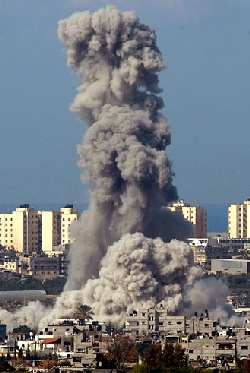 he United Nations’ most senior human rights official said last night that the Israeli military may have committed war crimes in Gaza. The warning came as Israeli troops pressed on with the deadly offensive in defiance of a UN security council resolution calling for a ceasefire.
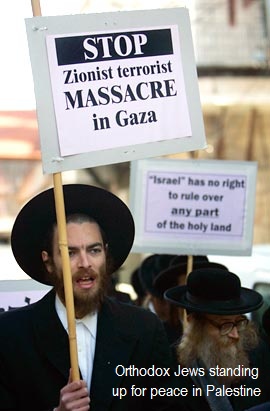 e had no choice,” has become Israel’s national mantra.
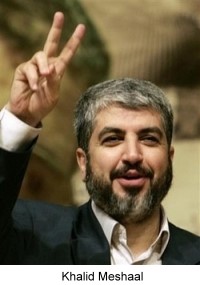 or 18 months my people in Gaza have been under siege, incarcerated inside the world’s biggest prison, sealed off from land, air and sea, caged and starved, denied even medication for our sick. After the slow death policy came the bombardment. In this most densely populated of places, nothing has been spared Israel’s warplanes, from government buildings to homes, mosques, hospitals, schools and markets. More than 540 have been killed and thousands permanently maimed. A third are women and children. Whole families have been massacred, some while they slept.