Author Archives: Paul Woodward

EDITORIAL: Israeli propaganda campaign downplays the success of the truce – UPDATED

Israeli propaganda campaign downplays the success of the truce

(UPDATE: Since the graphs appearing below have been removed from the Israeli Ministry of Foreign Affairs (MFA) website, some readers might have doubts about there authenticity. However, Jeffrey Goldberg who blogs at the Atlantic, has kindly alerted me to the source that the MFA continues to cite for its statistics on rocket fire from Gaza in 2008. The graphs I reproduced can be found in that document.

Goldberg writes: “Israel’s Ministry of Foreign Affairs cites this report [PDF] that claims that 362 rockets and mortars were fired into Israel from Gaza into Israel during what the report calls the ‘lull’ in the fighting. I think it’s fair to say that, though the numbers of rocket and mortar attacks dropped off dramatically during the ceasefire, there were, indeed, attacks.”

What Goldberg fails to point out is that of these 362 rockets and mortars fired, 324 were launched after Israel broke the ceasefire on November 4, 2008. During the period in which the ceasefire was being maintained by both Hamas and Israel from June 18 until November 4, there were a total of 38 fired. This averages 8.5 rocket and mortar attacks per month. As far as I am aware, none of these were conducted by Hamas and the level of attacks can be seen as a measure of the effectiveness (not absolute) with which Hamas was able to reign in other militant groups such as Islamic Jihad.)
_____

For four months, from Summer into Fall, the truce between Israel and Hamas was a stunning success. Indeed, if Israel doubted Hamas’ ability or willingness to engage in a truce, the Jewish state would have had no reason to request that the truce be extended as its expiration approached and passed in late December.

But now is a time of war and not only is talk of a truce being ruled out by the authors of this war but history is being re-written in order to degrade the value of a ceasefire. The memory of a period of recent calm that was the most durable peace that the residents of southern Israel have experienced in recent years must now be erased.

The Israeli government’s own graphical representation of the calm told the story in terms that even a child could understand. This is the graph that the Israel Ministry of Foreign Affairs displayed on its web site demonstrating that from July to October, rocket fire, if not reduced to a perfect zero, came stunningly close. From an average of 179 rockets per month in the preceding period of 2008, the number fell to just three per month:

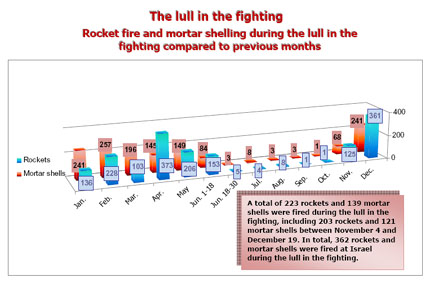
Now that the Israeli propaganda machine is revved up to full throttle, the image of an effective truce no longer suits the Israeli government’s purposes. Instead it has become more convenient to try and hide the numbers — with numbers! The foreign ministry has thus removed the simple graph shown above and replaced it with this:

In the earlier image, graph blocks dramatically portrayed the rise and fall in rocket fire rates. In the revised image, blocks of equal size (containing numbers) are used to obscure the graph. The effect, clearly intended, is to try and portray the lull as really nothing more than a minor undulation in a period of unremitting attacks.

The message Israel now wants to sell is that the truce never really worked. Instead of acknowledging that the truce effectively collapsed when Israel launched Operation “Double Challenge” on November 5, the rocket fire that followed that Israeli raid is being used to obscure the fact that rocket fire had effectively been curtailed up to that point.*

On the IDF Spokesman web site, a post on rocket statistics simply omits the part of the record that Israel now finds inconvenient to acknowledge:

  • Between Hamas’ takeover and the start of the Tahadiya (State of Calm), (June 14, 2007 – June 16, 2008), there was an average of over 361 attacks per month—an increase of an additional 350%.
  • On Nov. 4 – 5, Israel launched Operation “Double Challenge”, targeting a tunnel Hamas was building as part of a plan to kidnap Israeli soldiers.
  • From the end of Operation “Double Challenge” until the end of the Tahadiya, (Nov. 4 – Dec. 19, 2008) a period of only a month and a half, there were 170 mortars, 255 Qassams, and 5 Grads fired upon Israel’s civilian population centers.
  • Since the end of the Tahadiya (Dec. 19, 2009) until the beginning of Operation “Cast Lead,” (Dec. 27, 2008) a period of little more than a week, there were approximately 300 mortars and rockets fired onto Israel.
  • Since the begining of Operation “Cast Lead”, there have been an additional 500 launches, 284 of which have been verified as rockets (both Qassams and Grads), and 113 as mortars.

Was four months of calm really worthless? Given that it became the precursor to war, the answer now apparently is yes.

But it didn’t have to turn out this way. The effectiveness with which Hamas enforced a truce should have provided the impetus for Israel to lift its economic siege of Gaza.

Instead, we are once again witness to Israel’s seemingly insatiable appetite for war, even while it never tires of professing its love of peace.

* Should anyone doubt that the Israeli raid (official declarations about Israel’s commitment to the truce notwithstanding) constituted a unilateral breach of the truce, consider what Israel and the world’s response would have been in the event that the raid had been launched from Gaza. Hamas gunmen conducted a raid inside Israeli territory, killing six Israeli soldiers.

That wouldn’t have been described as a breakdown in the truce; it would have been regarded as an act of war.

Facebooktwittermail

NEWS & VIEWS ROUNDUP: January 4

Why Israel went to war in Gaza

After the debacle of its 2006 invasion of Lebanon – not only a military disaster for Israel, but also a political and diplomatic one – the government in Tel Aviv spent months laying the groundwork at home and abroad for the assault on Gaza with quiet but energetic lobbying of foreign administrations and diplomats, particularly in Europe and parts of the Arab world.

A new information directorate was established to influence the media, with some success. And when the attack began just over a week ago, a tide of diplomats, lobby groups, bloggers and other supporters of Israel were unleashed to hammer home a handful of carefully crafted core messages intended to ensure that Israel was seen as the victim, even as its bombardment killed more than 430 Palestinians over the past week, at least a third of them civilians or policemen.

The unrelenting attack on Gaza, with an air strike every 20 minutes on average, has not stopped Hamas firing rockets that have killed four Israelis since the assault began, reaching deeper into the Jewish state than ever before and sending tens of thousands of people fleeing. Last night Israel escalated its action further, as its troops poured across Gaza’s border, part of what appeared to be a significant ground invasion. And a diplomatic operation is already in full swing to justify the further cost in innocent lives that would almost certainly result. [continued…]

If Obama is serious, he should get tough with Israel

Jews worry for a living; their tragic history compels them to do so. In the next few years, there will be plenty to worry about, particularly when it comes to Israel. The current operation in Gaza won’t do much to ease these worries or to address Israel’s longer-term security needs. The potential for a nuclear Iran, combined with the growing accuracy and lethality of Hamas and Hizbullah rockets, will create tremendous concern. Anxiety may also be provoked by something else: an Obama administration determined to repair America’s image and credibility and to reach a deal in the Middle East.

Don’t get me wrong. Barack Obama—as every other U.S. president before him—will protect the special relationship with Israel. But the days of America’s exclusive ties to Israel may be coming to an end. Despite efforts to sound reassuring during the campaign, the new administration will have to be tough, much tougher than either Bill Clinton or George W. Bush were, if it’s serious about Arab-Israeli peacemaking. [continued…]

U.S. quashes Arab-backed Gaza cease-fire resolution in UN Security Council meet

The United States thwarted an effort by Libya on Sunday to persuade the UN Security Council to call for an immediate ceasefire in Gaza after Israel launched a ground invasion, diplomats said.

Several council diplomats told reporters that the U.S. refusal to back a Libyan-drafted demand for an immediate truce at a closed-door emergency session had killed the initiative, since council statements must be passed unanimously. [continued…]

Israel’s aim in Gaza is to break Hamas resistance

On Saturday night, one week after the start of Operation Cast Lead in the Gaza Strip, the ground operation began. The Israel Defense Forces started deploying combat units to surround Hamas’ main power base. The goal is not to chase after and destroy every last rocket launcher, but rather to break the Hamas’ resistance and force it to agree to a long-term cease-fire whose terms are more reasonable from Israel’s perspective. [continued…]

And there lie the bodies

As Israel has been preoccupied with Gaza throughout the entire week, nobody has asked whose blood is being spilled and why. Everything is permitted, legitimate and just. The moral voice of restraint, if it ever existed, has been left behind. Even if Israel wiped Gaza off the face of the earth, killing tens of thousands in the process, as a Chechnyan laborer working in Sderot proposed to me, one can assume that there would be no protest.

They liquidated Nizar Ghayan? Nobody counts the 20 women and children who lost their lives in the same attack. There was a massacre of dozens of officers during their graduation ceremony from the police academy? Acceptable. Five little sisters? Allowed. Palestinians are dying in hospitals that lack medical equipment? Peanuts. Whatever happened to the not-so-good old days of Salah Shahadeh? When we liquidated him in July 2002, we also killed 15 women and children. At least back then, moral qualms were raised for a moment.

Here lie their bodies, row upon row, some of them tiny. Our hearts have turned hard and our eyes have become dull. All of Israel has worn military fatigues, uniforms that are opaque and stained with blood and which enable us to carry out any crime. Even our leading intellectuals fail to speak out on what havoc we have wreaked. Amos Oz urges: “Cease-fire now.” David Grossman writes: “Hold your fire. Stop.” Meir Shalev wants “a punitive operation.” And not one word about our moral image, which has been horribly distorted. [continued…]

Land, sea, sky: all will kill you

As a way to share time on the phone, while my friend Houda’s neighbourhood was under aerial assault for more than 40 minutes, she and I discussed at length comparisons between previous Israeli military sieges we had been under. The carefully planned and premeditated strategy of terrorising an entire population by intensive and heavy bombardment of both military and civic institutions – destroying the entire civic infrastructure of a people – was identical. What is unprecedented here is that in Gaza there is nowhere to evacuate people to safety: they are imprisoned on all sides, with an acute awareness of the impossibility of escape. Land, sea, sky: all will kill you. [continued…]

Rules of engagement from Baghdad to Gaza

There is a word for the straightforward killing of enemies by a superior force where the victims are sparsely equipped and the odds one-sided. Much of the world is calling Israel’s actions in Gaza a massacre. By contrast the American press has been cleansed and euphemized. “3rd Day of Bombings,” said the New York Times headline on December 30, “Takes Out Interior Ministry.” Takes out. The Times paid an involuntary homage to George W. Bush: “I think it’s a good thing for the world that we took out Saddam Hussein.” Under that phrase are half a million Iraqis killed and a country destroyed. And for Israel in Gaza?

The U.S. and Israel share many things. A form of government, it is sometimes said; a set of ideals. But much more in the past ten years the U.S. and Israel have shared a fantasy. The fantasy says that the Arabs understand only force. It says we can end terrorism by killing all the terrorists. The neighbors of the terrorists will be overawed. No new terrorists will be created. Finally, when every face on the president’s fifty-two card deck is crossed out and the known composition of Hamas is dead, we can “address the social conditions” that foster terrorism. But perhaps there are no such conditions. Do the terrorists not hate for hate’s sake?

You can see the shape of the fantasy most distinctly in the writings of those journalistic enablers who move into position as soon as either country starts a war that needs interpreting. “It was Israel at its best,” writes Yossi Klein Halevy, a typical war broker, in a New Republic column posted on December 29. “In response to random attacks aimed at civilians, Israel launched precise attacks aimed at terrorists.” Halevy does not add that the precise attacks killed almost 400 persons and that one death in every four was civilian. [continued…]

Can the Jewish people survive without an enemy?

Tony Karon: Many Jews, in Israel and in America, see Israel as surrounded by deadly threats, and would see the benign and peaceful world you describe as a dangerous fantasy. What do you say to your critics?

Avrum Burg: I have very low expectations of new thinking and insight emerging from the mainstream Israeli and Jewish establishment. Their role is to maintain the status quo. Israel is bereft of forward thinking. We are experts at managing the crisis rather than finding alternatives to the crisis. In Israel you have many tanks, but not many think tanks. One of the reasons I left the Israeli politics was my growing feeling that Israel became a very efficient kingdom, but with no prophecy. Where is it going?

My idea of Judaism can be represented through a classic Talmudic dilemma: You are walking along by the river and there are two people drowning. One is Rabbi [Meir] Kahane, and the other is the Dalai Lama. You can only save one of them. For whom will you jump? If you jump for Rabbi Kahane because genetically he’s Jewish, you belong to a different camp than mine, because I would jump for the Dalai Lama. As much as he’s not genetically Jewish, he’s my Jewish brother when it comes to my value system. That’s the difference between me and the Jewish establishment in Israel and America. [continued…]

Which one’s the terrorist?

“A war to the bitter end.” That is how Israel’s Defense Minister Ehud Barak described his country’s latest military campaign in the Gaza strip. It is refreshing to hear an Israeli politician refer to what the western press routinely calls “a crisis” or “a cycle of violence” as a war, for that is in fact what is taking place in Gaza. But if war is in indeed an accurate description of the current conflict between Israel and Hamas, then can we continue referring to Hamas’ attacks against Israel as acts of terrorism? If a government declares war against a terrorist group, does it not in effect transform the group’s members from terrorists into soldiers? In a battle between a state like Israel and a “non-state entity” like Hamas, are acts of terror distinguishable from acts of war? [continued…]

Facebooktwittermail

NEWS & VIEWS ROUNDUP & EDITOR’S COMMENTS: January 3

Barack Obama’s silence on Gaza bombings is galling to Arabs

President-elect Barack Obama’s silence on the weeklong conflict in Gaza is drawing criticism among Arabs who have grown skeptical about hopes that his administration will break with the Mideast policies of the Bush era.

Obama, who is moving to Washington this weekend, was on vacation in Hawaii when the crisis erupted and has made no statements, either about Israel’s bombing of Gaza or Palestinian rocket attacks against Israel. His aides say that he does not wish to address foreign-policy issues in any way that could send “confusing signals” about U.S. policy as long as President George W. Bush is in office.

“President-elect Obama is closely monitoring global events, including the situation in Gaza, but there is one president at a time,” said Brooke Anderson, chief national security spokeswoman for the Obama transition team.

Arab commentators maintain, however, that Obama did comment on foreign affairs when he issued a statement condemning the terrorist attacks in Mumbai and that he has given several news conferences outlining his economic proposals. They suggest that his refusal to speak out on Gaza—where more than 400 Palestinians have died in the Israeli airstrikes, compared with four Israeli deaths from the rockets—implies indifference to the plight of Palestinians or even complicity with Israel’s bombing campaign. [continued…]

Editor’s Comment — Readers of The Huffington Post are apparently much more concerned about George Bush’s lack of leadership during his last three weeks in office than they are about Obama’s silence. As for the American blogosphere as a whole, the snapshot provided by Memeorandum suggests that a war that garnered lukewarm interest in its first week has now as it enters its second week virtually fallen off the radar.

One aspect of this “conflict” — I hesitate to call it a conflict because the Hamas counterattack at this point is little more than symbolic — is that a key component of the Israeli-US narrative on Hamas has failed to be proven.

Those who were skeptical about the viability of Israel entering into a truce with Hamas repeatedly argued that the lull would simply afford the “Iran-proxy” an opportunity to re-arm with a much more deadly arsenal of missiles.

Where are they? Are we to believe that they are being held in reserve for the right moment?

(Ashdod and Ashkelon have been struck by a handful of Grad rockets but this can hardly be compared with the fusillades of Katyushas that Hezbollah rained down on Israel in 2006.)

Israel’s YouTube “smoking gun” — “Grad rockets” being loaded into the back of a truck just before being blown up by a preemptive strike — turns out to have been bogus.

The tunnels from Egypt through which all the Iranian missiles were supposedly being funneled, appear to have really been what the residents of Gaza claimed: the supply line for everyday goods required inside a territory under economic siege.

As Obama continues to “monitor the situation” in Gaza, he should also listen to what the Organization of the Islamic Conference, meeting in Saudi Arabia, said today:

    We call on the US administration, namely the US President-elect Barack Obama, to pay the utmost attention to the possible repercussions of the ongoing Israeli war and its implications on the future of peace efforts in the Middle East and establishing lasting peace between the Israelis and the Palestinians. And to pay the utmost attention to the war’s consequences on the new administration’s efforts to enhance the image of the United States within the Muslim world.

Interestingly and perhaps surprisingly the most charitable view about what the president-elect can do before he takes office comes from Hamas’ Beirut representative, Osama Hamden:

    “If he talks against the Palestinians he will lose any chance before he has even started,” he told the Chicago Tribune. “And if he talks against the Israelis, this will not help him.”

Israel pounds Gaza as Hamas offensive enters second week

Israeli air strikes claimed a Hamas military commander and destroyed a Gaza school on Saturday as an assault on Gaza which has so far killed more than 440 Palestinians entered its second week.

Troops and tanks massed at the border remained on alert to advance into Gaza after seven days that have seen more than 750 air raids launched against Hamas leaders and military targets. [continued…]

Al Jazeera: Israeli bombardment of Gaza enters second week

Propaganda war: trusting what we see?

The Israeli propaganda effort is being directed to achieve two main aims.

The first is to justify the air attacks. The second is to show that there is no humanitarian calamity in Gaza.

Both these aims are intended to place Israel in a strong position internationally and to enable its diplomacy to act as an umbrella to fend off calls for a ceasefire while the military operation unfolds.

Israel has pursued the first aim by being very active in getting its story across that Hamas is to blame. The sight of Hamas rockets streaking into Israel has been helpful in this respect.

It has also allowed trucks in with food aid and has stressed that it will not let people starve, even if they go short.

Israel appears to think its efforts are working.

One of its spokespeople, who has regularly appeared on the international media, Major Avital Leibovich, said: “Quite a few outlets are very favourable to Israel.”

Israel has bolstered its approach by banning foreign correspondents from Gaza, despite a ruling from the Israeli Supreme Court. [continued…]

Editor’s Comment — It’s curious that the BBC, on the one hand provides in text the evidence that Israel mischaracterized a strike — evidence documented by the Israeli human rights organization B’Tselem — yet they only include the IDF’s video of the aerial view of the attack. This is what they left out:

Spokesman’s Unit hails ‘fair’ coverage

Foreign and domestic television crews are lined up along Herzl Street in Sderot on a cold Thursday afternoon. A siren sounds and the crews run into crowded bomb shelter doorways as three booming thumps are heard in the distance. Kassams have just struck the Negev town.

This first-hand experience of life under rocket fire may be one of the reasons Israeli diplomats and spokesmen feel Israel is finally getting a hearing in the international media.

“We’re talking to families who have lived under this for eight years,” said a journalist from a major European outlet who asked to remain anonymous. “It’s an important part of what’s happening here,” he said.

IDF officials, too, feel the coverage has been mostly fair.

“I’m surprised for the better. The coverage has been balanced on most channels, even on some outlets not known for being pro-Israel,” said Maj. Avital Leibovich, head of the foreign press department in the IDF Spokesman’s Unit. [continued…]

Polls show Israeli public in no mood for compromise

Some were troubled by pictures of children and women among the casualties, others voiced trepidation about a ground invasion, but the overwhelming view among Israelis on the streets of Jerusalem yesterday was that their government was right to attack Gaza and the offensive should go on for as long as it takes.

Israel’s relentless air strikes on the Palestinian enclave may be drawing strong criticism and calls for a ceasefire in much of the rest of the world, but a common reaction of Israelis is that outsiders simply don’t understand what they have been going through.

Domestic opposition has been much more muted than in some past wars, and even in those areas deemed to be Jerusalem’s most liberal, the mood was generally uncompromising. [continued…]

Report: Abbas to release hundreds of Hamas prisoners

Palestinian President Mahmoud Abbas has informed the Palestinian organizations that he plans to release hundreds of Hamas prisoners jailed in prisons in the West Bank, sources in Hamas claimed Saturday.

Abbas’ office has yet to respond to the report.

According to the report, Abbas is interested in making a goodwill gesture ahead of a possible renewal of the talks between the Palestinian factions and on the backdrop of the Israel Defense Forces’ offensive against the terror organizations in Gaza. [continued…]

Dem leaders out of step with voters on Israel’s attack on Gaza

A new Rasmussen Reports poll — the first to survey American public opinion specifically regarding the Israeli attack on Gaza — strongly bolsters the severe disconnect between American public opinion on U.S. policy toward Israel and the consensus views expressed by America’s political leadership.

Not only does Rasmussen find that Americans generally “are closely divided over whether the Jewish state should be taking military action against militants in the Gaza Strip” (44 percent to 41 percent, with 15 percent undecided), but Democratic voters overwhelmingly oppose the Israeli offensive — by a 24-point margin. By stark contrast, Republicans, as one would expect (in light of their history of supporting virtually any proposed attack on Arabs and Muslims), overwhelmingly support the Israeli bombing campaign (62 percent to 27 percent).

It’s not at all surprising that Republican leaders — from Dick Cheney and John Bolton to virtually all appendages of the right-wing noise machine — are unquestioning supporters of the Israeli attack. After all, they’re expressing the core ideology of the overwhelming majority of their voters and audience.

Much more notable is the fact that Democratic leaders — including Harry Reid and Nancy Pelosi — are just as lock step in their blind, uncritical support for the Israeli attack, in their absolute refusal to utter a word of criticism of, or even reservations about, Israeli actions. [continued…]

Where’s the academic outrage over the bombing of a University in Gaza?

Not one of the nearly 450 presidents of American colleges and universities who prominently denounced an effort by British academics to boycott Israeli universities in September 2007 have raised their voice in opposition to Israel’s bombardment of the Islamic University of Gaza earlier this week. Lee C. Bollinger, president of Columbia University, who organized the petition, has been silent, as have his co-signatories from Princeton, Northwestern, and Cornell Universities, and the Massachusetts Institute of Technology. Most others who signed similar petitions, like the 11,000 professors from nearly 1,000 universities around the world, have also refrained from expressing their outrage at Israel’s attack on the leading university in Gaza. The artfully named Scholars for Peace in the Middle East, which organized the latter appeal, has said nothing about the assault.

While the extent of the damage to the Islamic University, which was hit in six separate airstrikes, is still unknown, recent reports indicate that at least two major buildings were targeted, a science laboratory and the Ladies’ Building, where female students attended classes. There were no casualties, as the university was evacuated when the Israeli assault began on Saturday.

Virtually all the commentators agree that the Islamic University was attacked, in part, because it is a cultural symbol of Hamas, the ruling party in the elected Palestinian government, which Israel has targeted in its continuing attacks in Gaza. Mysteriously, hardly any of the news coverage has emphasized the educational significance of the university, which far exceeds its cultural or political symbolism. [continued…]

The Arab-Israeli Conflict: too complicated for our beautiful minds

There are so many words written about the “root causes” of the Arab-Israeli conflict, you might think the underlying issue is difficult to understand. But you’d be wrong. For all the mythology that interested parties want to wrap this conflict in, it’s really not difficult at all to understand the confrontation that has been going on in Palestine for more than a century now. All you have to do is try to imagine that what happened to Palestine happened instead here in the U.S. Then ask yourself, “What would Americans do in this position?”. And at that point, you find it miraculously stops being difficult to understand.

The problem with this approach is that American Exceptionalism has left us barely able to imagine being in other people’s shoes. So we explain the world to ourselves through ridiculous platitudes like we’re good and they’re evil, that actually explain nothing and leave us as confused as when we started. We just don’t do empathy very well.

But let’s try anyway. Let’s try imagining that what has been going on in Palestine for the last 100 years is going on instead here in the U.S., right now. [continued…]

Facebooktwittermail

NEWS & VIEWS ROUNDUP: January 2

Israel launches fresh attacks in seventh day of fighting

Israel bombed a mosque and the homes of at least half a dozen Hamas leaders in the Gaza Strip on Friday and allowed foreign passport holders to leave the ravaged territory, as speculation rose that a ground assault could be imminent.

A day after an airstrike killed a senior Hamas leader — the first from the militant group known to have died during the Israeli assault — Hamas continued to launch rockets into Israel, with several missiles landing in the southern city of Ashkelon. No deaths or serious injuries were reported. [continued…]

Israel running out of aerial targets

Six days in, Israel’s massive bombardment of Gaza shows little sign of abating. Israeli warplanes have flown more than 500 sorties, killing over 400 Palestinians and wounding hundreds. Israeli bombs have rained down on Gaza’s 1.5 million people from air and sea.

But with fewer targets left to strike – yesterday Israel bombed a mosque, the education ministry, the transportation ministry as well as the parliament building – a ground invasion would now appear imminent. [continued…]

Al Jazeera: B’Tselem questions Israeli account of attack

Al Jazeera: Palestinians brave Israeli assault to return home

Al Jazeera: Imprisoned in Gaza

West Bank anger over Gaza raids

Thousands of Palestinians in the West Bank have joined demonstrations after a call from Hamas for a “day of wrath” against the Israeli attacks on Gaza. Protests have also been held around the Muslim world after Friday Prayers. [continued…]

An alliance of values

Listening to the feelings expressed by Muslims around the world one gets a sentiment of anger and revolt mixed with a deep sense of helplessness. The current massacres are but a confirmation of the well-known: the “international community” does not really care about the Palestinians, and it is as if the state of Israel, with the support of the US and some European countries, has imposed a state of intellectual terror. Among the presidents and kings, nobody dares to speak out; nobody is ready to say the truth. All are paralysed by fear.

While the Israeli-Palestinian conflict is sometimes perceived, and experienced, as critical to the relationship between the west and Islam, many Muslims no longer know how to react. Is it a pure political conflict? What does Islam have to do with it? Should we make it an Islamic concern to call upon the ummah?

Muslims around the world are facing three distinctive phenomena. First, in the Muslim-majority countries or in the west, they see they can expect no reaction from governments, especially from the Arab states. Theirs is the guilty silence of the accomplice, the hypocrisy, the contempt for Palestinian lives. Second, western media coverage is alarming, with the majority buying the Israeli story: two equally powerful belligerents, with the victim of aggression (Israel) acting in self-defence. What a distortion! Yet the third phenomenon is interesting: while 73% of Europeans were backing Israel in 1967, more than 67% are supporting the Palestinians today. With time, understanding and sensitivity have moved: populations are not blindly following the games and hypocritical stands of their political elites. [continued…]

Yossi Sarid / If you (or I) were Palestinian

This week I spoke with my students about the Gaza war, in the context of a class on national security. One student, who had expressed rather conservative, accepted opinions – that is opinions tending slightly to the right – succeeded in surprising me. Without any provocation on my part, he opened his heart and confessed: “If I were a young Palestinian,” he said, “I’d fight the Jews fiercely, even by means of terror. Anyone who says anything different is telling you lies.”

His remarks sounded familiar – I had already heard them before. Suddenly I remembered: About 10 years ago they were uttered by our defense minister, Ehud Barak. Haaretz journalist Gideon Levy had asked him then, as a candidate for prime minister, what he would do had he been born Palestinian and Barak replied frankly: “I would join a terror organization.”

This is not my own answer; terrorism by individuals or organizations or states is always aimed at exacting casualties in a civilian population that has not drawn any blood. Not only is terror blind – consuming both the saint and the sinner – it also expands the circle of the hot-headed, whose blood rises to their brains: Our blood is on their heads, their blood is on our heads. And when an account of the blood of the innocent is opened, who can pay it in full, and when?

I hate all the terrorists in the world, whatever the purpose of their struggle. However, I support every active civil revolt against any occupation, and Israel too is among the despicable occupiers. Such revolt is both more just and more effective, and it does not extinguish one’s spark of humanity. And perhaps I’m just too much of an old codger to be a terrorist.

But, and pay attention to this but, if a normative young person has a spontaneous answer that is different from mine, and that answer also escaped the mouth of an Israeli lieutenant general, then every individual must see himself as though his son is running with the wrong crowd. If things were the other way around, our son-whom-we-loved would be a damned terrorist, almost certainly, because he is of the third and fourth generation of refugeehood and oppression, and whence cometh salvation? He has nothing to lose but his chains. [continued…]

Facebooktwittermail

OPINION & EDITOR’S COMMENT: Time for engagement in a new political process

Israel can’t bomb its way to peace

Israel has no viable political endgame here: There’s just no clear route from bombardment to a sustainable peace. But the damage caused by this new conflagration won’t be limited to the Israelis and Palestinians. Israel’s military offensive already has sparked outrage and protests throughout the Arab world. The current crisis also may destabilize some of the more moderate Arab governments in the region — in Egypt, for instance — where leaders now face popular backlash if they don’t repudiate Israel.

And if you think that none of this really matters for us here in the U.S., you’re kidding yourself. Arab and Islamic anger over Palestine continues to fuel anti-Western and anti-U.S. terrorism around the globe.

It’s time for the United States to wake up from its long slumber and reengage — forcefully — with the Middle East peace process. Only the U.S. — Israel’s primary supporter and main financial sponsor — can push it to make the hard choices necessary for its own long-term security, as well as the region’s. In January 2001, the Taba talks between Israel and the Palestinian Authority came achingly close to a final settlement, but talks broke down after Likud’s Ariel Sharon was elected prime minister on Feb. 6, 2001. Sharon refused to meet with Yasser Arafat, and newly inaugurated President George W. Bush had no interest in pushing Israel toward peace.

Eight years later, Israel faces another election, and we’re about to swear in a new president. When he takes office, Obama needs to push both Israelis and Palestinians to sit back down, with the abandoned Taba agreements as the starting point. Here’s to a less bloody 2009. [continued…]

Editor’s Comment — It’s good that there’s at least one American columnist willing to speak about what’s happening in Gaza without being an apologist for Israel. Yet in terms of the broader political perspective, calls for renewed US engagement in the Middle East peace process beg the most important question: engagement with whom?

When the dust finally settles in Gaza, Hamas will re-emerge politically strengthened while Fatah and the Palestinian Authority will be seen by most Palestinians as having been at best, ineffectual, and at worst, quislings serving the Israeli government.

What Israel’s latest war is doing is further unmasking the chasm between Arab leaders and the people they claim to represent.

The code word “moderate” means nothing more than an Arab leader with whom a Western leader is willing to be seen shaking hands. But what these hand shakes are capable of accomplishing politically has been vastly overestimated for the simple reason that the will of the people continues being left out of the equation.

If the Obama administration wants to make a radical break with the past, it might consider not a re-engagement with what has become a hollow “peace process.” It might in fact disengage from an issue that Israel has to solve for itself. Instead, it should look across the political landscape, become better acquainted with the real locuses of emerging political power and then deliver a message of bitter political realism to its regional allies: Look hard and fast for ways to accommodate your political foes, because if you don’t they will destroy you and in the chaos that ensues the whole world will suffer.

Facebooktwittermail

Regional impact of the war on Gaza

Gaza attack strengthens Egypt’s Muslim Brotherhood

Rarely do Egyptian demonstrations see thousands of people take to the streets. But, put together anti-Israeli and anti-government sentiments spearheaded by the powerful Muslim Brotherhood, and the result is the country’s largest street action since the first anniversary of the American invasion of Iraq in 2004.

With Israel vowing a “long” siege against the Gaza Strip, there are concerns that the already strong opposition Brotherhood could become even stronger in the face of Israel’s military action against Palestinians.

On Monday, thousands of Egyptians marched in downtown Cairo, chanting phrases such as, “Off to Gaza we go, martyrs by the million,” and “We all belong to Hamas.”

The government and the military were as much to blame as Israel, activists said. “Where is the Egyptian army?” was another slogan chanted by the throngs of demonstrators.

“It is disappointing that while our Palestinian brothers and sisters are being killed, [President Hosni] Mubarak and his cronies sit by and do nothing. Only the Brotherhood is leading this country on the right path,” says Ahmed Said, a university student who is supporting the efforts of the Brotherhood. [continued…]

Al Jazeera: Arab League inaction (part one)

Al Jazeera: Arab League inaction (part two)

Facebooktwittermail

NEWS & VIEWS ROUNDUP: January 1

Al Jazeera: Gazans live in fear of further attacks

New Year in Gaza: “Our fireworks are the Israeli missiles”

“Look outside, F-16 jet fighters are smiling for you, missiles are dancing for you, zannana [the Palestinian name for pilotless drones] are singing for you. I requested them all to wish you a happy new year.” That was the darkly humorous text message Fathi Tobal, a Gaza City resident, received from a friend on his mobile phone today.

Tobal added ironically, “While other people around the world celebrate, it seems the Israeli air force is trying to save us the cost of fireworks.”

On New Year’s Eve in Gaza, 1.5 million Palestinians are confined to their homes under candlelight and with scarce food supplies, but worst of all with the constant fear of the bombs which have already killed almost 400 people, and injured 2,000. [continued…]

The Gaza operation’s unstated goal: Anarchy

Israel is going after the trappings of governance, of power, of control, of rule. And the reason is the belief that the force that may eventually sweep Hamas from power is not Palestinian Authority President Mahmoud Abbas and Fatah, but pure anarchy.

If Hamas cannot rule, if it cannot provide the people with what they need, if the leaders are in hiding, if anarchy reigns, then Hamas’s legitimacy is delivered a major blow.

And this, to a large degree, explains Israel’s targets. Jerusalem wants to hit Hamas’s ability to rule, it wants to encourage anarchy that would threaten the organization.

Israel’s opening of the Gaza crossings to allow in humanitarian aid contributes somewhat to this sense of anarchy, because it makes Hamas look unable to govern. If the Palestinians must rely on Israel’s green light to let food aid in from third countries, then that undercuts Hamas’s argument that it is able to serve its public. [continued…]

We must adjust our distorted image of Hamas

Last week I was in Gaza. While I was there I met a group of 20 or so police officers who were undergoing a course in conflict management. They were eager to know whether foreigners felt safer since Hamas had taken over the Government? Indeed we did, we told them. Without doubt the past 18 months had seen a comparative calm on the streets of Gaza; no gunmen on the streets, no more kidnappings. They smiled with great pride and waved us goodbye.

Less than a week later all of these men were dead, killed by an Israeli rocket at a graduation ceremony. Were they “dangerous Hamas militant gunmen”? No, they were unarmed police officers, public servants killed not in a “militant training camp” but in the same police station in the middle of Gaza City that had been used by the British, the Israelis and Fatah during their periods of rule there.

This distinction is crucial because while the horrific scenes in Gaza and Israel play themselves out on our television screens, a war of words is being fought that is clouding our understanding of the realities on the ground. [continued…]

Haniyeh: Palestinian victory in Gaza is near

Hamas leader Ismail Haniyeh said on Wednesday that Israeli attacks on Gaza had to stop before any truce proposals could be considered.

“First, the Zionist aggression must end without any conditions… Second the siege must be lifted and all the crossings must be opened because the siege is the source of all of Gaza’s problems,” he said in a televised speech to Palestinians.

“After that it will be possible to talk on all issues without any exception,” Haniyeh said, referring to recent truce proposals raised by all parties, including Israel. [continued…]

The self delusion that plagues both sides in this bloody conflict

Israel… – always swift to announce its imminent destruction of “terrorism” – has never won a war in a built-up city, be it Beirut or Gaza, since its capture of Jerusalem in 1967. And it’s important to remember that the Israeli army, famous in song and legend for its supposed “purity of arms” and “elite” units, has proved itself to be a pretty third-rate army over recent years. Not since the 1973 Middle East conflict – 35 years ago – has it won a war. Its 1978 invasion of Lebanon was a failure, its 1982 invasion ended in disaster, propelling Arafat from Beirut but allowing its vicious Phalangist allies into the Sabra and Chatila camps where they committed mass murder. In neither the 1993 bombardment of Lebanon nor the 1996 bombardment of Lebanon – which fizzled out after the massacre of refugees at Qana – nor the 2006 war was its performance anything more than amateur. Indeed, if it wasn’t for the fact Arab armies are even more of a rabble than the Israelis, the Israeli state would be genuinely under threat from its neighbours.

One common feature of Middle East wars is the ability of all the antagonists to suffer from massive self-delusion. Israel’s promise to “root out terror” – be it of the PLO, Hizbollah, Hamas, Islamic Jihad, Iranian or any other kind – has always turned out to be false. “War to the bitter end,” the Israeli defence minister, Ehud Barak, has promised in Gaza. Nonsense. Just like the PLO’s boast – and Hamas’ boast and Hizbollah’s boast – to “liberate” Jerusalem. Eyewash. But the Israelis have usually shown a dangerous propensity to believe their own propaganda. Calling up more than 6,000 reservists and sitting them round the Gaza fence is one thing; sending them into the hovels of Gaza will be quite another. In 2006, Israel claimed it was sending 30,000 troops into Lebanon. In reality, it sent about 3,000 – and the moment they crossed the border, they were faced down by the Hizbollah. In some cases, Israeli soldiers actually ran back to their own frontier. [continued…]

Facebooktwittermail

EDITORIAL: Trust is not a birthright

Trust is not a birthright

There is a conceit that has so thoroughly poisoned the minds of most Israelis that it is regarded as an unquestionable truth: we occupy the moral high ground.

This poison distorts every question, not least the most pressing issue of this moment: can a ceasefire between Israel and Hamas be restored?

Implicit in that question as it is being considered by Israel is the assumption that Israel’s willingness and ability to abide by a ceasefire is beyond question and that the only real question is whether Hamas can be trusted to do the same. But even that is not really treated as a question. The heart of the issue, Israel would have us believe, is: can Hamas be forced into a truce?

When, after ignoring the subject for several days, the New York Times finally got around to making an editorial pronouncement on the war on Gaza, it trotted out what is among most inattentive observers the conventional wisdom:

Hamas never fully observed the cease-fire that went into effect on June 19 and Israel never really lived up to its commitment to ease its punishing embargo on Gaza.

In fact, Hamas’ compliance with the ceasefire was stunningly disciplined. Don’t take my word for it. The proof comes from the Israeli government.

Look at this graph provided by the Israeli Foreign Ministry showing rocket attacks from Gaza per month during 2008. From January through June there were an average of 179 rocket attacks per month. From July through October there were an average of 3 rocket attacks per month.

For the residents of Sderot, those months were indeed a period of calm. But the calm ended when Israel unilaterally broke the ceasefire right after the US elections and just before Hamas and Fatah sat down for crucial reconciliation talks in Cairo.

If Israel, as it would currently have the world believe, was so strongly in favor of extending the six-month ceasefire, why did it attach so little value to what had already been accomplished? Why did it not acknowledge the effectiveness with which Hamas was holding up its side of the bargain? Why did it not demonstrate that it valued the calm by lifting or at least easing the economic embargo on Gaza in a significant way?

All Israel accomplished was to confirm Hamas’ suspicions – suspicions shared by most Palestinians – that Israel cannot be trusted.

Facebooktwittermail

NEWS & VIEWS ROUNDUP: December 31

Israel rejects proposed cease-fire

Israeli leaders rejected on Wednesday a proposal to immediately pause attacks on the Gaza Strip for 48 hours, declaring that there were no guarantees Hamas fighters would in return stop firing rockets into Israel. Discussions were continuing in hopes of developing a more durable cease-fire. But after looking at the existing proposal, “we saw that it did not contain the necessary elements to make the truce permanent,” said Yigal Palmor, an Israeli Foreign Ministry spokesman. “It lacks a plan to enforce the ceasefire, to make sure Hamas won’t shoot rockets into Israel anymore, and stop the smuggling of weapons.”

“It does not contain any guarantees,” he added. “There is nothing in the proposal that if we declare a unilateral ceasefire it will mean anything to Hamas and that it will ensure a durable ceasefire afterwards.” [continued…]

Behind closed doors, U.S. seeks Israel exit strategy

While publicly declaring strong support for Israel, the Bush administration is increasingly nervous about the 4-day-old campaign in the Gaza Strip and is urging its ally to settle on a timetable and exit strategy, say foreign diplomats and Middle East experts close to the discussions.

U.S. officials are concerned that the campaign could drag on without destroying Hamas, and might even bolster support for the militant group — just as the 2006 Israeli campaign in Lebanon strengthened Hezbollah, they say.

“You’re not hearing that same confidence you did in 2006 that the Israeli military can impose a new strategic reality and should go full force,” said one Arab diplomat in Washington. “There’s a real contrast between their words then and now.”

U.S. officials were talking intensively Tuesday to Arab and European powers about the possibility of a two- or three-day cease-fire, diplomats said. U.S. diplomacy is complicated by differences between the White House and the State Department, these sources said. [continued…]

Obama’s silence on Gaza confirms low Arab expectations

President-elect Barack Obama, with his silence on Israel’s attacks in Gaza, has confirmed Arab expectations that foreign policy changes will come small and slow when he moves into the White House next month.

On the fourth day of Israeli air strikes which have killed more than 380 people in Gaza, the U.S. President-elect has yet to take a position, though he spoke out after militants’ attacks in Mumbai and has made detailed statements on the U.S. economy.

“He wants to be cautious and I think he will remain cautious because the Arab-Israeli conflict is not one of his priorities,” said Hassan Nafaa, an Egyptian political scientist and secretary-general of the Arab Thought Forum in Amman.

“Obama’s position is very precarious. The Jewish lobby warned against his election, so he has chosen to remain silent (on Gaza),” added Hilal Khashan, a professor of political science at the American University of Beirut.

“If Obama continues to remain silent … his silence will be seen and will have the operational effect of providing an endorsement for Israel’s war on Gaza,” said Paul Woodward of Conflicts Forum, an organisation aimed at changing Western policy towards Islamist movements such as Hamas. [continued…]

The IAF, bullies of the clear blue skies

Our finest young men are attacking Gaza now. Good boys from good homes are doing bad things. Most of them are eloquent, impressive, self-confident, often even highly principled in their own eyes, and on Black Saturday dozens of them set out to bomb some of the targets in our “target bank” for the Gaza Strip.

They set out to bomb the graduation ceremony for young police officers who had found that rare Gaza commodity, a job, massacring them by the dozen. They bombed a mosque, killing five sisters of the Balousha family, the youngest of whom was 4. They bombed a police station, hitting a doctor nearby; she lies in a vegetative state in Shifa Hospital, which is bursting with wounded and dead. They bombed a university that we in Israel call the Palestinian Rafael, the equivalent of Israel’s weapons developer, and destroyed student dormitories. They dropped hundreds of bombs out of blue skies free of all resistance.

In four days they killed 375 people. They did not, and could not, distinguish between a Hamas official and his children, between a traffic cop and a Qassam launch operator, between a weapons cache and a health clinic, between the first and second floors of a densely populated apartment building with dozens of children inside. According to reports, about half of the people killed were innocent civilians. We’re not complaining about the pilots’ accuracy, it cannot be otherwise when the weapon is a plane and the objective is a tiny, crowded strip of land. Our excellent pilots are effectively bullies now. As in training flights, they bomb undisturbed, facing neither an air force nor defense system. [continued…]

Understanding Gaza

It’s fear of another Holocaust that has driven Israel to bomb the crap out of the Palestinians in Gaza — at least, that’s if you believe what you read on the New York Times op ed page. (Never a good idea, of course, because as I’ve previously noted, when it comes to Israel and related fear-mongering, there simply is no hysteria deemed unworthy of the Times op ed page.)

Morris, a manic fellow at the best of times prone to intellectual mood swings — having laid bare the ethnic cleansing that created modern Israel, Morris then didn’t as much recant as complain that the problem was that Ben Gurion hadn’t finished the job. And since the 2000 debacle at Camp David, of course, he’s been a de facto editorial writer for Ehud Barak, the failed former Prime Minister nicknamed “Mr. Zig-Zag” while in office because of his inconsistency — and who, of course, is the author of the current operation in Gaza.

Barak, never shy about spewing utter rubbish when his audience is American and prone to be taken in by demagoguery, last weekend offered the priceless suggestion to Fox News that “expecting Israel to have a cease-fire with Hamas is like expecting you to have a cease-fire with al-Qaeda.” Presumably it would not occur to Fox’s anchors to ask why, then, had Barak maintained just such a cease-fire for the past six months? And why had he been seeking its renewal? [continued…]

Gaza crisis: a crossroads for Obama

The catastrophe unfolding in Gaza has the dark force of a recurring Middle Eastern nightmare: Scattered guerrilla-like attacks from the weak lead to massive retaliation by the strong. Excessive lethal force provokes enraged recriminations. Fresh bloodshed fuels the hard-liners on both sides.

We have seen this cycle many times before: throughout Lebanon (2006), across the occupied territories during the first intifada (1987-93), in east and west Beirut (1982), and even during the founding of modern Israel and the subsequent dispossession of the Palestinians in 1948.

When the smoke finally drifts from Gaza, and the human rights investigations begin – into the death of schoolchildren in midday rocket attacks or the demolition of a women’s dormitory – sober voices will ask why Israel has still not learned a fundamental lesson: By trying to crush your enemy, you only make him stronger. [continued…]

How not to make peace in the Middle East

Throughout the years, polls consistently showed respectable Israeli and Palestinian majorities in favor of a negotiated two-state settlement. The world held its breath awaiting a breakthrough, promising wholehearted support for a resolution. Even traditionally passive and cautious Saudi Arabia put forward the Arab Peace Initiative in 2002, persuaded Arab and Islamic nations to sign onto it, and formally presented it to Israel via the Arab League. Yet throughout, regardless of set-up, content, or style, the outcome has been depressingly the same. The plans were greeted with violence, bewilderment, and, more recently, a yawn. Why would more of the same, even if more intense, more vigorous, and more sustained, produce a different outcome?

Equally striking, three of the most significant Arab–Israeli breakthroughs occurred with the US nowhere in sight: Anwar Sadat’s trip to Jerusalem, the Oslo negotiations, and Israel’s treaty with Jordan. Nor is this merely a historical reflection. When Israeli–Syrian negotiations restarted this year, they were under Turkish, not American, sponsorship and the US sought to prevent, not facilitate them. America was and will be needed to capitalize on opportunities or crown a deal. But it is worth contemplating why it has been so unfailingly inept at launching successful initiatives—the Camp David summit of 2000 and the Annapolis process of 2007 and 2008 being only the latest, saddest examples.

Obama ought to take note of another intriguing feature: arguably the most momentous shift in the Israeli–Palestinian landscape since the 1993 Oslo accords has occurred as a result not of US policy and bilateral negotiations but of a unilateral decision. Israel’s withdrawal from Gaza in 2005 has left much to be desired. But had then Prime Minister Sharon and President Abbas sought to negotiate its details with American help, Israeli tanks and settlements almost certainly would still be there, as they are in much of the West Bank, despite endless negotiations. US-sponsored bilateral negotiations have become a formula for sustaining an otherwise untenable status quo. [continued…]

Facebooktwittermail

NEWS & VIEWS ROUNDUP & EDITOR’S COMMENTS: December 30

Hamas is hoping for an IDF ground operation in Gaza

Three days into Operation Cast Lead, Israel is proposing a diplomatic exit. A ground operation likely looms in an effort to increase the pressure on Hamas. At the same time, however, others argue that the air force is close to exhausting its target bank, so if Hamas can be brought to accept a cease-fire on terms convenient to Israel in the near future it would be better to do so.

Hamas intensified its rocket and mortar fire at Israel Monday. It is starting to recover from the initial shock of the assault, and the bad weather is helping to protect its launching crews from Israeli aircraft.

By 8 P.M., Hamas had fired more than 80 rockets and mortars at Israel, including a Grad Katyusha strike on Ashkelon that killed an Israeli construction worker and wounded 10 others. At 9:30 P.M., a Katyusha hit Ashdod, seriously wounding another two civilians . The Home Front Command says some of the civilian casualties of the last few days could have been prevented had people obeyed its orders and entered shelters when they heard the warning sirens.

Israel has thus far refused to officially discuss a cease-fire, but in practice it is conducting an indirect and hesitant dialogue with Hamas. As of yet, however, there is no official mediator.

Khaled Meshal, the Damascus-based head of Hamas’ political bureau, has been calling for a cease-fire for two days now. However, communications with the organization’s leadership in Gaza are hampered because all its leaders have gone underground for fear of Israeli assassination attempts, while Israel’s air strikes have disrupted the Strip’s communications networks. Paradoxically, the same measures that have hampered Hamas’ military response are also impeding efforts to end the fighting.

Israel will insist that any truce include a complete, long-term halt to the rocket fire from Gaza. In exchange, it will apparently agree to reopen the border crossings at some point, though no final decisions have been made. Some ministers want to continue the military operation, but Defense Minister Ehud Barak and the chief of staff of the Israel Defense Forces, Gabi Ashkenazi, are more cautious. [continued…]

Editor’s Comment — The war so meticulously planned not to be a re-run of Lebanon 2006 is turning into a re-run of Lebanon 2006. Hesitant to enter into a ground war in which Israel justifiably fears it would get bogged down, suffer unacceptably high casualties and ultimately face humiliation, the choice at this point is to move over to an “expanded target list.” In other words, having trumpeted the claim that this is all about “precision” strikes on Hamas (disingenuous as that claim had to be since those targets were situated in the heart of densely populated urban areas) Israel is now widening its scope to a point where its flimsy facade of discrimination falls away. The Washington Post reports:

    Israeli military officials said Monday that their target lists have expanded to include the vast support network that the Islamist movement relies on to stay in power in the strip. The choice of targets suggests that Israel intends to weaken all the various facets of Hamas rather than just its armed wing.

It’s only a couple of weeks ago that 200,000 people crammed into the center of Gaza City to celebrate Hamas’ 21st anniversary. In the minds of Israeli commanders one can only assume that everyone in Gaza is now a legitimate target. “Everything is connected.”

As for the level ground on which Hamas is prepared to meet its adversary, the fact that Israel has amassed its forces on the border means it either has to advance and risk getting stuck both figuratively and literally in the Gaza mud, or it backs away. Either way, the likelihood is that Israel will once again have demonstrated the limitations of its own military power.

Why bombing Ashkelon is the most tragic irony

How easy it is to snap off the history of the Palestinians, to delete the narrative of their tragedy, to avoid a grotesque irony about Gaza which – in any other conflict – journalists would be writing about in their first reports: that the original, legal owners of the Israeli land on which Hamas rockets are detonating live in Gaza.

That is why Gaza exists: because the Palestinians who lived in Ashkelon and the fields around it – Askalaan in Arabic – were dispossessed from their lands in 1948 when Israel was created and ended up on the beaches of Gaza. They – or their children and grandchildren and great-grandchildren – are among the one and a half million Palestinian refugees crammed into the cesspool of Gaza, 80 per cent of whose families once lived in what is now Israel. This, historically, is the real story: most of the people of Gaza don’t come from Gaza.

But watching the news shows, you’d think that history began yesterday, that a bunch of bearded anti-Semitic Islamist lunatics suddenly popped up in the slums of Gaza – a rubbish dump of destitute people of no origin – and began firing missiles into peace-loving, democratic Israel, only to meet with the righteous vengeance of the Israeli air force. The fact that the five sisters killed in Jabalya camp had grandparents who came from the very land whose more recent owners have now bombed them to death simply does not appear in the story. [continued…]

Hamas credo led it to end cease-fire

… in Ramallah, anti-Israeli and American sentiment was high among a small crowd of protesters gathered, incongruously, beneath a Stars and Bucks Cafe. Even here, in Fatah’s heartland, people said they admired Hamas for its willingness to take on a regional superpower.

Challenged on the point that firing highly inaccurate rockets from Gaza into Israel carried a huge cost in retaliation, one 30-year-old Palestinian who refused to give his name compared the attacks to the impotent yet defiant gesture of the Iraqi journalist Muntader al-Zaidi, who became a folk hero across the Arab world for throwing his shoes at President Bush.

Mustafa Saleh, 37, said: “I am originally Fatah and my voice will always be Fatah. But Hamas is resisting and we are a nation under occupation. I support the resistance, even here in the West Bank.”

Hamas hopes such sentiments will bring it new supporters.

But as he watched the protesters go by, Mohanad Salah, 42, said that emotions would calm down. Palestinians were quite capable of wanting Hamas-style “resistance” with their hearts but peace talks with their heads, he said.

“The more military operations by Israel either here or in Gaza, the more it will make people go away from wanting agreements,” he said.

“But you should know that even after Israel carried out this operation yesterday, if today it says ‘We want a political solution, let’s reach an agreement,’ it would be completely accepted by the majority of the Palestinian people,” Mr. Salah added. [continued…]

The world gives Israel a free hand

Barack Obama’s aides, in explaining the US president-elect’s silence, are meanwhile sticking to their mantra that the US only has one president at a time. But as the carnage and the outrage mount, this hands-off stance begins to look less like tact and more like a sign of a man who, confronted by a raw conflict that has defeated many more experienced statesmen before him, lacks new ideas.

Obama and his replacement for Rice, Hillary Clinton, have closely followed the Bush line on the ostracism of Hamas as an illegitimate terrorist organisation. He condemned Hamas rocket attacks in emotive, personalised terms during a visit to Sderot in southern Israel earlier this year.

“If somebody was sending rockets into my house where my two daughters sleep at night, I’m going to do everything in my power to stop that. And I would expect Israelis to do the same thing,” Obama said. Arab critics suggested at the time that a balancing line or two about the impact of the Israeli army on Palestinian family life in besieged Gaza would have been welcome. [continued…]

Editor’s Comment — The balancing line is utterly obvious (even if it’s impossible to imagine Obama using it): “If somebody was sending rockets into my house in Gaza where my two daughters sleep at night, I’m going to do everything in my power to stop that. And I would expect Palestinians to do the same thing.”

Gaza: the logic of colonial power

Terrorism is a normative term and not a descriptive concept. An empty word that means everything and nothing, it is used to describe what the Other does, not what we do. The powerful – whether Israel, America, Russia or China – will always describe their victims’ struggle as terrorism, but the destruction of Chechnya, the ethnic cleansing of Palestine, the slow slaughter of the remaining Palestinians, the American occupation of Iraq and Afghanistan – with the tens of thousands of civilians it has killed … these will never earn the title of terrorism, though civilians were the target and terrorising them was the purpose.

Counterinsurgency, now popular again among in the Pentagon, is another way of saying the suppression of national liberation struggles. Terror and intimidation are as essential to it as is winning hearts and minds.

Normative rules are determined by power relations. Those with power determine what is legal and illegal. They besiege the weak in legal prohibitions to prevent the weak from resisting. For the weak to resist is illegal by definition. Concepts like terrorism are invented and used normatively as if a neutral court had produced them, instead of the oppressors. The danger in this excessive use of legality actually undermines legality, diminishing the credibility of international institutions such as the United Nations. It becomes apparent that the powerful, those who make the rules, insist on legality merely to preserve the power relations that serve them or to maintain their occupation and colonialism. [continued…]

Facebooktwittermail

EDITORIAL: Silence has become complicity

Silence has become complicity

Is the incoming president, world-renowned for his eloquence, about to become better known for his silence?

Barack Obama may not have assumed office yet but a war is already being conducted in his name.

Israel’s defense minister, Ehud Barak, now says that Israel is engaged in a “war to the bitter end” against Hamas in Gaza. And in justifying this war to Israel’s state assembly, the Knesset, Barak said: “Obama said that if rockets were being fired at his home while his two daughters were sleeping, he would do everything he could to prevent it.”

Barak’s war has become Barack’s war — unless he breaks his silence.

Obama chooses his words carefully. He did so when speaking to the press in Sderot in southern Israel, during the presidential election campaign this summer. While he was clearly and shamelessly pandering to American Jewish voters, his statement expressed sympathy for the Israelis being targeted by Qassam rocket fire, but it also underlined that an effective response would focus on preventing further attacks — not merely the retaliatory and bellicose response with which Israelis are so familiar, that is, a military operation whose purpose is “to teach the Palestinians a lesson.”

If Obama continues to remain silent he will implicitly be sending a message to Israelis, Palestinians, and everyone else across the Arab world. His silence will be seen and will have the operational effect of providing an endorsement for Israel’s war on Gaza. His silence will set the tone for his whole approach to the Middle East. If his plan to give a major speech in a Muslim capital has not already been put on hold, it might as well now be scrapped.

But there is an alternative. This is what Obama can and should say:

I support the Israeli government in its goal of providing security for its citizens. However, I believe that the current operation in Gaza is unlikely to serve that goal and in the long run may further undermine Israel’s security.

What can Israel do now? Pull back its troops, offer to renew the truce and lift the siege.

The truce actually worked, as this graph from the Israeli Foreign Ministry clearly shows.

Rocket fire did not resume until Israel broke the truce on November 5.

What we now know, is that Israel did not view the truce as a means to bring calm to southern Israel but instead used it as an aid for gathering intelligence in preparation for war.

Had the Olmert government regarded the cessation of rocket fire as a foundation upon which it could build, it would have taken clear steps to lift the siege. (But to have pursued such a course would not however have provided the Palestinian body count upon which Israel’s next prime minister hopes to ride into office.)

Instead, what we now witness is a brutal spectacle in which, using the Orwellian language of war, Israel claims that it’s target is Hamas, not the residents of Gaza.

Obama is still in a position to exert influence, but the longer he waits, the less power he will have; the more likely he will be seen as the perpetuator of George Bush’s failed approach to the Middle East.

Facebooktwittermail

NEWS & VIEWS ROUNDUP: December 29

Israeli aircraft continue raids on Gaza; Arab anger rises

In a third straight day of deadly air strikes against the emblems and institutions of Hamas on Monday, Israeli warplanes pounded targets in Gaza including the Interior Ministry while the Israeli army declared areas around the beleaguered enclave a “closed military zone.” [continued…]

Hospitals face catastrophe as Israeli firestorm is unleashed

Gaza City was a ghost town of funeral tents and nervous bread queues yesterday as shocked residents ventured out of their homes under Israel’s massive firestorm only to carry out the bare necessities of life: buying food and burying their dead.

Hospital officials said that the death toll had risen to almost 300, with more than 1,000 injured. With 150 patients in critical condition and the city’s hospitals already on the verge of collapse even before the Israeli blitz, doctors expected the numbers of dead to swell even further.

“There is no way we can handle such a catastrophe. People are dying for want of basic amenities,” Hassan Abu Tawila, of al-Shifa hospital in Gaza City, said. “A normal country would have difficulty coping with such a catastrophe. Imagine the situation for a place that has been under Israeli siege for 18 months already.” [continued…]

The strategic price of Israel’s Gaza assault

Israel has acted in response to pressure to protect its citizenry from rocket attacks, but there’s a strong likelihood that such attacks will continue and possibly intensify as a result. That will draw Israeli ground troops into Gaza, where they, too, will suffer casualties at the hands of Palestinian gunmen. The Palestinian civilian death toll will be far higher, which will, in turn, isolate Israel on the diplomatic front — even those Arab regimes that would have been discreetly pleased to see Hamas dealt a harsh blow (because they fear the Islamist movement is becoming a model for those challenging their own governments) will be forced to distance themselves.

The air strikes will also give President Mahmoud Abbas no choice but to break off peace talks with Israel, although neither the Israelis nor most Palestinians treated those as any kind of serious peace process. Still, the Israeli offensive is likely to boost Palestinian political support for Hamas, and to further weaken Abbas. And, in the weeks preceding the strikes, Israeli security officials were warning that there’s no end game, because a limited campaign would be unlikely to eliminate Hamas in Gaza, and if Israel launched a full-blown ground invasion it would find itself forced to reoccupy the territory on a long-term basis.

So Hamas knows that Israel’s military intervention is unlikely to be a ground war to the finish, and it will hope that, like Hizballah in Lebanon in 2006, by simply surviving an Israeli onslaught it will emerge politically victorious. Israel will hope to sufficiently bloody the movement to put it on the defensive and make its leaders prioritize their own physical survival over pressing Israel to ease the siege. And hundreds more people could die in the weeks ahead as the two sides look to win the battle of wills. [continued…]

Israel has learned from its failure in Lebanon

Although many risks and uncertainties lie ahead, in particular the specter of getting bogged down in a ground war, the offensive has brought Israel to a psychological turning point, restoring a measure of the country’s confidence in its capacity to confront armed adversaries.

“Hamas is dazed and confused and has no explanation to offer its people,” Amos Gilad, a senior Israeli Defense Ministry official, told Israel Radio on Sunday. “But we must refrain from bragging and marking dramatic objectives.”

Rather than remove Hamas from power, he and other Israeli officials say, the goal is to weaken the movement and demonstrate the price it would pay for continuing to launch rockets. Sooner or later, Israel hopes to restore and strengthen an Egyptian-brokered cease-fire that worked for nearly five months before it started to break down in November.

“The army doesn’t even have the pretense of neutralizing Hamas’ ability to launch rockets. We have tried that before and failed,” said Alon Ben-David, military correspondent for Israel’s Channel 10 television.

“This operation,” he explained, “is directed at Hamas’ motivation to fire rockets at Israel rather than its actual ability to do so.”

For reasons that became evident during the Lebanon conflict, it is far from certain whether even that limited goal can be achieved. [continued…]

Key Arab states hope for weakened Hamas

The war in the Gaza Strip spilled over into Egypt Sunday when dozens of Gaza residents crossed the border only to encounter Egyptian gunfire aimed at driving them back. The ongoing closure of the Rafah crossing between Gaza and Egypt has become a symbol of Cairo’s policy, which critics charge is one of collaborating with Israel to impose economic sanctions on the Strip. Judging by Arab leaders’ statements to the media,
or the slogans shouted by demonstrators in several Arab capitals, one might have thought that Egypt, not Israel, was the one waging war on Gaza.

Hamas’ demand that Egypt open Rafah to all Gazans, and not just to the wounded seeking treatment abroad, has been rejected in part because Egypt
remains committed to an Israeli-Palestinian agreement from 2005 that governs the Gaza border crossings, even though it was never a signatory to the pact. But beyond this formal reason, Egypt wants to prevent thousands of Palestinians from once again crossing the border into its territory. This past January, when hundreds of thousands of Palestinians broke through the border fence, the Egyptian government suffered harsh criticism at home for allowing Egypt’s sovereignty to be violated.

Nevertheless, it seems unlikely that Cairo will long be able to withstand the enormous pressure being generated by the Arab media and public. [continued…]

Forty years, five lessons … will Israel never learn them

Israel’s use of its clear military superiority against Palestinians, Lebanese and other Arabs has consistently led to five parallel, linked and predictable consequences:

1. Israeli power temporarily shatters Palestinian and Arab military and civilian infrastructure, only for the bludgeoned Arabs to regroup and return a few years later – with much greater technical proficiency and political will to fight Israel. This happened when the Palestinians, who were driven out of Jordan in 1970, eventually re-established more lethal bases in Lebanon: and when Israel destroyed Fatah’s police facilities in the West Bank and Gaza a few years ago, they soon found themselves fighting Hamas’s capabilities instead.

2. Israel’s combination of military ferocity, insincerity in peace negotiations and continued colonisation sees “moderate” groups and peacemaking partners such as Fatah slowly self-destruct, to be challenged or even replaced by tougher foes. Fatah has given way to Hamas and Islamic Jihad, and to militant spin-offs from within Fatah, such Al Aqsa Martyrs’ Brigades. Hizbollah emerged in Lebanon after Israel invaded and occupied south Lebanon in 1982.

3. Israel’s insistence on militarily dominating the entire Middle East generates new enemies in lands where it once had strategic allies, such as Lebanon and Iran. Israel once worked closely with some predominantly Christian groups in Lebanon, and had deep security links with the Shah of Iran. Today – the figurative 40 years later – Israel sees its most serious, even existential, threats emanating from Hizbollah in Lebanon and the radical ruling regime in Iran. [continued…]

Trying to ‘teach Hamas a lesson’ is fundamentally wrong

Israel is striking at the Palestinians to “teach them a lesson.” That is a basic assumption that has accompanied the Zionist enterprise since its inception: We are the representatives of progress and enlightenment, sophisticated rationality and morality, while the Arabs are a primitive, violent rabble, ignorant children who must be educated and taught wisdom – via, of course, the carrot-and-stick method, just as the drover does with his donkey.

The bombing of Gaza is also supposed to “liquidate the Hamas regime,” in line with another assumption that has accompanied the Zionist movement since its inception: that it is possible to impose a “moderate” leadership on the Palestinians, one that will abandon their national aspirations.

As a corollary, Israel has also always believed that causing suffering to Palestinian civilians would make them rebel against their national leaders. This assumption has proven wrong over and over. [continued…]

We have no words left

“I will play music and celebrate what the Israeli air force is doing.” Those chilling words were spoken on al-Jazeera on Saturday by Ofer Shmerling, an Israeli civil defence official in the Sderot area adjacent to the Gaza Strip. For days Israeli planes have bombed Gaza. Almost 300 Palestinians have been killed and a thousand injured, the majority civilians, including women and children. Israel claims most of the dead were Hamas “terrorists”. In fact, the targets were police stations in dense residential areas, and the dead included many police officers and other civilians. Under international law, police officers are civilians, and targeting them is no less a war crime than aiming at other civilians.

Palestinians are at a loss to describe this new catastrophe. Is it our 9/11, or is it a taste of the “bigger shoah” Matan Vilnai, the deputy defence minister, threatened in February, after the last round of mass killings?

Israel says it is acting in “retaliation” for rockets fired with increasing intensity ever since a six-month truce expired on 19 December. But the bombs dropped on Gaza are only a variation in Israel’s method of killing Palestinians. In recent months they died mostly silent deaths, the elderly and sick especially, deprived of food, cancer treatments and other medicines by an Israeli blockade that targeted 1.5 million people – mostly refugees and children – caged into the Gaza Strip. The orders of Ehud Barak, the Israeli defence minister, to hold back medicine were just as lethal and illegal as those to send in the warplanes. [continued…]

Hamas has been targeted since it was elected

Again the Israelis bomb the starving and imprisoned population of Gaza. The world watches the plight of 1.5 million Gazans live, on television. The western media justifies it. Even some Arab outlets equate the Palestinian resistance with the might of the Israeli military machine. None of this is a surprise. The Israelis just concluded a round-the-world public relations campaign to gather support for their assault, gaining the collaboration of Arab states like Egypt. The international community is guilty for this latest massacre. Will it remain immune from the wrath of a desperate people?

An American journal once asked me to contribute an essay to a discussion on whether terrorism or attacks against civilians could ever be justified. My answer was that an American journal should not be asking this question: this is a question for the weak – for the Native American in the past, for the Jews in Nazi Germany, for the Palestinian today – to ask. Terrorism is an empty word that means everything and nothing. It describes what the Other does, not what We do.

The powerful – whether Israel, America, Russia or China – will always describe their victims’ struggles as terrorism. The destruction of Chechnya, the ethnic cleansing of Palestine, the slow slaughter of the remaining Palestinians, the American occupation of Iraq and Afghanistan, these will never be called terrorism. [continued…]

Facebooktwittermail

EDITORIAL: Surf’s up… while the bombs fall

Surf’s up… while the bombs fall

President-elect Obama has an excruciating dilemma: If he opens his mouth, he feels compelled to lie; if he says nothing, he ends up looking like an ineffectual, indifferent coward. The only thing going in his favor is that his current moral torpor is shared by the majority of Americans who look at the Middle East and simply say, “Oh my, there they go again. The Jews and the Arabs just don’t know how to get along. Isn’t it a shame, but what can we do?”

To reinforce this comforting sense of helplessness, The Huffington Post‘s Karin Kloosterman – “a member of the press” in Israel – kindly published President Shimon Peres’ statement to the press on why Gaza now reeks from blood and explosives.

Peres begins:

It is the first time in the history of Israel that we, the Israelis, cannot understand the motives or the purposes of the ones who are shooting at us. It is the most unreasonable war, done by the most unreasonable warriors.

From that disingenuous opening there follows a litany describing how Israel, in all its saintliness, has done everything it could to improve the lives of those who live in Gaza.

No mention of course about the fact that Israel – with international support – chose to disregard the democratic will of the Palestinian people when they elected a Hamas-led government in 2006. No mention that the siege on Gaza has been condemned by the UN as collective punishment that “constitutes a continuing flagrant and massive violation of international humanitarian law as laid down in Article 33 of the Fourth Geneva Convention.”

Before Hamas assumed power, Gaza was notoriously lawless. Under Hamas’ governance, law and order – even with such civil niceties as traffic control – have been established. But because Israel has been “pelted” – yes, that’s the apt term that’s used in the Israeli press – by Qassam rocket fire ever since Israel broke the truce on November 5, Israel is now engaged in Operation Cast Lead which is systematically destroying Hamas’ security structure in the name of preventing rocket fire. Oh, and never mind that most of the rockets were being launched by members of Islamic Jihad.

Just so that we can be sure that in the dwindling days of his tenure, Ehud Olmert is not being impulsive (no rerun of the 2006 war on Lebanon — that’s a relief!), Haaretz provides a highly informative description of the operation that was being planned even before Israel and Hamas entered an Egyptian-brokered “truce”. In front of all their critics who cried out that a truce would simply give Hamas time to rearm, Olmert and Barak can now grin with satisfaction, knowing that the truce was a ruse that Israel could use while it gathered intelligence in preparation for its next war. As Mechi Fendel, mother of seven in Sderot said: “What’s been happening in Gaza is fantastic” — although she still intends to vote for Netanyahu.

Now Kadima has demonstrated its willingness to start a new war, Israelis can be assured that Likud will remain committed to continuing the war — no matter who’s in the White House.

Does it matter who’s in the White House? (I’d still like to imagine so.)

And as the Arab world now vents its frustration at Israel’s brutality and the duplicity of its autocratic rulers, many observers will be taking note that — as Haaretz pointed out — two days before launching the operation, Israel’s foreign minister, Tzipi Livni, went to Cairo to inform President Mubarak what was about to happen.

This might explain why Egypt is now engaged in its own propaganda campaign portraying Hamas as unwilling to let casualties be taken to hospitals in Egypt. Perhaps Hamas is holding back victims, but it would not be hard to understand their anger at a country that remained silent when forewarned of an attack and only rushed to “help” once it was too late. Indeed, this report suggests that Egypt has a deep level of complicity in the Israeli operation.

Egypt collaborated with Israel by deliberately misleading Hamas and allowing Tel Aviv to deal a blow to the movement, a report claims.

Citing diplomatic sources, the London-based daily al-Quds al-Arabi reported Sunday that Egyptian Intelligence Minister Omar Suleiman had deceived Hamas into believing that Israel would not launch an attack on the Gaza Strip in the near future.

According to the report, the misinformation lured Hamas into not evacuating its security compounds and headquarters.

Suleiman convinced a number of Arab leaders that Israel was intending to launch only limited operations into the Gaza Strip to mount pressure on Hamas ahead of signing a new ceasefire agreement, the report added.

So, back in Hawaii, what’s a president-to-be to do in the midst of this ugly mess?

Carry on surfing.

Facebooktwittermail

What happened to the fierce urgency of now?

What happened to the fierce urgency of now?

Suppose the scenes now unfolding in Gaza were happening in Tel Aviv or Jerusalem. President-elect Obama would not have his chief national security spokesperson Brooke Anderson telling the press that he was “monitoring” the situation, mindful that “there is one president at a time.” Obama himself would be speaking in person about the unthinkable horror of what was being inflicted on Israel.

But the dead and wounded are not Israelis — they’re Palestinians. And so today is a day for international handwringing mixed in with the occasional absolving from guilt for those who can do no wrong.

Once Obama takes office, is he going to find the political courage that he clearly lacks right now? His current willingness to duck for cover suggests that when it comes to Israel, the prevailing view across the Middle East — that it makes little difference who occupies the White House — is well-founded.

Facebooktwittermail

NEWS & VIEWS & EDITOR’S COMMENTS: December 27

Scores die in Israeli air strikes

Israeli F-16 bombers have launched a series of air strikes against key targets in the Gaza Strip, killing at least 155 people, medical chiefs say.

Gaza officials and the Hamas militant group said about 200 others were hurt as missiles hit security compounds and militant bases across the territory.

The strikes, the most intense Israeli attacks on Gaza for decades, come days after a truce with Hamas expired. [continued…]

Editor’s Comment — What will Obama have to say? I expect that as a matter of political convenience he’ll rattle off the “Israel has the right to defend itself” line — yet again — and beyond that, it’ll be back to the one-president-at-a-time barricade.

At the same time, one message will go out for the millionth time across the Middle East: the political leadership across the region is impotent and their Western allies largely indifferent when it comes to the misery inflicted on Palestinians. Europeans will frown and say that the Israeli response is disproporationate, while Americans won’t even go that far. Another few thousand young men will be radicalized and the foundation of their conviction will be that institutionalized political power is indifferent to their plight.

Abbas in ‘urgent contact’ with other states over Gaza strikes

Palestinian president Mahmud Abbas said on Saturday that he was in “urgent contact” with numerous countries over the deadly Israeli air strikes on the Gaza Strip.

“We have carried out urgent contacts with numerous Arab countries and other nations to stop the cowardly aggressions and massacres in the Gaza Strip,” Abbas told AFP from Saudi Arabia which he is currently visiting. [continued…]

Hezbollah calls for urgent steps on Gaza among Arab leaders

Hezbollah’s head of international relations Nawaf Mousawi said Saturday that Arab leaders should take urgent steps against Israel’s attack on Gaza.

Mousawi criticized the Arab “suspicious silence” which will have its impact on the whole Arab nations by losing Jerusalem and Palestine.

He urged Arab people to resent the collaboration of their leaders, and go to the streets to pressure their leaders for urgent steps. [continued…]

Protests call for Palestinian unity

Palestinians in the West Bank have demonstrated for unity between the rival factions, Fatah and Hamas, after Israeli air attacks on the Gaza Strip killed more than 155 people and wounded 200 others.

Hundreds of Palestinians gathered in the centre of Ramallah in the West Bank on Saturday, some carrying banners reading: “We will not forget you, Gaza.”

The Israeli bombardment also sparked rallies across the Arab world, including in Amman, the capital of Jordan, and Damascus in Syria. [continued…]

How can anyone believe there is ‘progress’ in the Middle East?

If reporting is, as I suspect, a record of mankind’s folly, then the end of 2008 is proving my point.

Let’s kick off with the man who is not going to change the Middle East, Barack Obama, who last week, with infinite predictability, became Time’s “person of the year”. But buried in a long and immensely tedious interview inside the magazine, Obama devotes just one sentence to the Arab-Israeli conflict: “And seeing if we can build on some of the progress, at least in conversation, that’s been made around the Israeli-Palestinian conflict will be a priority.”

What is this man talking about? “Building on progress?” What progress? On the verge of another civil war between Hamas and the Palestinian Authority, with Benjamin Netanyahu a contender for Israeli prime minister, with Israel’s monstrous wall and its Jewish colonies still taking more Arab land, and Palestinians still firing rockets at Sderot, and Obama thinks there’s “progress” to build on? [continued…]

Peace for the Mideast

President-elect Barack Obama is about to inherit not just a nation entrenched in two wars but a world of instability and an entire Middle East that is sick with discord. While disputes in this region may seem eternal, there are reasons to be optimistic. If Obama joins with forces for peace and stability and acts boldly, his presidency could have a marked impact on world affairs.

The best medicine yet formulated for the Israeli-Palestinian dispute is the Arab peace initiative of 2002. One must consider the prospect of “peace” in context.

In May, Israel celebrated the 60th anniversary of its creation. For Palestinians and their Arab and Muslim brethren, Israel’s founding is “al-Naqba,” or “the Catastrophe.” It is the day the dream of an independent, Arab-Palestinian state was shattered; a day when the idea of a world built on equality, freedom and self-determination died. [continued…]

Pakistan moves troops amid tension with India

Pakistan has begun moving some troops away from its western border with Afghanistan and has stopped soldiers from going on leave amid rising tensions with India, Pakistani officials said Friday.

Two of the officials said the troops were headed to the border with India in the east.

The move is likely to frustrate the United States, which has been pressing Pakistan to battle militants in its lawless northwest territories and working hard to cool tempers in the two nuclear-armed countries, following terrorist attacks in Mumbai, India, last month. Indian officials have blamed a Pakistani militant group for the attacks.

By late Friday there was little to indicate that the troop movements constituted a major redeployment. [continued…]

Editor’s Comment — It’s a bit early for the planners of the Mumbai attacks to start unfurling banners that say “Mission Accomplished”, but events are clearly moving in the direction that they wanted.

Every time a government engages in a military response to terrorism, the message rings out across the world: terrorism works. It accomplishes its intended strategic goals — ironically, with much greater frequency than armies do!

‘Little blue pills among the ways CIA wins friends in Afghanistan

The Afghan chieftain looked older than his 60-odd years, and his bearded face bore the creases of a man burdened with duties as tribal patriarch and husband to four younger women. His visitor, a CIA officer, saw an opportunity, and reached into his bag for a small gift.

Four blue pills. Viagra.

“Take one of these. You’ll love it,” the officer said. Compliments of Uncle Sam.

The enticement worked. The officer, who described the encounter, returned four days later to an enthusiastic reception. The grinning chief offered up a bonanza of information about Taliban movements and supply routes — followed by a request for more pills. [continued…]

The shoe-thrower becomes an issue in Iraq election

Iraqis go to the polls next month in provincial elections that promise to be the most fiercely contested thus far, as the post-Saddam era moves to open a post-U.S. chapter. And one major issue will undoubtedly be case of shoe-tossing journalist Muntader al-Zaidi, who became a hero on the streets of Iraq and much of the Arab world after his failed attempt to bean President Bush at a press conference. Zaidi is to stand trial on New Year’s Eve, Abdul Satar Birqadr, the spokesman for Iraq’s High Judicial Council said Monday, on charges of “assaulting a foreign head of state visiting Iraq.” Even if putting Zaidi on trial appears to risk igniting public hostility, Prime Minister Nuri al-Maliki may yet seek to make the case work to his a political advantage ahead of next month’s poll, for which some 17.5 million are registered to vote. [continued…]

Facebooktwittermail

NEWS & VIEWS ROUNDUP: December 24

Transcending an imaginary divide

During the presidential campaign, Barack Obama said he would convene a conference of Muslim leaders from around the world within his first year in office.

Recently aides have said he may give a speech from a Muslim capital in his first 100 days. His hope, he has said, is to “make clear that we are not at war with Islam,” to describe to Muslims “what our values and our interests are” and to “insist that they need to help us to defeat the terrorist threats that are there.” This idea of trying to reconcile Islam and the West is well-intentioned, of course. But the premise is wrong.

Such an initiative would reinforce the all-too-accepted but false notion that “Islam” and “the West” are distinct entities with utterly different values. Those who want to promote dialogue and peace between “civilizations” or “cultures” concede at least one crucial point to those who, like Osama bin Laden, promote a clash of civilizations: that separate civilizations do exist. They seek to reverse the polarity, replacing hostility with sympathy, but they are still following Osama bin Laden’s narrative.

Instead, Obama, the first “post-racial” president, can do better. He can use his power to transform perceptions to the long-term advantage of the U.S. The page he should try to turn is not that of a supposed war between America and Islam, but the misconception of a monolithic Islam being the source of the main problems on the planet: terrorism, wars, nuclear proliferation, insurgencies and the like. [continued…]

Arabs are looking for deeds, not words

President-elect Barack Obama faces major challenges and opportunities in his foreign policy, and he is getting plenty of unsolicited advice. Here’s my contribution on an issue that he – in an interview with The Chicago Tribune earlier this month – defined as a priority for his administration: improving the US image in the Muslim world.

Obama plans a major speech in an Islamic capital to emphasize that the United States is not waging war against Islam or Muslims. This is a simplistic approach that he should drop quickly, because it reflects the failed strategy of President George W. Bush that treated Muslims as simpletons who could be swayed by nice words, rather than as adults who react to how people and countries actually behave. [continued…]

Afghan and U.S. officials plan to recruit local militias

Taking a page from the successful experiment in Iraq, American commanders and Afghan leaders are preparing to arm local militias to help in the fight against a resurgent Taliban. But along with hope, the move is raising fears here that the new armed groups could push the country into a deeper bloodletting.

The militias will be deployed to help American and Afghan security forces, which are stretched far and wide across this mountainous country. The first of the local defense forces are scheduled to begin operating early next year in Wardak Province, an area just outside the capital where the Taliban have overrun most government authority. [continued…]

Ending chaos in Afghanistan and Pakistan

U.S. diplomacy has been paralyzed by the rhetoric of “the war on terror” — a struggle against “evil,” in which other actors are “with us or with the terrorists.” Such rhetoric thwarts sound strategic thinking by assimilating opponents into a homogenous “terrorist” enemy. Only a political and diplomatic initiative that distinguishes political opponents of the United States — including violent ones — from global terrorists such as al Qaeda can reduce the threat faced by the Afghan and Pakistani states and secure the rest of the international community from the international terrorist groups based there. Such an initiative would have two elements. It would seek a political solution with as much of the Afghan and Pakistani insurgencies as possible, offering political inclusion, the integration of Pakistan’s indirectly ruled Federally Administered Tribal Areas (FATA) into the mainstream political and administrative institutions of Pakistan, and an end to hostile action by international troops in return for cooperation against al Qaeda. And it would include a major diplomatic and development initiative addressing the vast array of regional and global issues that have become intertwined with the crisis — and that serve to stimulate, intensify, and prolong conflict in both Afghanistan and Pakistan.

Afghanistan has been at war for three decades — a period longer than the one that started with World War I and ended with the Normandy landings on D-day in World War II — and now that war is spreading to Pakistan and beyond. This war and the attendant terrorism could well continue and spread, even to other continents — as on 9/11 — or lead to the collapse of a nuclear-armed state. The regional crisis is of that magnitude, and yet so far there is no international framework to address it other than the underresourced and poorly coordinated operations in Afghanistan and some attacks in the FATA. The next U.S. administration should launch an effort, initially based on a contact group authorized by the UN Security Council, to put an end to the increasingly destructive dynamics of the Great Game in the region. The game has become too deadly and has attracted too many players; it now resembles less a chess match than the Afghan game of buzkashi, with Afghanistan playing the role of the goat carcass fought over by innumerable teams. Washington must seize the opportunity now to replace this Great Game with a new grand bargain for the region. [continued…]

The Mideast’s ‘two-state solution’ is now a three-way stalemate

President Bush had hoped to leave office with Israelis and Palestinians having agreed on a two-state peace solution. Instead, he’ll leave behind a situation more akin to a three-state standoff primed to explode in a new bout of violence. And the embattled Palestinian leader upon whom the Bush administration has been depending in its peace efforts looks likely to see his role diminish even further.

Palestinian Authority President Mahmoud Abbas, who made a valedictory visit to the White House on Friday, has seen his political authority steadily enfeebled since Hamas won the Palestinian legislative elections almost three years ago, and then seized military control over Gaza 18 months later. Today, it is with Hamas that Israel has to deal — via Egyptian intermediaries — when it seeks to stop Palestinian rocket fire onto its territory. Abbas may enjoy the good offices of a lame-duck U.S. President, but he has been reduced once again to a powerless spectator as Israel and Hamas tussle over whether the tahdiyah truce, declared dead after six months by the militant group last week, will be revived.

And there may be worse to come for Abbas. Although Hamas has continued to recognize Abbas as the legitimate President of the Palestinian Authority, that may be about to change. Abbas’ presidential term expires on January 9. Although his own Fatah party makes a case that the term could legitimately be extended by another year, Hamas is having none of it. In the second week of 2009, it will no longer recognize Abbas as President, thereby formalizing the political divorce between the two Palestinian entities. Abbas has long since withdrawn recognition of the duly-elected Hamas government in the West Bank, which is controlled by his security forces in concert with the Israelis; now Hamas will formalize its de facto denial of Abbas’ authority in Gaza. [continued…]

Obama Mideast watch: Ross vs. Kurtzer

Middle East watchers are trying to follow a behind the scenes contest for Barack Obama’s ear when it comes to the region. The winner could become the incoming administration’s single most influential advisor on the area–perhaps Obama’s Middle East czar. Obama has properly emphasized that as president he will set the policy, and his subordinates will be tasked with implementing it. Yet his choice of Middle East guru– a special envoy, or whatever the title may be– will be an important signal of his inclinations. And given the complexities of the Middle East, and the complex intersection of those complexities with American politics nowadays, it’s hard to exaggerate the influence such a position could have as the question of war and peace hangs in the balance in Israel, Palestine, Iraq, Lebanon and Iran.

Judging from press reports such as here, here and here, the contest includes among others two Obama campaign advisors with very different perspectives: Dennis Ross, Bill Clinton’s Arab-Israeli negotiator, and Daniel Kurtzer, former U.S. ambassador to Egypt and Israel. Ross and Kurtzer are both Jewish; during the campaign, they sought to rally American Jewish voters wary of indications that Obama was lukewarm toward Israel. Each has influential supporters in the Beltway’s foreign policy establishment.

My take is that Ross would be a significant disappointment, Kurtzer an excellent choice. The contest, in fact, is more a tussle between two approaches to Middle East policy making than between individuals. [continued…]

Obama’s best pick?

On Friday, December 19, President-Elect Obama made his fifteenth and final appointment to the cabinet. In a move that was cheered by the AFL-CIO and greeted, predictably, with groans and whining from the business community, he chose Congresswoman Hilda Solis (D-CA) to be his Secretary of Labor.

While Obama has taken considerable flak from leftist intellectuals and the progressive wing of the Democratic party for many of his earlier cabinet choices—being accused of everything from “selling out” to Establishment interests to being inordinately “cautious” (after hammering us with his Time for Change campaign theme)—his choice for Labor Secretary has to be seen as a bold and decisive move.

Of course, it’s impossible to say in advance how any political appointee will perform in office. But based on what we know of Ms. Solis’ personal background and what can be ascertained from her voting record and history of social activism, she could very well turn out to be exactly what the doctored ordered—providing the doctor ordered a dramatic shift in how America views its “working class.”

Solis is not only the daughter of poor Latin American immigrants, she could very well be the first Labor Secretary in history who has firsthand knowledge of what it actually means to “work” for a living. Her father, a Mexican, was a shop steward with the IBT (International Brotherhood of Teamsters), in Mexico, and her mother, a Nicaraguan, was a former assembly line worker. [continued…]

What we will remember from 2008

Will the election of Mr Obama as US president or the collapse of Lehman Brothers prove to be the more significant event? That depends partly on whether you believe history is shaped more by the actions of remarkable individuals or by “vast, impersonal forces”. The global financial crisis has left me in a fatalistic mood – so I am opting for the vast, impersonal forces.

The collapse of Lehman Brothers on September 15 was the signature moment of the credit crunch. It has already triggered events that seemed unthinkable 12 months ago – massive state-funded bail-outs of some of the world’s leading financial institutions, the disappearance of investment banks, renowned companies such as General Motors on the edge of bankruptcy, interest rates slashed to close to zero. As one gloomy Parisian banker put it to me recently: “This is not just another boom-and-bust cycle. This is the failure of a system. It is the collapse of the Berlin Wall.” A trifle melodramatic perhaps – but the financial crisis is already threatening the economic and political stability of governments all over the world. [continued…]

Light at the end of a dark tunnel

FT: Is there a risk that the capitalist system doesn’t recover from this shock?

NR: We’re going to avoid the Great Depression and a severe recession even if there is a risk of protracted slow economic growth. So I don’t think this is the end of capitalism, of market economies, but it suggests that really there are significant market failures, that markets don’t self-regulate each other.

FT: Are you advising the future Obama administration?

NR: I’m not directly advising the administration. I’m of course in touch with a number of members in the economic team.

FT: What could be the next shoe to drop?

NR: There are many of them. I think the process of deleveraging is going to continue. You could have a thousand if not more hedge funds going bust all at the same time.

Another source of stress is emerging market economies. There are about a dozen of them that are on the verge of a potential financial crisis: Latvia, Estonia, Lithuania, Hungary, Bulgaria, Romania, Turkey, Ukraine in emerging Europe…Pakistan, Indonesia or Korea in Asia. Places like Ecuador that just defaulted. Argentina and Venezuela in Latin America. Some of these countries could get in trouble and there could be contagious effects to other financial markets in other emerging markets. [continued…]

(See the video of this interview.)

How Bush can transcend the shoe thrower

As a holiday gesture, President Bush ought to ask the Iraqi government to pardon Muntazer al-Zaidi — the Iraqi journalist who tried to hit him with his shoes.
[Commentary] AP

Sometimes a small outrage affords an opportunity for a grand gesture. The president was not harmed by the stunt. He had the grace to joke immediately afterwards that the missiles were a “size 10.” Video of the shoe-throwing, which went viral on the Internet and has been seen now by just about everyone on the planet, has mostly elicited laughter.

But already the consequences have been no joke for Mr. Zaidi. By most accounts, he has been roughly treated in prison, where he was taken after Iraqi Prime Minister Nouri al-Maliki’s guards were seen beating him after he threw the second shoe. He now faces as many as 15 years in prison, one for every one of his 15 minutes of fame. [continued…]

Conflicting reports on Iran-Russia missile deal

Iran has left little doubt that it wants to buy a sophisticated antiaircraft weapons system from Russia. The confusion in recent days has been over the question: Has Moscow said yes?

Under pressure from Israel, which views Iran as one of its major threats in the Middle East, Russian officials have promised not to sell S-300 mobile long-range defensive weapons to Tehran. But a flurry of recent conflicting reports has muddled the matter.

On Monday, Iran’s Foreign Ministry spokesman was cagey. Hassan Qashqavi told reporters that he had not “received any report” regarding the missiles from “relevant” officials.

“You know we have cultural, economic and political as well as defensive cooperation with Russia,” he said. “I cannot confirm or deny the news. You all know that we have several agreements with Russia. Some of the agreements have been implemented, some not.” [continued…]

No war and no peace

While a frenzy of war talk has animated the media on both sides of the India-Pakistan border, Washington has assured Islamabad that its satellite surveillance of the region reveals no evidence that India is preparing for war. But if physical preparations are absent, the rhetorical signs are more ambiguous.

An editorial in Pakistan’s The News International said: “Continued rumblings from the Indian side of the border keep tensions high. Sonia Gandhi, the chief of the Congress Party, has been the latest to warn Pakistan that her country is capable of delivering a ‘befitting reply’ to those who harbour terrorists. She has stressed India’s love for peace is not a weakness. The tone from Foreign Minister Pranab Mukherjee also remains threatening, demanding action even as Pakistan maintains that it lacks evidence on the basis of which it can take any.

“The tensions have been elevated to their highest level in six years. But the war hype is also being taken forward by hawks in both countries. The media has played its part. Evening papers, even though few people any longer believe their hysterical headlines, warn of Indian invasion. On the Indian side, many of the television channels and publications have been no less high-pitched; indeed in many cases they have gone further than their Pakistani counterparts. In cyber space chat rooms, Indians and Pakistanis banter and bully each other, comparing military readiness. Some of these exchanges are mock-serious; others seem to be in earnest. Tales of patriotic feats by citizens are told in many places, as if a mental preparation for war is taking place. Hawkish elements everywhere seem to be revelling in the current climate.” [continued…]

Cheney’s admissions to the CIA leak prosecutor and FBI

Vice President Dick Cheney, according to a still-highly confidential FBI report, admitted to federal investigators that he rewrote talking points for the press in July 2003 that made it much more likely that the role of then-covert CIA-officer Valerie Plame in sending her husband on a CIA-sponsored mission to Africa would come to light.

Cheney conceded during his interview with federal investigators that in drawing attention to Plame’s role in arranging her husband’s Africa trip reporters might also unmask her role as CIA officer.

Cheney denied to the investigators, however, that he had done anything on purpose that would lead to the outing of Plame as a covert CIA operative. But the investigators came away from their interview with Cheney believing that he had not given them a plausible explanation as to how he could focus attention on Plame’s role in arranging her husband’s trip without her CIA status also possibly publicly exposed. At the time, Plame was a covert CIA officer involved in preventing Iran from obtaining weapons of mass destruction, and Cheney’s office played a central role in exposing her and nullifying much of her work. [continued…]

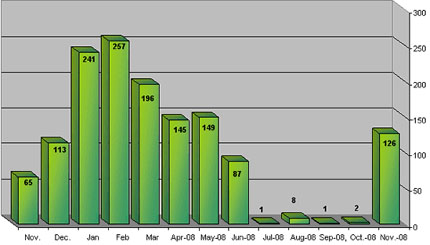
Facebooktwittermail

NEWS & VIEWS ROUNDUP: December 22

Taliban taunts US over 30,000 extra troops

Plans to double the number of US troops in Afghanistan will see them suffer the same defeat as the Soviet army, the Taliban claims.

Admiral Mike Mullen, chairman of the US Joint Chiefs of Staff, said Washington could send up to 30,000 more troops over the next six months. The senior US commander in the country, General David McKiernan, had previously asked for more than 20,000 soldiers to counter the increasingly violent Taliban insurgency.

But Yousuf Ahmadi, a Taliban spokesman claiming to represent the fugitive leader Mullah Omar, said: “Russians also sent that many troops but were badly defeated.

“When the US increases its troop levels to that of the Russians, they will also be cruelly defeated.”

He added: “More troops – that means there will be more targets for the Taliban.” [continued…]

It’s Hamas who decides

What suspense, what panic ensued at the end of the week. Will Hamas extend the cease-fire or won’t it? How exactly should Khaled Meshal’s “no” be interpreted, along with Mahmoud Zahar’s “maybe” and Ismail Haniyeh’s vague mutterings? In the communities of the western Negev, quotes from Al Jazeera have become more important than what Tzipi Livni or Ehud Barak have to say.

It is not the state that will determine what happens, it is the organization. And the organization decided – no more cease-fire. Ostensibly, a clear and agreed-on modus operandi has been created between Israel and Hamas. Hamas shoots – Israel closes the crossings; Hamas is quiet – Israel opens the crossings. Both sides know that military options are limited. Hamas will not bring Israel down with a few dozen Qassam rockets and Israel recognizes that at least at this stage it cannot propose more than a limited return of fire and continued sanctions.

But Hamas has a major advantage in this violent dialogue. The initiative of whether to extend the cease-fire or shoot has passed to them. Israel has been left in the position of reacting, and Hamas has scored some successes. [continued…]

Hamas: Israel can invade, by all means

Despite increasing calls among Israeli ministers of a need to launch a military operation to tackle the escalating threat of rocket attacks on the southern border, Hamas leaders in the Gaza Strip seemed unperturbed, with one senior member even daring Israel to take the action.

“For three years we’ve been hearing comments about an Israeli invasion into the Gaza Strip. Israel is like a teenager who begins to smoke, chokes, then stops,” Mahmoud Zahar, a top Hamas leader in the Gaza Strip, said during an interview with a Nazareth radio station. “If they want to [invade] – by all means.

“Even in the days of the ceasefire, Israel didn’t allow vital supplies into the Gaza Strip, and this is a callous violation,” he continued. “Israel promised to open the crossing but that never happened on the ground.” [continued…]

Will Obama press Israel to allow nuclear inspection of Dimona reactor?

One Israeli official who should be busy during the presidential reign of Barack Obama is Shaul Horev, director general of Israel’s Atomic Energy Commission. The new president and his choice for secretary of state, New York Senator Hillary Clinton, intend to revive international arms-control efforts, which have been on hold during the eight years of President George W. Bush’s administration. Such initiatives inevitably arouse suspicion and testiness among Israeli officials, who are anxious about the erosion of their country’s deterrent capability.

In their campaigns, Obama and Clinton promised that arms control would once again play a central role in American diplomacy. Their associates and supporters, some of whom are candidates for positions in the new administration, have repeated this message relentlessly to Israeli colleagues and acquaintances.

Last Sunday, Jim Hoagland, who writes a column on foreign affairs in The Washington Post, wrote that Obama should learn from president John F. Kennedy and call for worldwide nuclear disarmament. Hoagland’s columns generally express the consensus of the U.S. foreign affairs establishment. Kennedy was the last American president to have tried to stop the Israeli nuclear project. He threatened that there would be serious ramifications vis-a-vis U.S. support for Israel if the reactor in Dimona was not opened to frequent visits by inspectors. The pressure that Kennedy applied on the matter of Dimona was apparently one of the factors in David Ben-Gurion’s resignation in 1963. Kennedy’s assassination several months later led to a relaxation of that pressure and Israel was able to complete construction of the reactor in the Negev. [continued…]

Can Obama restore the US image in the Middle East?

… if “not being Bush” is not enough to turn around US relations with the Middle East, what will it take? A further analysis of polls, as well as focus groups I have conducted in five Middle Eastern countries, suggest that there are numerous questions about US policy in the Middle East that people there will be looking to the Obama administration to answer. The three most central ones are: (1) will the United States continue to have a dominating military presence in the region? (2) will the United States play an even-handed role in the Israel-Palestinian conflict? (3) will the United States support democratization in the region? [continued…]

Despite the optimism, Iraq is close to the edge

George W Bush, barely a month away from leaving office, flew to Baghdad last weekend for an eight-hour visit. On Wednesday, it was Gordon Brown’s turn. The arrival of president and prime minister in the Iraqi capital is part of a concerted effort to draw a line under the debacle that Iraq has become for the American and British governments. After nearly six years of occupation, Bush was keen to stress the progress he claimed had been made.

“The Iraq we’re standing in today is dramatically freer, dramatically safer and dramatically better,” he told American troops. Brown was a little more circumspect, simply declaring: “We leave Iraq a better place.” The startling actions of Iraqi journalist Muntazar al-Zaidi in throwing his shoes at Bush indicates that all is not as positive as Bush would have the world believe. There is a grave danger that by overstating the good news from Iraq, both Bush and Brown are making a return to civil war more likely. [continued…]

Iraq threatens to expel Iranian rebels

Iraqi officials say they intend to expel members of an Iranian exile group living in a camp north of Baghdad that is protected by the U.S. military. The expulsion, which the Shiite-led government has long sought, is expected to become feasible once the U.N. mandate that regulates the presence of U.S. troops — and which gave the Iranian opposition group protected status — expires at the end of the year. [continued…]

Al Shabaab on the rise as Ethiopia withdraws from Somalia

Two years after invading Somalia, ousting the Islamic Courts Union (ICU) government in Mogadishu and subsequently propping up the increasingly weak Transitional Federal Government (TFG), Ethiopia has reiterated its commitment to withdraw its forces in the next few days.

“This week, Ethiopian troops have begun to make preparations for their withdrawal. This has not, however, prevented continuing clashes with al Shabaab forces,” an Ethiopian foreign ministry statement said, referring to an ICU splinter group that has now taken control of much of the country, AFP reported. [continued…]

Forest plan in Brazil bears the traces of an activist’s vision

Twenty years ago, a Brazilian environmental activist and rubber tapper was shot to death at his home in Acre State by ranchers opposed to his efforts to save the Amazon rain forest.

After his death at age 44, Francisco Alves Mendes, better known as Chico, became a martyr for a concept that is only now gaining mainstream support here: that the value of a standing forest could be more than the value of a forest burned and logged in the name of development.

This month, Brazil took what environmentalists hope will be a big step forward in realizing Mr. Mendes’s vision. The government of President Luiz Inácio Lula da Silva introduced ambitious targets for reducing deforestation and carbon dioxide emissions in a nation that is one of the world’s top emitters of this heat-trapping gas. [continued…]

What motivates the torture enablers?

It is instructive to watch Major Matthew Alexander and Federalist Society kingpin David Rivkin discuss the torture issue on the Riz Khan Show:

We’ve seen this scenario played out several times in the last week, as broadcasters and newspapers around the country see the Levin-McCain Report as an opportunity to debate torture, despite the logical fallacy of this approach. (Perhaps for Christmas proper we’ll be treated to arguments for and against genocide, and on the fourth day of Christmas we’ll read the arguments for and against the practice of infanticide.) We’ve been treated to Christopher Hitchens against Michael Smerconish, Duncan Hunter against Jim Moran, and now the Alexander versus Rivkin encounter.[continued…]

The homicides you didn’t hear about in Hurricane Katrina

What do you do when you notice that there seems to have been a killing spree? While the national and international media were working themselves and much of the public into a frenzy about imaginary hordes of murderers, rapists, snipers, marauders, and general rampagers among the stranded crowds of mostly poor, mostly black people in New Orleans during Hurricane Katrina, a group of white men went on a shooting spree across the river.

Their criminal acts were no secret but they never became part of the official story. The media demonized the city’s black population for crimes that turned out not to have happened, and the retractions were, as always, too little too late. At one point FEMA sent a refrigerated 18-wheeler to pick up what a colonel in the National Guard expected to be 200 bodies in New Orleans’s Superdome, only to find six, including four who died naturally and a suicide. Meanwhile, the media never paid attention to the real rampage that took place openly across the river, even though there were corpses lying in unflooded streets and testimony everywhere you looked — or I looked, anyway.

The widely reported violent crimes in the Superdome turned out to be little more than hysterical rumor, but they painted African-Americans as out-of-control savages at a critical moment. The result was to shift institutional responses from disaster relief to law enforcement, a decision that resulted in further deaths among the thirsty, hot, stranded multitude. Governor Kathleen Blanco announced, “I have one message for these hoodlums: These troops know how to shoot and kill, and they are more than willing to do so if necessary, and I expect they will.” So would the white vigilantes, and though their exact body count remains unknown, at least 11 black men were apparently shot, some fatally. [continued…]

Katrina’s hidden race war

The way Donnell Herrington tells it, there was no warning. One second he was trudging through the heat. The next he was lying prostrate on the pavement, his life spilling out of a hole in his throat, his body racked with pain, his vision blurred and distorted.

It was September 1, 2005, some three days after Hurricane Katrina crashed into New Orleans, and somebody had just blasted Herrington, who is African-American, with a shotgun. “I just hit the ground. I didn’t even know what happened,” recalls Herrington, a burly 32-year-old with a soft drawl.

The sudden eruption of gunfire horrified Herrington’s companions–his cousin Marcel Alexander, then 17, and friend Chris Collins, then 18, who are also black. “I looked at Donnell and he had this big old hole in his neck,” Alexander recalls. “I tried to help him up, and they started shooting again.” Herrington says he was staggering to his feet when a second shotgun blast struck him from behind; the spray of lead pellets also caught Collins and Alexander. The buckshot peppered Alexander’s back, arm and buttocks. [continued…]

Facebooktwittermail

NEWS, VIEWS & EDITOR’S COMMENT: Treating the Hamas-denial complex

Livni: I will topple Hamas regime in Gaza if elected PM

Foreign Minister Tzipi Livni vowed on Sunday to end Hamas’s rule in the Gaza Strip if she is elected prime minister in a February election.

“The state of Israel, and a government under me, will make it a strategic objective to topple the Hamas regime in Gaza,” Livni told members of her centrist Kadima party. “The means for doing this should be military, economic and diplomatic.” [continued…]

Editor’s Comment — Did Tzipi Livni make this announcement in front of a crowd of 200,000 supporters (the size of the crowd in Gaza City that came to celebrate Hamas’ 21st anniversary)? Will her Kadima party even be around for 21 years?

The fact that Hamas is still in power is not due to a lack of effort on the part of Israel and its allies to apply a massive amount of pressure to bring the group down. Indeed, not only has Hamas demonstrated its resilience but it has also benefited politically from the pressure.

Having won parliamentary elections in 2006, had Hamas been allowed to govern, its merits and failings as a political organization and governing entity would subsequently have been judged by the Palestinian electorate. But neither Fatah, the Israelis or The Quartet were interested in finding out whether Hamas could pass this democratic test.

But let’s entertain some of Livni’s wishful thinking and suppose that a couple more years of siege and periodic bombardment might do the trick and lead to the collapse of the Hamas government. What then? Is liberal democracy going to rise from the ashes? Probably not. A much more probable course would be something parallel to what’s happened in Somalia. With the ousting of the Islamic Courts Union, taking its place as a political force has been the strengthening and expansion of the more radical Shabaab.

Those who dream of the end of Hamas should fear what the fulfillment of their dreams might bring.

Tony Blair, the dolt with a part-time job as envoy for The Quartet (a job to which he devotes just one week a month) told Haaretz: “I can’t see any basis for an agreement between the international community and Hamas. How do you negotiate the two-state solution with people if they don’t accept your right to exist? That’s the problem. Some people tell me, ‘You spoke with the IRA,’ and I tell them we only did that once they accepted that the solution will only be through peaceful means.”

Is Blair telling a pure, unadulterated lie, or has his political seasoning left incapable of discriminating between deceit and truthfulness?

The British government — as Blair surely knows — started talking to the IRA long before it renounced violence. The Good Friday Agreement enshrined that commitment. The end of violence, as everyone understood, would be among the fruits of successful negotiations — not a pre-condition for entering into talks.

If all sides were willing to simultaneously renounce violence, that would be a fine thing. Language after all is a far more constructive tool than explosives. But of course neither side believes it would benefit from unilateral disarmament. Instead, we can only have a much more ugly process that involves a mix of words and violence. The most practical and immediate goal should be for both sides to explore ways of adjusting the proportions of that mix. Right now, they’re both heading in the wrong direction.

Talk to Hamas

Politicians, generals and the public all know that any substantial incursion into the Gaza Strip will be a catastrophe. Still, no one dares ask why, for heaven’s sake, not try to talk directly with Hamas?

Gaza has an established authority that seized power democratically and then forcibly, and proved it has the power to control the territory. That, in itself, isn’t bad news after a period of anarchy. But Israel and the world don’t like Hamas. They want to overthrow it, but their diabolical scheme isn’t working out. The two-year siege and boycott that included starvation, blackouts and bombardments have produced no sign that Hamas is weaker. On the contrary: The ceasefire was violated first by Israel with its unnecessary operation of blowing up a tunnel.

What everybody already knew to be false – that the political choice of a people could be changed through violence, that the Gazans could be made into Zionists by being abused – was tried anyway. Now we have to finally change direction, to do what nobody has tried before, if only because we have no other choice.

Any excuse against such an attempt does not hold water. Hamas doesn’t recognize Israel; what does it matter? Hamas is a fundamentalist movement? That’s irrelevant. Hamas will decline holding talks? Let’s challenge it. Direct talks with Hamas will weaken Palestinian Authority President Mahmoud Abbas? He’s weak anyway.

What does Israel have to lose besides its much-anticipated wide-scale operation that it can carry out anytime? Why not try the diplomatic option before the military one, and not the other way around like we’re used to? [continued…]

Facebooktwittermail