Author Archives: Paul Woodward

CAMPAIGN 08 EDITORIAL: Rising to the Wright challenge

Rising to the Wright challenge

The “dirt” on Rev. Jeremiah Wright has been around for years, so why has ABC News chosen to highlight Obama’s controversial pastor now?

The race fire has been lit and those who believe it serves their political interests are happy to pour fuel on the flames.

How should Obama respond? It’s time for some jujitsu.

Let’s not confuse the package with the content.

In and of themselves, Wright’s statements are not totally outrageous. (I know. Some people will think it’s outrageous for me to say that.) What makes what he’s saying so inflammatory isn’t just what he’s saying but the way he’s saying it:

Wright is the scary, fiery, black preacher: the kind who might incite an insurrection. Contrast his tone, his body language, and his theatrical force with the calm, comforting, sensible message and sweet tone that comes from some of America’s favorite gentle men of God, Jerry Falwell and Pat Robertson:

Unless Wright’s passion — Wright’s unwhiteness — is really the issue, then instead of responding to his statements with some new formulation of reject-and-denounce, how about grabbing this bull by the horns and saying, OK, you want race to be a campaign issue? Let’s go for it!

“God damn America for treating our citizens as less than human,” says Rev Wright. Is this pure anti-American vitriol, or does Wright have a point?

One in a hundred Americans are behind bars.

That America, the land of the free, should have more people in prison than any other nation on earth is an issue that surely merits national attention.

If America’s prison population of 2.3 million was confined to one state, it would be a state bigger than New Mexico.

Among 20-34 year old black men, one in nine is incarcerated. This is a social disaster and it should be a national disgrace.

When it comes to issues such as this, the only people who can hold their hands on their hearts and say God Bless America are the shareholders of companies like Corrections Corporation of America who have seen their stock value and revenues steadily increase for the last eight years.

What should we be talking about? Rev Wright’s intemperate rhetoric? Or some of the things he’s calling attention to — even if he calls so loudly he might be hard to hear?

Facebooktwittermail

CAMPAIGN 08 & EDITOR’S COMMENT: What’s Hillary’s position on the Hitler Concept?

Hillary’s prayer: Hillary Clinton’s religion and politics

When Clinton first came to Washington in 1993, one of her first steps was to join a Bible study group. For the next eight years, she regularly met with a Christian “cell” whose members included Susan Baker, wife of Bush consigliere James Baker; Joanne Kemp, wife of conservative icon Jack Kemp; Eileen Bakke, wife of Dennis Bakke, a leader in the anti-union Christian management movement; and Grace Nelson, the wife of Senator Bill Nelson, a conservative Florida Democrat.

Clinton’s prayer group was part of the Fellowship (or “the Family”), a network of sex-segregated cells of political, business, and military leaders dedicated to “spiritual war” on behalf of Christ, many of them recruited at the Fellowship’s only public event, the annual National Prayer Breakfast. (Aside from the breakfast, the group has “made a fetish of being invisible,” former Republican Senator William Armstrong has said.) The Fellowship believes that the elite win power by the will of God, who uses them for his purposes. Its mission is to help the powerful understand their role in God’s plan.

Clinton declined our requests for an interview about her faith, but in Living History, she describes her first encounter with Fellowship leader Doug Coe at a 1993 lunch with her prayer cell at the Cedars, the Fellowship’s majestic estate on the Potomac. Coe, she writes, “is a unique presence in Washington: a genuinely loving spiritual mentor and guide to anyone, regardless of party or faith, who wants to deepen his or her relationship with God.” [complete article]

Editor’s Comment — In a 2006 New York Times interview, Hillary Clinton said warmly that “Doug [Coe] was always very supportive of me.” One wonders then what her position might be on Coe’s promotion of the “Hitler concept”?

This is how Coe explained the concept in a conversation recounted in Harper’s:

“Do you know what a difference a friend can make? A friend you can agree with?” He smiled. “Two or three agree, and they pray? They can do anything. Agree. Agreement. What’s that mean?” Doug looked at me. “You’re a writer. What does that mean?”

I remembered Paul’s letter to the Philippians, which we had begun to memorize. Fulfill ye my joy, that ye be likeminded.

“Unity,” I said. “Agreement means unity.”

Doug didn’t smile. “Yes,” he said. “Total unity. Two, or three, become one. Do you know,” he asked, “that there’s another word for that?”

No one spoke.

“It’s called a covenant. Two, or three, agree? They can do anything. A covenant is . . . powerful. Can you think of anyone who made a covenant with his friends?”

We all knew the answer to this, having heard his name invoked numerous times in this context. Andrew from Australia, sitting beside Doug, cleared his throat: “Hitler.”

“Yes,” Doug said. “Yes, Hitler made a covenant. The Mafia makes a covenant. It is such a very powerful thing. Two, or three, agree.”

And Jeff Sharlet, the author of the Harper’s piece, in a subsequent interview went on to explain more about this concept as understood by members of Coe’s secretive organization:

All these guys Hitler, Lenin, Pol Pot and Osama bin Laden is another guy they cite a lot, are guys who understood the power of a political avant garde. That’s what they mean by the Hitler Concept.

If the evidence of disarray inside her campaign is any indication, it doesn’t seem that Hillary is making use of this Family principle. Even so, her association with Coe and his organization does little to burnish her Democratic credentials.

Facebooktwittermail

CAMPAIGN 08 FEATURE: McCain adviser wants to destroy Islam

McCain’s spiritual guide: destroy Islam

Senator John McCain hailed as a spiritual adviser an Ohio megachurch pastor who has called upon Christians to wage a “war” against the “false religion” of Islam with the aim of destroying it.

On February 26, McCain appeared at a campaign rally in Cincinnati with the Reverend Rod Parsley of the World Harvest Church of Columbus, a supersize Pentecostal institution that features a 5,200-seat sanctuary, a television studio (where Parsley tapes a weekly show), and a 122,000-square-foot Ministry Activity Center. That day, a week before the Ohio primary, Parsley praised the Republican presidential front-runner as a “strong, true, consistent conservative.” The endorsement was important for McCain, who at the time was trying to put an end to the lingering challenge from former Arkansas governor Mike Huckabee, a favorite among Christian evangelicals. A politically influential figure in Ohio, Parsley could also play a key role in McCain’s effort to win this bellwether state in the general election. McCain, with Parsley by his side at the Cincinnati rally, called the evangelical minister a “spiritual guide.”

The leader of a 12,000-member congregation, Parsley has written several books outlining his fundamentalist religious outlook, including the 2005 Silent No More. In this work, Parsley decries the “spiritual desperation” of the United States, and he blasts away at the usual suspects: activist judges, civil libertarians who advocate the separation of church and state, the homosexual “culture” (“homosexuals are anything but happy and carefree”), the “abortion industry,” and the crass and profane entertainment industry. And Parsley targets another profound threat to the United States: the religion of Islam.

In a chapter titled “Islam: The Deception of Allah,” Parsley warns there is a “war between Islam and Christian civilization.” He continues:

I cannot tell you how important it is that we understand the true nature of Islam, that we see it for what it really is. In fact, I will tell you this: I do not believe our country can truly fulfill its divine purpose until we understand our historical conflict with Islam. I know that this statement sounds extreme, but I do not shrink from its implications. The fact is that America was founded, in part, with the intention of seeing this false religion destroyed, and I believe September 11, 2001, was a generational call to arms that we can no longer ignore.

Parsley is not shy about his desire to obliterate Islam. [complete article]

Facebooktwittermail

OPINION & EDITOR’S COMMENT: The slow rise and meteoric fall of Admiral “Fox” Fallon

American Icarus

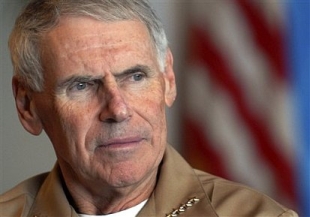
fallon.jpgThere is a view abroad, commonly held, that Admiral William “Fox” Fallon has been sacrificed, has been gotten out of the way, by the Bush Administration because he disagreed with its policies on Iran. That Fallon stood in the way of the neo-Conservative cabal who is bent on expanding the Middle East conflict and that, when given the order for the attack (at some point in the future), Fallon would have courageously refused the order and reversed the tide of history.

What bunk.

William Fox Fallon was and is a Navy officer and a patriot. As such, if given a legitimate order from the President of the United States, as passed through the legally constituted chain-of-command, he would have obeyed the order. Of this we can have absolutely no doubt. To do otherwise is treason and to believe otherwise is to believe that Fallon would have rejected every moment of training, every tradition of his service, every law and custom that has governed U.S. civilian-military relations. The problem is not that Fox Fallon disagreed with George Bush.

The problem is that he talked to Thomas Barnett. [complete article]

See also, The man between war and peace (Thomas Barnett) and Commander rejects article of praise (WP).

Editor’s Comment — Sometimes it’s better to get out sooner than later.

As much as I respect the knowledge and views of my friend and colleague Mark Perry, it’s hard for me to believe that Fallon didn’t know exactly what he was in for when agreed to spend several days with Thomas Barnett. Indeed, in addition to spending four-and-a-half days with him, Fallon later welcomed Barnett as a speaker at an event the admiral was hosting.

Barnett blogs: “… since I’d offered him a speech in return for the favor of letting me on the tour, and since his staff took that offer up by asking me to address the Bright Star post-exercise gathering of senior Mideast military leaders (which Fallon was hosting) in Cairo the weekend after the trip, I figured I’d get some chance for F2F [face-to-face] follow-up if required.”

Far from thinking that Fallon took a calculated risk in responding to Esquire’s invitation, I’m more inclined to think that on some level he got what he was asking for.

Barnett is upfront in spelling out his own motives where — in a comment on his blog — he refers to “outing” Fallon:

It’s the secrecy by which decisions are made that has poisoned the well. If “outing” any opposition to the administration’s line puts that person at risk, then is the journalist’s choice simply to ignore the internal debate to spare the public such knowledge?

Cause if it is, then we’re offering descriptions of our own government that historically are better leveled at authoritarian regimes, where America constantly needs to be careful shining a light on dissidents lest they fall under attack by authorities.

If we place our military leadership in that category, then this country is in a world of trouble.

The public’s right to know of internal debates on matters as crucial as to whether or not we go to war with Iran is sacrosanct in my mind. Wars of choice have to be national choices, not just leadership choices.

Fallon is now a free agent. Will he use his influence to more effect outside than he did inside the Pentagon? The answer to that may depend on who wins the Democratic presidential nomination, but if after a diplomatic silence of a few weeks, Ret Adm Fallon lends some solid military credibility to the campaign of the young senator from Illinois, I wouldn’t be surprised. And then, speculating even further over the horizon, why should we not ask: Which position offers the greater potential for Fallon to fulfill his stated mission?

He said, “I’d like to continue to do things that will be useful to the world and its inhabitants.”

Was he seeing himself as head of CENTCOM when he said that, or might he have had had some inkling that a larger brief lay ahead? Secretary of Defense, or Secretary of State, perhaps….

Facebooktwittermail

CAMPAIGN 08: Experience required

Senator Clinton’s claims of foreign policy experience are exaggerated

When your entire campaign is based upon a claim of experience, it is important that you have evidence to support that claim. Hillary Clinton’s argument that she has passed “the Commander- in-Chief test” is simply not supported by her record.

There is no doubt that Hillary Clinton played an important domestic policy role when she was First Lady. It is well known, for example, that she led the failed effort to pass universal health insurance. There is no reason to believe, however, that she was a key player in foreign policy at any time during the Clinton Administration. She did not sit in on National Security Council meetings. She did not have a security clearance. She did not attend meetings in the Situation Room. She did not manage any part of the national security bureaucracy, nor did she have her own national security staff. She did not do any heavy-lifting with foreign governments, whether they were friendly or not. She never managed a foreign policy crisis, and there is no evidence to suggest that she participated in the decision-making that occurred in connection with any such crisis. As far as the record shows, Senator Clinton never answered the phone either to make a decision on any pressing national security issue – not at 3 AM or at any other time of day.

When asked to describe her experience, Senator Clinton has cited a handful of international incidents where she says she played a central role. But any fair-minded and objective judge of these claims – i.e., by someone not affiliated with the Clinton campaign – would conclude that Senator Clinton’s claims of foreign policy experience are exaggerated. [complete article]

Facebooktwittermail

NEWS & FEATURE: Fallon quits

Top U.S. commander in Mideast to retire early

Adm. William J. Fallon, the top American commander in the Middle East whose views on Iran and other issues have seemed to put him at odds with the Bush administration, is retiring early, the Pentagon said Tuesday afternoon.

The retirement of Admiral Fallon, 63, who only a year ago became the first Navy man to be named the commander of the United States Central Command, was announced by his civilian boss, Defense Secretary Robert M. Gates, who said that he accepted the admiral’s request to retire “with reluctance and regret.”

President Bush said Admiral Fallon had served his country with “honor, determination and commitment” and deserved “considerable credit” for the progress in Afghanistan and Iraq.

But despite the warm words from Mr. Bush and Mr. Gates, there was no question that the admiral’s premature departure stemmed from a public appearance of policy differences with the administration, and with Gen. David H. Petraeus, the American commander in Iraq. [complete article]

The man between war and peace

If, in the dying light of the Bush administration, we go to war with Iran, it’ll all come down to one man. If we do not go to war with Iran, it’ll come down to the same man. He is that rarest of creatures in the Bush universe: the good cop on Iran, and a man of strategic brilliance. His name is William Fallon, although all of his friends call him “Fox,” which was his fighter-pilot call sign decades ago. Forty years into a military career that has seen this admiral rule over America’s two most important combatant commands, Pacific Command and now United States Central Command, it’s impossible to make this guy–as he likes to say–“nervous in the service.” Past American governments have used saber rattling as a useful tactic to get some bad actor on the world stage to fall in line. This government hasn’t mastered that kind of subtlety. When Dick Cheney has rattled his saber, it has generally meant that he intends to use it. And in spite of recent war spasms aimed at Iran from this sclerotic administration, Fallon is in no hurry to pick up any campaign medals for Iran. And therein lies the rub for the hard-liners led by Cheney. Army General David Petraeus, commanding America’s forces in Iraq, may say, “You cannot win in Iraq solely in Iraq,” but Fox Fallon is Petraeus’s boss, and he is the commander of United States Central Command, and Fallon doesn’t extend Petraeus’s logic to mean war against Iran. [complete article]

Commander rejects article of praise

The top U.S. commander in the Middle East is the subject of a glowing magazine article describing him as the only person who might stop the Bush administration from going to war against Iran.

Esquire magazine’s forthcoming profile of Adm. William “Fox” Fallon portrays the chief of the U.S. Central Command as “brazenly challenging” President Bush on Iran, pushing back “against what he saw as an ill-advised action.”

Written by Thomas P.M. Barnett, a former professor at the Naval War College, the article in the magazine’s April issue predicts that if Fallon leaves his position at Central Command, “it may well mean that the president and vice president intend to take military action against Iran before the end of this year and don’t want a commander standing in their way.”

The article is written in an admiring fashion, praising Fallon as “a man of strategic brilliance” whose understanding of the tumultuous situation in Pakistan “is far more complex than anyone else’s.”

Asked about the article yesterday, Fallon called it “poison pen stuff” that is “really disrespectful and ugly.” He did not cite specific objections. [complete article]

Facebooktwittermail

CAMPAIGN 08 & EDITOR’S COMMENT: The Hillary hoodwink

Clinton camp: Obama must pass ‘security threshold’ to be veep

Senior advisers to Sen. Hillary Rodham Clinton (D-N.Y.) on Monday sought to reconcile the campaign’s assertion that rival Sen. Barack Obama (D-Ill.) has not passed the “commander-in-chief test” with the Clintons’ hints in recent days that the New York senator would tap Obama as a running mate.

Howard Wolfson, Clinton’s chief spokesman, said during a conference call with reporters that Clinton would reject any running mate who has not met the “national security threshold,” as Clinton’s military advisers and Wolfson put it on the call. But he added that it is possible Obama could meet that threshold by this summer’s Democratic convention.

Wolfson repeated Clinton’s weekend assertion that picking Obama is “not something she would rule out at this point,” but he also reiterated that Obama is not ready to be commander in chief, a key requirement to being Clinton’s running mate.

When asked if Obama could do something to cross that “threshold,” Wolfson said, “It’s not something that I’m prepared to rule out at this time.” [complete article]

Editor’s Comment — Let’s see. Are we to suppose that the Clinton campaign is secretly putting together a VP crash course so that Obama can pass the “security threshold” just in time for the convention? For Hillary it took a lifetime of experience, but Obama’s such a quick study he’ll be able to do it in just four months. But hey, if he could do that, maybe that’s why he has the audacity to claim he’s ready now. But then again….

Maybe something else is going on. Maybe the Clinton campaign has pin-pointed a key demographic segment that they’re eager to grab – a chunk of the undecided voters that the analysts are far too polite to name: voters who can easily be hoodwinked. Here’s the pitch: “You know, I’ve said some pretty nasty things about Barak and in the unlikely event that I fail to win the nomination, he probably won’t want me as a running mate. He might even have the nerve to say he wants someone more experienced than me. But I’m big hearted and big minded and I care about what’s best for the Democratic party, so if you vote for me, I’ll bring him along too. He’s a good kid and I could knock him into shape in a few weeks. So, if you’re not a delusional dreamer who’s just a sucker for a good speech but you still like Obama, then vote for me. You know it makes sense. Repeat after me: I support Obama, so I will vote for Hillary. I support Obama, so I will vote for Hillary…. And when you get in the voting booth and you’re thinking, ‘I’m gonna vote for Obama,’ just remember: check the box next to the name ‘Clinton.'”

Facebooktwittermail

NEWS & VIEWS ROUNDUP: March 10

They knew, but did nothing

Repeatedly in 2001, [Richard] Clarke had gone to Rice and others in the White House and pressed them to move, urgently, to respond to a flood of warnings about an upcoming and catastrophic terrorist attack by Osama bin Laden. The threat, Clarke was arguing, was as dire as anything that he or the CIA had ever seen.

He pushed for an early meeting in 2001 with Bush to brief him about bin Laden’s network and the “nearly existential” threat it represented to the United States. But Rice rebuffed Clarke. She allowed him to give a briefing to Bush on the issue of cyber terrorism, but not on bin Laden; she told Clarke the al-Qaeda briefing could wait until after the White House had put the finishing touches that summer on a broader campaign against bin Laden. She moved Clarke and his issues off centre stage – in part at the urging of Zelikow and the transition team.

Bass told colleagues that he gasped when he found a memo written by Clarke to Rice on September 4, 2001, exactly a week before the attacks, in which Clarke seemed to predict what was just about to happen. It was a memo that seemed to spill out all of Clarke’s frustration about how slowly the Bush White House had responded to the cascade of terrorist threats that summer. The note was terrifying in its prescience.

“Are we serious about dealing with the al-Qaeda threat?” he asked Rice. “Decision makers should imagine themselves on a future day when the CSG [Counterterrorism Security Group] has not succeeded in stopping al-Qaeda attacks and hundreds of Americans lay dead in several countries, including the US.

Bass’s colleagues said he knew instantly that the September 4 email was so sensitive – and potentially damaging, especially to Rice – that the White House would never voluntarily release a copy to the commission or allow him to take notes from the room if they came close to reproducing its language. Under a written agreement between the commission and the White House, notes could not “significantly reproduce” the wording of a classified document.

Bass decided he would have to try to memorise it in pieces, several sentences at a time, and then rush back to the commission to bat them out on a computer keyboard.

The day he discovered the document, Bass all but burst into the commission’s offices and rushed over to Hurley.

“Holy shit, chief,” Bass said excitedly. “You won’t believe what I found.”

He told Hurley that Clarke’s September 4 memo was a “document that grabs you by the throat, a document that you write when you’re at the end of your tether – or well past it”, as Clarke clearly was in the weeks before September 11. Hurley instantly understood the significance of what he was being told by Bass. The question for both men was whether Zelikow would allow them to share any of it with the public.

No torture. No exceptions

In most issues of the Washington Monthly, we favor articles that we hope will launch a debate. In this issue we seek to end one. The unifying message of the articles that follow is, simply, Stop. In the wake of September 11, the United States became a nation that practiced torture. Astonishingly—despite the repudiation of torture by experts and the revelations of Guantanamo and Abu Ghraib—we remain one. As we go to press, President George W. Bush stands poised to veto a measure that would end all use of torture by the United States. His move, we suspect, will provoke only limited outcry. What once was shocking is now ordinary.

Carbon output must near zero to avert danger, new studies say

Using advanced computer models to factor in deep-sea warming and other aspects of the carbon cycle that naturally creates and removes carbon dioxide (CO2), the scientists, from countries including the United States, Canada and Germany, are delivering a simple message: The world must bring carbon emissions down to near zero to keep temperatures from rising further.

“The question is, what if we don’t want the Earth to warm anymore?” asked Carnegie Institution senior scientist Ken Caldeira, co-author of a paper published last week in the journal Geophysical Research Letters. “The answer implies a much more radical change to our energy system than people are thinking about.”

Although many nations have been pledging steps to curb emissions for nearly a decade, the world’s output of carbon from human activities totals about 10 billion tons a year and has been steadily rising.

For now, at least, a goal of zero emissions appears well beyond the reach of politicians here and abroad. U.S. leaders are just beginning to grapple with setting any mandatory limit on greenhouse gases. The Senate is poised to vote in June on legislation that would reduce U.S. emissions by 70 percent by 2050; the two Democratic senators running for president, Hillary Rodham Clinton (N.Y.) and Barack Obama (Ill.), back an 80 percent cut. The Republican presidential nominee, Sen. John McCain (Ariz.), supports a 60 percent reduction by mid-century.

NSA’s domestic spying grows as agency sweeps up data

Five years ago, Congress killed an experimental Pentagon antiterrorism program meant to vacuum up electronic data about people in the U.S. to search for suspicious patterns. Opponents called it too broad an intrusion on Americans’ privacy, even after the Sept. 11 terrorist attacks.

But the data-sifting effort didn’t disappear. The National Security Agency, once confined to foreign surveillance, has been building essentially the same system.

The central role the NSA has come to occupy in domestic intelligence gathering has never been publicly disclosed. But an inquiry reveals that its efforts have evolved to reach more broadly into data about people’s communications, travel and finances in the U.S. than the domestic surveillance programs brought to light since the 2001 terrorist attacks.

Facebooktwittermail

NEWS & VIEWS ROUNDUP: March 10

Sniping by aides hurt Clinton’s image as manager
NYT – The morning after Senator Barack Obama shook the Clinton campaign by winning five contests in one weekend, Senator Hillary Rodham Clinton’s new campaign manager — Maggie Williams, who had taken over in a shake-up the night before — assembled the curious if demoralized staff.

“You may not like the person next to you,” Ms. Williams told dozens of aides who ringed the conference room at the campaign’s Virginia headquarters last month, according to participants. “But you’re going to respect them. And we’re going to work together.”

Ms. Williams’s demand was dismissed as wishful thinking by some in her weary audience. But in the view of many Clinton supporters, it accurately reflected the urgent need to overhaul a campaign that at that point had set itself apart for its level of disorder and dysfunction.

Obama and the bigots
Nicholas Kristof – … the most monstrous bigotry in this election isn’t about either race or sex. It’s about religion.

Confronting the kitchen sink
Bob Herbert – We have seen election after election in which candidates have won by fanning the anxieties of voters. Elect me, or something terrible will happen to you! That is now the Clinton mantra, which is a measure of how grim our politics have become.

Sure, Obama’s a smart, sweet guy — but can he fight?
McClatchy – Can Barack Obama take a punch? Can he throw one? Will he fight back when sweet reason doesn’t work? Can he plunge into a smack-down without endangering the image he’s crafted as the avatar of a kinder, gentler politics that unites rather than divides?

The Israel litmus test
Aaron David Miller – Why do so many American Jews demand unwavering commitment to Israel from their politicians?

Iraq will not be a Qaedistan
Olivier Roy – One of the key questions in the U.S. presidential race is what will happen if U.S. troops leave Iraq. Of course nobody knows for sure. But I can say this: Al Qaeda will not take power and establish an Islamic state.

Feith assails colleagues over run-up to war
WP – In the first insider account of Pentagon decision-making on Iraq, one of the key architects of the war blasts former secretary of state Colin Powell, the CIA, retired Gen. Tommy R. Franks and former Iraq occupation chief L. Paul Bremer for mishandling the run-up to the invasion and the subsequent occupation of the country.

Saudis offer pioneering therapy for ex-jihadists
The Observer – Psychologists are turning militants into model citizens as they ‘deradicalise’ and providing education and financial help with marriages and cars.

Lost from Lebanon
Franklin Lamb – The case of Brigitte Gabriel, anti-Muslim bigot and pro-Israel apologist, highlights the indignity of those that celebrate military aggression against ordinary civilians

Look out below. The arms race in space may be on
NYT – It doesn’t take much imagination to realize how badly war in space could unfold. An enemy — say, China in a confrontation over Taiwan, or Iran staring down America over the Iranian nuclear program — could knock out the American satellite system in a barrage of antisatellite weapons, instantly paralyzing American troops, planes and ships around the world.

The unstudied art of interrogation
NYT – How do you get a terrorist to talk? Despite the questioning of tens of thousands of captives in Iraq and Afghanistan in the last six years, and a high-decibel political battle over torture, experts say there has been little serious research to answer that crucial question.

Facebooktwittermail

IDEAS & EDITOR’S COMMENT: How to keep up with a hyena

Sociable, and smart

hyenas.jpgBrain imaging studies have revealed that when people think about other people, parts of the frontal cortex become active. Advocates of the social brain hypothesis say the frontal cortex expanded in our ancestors because natural selection favored social intelligence.

Most of the research on the social brain hypothesis has focused on primates. One reason for that bias, Dr. Holekamp said, is many scientists thought that no other animals were worth studying. “Primatologists have argued for years,” she said, “that primates are unique in terms of the complexity of their social lives.”

From her experience with hyenas, Dr. Holekamp had her doubts. So she began to run experiments on spotted hyenas similar to the ones run on primates. She would play recordings of hyenas, for example, to see if other hyenas recognized them individually. They did. She soon came to see the primates-only view of the social brain as deeply flawed. [complete article]

Editor’s Comment — The idea that social intelligence is the locus of human intelligence seems to me a rock solid assumption. Inventiveness, genius, talent and innovative creativity are invaluable to humanity but they percolate up way off on the social periphery. The stuff that makes us human is not so grand, and, so it appears, stuff that in some significant measure we share with hyenas. What concerns me though is that we seem to be on a social trajectory that may in evolutionary terms end up making us worse off than hyenas.

What does the atomization of social groups and the trend towards affinity groupings portend for our social intelligence? In other words, what becomes of our social intelligence if the only people we understand are the people who think the way we do? Is this not the point at which intelligence has stopped functioning? The point at which thought has become inherently circular?

Facebooktwittermail

CAMPAIGN 08 OPINION & EDITOR’S COMMENT: Obama’s fight

Confronting the kitchen sink

Political campaigns are not about fairness, but they can often be about vision. Voters want more from Senator Obama.

He may not be able to close the deal with, say, working-class whites, but he more than anyone else has the eloquence to try and make a compelling case. He should go for it.

We have seen election after election in which candidates have won by fanning the anxieties of voters. Elect me, or something terrible will happen to you!

That is now the Clinton mantra, which is a measure of how grim our politics have become. [complete article]

Editor’s Comment — There’s a false dichotomy being created between the Obamian high road and the Clintonian knife fight. Obama does need to fight, but pushing for tax returns isn’t going to work. This is a contest between two visions of the presidency. Hillary presents herself as the champion-solutions-fighter, but it’s a false bill of goods. Sure, she’s demonstrating her willingness to fight, but that’s not the same as being able to win. She fought for health care when she had the privilege of being First Lady, and she lost. She came into the primaries way ahead in the polls yet still suffered a string of defeats. She may right now be enjoying a tactical advantage but when it comes to displaying organizational and strategic mastery, if the Clinton campaign itself foretells the nature of a Clinton presidency – makeshift, discordant, reactive and uninspired – we’re in for trouble.

Obama on the other hand need go no further than present his own campaign as a model for his ability to craft and steer an organization. It’s been knocked off course recently and he needs to do a better job of showing that he can steer it back and do so without kowtowing to the Clinton campaign’s rebukes – dumping Samantha Power was a big mistake – but make the campaign the focus of the campaign by holding it up as a blueprint of the presidency and then go back to that red phone question. Who does America want to take the call? A defensive curmudgeon, a presidential poseur, or someone who’s relative inexperience is amply counterbalanced with sound judgment, a cool temperament, and a passion to lead by raising up the country rather than a passion for trying to destroy his opponents?

Facebooktwittermail

CAMPAIGN 08: You can’t lick the boot that kicks you

The only way to fight the Clintons

joann-wypijewski.jpgTalk about the “kitchen sink”! If Barack Obama wanted to throw it at the eight years of First Lady experience that Hillary Clinton has made central to her resume for “the job” she says she wants us to “hire” her for, there is plenty there. People on the left who say he won’t, he can’t because he’s just like her, a creature of capital and empire, may be right in the grand scheme, but they shouldn’t be smug, because there aren’t exactly models of successful radical or even liberal fights against the Clintons. There are barely models of noble but failed fights. And Hillary’s own revamped self-presentation as the populist fighter, sworn foe of big corporations, friend of the little people, ultimate underdog, makes clear that Obama’s ties to Wall Street should be no more an impediment than hers are in the game of political fisticuffs.

Already it looks like Obama’s advisers are getting it completely wrong, though, challenging her for her First Lady papers and her tax returns and, implicitly, the source of her and Bill’s immense wealth. Obama can no more beat the Clintons at this kind of game than the right could. Every small, personal complaint looks petty or desperate or sexist, and only allows Hillary to play the part she likes best, after mud slinger and policy wonk, which is survivor. She played that part in New Hampshire and in Ohio, and she’ll play it again any time she wants to put on the show that “for anyone who’s ever been counted out”, for anyone who’s ever had to struggle against the odds, for anyone who’s ever been treated unfairly, she’s their gal. It’s as phony a show as can be imagined, but it’s the one the Clintons perfected against the right, and their hard core supporters are on autopilot now to respond to it. Likewise, Obama can’t beat the Clintons in pure bloviating wonkery. Some of his advisors are saying he should quit the big inspiring rallies and do small tedious meetings of the type that Hillary’s supporters walk out of, even as they’ll later pull the lever for her at the polls. It’s not her “plans” that draw voters; like Blanche McKinney, most people don’t even know what those plans involve even after reading them. It’s her aura of dogged competence, based on the entirely fraudulent story of “putting people first” and thus widening the circle of peace and prosperity during the Clinton years. It’s also her skin color, and if anyone doesn’t think Bill Clinton knew what he was doing in South Carolina, locking up the white racist vote for his wife, they should talk to some of her supporters in Ohio.

Obama can’t do anything about that last “asset” of Hillary Clinton, and maybe it is her ultimate chip, but it would make for a more interesting campaign going forward if he would challenge that First Lady experience by implicitly challenging the myths on which it stands, projecting an idea of the future unmoored from the Reagan-Clinton continuum, something Hillary is locked into. What drew so many people originally to Obama’s campaign was its call to “turn the page” on past Republican and Democratic politics alike, and its recognition that people are just fed up. But that call could never sustain itself purely on some attacks on lobbyists and the usual timid party nods toward health care, education and the environment. It was always going to need more meat on its bones. [complete article]

Never been afraid to talk about anything

I came across something interesting while doing some research on public diplomacy for an unrelated project. Since at least the 9/11 Commission Report, almost every foreign policy blueprint or platform has for better or for worse mentioned the need to fix American public diplomacy and to engage with the “war of ideas” in the Islamic world. I expected all three remaining Presidential candidates to offer at least some boilerplate rhetoric on the theme. What I found was different.

Barack Obama’s counterterrorism plan, as I already knew, prominently features the need for better public diplomacy and engagement with the “crucial debate.. taking place within Islam”. He has advanced some bold ideas such as convening a summit with the leaders of the Islamic world early in his administration and the “America’s Voice Initiative” modeled after the Peace Corps (an idea which I love for all kinds of reasons). He’s making rebuilding America’s relations with the Muslim world a real priority, while putting forward a sophisticated reading of the politics of the Islamic world. Indeed, his discourse about this the other day during a potentially difficult meeting with Ohio Jewish leaders is possibly the best I’ve ever heard from an American politician:

The question, then, is what do we do with the 1.3 billion Muslims, who are along a spectrum of belief. Some extraordinarily moderate, some very pious but not violent. How do we reach out to them? And it is my strong belief that that is the battlefield that we have to worry about, and that is where we have been losing badly over the last seven years. That is where Iraq has been a disaster. That is where the lack of effective public diplomacy has been a disaster. That is where our failure to challenge seriously human rights violations by countries like Saudi Arabia that are our allies has been a disaster. And so what we have to do is to speak to that broader Muslim world in a way that says we will consistently support human rights, women’s rights…. Those all contribute to people at least being open to our values and our ideas and a recognition that we are not the enemy and that the clash of civilizations is not inevitable.

Now, as I said, we enter into those conversations with the Muslim world being mindful that we also have to defend ourselves against those who will not accept the West, no matter how appropriately we engage. And that is the realism that has to leaven our hopefulness. But, we abandon the possibility of conversation with that broader Muslim world at our own peril. I think all we do then is further isolate it and feed the kinds of jihadist fanaticism….

To me, that’s great stuff. It exemplifies the reasons why I’ve supported Obama, and to the extent that it incites the radical fringe against him, all the better!

John McCain, for his part, talks about creating a “single, independent public diplomacy agency” to reverse our “unilateral disarmament in the war of ideas” (a phrase I seem to recall from the Kerry campaign). He calls understanding foreign cultures a “strategic necessity”, and advocates helping moderate Muslims against extremists. While I think that his vision of public diplomacy is overly militarized, really more about strategic information operations than about dialogue or public diplomacy, at least he’s got well-developed ideas about the subject. We disagree, but there’s something there to have an argument about.

But Hillary Clinton…. nothing. [complete article]

Facebooktwittermail

NEWS & VIEWS ROUNDUP: March 8

Nobel winner: Hillary Clinton’s ‘silly’ Irish peace claims

Hillary Clinton had no direct role in bringing peace to Northern Ireland and is a “wee bit silly” for exaggerating the part she played, according to Lord Trimble of Lisnagarvey, the Nobel Peace Prize winner and former First Minister of the province.

“I don’t know there was much she did apart from accompanying Bill [Clinton] going around,” he said. Her recent statements about being deeply involved were merely “the sort of thing people put in their canvassing leaflets” during elections. “She visited when things were happening, saw what was going on, she can certainly say it was part of her experience. I don’t want to rain on the thing for her but being a cheerleader for something is slightly different from being a principal player.”

Clinton’s experience claim under scrutiny

The debate over readiness for the global arena is emerging as the flash point in the race for the Democratic presidential nomination, crystallized by a dramatic Clinton campaign commercial asking who is best prepared to answer a 3 a.m. phone call to the White House during a crisis.

Clinton says she is the answer, arguing that Obama’s major achievement was his early opposition to the Iraq war in 2002. Indeed, Obama doesn’t have much in the way of experience managing foreign crises, nor does Sen. John McCain, the presumptive Republican nominee, for that matter. In fact, it is rare for any president to have that kind of experience before coming into office.

In Clinton’s case, she may well have exercised influence on foreign policy that is hard to document because she had a unique opportunity to offer private counsel to her husband, President Bill Clinton.

But while Hillary Clinton represented the U.S. on the world stage at important moments while she was first lady, there is scant evidence that she played a pivotal role in major foreign policy decisions or in managing global crises.

Breaking the final rule

It will come as a surprise to many people that there are rules in politics. Most of those rules are unwritten and are based on common understandings, acceptable practices, and the best interest of the political party a candidate seeks to lead. One of those rules is this: Do not provide ammunition to the opposition party that can be used to destroy your party’s nominee. This is a hyper-truth where the presidential contest is concerned.

By saying that only she and John McCain are qualified to lead the country, particularly in times of crisis, Hillary Clinton has broken that rule, severely damaged the Democratic candidate who may well be the party’s nominee, and, perhaps most ominously, revealed the unlimited lengths to which she will go to achieve power. She has essentially said that the Democratic party deserves to lose unless it nominates her.

As a veteran of red telephone ads and “where’s the beef” cleverness, I am keenly aware that sharp elbows get thrown by those trailing in the fourth quarter (and sometimes even earlier). “Politics ain’t beanbag,” is the old slogan. But that does not mean that it must also be rule-or-ruin, me-first-and-only-me, my way or the highway. That is not politics. That is raw, unrestrained ambition for power that cannot accept the will of the voters.

McCain’s consistent folly on Iraq

On the campaign trail, John McCain has retreated on immigration, changed his mind on tax cuts and admitted economics is not his strong suit. But all that’s unimportant, we are told, because he was Right On Iraq — back at the beginning, when he endorsed the invasion, and again over the past year, when he has stoutly supported the surge. So, whichever Democrat he faces, the November election could be a referendum on the Iraq war and his support for it.

If so, that may not be a plus for McCain. McCain has been consistent about Iraq, in the sense of being consistently wrong. If the American people get a long look at what he’s said and a clear picture of our fortunes in Iraq, he may yearn for the days when he was being pilloried for offering “amnesty” to illegal immigrants.

The Iran hawks’ latest surge

Recently, I asked former Mossad officer Michael Ross what he thought of the latest U.S. National Intelligence Estimate released in December, which downplayed the threat posed by Iran’s nuclear program. “That farce?” he replied, adding that many in Israeli intelligence were “furious about it — not just the conclusion of the estimate, but its timing as well.” Some Iran hawks believe that the United Nations Security Council was poised at the time, with the United States leading the charge, to tighten the vice on the Iranian regime with tough new sanctions. But in the wake of the NIE’s disclosure, there was a powerful shift in world opinion about Iran’s alleged nuclear program, and the momentum was apparently lost.

Quiet US support for Egypt’s Gaza effort

To defuse the threat from Gaza militants to Israel and President Bush’s Mideast peace program, the U.S. has decided that the ends justify the means.

Hamas, which controls the Gaza Strip, is considered a terrorist group by Washington. U.S. law forbids official contacts. Nonetheless, the Bush administration is giving quiet support for Egypt’s attempt to broker a deal with Hamas for a truce in Gaza.

Under this approach, which U.S. officials and Mideast diplomats confirmed, Hamas would halt rocket attacks from Gaza. Israel would agree not to launch the kind of military incursions that nearly wrecked the U.S.-sponsored peace talks last weekend and would ease its blockade of Gaza.

Another milestone on the road to serfdom

This weekend, the darkness continues to descend in Washington, the powers of the state continue to grow and the mechanisms of accountability rot away unused. Americans are focused on the selection of a new president. Many of them share the naïve assumption that on January 20, 2009, when a new leader takes the oath of office from the south steps of the Capitol Building, the Founders’ constitutional order will once more be set aright and the extra-constitutional excesses of the Bush years will be but a bad memory. But whoever is installed as the new guardian of presidential power will not likely part with many of the rights that Bush claimed and was allowed to use, unchallenged.

And this weekend, we should regard the three remaining candidates from a more skeptical predicate. This weekend, the curtain of tyranny descends further in Washington. The Bush regime, bolstered by a surging 17% public acceptance in one poll, moves more closely towards a façade of legality for its national surveillance state. It acknowledges its abuse of other legislation and will suffer no consequences for that abuse, and in a symbolic coup de grâce, Bush will veto the latest Congressional prohibition on torture–for indeed, torture is the very talisman of his unchecked rule and his arrogant indifference to the rule of law. And in the midst of this, where, this weekend, are the three presidential finalists? They busy themselves with the accumulation of delegates for their march on the White House. They will mutter fine sounding words on the campaign trail—sentences will glimmer with “freedom” and “liberty”—but they will offer no action that shows those words have content.

Bush announces veto of waterboarding ban

President Bush vetoed Saturday legislation meant to ban the CIA from using waterboarding and other harsh interrogation tactics, saying it “would take away one of the most valuable tools on the war on terror.”

“This is no time for Congress to abandon practices that have a proven track record of keeping America safe,” Bush said in his weekly radio address.

Why Iraq could blow up in John McCain’s face

In Baghdad the Iraqi government is eager to give the impression that peace is returning. “Not a single sectarian murder or displacement was reported in over a month,” claimed Brigadier Qasim Ata, the spokesman for the security plan for the capital. In the US, the Surge, the dispatch of 30,000 extra American troops in the first half of 2007, is portrayed as having turned the tide in Iraq. Democrats in Congress no longer call aggressively for a withdrawal of American troops. The supposed military success in Iraq has been brandished by Senator John McCain as vindication of his prowar stance.

Sadr takes break from politics, cites failures

Iraq’s elusive Shiite cleric Moqtada Sadr has decided to drop out of politics for the time being because his disillusionment with the political scene in Iraq has left him sick and anxious, he said in an unusually personal letter to his followers released Friday.

In a written response to a query from a group of followers asking why he hadn’t been seen in public for so long, Sadr said he had decided to devote himself to a period of study, reflection and prayer after failing in his core mission to rid Iraq of the U.S. occupation or to turn it into an Islamic society.

He also cited the betrayal of some followers, whom he accused of falling prey to “materialistic” politics.

“So far I did not succeed either to liberate Iraq or make it an Islamic society — whether because of my own inability or the inability of society, only God knows,” Sadr wrote.

Officials lean toward keeping next Iraq assessment secret

A new National Intelligence Estimate on Iraq is scheduled to be completed this month, according to U.S. intelligence officials. But leaders of the intelligence community have not decided whether to make its key judgments public, a step that caused an uproar when key judgments in an NIE about Iran were released in November.

Facebooktwittermail

CAMPAIGN 08 EDITORIAL: A monstrous attack?

A monstrous attack?

What’s worse? Being called a monster, or being likened to Kenneth Starr? I guess it depends on who’s keeping score.

samantha-power.jpgSamantha Power could have referred to Hillary Clinton as Lady Macbeth. She could have said that Barak Obama’s Democratic opponent is displaying an “unalloyed lust for power.” She could have said that Clinton seems to have become “unhinged” — so desperate to win the nomination that she is jeopardizing the Democratic party’s chances of winning back the White House.

Had she said any of these things, Power would now still be a key adviser to Senator Obama. Instead, she used the utterly shocking word “monster.” She fucked up — and at the very same time that she was acknowledging that the Obama campaign “f***** up in Ohio.” (Note that The Scotsman, a newspaper whose journalistic integrity compelled to run with this important story, is also so high-minded that it must protect its readers from the shocking f-word.)

This then is the state of politics and the way it gets reported: lies, distortions, exaggeration and deviousness provoke neither shock nor penalty, but an ill-chosen word and an indiscreet honest expression — this is what must always be denounced and rejected.

Power needed to acknowledge that she had blundered, but she didn’t need to resign. Her remarks were inexcusable not because of their content but because she was dumb enough to express them to a reporter.

Facebooktwittermail

REVIEW: Flat Earth News

Riots, terrorism etc

‘Important’ is a cant word in book reviewing: it usually means something like ‘slightly above average’, or ‘I was at university with her,’ or ‘I couldn’t be bothered to read it so I’m giving a quote instead.’ Very occasionally it might be stretched to mean ‘a book likely to be referred to in the future by other people who write about the same subject’. Nick Davies’s Flat Earth News, however, is a genuinely important book, one which is likely to change, permanently, the way anyone who reads it looks at the British newspaper industry. Davies’s book explains something easy to notice and complain about but hard to understand: the sense of the increasing thinness and attenuation of the British press. It’s not literal thinness: the papers, physically, are bigger than ever. There just seems to be less in them than there once was: less news, less thought (as opposed to opinion), less density of engagement, less time spent finding things out. Davies looks into all those questions, confirms that the impression of thinness is correct, explains how this came about, and offers no hope that things will improve.

His book starts at the point at which he got interested in the story of what he calls ‘flat earth news’: ‘A story appears to be true. It is widely accepted as true. It becomes a heresy to suggest that it is not true – even if it is riddled with falsehood, distortion and propaganda.’ That’s flat earth news, and Davies became interested in the phenomenon, via the story of the millennium bug. How on earth did so many papers get sucked into producing so many millions of words of, it turns out, total nonsense about the impending implosion of all government, all commerce, all human activity, by the catastrophe which was going to be caused by the bug? ‘National Health Service patients could die’ (Telegraph); ‘Banks could collapse’ (Guardian); ‘Riots, terrorism and a health crisis’ (Sunday Mirror); ‘Pensions contributions could be wiped out’ (Independent); ‘Nato alert over Russian missile millennium bug’ (Times). The British government spent a figure variously reported as £396 million, £430 million and £788 million. And then, on the big night, a tide gauge failed in Portsmouth harbour. That was pretty much it. Countries which had spent next to nothing – Russia, for instance, whose government of 140 million citizens spent less on the bug than British Airways – had no problems.

There are several ways of looking at this story, which has some of the aspects of a panic and some of those of a hoax or job-creation scheme.[*] Davies chooses to focus on the fact that of the millions of words written about the bug, all of them were written by journalists who had no idea whether what they were writing was true. They simply didn’t know. Flat Earth News makes a great deal of this. The most basic function of journalism, in Davies’s view, is to check facts. Journalists don’t just pass on what they’re told without making an effort to check it first. At least, in theory they don’t. In practice, contemporary journalism has been corrupted by an endemic failure to verify facts and stories in a manner so fundamental that it almost defies belief. The consequences of that are pervasive and systemic. [complete article]

Facebooktwittermail

NEWS & VIEWS ROUNDUP: March 7

8 burials for Jerusalem seminary’s dead

It was unclear what group, if any, was responsible for the massacre. The radical Islamic Hamas movement, which praised the deed on Thursday but did not claim it, on Friday took responsibility in an anonymous phone call to the Reuters news agency and said that details would come later. But Fawzi Barhoum, a senior Hamas spokesman in Gaza, said that no claim was official unless made in a written statement signed by the military wing of Hamas. The gunman’s family said he was intensely religious but did not belong to any militant group.

Mark Regev, spokesman for Prime Minister Ehud Olmert, said that the government would act after proper investigation and deliberation, and he condemned those, like Hamas, who celebrated the killings with parades in Gaza. “That Hamas calls this a heroic act, and praises it, this exposes them for what they are,” he said.

The young men died as they were studying in the library of the Mercaz Harav yeshiva in Jerusalem, a major center for the national-religious movement that provides the backbone of Israeli settlement in the West Bank — settlements like this one, which Israel intends to keep in any future peace treaty.

Gazans see attack on yeshiva as unusual achievement

The celebratory shooting in the air in Gaza that followed the terrorist attack in Jerusalem last night showed that the penetration of Merkaz Harav was viewed as an unusual political and military achievement for the group responsible.

The attack brought something to a wide public in the Gaza Strip that it had been waiting for all week – revenge.

The horror scenes from Gaza at the beginning of the week sent Hamas, Islamic Jihad and other groups racing for a terror attack, knowing that whoever managed to pull one off first would score major points in the Arab and Palestinian street.

Talk to Hamas

In these days “all of Gaza has become Hamas,” a former Fatah security officer who is far from being a Hamas supporter, told Haaretz. Al Jazeera is broadcasting to every home the horror pictures of the deaths of dozens of children and women.

In this situation, hatred triumphs and the only hope is the desire to take revenge. The rocket launchers are thus the heroes who gain the people’s sympathy, and support for Hamas is not getting any smaller – it’s growing.

So there is no escape but to talk to Hamas. We cannot choose our enemies. We embraced Yasser Arafat after saying for dozens of years (in the words of Yitzhak Rabin) that “we’ll meet the PLO only on the battlefield.”

U.S. policy is gasoline on the Gaza fires

Once upon a time, Israelis and Palestinians looked to the U.S. to intervene at moments of heightened confrontation to mediate between the two sides and contain the damage. The Bush Administration, however, has proved entirely incapable of playing this role, because its own diplomatic efforts are hidebound by the requirements of its own war on Hamas.

Condi Rice is sticking doggedly to that script, even though all the other players are making clear that the game is up. The New York Times tells us, for example, that U.S. officials are worried that efforts to broker a cease-fire to end the carnage in Gaza might undermine Washington’s priority, which is not to restore peace, but to isolate and eliminate Hamas: “Ms. Rice wants to avoid the word ‘cease-fire’ because administration officials believe that a negotiated cease-fire between Israel and Hamas — which the United States and Israel view as a terrorist organization — would legitimize Hamas in the eyes of the Palestinian people,” the Times reports. “The fear, administration officials said, is that a negotiated cease-fire would likely undermine Mr. Abbas and make it look like Hamas is the entity with which Israel and the West should be negotiating, and not Mr. Abbas.”

Israeli journalism

A year ago I applied for the job of Occupied Territories correspondent at Ma’ariv, an Israeli newspaper. I speak Arabic and have taught in Palestinian schools and taken part in many joint Jewish-Palestinian projects. At my interview the boss asked how I could possibly be objective. I had spent too much time with Palestinians; I was bound to be biased in their favour. I didn’t get the job. My next interview was with Walla, Israel’s most popular website. This time I did get the job and I became Walla’s Middle East correspondent. I soon understood what Tamar Liebes, the director of the Smart Institute of Communication at the Hebrew University, meant when she said: ‘Journalists and publishers see themselves as actors within the Zionist movement, not as critical outsiders.’

This is not to say that Israeli journalism is not professional. Corruption, social decay and dishonesty are pursued with commendable determination by newspapers, TV and radio. That Israelis heard exactly what former President Katsav did or didn’t do with his secretaries proves that the media are performing their watchdog role, even at the risk of causing national and international embarrassment. Ehud Olmert’s shady apartment deal, the business of Ariel Sharon’s mysterious Greek island, Binyamin Netanyahu’s secret love affair, Yitzhak Rabin’s secret American bank account: all of these are freely discussed by the Israeli media.

When it comes to ‘security’ there is no such freedom. It’s ‘us’ and ‘them’, the IDF and the ‘enemy’; military discourse, which is the only discourse allowed, trumps any other possible narrative. It’s not that Israeli journalists are following orders, or a written code: just that they’d rather think well of their security forces.

Facebooktwittermail

CAMPAIGN 08 EDITORIAL: How was Hillary tested?

How was Hillary tested?

crisis-manager.gif

It’s 3 a.m. and your children are safe and asleep. But there’s a phone in the White House and it’s ringing.

Something’s happening in the world. Your vote will decide who answers that call, whether it’s someone who already knows the world’s leaders, knows the military — someone tested and ready to lead in a dangerous world.

It’s 3 a.m. and your children are safe and asleep. Who do you want answering the phone?

We’ve all seen the “red phone” ad — an ad that implicitly questions whether Barak Obama has enough experience to deal with an international crisis. Hillary Clinton has been tested and is ready to lead in a dangerous world — or so we are meant to believe.

But that begs the question: what was the test? CNN anchor Kiran Chentry pressed Clinton for an answer:

Can you tell us what specific experience in handling a crisis that you can point to that would make you better equipped to handle that White House phone at 3 a.m.?

This is the first “specific experience in handling a crisis” that Clinton cited:

You know, I was involved for fifteen years in, you know, foreign policy and security policy — you know, I helped to bring peace to Northern Ireland.

Hillary and her campaign have had five days to come up with her best shot at a credible answer to this question. On Feb 29, Mark Penn, Howard Wolfson and Lee Feinstein, Clinton’s national security director, were stumped. The best they could come up with after a very long pause was to say she’s been endorsed by many high ranking members of the uniformed military.

So, when Hillary puts bringing peace to Northern Ireland at the top of her national security resume — the best example she has of a specific experience she’s had in handling a crisis — she must be on solid ground. Right? Apparently not.

While she played a role in the Northern Ireland Process, she had no direct part in the negotiations. This is confirmed by Senator George Mitchell, the Clinton administration’s leading Northern Ireland peace negotiator.

Hillary helped organize seminars and conferences under the banner of ‘Vital Voices‘ which particularly engaged women in the Peace Process and built momentum towards the Good Friday Agreement. She also co-hosted with Bill a number of events in the White House around St Patrick’s Day, the Investment Conference and so forth. No doubt these were all valuable contributions in helping bring peace to Northern Ireland but by no stretch of the imagination can any of this be described as experience in handling an international crisis.

Hillary’s contribution to the peace process did not come in any 3am moments — these were more like 3pm interludes during which, in the words of a political reporter for the Belfast Telegraph, she contributed to the “mood music” that made an eventual settlement possible.

The Washington Post‘s Fact Checker who in January assessed Clinton’s claims about her role in Northern Ireland, concluded that it was “more symbolic than substantive.”

Foreign policy experience and familiarity with world leaders are obviously valuable assets in any newly-elected president, but the ability to handle a crisis cannot hinge on the notion that this is familiar territory. On the contrary, effective crisis management is all about having the temperament and the judgment to remain calm at the very moment when everyone is saying, “We didn’t see this coming. What do we do?”

Hillary wants us to rely on her experience, yet when push comes to shove and she’s up against the reality that her experience is much more limited than she now claims, what will she do then? What will she do when at 3am she’s faced with a crisis and nothing in her experience provides her with a template for action?

The challenge for whoever answers the phone at 3am is not one of memory recall. It’s not about thinking I’ve been here before so I know what to do. Least of all is about a gnawing awareness that I claimed I was here before so I better pretend I know what to do.

It’s about calmness and clarity. It’s about confidence in the capabilities of the administration that you put together. It’s about having the diligence to stay well-briefed. It’s about not getting knocked off balance when suddenly you enter unfamiliar territory. At the most critical moment, it’s about having a clear eye in the face of the unforeseen.

Facebooktwittermail

How did McClinton do it?

How to lose by winning

What was the key to Hillary McClinton’s success last night? She proved – again – fear works, thus demonstrating why she’s already conceded to McCain. And she won big where Democrats are sure to lose in November: rural America. That sounds, at least to me, like the definition of a pyrrhic victory.

Facebooktwittermail