With Iraq’s top leaders directing the battle, Iraq’s army and national police pressed a major operation Tuesday to wrest control of the southern port city of Basra from the Shiite Mahdi Army militia. Fighting between government forces and the militia quickly spread through Iraq’s south and into Baghdad.
Prime Minister Nouri al Maliki and his defense and interior ministers took charge of the 15,000 Iraqi army troops and police units, which were deployed for what aides said was to be a three-day operation against militias in the city.
The battle at the oil-rich port began before dawn Tuesday and lasted into the early evening before subsiding slightly as the Mahdi Army, headed by firebrand cleric Muqtada al Sadr, defended positions in several neighborhoods. In the dead of night, residents reported artillery shelling, mortar rounds and guns being fired outside their homes. [complete article]
You know him well. His nickname was Gilligan, and he was a prisoner at Abu Ghraib, Saddam Hussein’s vast prison transformed into a vast American one and then transformed again by the Bush administration into a vast national disgrace. Gilligan was deprived of sleep, forced to stand on a small box, hooded like some medieval apparition, wired like a makeshift lamp and told (falsely) that if he fell he would be electrocuted. He was later released. Wrong man. Sorry.
The story of Gilligan is recounted in a forthcoming book and movie, both titled “Standard Operating Procedure” because that is precisely what the abuse of prisoners was at Abu Ghraib. Much of the book, written by Philip Gourevitch and Errol Morris (he made the documentary) and excerpted in last week’s New Yorker, relies on the verbatim testimony of the Americans who staffed Abu Ghraib. Some of them were the very ones who took the revolting pictures — including the iconic photo of Gilligan — that stunned the world.
What the interviews make clear is how pervasive and public the abuse of prisoners had been. Physical and mental abuse was conducted in the open. Photos were taken and passed up the chain of command. “Sleep deprivation, sexual humiliation, sensory disorientation and the imposition of physical and psychological pain,” Gourevitch and Morris write, were all permitted under the makeshift rules of the camp.
“They couldn’t say that we broke the rules because there were no rules,” said an Army reservist named Megan Ambuhl. Others talked of something even more insidious: the growing tolerance for inflicting pain. This is the stuff of famous psychology experiments (Milgram, etc.), but it also reminds me — and I know this is the extreme case — of the willingness of ordinary German soldiers in World War II to spend whole days in the routine murder of civilians. [complete article]
The Obama Doctrine By Spencer Ackerman, The American Prospect, March 24, 2008
[An] ability to see the world from different perspectives informs what the Obama [foreign policy] team hopes will replace the Iraq War mind-set: something they call dignity promotion. “I don’t think anyone in the foreign-policy community has as much an appreciation of the value of dignity as Obama does,” says Samantha Power, a former key aide and author of the groundbreaking study of U.S. foreign policy and genocide, A Problem From Hell. “Dignity is a way to unite a lot of different strands [of foreign-policy thinking],” she says. “If you start with that, it explains why it’s not enough to spend $3 billion on refugee camps in Darfur, because the way those people are living is not the way they want to live. It’s not a human way to live. It’s graceless — an affront to your sense of dignity.” [complete article]
Editor’s Comment — Replacing democracy promotion with dignity promotion sounds good, but I would hope that an Obama administration would have the wisdom to get out the promotion business altogether — though in saying that, I’m not advocating isolationism.
America’s evangelical fervor is invariably a source of trouble. Among the most common explanation for why Americans spend extended periods overseas is either as soldiers or as missionaries. Americans have a habit of venturing into the rest of the world in order to change it.
But what many people from wealthy societies discover if they have the opportunity to delve into a Third World culture is that there is no correlation between wealth and dignity. Far from it: many of the most dignified people who grace this planet also happen to be the poorest. Their dignity invariably resides in pride in their own culture. Conversely, nothing more reliably strips people of their dignity than to feed the notion that their heritage is inferior to another.
If we want to consider dignity promotion, maybe we should focus on how to do it in our own society.
What is the impact of mass entertainment that creates a spectacle out of humiliation — the crux of so much reality TV? Does the promotion of product brands have a corrosive effect on self esteem? Who do you become when it matters so much what you wear or what you drive? Has social respect become inextricable from wealth acquisition? Have we demeaned ourselves by becoming a nation of material consumers while forgetting what it means to be a cultural producer?
A significant dimension of Obama’s appeal is that he carries himself with dignity — something sadly lacking in much of public life. While it will undoubtedly be a good thing if an appreciation of the importance of human dignity underpins American foreign policy, we would do well to consider what it takes to restore dignity to the American way of life.
With friends like these By Gideon Levy, Haaretz, March 23, 2008
The amount of support being shown for Israel these days is almost embarrassing. The parade of highly-placed foreign guests and the warm reception received by Israeli statesmen abroad have not been seen for quite some time. Who hasn’t come to visit lately? From the German chancellor to the leading frontrunner for the American presidency. And the secretary-general of the United Nations is on his way. A visit to Israel has become de rigueur for foreign pols. If you haven’t been here, you’re nowhere.
The visitors are taken, of course, to the Yad Vashem Holocaust memorial, the Western Wall and now to Sderot as well – the new national pilgrimage site. A few also pay a perfunctory visit to Ramallah; no one goes to the Gaza Strip, and they all have nothing but praise for Israel. Not a word of criticism on the occupation, on Israel’s violent operations in the territories, on the siege and the starving – with the exception of a few vague remarks on the need for a solution. Israel squeezes the Sderot “informational” lemon for all it’s worth.
The mix of Sderot and the Holocaust, international Islamophobia and Hamas rule in Gaza do the trick. Israel hasn’t scored this kind of foreign-policy success since the days of the Oslo Accords. To judge by the declarations of our foreign guests and our hosts abroad, no other state in the world is more loved than we. A state that imposes a siege that is almost unprecedented in the world today in terms of its cruelty, that adopts an official policy of assassination, is embraced by the family of nations, if we are to judge by the words of the many statesmen who cross our doorstep.
Why we should fear a McCain presidency By Anatol Lieven, Financial Times, March 24, 2008
It may seem incredible to say this, given past experience, but a few years from now Europe and the world could be looking back at the Bush administration with nostalgia. This possibility will arise if the US elects Senator John McCain as president in November.
Over the years the US has inserted itself into potential flashpoints in different parts of the world. The Republican party is now about to put forward a natural incendiary as the man to deal with those flashpoints.
The problem that Mr McCain poses stems from his ideology, his policies and above all his personality. His ideology, like that of his chief advisers, is neo-conservative. In the past, Mr McCain was considered to be an old-style conservative realist. Today, the role of the realists on his team is merely decorative.
Where angels no longer fear to tread The Economist, March 19, 2008
By the standards of European scientific collaboration, €2m ($3.1m) is not a huge sum. But it might be the start of something that will challenge human perceptions of reality at least as much as the billions being spent by the European particle-physics laboratory (CERN) at Geneva. The first task of CERN’s new machine, the Large Hadron Collider, which is due to open later this year, will be to search for the Higgs boson—an object that has been dubbed, with a certain amount of hyperbole, the God particle. The €2m, by contrast, will be spent on the search for God Himself—or, rather, for the biological reasons why so many people believe in God, gods and religion in general.
“Explaining Religion”, as the project is known, is the largest-ever scientific study of the subject. It began last September, will run for three years, and involves scholars from 14 universities and a range of disciplines from psychology to economics. And it is merely the latest manifestation of a growing tendency for science to poke its nose into the God business.
Religion cries out for a biological explanation. It is a ubiquitous phenomenon—arguably one of the species markers of Homo sapiens—but a puzzling one. It has none of the obvious benefits of that other marker of humanity, language. Nevertheless, it consumes huge amounts of resources. Moreover, unlike language, it is the subject of violent disagreements. Science has, however, made significant progress in understanding the biology of language, from where it is processed in the brain to exactly how it communicates meaning. Time, therefore, to put religion under the microscope as well.
The naive armchair warriors are fighting a delusional war By Alastair Crooke, The Guardian, March 24, 2008
The French philosopher Michel Foucault notes that in all societies discourse is controlled – imperceptibly constrained, perhaps, but constrained nonetheless. We are not free to say exactly what we like. The norms set by institutions, convention and our need to keep within the boundaries of accepted behaviour and thought limit what may be touched upon. The Archbishop of Canterbury experienced the backlash from stepping outside these conventions when he spoke about aspects of Islamic law that might be imported into British life.
Once, a man was held to be mad if he strayed from this discourse – even if his utterings were credited with revealing some hidden truth. Today, he is called “naive”, or accused of having gone “native”. Recently, the Royal United Services Institute (Rusi) marshalled former senior military and intelligence experts in order to assert such limits to expression by warning us that “deference” to multiculturalism was undermining the fight against Islamic “extremism” and threatening security.
Former US secretary of state Henry Kissinger, in a recent interview with a German magazine, embellished Rusi’s complaints of naivety and “flabby thinking”. Radical Islam won’t stop, he warned, and the “virus” would only become more virulent if the US were to withdraw from Iraq.
U.S. captains bear weight of Iraq strategy By Michael Kamber, IHT, March 21, 2008
During the war in Iraq, young army and Marine captains have become American viceroys, officers with large sectors to run and near-autonomy to do it. In military parlance, they are the “ground-owners.” In practice, they are power brokers.
“They give us a chunk of land and say, ‘Fix it,’ ” said Captain Rich Thompson, 36, who controls an area east of Baghdad.
The Iraqis have learned that these captains, many still in their 20s, can call down devastating American firepower one day and approve multimillion-dollar projects the next. Some have become celebrities in their sectors, men whose names are known even to children.
Many in the military believe that these captains are the linchpins in the American strategy for success in Iraq, but as the war continues into its sixth year the military has been losing them in large numbers at a time when it says it needs thousands more.
While Barack Obama’s speech on race earlier this week was geared primarily toward domestic concerns, as an American of Middle Eastern origin, watching from a café in Jordan, I was struck by the possibilities it offered not only for race relations at home, but for our relationship with Arabs and Muslims abroad.
Obama declared that “the anger is real; it is powerful; and to simply wish it away, to condemn it without understanding its roots, only serves to widen the chasm of misunderstanding.” He was speaking, of course, about the legacy of slavery and segregation. But he might as well have been talking about the burgeoning anger toward America felt by millions of frustrated Muslims around the world. And the conversation Obama tried to initiate — contextualizing radicalism and seeking its source rather than merely denouncing it — is the sort of conversation that could also lay the groundwork for a long-overdue reassessment of our approach to the Middle East. [complete article]
What Muslims think By Alex Kingsbury, US News & World Report, March 14, 2008
[Interview of Prof. John Esposito and Dalia Mogahed — authors of, Who Speaks for Islam? What a Billion Muslims Really Think]
Have we learned more about Muslims than we knew in 2001?
We did a survey of Americans in 2002, asking what they knew about the beliefs and opinions of Muslims around the world. Fifty-four percent said they knew nothing or not much. We asked that same question in 2007, after we’ve had two wars and a great deal more media coverage of Muslims, and this time 57 percent said they knew nothing or not much. We are no closer to truly understanding this part of the world, even as we are more engaged with it.
Editor’s Comment — In a January interview with the French magazine, Paris Match, Obama said: “Once I’m elected, I want to organize a summit in the Muslim world, with all the heads of state, to have an honest discussion about ways to bridge the gap that grows every day between Muslims and the West.”
Sounds like a smart idea, yet none of the other candidates have supported it and groups such as the Republican Jewish Coalition said that they regarded the proposal as deeply troubling. Small wonder so many people say they understand less about Muslims now than they did in 2002. There are political powers that have too heavy an investment in perpetuating the ignorance of ordinary Americans.
U.S. toll in Iraq reaches 4,000 By Alexandra Zavis, Los Angeles Times, March 24, 2008
Four U.S. soldiers were killed when a bomb hit their vehicle in south Baghdad late Sunday, bringing the number of U.S. service members killed in the Iraq war to 4,000.
The grim milestone came at a time when attacks against the U.S. military are ebbing and officials have claimed significant progress against Iraq’s deadly insurgency and sectarian violence. It was reached about 10 p.m. on a day when more than 60 Iraqis were killed and dozens injured in attacks in Baghdad and north of the capital.
The Battle of Baghdad By Michael Schwartz, TomDispatch, March 23, 2008
Over the course of five years, Baghdad, the capital city of Iraq, has been transformed from a metropolis into an urban desert of half-destroyed buildings and next to no public services, dotted by partially deserted, mutually hostile mini-ghettos that used to be neighborhoods, surrounded by cement barriers reminiscent of medieval fortifications. The most prominent of these ghettos is the heavily fortified city-inside-a-city dubbed the Green Zone, where Iraq’s most fearsome militia, the United States military, is headquartered. It is governed by the Americans and by the American-sponsored Iraqi government, headed by Prime Minister Nouri al Maliki.
The remaining ghettos, large and small, are governed by local militias, most of them sworn enemies of the United States and the Maliki regime. In the expanding Shia areas of the capital, the local guardians are often members of the Mahdi Army, the militia of cleric Moqtada al-Sadr that has opposed the American presence since the occupation began. In the shrinking Sunni-controlled parts of the city, the local guardians are usually members of the Sahwa forces (the “Awakening” or, in U.S. military jargon, “Concerned Local Citizens”). The Americans have ceded to them control of their cement-enclosed domains as long as they discontinue insurgent attacks elsewhere.
The U.S. Military Index Foreign Policy, March/April, 2008
In an exclusive new index, Foreign Policy and the Center for a New American Security surveyed more than 3,400 active and retired officers at the highest levels of command about the state of the U.S. military. They see a force stretched dangerously thin and a country ill-prepared for the next fight.
[…]
Sixty percent say the U.S. military is weaker today than it was five years ago. Asked why, more than half cite the wars in Iraq and Afghanistan, and the pace of troop deployments those conflicts require. More than half the officers say the military is weaker than it was either 10 or 15 years ago. But asked whether “the demands of the war in Iraq have broken the U.S. military,” 56 percent of the officers say they disagree. That is not to say, however, that they are without concern. Nearly 90 percent say that they believe the demands of the war in Iraq have “stretched the U.S. military dangerously thin.”
Clinton backer points to Electoral College votes as new measure By Katherine Q Seelye, New York Times, March 24, 2008
Senator Evan Bayh of Indiana, who backs Senator Hillary Rodham Clinton for president, proposed another gauge Sunday by which superdelegates might judge whether to support Mrs. Clinton or Senator Barack Obama.
He suggested that they consider the electoral votes of the states that each of them has won.
“So who carried the states with the most Electoral College votes is an important factor to consider because ultimately, that’s how we choose the president of the United States,” Mr. Bayh said on CNN’s “Late Edition.”
[…]
Many Democrats, including Mrs. Clinton and Mr. Bayh, have opposed the Electoral College in the past, particularly after 2000, when Florida’s 25 electoral votes were awarded to George W. Bush, who became president, even though Al Gore, the Democratic nominee, had won the popular vote nationwide.
At the time, Mrs. Clinton, who had just been elected to the Senate, said, “I believe strongly that in a democracy, we should respect the will of the people and to me, that means it’s time to do away with the Electoral College and move to the popular election of our president.”
Hillary’s Balkan adventures, part II By Michael Dobbs, Washington Post, March 21, 2008
Hillary Clinton has been regaling supporters on the campaign trail with hair-raising tales of a trip she made to Bosnia in March 1996. In her retelling, she was sent to places that her husband, President Clinton, could not go because they were “too dangerous.” When her account was challenged by one of her traveling companions, the comedian Sinbad, she upped the ante and injected even more drama into the story. In a speech earlier this week, she talked about “landing under sniper fire” and running for safety with “our heads down.”
[…]
According to Sinbad, who provided entertainment on the trip along with the singer Sheryl Crow, the “scariest” part was deciding where to eat. As he told Mary Ann Akers of The Post, “I think the only ‘red-phone’ moment was: ‘Do we eat here or at the next place.'” Sinbad questioned the premise behind the Clinton version of events. “What kind of president would say ‘Hey man, I can’t go ’cause I might get shot so I’m going to send my wife. Oh, and take a guitar player and a comedian with you.”
Obama Aide: Bill Clinton Like McCarthy By Matt Apuzo, AP, March 22, 2008
Hillary Rodham Clinton’s campaign is trying to clarify comments by former President Clinton that seemed to question Barack Obama’s patriotism—comments an Obama aide likened to Joseph McCarthy.
Clinton’s campaign said the comments were being misinterpreted and quickly posted a clarification on its Web site. But retired Air Force Gen. Merrill “Tony” McPeak said he was disappointed by the comments and compared them to those of McCarthy, the 1950s communist-hunting senator.
The former president made the comments while speculating about a general election between his wife and Republican John McCain.
“I think it would be a great thing if we had an election year where you had two people who loved this country and were devoted to the interest of this country,” said Clinton, who was speaking to a group of veterans Friday in Charlotte, N.C. “And people could actually ask themselves who is right on these issues, instead of all this other stuff that always seems to intrude itself on our politics.”
Story behind the story: The Clinton myth By Jim Vadndehei and Mike Allen, Politico, March 21, 2008
One big fact has largely been lost in the recent coverage of the Democratic presidential race: Hillary Rodham Clinton has virtually no chance of winning.
Her own campaign acknowledges there is no way that she will finish ahead in pledged delegates. That means the only way she wins is if Democratic superdelegates are ready to risk a backlash of historic proportions from the party’s most reliable constituency.
Unless Clinton is able to at least win the primary popular vote — which also would take nothing less than an electoral miracle — and use that achievement to pressure superdelegates, she has only one scenario for victory. An African-American opponent and his backers would be told that, even though he won the contest with voters, the prize is going to someone else.
People who think that scenario is even remotely likely are living on another planet.
Dick Cheney’s error By Mickey Edwards, Washington Post, March 22, 2008
On Wednesday, reminded of the public’s disapproval of the war in Iraq, now five years old, the vice president shrugged off that fact (and thus, the people themselves) with a one-word answer: “So?”
“So,” Mr. Vice President?
Policy, Cheney went on to say, should not be tailored to fit fluctuations in the public attitudes. If there is one thing public attitudes have not been doing, however, it is fluctuating: Resistance to the Bush administration’s Iraq policy has been widespread, entrenched and consistent. Whether public opinion is right or wrong, it is not to be cavalierly dismissed.
U.S. pushed allies on Iraq, diplomat writes By Colum Lynch, Washington Post, March 23, 2008
In the months leading up to the U.S.-led invasion of Iraq, the Bush administration threatened trade reprisals against friendly countries who withheld their support, spied on its allies, and pressed for the recall of U.N. envoys that resisted U.S. pressure to endorse the war, according to an upcoming book by a top Chilean diplomat.
The rough-and-tumble diplomatic strategy has generated lasting “bitterness” and “deep mistrust” in Washington’s relations with allies in Europe, Latin America and elsewhere, Heraldo Munoz, Chile’s ambassador to the United Nations, writes in his book “A Solitary War: A Diplomat’s Chronicle of the Iraq War and Its Lessons,” set for publication next month.
“In the aftermath of the invasion, allies loyal to the United States were rejected, mocked and even punished” for their refusal to back a U.N. resolution authorizing military action against Saddam Hussein’s government, Munoz writes.
But the tough talk dissipated as the war situation worsened, and President Bush came to reach out to many of the same allies that he had spurned. Munoz’s account suggests that the U.S. strategy backfired in Latin America, damaging the administration’s standing in a region that has long been dubious of U.S. military intervention.
Administration puts its best spin on Iran report By Michael Abramowitz, Washington Post, March 24, 2008
Comments last week by President Bush and Vice President Cheney suggested continuing White House unhappiness at the conclusions of last December’s national intelligence estimate on Iran’s nuclear program.
Bush told U.S.-funded Radio Farda, which broadcasts into Iran in Farsi, that Iranian leaders have “declared they want to have a nuclear weapon to destroy people,” a statement that went well beyond the findings of the NIE.
Cheney, meanwhile, jousted with ABC’s Martha Raddatz when she tried to pin him down on whether he agreed with the NIE’s finding that Iran shut down its nuclear weapons program in 2003. Despite having several opportunities to endorse this finding, the vice president said in an interview only that “I have high confidence they have an ongoing enrichment program.”
U.S. may relent on Hamas role in talks By Helene Cooper, New York Times, March 19, 2008
After ruling out talks with Hamas, the militant Islamist group, the Bush administration is using Egypt as an intermediary to open a channel between Israel and representatives of the group, in what some diplomats say could be a softening of the American stance.
While administration officials still say they do not plan to deal directly with Hamas, the United States has given tacit support to an attempt by Egyptian officials to mediate a cease-fire between Israel and Hamas, which controls Gaza.
Secretary of State Condoleezza Rice discussed the mediation attempt with President Hosni Mubarak of Egypt and Foreign Minister Ahmed Aboul Gheit in Cairo early this month, and with Prime Minister Ehud Olmert of Israel, administration officials said. Egyptian civilian intelligence officials are the go-betweens, Arab diplomats said.
Words in context By Paul Woodward, War in Context, March 21, 2008
Suppose Thomas Jefferson and the other founding fathers of American democracy had been able to see into the future. As they looked forward to the America of 2008, what would have held their attention more firmly?
That the society they helped form was to make such significant advances towards equality that two people who once would not even have been able to vote would now be vying to become president?
Or, that a momentous democratic choice might hinge on the effect of a few emotive phrases uttered by a man not even running for office?
A couple of days ago in Time magazine, Joe Klein wrote:
Whether Obama survives now will depend on the most important and overlooked part of his speech [in Philadelphia] — the final section, in which he challenged the public and, especially, the media to stow the sensationalism: “We can play Reverend Wright’s sermons on every channel, every day … and make the only question in this campaign whether or not the American people think that I somehow believe or sympathize with his most offensive words,” he said. “But if we do, I can tell you that in the next election we’ll be talking about some other distraction … And nothing will change … Or, at this moment in this election, we can come together and say, ‘Not this time.'”
And that is the existential challenge of 2008: whether we will have a big election or a small one. Will we have a serious conversation about the enormous problems confronting the country — the wars, the economic crisis, the looming environmental cataclysm — or will we allow the same old carnival of swift boats and sound bites? The answer depends on the candidates, of course, and on the media — where cynicism too often passes for insight. But most of all, it depends on you.
Klein notes that Obama challenged the public “and especially the media” to turn away from the distractions that could prevent this from being “a big election,” yet he almost immediately lets the media off the hook. The existential challenge of 2008, he says, most of all “depends on you.”
Taken literally, that’s indisputable. We’re the ones who get to decide how we vote. Yet what Klein does — what everyone in the media does when their preeminent loyalty attaches to their paycheck — is to refuse to point a spotlight on the individuals who shape the news from the shadows.
In every single newsroom on every single day, commercial and political decisions are being made while cloaked under the pretense that events themselves are the overwhelming force that steers editorial judgment. But consider how little we actually know about the decision-making process that triggered what has become the most explosive story in the presidential campaign.
On Good Morning America on March 13, Brian Ross with the stealth of a terrorist who is just about to set off a bomb, uttered these seemingly innocent words: “… an ABC News review of more than a dozen sermons… ” — and we all know what followed.
What we don’t know, but what could be as illuminating as the DVDs themselves, is what led ABC News to be conducting a review of Rev Jeremiah Wright’s sermons in the first place.
For months, everyone who had been paying much attention knew that Wright’s connection with Obama had the potential to wreak political havoc. In an interview with the New York Times in March 2007, Rev Wright’s explanation for why he had been disinvited from Obama’s presidential announcement was that the senator had told him, “You can get kind of rough in the sermons, so what we’ve decided is that it’s best for you not to be out there in public.”
It was a decision that drew criticism from other black leaders because, as Al Sharpton put it, “the issue is standing by your own pastor.” A month earlier, a Rolling Stone article had identified Wright as an emblem of Obama’s “radical roots.” And a year later, Tim Russert as presidential debate moderator-cum-inquisitor had cited Wright in order to find out whether Obama was willing to denounce and reject Louis Farrakhan.
So, while every cable news channel has followed ABC News‘ lead and made Rev Wright campaign issue #1, no one has been pressing the ABC News investigative team to explain how exactly it came to set the political agenda.
Was the Good Morning America story the fruit of a tenacious piece of investigative journalism, or might it on the contrary have been an altogether lazy piece of journalism — a case of someone saying, “Here’s the ammo. All you need to do is load and fire”?
When news isn’t new then this issue of timing means that newsmaking is taking place inside the newsroom. The media has become manufacturer. Might we be allowed to become privy to the process?
For instance, it’s obvious why the ABC News editors would deem a line such as “America’s chickens are coming home to roost” as newsworthy. But how did they decide that most of what came immediately after that line was irrelevant. Would most Americans not have responded in a different way if they had then heard Wright say:
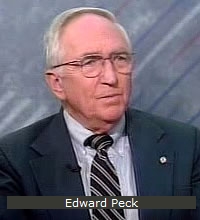
Violence begets violence. Hatred begets hatred. And terrorism begets terrorism. A white ambassador [Edward Peck] said that y’all, not a black militant. Not a reverend who preaches about racism. An ambassador whose eyes are wide open and who is trying to get us to wake up and move away from this dangerous precipice upon which we are now poised. The ambassador said the people we have wounded don’t have the military capability we have. But they do have individuals who are willing to die and take thousands with them. And we need to come to grips with that.
Rev Wright was telling his congregation, pay attention to this white man, Edward Peck. It’s worth listening to what he has to say. It’s worth taking into consideration the opinion of a man who had been the Deputy Director of the White House Task Force on Terrorism under President Ronald Reagan, former Deputy Coordinator, Covert Intelligence Programs at the State Department, U.S. Ambassador and Chief of Mission to Iraq (1977-1980), and a 32-year veteran of the Foreign Service. At least, as far as Rev Wright was concerned, Edward Peck was worth listening to and that’s what he told his congregation.
On October 8, 2001, on CNN, Peck was asked: “Wouldn’t this war against terrorism be a mistake if we stop at Osama bin Laden and don’t take out Saddam Hussein as well?”
Peck said it would not be a mistake because, “when you take out Saddam Hussein, the key question you have to ask then is, what happens after that? And we don’t have a clue. Nobody knows, but it’s probably going to be bad. And a lot of people are going to be very upset about that, because that really is not written into our role in this world is to decide who rules Iraq.”
Rev Wright suggested that “in the wake of the American tragedy” of 9/11, in a process of self-examination, it would really be in America’s interests to listen to people such as Edward Peck. ABC News and much of the rest of the media would rather that we pay attention to a few ill-chosen phrases.
An Internet-fueled squabble between Taliban leaders and influential Al-Qaeda sympathizers over nonviolent tactics and foreign influence in Afghanistan hints at deep disagreements that could alter counterinsurgency efforts in that country.
Islamic extremists who regularly post messages to a pro-Al-Qaeda website in Egypt are accusing Afghanistan’s Taliban of straying from the path of global jihad. Prominent Taliban have responded by lashing back with criticism of their own.
The development suggests a rift is emerging between the Taliban leadership and religious extremists in the Arab world — including the Al-Qaeda network that the Taliban had hosted in Afghanistan while it planned the September 11, 2001, terrorist attacks in the United States.
Such a break could affect Afghan government efforts to convince Taliban fighters to lay down their weapons and peacefully resolve their differences with officials, which could in turn influence whether non-Afghan Al-Qaeda fighters continue to be welcomed among the Taliban. [complete article]
What would be the effects on Iraqi domestic politics of an American announcement of a full withdrawal from Iraq over a 16-18 month period? For the purposes of this memo, I consider the precise timeline of the withdrawal less important than the firm, credible, public commitment to withdrawal.
First, any plausible withdrawal scenario must consider how the major actors will respond to a coming US departure and try to pre-empt most likely flashpoints. A US withdrawal should not seen exclusively as the removal of a barrier between otherwise unchanged Iraqi actors. A US withdrawal would change the identities, interests, expectations, and behavior of all actors. These transformative effects are a major reason why a firm and credible commitment to withdrawal on a clear timetable is necessary to achieve an acceptable outcome. Without such a commitment, Iraqi and regional actors alike will continue on their current course, while recent security gains will crumble as the political window closes. Without it, a Maliki-led or Maliki-like government will not be likely to deliver substantive political accommodation. Only faced with the loss of an open-ended U.S. commitment would its calculations would change. The same is true for every other actor in the Iraqi arena: Shia and Sunni, Green Zone and local, pro-US or insurgency. [complete article]
Imagine it’s early 2003, and President George W. Bush presents the following case for invading Iraq:
We’re about to go to war against Saddam Hussein. Victory on the battlefield will be swift and fairly clean. But then 100,000 U.S. troops will have to occupy Iraq for about 10 years. On average, nearly 1,000 of them will be killed and another 10,000 injured in each of the first 5 years. We’ll spend at least $1 trillion on the war and occupation, and possibly trillions more. Toppling Saddam will finish off a ghastly tyranny, but it will also uncork age-old sectarian tensions. More than 100,000 Iraqis will die, a few million will be displaced, and the best we can hope for will be a loosely federated Islamic republic that isn’t completely in Iran’s pocket. Finally, it will turn out that Saddam had neither weapons of mass destruction nor ties to the planners of 9/11. Our intervention and occupation will serve as the rallying cry for a new crop of terrorists.
It is extremely doubtful that Congress would have authorized such a war or that the American people would have shouted, “Bring it on!” [complete article]
According to the conventional wisdom among those who understand the way politics works, Barak Obama has for several days needed to do something with Rev Jeremiah Wright: “throw him under the bus.”
Obama refused to do so. He refused to treat his association with his pastor as a liability that political expediency would dictate he must disown. Some might see that as a foolish act of loyalty, yet if we were to pause for a moment there might be another and much more obvious explanation — an explanation that Obama himself has already provided: the YouTube clips of Rev Wright are not the definitive representation of who he is.
Consider for a second something that seems to have received very little if any attention. For a week we have been seeing the same clips over and over again. If these truly provide a well-rounded representation of Rev Wright’s character, why have we not seen more? We know these clips came from DVDs of sermons freely available. There must be hours of sermons from which other clips could be taken, so why just these few fleeting snippets?
The most obvious explanation is that so far, for no lack of effort, no one has been able to cull anything else that is particularly damning. Indeed, anything else might actually have the effect of diluting the impact of what has already been so widely disseminated. In other words, if people saw more of Rev Wright they might find him much less shocking.
It is presumably for that reason that Trinity Church has made other YouTube clips available. Critics will no doubt regard this as an effort at damage control, yet when the church says that they see their pastor as a victim of a “modern-day lynching,” it’s not hard to understand why — especially if you take the time to listen to some of the other things he has to say.
Here then are a couple of clips of Rev Wright (and one his successor, Rev Otis Moss III) that are unlikely to appear on Fox News, CNN or ABC any day soon:
The Rev. Jeremiah Wright spent 36 years teaching this congregation how to recognize injustice, and his parishioners sense it all around them now. On Sunday, more than 3,000 of them filled Trinity United Church of Christ on the city’s South Side to pray for their former pastor. They read a handout that described Wright’s newfound infamy as a “modern-day lynching.” They scrawled his name in tribute on the inside of their service programs and applauded as Wright’s protege, the Rev. Otis Moss III, stepped to the pulpit.
“No matter what they want,” Moss said, “we will not shut up.”
A simmering controversy over Wright’s provocative rhetoric and his connection to Sen. Barack Obama ignited last week after some of his old sermons were aired, prompting the Democratic presidential candidate to condemn them and severing Wright’s connection to the campaign. But inside this mega-church that Wright built up from financial ruin, his most loyal listeners offered a different interpretation: It is Wright, and black theology in its entirety, that is misunderstood. [complete article]
Maybe the most disturbing implication of the famous sentence “They create a desolation and call it peace” is that apologists for violence, by means of euphemism, come to believe what they hear themselves say.
On July 21, 2006, the tenth day of the Lebanon war, Condoleezza Rice explained why the US government had not thrown its weight behind a cease-fire:
What we’re seeing here, in a sense, is the growing — the birth pangs of a new Middle East, and whatever we do, we have to be certain that we’re pushing forward to the new Middle East, not going back to the old one.
Very likely these words were improvised. “Growing pains” seems to have been Rice’s initial thought; but as she went on, she dropped the “pains,” turned them into “pangs,” and brought back the violence with a hint of redemptive design: the pains were only birth pangs. The secretary of state was thinking still with the same metaphor when she spoke of “pushing,” but a literal image of a woman in labor could have proved awkward, and she trailed off in a deliberate anticlimax: “pushing forward” means “not going back.”
Many people at the time remarked the incongruity of Rice’s speech as applied to the devastation wrought by Israeli attacks in southern Lebanon and Beirut. Every bombed-out Lebanese home and mangled limb would be atoned for, the words seemed to be saying, just as a healthy infant vindicates the mother’s labor pains. Looked at from a longer distance, the statement suggested a degree of mental dissociation. For the self-serving boast was also offered as a fatalistic consolation—and this by an official whose call for a cease-fire might well have stopped the war. “The birth pangs of a new Middle East” will probably outlive most other phrases of our time, because, as a kind of metaphysical “conceit,” it accurately sketches the state of mind of the President and his advisers in 2006. [complete article]
Globalization Bush-style By Tom Engelhardt, TomDispatch, March 16, 2008
Imagine, for a moment, that you live in a small town somewhere near the Southern California coast. You’re going about your daily life, trying to scrape by in hard times, when the missile hits. It might have come from the Iranian unmanned aerial vehicle (UAV) — its pilot at a base on the outskirts of Tehran — that has had the village in its sights for the last six hours or from the Russian sub stationed just off the coast. In either case, it’s devastating.
In Moscow and Tehran, officials announce that, in a joint action, they have launched the missile as part of a carefully coordinated “surgical” operation to take out a “known terrorist,” a long-term danger to their national security. A Kremlin spokesman offers the following statement:
“As we have repeatedly said, we will continue to pursue terrorist activities and their operations wherever we may find them. We share common goals with respect to fighting terrorism. We will continue to seek out, identify, capture and, if necessary, kill terrorists where they plan their activities, carry out their operations or seek safe harbor.”
A family in a ramshackle house just down the street from you — he’s a carpenter; she works at the local Dairy Queen — are killed along with their pets. Their son is seriously wounded, their home blown to smithereens. Neighbors passing by as the missile hits are also wounded.
The conservative case for Barack Obama By Andrew J. Bacevich, The American Conservative, March 24, 2008
…why consider Obama? For one reason only: because this liberal Democrat has promised to end the U.S. combat role in Iraq. Contained within that promise, if fulfilled, lies some modest prospect of a conservative revival.
To appreciate that possibility requires seeing the Iraq War in perspective. As an episode in modern military history, Iraq qualifies at best as a very small war. Yet the ripples from this small war will extend far into the future, with remembrance of the event likely to have greater significance than the event itself. How Americans choose to incorporate Iraq into the nation’s historical narrative will either affirm our post-Cold War trajectory toward empire or create opportunities to set a saner course.
The neoconservatives understand this. If history renders a negative verdict on Iraq, that judgment will discredit the doctrine of preventive war. The “freedom agenda” will command as much authority as the domino theory. Advocates of “World War IV” will be treated with the derision they deserve. The claim that open-ended “global war” offers the proper antidote to Islamic radicalism will become subject to long overdue reconsideration.
Trying times for Trinity By Lisa Miller, Newsweek, March 15, 2008
The year was 1971, race riots flared across the country, and on the South Side of Chicago a tiny church was dying. Many blacks, disillusioned by their ministers’ failure to bring home the promises of the civil-rights movement, were abandoning Christianity. They converted to Islam or Judaism or fringe sects—or refused to go to church at all. This particular congregation was looking for a pastor to lead them through these troubling times, and before they launched their search, they wrote a blue-sky description of the community they wanted to be: we want to “serve as instruments of God and church,” the statement said, and we want to “elimin[ate] those things in our culture that lead to the dehumanization of persons.” They wanted to be Christian, in other words. And they wanted to keep fighting.
On New Year’s Eve, the search committee interviewed its final candidate. Jeremiah Wright Jr. was a young pastor enrolled at the University of Chicago Divinity School. Wright belonged to a group of black intellectuals who embraced “black liberation theology,” the idea that blacks shouldn’t have to choose between “Malcolm and Martin,” as the theologians put it. They could be Christian and black; they could be black and proud. When Barack Obama responded to the altar call at Trinity United Church of Christ in 1988, he was responding, in part, to that message.
GOP presidential candidate seen as best to handle a 3 a.m. crisis at the White House Zogby, March 16, 2008
The recent Hillary Clinton campaign advertisement asking who Americans want answering the phone in the White House when a crisis erupts at 3 a.m. has sparked a national debate about which candidate would best handle such a phone call. But while the ad was designed to boost the Clinton candidacy, likely voters nationwide say they would feel more secure having Republican John McCain answering the call of a crisis, a new Zogby International telephone poll shows.
Given the choice between Clinton and McCain, 55% preferred McCain while 37% would want Clinton to answer the phone, while 9% said they were unsure.
White male vote especially critical By Dan Balz, Washington Post, March 17, 2008
The results in Ohio in particular raised questions about whether Obama can attract support from this crucial demographic. They also brought to the forefront the question of whether racial prejudice would be a barrier to his candidacy in some of the major industrial battlegrounds in the general election if he becomes the Democratic nominee.
An examination of exit polls in Wisconsin and Ohio, states with striking similarities, shows that many more working-class white men in Ohio said race was a factor in their vote on March 4 than was the case in Wisconsin. The analysis makes clear that race was not the deciding factor in the Ohio primary but did contribute to Clinton’s margin of victory.
Many voting for Clinton to boost GOP By Scott Helman, Boston Globe, March 17, 2008
For a party that loves to hate the Clintons, Republican voters have cast an awful lot of ballots lately for Senator Hillary Clinton: About 100,000 GOP loyalists voted for her in Ohio, 119,000 in Texas, and about 38,000 in Mississippi, exit polls show.
A sudden change of heart? Hardly.
Six signs the U.S. is not headed for war in Iran By William M Arkin, Washington Post, March 16, 2008
There are a couple of military adages — “An Army marches on its stomach” and “Amateurs talk about tactics, but professionals study logistics” — that should adequately explain why the United States is not headed for war with Iran. There is no actual preparation for such a war going on. Moreover, the U.S. military is not in a position to carry off such an operation.
But then, we live in a world of “shock and awe,” where long-range air and missile strikes suggest the ability to use force without the commitment of boots on the ground. When Iran war junkies make their case for some kind of “October surprise,” they usually cite the need for preemption and say an attack can be unleashed by President Bush and Vice President Cheney with the mere push of a button.
Everyone here is flummoxed about why the president is in such a fine mood.
The dollar’s crumpling, the recession’s thundering, the Dow’s bungee-jumping and the world’s disapproving, yet George Bush has turned into Gene Kelly, tap dancing and singing in a one-man review called “The Most Happy Fella.”
“I’m coming to you as an optimistic fellow,” he told the Economic Club of New York on Friday. His manner — chortling and joshing — was in odd juxtaposition to the Fed’s bailing out the imploding Bear Stearns and his own acknowledgment that “our economy obviously is going through a tough time,” that gas prices are spiking, and that folks “are concerned about making their bills.”
He began by laughingly calling the latest news on the economic meltdown “a interesting moment” and ended by saying that “our energy policy has not been very wise” and that there was “no quick fix” on gasp-inducing gas prices.
“You know, I guess the best way to describe government policy is like a person trying to drive a car in a rough patch,” he said. “If you ever get stuck in a situation like that, you know full well it’s important not to overcorrect, because when you overcorrect you end up in the ditch.”
Dude, you’re already in the ditch.
Boy George crashed the family station wagon into the globe and now the global economy. Yet the more terrified Americans get, the more bizarrely carefree he seems. The former oilman reacted with cocky ignorance a couple of weeks ago when a reporter informed him that gas was barreling toward $4 a gallon. [complete article]
Editor’s Comment — I imagine Bush learned his happy-go-lucky trick some time in his adolescence. It’s a familiar ruse everyone remembers from the classroom. There’s a kid who’s mediocre but proud and he thinks he can avoid being embarrassed by his poor performance. He parades his lack of seriousness as though to say, “You know I could really excel if I wanted to, but none of this matters to me so I can’t be bothered. You can study and I’ll party.” This is Bush’s exit strategy from the White House. He wants to tell us he fooled us; that when we thought he was doing badly because we thought he was incompetent, in truth he wasn’t even trying.
During a trip to the Middle East this month, Secretary of State Condoleezza Rice served as an informal go-between for Hamas and its sworn enemy, the government of Israel, helping to arrange a tentative truce, according to U.S., Israeli and Arab officials.
The United States has long considered Hamas, the Palestinian militant group that seized the Gaza Strip last year, to be a terrorist group, and the Bush administration remains firmly opposed to direct talks until Hamas renounces violence and recognizes Israel. President Bush has decried Hamas’s “devotion to terrorism and murder” and said there cannot be peace until the group is dismantled.
Throughout her trip, Rice never publicly uttered the term “cease-fire.” But at the request of Egypt, Rice privately asked Israeli Prime Minister Ehud Olmert to issue a public statement that Israel would halt attacks if Hamas stopped firing crude rockets at Israeli towns and cities. One day later, Egyptian officials could point to the statement in talks with Hamas, and the daily barrage suddenly stopped.
Rice’s actions underscore the nuanced series of signals that are typical of Middle East diplomacy, but they also highlight the central role today of Hamas, formally called the Islamic Resistance Movement, in the Israeli-Palestinian conflict. Now some experts — and even Israelis — are questioning whether the isolation of Hamas continues to make sense. [complete article]
No one doubts that the road to Baghdad – or Tal Afar or Fallujah or Mosul – lies through Syria, and that the movement of suicide bombers from the Mediterranean coasts to the deserts of Iraq is a planned if not particularly sophisticated affair. What is astonishing – what is not mentioned by the Americans or the Iraqi “government” or the British authorities or indeed by many journalists – is the sheer scale of the suicide campaign, the vast numbers of young men (only occasionally women), who wilfully destroy themselves amid the American convoys, outside the Iraqi police stations, in markets and around mosques and in shopping streets and on lonely roads beside remote checkpoints across the huge cities and vast deserts of Iraq. Never have the true figures for this astonishing and unprecedented campaign of self-liquidation been calculated.
But a month-long investigation by The Independent, culling four Arabic-language newspapers, official Iraqi statistics, two Beirut news agencies and Western reports, shows that an incredible 1,121 Muslim suicide bombers have blown themselves up in Iraq. This is a very conservative figure and – given the propensity of the authorities (and of journalists) to report only those suicide bombings that kill dozens of people – the true estimate may be double this number. On several days, six – even nine – suicide bombers have exploded themselves in Iraq in a display of almost Wal-Mart availability. If life in Iraq is cheap, death is cheaper.
This is perhaps the most frightening and ghoulish legacy of George Bush’s invasion of Iraq five years ago. Suicide bombers in Iraq have killed at least 13,000 men, women and children – our most conservative estimate gives a total figure of 13,132 – and wounded a minimum of 16,112 people. If we include the dead and wounded in the mass stampede at the Baghdad Tigris river bridge in the summer of 2005 – caused by fear of suicide bombers – the figures rise to 14,132 and 16,612 respectively. Again, it must be emphasised that these statistics are minimums. For 529 of the suicide bombings in Iraq, no figures for wounded are available. Where wounded have been listed in news reports as “several”, we have made no addition to the figures. And the number of critically injured who later died remains unknown. Set against a possible death toll of half a million Iraqis since the March 2003 invasion, the suicide bombers’ victims may appear insignificant; but the killers’ ability to terrorise civilians, militiamen and Western troops and mercenaries is incalculable. [complete article]
There is a paradox in the current situation in Iraq. We are told that the surge has worked brilliantly and violence is way down. And yet the plan to reduce troop levels—which was at the heart of the original surge strategy—must be postponed or all hell will once again break loose. Making sense of this paradox is critical. Because in certain crucial ways things are not improving in Iraq, and unless they start improving soon, the United States faces the awful prospect of an unending peacekeeping operation—with continuing if limited casualties—for years to come.
In a brilliant and much-circulated essay written in August 2007, “Anatomy of a Tribal Revolt,” David Kilcullen, a veteran Australian officer who advised Gen. David Petraeus during the early days of the surge, wrote, “Our dilemma in Iraq is, and always has been, finding a way to create a sustainable security architecture that does not require ‘Coalition-in-the-loop,’ thereby allowing Iraq to stabilize and the Coalition to disengage in favorable circumstances.” We have achieved some security in Iraq, though even this should not be overstated. (Violence is still at 2005 levels, which were pretty gruesome.) But we have not built a sustainable security architecture. [complete article]
The Baiji refinery, with its distillation towers rising against the Hamrin Mountains, may be the most important industrial site in the Sunni Arab-dominated regions of Iraq. On a good day, 500 tanker trucks will leave the refinery filled with fuel with a street value of $10 million.
The sea of oil under Iraq is supposed to rebuild the nation, then make it prosper. But at least one-third, and possibly much more, of the fuel from Iraq’s largest refinery here is diverted to the black market, according to American military officials. Tankers are hijacked, drivers are bribed, papers are forged and meters are manipulated — and some of the earnings go to insurgents who are still killing more than 100 Iraqis a week.
“It’s the money pit of the insurgency,” said Capt. Joe Da Silva, who commands several platoons stationed at the refinery.
Five years after the war in Iraq began, the insurgency remains a lethal force. The steady flow of cash is one reason, even as the American troop buildup and the recruitment of former insurgents to American-backed militias have helped push the number of attacks down to 2005 levels. [complete article]
Coming together By Paul Woodward, War in Context, March 15, 2008
For those of us who’ve never seen ourselves as part of the political mainstream (or maybe anything mainstream), it’s sometimes easy to forget that when Barak Obama talks about bringing the country together, he really means it.
Unity in opposition is a groove that’s easy to slide into. Solidarity that comes through facing the other can only be sustained because we choose not to face ourselves; we define what we are by declaring what we are not.
So at a moment when division seems to have become the substance of the presidential race, it’s worth listening to what Obama had to say today in Indiana:
The text of this part of Obama’s speech:
Let me just close my initial remarks by talking about bringing this country together. You know, Bobby Kennedy gave one of his most — gave one of his most famous speeches on a dark night in Indianapolis. Right after Dr. King was shot. Some of you remember reading about this speech. Some of you were alive when this speech was given. He stood on top of a car. He was in a crowd mostly of African Americans. And he delivered the news that Dr. King had been shot and killed. And he said, at that moment of anguish, he said, we’ve got a choice. He said, we’ve got a choice in taking the rage and bitterness and disappointment and letting it fester and dividing us further so that we no longer see each other as Americans but we see each other as separate and apart and at odds with each other. Or we can take a different path that says we have different stories, but we have common dreams and common hopes. And we can decide to walk down this road together. And remake America once again. And, you know, I think about those words often, especially in the last several weeks – because this campaign started on the basis that we are one America. As I said in my speech at the convention in 2004, there is no Black America, or White America, or Asian America, or Latino America. There is the United States of America. But I noticed over the last several weeks that the forces of division have started to raise their ugly heads again. And I’m not here to cast blame or point fingers because everybody, you know, senses that there’s been this shift. You know, that you’ve been seeing in the reporting. You’ve been seeing some of the commentaries of supporters on all sides. Most recently, you heard some statements from my former pastor that were incendiary and that I completely reject, although I knew him and know him as somebody in my church who talked to me about Jesus and family and friendships, but clearly had — but if all I knew was those statements that I saw on television, I would be shocked. And it just reminds me that we’ve got a tragic history when it comes to race in this country. We’ve got a lot of pent-up anger and bitterness and misunderstanding. But what I continue to believe in is that this country wants to move beyond these kinds of divisions. That this country wants something different.
I just want to say to everybody here that as somebody who was born into a diverse family, as somebody who has little pieces of America all in me, I will not allow us to lose this moment, where we cannot forget about our past and not ignore the very real forces of racial inequality and gender inequality and the other things that divide us. I don’t want us to forget them. We have to acknowledge them and lift them up and when people say things like my former pastor said, you know, you have to speak out forcefully against them. But what you also have to do is remember what Bobby Kennedy said. That it is within our power to join together to truly make a United States of America. And that we have to do not just so that our children live in a more peaceful country and a more peaceful world, but that is the only way that we are going to deliver on the big issues that we’re facing in this country. We can’t solve health care divided. We cannot create an economy that works for everybody divided. We can’t fight terrorism divided. We can’t care for our veterans divided. We have to come together. That’s what this campaign is about. That’s why you are here. That’s why we’re going to win this election. That’s how we’re going to change the country.
Hillary Clinton and Barack Obama show few signs that they’re aware of it, but the general election campaign has already begun. And appropriately for the eve of St. Patrick’s Day, the pair have begun to destroy each other like the two crazy Irish cats of Kilkenny. The upshot is that both of them are already losing the general to John McCain. By the time the Democratic convention rolls around in August and the nomination is finally awarded, the battle may already be over.
Obama’s advisers point out, rightfully, that the Clinton campaign started this downward drift toward mutually assured destruction, Democratic-style, with its now infamous “red phone” ad before the critical Ohio and Texas primaries. Subtly but with devastating impact, the TV commercial raised questions about Obama’s preparedness to be commander in chief. The Obama campaign responded by effectively branding Hillary Clinton a liar about her own record. “As far as the record shows, Sen. Clinton never answered the phone either to make a decision on any pressing national security issue—not at 3 a.m. or at any other time of day,” top Obama adviser Greg Craig—a former close friend of Hillary’s—wrote this week in a widely circulated memo.
Winning elections is about setting the agenda and, while creating a positive image of oneself, negatively defining one’s opponent in the minds of the voters. This is happening for McCain—having Obama defined as unready and Hillary as lacking in integrity—without his having to lift a finger. If the current campaign keeps up—and there’s every sign it will—it’s likely that by summer irrepressible doubts about both Dems will have been lodged in the minds of the electorate. [complete article]
Editor’s Comment — Barak Obama — like most successful people — has been credited with possessing an excellent sense of timing. If there was ever a time when he desperately needed to seize the day, this is it. How can he do it?
Take the high road — no one should expect anything less from a candidate who presents himself as a unifier and natural leader — and call for a closed-door Democratic summit. He needs to reach out to Hillary Clinton and say, “I want to sit down with you and Howard Dean and for the three of us to arrive at a consensus about how we move forward in such a way that we ensure that when the party has a nominee, he or she will be able to lead a unified party.”
This isn’t about asking either campaign to accept defeat before they are ready to do so. It just means that they agree to pursue victory without doing so at the expense of the party.
[Jonathan Powell was Tony Blair’s chief of staff for 12 years] Jonathan Powell’s candid reflections on talking to terrorists in his book revealing an insider’s view of the Northern Ireland peace process will ring true to anyone who has worked at the highest levels of government – in Britain dealing with Northern Ireland, in France with Algeria, in Israel with Palestinian Islamists. But is his call that we should be prepared to communicate with al-Qaida a step too far?
Experts make a clear distinction between territorial-based groups such as Hamas and Lebanon’s Hizbullah, the Taliban in Afghanistan and the jihadist movement inspired by Osama bin Laden, below. “Al-Qaida are what we call ‘incorrigible terrorists’,” said Peter Lehr of St Andrews University. “They have political demands but we cannot and should not meet them. We need oil so we can’t leave the Arabian peninsula and we can’t help them dismantle Israel. There’s nothing to discuss.”
Talking to Hamas and Hizbullah is a different matter, Lehr argues. “They are rational actors fighting for something negotiable, and with negotiations you start with maximum demands and whittle them down until you get agreement, or not.” [complete article]
In her race to win the democratic nomination against a first-term Senator from Illinois, Hillary Clinton has put the criterion of experience front and center. She often references what she says is 35 years of work that qualifies her to run the country. And the most important achievements Clinton cites are the ones she claims from her years as First Lady — a job that carries no portfolio but can wield enormous influence.
The nature of Hillary Clinton’s involvement was always a matter of great sensitivity in her husband’s White House. After her disastrous 1994 foray into health-care reform, Bill Clinton’s aides went out of their way to downplay her role in Administration decision making. She rarely appeared at meetings in which officials hashed out important policy trade-offs, but when the discussion centered on issues that were among her priorities, she sent her aides — much the way Vice President Al Gore did. “There were certain issues they kind of owned,” recalls Gene Sperling, who headed economic policy in the Clinton White House. The First Lady’s top concerns, he says, were children’s issues, health care, and foster-care and adoption policies.
Now the former First Lady claims at least a share of the credit for a wide range of the Clinton Administration’s signature accomplishments, both domestic and overseas. Does she deserve it? [complete article]
Hillary Clinton, who has frequently described herself on the campaign trail as playing a pivotal role in forging a children’s health insurance plan, had little to do with crafting the landmark legislation or ushering it through Congress, according to several lawmakers, staffers, and healthcare advocates involved in the issue.
more stories like this
In campaign speeches, Clinton describes the State Children’s Health Insurance Program, or SCHIP, as an initiative “I helped to start.” Addressing Iowa voters in November, Clinton said, “in 1997, I joined forces with members of Congress and we passed the State Children’s Health Insurance Program.” Clinton regularly cites the number of children in each state who are covered by the program, and mothers of sick children have appeared at Clinton campaign rallies to thank her.
But the Clinton White House, while supportive of the idea of expanding children’s health, fought the first SCHIP effort, spearheaded by Senators Edward M. Kennedy, Democrat of Massachusetts, and Orrin G. Hatch, Republican of Utah, because of fears that it would derail a bigger budget bill. And several current and former lawmakers and staff said Hillary Clinton had no role in helping to write the congressional legislation, which grew out of a similar program approved in Massachusetts in 1996. [complete article]
Sen. Hillary Clinton claims that her experience in dealing with foreign affairs qualifies her to handle a crisis call at 3 a.m. and be commander in chief.
Sen. Barack Obama’s presidential campaign accuses Clinton of exaggerating her foreign affairs experience. It says that nothing in her background shows that she’s more prepared to handle an international crisis than he is.
No question is more central just now to their rivalry for the Democratic presidential nomination. Clinton has said that Obama hasn’t passed the “commander-in-chief test,” but that both she and presumptive Republican presidential nominee John McCain have. [complete article]




 Rev Wright was telling his congregation, pay attention to this white man,