Author Archives: Paul Woodward

Clueless in Syria

A New York Times report should be deeply encouraging to everyone who is vehemently opposed to U.S. intervention in Syria. The good news is that the CIA still can’t figure out who’s who among the rebels but they’re afraid that the weapons that are flowing into the country are going to the wrong guys. In other words, those who remain convinced that the uprising against Assad is being controlled by puppet masters in Washington can put their fears aside.

Needless to say, I jest, since it’s long been apparent that some people can’t see the words ‘CIA’ and ‘Syria’ in the same paragraph without automatically imputing ‘neocons,’ ‘Iraq,’ and ‘U.S. imperialism.’ To those who negatively deify American power there truly can be no evidence that the U.S. does not control the universe.

Meanwhile, David Sanger — a reporter who seems to remain unaware that news sources who are neither paid government officials nor political party apparatchiks do actually exist — lays out the concerns of those who want their concerns to be made known. That is, concerns about a U.S. effort to support Bashar al-Assad’s opponents that “has increasingly gone awry.”

This operation has gone awry, we are told, because weapons flowing into Syria, thanks to Saudi Arabia and Qatar, are going to “hard-line Islamic jihadists, and not the more secular opposition groups that the West wants to bolster”.

It is not until the end of the article that Sanger reveals how thin the evidence actually is to support these claims.

In several towns along the Turkey-Syria border, rebel commanders can be found seeking weapons and meeting with shadowy intermediaries, in a chaotic atmosphere where the true identities and affiliations of any party can be extremely difficult to ascertain.

Late last month in the Turkish border town of Antakya, at least two men who had recently been in Syria said they had seen Islamist rebels buying weapons in large quantities and then burying them in caches, to be used after the collapse of the Assad government. But it was impossible to verify these accounts, and other rebels derided the reports as wildly implausible.

Moreover, the rebels often adapt their language and appearance in ways they hope will appeal to those distributing weapons. For instance, many rebels have grown the long, scraggly beards favored by hard-line Salafi Muslims after hearing that Qatar was more inclined to give weapons to Islamists.

The Saudis and Qataris are themselves relying on intermediaries — some of them Lebanese — who have struggled to make sense of the complex affiliations of the rebels they deal with.

“We’re trying to improve the process,” said one Arab official involved in the effort to provide small arms to the rebels. “It is a very complex situation in Syria, but we are learning.”

Perhaps this report could have been condensed.

Saudis and Qataris pay for guns going to men with beards in Syria. CIA doesn’t know who these men are. Romney promises that if he becomes president he’ll press the Arab leaders to send weapons to men without beards. Rebels in Syria await the U.S. presidential election result, ready to request additional shipments of razors.

Facebooktwittermail

Panetta warns of dire threat of cyberattack on U.S.

This is how the U.S. Secretary of Defense yesterday described America’s vulnerability to a devastating cyber attack:

What Panetta failed to mention in the scenario he laid out was that the cyberweapons necessary for conducting such an attack have already been created by the U.S. government and are now freely available for anyone to duplicate.

The New York Times reports: Defense Secretary Leon E. Panetta warned Thursday that the United States was facing the possibility of a “cyber-Pearl Harbor” and was increasingly vulnerable to foreign computer hackers who could dismantle the nation’s power grid, transportation system, financial networks and government.

In a speech at the Intrepid Sea, Air and Space Museum in New York, Mr. Panetta painted a dire picture of how such an attack on the United States might unfold. He said he was reacting to increasing aggressiveness and technological advances by the nation’s adversaries, which officials identified as China, Russia, Iran and militant groups.

“An aggressor nation or extremist group could use these kinds of cyber tools to gain control of critical switches,” Mr. Panetta said. “They could derail passenger trains, or even more dangerous, derail passenger trains loaded with lethal chemicals. They could contaminate the water supply in major cities, or shut down the power grid across large parts of the country.”

Defense officials insisted that Mr. Panetta’s words were not hyperbole, and that he was responding to a recent wave of cyberattacks on large American financial institutions. He also cited an attack in August on the state oil company Saudi Aramco, which infected and made useless more than 30,000 computers.

But Pentagon officials acknowledged that Mr. Panetta was also pushing for legislation on Capitol Hill. It would require new standards at critical private-sector infrastructure facilities — like power plants, water treatment facilities and gas pipelines — where a computer breach could cause significant casualties or economic damage.

In August, a cybersecurity bill that had been one of the administration’s national security priorities was blocked by a group of Republicans, led by Senator John McCain of Arizona, who took the side of the U.S. Chamber of Commerce and said it would be too burdensome for corporations.

The most destructive possibilities, Mr. Panetta said, involve “cyber-actors launching several attacks on our critical infrastructure at one time, in combination with a physical attack.” He described the collective result as a “cyber-Pearl Harbor that would cause physical destruction and the loss of life, an attack that would paralyze and shock the nation and create a profound new sense of vulnerability.” [Continue reading…]

I have little doubt that in a second Obama term, cyber-defense will be used as a justification for an unprecedented erosion of civil liberties. There will be no acknowledgement that it was during this administration more than any other, Pandora’s box of cyberwarfare was thrown wide open.

While Panetta portrays this country’s vulnerability in terms similar to a conventional military or terrorist attack, it seems just as likely that a major cyber attack might be launched by disaffected members of America’s own cyber culture — libertarians who have no particular interest in harming the lives of ordinary Americans yet who believe in what they conceive as a righteous cause: crippling the U.S. government.

As computer security expert Ralph Langner notes: “In cyberspace, the real threat comes from nonstate actors against which military deterrence is powerless. It does not require the resources of a nation state to develop cyber weapons. I could achieve that by myself with just a handful of freelance experts.”

So, while government officials like Panetta couch cyber-defense in the traditional terms relating to foreign enemies, they are no doubt also looking for measures to protect their own interests from threats posed by domestic enemies. This is how civil liberties will come under attack. Don’t expect Congress or the media to mount a strong defense.

Facebooktwittermail

Congressional report on Huawei smacks of protectionism

Reuters reports: China’s leading telecom equipment makers accused in a U.S. congressional report of being a potential security risk may face fresh scrutiny in other markets, while American firms operating in China could be vulnerable to retaliation.

The U.S. House of Representatives’ Intelligence Committee on Monday warned that China could use equipment made by Huawei Technologies Co Ltd and ZTE Corp – the world’s second- and fifth-largest makers of routers and telecoms gear – for cyber-espionage through software embedded in Chinese-made network equipment.

In its 52-page report, the committee noted that “China’s military and intelligence services, recognizing the technological superiority of the U.S. military, are actively searching for asymmetrical advantages that could be exploited in any future conflict with the United States. … Malicious implants in the components of critical infrastructure, such as power grids or financial networks, would also be a tremendous weapon in China’s arsenal,” it stated.

China’s official People’s Daily newspaper accused the committee on Tuesday of acting on a “presumption of guilt” against Huawei and ZTE. “This foolhardy political step … will impede the healthy development of Sino-American trade cooperation,” said a commentary in the newspaper, which generally reflects government thinking.

It added that the committee had produced “not an iota” of evidence to back its accusation that Huawei and ZTE products were used for espionage in the United States. “This report, which spurns the facts and is suffused with prejudice, is a vicious expansion of trade protectionism,” it said.

Bloomberg columnist Paula Dwyer agrees: What the report lacks is evidence. It also smacks of protectionism, despite denials by the committee chairman, Michigan Republican Mike Rogers, that he is invoking national security to shield U.S. telecoms equipment companies from Chinese competition.

The House investigation found “credible” reports of illegal behavior by Huawei, including immigration violations, bribery and corruption. But the original allegations that triggered the investigation a year ago — that Huawei and ZTE were installing equipment with codes to relay sensitive information back to China — are far from proven.

60 Minutes ran a report on Huawei in which it contrasted the way Chinese companies are subservient to the government with the way U.S. companies supposedly operate without much government interference. That might apply to Wall Street, but when it comes to surveillance, the U.S. telecom corporations only concern about fulfilling government requests is that they receive adequate compensation.

In the CBS report, Huawei’s founder, Ren Zhengfei, is portrayed as a sinister character because of his ties with the Chinese military and Communist Party. Maybe Sprint’s CEO, Dan Hesse, should be viewed with equal suspicion. He does after all serve on President Obama’s National Security Telecommunications Advisory Committee. And maybe the $176,700 that the House intel committee chairman Mike Rogers received from the U.S. communications/electronics sector this year has some relevance here.

Facebooktwittermail

The myth of freedom through autonomy

It’s no wonder that the fiction of the self-made man has deep roots in American culture. A society built on the land of indigenous people and on backs of African slaves needs to find ingenious ways to dignify itself. The myth of self-creation has an obvious appeal as it negates the past and glorifies the future.

In 1624, when John Donne wrote, “No man is an island,” he merely eloquently phrased what throughout human existence had always been understood. Yet in 21st century America a debate continues between those who exalt autonomy versus those who emphasize human interdependence.

Eric Michael Johnson writes: Black-and-white colobus monkeys scrambled through the branches of Congo’s Ituri Forest in 1957 as a small band of Mbuti hunters wound cautiously through the undergrowth, joined by anthropologist Colin Turnbull. The Mbuti are pygmies, about 4 feet tall, but they are powerful and tough. Any one of them could take down an elephant with only a short-handled spear. Recent genetic evidence suggests that pygmies have lived in this region for about 60,000 years. But this particular hunt reflected a timeless ethical conflict for our species, and one that has special relevance for contemporary American society.

Mbuti hunter unfolding hunting net in Congo’s Ituri Forest.

The Mbuti employed long nets of twined liana bark to catch their prey, sometimes stretching the nets for 300 feet. Once the nets were hung, women and children began shouting, yelling, and beating the ground to frighten animals toward the trap. As Turnbull came to understand, Mbuti hunts were collective efforts in which each hunter’s success belonged to everybody else. But one man, a rugged individualist named Cephu, had other ideas. When no one was looking, Cephu slipped away to set up his own net in front of the others. “In this way he caught the first of the animals fleeing from the beaters,” explained Turnbull in his book The Forest People, “but he had not been able to retreat before he was discovered.” Word spread among camp members that Cephu had been trying to steal meat from the tribe, and a consensus quickly developed that he should answer for this crime.

At an impromptu trial, Cephu defended himself with arguments for individual initiative and personal responsibility. “He felt he deserved a better place in the line of nets,” Turnbull wrote. “After all, was he not an important man, a chief, in fact, of his own band?” But if that were the case, replied a respected member of the camp, Cephu should leave and never return. The Mbuti have no chiefs, they are a society of equals in which redistribution governs everyone’s livelihood. The rest of the camp sat in silent agreement.

Faced with banishment, a punishment nearly equivalent to a death sentence, Cephu relented. “He apologized profusely,” Turnbull wrote, “and said that in any case he would hand over all the meat.” This ended the matter, and members of the group pulled chunks of meat from Cephu’s basket. He clutched his stomach and moaned, begging that he be left with something to eat. The others merely laughed and walked away with their pound of flesh. Like the mythical figure Atlas from Greek antiquity, condemned by vindictive gods to carry the world on his shoulders for all eternity, Cephu was bound to support the tribe whether he chose to or not.

Meanwhile, in the concrete jungle of New York City, another struggle between the individual and the group was unfolding. In October of 1957, Ayn Rand published her dystopian novel Atlas Shrugged, in which a libertarian hero named John Galt condemns his collectivist society because of its failure to support individual rights. “By the grace of reality and the nature of life, man — every man — is an end in himself,” Galt announced, “he exists for his own sake, and the achievement of his own happiness is his highest moral purpose.” Unlike Cephu, Galt had the means to end his societal bondage. By withdrawing his participation and convincing others to do the same, he would stop the motor of the world. Atlas would shrug. “Every living species has a way of survival demanded by its nature,” Galt insisted. “I swear by my life, and my love of it, that I will never live for the sake of another man, nor ask another man to live for mine.”

Ayn Rand’s defense of a human nature based on rationality and individual achievement, with capitalism as its natural extension, became the rallying cry for an emerging libertarian stripe in conservative American politics. Paul Ryan cites Atlas Shrugged as forming the basis of his value system and says it was one of the main reasons he chose to enter politics. Other notable admirers include Rush Limbaugh, Alan Greenspan, Clarence Thomas, as well as Congressional Tea Party Caucus members Steve King, Mick Mulvaney, and Allen West.

“Collectivism,” Rand wrote in Capitalism: The Unknown Ideal, “is the tribal premise of primordial savages who, unable to conceive of individual rights, believed that the tribe is a supreme, omnipotent ruler, that it owns the lives of its members and may sacrifice them whenever it pleases.” An objective understanding of “man’s nature and man’s relationship to existence” should inoculate society from the disease of altruistic morality and economic redistribution. Therefore, “one must begin by identifying man’s nature, i.e., those essential characteristics which distinguish him from all other living species.” She identifies two: a brain evolved for rational thought and a survival instinct based on the desire for personal freedom.

Ultimately, Rand was searching for the origin of John Galt in the pages of human nature. But was she right? Are we rational egotists trapped in a net of social obligations? Or are we an innately social species for whom altruism was integral to our success on this planet? There was only one place she could look: the Pleistocene. [Continue reading…]

Facebooktwittermail

Islamophobia and Hollywood

At Salon, Sandy Tolan writes:

Society has forged standards of respect and unacceptability about racial, ethnic, anti-Semitic and homophobic slurs. Rightly or wrongly, the message is: use certain hateful words in public, and you’ll pay the price. So why is there a different set of values at work when it comes to the hurt caused Muslims by hateful, Islamophobic characterizations of the Prophet Mohammed, or denigrations of Islam?

Tolan notes:

There is little in the public conversation that seeks to understand and explain the hurt caused to Muslims by these slurs. “To mock, to denigrate, to make fun of, somebody who’s deep…[in] the hearts of the Muslims? Really?” asked Sheikh Hamza Yusuf at a packed forum at Zaytuna College, a new Muslim college in Berkeley, in the aftermath of the … furor [provoked by the YouTube trailer to “Innocence of Muslims”]. (I was the forum’s moderator.) Yusuf argued that religious denigration should be seen in the same light as racial slurs, where “there are consequences. You will lose your job! We don’t accept racial denigration anymore. I think religious denigration has to be seen as identity.”

Islamophobia, and the accompanying hating on Arabs, helps provide cover for exceptional denigration. At the Zaytuna forum, Hatem Bazian, a co-founder of the college, described “an Islamophobic production industry that is dedicated to demeaning, to speaking ill of Muslims and attempting to silence Muslims from civil discourse.” This “othering” simply does not spur the same kind of outrage as slurs on blacks, gays, Jews, Asians or Latinos. In Hollywood especially, from “Raiders of the Lost Ark” to “Don’t Mess with the Zohan,” Arabs and Muslims are the last fair game for attacks with impunity.

The question is: why should this apply especially to Hollywood?

The entertainment industry likes to portray itself in the humble position of giving people what they want — that it mirrors this society much more than it shapes its values. But when it comes to issues like homophobia, there’s no question that Hollywood has taken a lead in combating prejudice; it hasn’t simply kept in step with changing societal attitudes. So why has this socially progressive force more often fueled rather than challenged Islamophobia?

A couple of years ago, JewishJournal.com reported on the history of Hollywood as described by Werner Hanak-Lettner, a curator for the Jüdisches Museum Wien (the Jewish Museum Vienna).

Hollywood’s founders went West, Hanak-Lettner said, because the East Coast was code for Jewish emigration. Way out West, they could not only become American, they could envisage the ideal of what it would mean to be American.

“They created not only a whole history, a whole industry, but they also recoined the American myth and gave images to it,” Hanak-Lettner said. “It isn’t very often that somebody comes from the outside and has the eye for what is the core of the society and can make [it into] a narrative that then is accepted by the whole.”
[…]
“Hollywood helped Jews find a place in America, and it is a very special cultural life that Jews gave to Hollywood and to Los Angeles: Just look at the historic sight of Wilshire Boulevard Temple with the murals inside. Nobody else in the world, even in a Reform synagogue, has murals like that. There you feel [a sense of] some sort of kingdom that was once here.”

It was Warner Bros. chieftain Jack Warner who commissioned the biblically inspired murals in 1929, and they are emblamatic of Hollywood’s importance to the Jewish community, a reminder that the Kingdom of Hollywood was a Jewish response to the modern world.

“A guy once said to me — a musician working in TV — ‘It would be interesting to work in Hollywood, but you have to be a Jew.’ I said, ‘I don’t believe that, because I know other musicians in Hollywood who aren’t Jewish; you just have to face [the fact that] they invented it!’ ” Hanak-Lettner said.

To assert that Islamophobia should reap consequences in just the same way that other forms of prejudice do is to fail to address the more fundamental question: why is this form of hatred so widely accepted in America?

When it comes to Hollywood’s portrayal of the Middle East, Arabs, and Islam, the narrative that Americans have been fed has indisputably been shaped by tribal animosity.

“In every movie they make, every time an Arab utters the word Allah? Something blows up,” said Eyad Zahra, a young filmmaker who organized the Los Angeles premiere of Jack Shaheen’s documentary “Reel Bad Arabs.”

Islamophobia emanates from many sources in America yet an entertainment industry that has for decades vilified the Middle East, its peoples, cultures and predominant religion must be seen as a primary agent in legitimizing and sustaining this prejudice.

Facebooktwittermail

U.S. is tracking suspects in attack on Libya mission

The New York Times reports: The United States is laying the groundwork for operations to kill or capture militants implicated in the deadly attack on a diplomatic mission in Libya, senior military and counterterrorism officials said Tuesday, as the weak Libyan government appears unable to arrest or even question fighters involved in the assault.

The top-secret Joint Special Operations Command is compiling so-called target packages of detailed information about the suspects, the officials said. Working with the Pentagon and the C.I.A., the command is preparing the dossiers as the first step in anticipation of possible orders from President Obama to take action against those determined to have played a role in the attack on a diplomatic mission in the eastern city of Benghazi that killed Ambassador J. Christopher Stevens and three colleagues three weeks ago.

Potential military options could include drone strikes, Special Operations raids like the one that killed Osama bin Laden and joint missions with Libyan authorities. But administration officials say no decisions have been made on any potential targets.

Spokesmen for the Defense Department and C.I.A. declined to comment.

The preparations underscore the bind confronting the White House over the Benghazi attack. Mr. Obama has vowed to bring the killers to justice, and in the final weeks of the presidential campaign Republicans have hammered the administration over the possible intelligence failures that preceded the attack — including a new accusation that repeated requests for strengthened security in Benghazi had been rejected.

But any American military action on Libyan soil would risk casualties and almost certainly set off a popular backlash at a moment when support for the revolt against Col. Muammar el-Qaddafi had created a surge in good feeling toward the United States that is unique in the region.

Reflecting a surge in nationalism, the Libyan government has opposed any unilateral American military action in Libya against the attackers. “We will not accept anyone entering inside Libya,” Mustafa Abu Shagur, Libya’s new prime minister, told the Al Jazeera television network. “That would infringe on sovereignty and we will refuse.”

Note: the New York Times headline doesn’t say “suspects”; it says “killers.” Naturally, Times journalists lack the authority to question their government handlers and if “killers” is the term administration officials use, then “killers” is the term the paper of record will repeat. After all, if there might be any doubt about the identity of individuals being lined up for possible execution in a U.S. drone firing range, it would be reasonable to question the use of drones.

A Gallup poll conducted in March and April showed that 75% of Libyans supported the NATO military intervention in 2011. Gallup also noted:

U.S. support for the Libyan revolution may have generated an almost unprecedented level of goodwill toward the U.S. In 2012, 54% of Libyans approve of U.S. leadership — among the highest approval Gallup has ever recorded in the Middle East and North Africa region, outside of Israel.

If President Obama goes ahead and authorizes drone strikes in Libya right before the U.S. presidential election, then whatever national security justification officials may provide for such killing, the “necessity” for such an operation can reasonably be inferred to have been political.

Facebooktwittermail

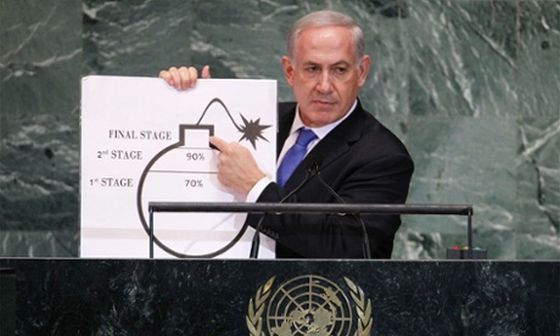
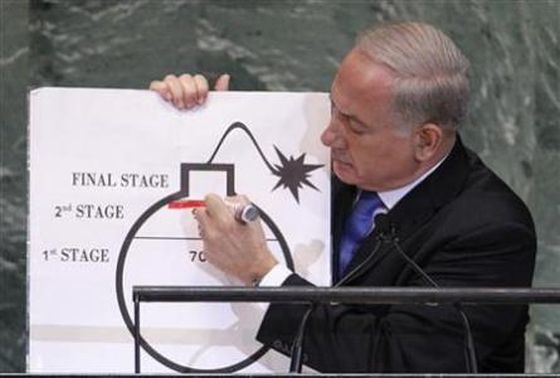
Netanyahu draws a red line — with a marker pen — on a cartoon bomb

Benjamin Netanyahu must be a happy man. He’s been yearning to draw a red line and now, in front of an assembly of world leaders at the United Nations General Assembly, he’s done just that.

Here’s Bibi with bomb:

Bibi's bomb

And here comes the red marker pen. Voila! A red line has been drawn.

Bibi's red line

There’s a fitting irony at a time when Muslims get mocked because a few among their ranks get irate about cartoons of the Prophet Muhammad, that one of the arch demonizers of Islam, Benjamin Netanyahu, would allow a cartoon bomb to blow up in his face.

The Israeli prime minister even managed to embarrass one of his most reliable American defenders, Jeffrey Goldberg:

Still, Netanyahu can’t take all the blame. He had accomplices in this bomb-making event. An artist was employed. Perhaps there was a meeting of Netanyahu’s inner cabinet. The graphic was displayed. The assembled all agreed: this’ll show the world.

Darn right! But maybe it didn’t signal the intended message.

Facebooktwittermail

New York Times covers Morsi’s U.N. speech but refuses to mention Palestine

Egypt’s newly elected president, Mohammed Morsi, gave an historic speech at the United Nations General Assembly yesterday.

The focus of Morsi’s speech was Palestine — yet you wouldn’t know it if you read the New York Times. The preoccupation of its reporter seemed to be the Egyptian leader’s omission of a stalwart defense of free speech. In other words, the New York Times, which prides itself as “the paper of record,” is acutely attuned to this constitutional and libertarian issue at the very same time that — more artfully than Izvestia ever did — it engages in self-censorship. At least in the Soviet Union everyone knew they were being lied to. The average reader of the Times on the other hand remains blissfully ignorant about the information that their trusted newspaper chooses not to report.

This is the part of Morsi’s speech — its core — that the New York Times neglected to mention:

The first issue which the world must exert all its efforts in resolving, on the basis of justice and dignity, is the Palestinian cause. Long decades have passed since the Palestinian People expressed their longing for restoring their full rights and for building their independent state, with Jerusalem as its capital. Despite their continued struggle, through all legitimate means to attain their rights, and despite the acceptance by their representatives of the resolutions adopted by the international community as a basis for resolving its problems, this international legitimacy remains unable until now to realize the hopes and aspirations of the Palestinian people. The resolutions remain far from being implemented.

Our brothers and sisters in Palestine must also taste the fruits of freedom and dignity. It is shameful that the free world accepts, regardless of the justifications provided, that a member of the international community continues to deny the rights of a nation that has been longing for decades for independence. It is also disgraceful that settlement activities continue on the territories of these people, along with the delay in implementing the decisions of international legitimacy.

Proceeding from the perspective of defending truth, freedom, and dignity and from my duty to support our Palestinian brothers and sisters, I place the international community face to face with its responsibilities which require the achievement of a just and comprehensive peace and the end of all forms of occupation of Arab lands, and the implementation of relevant international resolutions. I call for immediate and significant measures to put an end to colonization, settlement activities, and the alteration in the identity of Occupied Jerusalem.

The entire Palestinian leadership has charted a clear path towards the restoration of the rights of the Palestinian people, within and outside Palestine. The Arab world has given it its full support. The latter has also presented a comprehensive peace initiative based on just peace. One that restores the usurped rights of the Palestinian People, is founded on international legitimacy, and lays the foundation of an independent sovereign Palestinian state. One that also achieves the security and stability the peoples of the region have long been waiting for.

On that basis, I assure you of Egypt’s full support to any course of action Palestine decides to follow in the United Nations. I call upon all of you, just as you have supported the revolutions of the Arab peoples, to lend your support to the Palestinians in their endeavors to regain the full and legitimate rights of a people struggling to gain its freedom and establish its independent state.

I say it loudly to those wondering about our position vis-a-vis the international agreements and conventions that we have previously adhered to: we are committed to what we have signed on. We also support the inalienable rights of the Palestinian people and are determined to pursue all efforts side by side with them until they regain their rights.

To reiterate: “The first issue which the world must exert all its efforts in resolving, on the basis of justice and dignity, is the Palestinian cause” — but apparently it’s the last issue that concerns the New York Times.

But this was not the only noteworthy feature of Morsi’s speech. Repeatedly he referred to Egypt as an African nation, underlining its pivotal place joining two continents and positioning the new democracy not only as a leader of the Arab world but more broadly the developing world.

The New Egypt is determined to regain its standing among nations, and assume an effective role in global issues, stemming from the will of its people, as well as the legitimacy on which its regime is founded. This will is rooted in Egypt’s ancient and modern history, its Arabic and Islamic spheres, as well as its African identity. Egypt’s involvement in Arab, Islamic and African issues is the reflection of the essential role it plays in defense of interconnected fates and interlinked interests and values.

Turning to the current epicenter of Middle East strife, Morsi said:

Egypt is committed to pursue the sincere efforts it has been exerting to put an end to the catastrophe in Syria, within an Arab, regional and international framework. One that preserves the unity of this brotherly state, involves all factions of the Syrian people without racial, religious or sectarian discrimination, and spares Syria the dangers of foreign military intervention that we oppose.

On the imminent threat of a war against Iran, instigated by Israel, Morsi laid down multiple challenges:

The will of the people, especially in our region, no longer tolerates the continued non-accession of any country [namely, Israel] to the Nuclear Non-Proliferation Treaty and the non-application of the safeguards regime to their nuclear facilities, especially if this is coupled with irresponsible policies or arbitrary threats. In this regard, the acceptance by the international community of the principle of pre-emptiveness or the attempt to legitimize it is in itself a serious matter and must be firmly confronted to avoid the prevalence of the law of the jungle.

Cognizant of the danger that the status quo entails on the security of this important region, with its natural resources and trade passages, Egypt stresses the necessity of mobilizing international efforts to hold the conference on achieving a Middle East free of nuclear weapons and all other weapons of mass destruction before the end of the current year 2012, with the participation of all concerned parties without exception. And I say it very clearly: the only solution is to get rid of nuclear weapons, and all weapons of mass destruction. But we also emphasize the right of all countries of the region to the peaceful use of nuclear energy within the framework of the NPT, with a commitment to honor their obligations in this respect and provide the necessary guarantees to the countries of the region so as to remove any doubts surrounding their intentions.

Noting that the United Nations in its structure still enshrines the inequities of a bygone era, Morsi called for a new order based on equality and mutual respect.

Egypt would like to stress that the international system will not get fixed as long as the application of double standards remains. We expect from others, as they expect from us, that they respect our cultural particularities and religious points of reference, and not seek to impose concepts that are unacceptable to us or politicize certain issues and use them as a pretext to intervene in the affairs of others.

What Muslims and migrants are going through in a number of regions worldwide, in terms of discrimination and violation of their human rights, and vicious campaigns against what they hold sacred, is unacceptable. It is opposed to the most basic principles of the Charter of the Organization where we meet today. These practices have become pervasive enough that they now carry a name: Islamophobia.

We must join hands in confronting these regressive ideas that hinder cooperation among us. We must act together in the face of extremism, discrimination, and incitement to hatred on the basis of religion or race. The General Assembly, as well as the Security Council, has the principal responsibility in addressing this phenomenon that is starting to have implications that clearly affect international peace and security.

The obscenities recently released as part of an organized campaign against Islamic sanctities is unacceptable and requires a firm stand. We have a responsibility in this international gathering to study how we can protect the world from instability and hatred. Egypt respects freedom of expression.

One that is not used to incite hatred against anyone. One that is not directed towards one specific religion or culture.

A freedom of expression that tackles extremism and violence. Not the freedom of expression that deepens ignorance and disregards others. But we also stand firmly against the use of violence in expressing objection to these obscenities.

Facebooktwittermail

Neanderthals more advanced than contemporary humans?

Scientific America reports: Experts agree that Neanderthals hunted large game, controlled fire, wore animal furs and made stone tools. But whether they also engaged in activities deemed to be more advanced has been a matter of heated debate. Some researchers have argued that Neanderthals lacked the know-how to effectively exploit small prey, such as birds, and that they did not routinely express themselves through language and other symbolic behaviors. Such shortcomings put the Neanderthals at a distinct disadvantage when anatomically modern humans availed of these skills invaded Europe—which was a Neanderthal stronghold for hundreds of thousands of years—and presumably began competing with them, so the story goes.

Over the past couple decades hints that Neanderthals were savvier than previously thought have surfaced, however. Pigment stains on shells from Spain suggest they painted, pierced animal teeth from France are by all appearances Neanderthal pendants. The list goes on. Yet in all of these cases skeptics have cautioned that the evidence is scant and does not establish that such sophistication was an integral part of the Neanderthal gestalt.

The cutmarked bones from Gibraltar as well as bird remains from other sites could force them to rethink that view. In a paper published September 17 in PLOS ONE, paleontologist Clive Finlayson of the Gibraltar Museum, Rosell, a zooarchaeologist at Rovira I Virgili University in Tarragona, Spain, and their colleagues report on their analyses of animal remains from 1699 fossil sites in Eurasia and north Africa spanning the Pleistocene epoch. Their results show that Neanderthals across western Eurasia were strongly associated with corvids (ravens and the like) and raptors (vultures and their relatives) — more so than were the anatomically modern humans who succeeded them.

The Neanderthals seem unlikely to have hunted these birds for food. People today do not eat corvids or raptors. Moreover, if the Neanderthals did hunt the birds for food, one would expect to see signs of butchery on those bones linked to fleshy parts of the bird, such as the breastbone. Yet the team’s study of the bird bones from the Gibraltar sites found the cutmarks on wing bones, which have little meat — a sign that the Neanderthals targeted the birds for their feathers rather than their meat.

Exactly what the Neanderthals were doing with the feathers is unknown, but because they specifically sought out birds with dark plumage, the researchers suspect that our kissing cousins were festooning themselves with the resplendent flight feathers. Not only are feathers beautiful, they are also lightweight, which makes them ideal for decoration, Finlayson points out. “We don’t think it’s a coincidence that so many modern human cultures across the world have used them.”

Everyone loves these stories that reveal similarities between contemporary humans and our distant ancestors (or even non-human species). But it strikes me that as much as these narratives resonate with a desire for the experience of ancient kinship, they are also colored with condescension. Beings we took to be of very limited intelligence turn out to have a few of the markers that we associate with our own supposedly abundant intelligence.

So, it appears that Neanderthals had a greater interest in their personal appearance than we would have expected among those whose outfits were limited to a choice of animals skins. They adorned themselves with feathers. Still, they weren’t advanced enough to be able to accessorize with Gucci.

In cultures obsessed with stuff, cultural comparisons invariably get limited to comparisons between objects — feathers vs. designer clothes. But even if anthropologists hesitate to speculate at length about why Neanderthals used feathers, I have little doubt that the Neanderthals knew why and their explanations would not have been so banal as simply the idea that feathers look cool. They were adorning themselves with forms endowed with meaning.

What Neanderthals surely possessed were the talents handed down in cultures of every age prior to the age of consumerism. Which is to say, the abilities to create things and to possess them were deeply intertwined. Skills in craft and artistry were a dimension of the social skills that wove societies together. Dexterity, agility and the keen perceptions of those who were attuned to their environment were all necessary for survival.

Even if we live in cultures endowed with the most sophisticated artifacts ever created, the application and cultivation of ingenuity now confined within the hands of a few has rendered the hands of many with no greater skill than the ability to hand over a credit card as culture has been turned into a commodity.

(The Omo People.)

Facebooktwittermail

The Washington Post dreams about Israel bombing Iran

The editors of the Washington Post must be in funk as Mitt Romney’s chances for electoral success rapidly dwindle. Maybe that’s why they decided to indulge in their favorite fantasy: an imminent Israeli attack on Iran. But rather than bore themselves and their readers with the tedious ruminations of national security experts, they think the topic can be handled more colorfully through the medium of fiction, providing post-strike views from Washington, Tel Aviv, and Tehran.

Azadeh Moaveni’s effort in presenting the view from Tehran is commendable. Karim Sadjadpour and Blake Hounshell demonstrate why if either ever took a creative writing class they got an F, and the contribution coming from the Israeli criminologist, Anat Berko, is nothing less than delusional.

Berko writes: [After hearing explosions from incoming missiles] I bring my mother, who lives nearby, over to the house so she won’t be alone. Her 72-year-old face is lined from age and decades of worry and war. “They will never leave us alone,” she mutters. “Your father was in Iran for two years when he fled Iraq on his way to Israel. It was different then [under the Shah]; the Iranians loved us. Why did everything change?”

Together, with my three children, we go to our safe room. Almost every house in Israel has a room like this: a bomb shelter with thick, concrete walls, stocked with food and water, a radio, TV, and Internet, sometimes in the basement, but often a spare room used as a bedroom.

In late August the Israeli government distributed booklets on civil defense with the happy face of a muppet on the cover. They warn Israelis they would have “only between 30 seconds and three minutes to find cover and hunker down between the time air raid sirens sound and rockets slam into their area.” But the Los Angeles Times reported many Israelis don’t have anywhere to take cover:

Less than half the population has gas masks and only 30% have reinforced safe rooms, officials estimate. More than 25% lack access to a bomb shelter.

In Tel Aviv, probably a primary target of missiles, city officials this month designated 60 underground parking garages to serve as emergency shelters, capable of temporarily shielding 800,000 people, nearly twice the city’s population. The move came after critics noted that the city’s 241 public bomb shelters could accommodate only about 40,000 people.

Sadjadpour and Hounshell obviously missed the recent poll which showed most Americans are in no doubt that in the event of an Israeli attack on Iran, then Israel should bear responsibility for the consequences.

When gas prices soar after Israel bombs Iran, the average American can be credited with having enough intelligence to understand who to blame — though apparently some in Washington assume otherwise.

When the stock market closes [after the Israeli attack], oil prices are up nearly 40 percent, the largest 24-hour increase in history. CNN interviews Americans at gas stations across the country, notably in swing states such as Florida and Ohio; most blame Iran, not Israel or Obama, for the price jumps.

By Friday evening, leaks have emerged from within the U.S. government and military saying that the United States had no prior knowledge of Israel’s actions.

Obama manages to break away from his national security team to join his family for a quick dinner. Sasha and Malia are talking about their schoolwork. “I don’t like physics,” Malia says. “It’s too complicated.”

“I know just how you feel, honey,” Obama says. “I’ve got a few problems like that, too.”

Azadeh Moaveni presents the view from Tehran through the eyes of “Hamid,” a political science professor.

He flicks on the television at home; the state channel shows emergency workers in white hazmat suits carrying stretchers out of the dusty rubble outside Isfahan. All 1,000 workers at the plant have been killed, and winds are sweeping toxic smoke toward the nearby city. The supreme leader’s war council must be sitting on a woolen rug at Khamenei’s guarded house, appraising the damage to the nuclear sites and calibrating its response. The ticker at bottom of the TV screen says the price of crude oil has jumped to $130 a barrel.

Iraqi Prime Minister Nouri al-Maliki condemns the attacks and warns that his country’s airspace is off limits to “further aggression.” Iraq and Iran have grown friendlier since the end of the U.S. war, and Maliki might be willing to look the other way should some Iraqi pipelines mysteriously explode, diverting millions of barrels from the market. Hamid knows that the clerics want to avoid a regional war, but they can destabilize the world economy without going to such lengths. He thinks of the relief that Bashar al-Assad must be feeling in Syria, his regime bought precious days by Iran’s misfortune.

In the morning rush hour, cars whiz past billboards of smiling clerics on the expressway; everyone’s moving fast save for those in the two-block-long line at the nearest gas station. Hamid’s political-theory class starts at 10 a.m., but he has left early to see if he can get online at work; he must e-mail his daughter in Los Angeles to say he’s safe.

The authorities have shut down the cellphone network, worried that Israel’s agents will report back via the phone lines and that the Iranian opposition will scramble to exploit the chaos. The radio reports that the Islamic Association of Students has gathered outside the Swiss Embassy, which looks after U.S. interests in Iran, chanting “Death to America” and “Death to Israel,” pelting rocks and tossing gasoline bombs over the concrete walls. These are the Basij front line, Hamid knows, the militiamen organized by the government.

He parks his Kia in the staff lot, wondering which former student he can reach to find out how officials are reacting. Most of Hamid’s students go on to key posts in the diplomatic corps and the Revolutionary Guard; he has supervised at least 20 theses gaming out precisely what might happen in this scenario, watched as his students defended their conclusions with glistening eyes, their fervor evident. Not all of them had itched for war with Israel, he reminds himself. Maybe just half.

After his class, in which rattled students argued that Iran should move to weaponize its nuclear program immediately, Hamid watches the supreme leader address the country, transfixed by the elderly mullah’s forceful calm. Ayatollah Ali Khamenei has never captured even a glint of his predecessor Ruhollah Khomeini’s legendary fire. Today, however, his oratory is masterful. He vows that Iran will not be defeated, that the great nation will retaliate and bring the Zionist enemy to its knees.

The speech is over, and the broadcast cuts to images of Tehran’s snow-capped Alborz Mountains and the Caspian Sea, set to “Vatanam,” a patriotic song of his youth. Hamid’s eyes fill with tears. He is a secular aristocrat by birth, the grandson of a shah’s cabinet minister, trained in Weber and Rousseau, but he is not above being moved by nationalism. Today it is not propaganda; it is genuine solidarity.

Facebooktwittermail

If Israel attacks Iran and Iran retaliates, most Americans oppose U.S. military support for Israel

The Chicago Council on Global Affairs recently released the results of a survey on American public opinion about US foreign policy. Their report includes this finding:

A persistent issue in regard to Iran’s nuclear program is the possibility that Israel will attack Iranian nuclear facilities regardless of UN or U.S. approval. In the hypothetical situation in which Israel were to bomb Iran’s nuclear facilities, Iran were to retaliate against Israel, and the two were to go to war, only 38 percent say the United States should bring its military forces into the war on the side of Israel. A majority (59%) says it should not.

An even larger majority — 70% — oppose a unilateral U.S. strike on Iran.

In the same survey 65% of respondents said that the U.S. should not take sides in the Israeli-Palestinian conflict.

Facebooktwittermail

On real and fabricated insults to Islam

In an excerpt from his new book, Joseph Anton: A Memoir (released today), Salmon Rushdie (who writes about himself in the third person) recounts the publication of The Satanic Verses:

The book took more than four years to write. Afterward, when people tried to reduce it to an “insult,” he wanted to reply, “I can insult people a lot faster than that.” But it did not strike his opponents as strange that a serious writer should spend a tenth of his life creating something as crude as an insult. This was because they refused to see him as a serious writer. In order to attack him and his work, they had to paint him as a bad person, an apostate traitor, an unscrupulous seeker of fame and wealth, an opportunist who “attacked Islam” for his own personal gain. This was what was meant by the much repeated phrase “He did it on purpose.” Well, of course he had done it on purpose. How could one write a quarter of a million words by accident? The problem, as Bill Clinton might have said, was what one meant by “it.”

The ironic truth was that, after two novels that engaged directly with the public history of the Indian subcontinent, he saw this new book as a more personal exploration, a first attempt to create a work out of his own experience of migration and metamorphosis. To him, it was the least political of the three books. And the material derived from the origin story of Islam was, he thought, essentially respectful toward the Prophet of Islam, even admiring of him. It treated him as he always said he wanted to be treated, not as a divine figure (like the Christians’ “Son of God”) but as a man (“the Messenger”). It showed him as a man of his time, shaped by that time, and, as a leader, both subject to temptation and capable of overcoming it. “What kind of idea are you?” the novel asked the new religion, and suggested that an idea that refused to bend or compromise would, in all likelihood, be destroyed, but conceded that, in very rare instances, such ideas became the ones that changed the world. His Prophet flirted with compromise, then rejected it, and his unbending idea grew strong enough to bend history to its will.

When he was first accused of being offensive, he was truly perplexed. He thought he had made an artistic engagement with the phenomenon of revelation — an engagement from the point of view of an unbeliever, certainly, but a genuine one nonetheless. How could that be thought offensive? The thin-skinned years of rage-defined identity politics that followed taught him, and everyone else, the answer to that question.

The British edition of The Satanic Verses came out on Monday, September 26, 1988, and, for a brief moment that fall, the publication was a literary event, discussed in the language of books. Was it any good? Was it, as Victoria Glendinning suggested in the London Times, “better than Midnight’s Children, because it is more contained, but only in the sense that the Niagara Falls are contained,” or, as Angela Carter said in the Guardian, “an epic into which holes have been punched to let in visions . . . [a] populous, loquacious, sometimes hilarious, extraordinary contemporary novel”? Or was it, as Claire Tomalin wrote in the Independent, a “wheel that would not turn,” or, in Hermione Lee’s even harsher opinion, in the Observer, a novel that went “plunging down, on melting wings toward unreadability”? How large was the membership of the apocryphal Page 15 Club of readers who could not get past that point in the book?

Soon enough, the language of literature would be drowned in the cacophony of other discourses — political, religious, sociological, postcolonial — and the subject of quality, of artistic intent, would come to seem almost frivolous. The book that he had written would vanish and be replaced by one that scarcely existed, in which Rushdie referred to the Prophet and his companions as “scums and bums” (he didn’t, though he did allow the characters who persecuted the followers of his fictional Prophet to use abusive language), and called the wives of the Prophet whores (he hadn’t — although whores in a brothel in his imaginary city, Jahilia, take on the names of the Prophet’s wives to arouse their clients, the wives themselves are clearly described as living chastely in the harem). This nonexistent novel was the one against which the rage of Islam would be directed, and after that few people wished to talk about the real book, except, usually, to concur with Hermione Lee’s negative assessment.

When friends asked what they could do to help, he pleaded, “Defend the text.” The attack was very specific, yet the defense was often a general one, resting on the mighty principle of freedom of speech. He hoped for, felt that he needed, a more particular defense, like those made in the case of other assaulted books, such as “Lady Chatterley’s Lover,” “Ulysses,” or “Lolita” — because this was a violent attack not on the novel in general, or on free speech per se, but on a particular accumulation of words, and on the intentions and integrity and ability of the writer who had put those words together. He did it for money. He did it for fame. The Jews made him do it. Nobody would have bought his unreadable book if he hadn’t vilified Islam. That was the nature of the attack, and so for many years The Satanic Verses was denied the ordinary life of a novel. It became something smaller and uglier: an insult. And he became the Insulter, not only in Muslim eyes but in the opinion of the public at large.

Even now, the demonization of the writer continues as the Iranian Ayatollah Hassan Saneii suggested in a statement published on Sunday that recent insults to Islam are a result of the fact that Rushdie has still not been murdered: “As long as the exalted Imam Khomeini’s historical fatwa against apostate Rushdie is not carried out, it won’t be the last insult. If the fatwa had been carried out, later insults in the form of caricature, articles and films that have continued would have not happened.”

In another statement (this and the previous one noted by Robert Mackey), Iran’s Supreme Leader Ayatollah Ali Khamenei references the same “evil chain” of insults.

At this point Rushdie can reasonably include himself among those who have been grossly insulted as his work of literature is now linked to a trashy video.

If the protection of sacredness is itself to be viewed as an expression of reverence, then surely it cannot flay about so indiscriminately.

While Khomeini’s fatwa is frequently referred to as having targeted Rushdie, he also included in his death sentence “all those involved in its publication who were aware of its content”. There is a legal exactness in the fact that he only sentenced those who were aware of the book’s content — not simply all the employees of Viking Press. Yet it begs the question: how aware of the book’s content was Khomeini himself? Less than four months away from his own death I doubt he ever set his hands on a copy and almost certainly never studied its content and yet on his command dozens of deaths followed. Ayatollah Saneii was wrong to say that the fatwa has not been carried out.

Laws about blasphemy have long been employed in the name of protecting religion, yet during what Rushdie reasonably calls these “thin-skinned years of rage-defined identity politics” a few words from a British government minister seem worthy of consideration by members of any faith: “the strength of their own belief is the best armour against mockers and blasphemers”.

Soon after Khomeini issued his fatwa, Rushdie was interviewed on CBS television and recalls in his memoir (again, referring to himself in the third person):

On air, when he was asked for a response to the threat, he said, “I wish I’d written a more critical book.” He was proud, then and always, that he had said this. It was the truth. He did not feel that his book was especially critical of Islam, but, as he said on American television that morning, a religion whose leaders behaved in this way could probably use a little criticism.

While calculated acts of provocation deserve to be condemned, so do acts of violence carried out in the name of protecting the faith — any faith.

Facebooktwittermail

A universal message in the Middle East protests

Reuters reports: Protesters enraged by a film mocking the Prophet Mohammad battled with police in several Asian cities on Monday and vented their fury against the United States, blaming it for what they see as an attack on the Muslim religion.

Police fired in the air to break up a crowd marching on the U.S. consulate in the Pakistani city of Karachi while in Afghanistan and Indonesia people burnt U.S. flags and chanted “Death to America”.

Indonesian police fired tear gas and water cannon to disperse hundreds of demonstrators who massed outside the U.S. Embassy in Jakarta, capital of the most populous Muslim nation.

In Kabul, protesters set fire to cars and shops and threw stones at police.

“We will defend our prophet until we have blood across our bodies. We will not let anyone insult him,” said one protester in the Afghan capital. “Americans will pay for their dishonor.”

Thousands also marched in Beirut, where a Hezbollah leader accused U.S. spy agencies of being behind events that have unleashed a wave of anti-Western sentiment in the Muslim and Arab world.

The demonstrations were the latest across the world ignited by a short film made with private funds in the United States and posted on the Internet that depicted the Prophet Mohammad as a fool, a womanizer and a homosexual.

The situation saddles U.S. President Barack Obama with an unexpected foreign policy headache as he campaigns for re-election in November, even though his administration has condemned the film as reprehensible and disgusting.

In a torrent of violence last week, the U.S. ambassador to Libya and three other Americans were killed in an attack in Benghazi and U.S. and other foreign embassies were stormed in cities in Asia, Africa and the Middle East by furious Muslims. At least nine other people have been killed.

Washington has sent ships, extra troops and special forces to protect U.S. interests and citizens in the Middle East, while a number of its embassies have evacuated staff and are on high alert for trouble.

A White House spokesman said Obama spoke by telephone to senior diplomats at the weekend to reassure them of his support.

“He called the chiefs of mission in Sudan, Tunisia, Libya and Yemen to let those diplomats know that he was thinking about them, that their safety remains a top priority of his, and it is something he will remain focused on,” spokesman Josh Earnest said.

Despite Obama’s efforts early in his tenure to improve relations with the Arab and Muslim world, the new violence adds to a host of problems including the continued U.S. military involvement in Afghanistan, Iran’s nuclear program, the Syrian civil war and the fall-out from the Arab Spring revolts.

The renewed protests on Monday dashed any hopes that the furor over the film might fade despite an appeal over the weekend from the senior cleric in Saudi Arabia, home to Islam’s holiest shrines, for calm.

In the Kabul demonstration, protesters shouted “Death to America” and burned the flags of the United States and of Israel, a country reviled by many Muslims and Arabs because of the Palestinian issue.

As many have asked: why are Muslims across the world protesting against a crude anti-Islam movie and not against the thousands of Muslims being killed by the Assad regime?

I don’t think it’s because of indifference or apathy about the plight of Syrians. One issue is seen as an attack on Muslim identity while the other isn’t. Assad is killing his own people, not because they are Muslims but because they have risen up to throw him out of power. His actions don’t fall within the wider context of what has long been perceived as a war on Islam waged by the U.S., Israel and their allies. (This is not to deny that Assad is a worthy target of protests, both in the Middle East and across the world.)

Even so, the religious dimension should perhaps be seen as merely a veneer than rests on top of a more fundamental issue — one which explains why the Palestinian issue has for so long been at the center of Middle Eastern rage.

Do Muslims across the region care more about Palestinians than anyone else? Almost certainly not. But the treatment of Palestinians by Israelis is regarded as emblematic of Western contempt for Muslims. In this perception, Israel’s allies have been willing to tolerate the daily abuses which Palestinians suffer, not because the West bears a particular hostility towards Palestinians but because it regards Arabs and Muslims in general as inferior people.

If those protesting against the Innocence of Muslims are screaming in rage about an insult to the Prophet, their passion reveals perhaps more about the experience of being insulted.

Those who suffer frequent insults either internalize them and come to believe that the lack of respect they are shown reflects the lack of respect they deserve, or, they stand up to defend their dignity.

Strangely, the dignity of ordinary people is something more in evidence in traditional societies than modern ones.

In societies that see themselves as the most advanced, we have an abundance of material reasons to feel superior to others, yet woven into the Western way of life are so many indignities that we have come to see them as normality.

We are slaves of commerce who feel insecure unless suitably branded. We treat the fabrications of Hollywood as the ideals of social status and good looks. We take for granted that our elected representatives rarely represent our interests. We accept that the grind of monotonous work is a necessity for economic survival. And we live in socially fragmented communities in which in so many of our dealings we are strangers living invisible lives among strangers.

All of this results in a loss of dignity and a loss of appreciation for its value. And that loss has reached a point where when we witness Muslims making vociferous demands for respect, we all too easily dismiss this as nothing more than the expression of religious fanaticism.

Facebooktwittermail

Hezbollah leader joins calls for protests against anti-Islam film

If there are political powers in the Middle East for whom protests against the anti-Islam film, Innocence of Muslims, have provided a useful distraction, nowhere is this more likely the case than for a resistance movement locked in the uncomfortable position of supporting the brutal military regime next door.

On Al Manar television yesterday, Hezbollah leader Sheik Hassan Nasrallah said to his followers: “Tomorrow, and in the coming days you should bear your responsibility in the Arab world the world as a whole. They should see the rage in your faces and feel it in your screams.”

The Daily Star reports: During his speech Sunday, Nasrallah also echoed calls by MP Walid Jumblatt last week for the global criminalization of insults against religions similar to those adopted in West against anti-Semitism.

He said the solution to prevent the recurrence of such incidents is to “work on issuing an international law throughout global institutions that criminalizes any insult against the celestial religions or at least to the prophets of the religions.”

Nasrallah also urged Muslim communities in the U.S. to “bear a historic responsibility” and rally for such a law to be issued in Congress.

He also urged the Lebanese government to work at the Arab League level to lobby for such a law.

“Lebanon, which carries the message of co-existence, can play a role in this … by calling for an emergency meeting of the Arab League and call for the convening of an Islamic summit and adopt ideas [such as criminalizing religious insults].”

Shortly following Nasrallah’s speech, Lebanon’s Foreign Affairs Minister Adnan Mansour urged the head of the Arab League to convene an emergency session to discuss the issue, according to Al-Manar.

Nasrallah said he had delayed announcing the call for protests because of the visit of Pope Benedict XVI to Lebanon.

“We delayed the protest because of the exceptional days that have passed with the head of the Catholic Church’s visit to Lebanon and fearing that [the protest] could be used for other purposes,” Nasrallah said.

Hate speech is indeed against the law in most Western countries, but as Frederick Schauer has noted in “The Exceptional First Amendment“:

[T]he vast majority of non-American laws prohibiting the incitement to racial hatred would be unconstitutional in the United States, as would be the overwhelming proportion of actual legal actions brought under those laws. Jean Le Pen could not be sanctioned in the United States, as he was in France, for accusing Jews of exaggerating the Holocaust, nor could Brigitte Bardot be fined in the United States, as she was in France, for crusading against Islam and urging the deportation of those of Arab ethnicity. Ernst Zundel and James Keegstra can be charged with crimes in Canada for denying the Holocaust, but not in the United States.

The U.S. Constitution is not a sacred document — even if many Americans regard it as such — so it can certainly be argued that there is oftentimes a kind of literalist fundamentalism at work when legal principles end up resting on determinations of their constitutionality. Nevertheless, there are cultural and pragmatic reasons why it is preferable that social norms not be determined by laws.

Islamophobes are not able to wield their influence in America and beyond its shores simply because they are able to exploit the protections provided by the First Amendment. They do so because a hostile anti-Islam and anti-Arab sentiment has grown unchecked across this country throughout the last decade.

Bigotry has spread not only through the efforts of hatemongers like Pamela Geller and Pastor Terry Jones but because fear of Islam has seeped into American consciousness in subtler ways. Even while television networks and others who shape public opinion have been activists in challenging racism, sexism, and homophobia, they have rarely had the courage to forcefully challenge Islamophobia. And that lack of courage both reflects and reinforces a simple fact: fear and hatred of Muslims has become the socially accepted bigotry of this era. That fact will not be changed by abandoning the First Amendment but by the painstaking efforts of those who make it clear that hatred which can legally be expressed is nevertheless socially unacceptable.

Facebooktwittermail

NBC interviews ‘the leader of the Jewish people’: Benjamin Netanyahu

David Gregory, presenter of NBC’s Meet the Press, is Jewish. On today’s show which fell on Rosh Hashanah, the Jewish New Year, Gregory addressed the Israeli prime minister, Benjamin Netanyahu, as “the leader of the Jewish people.” No doubt many American Jewish viewers’ jaws dropped as they said/thought, say what?!

Gregory later tweeted for clarification, “This am I called Israeli PM the leader of the jewish ppl. Better to say he’s leader of jewish state.” And, “Didn’t mean to imply all jews believe he represents them.”

His clarifications are interesting. Had he just stuck with the first tweet, we’d have been left to assume that he simply misspoke. But his second tweet was perhaps more illuminating since it suggests that some American Jews do regard Netanyahu as their leader.

Visit NBCNews.com for breaking news, world news, and news about the economy

In the interview, Netanyahu retreats from his hardline on red lines — the point that would trigger a U.S. attack on Iran. He’s now introduced a new metaphor and says that we’re already in a “red zone” and Iran mustn’t be allowed to make a “touch down.”

If we’re already in the red zone then apparently Iran has not crossed the red line. And if crossing that red line would mean they scored a touch down, it sounds an awful lot like Netanyahu has wiggled over to Obama’s position: that Iran can’t be allowed to produce nuclear weapons. I know it’s just a metaphor, but touch down sounds much more like weapons than capability.

Moreover, while Netanyahu continued employing his red-line line, note this ambiguity: he says that the Iranians respect red lines. They are rational actors. But they can’t be allowed to create nuclear weapons because they are suicidal maniacs.

Throughout the interview, Netanyahu attempts to tie “the fanatics” who have been attacking U.S. embassies across the region with “the fanatics” who rule Iran. Most observers acknowledge that Salafists have been a driving force in the protests — radicals who primarily draw their support from Saudi Arabia and have no connection at all with Iran. But that distinction matters little to the Israeli leader since his goal is to continue pressing on the same theme that he has hammered away at since 9/11: that Israelis and Americans are one people united against a common enemy. It’s less important that that enemy be clearly identified than that the illusion of our indivisible interests be perpetuated.

Facebooktwittermail

Muslims and the patronizing ‘hurt-feelings’ meme

Roger Ebert writes: Set aside for a moment all of the controversy. Do me the favor of reading the actual words of the statement released by our Egyptian Embassy six hours before it was attacked by radicals, and before a similar attack in Libya that took four innocent lives. Here it is:

“The Embassy of the United States in Cairo condemns the continuing efforts by misguided individuals to hurt the religious feelings of Muslims — as we condemn efforts to offend believers of all religions. Today, the 11th anniversary of the Sept. 11, 2001, terrorist attacks on the United States, Americans are honoring our patriots and those who serve our nation as the fitting response to the enemies of democracy. Respect for religious beliefs is a cornerstone of American democracy. We firmly reject the actions by those who abuse the universal right of free speech to hurt the religious beliefs of others.”

What exactly, is wrong with those words? Which ones do you disagree with? Let me set the stage for the statement. A “trailer” of dubious origin, for a film that has not been seen, was released some time ago on YouTube and widely overlooked. Then the “trailer” was translated into Arabic, and predictably stirred up outrage. As outrage spread in the Middle East, a press official for the Embassy wrote and released the statement without higher approval.

I agree with every word of this statement. Which parts would you disagree with? Why?

Sentence One: One-quarter of the earth’s population is Muslim, including many Americans. Yes, their feelings can be hurt by a crude attack on the Prophet. I would go so far as to suggest those who made the trailer hoped to hurt their feelings. Why else, when their original effort failed to attract attention, did they pay to have it translated into Arabic, so it could be understood in nations where the box office appeal of the so-called film would be non-existent? The only purpose must have been to hurt feelings.

Children are experts at having and causing hurt feelings. They do nasty things and make each other cry. And then adults or older children have to step in and teach them about empathy and consideration for others and the need we all have to live in harmony.

When government officials or commentators scold those who disparage Muslims, they end up sounding like school teachers admonishing troublesome children, saying, don’t be so nasty to the Muslims. You’re being insensitive. And look what you did. Now you made them cry.

Not only is this utterly condescending to Muslims, but it also totally mischaracterizes the nature of acts of provocation such as the creation and promotion of the Innocence of Muslims.

This is not a film intended to hurt the feelings of Muslims. It is designed to provoke outrage and then capitalize on that outrage. It is provocation intended to trigger an over-reaction so that scorn can then be poured on those who are so easily provoked. This goes way beyond the intention to hurt feelings.

Islamophobes are not social blunderers who go around hurting Muslims feelings. They are social engineers attempting to show why Muslims must be kept in their place and are not fit to be treated as equals. Their goal is to breed contempt for Muslims in just the same way that the Nazis turned their venom on Jews.

Nakoula Basseley Nakoula, a California Coptic Christian with a long criminal record may be at the center of the current furor, but let’s not lose sight of the fact that as an ideological objective, keeping Muslims in their place is central to one cause more than any other: Zionism. Inside the villa in the jungle no one is in any doubt about whose comforts must be protected and who must be treated like a wild animal.

Facebooktwittermail

Benghazi airspace closed for several hours to enable U.S. drone patrols

As attacks on U.S. embassies around the region proliferate, President Obama is under increasing domestic political pressure to make some kind of demonstration of American strength. He’s in serious jeopardy of following in the footsteps of Bill Clinton and authorizing a drone strike that “brings justice” to the killers of Ambassador Chris Stevens.

Even if — unlike for Clinton — this time around the targeting happens to be accurate, the use of missiles to expedite a legal process will do no more than reinforce the perception that Americans always believe, might is right.

And therein lies Obama’s dilemma: he’s campaigning to win votes from Americans many of whom have a quasi-religious conviction in the righteousness of American power, and yet his actions are likely to have an immediate impact on many more millions of non-Americans who, for good reason, think that the United States has only one tool for engaging with the world: the use of military force.

Can Obama resist the temptation to use drone missiles for the sake of winning a few votes? We’ll see.

The Libya Herald reports: The airspace over Benghazi was closed for several hours this morning, reportedly to enable unmanned aerial drones to patrol overhead.

The manager of Benghazi’s Benina International Airport told reporters earlier today that the airspace was closed shortly after midnight for security reasons.

“Benghazi airspace has been closed since 00:30 GMT for routine security checks” Taba Mohammed said, without elaborating further. The airspace is said to have reopened around 12:15.

There have been reports that flights were grounded as part of an operation to prevent suspects involved in Tuesday’s fatal attacks on the US consulate from using the airport as an escape route.

However, a UK-based risk and intelligence company has confirmed to the Libya Herald that it believes the primary purpose of the closure was to enable patrols by American drone aircraft.

“We believe our intelligence is accuarate”, said Cassie Blombaum, an intelligence analyst at the Inkerman Group.

“We have multiple sources, including video footage of Libyans actually spotting the drones”.

Drones were reported to have been deployed over Libya following Tuesday’s attacks, which resulted in the death of the American ambassador together with three of his staff, but Blombaum says that the surveillance aircraft have likely been operating in the country over a much longer period. [Continue reading…]

Facebooktwittermail

Associated Press and others: guilty of a blood libel?

Here’s a first — citing The Hollywood Reporter: If initial reports that the anti-Muslim film that triggered riots in Libya and Egypt is the work of an Israeli filmmaker supported by Jewish donors are incorrect, then the media is guilty of a “blood libel,” Rabbi Abraham Cooper, associate dean of the Simon Wiesenthal Center in Los Angeles, said Wednesday.

He said that the media will have to answer for its role in spreading controversial and possibly false information about the makers of the purported film Innocence of Muslims, which ridicules the prophet Muhammad, without thorough fact-checking.

Cooper specifically cited the Associated Press, which reported on a phone interview with a man who identified himself as Sam Bacile and claimed to be an Israeli-born Jewish writer-director who made the film with the backing of 100 Jewish donors. Subsequent reports have cast doubt on the filmmaker’s identity, claiming that the man might not be either Jewish or Israeli and is using a false name.

The AP has continued to report on the film, most recently tying a California Coptic Christian named Najoula Basseley Nakoula to the film. According to that report, Nakoula denied he directed the film and said he knew the self-described filmmaker, Sam Bacile. But the cellphone number that AP used to contacted Bacile traced to the same address near Los Angeles where AP found Nakoula. The report also cites court papers that show Nakoula’s aliases included Nicola Bacily, Erwin Salameh and others.

In the midst of the riots in Libya, an attack on the U.S. consultant [sic] resulted in the death of Ambassador Chris Stevens and three other staffers. Cooper blamed the diplomat’s death and the incidents in Egypt on terrorists who were looking to send a message on the anniversary of the 9/11 attacks. “If it wasn’t a Jew who made [Innocence of Muslims], then we have blood libel on the part of the media for failing to do its due diligence,” he said. “The fact someone out there ascribed this to Jews is classic anti-Semitic blood libel.”

Thanks to Rabbi Cooper for stating the “facts”!

It’s funny how when people make unsubstantiated assertions they so frequently claim they are facts.

Two days after the deadly attack on the U.S. consulate in Benghazi, facts are still in short supply, but still, I think it’s possible to engage in some fruitful analysis while scrutinizing the claim that a classic anti-Semitic blood libel has been committed.

Based on AP’s current reporting it seems probable that the film was made by an Egyptian Coptic Christian. The trailer includes several clues that point in that direction — the depiction of Christians being persecuted by Muslims and a reference to the “Islamic Egyptian police” — and now Nakoula Basseley Nakoula, reported to be a California Coptic Christian, appears as though he may have previously dubbed himself as “Sam Bacile” and claimed he was an Israeli.

As an Islamophobic Coptic Christian, did Nakoula assume an Israeli identity so that he could accomplish a two-for-the-price-of-one attack on Muslims and Jews?

I doubt it. It’s seems much more likely that he imagined his cause would be better served here if it was aligned with Israel than with Egypt’s Coptics, the latter being a much more obscure cause in the eyes of most Americans.

As for Associated Press propagating the “blood libel” — all it was doing was reporting what it was told by a heavily accented man who called himself Bacile and said he was an Israeli. (I’ll admit being mildly frustrated that the AP reporter referred to his “thickly accented” voice without venturing an interpretation of the origin of this accent. Of course it was safer not to hazard a guess.)

But then there’s a broader question: for those of us who did focus on those details of the report — the “Israeli” producer and the “Jewish” donors — is that attention an indication of an anti-Semitic/anti-Israeli bias? (As far as I’m aware the only news report that actually highlighted the Jewish donors angle of the story was one appearing in the Times of Israel, not an outlet one would expect to have an interest in propagating blood libels. Note: ToI later changed the headline but the original headline is retained in the URL.)

It might be if there was no reason to make a Jewish/Israeli connection with Islamophobia — but that connection is well documented. To be clear, I’m not suggesting that Jews in general are Islamophobic, but simply that the anti-Islam movement in America has a disproportionate number of Jews among its leaders — Pamela Geller, David Yerushalmi, Daniel Pipes, and David Horowitz, to name just a few.

I would also note that the Jewish community is well aware of the dangers that are posed by such hatemongers. The Anti-Defamation League has identified Geller’s “Stop Islamization of America” as an extremist organization. Geller’s partner in this operation, Robert Spencer, is a Melkite Greek Catholic.

Cooper says: “If it turns out the filmmaker Sam Bacile is not a Jew, then this is a very successful ploy for which the price tag has already been paid by American diplomats and the Jewish community.”

To call it a ploy is paranoiac and also misleading. The protests in Libya and Egypt were in response to an “American” film disparaging Islam. The details of an “Israeli producer” and “Jewish donors” were only introduced after the attacks on the two U.S. missions had already occurred, and each detail came into question within hours of its appearance.

Maybe if he was less obsessed with threats to Jews and more concerned about victimization in general, instead of leaping up to accuse others of blood libels, the rabbi could acknowledge that the targets of victimization these days are much more often Muslims than Jews and the dominant prejudice of this era is not anti-Semitism, it is Islamophobia.

Facebooktwittermail