The New York Times reports: The Patriot News Agency website popped up in July, soon after it became clear that Donald J. Trump would win the Republican presidential nomination, bearing a logo of a red, white and blue eagle and the motto “Built by patriots, for patriots.”
Tucked away on a corner of the site, next to links for Twitter and YouTube, is a link to another social media platform that most Americans have never heard of: VKontakte, the Russian equivalent of Facebook. It is a clue that Patriot News, like many sites that appeared out of nowhere and pumped out pro-Trump hoaxes tying his opponent Hillary Clinton to Satanism, pedophilia and other conspiracies, is actually run by foreigners based overseas.
But while most of those others seem be the work of young, apolitical opportunists cashing in on a conservative appetite for viral nonsense, operators of Patriot News had an explicitly partisan motivation: getting Mr. Trump elected. [Continue reading…]
Category Archives: Analysis
Donald Trump’s pick for ambassador to Israel opens a world of unknowns
Karl Vick writes: Don’t even try thinking of Donald Trump’s choice for ambassador to Israel as a diplomat. David M. Friedman is far from that. But he serves very well as a reply in kind, an answer in human form.
It’s like this: For the last three years Prime Minister Benjamin Netanyahu, the man who leads Israel, has sent signal after signal that he’s done with peace talks, or ever pulling Israeli troops out of the West Bank. Sometimes these signals were verbal — in the 2015 election campaign, Netanyahu declared flat out that there would be no Palestinian state. More recently the signals arrived in the form of diplomats — men who, like Friedman, had no prior experience in the subtle arts of statecraft, but whose biographies and attitudes said a great deal. In August, Dani Dayan became Israel’s Consul General in New York. To get his stuff, the moving van had to leave Israel and drive across the Green Line into Palestinian territory, where Dayan lived. He is a settler, a Jewish Israeli who moved to the West Bank in order to stake a claim to rocky hills that are also home to some two million Palestinians. In fact, for six years, Dayan headed the settlers’ primary organization, the Yesha Council. Earlier in the year, Brazil rejected his appointment as Israel’s ambassador to Brasilia, citing his settler background.
In New York, Dayan joined a man with a similar name — Danny Danon, the new Israeli ambassador to the United Nations. Danon was Netanyahu’s remarkable choice for the international body where the topic of Israel’s 50-year occupation of Palestinian territory is a chronic one. The new ambassador had written wrote a book suggesting that Israel simply annex the West Bank, perhaps leaving the Palestinians some urban areas. His rhetoric is famously scalding; after Israeli Defense Forces commandos killed nine Turks on a relief boat headed to the Gaza Strip, Danon wrote to Turkey’s prime minister saying “We are sorry that due to the IDF’s over-cautious behavior, only nine terrorists were killed…” Danon’s appointment to Israel’s premiere diplomatic post — like Dayan’s as envoy to the largest concentration of American Jews — was as far as you can get from business as usual in Israeli diplomacy. For more than a generation, it at least nodded to the idea of a Palestinian state. That’s no longer the case. Not even from the next U.S. ambassador — a bankruptcy lawyer who has represented Trump’s casinos.
“There has never been a two-state solution,” Friedman wrote in August, “only a two-state narrative.” And if it was that was a narrative in which moderate Palestinians invested pretty much everything, a story in which almost the entire world continues to believe, the crystalline signal from both Trump Tower and Jerusalem is that it’s all over now. [Continue reading…]
China says U.S. is ‘appropriately handling’ seizure of marine research robot — a lesson for Trump?
Reuters reports: China and the United States are using military channels to “appropriately handle” the seizure by the Chinese navy of a U.S. underwater drone in the South China Sea, China said on Saturday, and a Chinese state-run newspaper said it expected a smooth resolution.
The drone was taken on Thursday, the first seizure of its kind in recent memory, about 50 nautical miles northwest of Subic Bay off the Philippines, just as the USNS Bowditch was about to retrieve the unmanned underwater vehicle (UUV), U.S. officials said.
“It is understood that China and the United States are using military channels to appropriately handle this issue,” China’s Foreign Ministry said in a brief statement sent to Reuters, without elaborating. [Continue reading…]
Given Donald Trump’s focus on attending victory rallies and his lack of interest in receiving intelligence briefings, it’s possible that this brief diplomatic incident escaped his attention. At least we can surmise at this point that the president-elect did not deem this matter tweet-worthy.
Nevertheless, I have to wonder whether the Chinese had the intention of providing Trump with a teachable moment so that he can understand that it’s possible to deal with a small provocation without starting World War III.
Let’s hope this isn’t the last time we hear a foreign power saying that the U.S. is appropriately handling an unexpected situation.
But given that even before Trump has entered office he has rocked U.S.-Chinese relations, his destabilizing influence on global affairs seems much more likely to grow before or if it can be held in check.
I spoke too soon!
Literally as I was writing this, Trump tweeted this:
China steals United States Navy research drone in international waters – rips it out of water and takes it to China in unpresidented act.
— Donald J. Trump (@realDonaldTrump) December 17, 2016
I don’t know if Trump corrects his tweets, so just in case, here’s a screenshot:
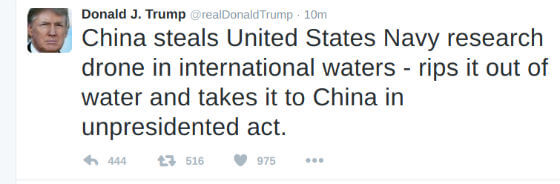
Unpresidented?
I guess Trump could be coining an expression that means an action unworthy of a president. Much more likely, it just means that early on a Saturday morning he doesn’t have any staff nearby to tell him how to spell unprecedented.
As for the substance, Trump is incorrect in claiming that China’s action is unprecedented. Moreover, from China’s point of view it is the U.S. surveillance operations which are the provocation as it has previously made clear.
In 2002, the same U.S. ship was involved in a flare of tensions between the U.S. and China. As the Associated Press reported at the time:
Chinese patrol planes buzzed an unarmed U.S. Navy ship several times while it was conducting what the Pentagon called routine military surveys in the Yellow Sea, and Beijing demanded that it cease “illegal operations” inside China’s 200-mile economic exclusion zone.
The incidents happened over a period of weeks starting in early September. After Chinese officials lodged private protests at least twice, the United States responded Thursday with a note that asserted its right to conduct such activities inside any nation’s economic exclusion zone.
In Beijing, Foreign Ministry spokeswoman Zhang Qiyue said, “We think it violates the international maritime law, and we have made several representations to the U.S. side.”
The report also said:
This was not the first time the Bowditch’s work has rankled the Chinese. On March 23, 2001, just nine days before the EP-3 collision, a Chinese warship chased the Bowditch out of the Yellow Sea.
That collision being between a Chinese fighter plane and a U.S. Navy surveillance aircraft over the South China Sea — an incident that caused much of the world to hold its breath as it waited to see whether an inexperienced and brash American president, George W. Bush, would over-react.
Who could imagine that 16 years later, Bush would, in retrospect, look like a seasoned statesman compared to the man who is about to enter the White House!?
Of course, Bush’s test with China was a prelude to a much greater test six months later whose consequences still reverberate around the world.
The prospect of Trump facing a similar test are too horrific to imagine.
Stay informed. Click below to sign up for daily email updates from War in Context:

Trump’s swaggering sparks war talk from China
Newsweek reports: In mid-summer 2015, the Pentagon deployed a vast fleet to the Western Pacific with an invasion force of 33,000 troops. The little reported exercise was supported by warplanes and attack helicopters, along with 21 ships, including the aircraft carrier George Washington and three nuclear missile-bearing submarines.
It was only a game, the Navy said. But it looked very much like practice for the real thing on or near Chinese shores. On the night of July 4 — Independence Day in the U.S. — Operation Talisman Saber kicked off with U.S. high-altitude paratroopers dropping from the sky near Fog Bay, in Australia’s Northern Territory. Naval artillery boomed. Tanks rolled ashore. The invasion was on.
A U.S. Navy press release made it sound routine, an “exercise [that] illustrates the closeness of the Australian and U.S. alliance…” But Military Times, a close observer of the Defense Department, put its finger on what it was really about: “Talisman Sabre: Trying to Deter China,” its headline said. [Continue reading…]
Russia’s fear of Hillary Clinton eclipsed any affection for Donald Trump
Max Fisher writes: Russia’s unprecedented intervention in the United States election came amid more than United States-Russia tension and Donald J. Trump’s praise of Vladimir V. Putin, the Russian president. It also coincided with a growing belief, in Moscow, that Russia faced an imminent threat in Hillary Clinton’s candidacy.
Mrs. Clinton is viewed in Moscow as innately hostile to Russia. Widely held conspiracy theories portray her as seeking to foment unrest that will return Russia to the chaos and depression of the 1990s. Even many government technocrats view her with suspicion that at times verges on paranoia.
She referred to these views at an event on Thursday, telling donors that Mr. Putin’s “personal beef” with her had driven Russia’s intervention in the American election.
Mark Galeotti, a Russia expert at the Institute of International Relations, based in Prague, said the Kremlin was consumed by something more urgent than petty revenge: self-preservation.
“It’s not just they didn’t like Clinton, but they actually thought that she represented a threat,” he said, describing Russia’s actions as a matter of “policy, not pique.”
No one factor can fully explain Russia’s decision to hack and pass on Democratic emails, analysts say, and intelligence agencies appear divided on assessing Russian motives. But, in Moscow, fear of Mrs. Clinton has loomed as large or larger than any warmth for Mr. Trump. [Continue reading…]
Everyone connected with the abomination in Aleppo will pay a heavy price
Fred Hof writes: Some 70 months ago, unarmed, ordinary Syrians rose peacefully against a regime whose incompetence and corruption they had come grudgingly to accept. It was their rulers’ detention and beating of children that provided the tipping point. The same regime seeks now to capitalize on a bloody victory in Aleppo, where children again have been targeted. But the actual and prospective costs associated with the deliberate slaughter of civilians in Aleppo and elsewhere in Syria are steep, and everyone connected with this abomination will pay, especially those who have stood by and watched.
For Syrians hoping for a future free of the Assad family and entourage, the price of Aleppo is bitter. Prodded by a violent regime into armed resistance it did not want, undermined by regime-facilitated extremists and abandoned by pseudo-friends unwilling to match words with deeds, Syrian nationalists must now acknowledge that Syrian President Bashar al-Assad’s survival strategy is working.
That strategy is rooted in collective punishment. The regime, with the enthusiastic support of Russia and Iran, does not hesitate to kill, maim, terrorize and displace civilians in areas where rebel forces are present. Indeed, the Russian air force has demonstrated a special aptitude for destroying hospitals. For Assad and his allies, no atrocity is unthinkable.
Nationalists opposing Assad must ask and answer some hard questions. Has armed resistance run its course? Would it be more humane to lay down arms in the hope that fewer people will be killed, maimed, tortured, starved and displaced than is currently the case? Should ending industrial-strength terror from the skies and starvation sieges down below be the top priority? Given the carnage of Aleppo and all that has preceded it, there is no doubt about what the regime and its allies are willing to do. Neither can there be any doubt about the refusal of the West, notwithstanding its “Never Again” rhetoric, to offer a modicum of protection. [Continue reading…]
Assad’s lesson from Aleppo: Force works, with few consequences
The New York Times reports: For months, the bodies have been piling up in eastern Aleppo as the buildings have come down, pulverized by Syrian and Russian jets, burying residents who could not flee in avalanches of bricks and mortar.
And now it is almost over, not because diplomats reached a deal in Geneva, but because President Bashar al-Assad of Syria and his foreign allies have won the city. Cold, hungry and scarred by the deaths of loved ones, tens of thousands of civilians and fighters are awaiting buses to take them from their homes to uncertain futures.
It is not the first victory that Mr. Assad has secured with overwhelming force in the Syrian conflict. But his subjugation of eastern Aleppo has echoed across the Middle East and beyond, rattling alliances, proving the effectiveness of violence and highlighting the reluctance of many countries, perhaps most notably the United States, to get involved.
President Obama, on Friday at his final news conference of the year, acknowledged that the nearly six-year-old war in Syria had been among the hardest issues he has faced, and that the world was “united in horror” at the butchery in Aleppo. But Mr. Obama — who came into office committed to reducing America’s military entanglements in the Middle East — also defended his decision not to intervene more forcefully.
To do otherwise, he said, would have required the United States to be “all in and willing to take over Syria.”
The message for autocratic leaders in the region and elsewhere is that force works — and brings few consequences, said Maha Yahya, the director of the Carnegie Middle East Center in Beirut.
The lesson for the victims of that force is that they are on their own. [Continue reading…]
"Aleppo is a place where the children have stopped crying." Scenes of sheer terror and grief in the last hospital in the last days of Aleppo pic.twitter.com/sy1NgjD4gY
— Channel 4 News (@Channel4News) December 16, 2016
Is Donald Trump a threat to democracy?
Steven Levitsky and Daniel Ziblatt write: Donald J. Trump’s election has raised a question that few Americans ever imagined asking: Is our democracy in danger? With the possible exception of the Civil War, American democracy has never collapsed; indeed, no democracy as rich or as established as America’s ever has. Yet past stability is no guarantee of democracy’s future survival.
We have spent two decades studying the emergence and breakdown of democracy in Europe and Latin America. Our research points to several warning signs.
The clearest warning sign is the ascent of anti-democratic politicians into mainstream politics. Drawing on a close study of democracy’s demise in 1930s Europe, the eminent political scientist Juan J. Linz designed a “litmus test” to identify anti-democratic politicians. His indicators include a failure to reject violence unambiguously, a readiness to curtail rivals’ civil liberties, and the denial of the legitimacy of elected governments.
Mr. Trump tests positive. In the campaign, he encouraged violence among supporters; pledged to prosecute Hillary Clinton; threatened legal action against unfriendly media; and suggested that he might not accept the election results.
This anti-democratic behavior has continued since the election. With the false claim that he lost the popular vote because of “millions of people who voted illegally,” Mr. Trump openly challenged the legitimacy of the electoral process. At the same time, he has been remarkably dismissive of United States intelligence agencies’ reports of Russian hacking to tilt the election in his favor. [Continue reading…]
Donald Trump’s war on science
Lawrence M. Krauss writes: Last week, the Space, Science, and Technology subcommittee of the House of Representatives tweeted a misleading story from Breitbart News: “Global Temperatures Plunge. Icy Silence from Climate Alarmists.” (There is always some drop in temperature when El Niño transitions into La Niña — but there has been no anomalous plunge.) Under normal circumstances, this tweet wouldn’t be so surprising: Lamar Smith, the chair of the committee since 2013, is a well-known climate-change denier. But these are not normal times. The tweet is best interpreted as something new: a warning shot. It’s a sign of things to come — a declaration of the Trump Administration’s intent to sideline science.
In a 1946 essay, George Orwell wrote that “to see what is in front of one’s nose needs a constant struggle.” It’s not just that we’re easily misled. It’s that, by “impudently twisting the facts,” we can convince ourselves of “things which we know to be untrue.” A whole society, he wrote, can deceive itself “for an indefinite time,” and the only check on that mass delusion is that “sooner or later a false belief bumps up against solid reality.” Science is one source of that solid reality. The Trump Administration seems determined to keep it at bay, and the consequences for society and the environment will be profound.
The first sign of Trump’s intention to spread lies about empirical reality, “1984”-style, was, of course, the appointment of Steve Bannon, the former executive chairman of the Breitbart News Network, as Trump’s “senior counselor and strategist.” This year, Breitbart hosted stories with titles such as “1001 Reasons Why Global Warming Is So Totally Over in 2016,” despite the fact that 2016 is now overwhelmingly on track to be the hottest year on record, beating 2015, which beat 2014, which beat 2013. Such stories do more than spread disinformation. Their purpose is the creation of an alternative reality — one in which scientific evidence is a sham — so that hyperbole and fearmongering can divide and conquer the public. [Continue reading…]
U.S. faces tall hurdles in detaining or deterring Russian hackers
The New York Times reports: When a suspected Russian cybercriminal named Dmitry Ukrainsky was arrested in a Thai resort town last summer, the American authorities hoped they could whisk him back to New York for trial and put at least a temporary dent in Russia’s arsenal of computer hackers.
But the Russian authorities moved quickly to persuade Thailand not to extradite him, saying that he should be prosecuted at home. American officials knew what that meant. If Mr. Ukrainsky got on a plane to Moscow, they concluded, he would soon be back at work in front of a computer.
“The American authorities continue the unacceptable practice of ‘hunting’ for Russians all over the world, ignoring the norms of international laws and twisting other states’ arms,” the Russian Foreign Ministry said.
The dispute over Mr. Ukrainsky, whose case remains in limbo, highlights the difficulties — and at times impossibilities — that the United States faces in combating Russian hackers, including those behind the recent attacks on the Democratic National Committee. That hack influenced the course, if not the outcome, of a presidential campaign and was the culmination of years of increasingly brazen digital assaults on American infrastructure.
The United States has few options for responding to such hacks. Russia does not extradite its citizens and has shown that it will not easily be deterred through public shaming. At times, the American authorities have enlisted local police officials to arrest suspects when they leave Russia — for vacation in the Maldives, for example. But more often than not, the F.B.I. and Justice Department investigate and compile accusations and evidence against people who will almost certainly never stand trial. [Continue reading…]
From Rwanda to Aleppo — non-intervention has consequences too
Lindsey Hilsum writes: Every few hours I check my WhatsApp feed from the doctors in East Aleppo. They post videos of injured children and a combination of eyewitness news and desperate messages: “Iran militia shot the convoy,” “The regime forces are still angry, I may die tens times now,” “Warplane with heavy machine gun attacking right now.”
Injured boys at a field hospital after airstrikes on the rebel held areas of Aleppo, Syria November 18, 2016.
It takes me back to April 1994, when I sat, terrified, in my house in Kigali listening to Rwandan friends who called to tell me about the slaughter in their neighbourhoods. Monica dictated to me her last words to pass onto her husband, Marcel, who was travelling. As it happened, she survived, but their five children, who were staying with their grandparents, were murdered. These are not easy memories.A few years later, Samantha Power, then Professor of Human Rights Practice at Harvard’s John F. Kennedy School of Governance, published a book called A Problem from Hell; America and the Age of Genocide. Her thesis, simply put, was that in the face of mass slaughter the USA has a moral and legal obligation to intervene. America did nothing when Saddam Hussein gassed the Kurds in Halabja, nor during the genocide in Rwanda nor the massacre of 7,000 men and boys at Srebrenica in Bosnia the following year.
Last week, Power, now US Ambassador to the UN, made an impassioned and futile speech in the Security Council. [Continue reading…]
Team Trump is backing Iran, a regime they supposedly hate
Michael Weiss writes: In 2007, an Iranian-backed Shia militia known as Asaib Ahl al-Haq kidnapped and murdered five U.S. servicemen in an ambush in the Iraqi city of Karbala. At the time, the group’s deputy secretary-general was Akram al-Kaabi, a man who has since said publicly that he would gladly overthrow Iraq’s government if asked to do so by Iran’s supreme leader, Ayatollah Ali Khamenei.
Today, al-Kaabi heads a splinter faction of his original militia. Known as Harakat Hezbollah al-Nujaba, it’s now an official arm of the Iraqi security establishment, but fighting in Syria. And the United Nations has just accused it of taking part this week in the massacre of at least 82 civilians in East Aleppo, including 11 women and 13 children—a slaughter perpetrated alongside other sectarian Shiite proxies of Iran and the Russian-Iran-backed Baathist dictatorship of Bashar al-Assad.
The Syrian army as a fighting force is largely spent. Without Russian air support and the some 6,000 to 8,000 Iranian-run paramilitaries Assad now relies on to wage war for him, Aleppo would never have been recaptured.
Nor are the Iranians masking their pride in the accomplishment.“Aleppo was liberated thanks to a coalition between Iran, Syria, Russia, and Lebanon’s Hezbollah,” Tehran’s defense minister, Seyed Yahya Rahim-Safavi, proclaimed Wednesday. “Iran is on one side of this coalition which is approaching victory and this has shown our strength. The new American president should take heed of the powers of Iran.”
That last sentence should not be read as a mere perfunctory warning to U.S. President-elect Donald Trump. It’s a statement of fact, and one that neither Trump nor his people have gotten their heads around. Trump has made it clear he wants to join the Russian side in this war, while he is adamantly opposed to the Iranian side. But in the world of real reality they are the same side. [Continue reading…]
The Trump plutocracy: Combined wealth of 17 cabinet picks exceeds that of one third of American household
Quartz reports: The 17 people who US president-elect Donald Trump has selected for his cabinet or for posts with cabinet rank have well over $9.5 billion in combined wealth, with several positions still unfilled. This collection of wealth is greater than that of the 43 million least wealthy American households combined—over one third of the 126 million households total in the US.
Affluence of this magnitude in a US presidential cabinet is unprecedented. [Continue reading…]
‘A pattern of egregious, unjustified security breaches’ during Michael Flynn’s career
The Daily Beast reports: If retired Lt. Gen. Michael Flynn were a rank-and-file intelligence analyst, military officer or congressional aide, his career would be in smoldering ruins. But instead, he’s getting a big-league promotion.
President-elect Donald Trump’s incoming White House national security adviser is on the hot seat once again after The Washington Post reported Wednesday on a secret military investigation that concluded that Flynn “inappropriately shared” classified information with foreign military officers but did not act “knowingly” and did no damage to national security.
The report also disclosed that Flynn mentioned sensitive information to Pakistan about secret U.S. intelligence capabilities being used to monitor the Haqqani network, an insurgent group responsible for repeated attacks on American forces in Afghanistan. (Some Pakistani intelligence officials have been accused of actively aiding the network.)
But these are just two of the security breaches that Flynn has been involved with. In fact, his career has involved multiple violations of rules intended to protect national security—exposing both his own hypocrisy and the double standards of a system which overlooks security breaches for high-ranking officials while punishing everyday workers. [Continue reading…]
Fake news is a convenient scapegoat, but the big 2016 problem was the real news
Matthew Yglesias writes: Speaking in early December at a ceremony to honor Harry Reid’s retirement from the US Senate, Hillary Clinton took aim at a target that would have been totally unfamiliar to audiences as recently as the summer of 2016: fake news.
She spoke of “an epidemic” of the stuff that has “flooded social media” over the past year and “can have real-world consequences.”
This was reported largely as commentary on the Pizzagate conspiracy theory, which had recently led to an alarming armed standoff at DC’s Comet Ping Pong restaurant. But it was also pretty clearly an allusion to her own recently failed presidential campaign, especially because she spoke favorably of the idea of bipartisan legislation to curb foreign propaganda news, arguing that “it is imperative that leaders in both the private and public sector step up to protect our democracy and innocent lives.”
While it’s true that fake news appears to have circulated widely in Trump-friendly corners of the internet — possibly with some assistance from the Russian government — the idea that fake news was central to the outcome of the campaign has little basis in fact. The very nature of viral fake news is that it’s mostly likely to be shared by people who have already bought into a partisan or ideological worldview, with pro-Trump fake news largely shared by Trump supporters to other Trump supporters. [Continue reading…]
Iran sanctions extended, but without Obama’s irrelevant signature
The Washington Post reports: Sanctions against Iran were officially extended for another decade Thursday, even though President Obama did not sign the legislation, a symbolic move intended to show the White House’s disapproval of the bill.
The sanctions renewal, which passed Congress with enough votes to be veto-proof, has triggered complaints from Tehran. The Iranian government views the nuclear agreement as entailing a promise of no new sanctions. The White House, by not signing the bill, is trying to alleviate Iran’s concerns.
Secretary of State John F. Kerry said the nuclear deal is still a “top strategic objective” for the United States. With or without the sanctions renewed, he said, the United States could snap sanctions back into place if Iran were to violate the Joint Comprehensive Plan of Action (JCPOA), the formal name for the nuclear deal. Kerry said that even though he considers it unnecessary to renew the existing waivers, he had done so anyway “to ensure maximum clarity” that the United States will meet its obligations under the deal.
He also said he had contacted Iran’s foreign minister, Mohammad Javad Zarif, and U.S. allies to reassure them that the United States remains committed to the deal that gave Iran sanctions relief once it pared back its nuclear program.
“As long as Iran adheres to its commitments under the JCPOA, we remain steadfastly committed to maintaining ours as well,” he said.
But with President-elect Donald Trump just five weeks away from taking office, Kerry’s guarantees may be short-lived if the new administration takes a tougher approach to Iran, as is expected. [Continue reading…]
What’s in store for Syria after Aleppo falls? Russia and Iran will decide
Scott Lucas, University of Birmingham
Let us be clear. The imminent victory in Syria’s largest city of Bashar al-Assad’s government – and of its essential supporters, Russia, Iran, and Hezbollah – is built on war crimes.
For months, hundreds of thousands of people in opposition-held areas of Syria’s largest city have been besieged and bombed. Thousands have been killed. Men of fighting age seized in recent days by pro-Assad forces face conscription into the Syrian military or detention and torture. Scores of residents reportedly executed in the 24 hours before a ceasefire was announced on December 13.
Rebels and civilians will get some respite, if yesterday’s agreement for their removal from Aleppo to other areas in north-west Syria is implemented. But this is only the end of one chapter: the war goes on, as it has since the uprising against Assad in March 2011.
Opposition forces are still holding out in some areas near Damascus and in southern Syria; more importantly, they control much of Syria’s north-west, including almost all of Idlib Province and parts of Hama, Aleppo, and Homs provinces. A joint Turkish-rebel offensive has captured a significant part of northern Syria. The so-called Islamic State (IS) is far from gone: only days before Aleppo really began to give way, it recaptured large parts of the historic city of Palmyra from the Assad regime. Syria’s Kurds have their own areas, especially in the north-east of the country.
In this multi-sided conflict, will there be more Aleppos? Or will there finally be a period without quite as many war crimes and bloodshed?
Assad doesn’t have the answer, however much he claims control of his “Syrian nation”. The US has little more to contribute, now effectively sidelined after years of indecision and a misguided decision to follow Moscow’s lead. As things stand, much of the future of Syria is at the mercy of Russia and Iran.
The Putin paradigm: How Trump will rule America

Masha Gessen writes: Over the last few days, concerns about some kind of a hidden alliance between Donald Trump and Vladimir Putin have exploded. There is the president-elect with his apparently fawning regard for the Russian leader. There are Trump’s top cabinet picks, with their unusual Russian ties: as national security advisor, Lt. General Mike Flynn, who has met Putin and done paid events for a Kremlin-sponsored TV station; and as secretary of state, ExxonMobil CEO Rex Tillerson, who has done billions of dollars of business in Russia and received an award from Putin. And then there is the revelation, from the CIA, that Russia may have actively interfered in the US election to get Trump elected.
Of course, Putin may well have reasons for wanting Trump to be president — not least Trump’s apparent skepticism toward NATO and his lack of opposition to Russia’s military interventions in Ukraine and Syria. But a more important connection between the two men may be their common approach to leadership, which will almost certainly outlast any friendship that may form between them. During his campaign, Donald Trump repeatedly expressed admiration for the way Putin governed. “The man has very strong control over his country,” Trump said at one point. “He’s been a leader far more than our president has been a leader.” That revealed a lot about Trump’s concept of the presidency—he seems to believe that effectiveness is measured by the extent to which the leader “controls” the country. But how might that play out in practice? To what extent can Putin provide insight into Trump’s understanding of power?
There is still much we don’t know about how Trump will rule. But in the month since his election, some characteristic patterns have emerged — and they bear some instructive similarities to the style Putin has practiced over many years. [Continue reading…]