Category Archives: Analysis

Anjem Choudary was a leader. His conviction will damage terror networks

Raffaello Pantucci writes: The conviction of Anjem Choudary marks a significant moment in the history of British jihadism, but it is unclear what kind of an impact it will have. Terrorist groups and networks do suffer when they lose charismatic leaders. Their removal is unlikely to completely destroy a group, but it does change the dynamic.

Terrorist networks are, at their core, groups of people gathering around an ideology. Individuals are drawn in for various (often deeply personal) reasons, but to function as an effective unit that works to advance an ideology requires organisation and leadership. Otherwise, it is just a cluster of angry people with no particular direction.

It is here that leadership figures are key. They provide direction and can help motivate others, as well as offering some practical experience and, crucially, contacts. An individual who has risen to the top of a terrorist network after a long period of time will develop an understanding of what works. The relationships they will have developed over time are hard to replicate. [Continue reading…]

Facebooktwittermail

How work can lead to suicide in a globalised economy

By Sarah Waters, University of Leeds and Jenny Chan, University of Oxford

A Paris prosecutor recently called for the former CEO and six senior managers of telecoms provider, France Télécom, to face criminal charges for workplace harassment. The recommendation followed a lengthy inquiry into the suicides of a number of employees at the company between 2005 and 2009. The prosecutor accused management of deliberately “destabilising” employees and creating a “stressful professional climate” through a company-wide strategy of “harcèlement moral” – psychological bullying.

All deny any wrongdoing and it is now up to a judge to decide whether to follow the prosecutor’s advice or dismiss the case. If it goes ahead, it would be a landmark criminal trial, with implications far beyond just one company.

Workplace suicides are sharply on the rise internationally, with increasing numbers of employees choosing to take their own lives in the face of extreme pressures at work. Recent studies in the United States, Australia, Japan, South Korea, China, India and Taiwan all point to a steep rise in suicides in the context of a generalised deterioration in working conditions.

Rising suicides are part of the profound transformations in the workplace that have taken place over the past 30 years. These transformations are arguably rooted in the political and economic shift to globalisation that has radically altered the way we work.

In the post-war Fordist era of industry (pioneered by US car manufacturer Henry Ford), jobs generally provided stability and a clear career trajectory for many, allowing people to define their collective identity and their place in the world. Strong trade unions in major industrial sectors meant that employees could negotiate their working rights and conditions.

But today’s globalised workplace is characterised by job insecurity, intense work, forced redeployments, flexible contracts, worker surveillance, and limited social protection and representation. Zero-hour contracts are the new norm for many in the hospitality and healthcare industries, for example.

Now, it is not enough simply to work hard. In the words of Marxist theorist Franco Berardi, “the soul is put to work” and workers must devote their whole selves to the needs of the company.

For the economist Guy Standing, the precariat is the new social class of the 21st century, characterised by the lack of job security and even basic stability. Workers move in and out of jobs which give little meaning to their lives. This shift has had deleterious effects on many people’s experience of work, with rising cases of acute stress, anxiety, sleep disorders, burnout, hopelessness and, in some cases, suicide.

Continue reading

Facebooktwittermail

Green beans: Why pulses are the eco-friendly option for feeding – and saving – the world

By Caroline Wood, University of Sheffield and Wayne Martindale, Sheffield Hallam University

We all know the score: current trends predict there will be 9.7 billion mouths to feed by 2050. Producing enough food without using more land, exacerbating climate change or putting more pressure on water, soil and energy reserves will be challenging.

In the past, food security researchers have focused on production with less attention paid to consumer demand and how food is ultimately used in meals. However as developing nations aspire towards the “Western diet”, demand for meat and animal products is rapidly climbing.

This is bad news for the planet. Meat is a luxury item and comes at a huge environmental cost. Shuttling crops through animals to make protein is highly inefficient: in US beef, just 5% of the original protein survives the journey from animal feed to meat on the plate. Even milk, which has the best conversion efficiency, has just 40% of the original protein.

Consequently, livestock farming requires huge amounts of water and land for grazing and feed production, taking up an estimated 70% of all agricultural land and 27% of the human water footprint. Much of this land is becoming steadily degraded through overgrazing and erosion, prompting farmers to expand into new areas; 70% of cleared forest in the Amazon, for instance, is now pastureland. Livestock production is also one of the greatest contributors to greenhouse gas emissions, including 65% of man-made nitrous oxide emissions (which have a global warming potential 296 times greater than CO₂).

Nevertheless, millions of people in developing countries still suffer from protein malnutrition. The burden, therefore, must fall on people in richer nations to reduce their meat consumption and embrace other sources of protein.

Continue reading

Facebooktwittermail

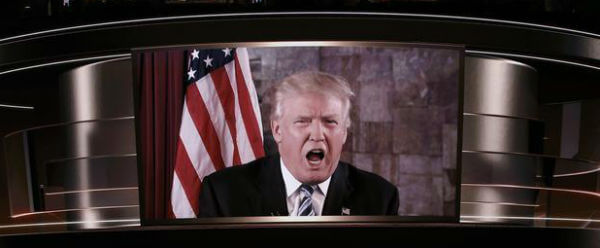
The deep roots of Donald Trump’s white nationalism

trump-purge

Timothy Shenk writes: [Leviathan and Its Enemies, by Samuel Francis, finished in 1995 but not discovered until after his death a decade later and published earlier this year, is] one of the most impressive books to come out of the American right in a generation – and the most frightening. It is a searching diagnosis of managerial society, written by an author looking for a strategy that could break it apart.

Like much of Francis’s writing, Leviathan and Its Enemies began with Burnham – in this case, quite literally. “This book,” Francis announced in the first sentence, “is an effort to revise and reformulate the theory of the managerial revolution as advanced by James Burnham in 1941 [in The Managerial Revolution: What Is Happening in the World].”

Francis agreed that society had been taken over by managers, but he believed the new ruling class was far more vulnerable than Burnham had realised. Not everyone had benefited from the rise of the experts – and Francis saw this unequal distribution of rewards as the managerial regime’s greatest weakness.

For reasons he never quite explained, he insisted that the cosmopolitan elite threatened the traditional values cherished by most Americans: “morality and religion, family, nation, local community, and at times racial integrity and identity”. These were sacred principles for members of a new “post-bourgeois proletariat” drawn from the working class and the lower ranks of the middle class. Lacking the skills prized by technocrats, but not far enough down the social ladder to win the attention of reformers, these white voters considered themselves victims of a coalition between the top and bottom against the middle.

According to Francis, this cohort had supplied the animating spirit of rightwing politics since the death of Franklin Roosevelt in 1945. They had supported Goldwater – but Francis regarded Goldwater’s programme, like the “movement conservatism” of the National Review, as a “quaintly bourgeois” throwback to the oligarchic politics of the 19th century, with nothing to offer the modern working man. Their tribune was not Goldwater but George Wallace, the notorious segregationist and Democratic governor of Alabama – who won five southern states as an anti-civil rights third-party candidate in the 1968 presidential election. Richard Nixon and Ronald Reagan had appealed to this group, too, but neglected their interests after taking office. Despite having elected multiple presidents, the post-bourgeois proletariat had yet to find a voice.

Yet Francis had difficulty explaining why managerial society would generate so much opposition in the first place. In Leviathan and Its Enemies, he argued that resistance to the cosmopolitan elite would be driven by “immutable elements of human nature” that “necessitate attachment to the concrete and historical roots of moral values and meaning”.

He was more candid in a speech he gave while working on the book. “What we as whites must do,” he declared, “is reassert our identity and our solidarity, and we must do so in explicitly racial terms through the articulation of a racial consciousness as whites.” Where mainstream conservatives depicted the US as a nation whose diverse population was linked by devotion to its founding principles, Francis viewed it as a racial project inextricably bound up with white rule. The managerial revolution jeopardised this racial hierarchy, and so it must be overthrown.

Francis delivered his remarks on racial consciousness at a conference organised by American Renaissance, an obscure journal devoted to promoting white nationalism. Years earlier, Francis had struck up a friendship with Jared Taylor, who went on to found the magazine with Francis’s encouragement. From their first encounter, Taylor recalled, he and Francis “understood each other immediately”.

Francis’s employers at the Washington Times were not as sympathetic. The paper fired him after his comments were released, a move that was part of his larger expulsion from the respectable right. [William J.] Buckley himself dismissed Francis as “spokesman” for a group that had “earned their exclusion from thoughtful conservative ranks”.

Yet Francis would not be so easily purged. For years he had cultivated a relationship with Pat Buchanan, a one-time Nixon protege who had become one of the country’s most recognisable conservatives thanks to his role as co-host of CNN’s popular debating programme Crossfire. In 1992, Buchanan launched a long-shot campaign against incumbent president George HW Bush that, against all expectations, garnered almost 3m votes in the primaries. While all this was going on, Buchanan was growing closer to Francis, whom he later called “perhaps the brightest and best thinker on the right”.

Francis and Buchanan were linked by their association with a breakaway faction on the right known as paleoconservatism. While mainstream conservatives had taken advantage of cushy gigs in New York and Washington, paleocons depicted themselves as spokesmen for the forgotten residents of flyover country. Francis urged Buchanan to make another run for the White House in 1996, this time as the candidate of the post-bourgeois resistance. That campaign would be based on three issues: protectionism, opposition to immigration and an “America First” foreign policy that repudiated global commitments and foreign interventions in order to focus on defending the national interest. [Continue reading…]

Facebooktwittermail

Is the U.S. electoral system really ‘rigged’?

By Timothy Frye, Columbia University

Many have speculated how a Trump victory would affect the U.S., but few have thought about the consequences of a Trump loss. After falling behind Hillary Clinton in the polls, Donald Trump has already developed a narrative for his exit: The election was rigged.

So how likely is a rigged vote?

Full-throated claims

Last week Trump told Fox News: “I’m telling you – Nov. 8, we’d better be careful because that election is going to be rigged. And I hope the Republicans are watching closely or it is going to be taken away from us.”

This is not just an isolated or off-the-cuff statement. Trump confidant Roger Stone recently noted: “I think that we have widespread voter fraud, but the first thing that Trump needs to do is begin talking about it constantly.”

Trump’s campaign manager Paul Manafort noted: “Frankly we think that the situation in the country, just like with the DNC’s primaries, is a situation where if you rely on the Justice Department to ensure the security of elections, we have to be worried.”

That President Obama has dismissed these claims as ridiculous will do little to reassure Trump supporters.

Continue reading

Facebooktwittermail

White Christian America is dying

In an interview with the Washington Post, Robert P. Jones, author of The End of White Christian America, says: The American religious landscape is being remade, most notably by the decline of the white Protestant majority and the rise of the religiously unaffiliated. These religious transformations have been swift and dramatic, occurring largely within the last four decades. Many white Americans have sensed these changes, and there has been some media coverage of the demographic piece of the puzzle. But while the country’s shifting racial dynamics are certainly a source of apprehension for many white Americans, it is the disappearance of White Christian America that is driving their strong, sometimes apocalyptic reactions. Falling numbers and the marginalization of a once-dominant racial and religious identity — one that has been central not just to white Christians themselves but to the national mythos — threatens white Christians’ understanding of America itself. [Continue reading…]

Facebooktwittermail

The never-told-before story of the meeting that led to the creation of ISIS

Harald Doornbos and Jenan Moussa write: Abu Ahmad never hesitated in his embrace of the Syrian uprising. Born in a northern Syrian city to a conservative and religious Sunni Arab family, he was a student when the revolt began in March 2011, and joined the protests against President Bashar al-Assad from day one.

“With excitement in our hearts we saw [the uprising in] Egypt happening, followed by the revolution in Libya,” he said. “We hoped the wind of change would not pass our country.”

When the uprising became a full-fledged civil war by mid-2012, Abu Ahmad decided to take up arms and fight. He joined a jihadi-leaning rebel group, whose members were mostly Syrians but also included some foreign fighters from Europe and Central Asia. The composition of the brigades was in flux then — every couple of months, Abu Ahmad’s group would either change its name or unite with other jihadi rebels. But then the groups began to consolidate: In Spring 2013, Abu Ahmad chose to side with the Islamic State of Iraq and the Levant when it officially expanded into Syria, as tensions escalated between the jihadi group and the Nusra Front. The group would go on to proclaim itself a worldwide caliphate in June 2014, assuming the name “Islamic State” to reflect its global ambitions. To this day, Abu Ahmad is a serving member in the organization, with unique insight into the group’s behavior and its history.

Over the course of our more than 15 meetings with Abu Ahmad, we questioned him intensively about his knowledge of the jihadi group and his bona fides as one of the “soldiers of the caliphate.” Over a period of 10 months, we spent more than 100 hours with him. He patiently answered our questions on everything from how he ended up with the Islamic State, how the organization is organized, and the identity of the European foreign fighters within the group. Our interviews would go on for six hours a day, in week-long stretches.

Abu Ahmad took a great personal risk in talking to us. Because he is still with the Islamic State, we had to deliberately obscure some details about his life to protect his identity.

Abu Ahmad agreed to speak to us, he explained, for several reasons. Although he is still with the Islamic State, he doesn’t agree with everything the outfit does. He is attracted to the organization because he views it as the strongest Sunni group in the region. However, he is disappointed that it “has become too extreme,” blaming it for doing such things as crucifying, burning, and drowning its opponents and those who violate its rules.

For example, Abu Ahmad objected to a punishment that the Islamic State implemented in the northern Syrian city of al-Bab, where it put a cage in the middle of the city center, known as Freedom Square, to punish Syrian civilians guilty of minor crimes, such as selling cigarettes. The group, Abu Ahmad said, imprisoned Syrians in the cage for three days at a time, hanging a sign around their neck stating the crime that they had committed.

“Now the square is known as the Punishment Square,” he said. “I think this kind of harsh punishment is bad for us. It is making ISIS more feared than liked by Sunnis, which is not good at all.”

In the past, Abu Ahmad said, he had hoped the Islamic State would become “jihadi unifiers,” capable of bringing Sunni jihadis together under one banner. He admired the foreign fighters whom he knew, mainly young men from Belgium and the Netherlands who had traveled to Syria to fight jihad. They had all lived in rich and peaceful countries, and while tens of thousands of Syrians had paid large sums of money to be smuggled to Europe to escape the war, these jihadis voluntarily traveled in the exact opposite direction.

“These foreigners left their families, their houses, their lands and traveled all the way to help us here in Syria,” Abu Ahmad said. “So to support us they are truly sacrificing everything they have.”

But Abu Ahmad would soon sour on aspects of the jihadi group. First, the Islamic State has not brought jihadis together; on the contrary, tensions have risen with other groups, and he worried that “the rise of ISIS led to the breakup with the Nusra Front and the weakening of unified jihadi forces in Syria.”

Secondly, while some of the foreign fighters were men who led truly religious lives in Europe, he discovered another group that he took to thinking of as the “crazies.” These were mostly young Belgian and Dutch criminals of Moroccan descent, unemployed and from broken homes, who lived marginal lives in marginal suburbs of marginal cities. Most of these crazies had no idea about religion, and hardly any of them ever read the Quran. To them, fighting in Syria was either an adventure or a way to repent for their “sinful lives” in Europe’s bars and discos. [Continue reading…]

Facebooktwittermail

Promises unfulfilled: How a State Department plan to stabilize Iraq broke apart

The Washington Post reports: A week before the last U.S. soldiers left his country in December 2011, Iraqi Prime Minister Nouri al-Maliki traveled to Washington to meet the team that would help shape Iraq’s future once the troops and tanks were gone.

Over dinner at the Blair House, guest quarters for elite White House visitors since the 1940s, the dour Iraqi sipped tea while Secretary of State Hillary Rodham Clinton spoke of how her department’s civilian experts could help Iraqis avoid a return to terrorism and sectarian bloodshed.

Iraq would see a “robust civilian presence,” Clinton told reporters afterward, summing up the Obama administration’s pledges to Maliki. “We are working to achieve that,” she said.

Less than three years later, the relatively calm Iraq that Maliki had led in 2011 was gone. The country’s government was in crisis, its U.S.-trained army humiliated, and a third of its territory overrun by fighters from the Islamic State. Meanwhile, State Department programs aimed at helping Iraqis prevent such an outcome had been slashed or curtailed, and some had never materialized at all.

Clinton’s political foes would later seek to blame her, together with President Obama, for the Islamic State’s stunning takeover of western Iraq, saying the State Department failed to preserve fragile security gains achieved at great cost by U.S. troops. In a speech Monday on how he would deal with terrorist threats, Republican presidential nominee Donald Trump said, “The rise of ISIS is the direct result of policy decisions made by President Obama and Secretary of State Clinton.”

But an intensive review of the record during Clinton’s tenure presents a broader picture of missteps and miscalculations by multiple actors — including her State Department as well as the Maliki government, the White House and Congress — that left Iraqi security forces weakened and vulnerable to the Islamic State’s 2014 surge. [Continue reading…]

Facebooktwittermail

The specter of an accidental China-U. S. war

The Wall Street Journal reports: The last time America and China went to war—in Korea in 1950—they fought each other to a standstill.

Later that decade, as the Cold War ramped up, they came close to blows again; the Eisenhower administration repeatedly threatened “Red China” with nuclear devastation as tensions bubbled over Taiwan.

Today, given the astronomical stakes at play, many assume that armed conflict between the two giants is out of the question. They are each other’s largest trading partner. Military confrontation wouldn’t only threaten these huge flows but also student exchanges, scientific collaboration, joint technical projects and the myriad other ways in which the fates and fortunes of the world’s two largest economies and their peoples are inextricably linked.

Yet, as China flexes its muscles in the South China Sea and East China Sea, the risks of an inadvertent clash on the water or in the air are growing by the day.

A new RAND Corp study says that a Sino-U. S. war as a result of such a crisis “cannot be considered implausible.”

Violence could ignite quickly, the report warns. That is because each side has deployed precision-guided munitions, as well as cyber and space technologies, able to inflict devastating damage on the other’s military assets, including Chinese land-based missile batteries and American aircraft carriers. Thus they have a strong incentive to launch massive strikes first as part of a “use it or lose it” calculation. [Continue reading…]

Facebooktwittermail

A world-war mentality is needed to face the threat from climate change

Bill McKibben writes: In the North this summer, a devastating offensive is underway. Enemy forces have seized huge swaths of territory; with each passing week, another 22,000 square miles of Arctic ice disappears. Experts dispatched to the battlefield in July saw little cause for hope, especially since this siege is one of the oldest fronts in the war. “In 30 years, the area has shrunk approximately by half,” said a scientist who examined the onslaught. “There doesn’t seem anything able to stop this.”

In the Pacific this spring, the enemy staged a daring breakout across thousands of miles of ocean, waging a full-scale assault on the region’s coral reefs. In a matter of months, long stretches of formations like the Great Barrier Reef — dating back past the start of human civilization and visible from space — were reduced to white bone-yards.

Day after day, week after week, saboteurs behind our lines are unleashing a series of brilliant and overwhelming attacks. In the past few months alone, our foes have used a firestorm to force the total evacuation of a city of 90,000 in Canada, drought to ravage crops to the point where southern Africans are literally eating their seed corn, and floods to threaten the priceless repository of art in the Louvre. The enemy is even deploying biological weapons to spread psychological terror: The Zika virus, loaded like a bomb into a growing army of mosquitoes, has shrunk the heads of newborn babies across an entire continent; panicked health ministers in seven countries are now urging women not to get pregnant. And as in all conflicts, millions of refugees are fleeing the horrors of war, their numbers swelling daily as they’re forced to abandon their homes to escape famine and desolation and disease.

World War III is well and truly underway. And we are losing. [Continue reading…]

Facebooktwittermail

Wall Street Journal gives Trump an ultimatum

In an editorial, the Wall Street Journal says: Mr. Trump’s advisers and his family want the candidate to deliver a consistent message making the case for change. They’d like him to be disciplined. They want him to focus on growing the economy and raising incomes and fighting terrorism.

They think he should make the election a referendum on Hillary Clinton, not on himself. And they’d like him to spend a little time each day — a half hour even — studying the issues he’ll need to understand if he becomes President.

Is that so hard? Apparently so. Mr. Trump prefers to watch the cable shows rather than read a briefing paper. He thinks the same shoot-from-the-lip style that won over a plurality of GOP primary voters can persuade other Republicans and independents who worry if he has the temperament to be Commander in Chief.

He also thinks the crowds at his campaign rallies are a substitute for the lack of a field organization and digital turnout strategy. And he thinks that Twitter and social media can make up for being outspent $100 million to zero in battleground states.

By now it should be obvious that none of this is working. It’s obvious to many of his advisers, who are the sources for the news stories about dysfunction.

The “Trump pivot” always seemed implausible given his lifelong instincts and habits, but Mr. Trump promised Republicans. “At some point I’ll be so presidential that you people will be so bored, and I’ll come back as a presidential person, and instead of 10,000 people I’ll have about 150 people and they’ll say, boy, he really looks presidential,” he said in April.

Those who sold Mr. Trump to GOP voters as the man who could defeat Hillary Clinton now face a moment of truth. Chris Christie, Newt Gingrich, Rudy Giuliani, Paul Manafort and the talk-radio right told Republicans their man could rise to the occasion.

If they can’t get Mr. Trump to change his act by Labor Day, the GOP will have no choice but to write off the nominee as hopeless and focus on salvaging the Senate and House and other down-ballot races. As for Mr. Trump, he needs to stop blaming everyone else and decide if he wants to behave like someone who wants to be President — or turn the nomination over to Mike Pence. [Continue reading…]

Two days after claiming that the only way he could lose in Pennsylvania would be if there was “cheating” on election day, Trump now concedes that he could lose for a much more likely reason: that an insufficient number of votes are cast in his favor.

He noted this yesterday in Connecticut while reiterating the fact that whatever happens on November 8, his arrival on Pennsylvania Avenue is assured:

I’m building a hotel on Pennsylvania Avenue, right next to The White House. I’ve said, I don’t give a damn — I’m coming to Pennsylvania Avenue one way or the other. Trump International. It was the Old Post Office building… it’s one of the most beautiful buildings in the country. Can you imagine, I got it through the Obama administration? Does that tell you how good I am?… It’s almost finished. It’s more than one year ahead of schedule and it’s substantially under budget… Wouldn’t it be great if our country could do things where they’re ahead of schedule and under budget?… With all the money I spent — in the primaries I spent over $50 million. Now I’m spending a fortune for the general election.

Oh you’d better elect me folks or I’ll never speak to you again.

Can you imagine how badly I’ll feel if I spent all of that money, all of this energy, all of this time, and lost? I will never ever forgive the people of Connecticut, I will never forgive the people of Florida and Pennsylvania and Ohio, but I love them anyway…

This isn’t an election in which Trump thinks he has to demonstrate what makes him worthy of support. On the contrary, it’s a test of the American people to discover whether this country is capable of grasping the opportunity of coming under Trump’s unparalleled leadership.

From Trump’s perspective, if he loses the election it will be America’s loss. He has no doubt that he’d be a great president, but what seems to be dawning on him is that there may be an insufficient number of Americans who share his conviction in his own greatness.

What Trump will never abandon is his narrative of success. For him to follow advice from the Wall Street Journal or anyone else would be to concede that he’s mismanaged his own campaign and that would be a concession that undermines the core of his identity.

Facebooktwittermail

Trump’s ‘rigged election’ message probably makes his supporters less likely to vote

John Sides writes: If you were running for president, and you wanted to make sure that your supporters actually showed up and voted on Nov. 8, should you be warning of a “rigged election”? If you are Donald Trump, the apparent answer is yes.

Already people are dubious about whether this is actually a good strategy:


Now, new research by political scientists Adam Levine and Robin Stiles suggests that, indeed, Trump’s message is not good for mobilizing voters. [Continue reading…]

Facebooktwittermail

Alleged Ukrainian terror plot gives Putin excuse to pull out of upcoming meeting with Normandy group of Western nations

Owen Matthews writes: I was recently invited to appear as a guest on Channel One’s “Special Correspondent,” a news-related chat show, where I sat through two hours of increasingly wild theories linking the Olympic doping ban to a Western conspiracy to punish Russia for its “independent” stance in international affairs.

“Tell us, Owen, do you agree that the Olympic ban is payback for our having taken Crimea?” barked the quick-talking presenter Evgeny Popov. “Russia defied Washington’s hegemony and now its time for us to be punished?”

Then, on Friday, Sergei Ivanov, a former KGB officer and long-time Putin ally, was removed from his post as head of the Presidential Administration and replaced by his deputy, Andrei Vaino, a minor apparatchik who made his way up in the Kremlin protocol service.

Ivanov’s sacking is part of a pattern. Russian President Vladimir Putin has consolidated his personal rule, purging long-time political allies in favor of young, faceless, but utterly loyal bureaucrats.

Earlier this year, Putin appointed two former bodyguards as the governors of the Tula and Kalinigrad regions, and he placed his former personal bodyguard, Viktor Zolotov, in charge of the powerful National Guard, a newly-formed law enforcement organ composed of 250,000 armed men and directly answerable to the Kremlin.

“Putin is purging old friends and replacing them with servants,” Kremlin-connected analyst Stanislav Belkovsky told fontanka.ru. “These people reminded [Putin] of a time before he was a boss, let alone President … Now he needs executors, not advisers.” In other words, Putin is removing anybody capable of standing up to him. [Continue reading…]

Facebooktwittermail

End the first-use policy for nuclear weapons

James E. Cartwright, a former vice chairman of the Joint Chiefs of Staff and former commander of the United States Strategic Command, and Bruce G. Blair, a former Minuteman launch officer, write: Throughout the nuclear age, presidents have allowed their senior commanders to plan for the first use of nuclear weapons. Contingency plans were drawn to initiate first strikes to repel an invasion of Europe by the Soviet Union, defeat China and North Korea, take out chemical and biological weapons and conduct other missions.

After the end of the Cold War, which coincided with revolutionary advances in our nonnuclear military capacities, the range of these missions steadily narrowed to the point where nuclear weapons today no longer serve any purpose beyond deterring the first use of such weapons by our adversaries. Our nonnuclear strength, including economic and diplomatic power, our alliances, our conventional and cyber weaponry and our technological advantages, constitute a global military juggernaut unmatched in history. The United States simply does not need nuclear weapons to defend its own and its allies’ vital interests, as long as our adversaries refrain from their use.

Using nuclear weapons first against Russia and China would endanger our and our allies’ very survival by encouraging full-scale retaliation. Any first use against lesser threats, such as countries or terrorist groups with chemical and biological weapons, would be gratuitous; there are alternative means of countering those threats. Such use against North Korea would be likely to result in the blanketing of Japan and possibly South Korea with deadly radioactive fallout.

But beyond reducing those dangers, ruling out first use would also bring myriad benefits. To start, it would reduce the risk of a first strike against us during global crises. Leaders of other countries would be calmed by the knowledge that the United States viewed its own weapons as deterrents to nuclear warfare, not as tools of aggression. [Continue reading…]

Facebooktwittermail

The rising power of China will create new political fissures in the West

Gideon Rachman writes: Whether he wins or loses the US presidency next November, Donald Trump has already come up with one of the defining slogans of 2016 – “Make America great again”.

Trump’s vision of an America in precipitous decline is all-encompassing. At home, he points to falling living standards for many Americans and the disappearance of well-paid manufacturing jobs. Overseas, he claims the world is laughing at the US and laments that “we don’t win any more”.

Many in Europe are tempted to see Trump as an “only in America” aberration. Yet the fear of economic and geopolitical decline that Trump is capitalising upon is widely visible across the west. The coalition of frustrated working-class voters and nostalgic nationalists that the Republican has put together is uncomfortably reminiscent of the alliance that voted for Brexit in the UK. Trump’s “make America great again” mantra has an echo of the Brexit campaign’s winning slogan – “Take back control”. Nor is this is just an Anglo-American phenomenon. Across the EU, including in France, the Netherlands, Italy and Poland, protectionists and nationalists are gaining ground.

As Trump might put it: “Something’s going on.” That something is a historic shift in economic and geopolitical power that is bringing to an end a 500-year period in which western nations have dominated global affairs. This erosion of the west’s privileged position in world affairs is creating new economic, geopolitical and even psychological pressures in both the US and the EU.

The driving force of this change is the extraordinary economic development of Asia over the past 50 years. In 2014, the IMF reported that, measured in purchasing power, China is now the world’s largest economy. The US had held this title since 1871, when it displaced the UK; now China is number one. The rise of China is just part of a broader shift of economic power towards Asia. The IMF reports that three of the world’s four largest economies are now in Asia. China is first, the US is second, India third and Japan fourth. [Continue reading…]

Facebooktwittermail

The tale of two victories against Syria’s worst killers

Hassan Hassan writes: On two consecutive Fridays this month, Aleppo was the site of major victories against the Assad regime and ISIL in Syria. In southwestern Aleppo, anti-government forces broke a month-long siege enforced by the regime. In eastern Aleppo, a coalition of Arab and Kurdish forces drove out ISIL from one of its critical strongholds, Manbij.

The two developments are a blow to the country’s worst killers, and thus should be commended. The win in southwestern Aleppo saved about 300,000 civilians from a crippling siege and a slow death, while the defeat of ISIL in Manbij will further weaken the group and deprive it a crucial planning and recruitment hub.

Notwithstanding the benefits of defeating regime forces in southern Aleppo, the liberation of Manbij is in many ways a far greater victory for Syria.

The battle for breaking the siege was framed as a victory for Al Qaeda’s newly-rebranded Jabhat Fateh Al Sham (JFS), formerly Jabhat Al Nusra. A week after the JFS-led forces stormed the Artillery Academy, one of the regime’s key bastions near the city of Aleppo, a tug-of-war erupted on social media after JFS members lashed out at attempts by some rebels to take credit for the accomplishment. [Continue reading…]

Facebooktwittermail

Trump seems to be seriously inciting intimidation of minority voters


Based on its analysis of the polls, FiveThrityEight currently gives Donald Trump an 11.9% chance of winning Pennsylvania’s 20 electoral votes on November 8. In its aggregate of all recent polls in Pennsylvania, RealClearPolitics finds that in a two-way race, Hillary Clinton leads with 49.2% and Trump trails at 40.0%.

With collapsing support, Trump seems to have concluded that the only way he can win in a state like this is by promoting a stop-the-vote campaign targeting minority voters.

The Los Angeles Times reports: In remarks with strong racial overtones, Donald Trump told a mainly white rural crowd in Pennsylvania on Friday that vote fraud could cheat him out of victory and vowed to dispatch police who support him to monitor polls in “certain parts” of the state.

“We’re going to have unbelievable turnout, but we don’t want to see people voting five times, folks,” the Republican presidential nominee said at a rally in Altoona, Pa.

After months of racially charged violence between Trump supporters and protesters at his rallies, the comments raised the specter of confrontations on election day in precincts with many minority voters.

Trump, who previously suggested the Nov. 8 election would be rigged for Democratic rival Hillary Clinton, said he’d “heard some stories about certain parts of the state, and we have to be very careful.”

“Maybe you should go down and volunteer or do something,” Trump told the audience, bemoaning Pennsylvania’s lack of voter identification requirements.

“We have a lot of law enforcement people working that day,” he said. “We’re hiring a lot of people. We’re putting a lot of law enforcement — we’re going to watch Pennsylvania, go down to certain areas and watch and study, and make sure other people don’t come in and vote five times.”

Trump’s remarks came two weeks after a federal appeals court struck down a voter ID law in North Carolina, another presidential battleground state. The law targeted African Americans “with almost surgical precision” in an effort to suppress the black vote, the court found. [Continue reading…]

The Washington Post reports: After telling an audience in Altoona, Pa., that he would seek their help in policing the polls in November to root out voter fraud — something that even the state of Pennsylvania has noted doesn’t exist in any meaningful way — Donald Trump’s campaign nationalized the effort on Saturday morning. Now eager Trump backers can go to Trump’s website and sign up to be “a Trump Election Observer.” Do so, and you get an email thanking you for volunteering and assuring you that the campaign will “do everything we are legally allowed to do to stop crooked Hillary from rigging this election.”

There are any number of problems with this, again starting with the fact that the frequency of in-person voter fraud in elections is lower than getting five numbers right in the Powerball. But there’s a potentially bigger legal problem noted by election law expert Rick Hasen of the University of California at Irvine: Trump’s unnecessary effort could be violating a prohibition against voter intimidation that applies to the Republican Party. [Continue reading…]

Facebooktwittermail

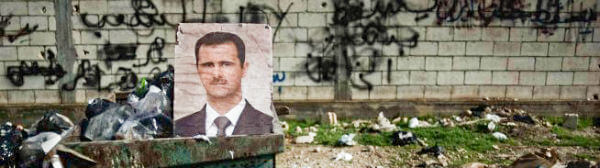
The Democratic Party’s silence on Syria

assad-dumped

Kim Ghattas writes: Syria cannot be made to fit a clear pattern of injustice, with an occupier and an occupied, like with Israel and the Palestinians, or an oppressed and an oppressor, like with South Africa’s apartheid. Any meaningful U.S. action in Syria would require more military force, a no-no for the left. And rather inconveniently, Assad belongs to the so-called axis of resistance against Israel that includes Hezbollah — and for which the American left has a tendency to voice support with little questioning, because it has the luxury of geographical distance from the consequences of life under its rule.

American political scientist and Israel critic Norman Finkelstein exemplified that attitude when he visited Lebanon in 2008 to show his support for Hezbollah, which he lauded for its courage and discipline in its 2006 war with Israel. A local interviewer pointed out that the widespread support Hezbollah enjoyed among Lebanese after it forced Israel to withdraw from southern Lebanon in 2000 had dissipated in the wake of the costly 2006 war that had wrecked much of the country’s infrastructure — a war which many Lebanese blamed on Hezbollah. “I am not telling you what to do with your lives, and if you’d rather live crawling on your feet, I could respect that,” Finkelstein replied, evoking Spanish Civil War heroine Dolores Ibárruri, who said “It is better to die on your feet than to live on your knees.”

When the interviewer pressed that support for Hezbollah should be a choice left to the Lebanese who have to live with the consequences of the group’s actions, Finkelstein’s answer was again that it was always better to resist and die with honor, adding dismissively that he doesn’t live in Lebanon, so the internal political divisions were irrelevant to him.

Such thinking is prevalent on the left when it comes to Syria, and its adherents are unwilling to vocalize any criticism of Assad’s use of force, lest it indicate support for removing him from power. Mouaz Moustafa, the executive director of the Syrian Emergency Task Force, which supports the opposition, told me Assad’s positions on the Palestinian cause means that “a large segment of the left has completely ignored Syria, and turned a blind eye to what is going on, or even subscribed to conspiracy theories” that the war was manufactured by the West to weaken Assad.

“They believe that U.S. power and military can never be used for good, and somehow they believe Russia provides a balance in the world, but they don’t realize that the Russians are much more brutal,” he said, a pertinent point as President Vladimir Putin’s influence or interference in this election cycle has become a point of debate.

Mustafa said he believed that Sanders’s silence reflected a lack of understanding of both Syria’s geopolitical complexities and the horror of a war where the overwhelming majority of civilian victims have been killed by government forces. “He should go to the Syrian border in Turkey. He should see for himself what is happening and then see if that shifts his position in the right direction,” Mustafa said. “This is our ‘never again’ moment. He needs to clarify his stance, not just keep repeating: We can’t depose dictators, we can’t use force, we can’t have no-fly zones.”

But if the left opposes military action, what about humanitarian action? Even if the United States does not impose a no-fly zone, it could still ramp up funding for overwhelmed and underfunded U.N. agencies and refugee organizations.

This is where [running mate Tim] Kaine’s views are closer to Clinton’s than even some of her own advisors, and those of President Barack Obama himself. As chairman of the Senate Foreign Relations subcommittee on the Middle East, he traveled to the region often, speaking passionately about the refugee crisis — including in March 2014, when he said that he refused to accept that “there’s nothing more we can do to end the suffering.” He spearheaded an effort to pass a Senate resolution to press the administration to beef up its humanitarian assistance.

There are two key components to Kaine’s thinking on Syria: First, he believes that the United States should push for a humanitarian zone to deliver aid. In November, he said the zone would be “principally a tool for delivering humanitarian aid pursuant to the U.N. Security Council resolution that even Russia voted for. I think, done correctly, it could also accelerate a path to a negotiated end to the Syrian Civil War.” In other words, this creates space to push back against Assad.

Secondly, Kaine believes the challenge of the Islamic State and the issue of Assad are connected, and Washington’s single-minded focus on the jihadi group means its Syria strategy is nonexistent or a mess. “These are two problems that are connected, and you can’t have a strategy that’s just about one,” he told NPR in October. [Continue reading…]

Facebooktwittermail