Category Archives: Analysis

Putin, Obama and the battle for Aleppo

By Layla Saleh, Qatar University

The battle for Aleppo has the Arab world, Middle East observers and Western policymakers on edge.

In what is likely a turning point in the long Syrian civil war, a coalition of opposition fighters is attempting to break Bashar al-Assad regime’s siege of the country’s commercial capital. Meanwhile, the Syrian government – with Russian support – is bombing rebel strongholds in the city which is still home to 250,000 people, according to the BBC.

Thanks to recent U.S. diplomatic overtures to deepen cooperation with Russia against the Islamic State, or IS, and al-Qaida affiliate Al-Nusra Front, the U.S. could be considered a partner in those airstrikes. The U.S. overtures have been criticized as strategically inconsistent and Putin-pleasing.

As a student of American policy in the Middle East, I’d argue that American efforts are key to the tumultuous trajectory of Syria’s uprising-turned-war. What’s less clear to me is how much U.S. President Barack Obama’s approach prioritizes either the immediate needs of Syrians suffering from war and terrorism or their aspirations for self-liberation from authoritarian rule.

Continue reading

Facebooktwittermail

Trump crowds are angry about the demise of America’s white Christian majority

Robert P. Jones writes: On the surface, the answer to why the campaign rallies of Donald Trump have been frequently marked by vitriolic and racist outbursts, harsh rhetoric and even violence is simple: the candidate has encouraged it. But the raw materials Trump has at his disposal have been mined and refined for nearly half a century. Trump is not the source but an igniting spark.

The apocalyptic rhetoric that regularly escapes the bounds of civil discourse at Trump events is fueled by the particular energies that are unleashed when a long-dominant group senses the looming end of its era. Certainly, the boarded up shop fronts of small towns that testify to the disappearance of reliable working class jobs are a critical part of this sense of loss and distress. But the watershed moment that many analysts have missed, and that Trump’s most ardent supporters feel in their bones, is this: During Barack Obama’s tenure as president, the United States has crossed the threshold from being a majority white Christian country (54 percent in 2008) to a minority white Christian country (45 percent in 2015). The passing of a coherent cultural world — where working class jobs made ends meet and white conservative Christian values held sway — has produced this powerful politics of white Christian resentment. [Continue reading…]

Facebooktwittermail

Don’t celebrate ISIS setbacks too soon

William McCants writes: There’s a broad consensus in the analytical community that the Islamic State’s legitimacy would be damaged if it lost its government — the only debate is over how much. A state without a state would be a laughingstock, the argument goes, which I agree with in the main. But if the group’s previous incarnation is any indication, the laughter will be a long time coming — perhaps as long as a generation.

The Islamic State suffered ridicule for its outsized ambitions early on. When the leader of al-Qaida in Iraq dissolved the organization and proclaimed the establishment of the Islamic State of Iraq in 2006, jihadis scoffed. How could a rebel group that controlled little territory possibly convince anyone that it was an actual state? The Islamic State’s rejoinder that it was a state because it was trying to behave like a state fell flat.

You might anticipate that the Islamic State’s credibility in jihadi circles would have suffered irreparably when the group was defeated as an insurgency in 2008. But strangely, its popularity soared. The group kept itself in the news by launching spectacular terrorist attacks in Iraq so its fans wouldn’t lose heart. It promised to “endure” against all odds. And as I document in my book, other al-Qaida affiliates took up its flag and its state-building ambitions, which kept hope alive. By the time the Islamic State got a second bite at the state-building apple with the civil war in Syria and the drawdown of American troops in Iraq, the Islamic State’s cause was wildly popular in jihadi circles and thousands left their homes to fight under its banner.

Faced with the loss of its so-called caliphate today, the Islamic State has not adopted the absurd know-nothing analysis of “Baghdad Bob” during the American invasion of Iraq. Rather, its spokesman has frankly acknowledged that the Islamic State may lose all its land. But he promises it will return. Given the group’s recent history, it’s not an empty promise. [Continue reading…]

Facebooktwittermail

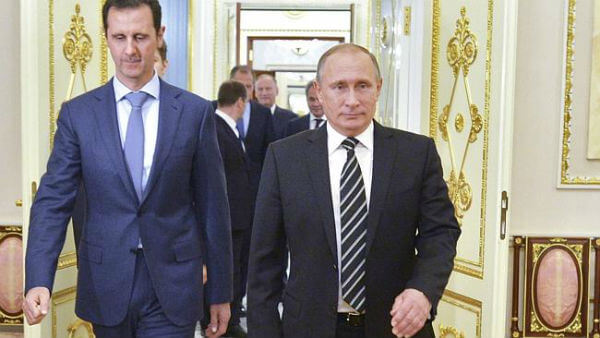
Pity Aleppo as Putin drops his bombs to salvage Russia’s pride

assad-putin

Natalie Nougayrède writes: A few days after Russia launched its military intervention in Syria in September 2015, Barack Obama said it would “get stuck in a quagmire and it won’t work”. Ten months on, that has yet to come to pass. As Russia helps its ally Bashar al-Assad try to retake Aleppo, the last strategic urban stronghold of the Syrian opposition, there aren’t many signs of the Kremlin’s war machine being either hamstrung or stuck. Indeed Russia seems to have registered more victories than setbacks in Syria. Hardly anyone remembers that, just last March, Vladimir Putin had announced he would begin withdrawing his forces. The withdrawal turned out to be as theoretical as Obama’s quagmire.

Most attempts to explain Putin’s military operation in Syria have focused on the following: 1) allergic to popular uprisings, he wants to prevent regime change in Damascus of the sort that happened in 2011 in Tunisia, Egypt and Libya; 2) he wants to secure Russia’s last foothold in the Arab world; 3) he wants to demonstrate Russia will do what it takes to defend an ally; 4) he wishes to divert attention from Ukraine as well as extract western concessions such as the easing of sanctions; 5) he is opportunistic and has capitalised on American unwillingness to get further involved in the Middle East; 6) he believes that by creating chaos, even if there is no clear endgame, Russia shows it can overturn western plans ; 7) it’s all about Russian domestic politics: nationalism and military assertiveness go hand in hand with Putin’s need to safeguard his own power structure.

There is probably truth to all of the above. But as Russia’s bombers hammer Aleppo’s besieged population in what could be the most decisive battle of Syria’s civil war, consider this as another piece to the puzzle of Putin’s mind: Syria is where Russia wants to erase the humiliation of the Soviet Union’s defeat in Afghanistan in the 1980s. [Continue reading…]

Facebooktwittermail

Radicalisation in Bosnia: Old wounds reopened by an emerging problem

By Louis Monroy Santander, University of Birmingham

Bosnia experienced a difficult reconstruction process after its 1992–1995 war. Now its ongoing political and economic crisis is making it harder to respond to a growing global problem – radicalisation.

According to recent reports, Bosnians have been travelling to Syria to fight for radical Islamist groups in increasing numbers since 2012. They now constitute one of the largest European foreign fighter contingents as a proportion of national population. Figures from 2015 suggest there are more than 300 Bosnians in Syria.

There have also been a number of low-level incidents of terrorist violence in Bosnia. In April 2015, for example, a 24-year-old man from an area near the town of Zvornik drove into a police station and opened fire. He killed one officer and injured two others before being shot dead.

This has prompted heated debates about how to handle the problem without feeding into the tensions that pervade in Bosnian politics. Of particular concern is the possibility that decisions about security will be coloured by ethno-politics.

Continue reading

Facebooktwittermail

Former ISIS members open up to German investigators

Der Spiegel reports: Prior to his field trip into the realm of the murderous IS band, Nils D. had been a good-for-nothing. He would sleep until mid-day, then surf the Internet and meet up with his buddies in a café, where they took drugs, drank booze and played cards. They didn’t have any hobbies and they lacked any enthusiasm. The company that had provided him with vocational training fired him because he wasn’t attending the vocational school courses that were part of the program. Afterward, the most he found were temporary jobs. “I was a pothead,” Nils D. says. “I didn’t feel like doing anything.”

This continued for years. Then D. discovered Islam through his cousin Philip B. and became a Salafist. He was still serving a sentence for grand theft when his cousin and the other guys went to Syria to fight. Then, during the autumn of 2013, D. also traveled to the “caliphate.”

During his trial in the dock of the Higher Regional Court in Düsseldorf, Nils D. said “he wanted to see things for himself.” He then quickly became part of the murderous system. In Manbij, he joined a special IS unit. The force’s task was to capture suspected traitors, spies or deserters. D. is believed to have taken part in up to 15 missions.

He also knew what happened to the men he had helped to capture. The former pothead from Dinslaken knew about the wooden crates they would be placed in. There were large ones in which they could stand, sandwiched. And there were small ones in which the prisoners could only crouch — sometimes for days at a time.

Nils D. sported a typical Islamist beard. Whenever he went out, it was always dressed in black and with his face covered. He attended five executions as a spectator. “I had goosebumps all over,” D. would later tell investigators with the State Office of Criminal Investigation in Düsseldorf. “But after a while it bounces off you.” [Continue reading…]

Facebooktwittermail

The Middle East needs help with its long game: education and jobs for the young

By Zahir Irani, Brunel University London

The future for many young people across the Middle East and North Africa looks bleak. The World Bank records that 54% of the working age population in the Middle East and North Africa is unemployed with little prospect of any positive immediate change. An average of 28.7% of 15 to 24-year-olds in the Middle East and 30.6% of those in North Africa are unemployed according to the International Labour Organisation.

Much of the world’s response to this chronic problem has been to intervene financially: in the form of aid or debt restructuring. But through supporting economic recovery by giving generations of young people new skills and new opportunities to improve themselves, the world can help Middle Eastern societies in a more sustainable and thoughtful way.

Reliance on public sector jobs

One of the biggest challenges the World Bank identifies in this broad region is that unemployment rates are the highest among the educated, with university graduates making up 30% of the region’s unemployed. They are slowly losing optimism and hope for a better life and future.

This is largely attributed to a reliance on the public sector to provide jobs that come with steady albeit low salaries but high degrees of job security. In many North African countries or those Middle Eastern ones with high populations, other than wait in line for a public sector job, there are few other alternatives. At one end of the spectrum there’s the misery of violence and refugee camps in Jordan, Syria, Iraq and Lebanon, and the other – even if you’ve excelled – a flat and static job market for the best and brightest. No wonder so many highly-skilled people are fleeing to Europe in search of stability and new opportunities.

Continue reading

Facebooktwittermail

The woman pushing women into Tunisia’s politics

Sharmilla Ganesan writes: When the Tunisian revolution of 2011 opened a path toward democracy, the activist Ikram Ben Said saw an opportunity to include women’s voices in the country’s emerging political landscape. At 30, Ben Said was already a vocal advocate for social causes. She was a senior program manager with a peacekeeping organization called Search for Common Ground, and volunteered with several nonprofits that worked with single mothers and abandoned children.

Shaped by these experiences, she founded the organization Aswat Nissa (“Voices of Women”), an effort to cut across Tunisia’s political party lines to unite women in seeking equal political and government participation. In Tunisia, men are still considered the legal head of a family, and until last November, a woman could not legally travel abroad with her minor-aged children without permission from her husband. It is in this context that Aswat Nissa is trying to get women both the opportunity and the confidence to take part in the political process. At the moment, roughly a third of Tunisia’s parliament is made up of women.

Aswat Nissa trains female candidates to stand for election and organizes widespread programs around the country to encourage women to vote, reaching beyond activists to ordinary citizens. In 2014, Aswat Nissa was awarded the Madeleine K. Albright Award for its efforts.

Ben Said is no longer president of Aswat Nissa, but she continues to be involved as a member and voluntary adviser. For the past year, she has been a Hubert H. Humphrey Fellow at the University of Minnesota’s Humphrey School of Public Affairs, focusing on public-policy analysis as well as women, peace, and security.

I recently spoke to her about her life, her work, and how women in her country are making their way into positions of leadership. [Continue reading…]

Facebooktwittermail

If Trump wins, what happens to U.S. relations with its traditional allies?

Politico reports: It was a strange day for Estonia when the tiny Baltic nation became the focus of intense debate in the U.S. presidential campaign.

At issue: Would the United States honor its NATO obligation to defend Estonia in the event of an attack by Russia? Donald Trump, who has repeatedly criticized small NATO members for “taking advantage” of the United States, hedged his answer. “Have they fulfilled their obligations to us?” he told the New York Times. “If they fulfill their obligations to us, the answer is yes.”

Hours later, Trump backer Newt Gingrich doubled down on the Republican candidate’s skepticism toward NATO duties, saying: “Estonia is in the suburbs of [the Russian city of] St. Petersburg … I’m not sure I would risk nuclear war over the suburbs of St. Petersburg.”

For Estonians, and all other NATO members in the region, that was a chilling message. “All of a sudden the issue closest to our skin — the defense of Estonia, of all things — becomes an issue in this campaign,” Jüri Luik, former Estonian ambassador to Russia, said. “It’s a totally unexpected development, and a gloomy situation for all of Eastern Europe.”

“NATO’s deterrent power depends in large part on the U.S. president’s position. If he is unsure … that weakens the deterrent immensely.”

Beyond regional security, the Estonian episode raised a bigger, more troubling question for Europeans watching the U.S. presidential campaign: If Trump wins, will he feel any obligation to uphold his country’s historical role as defender and guarantor of the West? [Continue reading…]

Facebooktwittermail

New Clinton ad insinuates Trump won’t put America first


The Washington Post reports: Insinuations, accusations and speculations have been a staple of Donald Trump’s presidential campaign. Now Hillary Clinton is using the Republican nominee’s own methods against him.

In a new online advertisement, her campaign makes a few factual statements about Trump’s Russian sympathies, stretches the truth in a couple of ways and then invites readers to draw their own conclusions.

It is exactly the technique that Trump has used repeatedly throughout the campaign to feed conspiracy theories, said Joseph Uscinski, a political scientist at the University of Miami who studies conspiracy theories. The advertisement, which is titled “What Is Donald Trump’s Connection to Vladimir Putin?” and appeared online Friday, insinuates that Trump has some kind of business or political alliance with Russia’s president, Uscinski said.

“We don’t know what’s going on here, and Donald won’t tell us,” the spot concludes. “We’ll let you guess.”

To be sure, a victory for Trump would augur a radical shift in U.S. foreign policy toward Russia. The United States would be much friendlier toward Putin and much more accommodating of his international agenda.

Trump has surrounded himself with people who are sympathetic to Putin. Paul Manafort, the chairman of Trump’s campaign, also advised former Ukranian president Viktor Yanukovych, who was aligned with Putin. Carter Page, one of Trump’s advisers on foreign affairs, has openly praised Putin and criticized Western sanctions on Russian officials.

Trump himself has praised Putin, as well, and has also called for the United States to retreat from its responsibilities in NATO — which would probably increase Putin’s influence in the region.

At this point, however, there is no evidence that anyone in the Trump campaign has a direct connection with the Kremlin, as Clinton’s spot insinuated. [Continue reading…]

Facebooktwittermail

Donald Trump is wrong. Rigging an election is almost impossible

Ari Berman writes: In a span of two weeks, federal courts have struck down Republican-backed voting restrictions in six states, including laws that required strict forms of government-issued ID in order to cast a ballot, cut back on early-voting days and made it harder to register. The rulings found that the laws — in Texas, North Carolina, Michigan, North Dakota, Kansas and Wisconsin — violated the Voting Rights Act by discriminating against people of color, sometimes “with almost surgical precision.”

Rather than seeing these rulings as a victory for democracy, Donald Trump says they will lead to a record number of fraudulent votes for Hillary Clinton in November. “The voter-ID situation has turned out to be a very unfair development,” Trump told The Washington Post. “We may have people vote 10 times. . . . Why not? If you don’t have voter ID, you can just keep voting and voting and voting.”

Just how easy would it be to rig a Presidential election, as Trump suggests Democrats are preparing to do? How many people would it require, what tactics would they have to use, and how many votes would they need to flip a major contest or state? [Continue reading…]

Facebooktwittermail

Why Vladimir Putin might want to interfere in the U.S. presidential elections

Fiona Hill writes: Whatever his personal preferences, … Putin cannot reasonably expect to influence the outcome of the US presidential election. The best he can hope for is to reduce the ability of whoever comes into the Oval Office to pursue policies that are detrimental to Putin’s and Russia’s interests.

Right now, Putin wants the US to remove sanctions imposed on Russia after its annexation of Crimea in March 2014. Perhaps even more importantly, Russia has parliamentary elections this September, and presidential elections again in 2018, when Putin is expected to run for a fourth term. The Kremlin does not want a repeat of the protests of 2011-’12, and certainly no pronouncements from the US about whether the elections are free and fair or whether Putin has a genuine popular mandate for his next presidency.

Against this backdrop, the information from the DNC files underscores for the Russian public, and the outside world, that US party politics is just as dirty as in Russia or anywhere else. The US looks a lot less credible as the moral authority on the conduct of elections.

Irrespective of whether Donald Trump or Hillary Clinton is elected, from Moscow’s perspective, at the end of this ruinous political campaign, the new US president will look as wounded as Putin did when he took office again in 2012. A US president who is elected amid controversy and recrimination, reviled by a large segment of the electorate, and mired in domestic crises will be hard-pressed to forge a coherent foreign policy and challenge Russia. [Continue reading…]

Facebooktwittermail

Can we trust Julian Assange and WikiLeaks?

Alex Gibney writes: I’ve had my own run-ins with Mr. Assange. During the making of my 2013 film, “We Steal Secrets: The Story of WikiLeaks,” I spent an agonizing six hours with him, when he was living in an English country house while out on bail. I was struck by how insistently he steered the conversation away from matters of principle to personal slights against him, and his plans for payback. He demanded personal “intel” on others I had interviewed, and dismissed questions about the organization by saying, “I am WikiLeaks” repeatedly. (Later, Mr. Assange and his followers attacked both me and my film.)

Even given that history, I believe that WikiLeaks was fully justified in publishing the D.N.C. emails, which provided proof that members of the D.N.C., in a hotly contested primary, discussed how to undermine the campaign of Bernie Sanders. They are clearly in the public interest.

As for Mr. Assange’s animus against Hillary Clinton — he has written that she “lacks judgment and will push the United States into endless, stupid wars which spread terrorism” — that is evidence of bias, but no more than that. After all, many news outlets are clearly, and sometimes proudly, biased.

We still don’t know who leaked the D.N.C. archive, but given Mr. Assange’s past association with Russia, it wouldn’t surprise me to learn that it was a Russian agent or an intermediary. Mr. Assange insists this is a mere distraction from the issue of D.N.C. interference, but the answer is also in the public interest. We should all be concerned (although hardly surprised) if it is that easy for the Russians to break into the D.N.C. and possibly United States government networks. [Continue reading…]

Facebooktwittermail

Visualizing the world’s shipping routes

world-shipping-routes

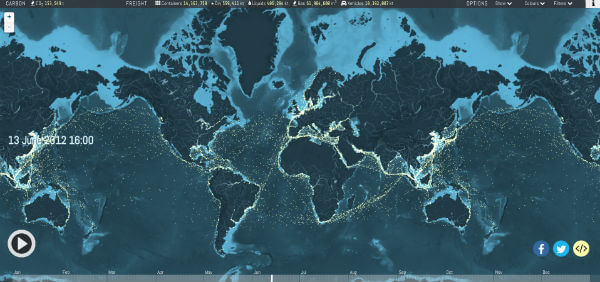
Click on the image above to view a data visualization of the world’s shipping routes created by Kiln studio and the UCL Energy Institute. Click the play button to follow a guided tour around the map. (Note: this data visualization web page uses a lot of memory — you might experience problems if you’re using an old computer and/or have a slow internet connection.)

What can I see?
You can see movements of the global merchant fleet over the course of 2012, overlaid on a bathymetric map. You can also see a few statistics such as a counter for emitted CO2 (in thousand tonnes) and maximum freight carried by represented vessels (varying units).

What can I do?
You can pan and zoom in the usual ways, and skip back and forward in time using the timeline at the bottom of the screen. The controls at the top right let you show and hide different map layers: port names, the background map, routes (a plot of all recorded vessel positions), and the animated ships view. There are also controls for filtering and colouring by vessel type.

What the are types of ships shown?
The merchant fleet is divided into five categories, each of which has a filter and a CO2 and freight counter for the hour shown on the clock. The ship types and units are as follows:

  • Container (e.g. manufactured goods): number of container slots equivalent to 20 feet (i.e. a 40-foot container takes two slots)
  • Dry bulk (e.g. coal, aggregates): combined weight of cargo, fuel, water, provisions, passengers and crew a vessel can carry, measured in thousand tonnes
  • Tanker (e.g. oil, chemicals): same as dry bulk
  • Gas bulk (e.g. liquified natural gas): capacity for gases, measured in cubic metres
  • Vehicles (e.g. cars): same as dry bulk

Why do ships sometimes appear to move across land?
In some cases this is because there are ships navigating via canals or rivers that aren’t visible on the map. Generally, though, this effect is an artefact of animating a ship between two recorded positions with missing data between, especially when the positions are separated by a narrow strip of land. We may develop the map to remove this effect in the future.

Why are there fewer ships visible in the first part of the year?
Unfortunately the data we are using for the map is incomplete for the first few months of the year: roughly January to April.

Facebooktwittermail

The mind of Donald Trump

trump-frown

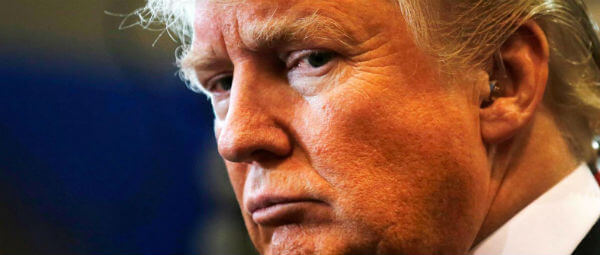
Dan McAdams writes: Donald Trump’s basic personality traits suggest a presidency that could be highly combustible. One possible yield is an energetic, activist president who has a less than cordial relationship with the truth. He could be a daring and ruthlessly aggressive decision maker who desperately desires to create the strongest, tallest, shiniest, and most awesome result — and who never thinks twice about the collateral damage he will leave behind. Tough. Bellicose. Threatening. Explosive.

In the presidential contest of 1824, Andrew Jackson won the most electoral votes, edging out John Quincy Adams, Henry Clay, and William Crawford. Because Jackson did not have a majority, however, the election was decided in the House of Representatives, where Adams prevailed. Adams subsequently chose Clay as his secretary of state. Jackson’s supporters were infuriated by what they described as a “corrupt bargain” between Adams and Clay. The Washington establishment had defied the will of the people, they believed. Jackson rode the wave of public resentment to victory four years later, marking a dramatic turning point in American politics. A beloved hero of western farmers and frontiersmen, Jackson was the first nonaristocrat to become president. He was the first president to invite everyday folk to the inaugural reception. To the horror of the political elite, throngs tracked mud through the White House and broke dishes and decorative objects. Washington insiders reviled Jackson. They saw him as intemperate, vulgar, and stupid. Opponents called him a jackass—the origin of the donkey symbol for the Democratic Party. In a conversation with Daniel Webster in 1824, Thomas Jefferson described Jackson as “one of the most unfit men I know of” to become president of the United States, “a dangerous man” who cannot speak in a civilized manner because he “choke[s] with rage,” a man whose “passions are terrible.” Jefferson feared that the slightest insult from a foreign leader could impel Jackson to declare war. Even Jackson’s friends and admiring colleagues feared his volcanic temper. Jackson fought at least 14 duels in his life, leaving him with bullet fragments lodged throughout his body. On the last day of his presidency, he admitted to only two regrets: that he was never able to shoot Henry Clay or hang John C. Calhoun.

The similarities between Andrew Jackson and Donald Trump do not end with their aggressive temperaments and their respective positions as Washington outsiders. The similarities extend to the dynamic created between these dominant social actors and their adoring audiences — or, to be fairer to Jackson, what Jackson’s political opponents consistently feared that dynamic to be. They named Jackson “King Mob” for what they perceived as his demagoguery. Jackson was an angry populist, they believed — a wild-haired mountain man who channeled the crude sensibilities of the masses. More than 100 years before social scientists would invent the concept of the authoritarian personality to explain the people who are drawn to autocratic leaders, Jackson’s detractors feared what a popular strongman might do when encouraged by an angry mob.

During and after World War II, psychologists conceived of the authoritarian personality as a pattern of attitudes and values revolving around adherence to society’s traditional norms, submission to authorities who personify or reinforce those norms, and antipathy — to the point of hatred and aggression — toward those who either challenge in-group norms or lie outside their orbit. Among white Americans, high scores on measures of authoritarianism today tend to be associated with prejudice against a wide range of “out-groups,” including homosexuals, African Americans, immigrants, and Muslims. Authoritarianism is also associated with suspiciousness of the humanities and the arts, and with cognitive rigidity, militaristic sentiments, and Christian fundamentalism.

When individuals with authoritarian proclivities fear that their way of life is being threatened, they may turn to strong leaders who promise to keep them safe — leaders like Donald Trump. In a national poll conducted recently by the political scientist Matthew MacWilliams, high levels of authoritarianism emerged as the single strongest predictor of expressing political support for Donald Trump. Trump’s promise to build a wall on the Mexican border to keep illegal immigrants out and his railing against Muslims and other outsiders have presumably fed that dynamic.

As the social psychologist Jesse Graham has noted, Trump appeals to an ancient fear of contagion, which analogizes out-groups to parasites, poisons, and other impurities. In this regard, it is perhaps no psychological accident that Trump displays a phobia of germs, and seems repulsed by bodily fluids, especially women’s. He famously remarked that Megyn Kelly of Fox News had “blood coming out of her wherever,” and he repeatedly characterized Hillary Clinton’s bathroom break during a Democratic debate as “disgusting.” Disgust is a primal response to impurity. On a daily basis, Trump seems to experience more disgust, or at least to say he does, than most people do.

The authoritarian mandate is to ensure the security, purity, and goodness of the in-group — to keep the good stuff in and the bad stuff out. In the 1820s, white settlers in Georgia and other frontier areas lived in constant fear of American Indian tribes. They resented the federal government for not keeping them safe from what they perceived to be a mortal threat and a corrupting contagion. Responding to these fears, President Jackson pushed hard for the passage of the Indian Removal Act, which eventually led to the forced relocation of 45,000 American Indians. At least 4,000 Cherokees died on the Trail of Tears, which ran from Georgia to the Oklahoma territory.

An American strand of authoritarianism may help explain why the thrice-married, foul-mouthed Donald Trump should prove to be so attractive to white Christian evangelicals. As Jerry Falwell Jr. told The New York Times in February, “All the social issues — traditional family values, abortion — are moot if isis blows up some of our cities or if the borders are not fortified.” Rank-and-file evangelicals “are trying to save the country,” Falwell said. Being “saved” has a special resonance among evangelicals — saved from sin and damnation, of course, but also saved from the threats and impurities of a corrupt and dangerous world.

When my research associates and I once asked politically conservative Christians scoring high on authoritarianism to imagine what their life (and their world) might have been like had they never found religious faith, many described utter chaos — families torn apart, rampant infidelity and hate, cities on fire, the inner rings of hell. By contrast, equally devout politically liberal Christians who scored low on authoritarianism described a barren world depleted of all resources, joyless and bleak, like the arid surface of the moon. For authoritarian Christians, a strong faith — like a strong leader — saves them from chaos and tamps down fears and conflicts. Donald Trump is a savior, even if he preens and swears, and waffles on the issue of abortion.

In December, on the campaign trail in Raleigh, North Carolina, Trump stoked fears in his audience by repeatedly saying that “something bad is happening” and “something really dangerous is going on.” He was asked by a 12-year-old girl from Virginia, “I’m scared — what are you going to do to protect this country?”

Trump responded: “You know what, darling? You’re not going to be scared anymore. They’re going to be scared.” [Continue reading…]

Facebooktwittermail

Why ‘launch under attack’ should not be a mainstay of U.S. nuclear policy

French nuclear test "Licorne",  French Polynesia, July, 1970

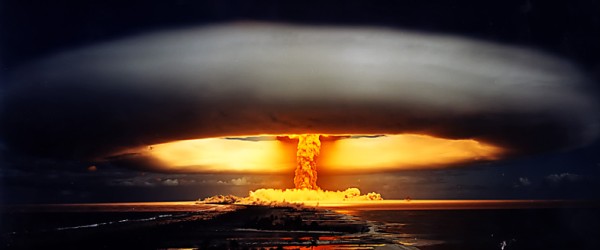
Jeffrey Lewis writes: Once a president gives the order to use nuclear weapons, there is no turning back. The system is designed to very quickly render the president’s will into death and destruction on the other side of the world. So maybe don’t elect the guy who melts down on Twitter every other day.

Trump’s temperament is pretty different from, say, that of Brzezinski, who tells the story about the 3 a.m. phone call as kind of a dark gag. I suppose Zbig got used to it. There was a series of false alarms in June 1980, usually described as having occurred because of the failure of a 46 cent computer chip. A few years later, the Center for Defense Information — the forerunner, in a roundabout way, to Global Zero — learned that between 1977 and 1984, there were 1,152 “moderately serious” false alarms. False alarms are so common that I actually suspect the system would fail to respond to a real Russian launch. I just can’t imagine Bushes, Clintons, or Barack Obama retaliating while there’s even a glimmer of doubt about an attack. My guess is that they would all decide to risk waiting to be sure an attack was underway, that it wasn’t a false alarm or cyberattack, instead of hastily opting for certain nuclear holocaust. Given what we know about human beings and confirmation bias, launch under attack is probably less dangerous than just pointless.

The problem, though, is what happens in a crisis. What happens when confirmation bias is pushing in the other direction? If we think Russia might launch such an attack, then it is easier to imagine a president making a hasty decision.

My advice to any future president would be to drop launch under attack as a mainstay of U.S. nuclear policy. Some systems might still be capable of launching quickly, but I would design the nuclear force around the assumption that the president plans to “ride out” a nuclear attack. This means having enough weapons at sea to do the job and relegating any land-based nuclear weapons to the role of warhead “sink,” drawing fire away from cities. The Obama administration has made some steps in this direction, instructing the military to plan for more realistic contingencies — but it has still elected to retain launch under attack as an option.

I am not much of a fan of launch under attack, and have said as much to policymakers in Washington, but I’ve long been resigned to no one listening to me. Defense experts have a fetish about giving the president options, and they are simply loath to abandon this one, no matter how unrealistic. It is U.S. policy now and for the foreseeable future. In fact, Washington has gone to great lengths to design its nuclear forces, as well as its command and control system, around the ability of the president to determine the fate of hundreds of millions of people in a matter of minutes. The upcoming deliberations about nuclear modernization, which will probably cost a trillion dollars over the next 30 years or so, will proceed on the same assumption. If we’re going to design the entire system in this way, to emphasize the speed and decisiveness of a single person, we should probably also pick that person carefully. [Continue reading…]

Facebooktwittermail

Trump’s core supporters don’t like the way he treated the Khans — but they’re still afraid of Muslims

Greg Sargent writes: Trump’s attacks on the Khan family appear to have gone too far even for his core supporters. American voters overall disapprove of his handling of the exchange with the Khans by 74-13, and Trump-leaning groups agree: Non-college whites disapprove by 67-14; non-college white men disapprove by 64-19; and white evangelicals disapprove by 63-20. (By the way, Republicans and GOP-leaners disapprove by 58-23, and conservatives disapprove by 62-18.)

The overwhelming public disapproval of Trump’s battle with the Khan family is encouraging to see. It’s looking increasingly like Trump, by engaging the Khans, helpfully reinforced many of the messages coming out of the Democratic convention about Trump’s demagogic scapegoating by religion and his overall hostility towards diversifying America. If the Dem convention brought a sledgehammer down on Trump’s worldview, he basically picked up that sledgehammer and continued to hit himself over the head with it — especially in the eyes of the college educated white voters who appear increasingly repulsed by Trumpism.

And yet, even after the battle over the Khans forced a national debate over Trump’s fearmongering about Muslims, his core voting groups are still sticking by the temporary ban on their entry into the United States — which, after all, is a core tenet of the story he’s telling about America. [Continue reading…]

Facebooktwittermail

Why are some conservative thinkers falling for Trump?

Peter Beinart writes: Logically, Donald Trump should have less support among intellectuals than he had a year ago. That’s because over the past year, he has made statements that expose him as both ignorant of public policy and contemptuous of liberal-democratic norms. He has proposed banning Muslims from entering the United States, incited violence against protesters at his rallies, responded to The Washington Post’s critical coverage by warning that its owner is “getting away with murder” on his taxes and “we can’t let him get away with it,” declared a federal judge biased because he’s Mexican American, and twice revealed his unfamiliarity with the term nuclear triad.

Instead, more than a year after Trump announced his presidential bid, his support among intellectuals has grown. Of course, many prominent conservatives — from George Will to William Kristol to David Brooks to Erick Erickson — oppose him militantly. But another cluster of writers and thinkers have declared themselves supportive of, or at least open to supporting, Trump. Among Trump’s critics, the predominant explanation for this openness is opportunism: Supporting the Republican nominee can have professional benefits. But a deeper dynamic is at work. It’s just hard to recognize, because American intellectuals haven’t felt the allure of authoritarian, illiberal politics this strongly in a long time.

In 1953, Czesław Miłosz published The Captive Mind, which described how a series of Polish intellectuals came to embrace Stalinism. Miłosz detailed the role that “coercion” and “personal ambition” played in their ideological transformation. But he stressed that he was concerned “with questions more significant than mere force” or material advancement. “To belong to the masses is the great longing of the ‘alienated’ intellectual,” Miłosz argued. “The gratifications of personal ambition … are merely the outward and visible signs of social usefulness, symbols of a recognition that strengthens the intellectual’s feeling of belonging.” [Continue reading…]

Facebooktwittermail