Category Archives: Analysis

Burning Country: Syrians in Revolution and War

On April 18, the Middle East Institute (MEI) hosted novelist Robin Yassin-Kassab and human rights activist Leila Al-Shami for a discussion about their recent book, Burning Country: Syrians in Revolution and War, which tells the stories of Syrian civilians organizing, resisting, and surviving inside Syria since the 2011 uprising.

Burning Country explores the reality of life in present-day Syria, examining new grassroots revolutionary organizations, the rise of ISIS and Islamism, and the emergence of the worst refugee crisis since World War II. In this vivid account of a modern-day political and humanitarian nightmare, Yassin-Kassab and Al-Shami give voice to a Syrian people who continue to struggle for justice.

(Note: During the recording of this discussion, Leila Al-Shami remained off camera at her request.)

Facebooktwittermail

The importance of bearing witness to Syria’s war

Caitlin L Chandler writes: The wound in the middle of the man’s arm is a large circle of ribbed red blood and tendon, the edges of the flesh curving up and out like petals. Metal prongs inserted into the skin on either side of the wound hold his arm in place; his chest rises and falls with each breath.

To observe surgery up close is at first disorienting and surreal, like watching a perfectly shot film in the cinema and then walking through the screen to realize there is no such thing – only machines and people creating the images that were streaming as reality before you. I do not normally see bodies in disrepair that are being painstakingly stitched back together; I feel like I’m trespassing on something sacred.

The Médecins sans Frontières (Doctors Without Borders) trauma hospital in Ramtha, Jordan, is located 3 miles (5km) from the Syrian border. From the roof of MSF’s house, where its international staff live, you can see the blue-green hills that demarcate the border, stretching between the two countries like a gentle wave. Once you could have strolled in those hills, or laid down in the grass and daydreamed.

At night on the roof the lights of nearby Irbid glitter, some of them marking the apartments where thousands of urban refugees dwell, waiting for the war to end, for resettlement or for the chance to try to make their way across the ocean to Europe. Everyone is waiting – to see whether the fragile cease-fire matters and whether the E.U. will continue to turn its back on the men, women and children drowning in its seas. In Ramtha, they are waiting for a medical outcome.

As a humanitarian affairs officer with MSF, part of my job is to understand and construct here in Jordan how MSF practices temoignage – the act of witnessing. Since MSF’s inception, witnessing has been intertwined with the organization’s medical activities, which often occur in contexts where MSF is one of the only organizations to see at first hand the effects of conflict and disaster. It is what always set MSF apart for me from other organizations; although I know witnessing can be an imperfect offering, it at least implies responsibility.

To witness the effects of war is to witness what you cannot change; it is to observe mutilated bodies and sense the dislocation that comes with forced exile. It is to reflect on what meaning you can make in life when you are here, alive, and so many others are dead. For years I did not want to do an MSF mission because I thought it was not the real world, that it would change me in ways I did not want, but now I know that was fear. On the other side of fear is the world; it is still there, whether you choose to look at it or not. [Continue reading…]

Facebooktwittermail

William deBuys: No more wide open spaces?

One summer 43 years ago, I headed west with a photographer friend, interviewing Americans at minor league baseball parks, fairgrounds, tourist spots, campgrounds, wherever the moment and our Volkswagen van took us.  Grandiosely enough, our goal was “to tap the mood of the nation,” which led to my first book, Beyond Our Control: America in the Mid Seventies.  Looking back, I now realize that, in 1973, three decades ahead of schedule, we met the precursors to the Tea Party movement, angry and unnerved white Americans of a certain age, camped out in their RVs and distinctly dyspeptic about where this country was going.  This was a crowd, as I wrote at the time, that when it came to the lifestyles they had known and enjoyed could already “feel the tremors under their feet” and I predicted that one of these days they would be the ones to suffer.  “You can bet,” I observed, that “America’s corporate pushers won’t be going through the same sort of withdrawal pains as their victims.”  And I added, “What makes it so frightening is this: When these people find themselves desperate, they may panic and grab for the first help in sight, and I’m afraid to think what that will be.”  All these decades later, we may finally have a better idea of what that, in fact, is.

As it happened, for this born and bred New York City boy for whom Central Park was the wilderness, there was another unforgettable aspect of that journey from coast to coast.  I saw up close and personal something of the West, of lands that seemed to stretch out toward eternity, that could take your breath away, and that, as TomDispatch regular William deBuys points out today, still — though for how long we don’t know — belong to all of us.  Of our visit to Yellowstone Park (where the warnings about grizzlies in the campgrounds touched off the panic button in this urbanite), I wrote:

“Early this afternoon, we rested by a lake and watched a Swainson’s hawk hover and hunt, all its energy focused on a few yards of field. Suddenly, it plummeted out of sight, rose with a field mouse in its claws and was gone.  Yellowstone’s been like that, just the opposite of our expectations.  Gigantic, wild-looking, beautiful. The roads don’t even dent it, at least in the eastern part where we’ve come in. Strangest of all, it’s not crawling with people.  We didn’t see anybody until we pulled into the parking lot of the Hamilton General Store.”

And here’s a small miracle: in this era of privatization — even the military now goes into its war zones with a set of corporate warriors in tow — those awesome American lands are still ours, still public.  My children can still spend time in them and appreciate a world they would otherwise have no access to.  But my grandson when he grows up?  Who knows?  As deBuys makes clear today, behind the latest wing-nuts of the American West lie corporate interests that, in this age of growing inequality, might someday take part in one of the great land grabs of modern times.  Fortunately, there are still writers like deBuys to remind us of just what’s at stake. Tom Engelhardt

Privatizing America’s public land
How the raid on Malheur screened a future raid on real estate
By William deBuys

It goes without saying that in a democracy everyone is entitled to his or her own opinions. The trouble starts when people think they are also entitled to their own facts.

Away out West, on the hundreds of millions of acres of public lands that most Americans take for granted (if they are aware of them at all), the trouble is deep, widespread, and won’t soon go away. Last winter’s armed take-over and 41-day occupation of Malheur National Wildlife Refuge in southeastern Oregon is a case in point. It was carried out by people who, if they hadn’t been white and dressed as cowboys, might have been called “terrorists” and treated as such. Their interpretation of the history of western lands and of the judicial basis for federal land ownership — or at least that of their leaders, since they weren’t exactly a band of intellectuals — was only loosely linked to reality.

Continue reading

Facebooktwittermail

Donald Trump’s war on the media threatens fundamental American principles

Peter Beinart writes: On Saturday, Donald Trump ally and confidante Roger Stone declared that CNN “is not a news organization but an advocacy group” and that “when Donald Trump is president, he should turn off their FCC license.” (Full disclosure: I’m a CNN contributor.)

In any other election year, that would be news. But this cycle, Trump and his campaign have threatened the press in so many unprecedented ways that they’ve overloaded the system. The press itself can’t keep up. The day before Stone’s comments, Trump implied that he’d retaliate against The Washington Post’s critical coverage of him by going after its owner, Amazon CEO Jeff Bezos, who has been “getting away with murder, tax-wise” and has a “huge antitrust problem.” In March, Trump campaign manager Corey Lewandowski was arrested on misdemeanor battery charges for grabbing Breitbart reporter Michelle Fields at a campaign rally. (The charges were later dropped.) In February, Trump declared, “If I win … I’m going to open up our libel laws so when they [journalists] write purposely negative and horrible and false articles, we can sue them and win lots of money.” In January, the Trump campaign barred New York Times reporters from covering campaign events after the Times published an unflattering story about his ground operation. (At various times, Team Trump has also barred reporters from National Review, The Des Moines Register, Univision, BuzzFeed, The Daily Beast, Fusion, The Huffington Post, Mother Jones, and Politico, sometimes in explicit retaliation for negative coverage.)

There’s more. Trump has publicly called the journalists who cover him “scum” on at least two occasions. Last July, when The Daily Beast ran a piece about sexual-assault accusations by Trump’s ex-wife, Michael Cohen — executive vice-president at the Trump Organization — told the reporters who wrote it that “what I’m going to do to you is going to be fucking disgusting … I’m going to mess your life up.” As Vice’s Olivia Becker has noted, “Trump is the only presidential candidate whose rallies feature a specific area in the back where journalists are corralled and not permitted to leave. Other candidates have areas designated for the media, but reporters are free to mingle in the crowd to interview people. Leaving the press pen at a Trump rally [by contrast] comes with its own risk.” In February, when a Time magazine journalist tried to leave the pen to photograph protesters being ejected, a secret-service agent grabbed him by the neck and slammed him to the ground. [Continue reading…]

Facebooktwittermail

Hell on Earth: Life under ISIS in Libya

The Daily Beast reports: Amjad bin Sasi was a young man who enjoyed Western clothing, a fashionable haircut, and even the odd drink.

When ISIS seized control of his hometown of Sirte on Libya’s Mediterranean coast last year, bin Sasi was one of tens of thousands consigned to living in hell on Earth. His torment lasted less than a year—he was shot in the back of the head by an ISIS executioner at the age of 23.

The crime for which he was arrested? Cursing.

This is the reality of life under the control of the self-proclaimed Islamic State in Libya, according to a report by Human Rights Watch, which includes allegations of crimes against humanity, war crimes, mutilation, beatings, and extra-judicial killings.

The U.S. military has drawn up plans for an assault on the ISIS stronghold, but President Obama has refused to sanction any military intervention.

The residents of Sirte live in constant fear of being caught breaking the strict codes of conduct imposed by their ISIS rulers. Every neighbor could be an informant for the Hisba morality police, and harsh penalties are routinely handed down by religious judges after unfair trials.

“Life is hell for people in Sirte,” Letta Tayler, the author of the HRW report, told The Daily Beast. “People told me they are living in constant fear. Many of the men and women I interviewed in Misrata [a nearby city] started crying when they spoke about having to go back because they had no place to go. People were living in absolute terror.”

One of the extraordinary things about life in this ISIS outpost is that even those who bow their heads and follow the hardline rules are forced to live in misery. [Continue reading…]

Facebooktwittermail

Iraq’s Shi’ite rivalries risk turning violent, weakening war on ISIS

Reuters reports: A power struggle within Iraq’s Shi’ite Muslim majority has intensified as attempts to form a new government flounder, threatening to turn violent and ruin U.S.-led efforts to defeat Islamic State.

For the first time since the U.S. withdrawal at the end of 2011, Shi’ite factions came close to taking arms against each another last month, when followers of powerful cleric Moqtada al-Sadr stormed the parliament in Baghdad’s Green Zone.

Rival Shi’ite militiamen took up positions nearby, raising the specter of intra-Shi’ite fighting similar to events in the southern city of Basra in 2008, in which hundreds of people were killed.

Trucks carrying those militiamen, armed with rocket-propelled grenades and machine guns, patrolled the capital in clear view of the security forces, video published on the website of Iranian-backed group Saraya al-Khorasani showed.

The crisis presents the biggest political challenge yet to Prime Minister Haider al-Abadi, a moderate Shi’ite Islamist who took office in 2014 promising to defeat Islamic State, mend rifts with the minority Sunnis and Kurds, and root out corruption eating away at state income which has already been eroded by a slump in oil prices.

Sadr, the heir of a revered clerical dynasty, says he backs Abadi’s planned political reforms and has accused other Shi’ite leaders of seeking to preserve a system of political patronage that makes the public administration rife for corruption.

His followers stormed the heavily fortified Green Zone on April 30 after rival political groups blocked parliamentary approval of a new cabinet made up of independent technocrats proposed by Abadi to fight graft.

A commander in Saraya al-Khorasani, which deployed near the Green Zone in response, made it clear that they would fight rather than allow Sadr’s followers to occupy the district which houses parliament, government offices and embassies.

“We are here to kill this sedition in its cradle,” the commander, dressed in green camouflage and a black turban told his fighters, the online video shows. [Continue reading…]

Facebooktwittermail

Fallujah could be the next big battle of the ISIS war

The Daily Beast reports: The Iraqi government is putting the ISIS-controlled city of Fallujah as next on its target list.

That’s not because of increasingly dire reports that the citizens of Fallujah are suffering from starvation and torture under ISIS’s cruel grip. Nor do Iraqi officials see the city as key to dislodging ISIS from its Iraqi stronghold, Mosul.

Rather, Iraqi officials have told their American counterparts that they suspect the restive Sunni-dominated city is sending jihadists to attack Baghdad, the Shiite-dominated capital. In the last week, there have been multiple daily bombings in Baghdad that have killed more than 200 people and wounded hundreds more. On Tuesday alone, a combination of suicide attacks and car bombings took the lives of nearly 70 people; ISIS claimed responsibility for some of those bombings.

In other words: While all eyes were on Baghdad and the deadliest spate of bombings to strike the capital in years, the Iraqi government was quietly pointing its finger at Fallujah.

Such accusations toward Fallujah, arguably, is precisely what ISIS wanted its bombings to incite, a return to the kind of sectarianism that has, in the past, threatened to tear the state apart — and was supposed to dissipate under Prime Minister Haider al Abadi. [Continue reading…]

Facebooktwittermail

Afghanistan paid 11,000 militants to lay down their arms. Now the money has run out

The Washington Post reports: Faridoon Hanafi says he probably killed American soldiers as a Taliban commander in eastern Afghanistan from 2009 through 2014. And he’s certainly killed some Afghan troops.

But since then, Hanafi has joined a rare demographic here: reformed, de-radicalized Islamist militants.

After he handed over his assault rifles and grenade launchers to intelligence agents, Hanafi settled into a safe house and started collecting $200 a month. In return for those payments, funded with foreign aid, Hanafi worked with local officials in Nangahar province to try to lure other militants away from the fight.

Now, the money is drying up, and a central goal of the U.S.-led effort to rebuild Afghanistan — that Islamist militants can be rehabilitated or paid to reintegrate into the law-abiding public — is at a crossroads as the war drags into its 15th year.

“If the government stops paying, these people will find another way to get money, and negotiations will fail,” Hanafi said in an interview. [Continue reading…]

Facebooktwittermail

The U.S. and Russia are fighting about missile defense when they should be settling differences

Fred Kaplan writes: The Standard Missile 3, or SM-3 as it’s called, is purely defensive; it works not by blowing up a missile in midair but by slamming into it with great force; in other words, it couldn’t be turned into an offensive weapon, even if some future Western leader wanted it to be.

But from Russia’s point of view, that’s not the issue. As one military adage has it, the only purely defensive weapon is a foxhole, and a battery of antimissile missiles doesn’t change this fact. In the odd world of nuclear strategy, a nation deters an attack by posing a credible threat of “retaliation in kind.” Side A attacks Side B; Side B strikes back against Side A; therefore, Side A doesn’t attack in the first place. But imagine that Side A has an effective missile-defense system. Side A attacks Side B; Side B strikes back, but most of its missiles get shot down before reaching their targets; therefore, Side B is unable to “retaliate in kind.” Both sides do the calculation and understand the strategic imbalance, and therefore (so goes the theory), Side A dominates Side B — intimidates it into doing certain things in A’s favor — without having to go to war.

This is why Russian officials see missile defense systems as a threat. It’s a concept they learned from the Americans. In the 1950s and early ’60s, many American nuclear strategists, notably Herman Kahn, author of the best-seller On Thermonuclear War, advocated anti-ballistic-missile systems as an explicit adjunct to an offensive first-strike strategy: The U.S. launches a nuclear attack on the USSR; the USSR strikes back with the few nuclear missiles that survived the first strike; the U.S. shoots them down with its antimissile missiles. Or, more to the point, the U.S. has the capability to do these things — which puts the U.S. in a dominant position in international confrontations.

In the mid-1960s, when Secretary of Defense Robert McNamara proposed a treaty banning anti-ballistic missiles in the United States and Soviet Union, some Russian officials were puzzled: Why ban defensive weapons, they asked? McNamara schooled them on nuclear strategy; he essentially wanted to avoid the destabilizing situation that Herman Kahn wanted to foster and exploit. The Russians learned the lesson. [Continue reading…]

Facebooktwittermail

Cavorting with extremism: UK cracks down at home, befriends extremists abroad

By Brian Whitaker, May 18, 2016

Today Queen Elizabeth will deliver her annual speech to the British parliament setting out the government’s programme for the next 12 months. High on the list of proposals is a renewed effort to combat “extremism”, and one idea is to establish a register of “extremists” – similar to the register of sex offenders – intended “to stop radicals infiltrating schools, colleges, charities and care homes, where they could brainwash vulnerable young people or disabled adults into violence”.

The problem with this, as with the rest of the government’s “counter-extremism” policy, is how to define “extremism”. In a recent article for The Independent, Liberal Democrat MP Alistair Carmichael explained:

“The [government’s] current definition of extremism as ‘the vocal or active opposition to our fundamental values, including democracy, the rule of law, individual liberty and the mutual respect and tolerance of different faiths and beliefs’ is drafted so widely that it will not only catch terrorist sympathisers but perhaps even those who oppose the government, believe the monarchy should be abolished or disagree with same-sex marriage.”

But the problem goes deeper than that. Last Sunday a spectacular event featuring TV celebrities and 900 horses was held at Windsor Castle to mark the Queen’s 90th birthday. The royal family were in attendance and, seated at the Queen’s right-hand side was a man who by any reasonable interpretation of the government’s definition would be considered an extremist: the king of Bahrain.

Continue reading

Facebooktwittermail

‘Brexit’ vote worries European immigrants living in Britain

The New York Times reports: For years, Britain’s relatively vibrant economy has attracted a steady flow of young people fleeing a lack of opportunity in their home countries on the Continent. London in particular is full of young Europeans, who have helped give the city its dynamic, global feel. From entrepreneurs, bankers and fashion designers to artists, waiters and students, all are free to resettle in Britain and make their futures here without so much as a visa.

No one knows for sure what would happen to them if Britain voted to leave the European Union — their immigration status would have to be worked out in the negotiations that would follow — but the debate itself has left some of the young people feeling fearful, frustrated and even angry.

“Maybe I’m too much of a drama queen, but I feel that it’s such a bold statement against immigrants and Europeans,” said Alejandro Macías, 31, a Spaniard who lived in Germany before moving to Britain to work in an audience research company.

If Britain votes out, three-quarters of citizens from other European Union countries who are working in the country would not meet current visa requirements for overseas workers, according to a report by the Migration Observatory at Oxford University. The impact would be greatest for workers in agriculture and the hospitality industry, it said.

There are concerns that London in particular would suffer if the flow of skilled immigrants fell. About a million European Union citizens from other countries work in London, a city of more than 8.5 million people. [Continue reading…]

Facebooktwittermail

April breaks global temperature record, marking seven months of new highs

shadow15

The Guardian reports: Last month was the hottest April on record globally – and the seventh month in a row to have broken global temperature records.

The latest figures smashed the previous record for April by the largest margin ever recorded.

It makes three months in a row that the monthly record has been broken by the largest margin ever, and seven months in a row that are at least 1C above the 1951-80 mean for that month. When the string of record-smashing months started in February, scientists began talking about a “climate emergency”.

Figures released by Nasa over the weekend show the global temperature of land and sea was 1.11C warmer in April than the average temperature for April during the period 1951-1980.

It all but assures that 2016 will be the hottest year on record, and probably by the largest margin ever. [Continue reading…]

Facebooktwittermail

The map ISIS hates

sykes-picot

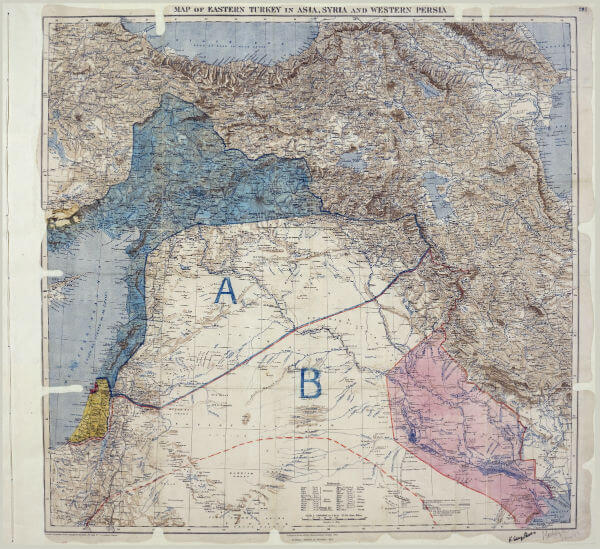
In 2014, Malise Ruthven wrote: When the jihadists of ISIS (the Islamic State of Iraq and Syria) tweeted pictures of a bulldozer crashing through the earthen barrier that forms part of the frontier between Syria and Iraq, they announced — triumphantly — that they were destroying the “Sykes-Picot” border. The reference to a 1916 Franco-British agreement about the Middle East may seem puzzling, coming from a radical group fighting a brutal ethnic and religious insurgency against Bashar al-Assad’s Syria and Nouri al-Maliki’s Iraq. But jihadist groups have long drawn on a fertile historical imagination, and old grievances about the West in particular.

This symbolic action by ISIS fighters against a century-old imperial carve-up shows the extent to which one of the most radical groups fighting in the Middle East today is nurtured by the myth of precolonial innocence, when the Ottoman Empire and Sunni Islam ruled over an unbroken realm from North Africa to the Persian Gulf and the Shias knew their place. (Indeed, the Arabic name of ISIS — al-Dawla al-Islamiya fil-Iraq wa al-Sham — refers to a historic idea of the greater Levant (al-Sham) that transcends the region’s modern, Western-imposed state borders.)

But why is Sykes-Picot so important? One reason is that it stands near the beginning of what many Arabs view as a sequence of Western betrayals spanning from the dismantling of the Ottoman Empire in World War I to the establishment of Israel in 1948 and the 2003 invasion of Iraq. The Sykes-Picot agreement — named after the British and French diplomats who signed it — was entered in secret, with Russia’s assent, in May 1916 to divide the Arab provinces of the Ottoman Empire into British and French “spheres of influence.” It designated each power’s areas of future control in the event of victory by the Triple Entente over Germany, Austria, and their Ottoman ally. Under the agreement Britain was allocated the coastal strip between the Mediterranean and the river Jordan, Transjordan and southern Iraq, with enclaves including the ports of Haifa and Acre, while France was allocated south-eastern Turkey, northern Iraq, all of Syria and Lebanon. Russia was to get Istanbul, the Dardanelles, and the Ottoman Empire’s Armenian districts.

Under the 1920 San Remo agreement, which built on Sykes-Picot, the Western powers were free to decide on state boundaries within these areas. The international frontiers — with Iraq’s framed by the merging of the three Ottoman vilayets of Mosul, Baghdad, and Basra — were consolidated by the separate mandates granted by the League of Nations to France in Lebanon and Syria, and to Britain in Palestine, Transjordan, and Iraq. The frontier between French-controlled Syria and British-controlled Iraq included the desert of Anbar province that was bulldozed by ISIS this month.

Kept hidden for more than a year, the Anglo-French pact caused a furor when it was first revealed by the Bolsheviks after the 1917 Russian Revolution — with the Syrian Congress, convened in July 1919, demanding “the full freedom and independence that had been promised to us.” Not only did the agreement map out — unbeknownst to the Arab leaders of the time — a new system of Western control of local populations. It also directly contradicted the promise that Britain’s man in Cairo, Sir Henry McMahon, had made to the ruler of Mecca, the Sharif Hussein, that he would have an Arab kingdom in the event of Ottoman defeat. In fact, that promise itself, which had been conveyed in McMahon’s correspondence with the Sharif between July 1915 and January 1916, left ambiguous the borders of the future Arab state, and was later used to deny Arab control of Palestine. McMahon had excluded from the proposed Arab kingdom “portions of Syria lying to the west of the districts of Damascus, Homs, Hama and Aleppo [that] cannot be said to be purely Arab.” This clause led to lengthy and bitter debates as to whether Palestine — which Britain meanwhile promised as a homeland for Jews under the terms of the November 1917 Balfour Declaration — could be defined as lying “west” of the vilayet, or district, of Damascus. [Continue reading…]

Facebooktwittermail

Donald Trump is about to start getting intelligence briefings — ‘it could be a disaster’

NPR reports: Harry Truman had been vice president for only 82 days when Franklin Roosevelt died, so there was quite a lot he needed to learn when he became president in 1945.

“He didn’t even know the atomic bomb existed,” historian David Priess said. “He didn’t know about the Manhattan Project.”

Priess, a former CIA officer and author of The President’s Book of Secrets, a history of the president’s daily brief, said that experience made Truman resolve that no future president should come into office unprepared.

So in 1952, as the world grew accustomed to nuclear peril and other threats in the unfolding Cold War, Truman offered classified briefings about the global security situation to each of the major-party nominees running to replace him. That tradition has held up ever since.

Traditionally, the White House waits until Republicans and Democrats have formally nominated their candidates at their party conventions, Priess said, but not always. Georgia Gov. Jimmy Carter had no experience with foreign intelligence, so he asked President Gerald Ford for his briefings before he was nominated — and got them.

“Ultimately, it’s the president’s call,” Priess said, about who is briefed and when.

Although presidents typically try to accommodate candidates, even ones in the opposite party, they do not share everything. So, as the White House prepares to arrange briefings by the intelligence community, officials will likely hold back sensitive details about covert operations, secret nuclear and other defense programs, and other such details.

In fact, intelligence briefers this year may need to be more careful than ever, said former CIA analyst Aki Peritz. The de facto Republican nominee, Donald Trump, is “a man famously with no filter,” Peritz said of Trump, who has built his campaign upon what he calls straight talk.

“He’s never held public office before,” Peritz said. “He’s a business developer and a reality TV star. So if the United States starts giving Donald Trump classified briefings” with certain kinds of sensitive information, “it could be a disaster.” [Continue reading…]

Facebooktwittermail

For Twitter, ties to CIA create worse ‘optics’ than links to Russian government

L Gordon Crovitz writes: Silicon Valley’s hostility to U.S. intelligence and law enforcement reached a new low last week when Twitter rejected the Central Intelligence Agency as a customer for data based on its tweets — while continuing to serve an entity controlled by Vladimir Putin.

The Wall Street Journal broke the news that Twitter decided U.S. intelligence services could no longer buy services from Dataminr, which has a unique relationship with Twitter. Dataminr is the only company Twitter allows to have access to its full stream of hundreds of millions of daily tweets and sell the resulting intelligence to customers. Dataminr applies “big data” algorithms to identify unusual developments in real time. Customers who can profit from knowing about events instantly, such as hedge funds and news publishers, pay a hefty price for the alerts.

For the past two years, Dataminr provided its service to the CIA under a pilot program. The CIA and Dataminr then negotiated a contract to continue the service, but sources say Twitter CEO Jack Dorsey vetoed the contract at the last minute because he objects to the “optics” of continuing to help intelligence agencies. It’s unclear what happens to a small agreement Dataminr previously made with the Department of Homeland Security. With the new policy dictated by Twitter, Dataminr should drop the claim on its website that it includes “clients in the public sector, providing information first when there are lives at stake.”

Among the customers still getting the Dataminr alerts is RT, the broadcaster created and funded by the Russian government. Vladimir Putin has said that the government runs RT to “try to break the Anglo-Saxon monopoly on the global information streams.” RT disclosed it is a Dataminr customer in its news account of Twitter barring the CIA. Agents of Russia’s Federal Security Service, formerly known as the KGB, have full access via RT to the alerts now being denied to the CIA. [Continue reading…]

Facebooktwittermail

Why Putin tolerates corruption

Ivan Krastev writes: Russian elites have the right to be corrupt, but only if they have proved their loyalty. Paradoxically, the West’s sanctions against business figures closest to the Russian president helped whitewash some of the most notoriously corrupt Russian oligarchs and allow Russian propaganda to present them as selfless defenders of the motherland.

Ultimately, the most important reason for Mr. Putin’s reluctance to declare a war on corruption is that any anti-corruption campaign will inspire the public to demand change. It plays not only on the public’s anger, but also on its aspirations. And it is precisely this demand for change that the Kremlin fears most. Unlike in China, leaders in Russia avoid promising that life will be better tomorrow; what they promise is that things will not get worse. And unlike in China, they can afford to do so because the Russian economy is driven not by the entrepreneurial energy of the masses, but by natural resources.

This is why the Russian government is ready to acknowledge corruption’s ubiquity — the slickest propaganda couldn’t convince people otherwise. But the government also advances the idea that corruption is a way of life and is thus a natural phenomenon. In a way, corruption is like vodka: You know it hurts, but Russia is unimaginable without it. [Continue reading…]

Facebooktwittermail

In fight against Western decadence, Iranian prosecutor attacks ‘actions that run counter to the values of the establishment’

The New York Times reports: Iran’s judiciary unleashed one of its periodic crackdowns on social media permissiveness on Sunday, announcing the arrest of eight people involved in online modeling without a mandatory head scarf and questioning another woman, a former model, live on state television on Sunday.

A blogger, Mehdi Abutorabi, 53, who managed a publishing tool called Persian Blog, was also detained, the semiofficial student news agency ISNA reported Monday.

The former model, Elham Arab, 26, had been something of an Instagram star, posting pictures of herself in bridal gowns with eye-catching, dyed-blond hair. But on Sunday, months after her Instagram account had been shut down, she wore a pious black scarf and matching gloves as she was questioned by two prosecutors during a live television program.

In sharp contrast to the happy and glamorous images of herself posted online, Ms. Arab spoke of her “bitter experiences” in Iran’s technically illegal modeling industry and warned young women to think twice before posting pictures of themselves online. “You can be certain that no man would want to marry a model whose fame has come by losing her honor,” she said.

The head scarf issue often features prominently in the constant tug of war between powerful hard-liners and Iran’s increasingly urbanized and worldly society. Iran’s laws require that all women, even visiting foreigners, cover their hair out of a traditional respect for culture and morality. Many hard-liners view the obligatory veil as a last-ditch defense against what they say is an onslaught of Western cultural decadence.

But the main culprit was not Ms. Arab, Tehran’s public prosecutor, Abbas Jafar-Dolatabadi, concluded on the television program. No, the main offender was “the enemy,” Iran’s household label for the West and its unwanted influences.

“The enemy is investing in order to create a generation without any willpower,” the prosecutor said of social media. “We must refrain from any actions that run counter to the values of the establishment.” [Continue reading…]

IranWire reports: In March, Iran’s online authorities shut down the Instagram pages of several well-known models, as well as those of hair salons and photography workshops. In their place, online visitors found a large blue frame with the caption “These pages are blocked by the authority of Operation Spider 2 to open security cases by order of the judiciary.” They did not provide any details about the operation, which became known as “the spider attacks.”

Now, Dolatabadi has explained what the so-called “spider attacks” were all about. “In the past two years, a lot of good things have been done in the fight against hair salons and fashion workshops related to modeling,” he said. “In operations Spider 1 and Spider 2, around 50 hair salons, 50 fashion workshops, and 50 photography workshops were prosecuted. Individuals were arrested and pages were shut down by the supervisor of the Prosecution Office for Media Crimes.”

At the same time, the website Gerdab, which promotes news about Revolutionary Guards’ online activities, reported on what it called the successes of Operation Spider 2 over the past two years.

Gerdab’s report accused the “secret supporters and operators of Instagram” of attempting to subvert the “Islamic Iranian lifestyle.” It championed what it called an important achievement in combating “modeling and vulgarity.”

“The first phase resulted in the creation of an accurate database of more than 300 Instagram pages,” the report said, quoting the Organized Cyberspace Crimes Unit of the Revolutionary Guards. “The database is an intelligent collection of specifics about these pages such as postings, followers, those who are followed, the ‘likes,’ the comment writers, addresses of [account users on sites] such as Facebook, Line, and Telegram, and emails, phone numbers, addresses and bank account numbers.” [Continue reading…]

Facebooktwittermail