Reuters reports: Four years ago, Saadu Sharapudinov was a wanted man in Russia. A member of an outlawed Islamist group, he was hiding in the forests of the North Caucasus, dodging patrols by paramilitary police and plotting a holy war against Moscow.
Then his fortunes took a dramatic turn. Sharapudinov, 38, told Reuters that in December 2012 Russian intelligence officers presented him with an unexpected offer. If he agreed to leave Russia, the authorities would not arrest him. In fact, they would facilitate his departure.
“I was in hiding, I was part of an illegal armed group, I was armed,” said Sharapudinov during an interview in a country outside Russia. Yet he says the authorities cut him a deal. “They said: ‘We want you to leave.’”
Sharapudinov agreed to go. A few months later, he was given a new passport in a new name, and a one-way plane ticket to Istanbul. Shortly after arriving in Turkey, he crossed into Syria and joined an Islamist group that would later pledge allegiance to radical Sunni group Islamic State.
Reuters has identified five other Russian radicals who, relatives and local officials say, also left Russia with direct or indirect help from the authorities and ended up in Syria. The departures followed a pattern, said Sharapudinov, relatives of the Islamists and former and acting officials: Moscow wanted to eradicate the risk of domestic terror attacks, so intelligence and police officials turned a blind eye to Islamic militants leaving the country. Some sources say officials even encouraged militants to leave. [Continue reading…]
Category Archives: Analysis
Syrian activists keep alive the revolutionary spirit of 2011 uprising
Syria’s peace plan is flawed and Jabhat Al Nusra knows it
Hassan Hassan writes: If the United States and Russia do not see that Al Qaeda’s main Syrian franchise is benefiting from the peace process, they should look again. In recent months, Jabhat Al Nusra has led a number of battles against the forces of Bashar Al Assad in the north, while poorly-executed ceasefires are causing people to question the efficiency of nationalist forces.
The reactions of some Syrians in the opposition towards the regime losses, especially in the context of the government’s violations of the recent truces, were captured by one activist’s Facebook post: “Some of us take to the streets to protest against Jabhat Al Nusra and demand that it breaks away from Al Qaeda,” he wrote. “Had jihadist groups like Jabhat Al Nusra done everything we wanted them to do, the only place in which we could raise our revolution’s flag today would be in Taksim Square in Turkey.”
For Jabhat Al Nusra, the gains against the regime do not have to hold. Mr Al Assad can retake the areas, but the fact that it is battling the regime while other forces stand by watching weakens the latter’s stance in the eyes of some Syrians. Jabhat Al Nusra has even produced footage of its recent operations using drones, including an ambush against a foreign fighter, the blowing up of a Baath party building and the storming of a government base in Aleppo. [Continue reading…]
With Iran-backed conversions, Shiites gain ground in Africa
The Wall Street Journal reports: Walking from classroom to classroom at the Ahl ul Bayt Linguistic Center, which teaches Arabic and Islam, director Ahmed Tijani pointed at his students, a mixture of teens and young adults.
“This one is Shiite, these ones are also Shiite,” he said. “And these ones, they are still Sunni.”
Mr. Tijani, whose office in the Cameroonian capital is decorated with an Iranian flag and a poster of Iran’s supreme leader, Ayatollah Ali Khamenei, was also once a Sunni Muslim. Then he made the life-changing choice of enrolling at a similar Iranian-funded academy in the coastal city of Douala.
Since converting to Shiite Islam a decade ago, the 39-year-old educator has risen through the ranks, establishing this school in Yaoundé and even visiting Iran on a government-sponsored trip in 2012.
“There is a big difference between Shiite Islam and Sunni Islam,” he said. “Only the Shiites are spreading the truth.”
Such sectarian talk used to be exceedingly rare in much of Africa. So were actual Shiites. The few who could be found in Africa belonged to immigrant communities from Lebanon or the Indian subcontinent. Now, parts of the continent’s Sunni Muslim heartland are living through the biggest wave of Sunni-to-Shiite conversions since many Sunni tribes of southern Iraq adopted Shiism in the 19th century.
Hard figures are difficult to come by. But in Nigeria alone, Africa’s most populous nation, some 12% of its 90-million-strong Muslim population have identified themselves as Shiite in a recent survey by the Pew Research Center, up from virtually zero in 1980. The number is 21% for the Muslims of Chad, 20% for Tanzania, and 8% for Ghana, according to the survey.
That demographic change is occurring just as the Muslim world becomes increasingly polarized along sectarian lines, with Saudi Arabia, a self-proclaimed standard-bearer of the Sunni cause, engaged in proxy struggles from Yemen to Syria to Bahrain against a rival axis led by Iran’s Shiite theocracy.
“The core of the Saudi-Iranian confrontation over power and territory is in the Middle East. But West African Shiites are of symbolic value to Iran, for it to be able to say that its vision of Islam is expanding rather than shrinking. They give Iran more of a claim that they’re able to speak for Muslims in the whole world,” said Vali Nasr, dean of the School of Advanced International Studies at Johns Hopkins University and author of a book on the Shiite revival. [Continue reading…]
What leads engineers to become jihadists?

In a review of Engineers of Jihad: The Curious Connection between Extremism and Education, by Diego Gambetta and Steffen Hertog, Ursula Lindsey writes: The second argument advanced by the authors to explain the “strange correlation” between studying engineering and joining a jihadist group is based on a comparative study of the political affinities of the members of radical left- and right-wing groups in the West. It shows that engineers are overrepresented among right-wing radicals generally (while humanities and social science students are more abundant among left-wing militants).
The authors suggest that Islamist and right-wing militants share a number of personality traits that have been shown to be associated with political conservatism. These include a propensity to feel disgust; a strong identification with an “in-group” and hostility toward those who don’t belong to it; and a discomfort with ambiguity and open-ended discussions (known in the literature as a “need for closure”). In Islamist circles, the authors write, “proneness to disgust is related to the strong reaction to perceived corruption of customs and a desire for social and sexual purity. In-group bias is related to a marked aversion for those who are different, be they immigrants, ethnic others, or infidels. The most multifaceted of these traits, need for closure (NFC), is related to a strong preference for hierarchy and social order and an aversion to change, which can reach the extreme of longing for a mythical past.”
Because of these underlying affinities, the authors speculate, some individuals may be “attracted to engineering as a discipline that provides concrete, unambiguous answers, and recoil from the open-ended project of natural science and the ambiguities of the humanities and social sciences.” Engineering students, “like followers of text-based religions, rely more strongly on answers that have already been given.” [Continue reading…]
‘You want a description of hell?’ OxyContin’s 12-hour problem
The Los Angeles Times reports: The drugmaker Purdue Pharma launched OxyContin two decades ago with a bold marketing claim: One dose relieves pain for 12 hours, more than twice as long as generic medications.
Patients would no longer have to wake up in the middle of the night to take their pills, Purdue told doctors. One OxyContin tablet in the morning and one before bed would provide “smooth and sustained pain control all day and all night.”
On the strength of that promise, OxyContin became America’s bestselling painkiller, and Purdue reaped $31 billion in revenue.
But OxyContin’s stunning success masked a fundamental problem: The drug wears off hours early in many people, a Los Angeles Times investigation found. OxyContin is a chemical cousin of heroin, and when it doesn’t last, patients can experience excruciating symptoms of withdrawal, including an intense craving for the drug.
The problem offers new insight into why so many people have become addicted to OxyContin, one of the most abused pharmaceuticals in U.S. history. [Continue reading…]
Four ideas about the crisis of the Arab world that need to be repudiated

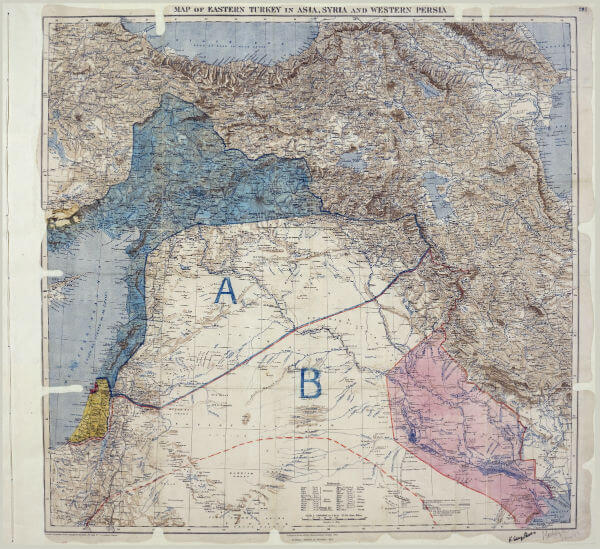
An editorial in The Economist says: Arab states are suffering a crisis of legitimacy. In a way, they have never got over the fall of the Ottoman empire. The prominent ideologies — Arabism, Islamism and now jihadism — have all sought some greater statehood beyond the frontiers left by the colonisers. Now that states are collapsing, Arabs are reverting to ethnic and religious identities. To some the bloodletting resembles the wars of the former Yugoslavia in the 1990s. Others find parallels with the religious strife of Europe’s Thirty Years War in the 17th century. Whatever the comparison, the crisis of the Arab world is deep and complex. Facile solutions are dangerous. Four ideas, in particular, need to be repudiated.
First, many blame the mayhem on Western powers — from Sykes-Picot to the creation of Israel, the Franco-British takeover of the Suez Canal in 1956 and repeated American interventions. Foreigners have often made things worse; America’s invasion of Iraq in 2003 released its sectarian demons. But the idea that America should turn away from the region — which Barack Obama seems to embrace — can be as destabilising as intervention, as the catastrophe in Syria shows.
Lots of countries have blossomed despite traumatic histories: South Korea and Poland — not to mention Israel. As our special report (see article) sets out, the Arab world has suffered from many failures of its own making. Many leaders were despots who masked their autocracy with the rhetoric of Arab unity and the liberation of Palestine (and realised neither). Oil money and other rents allowed rulers to buy loyalty, pay for oppressive security agencies and preserve failing state-led economic models long abandoned by the rest of the world.
A second wrong-headed notion is that redrawing the borders of Arab countries will create more stable states that match the ethnic and religious contours of the population. Not so: there are no neat lines in a region where ethnic groups and sects can change from one village or one street to the next. A new Sykes-Picot risks creating as many injustices as it resolves, and may provoke more bloodshed as all try to grab land and expel rivals. Perhaps the Kurds in Iraq and Syria will go their own way: denied statehood by the colonisers and oppressed by later regimes, they have proved doughty fighters against IS. For the most part, though, decentralisation and federalism offer better answers, and might convince the Kurds to remain within the Arab system. Reducing the powers of the central government should not be seen as further dividing a land that has been unjustly divided. It should instead be seen as the means to reunite states that have already been splintered; the alternative to a looser structure is permanent break-up.
A third ill-advised idea is that Arab autocracy is the way to hold back extremism and chaos. In Egypt Mr Sisi’s rule is proving as oppressive as it is arbitrary and economically incompetent. Popular discontent is growing. In Syria Bashar al-Assad and his allies would like to portray his regime as the only force that can control disorder. The contrary is true: Mr Assad’s violence is the primary cause of the turmoil. Arab authoritarianism is no basis for stability. That much, at least, should have become clear from the uprisings of 2011.
The fourth bad argument is that the disarray is the fault of Islam. Naming the problem as Islam, as Donald Trump and some American conservatives seek to do, is akin to naming Christianity as the cause of Europe’s wars and murderous anti-Semitism: partly true, but of little practical help. Which Islam would that be? The head-chopping sort espoused by IS, the revolutionary-state variety that is decaying in Iran or the political version advocated by the besuited leaders of Ennahda in Tunisia, who now call themselves “Muslim democrats”? To demonise Islam is to strengthen the Manichean vision of IS. The world should instead recognise the variety of thought within Islam, support moderate trends and challenge extremists. Without Islam, no solution is likely to endure. [Continue reading…]
Struggling to fight ISIS in a fractured Libya
Frederic Wehrey writes from Sabratha, Libya: Ahmed “Amu” Dabbashi, the 28-year-old leader of a militia in this seaside town near the Tunisian border, proudly unfurls a black Islamic State flag, seized during late-February raids on safe houses of ISIS, as the group is also known. He shows me a captured arsenal, too: truck-borne explosives, detonators, crates of ammo, crew-served machine guns, and identification cards of foreign fighters.
Days earlier, American warplanes had bombed an Islamic State training site at a nearby house. Then, Amu tells me, “we decided to cleanse our town.” In the raids that followed, fighters for the so-called caliphate struck back, assaulting a police station and cutting the throats of several officers. Scores of youths perished in gunbattles.
Elsewhere across Libya, disparate factions are trying to hold the line against ISIS, often tenuously. The terrorist group is most entrenched in the central city of Sirte. Refugees fleeting Sirte tell me that ISIS extorts businesses and stops traffic to conduct executions.
In late March, a new presidential council — formed under the auspices of a U.N.-brokered unity agreement — arrived with great fanfare in the capital of Tripoli. Washington and its allies had hoped this would provide a foundation for a military campaign against ISIS. But after an initial burst of public enthusiasm, the council is struggling to exert its authority.
The fight against Islamic State faces daunting challenges. First, there still is no unified military structure through which the U.S. and Western allies can channel assistance. A powerful eastern faction allied with Gen. Khalifa Haftar remains hostile to the unity agreement and has tried to sell oil independently from Tripoli. Other militias, even if nominally supporting the new government, remain beholden to towns, tribes and power brokers.
Thus, Western special forces must work with militia surrogates in any operations against Islamic State. But this is risky: Assisting these armed groups could rekindle old rivalries and further reduce the incentives for national reconciliation.
Militias have figured out that signing up for the campaign against Islamic State is the best way to get legitimacy and attention. Whether or not they intend to use outside support solely against ISIS is another story. Many still regard their local rivals as the pressing concern. In some cases, the West may find them unsavory partners: traffickers, hard-line Salafists, tribal supremacists, military officers with authoritarian and anti-Islamist leanings.
This is evident in Sabratha, where Amu’s extended family has had longtime links with smugglers and jihadists. In the capital of Tripoli, a Salafist militia leader lets me tour his prison’s rehabilitation center, where Islamic State suspects are thrown in with drug addicts for undefined stretches with no due process. In a trip to Benghazi last fall, I saw how neighborhood militias carried out what amounts to personal and tribal vendettas, all under the cover of combating Islamic State. [Continue reading…]
Britain should stop trying to pretend that its empire was benevolent
By Alan Lester, University of Sussex
The recent debacle of David Cameron’s filmed condemnation of Nigerian and Afghan corruption and the Queen’s remark on Chinese officials’ rudeness highlights the persistence of imperial thinking in Britain. There seems to be a continuing assumption within the British establishment that it sets an example for others to follow and that the British are owed deference by others.
Ever since evangelical antislavery activists campaigned for Britain to abolish the transatlantic slave trade, Britons have assured themselves that imperial overrule is compatible with the “benign tutelage” of other races and nations. Unlike the other European empires, Britons tell themselves, theirs was an empire founded on humanitarian compassion for colonised subjects.
The argument runs like this: while the Spanish, Portuguese, French, Belgians and Germans exploited and abused, the British empire brought ideas of protection for lesser races and fostered their incremental development. With British tutelage colonised peoples could become, eventually, as competent, as knowledgeable, as “civilised” as Britain itself. These platitudes have been repeated time and again – they are still at the heart of most popular representations of the British Empire.
Even when we are encouraged to pay attention to empire’s costs as well as its benefits, these costs are imagined solely in terms of specific incidents of violence such as the Amritsar Massacre in India or the suppression of the Mau Mau rebellion in Kenya. Britain has excused itself from that most structural injustice of empire – the slave trade itself – by the fact that it was Britain that pioneered its abolition.
Why Brexit would be the perfect gift for Vladimir Putin
Garry Kasparov writes: olitics often makes for strange bedfellows. Far-right parties in the UK and across Europe push for anything that will weaken the European Union – a goal shared by Vladimir Putin and Donald Trump. This week, their fellow Brexiteer Boris Johnson went as far as to repeat the Kremlin line that Europe is partly to blame for Putin’s ongoing invasion of Ukraine.
One does not expect clear policy statements from Trump or Johnson, but Putin’s reasoning is irrefutable. His goal is to weaken the institutions, including Nato and the EU, that could thwart his neo-Soviet ambitions. The Kremlin was in mourning when Scotland narrowly voted to stay in the UK. Putin sees Europe as his enemy and wants his adversaries to be divided, smaller and weaker.
Divide and conquer isn’t new, but that doesn’t mean it isn’t effective. During his 16 years in power, Putin has done a good job of picking off the weakest, most pliable members from the herd of European leaders and using them as a wedge against a united Europe. He had Silvio Berlusconi, who boasted he was Putin’s personal advocate. He had Gerhard Schröder – and in fact still has him as chairman of the Nord Stream gas pipeline connecting Russia to Germany, which Schröder signed into effect as German chancellor.
Brexit isn’t simply an item on Putin’s wish list. Russia Today and Sputnik, Kremlin propaganda outlets that are inexplicably treated as legitimate news sources in the west, are full of Brexit articles (next to the pro-Trump ones).
Putin always supports the most divisive elements in European politics, and hopes they will repay the favour by voting to end the EU sanctions placed on Russia after his invasion of Ukraine. Europe’s anti-immigrant parties, the quasi-fascists and the not-so-quasi fascists, openly venerate the man who has annexed European territory and continues his military assault in Ukraine – a country Putin wishes to punish for following the dream of joining the EU, a dream some in Britain would freely abandon. [Continue reading…]
Mustafa Badreddine, the pyromaniac playboy who led Hezbollah’s fight in Syria
Last August, Alex Rowell wrote: To close friends, he is “Dhu al-Faqar”—the name, meaning, “the cleaver of vertebrae,” of the legendary double-tipped sword given by the Prophet Muhammad to his son-in-law, Ali bin Abi Talib, the patron imam of Shia Islam. To the Kuwaiti government, who sentenced him to death in 1984 for a spate of audacious bombings on targets including the American and French embassies and the airport, he is Elias Fouad Saab. To prosecutors at the Special Tribunal for Lebanon (STL) in The Hague, who are currently trying him in absentia on suspicion of assassinating Lebanese Prime Minister Rafiq al-Hariri in 2005, he is Mustafa Amine Badreddine. To genteel dining companions — and multiple mistresses — entertained at his seaside home north of Beirut, he is the boat-owning, Mercedes-driving Christian jeweler, Sami Issa.
Or, rather, he was. The Frank Abagnale Jr. of jihad has found yet another preoccupation in the last few years. According to sources as discrepant as the U.S. Treasury Department and a militantly pro-Hezbollah newspaper in Beirut, the man who also goes by the name Safi Badr is currently leading the Party of God’s military intervention against the Syrian uprising, personally sitting in on meetings between President Bashar al-Assad and Hezbollah Secretary-General Hassan Nasrallah. It’s a distinction that earned the “Specially Designated Global Terrorist” a fresh dose of American sanctions just last week. [Continue reading…]
Beijing is setting the stage for war in the South China Sea

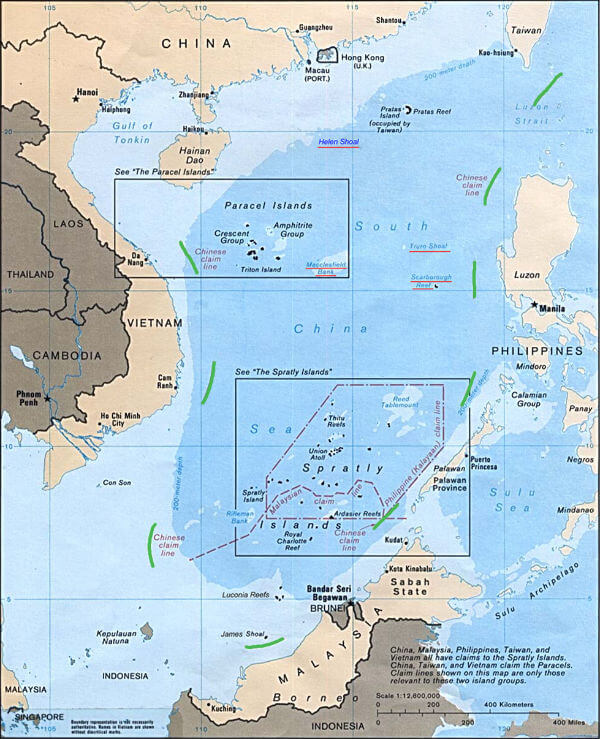
Steve Mollman writes: All any nation needs to go to war is a good provocation, and China is no exception. With its sweeping territorial claims, island-building, militarization, patriotic fervor, and prickly rhetoric, Beijing is setting itself up to be repeatedly provoked in the South China Sea. It might even be counting on it.
Consider the nation’s manmade, militarized island at Fiery Cross Reef in the Spratly archipelago. Though it didn’t even exist a few years ago, and for decades ships from other nations could routinely sail by it without disturbance, now Beijing feels provoked if anyone goes near it — and sends out warnings or makes aggressive gestures in response.
This week the USS William P. Lawrence, a guided missile destroyer from the US Navy, conducted a “freedom of navigation” operation near the island. It deliberately sailed within 12 nautical miles of Fiery Cross Reef. If the US recognized the reef as China’s territory to begin with — which it does not — that would be considered entering China’s territory.
The problem is China has claimed, outrageously, that nearly the entire sea is its own territory. Considering the fact that some $5 trillion in ship-borne trade passes through the strategic waterway every year, that’s a problem not just for the US, but any number of countries participating in the global economy. The US Navy’s operation was a reminder to China that the sea is open waters, despite any impromptu islands that might have been constructed of late.
China bases its sea claim on a “nine-dash line” that it drew on a map after World War 2. Never mind that the line conflicts with international norms and overlapping claims by nearby nations, including the Philippines, Vietnam, and Malaysia, nations whose coasts are much closer to the disputed sea than China’s. [Continue reading…]
200 years ago, the sky went dark and there was no summer

Ishaan Tharoor writes: As summer approaches, many in the United States will be awaiting warmer, balmier days. It’s a prospect keenly felt right now by those in the nation’s capital, which has endured two weeks of ceaseless rain.
But things could be much worse. Two hundred years ago, the U.S. Eastern Seaboard registered record-low temperatures. On June 6, 1816, six inches of snow fell across wide swaths of New England. “The heads of all the mountains on every side were crowned with snow,” one area farmer wrote. “The most gloomy and extraordinary weather ever seen.”
A Connecticut clockmaker recalled at the time having to wear an overcoat and mittens for much of the summer; another bookkeeper noted in his diary that “the vegetation does not seem to advance at all.” Frosts set in and crops failed. In Montreal, there were reports of frozen birds dropping dead on the city streets. Denizens of Vermont were forced to subsist on “nettles, wild turnips and hedgehogs.”
These early Americans probably did not know the cause of the epic cold spell: A year prior, after months of rumbling, a colossal eruption occurred at Mount Tambora, on a small island in what was then the Dutch East Indies and is now Indonesia. Millions of tons of ash and sulfurous gas went dozens of miles up into the stratosphere, creating a kind of dusty veil around the planet and plunging part of Asia in darkness. [Continue reading…]
Saudia Arabia and Iran: The Cold War of Islam
Der Spiegel reports: No previous US president had been made to suffer such an indignity when visiting America’s supposedly closest ally in the Arab world: When Barack Obama touched down at the airport in Riyadh in mid-April, King Salman opted to remain in his palace. The most powerful man in the world was received by the governor of Riyadh instead. There was no pomp or ceremonial reception and state-controlled television declined to broadcast the arrival. Obama seemed slightly at a loss on the tarmac before trying to cover up the affront with a broad smile.
The message was clear: Saudi Arabia feels as though it has been left in the lurch by America and is not afraid to show that it isn’t happy.
The story of the failed reception is more than just an anecdote from the international diplomatic stage. It serves to illustrate the massive geo-political shift and the growing conflict that has gripped the entire Middle East. It has become the Cold War of our era, pitting Saudi Arabia against Iran, the two rivals that are striving for supremacy in the region. And it is not entirely clear which side the US is on.
The Middle East as we have long known it is changing dramatically. And no matter where one looks, Tehran and Riyadh are standing behind at least one of the parties involved in the conflict. The kingdom of Saudi Arabia, host and protector of the holy sites in Mecca and Medina, sees itself as the home of Sunni Islam, to which the majority of the world’s Muslims belong. The Islamic Republic of Iran, a Shiite theocracy, claims leadership of the Shiites, which make up roughly 13 percent of Muslims worldwide. For both regimes, religion is an important tool of power.
Today’s bloodiest civil war, the conflict in Syria, is entering its sixth year and has thus far cost the lives of more than 250,000 people — and the cease-fire that has been in place for the last two months doesn’t look as though it will last much longer. In Syria, and also in the conflicts in Iraq and in Yemen, the fighting fronts run primarily along confessional lines: Sunnis against Shiites. A fragile peace holds in Lebanon and Bahrain, but it is one that could be shattered at any time by confessional unrest.
All of these proxy wars and confessional conflicts have unleashed a wave of migration among those who have been displaced: more than 6 million people from Syria and Iraq along with almost 3 million from Yemen. And out of the rubble of the Middle East, hydra-headed monster has risen that seeks to terrorize Brussels, Paris, Istanbul and the rest of the world: Islamic State. In an irony of history, the Sunni terror militia sees both Iran and Saudi Arabia as its enemies.
At its essence, the escalation in the Middle East also has to do with America and its changing role in the world. After decades of enmity with Iran, US President Barack Obama wanted to restart a dialogue with the country and he negotiated a nuclear treaty with Tehran. The hope is that the deal will limit Iran’s ability to pursue a nuclear weapon while making it possible for the country to do business with the West in return.
At the same time, though, the US would prefer to withdraw from this complicated, crisis-plagued region of the world. Current developments are also a product of this trend.
Iran, meanwhile, following decades of isolation, would like to revert to its former position of regional importance. The more Middle Eastern countries there are under the control of Shiites, the stronger Iran feels — and the more hard-pressed Saudi Arabia feels, a country whose rulers once rose to power by way of a pact with Sunni fundamentalists, the Wahhabis.
This new Cold War affects the entire world, making it vital to search out its causes and to scrutinize what is pushing Saudi Arabia and Iran to continue on the path of escalation. A team of SPIEGEL reporters went to both countries to investigate and spoke with politicians, religious leaders, activists, intellectuals and normal people on the streets. [Continue reading…]

Bernie Sanders could still win the Democratic nomination — no, seriously
Seth Abramson writes: Last night on CNN, while discussing Bernie Sanders’ landslide victory over Hillary Clinton in West Virginia — which followed a 5-point Sanders win in Indiana last week — Michael Smerconish said that “Democratic super-delegates might have to rethink” their support of Hillary Clinton given how dramatically better Sanders fares in head-to-head match-ups against Donald Trump.
After Clinton’s Indiana loss, John King had told CNN viewers that “if Sanders were to win nine out of ten of the remaining contests, there’s no doubt that some of the super-delegates would panic. There’s no doubt some of them would switch to Sanders. What he has to do is win the bulk of the remaining contests. Would that send jitters, if not panic, through the Democratic Party? Yes. Yes it would.”
So what gives? Isn’t this thing over?
Almost, but not quite.
What Smerconish (and Wolf Blitzer) were discussing last night, and John King was discussing last week, is a very simple theory — call it “run-the-table” — which is easy enough to understand if you simply know the history of Democratic super-delegates and what’s happened in the 2016 Democratic primary since Super Tuesday.
So here it is — both a brief history of the “super-delegate” and an explanation of the “run-the-table” scenario that increasingly is making it into the mainstream media. [Continue reading…]
Why many of Iran’s ‘moderates’ say they prefer Trump to Clinton
Jeremy Shapiro and Ellie Geranmayeh write: Much of the world seems fairly put off by Donald Trump. Europeans are annoyed that he has threatened to withdraw from NATO. The Japanese and South Koreans seem upset about his intention to withdraw US troops from their shores. Mexicans dislike him so much they are selling Donald Trump piñatas like hotcakes. Even the Chinese seem worried about his idea to slap them with a 45 percent tariff and his support for a nuclear-armed Japan.
So does anyone outside of America like Trump? Many people point to Russian President Vladimir Putin. He and Trump have expressed admiration for each other’s leadership qualities. But beyond Putin, there is (unsurprisingly) little foreign support for Trump’s trademark blend of American nationalism and xenophobia.
Recent conversations, however, have led us to suspect that there might be another country of potential Trump supporters out there: Iran. [Continue reading…]
Trump’s empty administration

Politico reports: Top Republican political leaders aren’t the only ones shunning their party’s presidential nominee — a vast number of highly skilled managers and policy experts, veterans of recent GOP administrations who would normally be expected to fill key positions for a new White House, are also vowing to sit out a Donald Trump presidency.
And while the failure of the two Presidents Bush or House Speaker Paul Ryan to endorse the presumptive nominee carries political consequences, the absence of policy veterans in a new administration would have a substantive effect on the running of government.
POLITICO interviewed nearly five dozen Republicans over the past two weeks — people with experience working in government and who understand how Congress can enact, or shred, a new president’s agenda — and heard the same sentiment expressed repeatedly. If Trump doesn’t change his tune or extend much longer olive branches, many of these government veterans say they intend to cede highly coveted administration posts to less-experienced competitors.
“I would never serve in a Trump administration,” said James Capretta, a former Office of Management and Budget official under George W. Bush. “The person at the top is unfit for the presidency. He’s made that very clear with his behavior.” [Continue reading…]
Behind the carnage in Iraq: ISIS intends to divide and conquer
The Daily Beast reports: Baghdad suffered its deadliest day in months during a series of attacks Wednesday. The carnage not only shocked the capital, but also raised questions about whether Iraqi security forces are capable of reclaiming Mosul, Iraq’s second-largest city, which has been occupied for almost two years by the self-proclaimed Islamic State.
One obvious question is how Iraqi security forces can retake and secure Mosul if they cannot protect Baghdad from three suicide bombings in a matter of hours. But the picture is more complicated, and indeed, more problematic even than that.
The bombings targeted Shia neighborhoods in what appears to be part of the continuing ISIS effort to provoke a frenzy of ethnic cleansing similar to that of a decade ago. As one U.S. official immersed in the anti-ISIS war puts it, “Sunnis see ISIS as their protection — their wall against Shia revenge.”
The estimates of those killed Wednesday are as high as 150, with hundreds more injured. Among those reportedly killed were several women at a hair salon struck by a truck bomb as they prepared for their wedding day. [Continue reading…]