Category Archives: Analysis

Lack of plan for ISIS detainees raises human rights concerns

The New York Times reports: The Islamic State calls them “inghimasi” — zealous foot soldiers who intend to fight to their deaths. And as the American-backed coalition has reclaimed territory from the group in Iraq and Syria, that fervor has kept prisoners from being much of a problem: The shooting only stops when almost every Islamic State fighter has been killed.

But that could change as the coalition moves toward the Islamic State’s largest urban strongholds — Mosul, Iraq, and Raqqa, Syria — raising a potential problem for the United States. If the coalition is successful and thousands of ordinary members of a collapsing Islamic State have nowhere left to retreat, will they start to surrender in greater numbers? And if so, who will be responsible for imprisoning them?

After the experiences of the past decade in the wars in Afghanistan and Iraq, the Obama administration is determined not to revive large-scale detention operations. But it is far from clear whether allies on the ground — especially rebels in Syria — are prepared to hold large numbers of prisoners, raising the prospect of an ugly aftermath to any victory.

“If they’re not killed but detained, we are concerned about the standards of care, who would do it and how it would be done,” Peter Maurer, the president of the International Committee of the Red Cross, said in an interview. [Continue reading…]

Facebooktwittermail

The FBI is keeping 80,000 secret files on the Saudis and 9/11

The Daily Beast reports: The Obama administration may soon release 28 classified pages from a congressional investigation that allegedly links Saudis in the United States to the 9/11 attackers. A former Republican member of the 9/11 Commission alleged Thursday that there was “clear evidence” of support for the hijackers from Saudi officials.

But in Florida, a federal judge is weighing whether to declassify portions of some 80,000 classified pages that could reveal far more about the hijackers’ Saudis connections and their activities in the weeks preceding the worst attack on U.S. soil.

The still-secret files speak to one of the strangest and most enduring mysteries of the 9/11 attacks. Why did the Saudi occupants of a posh house in gated community in Sarasota, Florida, suddenly vanish in the two weeks prior to the attacks? And had they been in touch with the leader of the operation, Mohamed Atta, and two of his co-conspirators?

No way, the FBI says, even though the bureau’s own agents did initially suspect the family was linked to some of the hijackers. On further scrutiny, those connections proved unfounded, officials now say.

But a team of lawyers and investigative journalists has found what they say is hard evidence pointing in the other direction. Atta did visit the family before he led 18 men to their deaths and murdered 3,000 people, they say, and phone records connect the house to members of the 9/11 conspiracy. [Continue reading…]

Facebooktwittermail

Bob Graham: Release the uncensored truth about 9/11

Former senator Bob Graham writes: Nearly 15 years after the horrific events of 9/11, President Obama must decide whether to release 28 pages of information withheld as classified from the publicly released report of the congressional inquiry into the terrorist attacks that killed thousands of Americans.

On April 10, the CBS program “60 Minutes” aired a story about the missing 28 pages. I was one of several former public officials — including former House Intelligence Committee chairman and CIA director Porter Goss (R-Fla.) ; Medal of Honor recipient and former senator Bob Kerrey (D-Neb.); former Navy secretary John Lehman; and former ambassador and representative Tim Roemer (D-Ind.) — who called on the White House to declassify and release the documents.

Two days after that broadcast, I received a call from a White House staff member who told me that the president would make a decision about the 28 pages no later than June. While that official made no promises as to what Obama would do, I viewed the news as a step in the right direction. [Continue reading…]

Facebooktwittermail

Zionism threatens to bring anti-Semitism full-circle

Jonathan Ofir writes: Zionism is very much a mirror image of anti-Semitism. It was founded and based on an assumption that assimilation is bound to fail, and that the Jews must resort to other measures in order to protect their existence – as persons, but perhaps even more significantly – as a supposed nation. David Ben-Gurion’s words to the Mapai committee in 1938 reveal how the national aspect could supersede the humanitarian concern to actual people: ”If I knew that it was possible to save all the children of Germany by transporting them to England, and only half by transferring them to the Land of Israel, I would choose the latter, for before us lies not only the numbers of these children but the historical reckoning of the people of Israel.” In that same year he spoke to the Jewish Agency in regards to the Évian conference which sought to facilitate the plight of Jewish refugees, saying, “[I do] not know if the conference will open the gates of other countries. . . . But I am afraid [ it ] might cause tremendous harm to Eretz Yisrael and Zionism. . . . and the more we emphasize the terrible distress of the Jewish masses in Germany, Poland and Rumania, the more damage we shall cause” — to Zionism and Eretz Israel by promoting emigration to western countries. [Both quotes at this link.]

That is to say, that the priority of nationalism (as opposed to personal security) was extremely high in Zionism from the outset. Zionism sought to forge a sense of ‘nationhood’ for a people that were of a vast spectrum of ethnicity, language, even religion (from ultra-orthodox to atheist) and claim that they were one. The British (and notably Jewish) Secretary of State for India Edwin Montagu, in his critique of Her Majesty’s Government’s intentions to endorse a ‘Jewish national home” in Palestine in 1917, said: “I assert that there is not a Jewish nation. The members of my family, for instance, who have been in this country for generations, have no sort or kind of community of view or of desire with any Jewish family in any other country beyond the fact that they profess to a greater or less degree the same religion. It is no more true to say that a Jewish Englishman and a Jewish Moor are of the same nation than it is to say that a Christian Englishman and a Christian Frenchman are of the same nation: of the same race, perhaps, traced back through the centuries – through centuries of the history of a peculiarly adaptable race”. [Continue reading…]

Facebooktwittermail

How do we know the distance to the stars?

galaxies
Exploration is in our nature. We began as wanderers, and we are wanderers still. We have lingered long enough on the shores of the cosmic ocean. We are ready at last to set sail for the stars. — Carl Sagan

Ethan Siegel writes: To look out at the night sky and marvel at the seemingly endless canopy of stars is one of the oldest and most enduring human experiences we know of. Since antiquity, we’ve gazed towards the heavens and wondered at the faint, distant lights in the sky, curious as to their nature and their distance from us. As we’ve come to more modern times, one of our cosmic goals is to measure the distances to the faintest objects in the Universe, in an attempt to uncover the truth about how our Universe has expanded from the Big Bang until the present day. Yet even that lofty goal depends on getting the distances right to our nearest galactic neighbors, a process we’re still refining. We’ve taken three great steps forward in our quest to measure the distance to the stars, but we’ve still got further to go.

The story starts in the 1600s with the Dutch scientist, Christiaan Huygens. Although he wasn’t the first to theorize that the faint, nighttime stars were Suns like our own that were simply incredibly far away, he was the first to attempt to measure their distance. An equally bright light that was twice as far away, he reasoned, would only appear one quarter as bright. A light ten times as distant would be just one hundredth as bright. And so if he could measure the brightness of the brightest star in the night sky  — Sirius  —  as a fraction of the brightness of the Sun, he could figure out how much more distant Sirius was than our parent star. [Continue reading…]

Facebooktwittermail

The human side of cybercrime

M. Mitchell Waldrop writes: Say what you will about cybercriminals, says Angela Sasse, “their victims rave about the customer service”.

Sasse is talking about ransomware: an extortion scheme in which hackers encrypt the data on a user’s computer, then demand money for the digital key to unlock them. Victims get detailed, easy-to-follow instructions for the payment process (all major credit cards accepted), and how to use the key. If they run into technical difficulties, there are 24/7 call centres.

“It’s better support than they get from their own Internet service providers,” says Sasse, a psychologist and computer scientist at University College London who heads the Research Institute in Science of Cyber Security. That, she adds, is today’s cybersecurity challenge in a nutshell: “The attackers are so far ahead of the defenders, it worries me quite a lot.”

Long gone are the days when computer hacking was the domain of thrill-seeking teenagers and college students: since the mid-2000s, cyberattacks have become dramatically more sophisticated. Today, shadowy, state-sponsored groups launch exploits such as the 2014 hack of Sony Pictures Entertainment and the 2015 theft of millions of records from the US Office of Personnel Management, allegedly sponsored by North Korea and China, respectively. ‘Hacktivist’ groups such as Anonymous carry out ideologically driven attacks on high-profile terrorists and celebrities. And a vast criminal underground traffics in everything from counterfeit Viagra to corporate espionage. By one estimate, cybercrime costs the global economy between US$375 billion and $575 billion each year. [Continue reading…]

Facebooktwittermail

World’s carbon dioxide concentration teetering on the point of no return

Earth

The Guardian reports: The world is hurtling towards an era when global concentrations of carbon dioxide never again dip below the 400 parts per million (ppm) milestone, as two important measuring stations sit on the point of no return.

The news comes as one important atmospheric measuring station at Cape Grim in Australia is poised on the verge of 400ppm for the first time. Sitting in a region with stable CO2 concentrations, once that happens, it will never get a reading below 400ppm.

Meanwhile another station in the northern hemisphere may have gone above the 400ppm line for the last time, never to dip below it again.

“We’re going into very new territory,” James Butler, director of the global monitoring division at the US National Oceanographic and Atmospheric Administration, told the Guardian.

When enough CO2 is pumped into the atmosphere from burning fossil fuels, the seasonal cycles that drive the concentrations up and down throughout the year will eventually stop dipping the concentration below the 400ppm mark. The 400ppm figure is just symbolic, but it’s psychologically powerful, says Butler.

The first 400ppm milestone was reached in 2013 when a station on the Hawaiian volcano of Mauna Loa first registered a monthly average of 400ppm. But the northern hemisphere has a large seasonal cycle, where it increases in summer but decreases in winter. So each year since it has dipped back below 400ppm.

Then, combining all the global readings, the global monthly average was found to pass 400ppm in March 2015.

In the southern hemisphere, the seasonal cycle is less pronounced and atmospheric levels of CO2 hardly drop, usually just slowing in the southern hemisphere summer months. This week scientists revealed to Fairfax Media that Cape Grim had a reading of 399.9ppm on 6 May. Within weeks it would pop above 400ppm and never return.

“We wouldn’t have expected to reach the 400ppm mark so early,” said David Etheridge, an atmospheric scientist from the CSIRO, which runs the Cape Grim station. “With El Nino, the ocean essentially caps off it’s ability to take up heat so the concentrations are growing fast as warmer land areas release carbon. So we would have otherwise expected it to happen later in the year.

“No matter what the world’s emissions are now, we can decrease growth but we can’t decrease the concentration. [Continue reading…]

Facebooktwittermail

Russia’s new missile means the nuclear arms race is back on

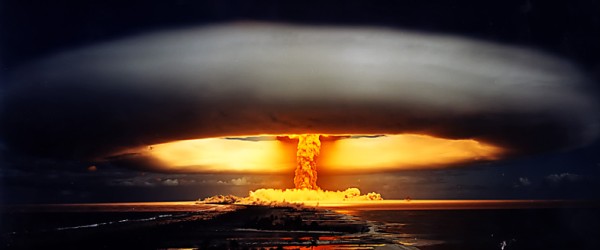
French nuclear test "Licorne",  French Polynesia, July, 1970

David Axe reports: Russia has a new nuclear missile — one that Zvezda, a Russian government-owned T.V. network, claimed can wipe out an area “the size of Texas or France.”

Actually, no, a single SS-30 rocket with a standard payload of 12 independent warheads, most certainly could not destroy Texas or France. Not immediately. And not by itself.

Each of the SS-30’s multiple independently targetable reentry vehicle warheads, or MIRVs, could devastate a single city. But Texas alone has no fewer than 35 cities of 100,000 people or more.

Which is not to say the instantaneous destruction of a dozen cities and the deaths of millions of people in a single U.S. state wouldn’t mean the end of the world as we know it.

Nobody nukes just Texas. And if Russia is disintegrating Texan cities, that means Russia is also blasting cities all over the United States and allied countries — while America and its allies nuke Russia right back.

Moscow’s arsenal of roughly 7,000 atomic weapons — 1,800 of which are on high alert — and America’s own, slighly smaller arsenal — again, only 1,800 of which are ready to fire at any given time — plus the approximately 1,000 warheads that the rest of the world’s nuclear powers possess are, together, more than adequate to kill every human being on Earth as well as most other forms of life.

One new Russian rocket doesn’t significantly alter that terrible calculus.

But that doesn’t mean you shouldn’t be alarmed. The SS-30 is only the latest manifestation of a worrying trend. After decades of steady disarmament, the United States and Russia are pouring tens of billions of dollars into building new and more capable nuclear weaponry that experts agree neither country needs, nor can afford.

The SS-30 by itself is just slightly more destructive than older Russian missiles. It’s what the new weapon represents that’s frightening. The post-Cold War nuclear holiday is over. And apocalyptic weaponry such as Russia’s new SS-30 are back at work making the world a very, very scary place. [Continue reading…]

Facebooktwittermail

How the New York Times Magazine botched its Iran story

Joe Cirincione writes: A devious president and his top aides trick the nation into a dangerous foreign entanglement with the help of a gullible press corps and complicit experts. George W. Bush and war with Iraq? No, Barack Obama and diplomacy with Iran. At least according to David Samuels’ telling in an instantly controversial article for this past Sunday’s New York Times Magazine about White House adviser Ben Rhodes.

Rhodes, whom I know, is very talented, but he is no modern-day Rasputin casting a spell over Obama, the press and public. The truth is that Samuels used his access to Rhodes to attack a deal he never liked and publicly campaigned against.

In his article, Samuels claims Obama was “actively misleading” the public about Iran. He says the president made up a story of how the 2013 election of pragmatic Iranian President Hassan Rouhani created a new opening with Iran. This, so Obama could win “broad public currency for the thought that there was a significant split in the regime.” This, in turn, claims Samuels, allowed Obama to avoid a “divisive but clarifying debate of the actual policy choices” and eliminate the “fuss about Iran’s nuclear program” so that Obama could pursue his real agenda: “a large-scale disengagement from the Middle East.”

Every element of this thesis falls apart under scrutiny.

Obama did not mislead the public about negotiations with Iran. Most of the talks the United States held with Iran under the previous, hard-line President Mahmoud Ahmadinejad were widely reported. Even the secret talks that opened up the engagement with the more pragmatic Rouhani government were disclosed by the dogged reporting of Laura Rozen and others well before the congressional vote last year. And the imagined plot to sell out our Middle East allies to Iran is a common talking point of the far right, without any supporting evidence.

But one of Samuels’ biggest fallacies is his claim that the world’s leading nuclear policy and national security experts were duped by Rhodes, the deputy national security adviser whom Samuels portrays as a digital Machiavelli spinning gullible reporters and compliant experts into accepting a bad deal.

Samuels says this is the only way to explain “the onslaught of freshly minted experts cheerleading for the deal.” He claims that in the spring of 2015, “legions of arms-control experts began popping up at think tanks and on social media and then became key sources for hundreds of often-clueless reporters.”

This is utter nonsense.

In London, Paris, Berlin and Washington the deal was evaluated on its merits, not on spin. Nor did we wait for the White House to fire the starting gun. Ploughshares Fund, the group I head, began our campaign to shut down Iran’s paths to a bomb six years ago. We helped fund a network of experts, advocates, faith leaders, military leaders and diplomats who trade views and coordinate efforts.

Samuels takes a swipe at our work directly, quoting Rhodes as saying, “In the absence of rational discourse, we are going to discourse the [expletive] out of this. … We had test drives to know who was going to be able to carry our message effectively, and how to use outside groups like Ploughshares, the Iran Project and whomever else.” [Continue reading…]

Facebooktwittermail

‘Good Muslims’ or ‘Good citizens’: How Muslim women feel about integration

By Line Nyhagen, Loughborough University

A great many things have been said about Muslims as UK citizens, mainly by non-Muslims. The prime minister, David Cameron, believes that if more Muslim women became proficient in English, for example, it would help beat extremism and terrorism. Meanwhile, Trevor Phillips, the former chair of the Equality and Human Rights Commission, says that UK Muslims “See the world differently from the rest of us”.

Phillips also presented a controversial Channel 4 programme called What British Muslims Really Think, which put across the message that Muslims are more conservative than the majority population and don’t want to integrate into wider society.

The debate is often highly intemperate – and both Muslim and non-Muslim voices alike have suggested it contributes to further stigmatisation of an already marginalised and disadvantaged Muslim population. In this highly politicised climate, the relationship between Islam and citizenship has also come under scrutiny by Citizens UK, a charitable voluntary organisation with churches, mosques and unions among its members.

In July 2015, Citizens UK launched its Commission on Islam, Participation and Public Life headed by conservative MP Dominic Greave. Greave somewhat unfortunately framed the Commission’s work as aiming to “help tackle extremism”.

Continue reading

Facebooktwittermail

In remote corner of Iraq, an unlikely alliance forms against ISIS

Reuters reports: They share little more than an enemy and struggle to communicate on the battlefield, but together two relatively obscure groups have opened up a new front against Islamic State militants in a remote corner of Iraq.

The unlikely alliance between an offshoot of a leftist Kurdish organization and an Arab tribal militia in northern Iraq is a measure of the extent to which Islamic State has upended the regional order.

Across Iraq and Syria, new groups have emerged where old powers have waned, competing to claim fragments of territory from Islamic State and complicating the outlook when they win.

“Chaos sometimes produces unexpected things,” said the head of the Arab tribal force, Abdulkhaleq al-Jarba. “After Daesh (Islamic State), the political map of the region has changed. There is a new reality and we are part of it.”

In Nineveh province, this “new reality” was born in 2014 when official security forces failed to defend the Sinjar area against the Sunni Islamic State militants who purged its Yazidi population.

A Syrian affiliate of the Kurdistan Workers’ Party (PKK) came to the rescue, which won the gratitude of Yazidis, and another local franchise called the Sinjar Resistance Units (YBS) was set up.

The mainly Kurdish secular group, which includes Yazidis, controls a pocket of territory in Sinjar and recently formed an alliance with a Sunni Arab militia drawn from the powerful Shammar tribe.

“In the beginning we were unsure (about them),” said a wiry older member of the Arab force, which was assembled over the past three months and is now more than 400-strong. “We thought they were Kurdish occupiers.”

Their cooperation is all the more unusual because many Yazidis accuse their Sunni Muslim neighbors of complicity in atrocities committed against them by Islamic State, and say they cannot live together again. [Continue reading…]

Facebooktwittermail

Mosul: Suspicion and hostility cloud fight to recapture Iraqi city from ISIS

The Guardian reports: At the bottom of a hill near the frontline with Islamic State fighters, the Iraqi army had been digging in. Their white tents stood near the brown earth gouged by the armoured trucks that had carried them there – the closest point to Mosul they had reached before an assault on Iraq’s second largest city.

For a few days early last month, the offensive looked like it already might be under way. But that soon changed when the Iraqis, trained by US forces, were quickly ousted from al-Nasr, the first town they had seized. There were about 25 more small towns and villages, all occupied by Isis, between them and Mosul. And 60 miles to go.

Behind the Iraqis, the Kurdish peshmerga remained dug into positions near the city of Makhmour that had marked the frontline since not long after Mosul was seized in June 2014. The war had been theirs until the national army arrived. The new partnership is not going well.

On both sides, there is a belief that what happens on the road to Mosul will not only define the course of the war but also shape the future of Iraq. And, despite the high stakes, planning for how to take things from here is increasingly clouded by suspicion and enmity. [Continue reading…]

Facebooktwittermail

As war strangles Yemen, many fear the grip will never break

yemen-bombing

The New York Times reports: The familiar thud of shelling echoed off the mountains that cradle this besieged and ravaged city. For a few terrifying minutes, a warplane circled over neighborhoods and humming afternoon markets before dropping a bomb that momentarily silenced the guns.

But the fighting never stops for long in Taiz, or across Yemen for that matter, a country that has endured 14 months of shattering civil war.

Yemen’s government and its main opponents, the Houthi rebels, have been negotiating for weeks to end the conflict, under intense pressure from the United States and from other Western nations alarmed that Al Qaeda’s local affiliate, Al Qaeda in the Arabian Peninsula, is gaining recruits, weapons and money in the midst of the country’s collapse.

A frenzied escalation of violence over the last few days is threatening a nationwide cease-fire that was supposed to build confidence for the talks. The bloodshed has laid bare the furious rivalries — between aging warlords, tribes, Islamist groups and regional powers — that are making Yemen’s hostilities almost impossible to stop.

Even if the negotiations somehow succeed, Yemenis scarred by the vicious fighting, past broken promises and deepening divisions say they fear that any truce would just be a prelude to an even uglier war, fought between regions, religious sects — even neighbors. [Continue reading…]

Facebooktwittermail

Released emails show use of unclassified systems was routine

The New York Times reports: On the morning of March 13, 2011, the assistant secretary of state for Near Eastern affairs, Jeffrey D. Feltman, wrote an urgent email to more than two dozen colleagues informing them that Saudi Arabia and the United Arab Emirates were sending troops into Bahrain to put down antigovernment protests there.

Mr. Feltman’s email prompted a string of 10 replies and forwards over the next 24 hours, including to Secretary of State Hillary Clinton, as the Obama administration debated what was happening and how to respond.

The chain contained information now declared classified, including portions of messages written by Mr. Feltman; the former ambassador in Kuwait, Deborah K. Jones; and the current director of the Central Intelligence Agency, John O. Brennan.

The top administration officials discussed the Bahrain situation on unclassified government computer networks, except for Mrs. Clinton, who used a private email server while serving as secretary of state.

Her server is now the subject of an F.B.I. investigation, which is likely to conclude in the next month, about whether classified information was mishandled.

Whatever the disposition of the investigation, the discussion of troops to Bahrain reveals how routinely sensitive information is emailed on unclassified government servers, reflecting what many officials describe as diplomacy in the age of the Internet, especially in urgent, fast-developing situations. [Continue reading…]

Facebooktwittermail

Ancient space dust hints at a mysterious period in Earth’s early history

pattern3

Rebecca Boyle writes: Geologists tell a pretty broad-brush narrative of Earth’s 4.5 billion-year history. For its first half-billion years, the newly formed planet was a seething ball of lava constantly pelted by giant space rocks, including a Mars-sized object that sheared off a chunk that became the moon. Things calmed down when the Late Heavy Bombardment tapered off some 3.8 billion years ago, but volcanoes ensured Earth’s atmosphere remained a toxic stew of gases with almost no oxygen to speak of. It stayed that way for another billion years, when single-celled bacteria filled the oceans. Around 2.5 billion years ago, at the end of the Archean era, algae figured out how to make energy from sunlight, and the Great Oxygenation Event gave Earth its lungs. Complex life took its time, finally exploding in the Cambrian era some 500 million years ago. Evolution moved a lot faster after that, resulting in dinosaurs, then mammals, then us.

It’s a great story, and scientists have been telling it for decades, but tiny fossilized space pebbles from Australia may upend it entirely, giving us a new narrative about Earth’s adolescence. These pebbles rained down on our planet’s surface 2.7 billion years ago. As they passed through the upper atmosphere, they melted and rusted, making new crystal shapes and minerals that only form where there is plenty of oxygen. A new paper describing the space pebbles will be published today in the journal Nature. It suggests the atmosphere’s upper reaches were surprisingly rich in oxygen during the Archean, when Earth’s surface had practically none.

“If they’re right, a lot of people have had misconceptions, or have been wrong,” says Kevin Zahnle, a planetary scientist at NASA’s Ames Research Center. Moreover, if the research holds up, geologists will have a new mystery on their hands: How did all that oxygen get there, and why didn’t it reach the ground? [Continue reading…]

Facebooktwittermail

Sadiq Khan vs. Donald Trump

Roger Cohen writes: The most important political event of recent weeks was not the emergence of Donald J. Trump as the presumptive presidential nominee of the Republican Party but the election of Sadiq Khan, the Muslim son of a London bus driver, as mayor of London.

Trump has not won any kind of political office yet, but Khan, the Labour Party candidate, crushed Zac Goldsmith, a Conservative, to take charge of one of the world’s great cities, a vibrant metropolis where every tongue is heard. In his victory, a triumph over the slurs that tried to tie him to Islamist extremism, Khan stood up for openness against isolationism, integration against confrontation, opportunity for all against racism and misogyny. He was the anti-Trump.

Before the election, Khan told my colleague Stephen Castle, “I’m a Londoner, I’m a European, I’m British, I’m English, I’m of Islamic faith, of Asian origin, of Pakistani heritage, a dad, a husband.”

The world of the 21st century is going to be shaped by such elided, many-faceted identities and by the booming cities that celebrate diversity, not by some bullying, brash, bigoted, “America first” white dude who wants to build walls. [Continue reading…]

Time interviewed Khan and asked:

You’re the first Muslim mayor of a major western city. Do you feel an extra responsibility to tackle religious extremism?

One of the things that’s important to me as a Londoner is making sure my family, people I care about, are safe. But clearly, being someone who is a Muslim brings with it experiences that I can use in relation to dealing with extremists and those who want to blow us up. And so it’s really important that I use my experiences to defeat radicalization and extremism. What I think the election showed was that actually there is no clash of civilization between Islam and the West. I am the West, I am a Londoner, I’m British, I’m of Islamic faith, Asian origin, Pakistan heritage, so whether it’s [ISIS] or these others who want to destroy our way of life and talk about the West, they’re talking about me. What better antidote to the hatred they spew than someone like me being in this position? [Continue reading…]

The Independent reports: Sadiq Khan has criticised Donald Trump for suggesting he would exempt him from his proposed temporary ban on Muslims entering the US, adding his comments play “into the hands of extremists”.

It comes after Mr Trump, the presumptive Republican presidential candidate, said he was happy to see London’s new Muslim mayor elected, saying it could be “very, very good”.

The billionaire property mogul caused international outrage when he called for the temporary ban after the November 2015 Paris attacks. David Cameron labelled the idea “stupid” and calls to ban Mr Trump from entering Britain were raised in Parliament after a petition attracted nearly 600,000 signatures.

“This isn’t just about me – it’s about my friends, my family and everyone who comes from a background similar to mine, anywhere in the world,” Mr Khan said.

“Donald Trump’s ignorant view of Islam could make both our countries less safe – it risks alienating mainstream Muslims around the world and plays into the hands of the extremists.

“Donald Trump and those around him think that western liberal values are incompatible with mainstream Islam – London has proved him wrong.” [Continue reading…]

Facebooktwittermail

Are oxygen-depleted oceans from California to Namibia a harbinger of the next mass extinction?

hypoxia-dead-zones

Moises Velasquez-Manoff writes: It was crabbers who first reported something amiss. In 2002, they began pulling in traps full of corpses. (Crabs should be alive when you catch them.) And they mentioned something else: Little octopuses had followed their crab lines to the surface, as if fleeing inhospitable conditions below.

Then heaps of dead crustaceans began washing ashore along a stretch of Oregon’s coast. When scientists sent a robotic submersible offshore, they discovered mile upon mile of dead crustaceans, the water brown and murky with detritus.

The killer was low oxygen, or hypoxia. Nearly all animals require oxygen to live, and, that year, dissolved oxygen had fallen so low off Oregon’s coast that whatever mobile creatures could had fled, while more-sessile life had simply suffocated.

Every year since, those hypoxic waters have appeared in late summer and early autumn. In 2006, they became anoxic, meaning they lost all their oxygen. “You didn’t see a single fish in a day,” says Jack Barth, a professor at Oregon State University, “just the piles of crab carcasses and worms that had come out of the bottom, sort of wafting in the current.” When scientists examined the roughly 50-year record of oxygen measurements from the region, they couldn’t find a single comparable event in the past. The hypoxia, it seemed, was unprecedented.

And then it spread.

In 2013, low-oxygen water showed up off the California coast just north of San Francisco. The following year, crabbers pulled in dead crabs in Half Moon Bay, just below San Francisco. Further south, the Monterey Bay Aquarium registered a decline in the oxygen content of the water it pumps in from the ocean.

“It seems like something has changed,” says John Largier, head of the Coastal Oceanography Group at the University of California-Davis. He tries to remain skeptical, but he suspects “large-scale global change.”

These suffocated patches of ocean aren’t just bad for fishermen and their catch; they represent a change in the ocean that has, at times in Earth’s past, heralded mass extinction. [Continue reading…]

Facebooktwittermail

One in five of world’s plant species at risk of extinction

lichen8

Phys.org reports: The first annual State of the World’s Plants report, which involved more than 80 scientists and took a year to produce, is a baseline assessment of current knowledge on the diversity of plants on earth, the global threats these plants currently face, as well as the policies in place and their effectiveness in dealing with threats.

“This is the first ever global assessment on the state of the world’s plants. We already have a ‘State of the World’s …birds, sea-turtles, forests, cities, mothers, fathers, children even antibiotics’ but not plants. I find this remarkable given the importance of plants to all of our lives- from food, medicines, clothing, building materials and biofuels, to climate regulation. This report therefore provides the first step in filling this critical knowledge gap.” said Professor Kathy Willis, Director of Science at the Royal Botanic Gardens, Kew at the report launch on Monday.

“But to have effect, the findings must serve to galvanise the international scientific, conservation, business and governmental communities to work together to fill the knowledge gaps we’ve highlighted and expand international collaboration, partnerships and frameworks for plant conservation and use,” she added.

The status of plants outlined in the report is based on the most up to date knowledge from around the world as of 2016 and is divided into three sections; describing the world’s plants, global threats to plants and policies and international trade. [Continue reading…]

Facebooktwittermail