Category Archives: Analysis

Activating the sleepers: ISIS adopts a new strategy in Europe

Christoph Reuter reports: They chose the perfect moment. Just as Europe was letting out a sigh of relief, having captured one of the Paris terrorists after months of pursuit, the bombers detonated their explosives. The signal sent by the arrest was that Islamic State (IS) is defeatable. But the Brussels attack tells us that isn’t the case. Just when you think you’ve beaten us, we’ll strike you right in the heart.

Investigators and intelligence agencies both agree that preparations for the attacks in Brussels must have begun long ago. The Belgian bombs thus heralded a new approach for Islamic State in Europe — one that does not bode well for those trying to prevent acts of terrorism — because the threat is no longer limited to individuals known to the police or already on wanted lists, but also comes from those in the shadows in the second or third rank. Even jihadists who have not yet been identified by officials are now capable of striking.

This approach reflects the one used in IS’ main battle grounds of Syria and Iraq. For some time there, unsuspected aggressors, who have been discreetly trained, have infiltrated targeted circles and built up long-term sleeper cells. Or men from regions neighboring a target are recruited to wait and attack at the right moment.

This is a modus operandi that has been employed by terrorists against prominent and often well-defended opponents multiple times — it’s how Abu Khalid al Suri, the Syrian emissary for al-Qaida boss Aiman al-Zawahiri, was betrayed by one of his own employees and killed in early 2014 by IS despite all possible protective measures being taken at his top secret hideout.

A rebel commander who had fled after Islamic State had taken over Raqqa was abducted by his own driver in Turkey, who was working under the orders of IS. And the founder of the secret activist network Raqqa Is Being Slaughtered Silently was massacred in his apartment in the Turkish city of Sanliurfa by an IS agent who had infiltrated the opponents months before, posing as a supporter.

The people behind this terror are proving to be surprisingly farsighted, patient planners and not rash actors — and this applies in both Europe and Syria. This is the new and long underestimated side of IS. [Continue reading…]


Facebooktwittermail

Is Belgium’s nuclear security up to scratch?

By Robert J Downes, King’s College London and Daniel Salisbury, King’s College London

Belgium’s counter-terrorism efforts are once again being called into question following the recent tragedies in Brussels. The attacks were carried out against soft targets – the public check-in area of Brussels Airport and Maelbeek metro station – but a series of unusual and suspicious occurrences were also reported at nuclear facilities in the country.

Occurring a week before a major international summit on nuclear security, these events highlight the very real threat to nuclear facilities. For Belgium, this recent episode is one item on a long list of security concerns.

The US repeatedly has voiced concerns about Belgium’s nuclear security arrangements since 2003. That year, Nizar Trabelsi, a Tunisian national and former professional footballer, planned to bomb the Belgian Kleine-Brogel airbase under the aegis of Al-Qaeda.

The airbase, which holds US nuclear weapons, has seen multiple incursions by anti-nuclear activists who have gained access to the site’s “protected area”, which surrounds hardened weapons storage bunkers.

Yet, Belgium only started using armed guards at its nuclear facilities weeks before the March 2016 attacks.

Continue reading

Facebooktwittermail

Washington’s nuclear strategy doesn’t keep Europe safe — it puts everyone at risk of apocalyptic terrorism

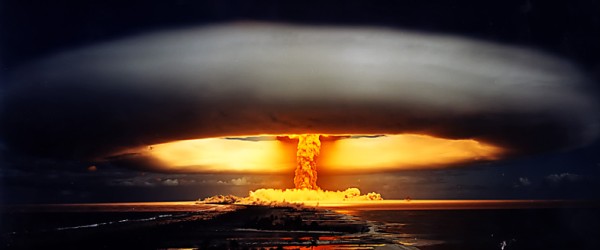
French nuclear test "Licorne", French Polynesia, July, 1970

Jeffrey Lewis writes: In an earlier job, I ran a project that tried to outline options for what would become the 2009 Nuclear Posture Review. One of the better parts was the travel. I made a lovely visit to Brussels, where my team had a series of very high-level meetings at the European Union and NATO headquarters. There were some steak frites, a little lambic beer, and a lot of talk about nuclear weapons. And at the time, senior U.S. military officers made one thing very clear to us: The security at the bases stunk. One commander noted that the upgrades necessary to meet security requirements would run into the hundreds of millions of dollars. Another said his worst fear was that a group of activists would be able to get inside the shelters where the nuclear weapons are stored and use a cell phone to publish a picture of the vaults.

And then it happened. In January 2010, a group of protesters who call themselves “Bombspotters” entered Kleine Brogel.

Apparently the plan was to hang around on the tarmac of the runway and get arrested. But no one came to arrest them. So they wandered around — for either 40 minutes or an hour, the accounts differ — before walking through an open gate into an area with hardened aircraft shelters for the base’s F-16s. Eventually, as the hippies continued to wander around the shelters, security arrived.

The “security force” was one moderately annoyed-looking Belgian guy with a rifle — an unloaded rifle. The effect would only have been more comedic if he had some powdered sugar on his face and maybe a little bit of waffle stuck to his uniform.

The protestors were briefly detained but not for long. There was no panic. The mood in Belgium seemed to be something like “you crazy kids.” Not to worry, the Belgians assured their American partners, the activists weren’t anywhere near the shelters with nuclear weapons.

So, a few months later, the activists entered the base again. They helpfully sent me a little note. This time, they not only got inside the proper area, but they also got inside one of the shelters.

Security never showed up. Apparently, the base commander found out about the incursion when the rest of us did — when the activists posted a video on YouTube a day or so later. This was literally the scenario the U.S. military officer had warned us about — hippies inside a shelter with a cell phone, security nowhere to be found.

Yet still no panic.

One way to look at this is to say that the multiple and redundant security features worked. Sure, the Belgians should have caught the activists at the fence. And, sure, the hippies got inside the inner perimeter. And, sure, the shelter shouldn’t have been unlocked. But the nuclear weapons inside the shelter were still secure in a vault in the floor. A terrorist would have needed the code or a jackhammer to access the bomb itself. Even if it was only the last, or next to last, line of defense, it still worked. Another day without a nuclear holocaust. Who’s complaining?

The other way to look at it is to see that the security failures were not independent. The base had a lax security culture that makes anything possible. There were no dogs because the Belgians were too cheap to hire a dog-master. Who is to say what other security breaches might be possible? Who is to say the same people who didn’t bother to lock the gates or the shelters wouldn’t also leave a vault open? Or wouldn’t say something indiscreet, allowing a group of armed men to show up as a bomb is being moved for servicing? According to this view, you either take security seriously, or you don’t. If you don’t, you are vulnerable to systematic breakdowns that allow the seemingly impossible to happen. [Continue reading…]

Facebooktwittermail

Mass surveillance silences minority opinions, according to study

Karen Turner reports: A new study shows that knowledge of government surveillance causes people to self-censor their dissenting opinions online. The research offers a sobering look at the oft-touted “democratizing” effect of social media and Internet access that bolsters minority opinion.

The study, published in Journalism and Mass Communication Quarterly, studied the effects of subtle reminders of mass surveillance on its subjects. The majority of participants reacted by suppressing opinions that they perceived to be in the minority. This research illustrates the silencing effect of participants’ dissenting opinions in the wake of widespread knowledge of government surveillance, as revealed by whistleblower Edward Snowden in 2013.

The “spiral of silence” is a well-researched phenomenon in which people suppress unpopular opinions to fit in and avoid social isolation. It has been looked at in the context of social media and the echo-chamber effect, in which we tailor our opinions to fit the online activity of our Facebook and Twitter friends. But this study adds a new layer by explicitly examining how government surveillance affects self-censorship. [Continue reading…]

Facebooktwittermail

FBI backs off from its day in court with Apple this time – but there will be others

By Martin Kleppmann, University of Cambridge

After a very public stand-off over an encrypted terrorist’s smartphone, the FBI has backed down in its court case against Apple, stating that an “outside party” – rumoured to be an Israeli mobile forensics company – has found a way of accessing the data on the phone.

The exact method is not known. Forensics experts have speculated that it involves tricking the hardware into not recording how many passcode combinations have been tried, which would allow all 10,000 possible four-digit passcodes to be tried within a fairly short time. This technique would apply to the iPhone 5C in question, but not newer models, which have stronger hardware protection through the so-called secure enclave, a chip that performs security-critical operations in hardware. The FBI has denied that the technique involves copying storage chips.

So while the details of the technique remain classified, it’s reasonable to assume that any security technology can be broken given sufficient resources. In fact, the technology industry’s dirty secret is that most products are frighteningly insecure.

Continue reading

Facebooktwittermail

Leaks reveal industrial scale bribery operation involving major U.S., European and Asian companies

oil-industry

Fairfax Media and The Huffington Post report: A massive leak of confidential documents has for the first time exposed the true extent of corruption within the oil industry, implicating dozens of leading companies, bureaucrats and politicians in a sophisticated global web of bribery and graft.

After a six-month investigation across two continents, Fairfax Media and The Huffington Post can reveal that billions of dollars of government contracts were awarded as the direct result of bribes paid on behalf of firms including British icon Rolls-Royce, US giant Halliburton, Australia’s Leighton Holdings and Korean heavyweights Samsung and Hyundai.

The investigation centres on a Monaco company called Unaoil, run by the jet-setting Ahsani clan. Following a coded ad in a French newspaper, a series of clandestine meetings and midnight phone calls led to our reporters obtaining hundreds of thousands of the Ahsanis’ leaked emails and documents.

The trove reveals how they rub shoulders with royalty, party in style, mock anti-corruption agencies and operate a secret network of fixers and middlemen throughout the world’s oil producing nations.

Corruption in oil production – one of the world’s richest industries and one that touches us all through our reliance on petrol – fuels inequality, robs people of their basic needs and causes social unrest in some of the world’s poorest countries. It was among the factors that prompted the Arab Spring.

Fairfax Media and The Huffington Post today reveal how Unaoil carved up portions of the Middle East oil industry for the benefit of western companies between 2002 and 2012. [Continue reading…]

Facebooktwittermail

The end of the Arab affair

Bassel Salloukh writes: What kind of a Syria will emerge from the wreckage of – so far – more than five years of fighting? This is the question international, regional, and local actors are pondering as ‘proximity talks’ between Syrian government envoys and representatives of the internationally-designated opposition commenced in Geneva in March 2016 under UN auspices.

What political system can restore a semblance of territorial integrity to a country devastated by all kinds of overlapping international, regional, and local wars and crisscrossed by transnational and local salafi-jihadi groups, where sectarian and ethnic identities, never the sole markers of political identity, have been securitised and are now assumed primordial and the main source of political identity and community?

How will communities that have witnessed political mobilisation in the name of the sect or the ethnic group, as well as sectarian and ethnic massacres, accept to live together again under the same flag or inside the same borders?

The inescapable question then is whether postwar Syria will retain its centralised unitary political structure, will be divided along ethno-federal lines, or a middle ground will be devised between these binary choices that may help restore peace to Syria without altering its political geography forever or denying its peoples their justifiable democratic aspirations. [Continue reading…]

Facebooktwittermail

During Russia’s ‘withdrawal,’ it has been shipping more into Syria than it has been removing

Reuters reports: When Vladimir Putin announced the withdrawal of most of Russia’s military contingent from Syria there was an expectation that the Yauza, a Russian naval icebreaker and one of the mission’s main supply vessels, would return home to its Arctic Ocean port.

Instead, three days after Putin’s March 14 declaration, the Yauza, part of the “Syrian Express”, the nickname given to the ships that have kept Russian forces supplied, left the Russian Black Sea port of Novorossiysk for Tartous, Russia’s naval facility in Syria.

Whatever it was carrying was heavy; it sat so low in the water that its load line was barely visible.

Its movements and those of other Russian ships in the two weeks since Putin’s announcement of a partial withdrawal suggest Moscow has in fact shipped more equipment and supplies to Syria than it has brought back in the same period, a Reuters analysis shows.

It is not known what the ships were carrying or how much equipment has been flown out in giant cargo planes accompanying returning war planes.

But the movements – while only a partial snapshot – suggest Russia is working intensively to maintain its military infrastructure in Syria and to supply the Syrian army so that it can scale up again swiftly if need be. [Continue reading…]

Facebooktwittermail

Why it’s wrong to say that the Arab uprisings failed

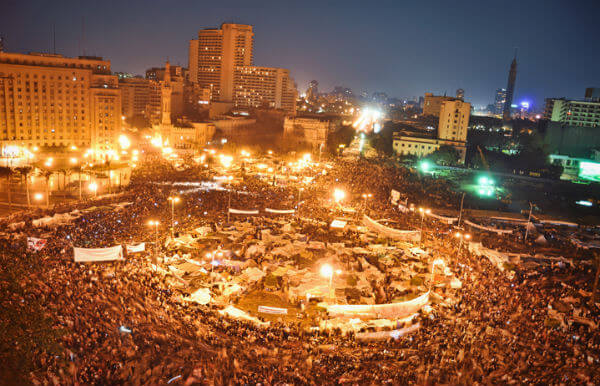
Tahrir_Square

Marc Lynch writes: Conventional wisdom holds that the Arab uprisings that began in Tunisia in December 2010 failed. It’s hard to argue with such a harsh verdict. Most Arab regimes managed to survive their popular challenges through some combination of cooptation, coercion and modest reform. Egypt’s transition ended in an even harsher military regime. Yemen and Libya collapsed into state failure and regionalized wars, while Syria degenerated into a horrific war.

But simply dismissing the uprisings as a failure does not capture how fully they have transformed every dimension of the region’s politics. Today’s authoritarians are more repressive because they are less stable, more frightened and ever more incapable of sustaining their domination. With oil prices collapsing and popular discontent again spiking, it is obvious that the generational challenge of the Arab uprising is continuing to unfold. “Success or failure” is not a helpful way to understand these ongoing societal and political processes.

Instead of binary outcomes, political scientists have begun to more closely examine the new political forms and patterns, which the uprisings generated. A few months ago, the Project on Middle East Political Science convened a virtual symposium with 30 political scientists examining how the turmoil of the past five years have affected Arab politics. Those essays, many of them originally published on the Monkey Cage, are now available for open access download as an issue of POMEPS Studies. Those essays offer an ambivalent, nuanced perspective on what has and has not changed in the region since 2011 – and point to the many challenges to come.

The new politics shaped by the Arab uprising can be tracked along multiple levels of analysis, including regional international relations, regimes, states, and ideas. [Continue reading…]

Facebooktwittermail

How ISIS built the machinery of terror under Europe’s gaze

shadow8

The New York Times reports: The day he left Syria with instructions to carry out a terrorist attack in France, Reda Hame, a 29-year-old computer technician from Paris, had been a member of the Islamic State for just over a week.

His French passport and his background in information technology made him an ideal recruit for a rapidly expanding group within ISIS that was dedicated to terrorizing Europe. Over just a few days, he was rushed to a park, shown how to fire an assault rifle, handed a grenade and told to hurl it at a human silhouette. His accelerated course included how to use an encryption program called TrueCrypt, the first step in a process intended to mask communications with his ISIS handler back in Syria.

The handler, code-named Dad, drove Mr. Hame to the Turkish border and sent him off with advice to pick an easy target, shoot as many civilians as possible and hold hostages until the security forces made a martyr of him.

“Be brave,” Dad said, embracing him.

Mr. Hame was sent out by a body inside the Islamic State that was obsessed with striking Europe for at least two years before the deadly assaults in Paris last November and in Brussels this month. In that time, the group dispatched a string of operatives trained in Syria, aiming to carry out small attacks meant to test and stretch Europe’s security apparatus even as the most deadly assaults were in the works, according to court proceedings, interrogation transcripts and records of European wiretaps obtained by The New York Times. [Continue reading…]

Facebooktwittermail

Thomas Frank: The inequality sweepstakes

Reading Thomas Frank’s new book, Listen, Liberal, or What Ever Happened to the Party of the People?, I was reminded of the snapshot that Oxfam offered us early this year: 62 billionaires now have more wealth than the bottom 50% of the global population, while the richest 1% own more than the other 99% combined. And in case you’re wondering in which direction inequality is trending on Planet Earth, note that in 2010, it took 388 of the super-rich to equal the holdings of that bottom 50%. At this rate in the inequality sweepstakes, by 2030, just the top 10 billionaires might do the trick. Let me just add that, as Frank makes clear in his brilliant new work, Donald Trump doesn’t have to win the presidency for billionaires to stand triumphant on the American part of our planet. Hillary Clinton will do just fine, thank you.

Listen, Liberal is, in a sense, a history of how, from the Clintonesque 1990s on, the Democratic Party managed to ditch the working class (hello, Donald Trump!) and its New Deal tradition, throw its support behind a rising “professional” and technocratic class, and go gaga over Wall Street and those billionaires to come. In the process, its leaders fell in love with Goldman Sachs and every miserable trade pact that hit town, led the way in deregulating the financial system, and helped launch what Frank terms “the greatest wave of insider looting ever seen”; the party, that is, went Silicon Valley and left Flint, Michigan, to the Republicans.  Only a few years after Bill Clinton vacated the Oval Office the financial system he and his team had played such a role in deregulating had to be rescued, lock, stock, and barrel from ultimate collapse. Quite a record all in all. Put another way, as Frank makes clear, in these years the Democrats (with obvious exceptions) became a more or less traditional Republican party. And if the Democrats are now the party of inequality, then what in the world are the Republicans? Don’t even get me started on the cliff that crew walked off of.

In the following post, adapted from his new book, Frank does a typically brainy thing. Since we’ve all heard for years about how the Democrats have been stopped from truly pursuing their political program by Republican experts in political paralysis, he turns to a rare set of places where, in fact, the Republicans were incapable of getting in the way and… well, let him tell the story. Tom Engelhardt

The blue state model
How the Democrats created a “liberalism of the rich”
By Thomas Frank

[This piece has been adapted from Thomas Frank’s new book, Listen, Liberal, or What Ever Happened to the Party of the People? (Metropolitan Books).]

When you press Democrats on their uninspiring deeds — their lousy free trade deals, for example, or their flaccid response to Wall Street misbehavior — when you press them on any of these things, they automatically reply that this is the best anyone could have done. After all, they had to deal with those awful Republicans, and those awful Republicans wouldn’t let the really good stuff get through. They filibustered in the Senate. They gerrymandered the congressional districts. And besides, change takes a long time. Surely you don’t think the tepid-to-lukewarm things Bill Clinton and Barack Obama have done in Washington really represent the fiery Democratic soul.

So let’s go to a place that does. Let’s choose a locale where Democratic rule is virtually unopposed, a place where Republican obstruction and sabotage can’t taint the experiment.

Continue reading

Facebooktwittermail

Companies are leaving the West Bank as international boycott campaign gains ground

Vice News reports: For the past 28 years, the Israeli cosmetics giant Ahava has manufactured its line of Dead Sea mud-based skincare products in a settlement located in the Israeli-occupied West Bank. But this month, the company announced it would build a new facility 10 miles to the south, just across the internationally recognized border separating Israel proper from the Palestinian territory.

Though the company did not link the move to political pressure, instead citing “expanding production needs due the success in marketing Ahava products around the world,” it has long been targeted by activists who protest Israeli companies operating in the West Bank, which much of the international community regards as illegally occupied.

Ahava is not alone — a number of companies have chosen to abandon their operations in the West Bank, according to a new report by the Israeli anti-occupation group Gush Shalom that was compiled from publicly available information and published as a wiki-entry.

Twenty years ago, Gush Shalom drew up a list of Israeli companies doing business across the Green Line, the pre-1967 boundary between Israel and the West Bank that has been a sticking point in negotiations over a future Palestinian state. As of March, between 20 and 30 percent of those companies are no longer operating there. [Continue reading…]

Facebooktwittermail

European policy is driving refugees to more dangerous routes across the Mediterranean

By Heaven Crawley, Coventry University and Nando Sigona, University of Birmingham

It is estimated that in 2015, more than a million people crossed the
Mediterranean to Europe in search of safety and a better life. 3,770 are known to have died trying to make this journey during the same period. This so-called “migration crisis” is the largest humanitarian disaster to face Europe since the end of World War II.

That’s why we’ve been working to examine the conditions underpinning this recent migration across, and loss of life in, the Mediterranean.

Our first research brief , based on interviews with 600 people, including 500 refugees, shines a light on the reasons why so many risk everything on the dangerous sea crossing. It also offers an insight into why the EU response has been so ineffective.

One of the main problems with the current approach to this crisis is the assumption that refugees and migrants are drawn towards particular countries because they offer employment, welfare, education or housing. This ignores the fact that in 2015 over 90% of those arriving by sea in Greece came from the world’s top-ten refugee producing countries, 56% from Syria. The ‘migration crisis’ is in fact a crisis of refugee protection.

Continue reading

Facebooktwittermail

Nusra’s ambition to govern faces challenge from Syrian activists

Borzou Daragahi reports: Syria’s al-Qaeda branch is seeking to emulate its jihadi rival, ISIS, by establishing its own government in areas it controls.

Over the past year, the Nusra Front, a powerful and well-organized Syrian rebel army that is the country’s official arm of al-Qaeda, has shifted tactics from being a solely military force to one seeking to tighten its hold over areas under its control by seizing the reins of governance, including law enforcement and municipal affairs, in what its supporters have hinted could become its own emirate in the northwestern Idlib province.

“They switched from just being a military power to taking over services,” said Abu Yahya, nom de guerre of a Syrian activist in the city of Muraat al-Noman, in Idlib province. “Nusra is trying to build institutions and trying to oversee services. They have now developed a love for power.”

The group’s efforts are concentrated on the city of Idlib, which the regime surrendered last year as a coalition of Islamist rebel groups that included Nusra pushed its way into the city. Over the following months, Nusra began to muscle out other rebel groups when it came to running the city. It did the same in other parts of Idlib province, where it has sought to create an institution called the The Liberated Districts Administration (Idaret al Manateq al Muharrarra), in an area that includes the cities of Idlib, Reeha and Jusr al-Shughoor, which would give them direct control of taxation, sanitation, electricity, water and as well as municipal governance. [Continue reading…]

Facebooktwittermail

Assad’s success in Palmyra dims prospects for political change in Syria

Charles Lister writes: The capture of Palmyra is an invaluable opportunity for the Assad regime and Russia to now proclaim themselves as capable and willing partners in the fight against ISIS. But we must not forget that the Assad regime purposefully ignored ISIS gains in Syria for nearly 18 months — April 2013 to August 2014 — as they proved an effective counterweight to the mainstream opposition. There is also bountiful evidence of the Assad regime’s deep and decades-long complicity in bolstering ISIS and its predecessor movements, for the purpose of manipulating them into shaping Syria’s domestic and foreign policy agendas. While there can be no doubting that ISIS’ loss of Palmyra represents a substantial strategic blow to their operations in Syria, this is the Assad regime’s first major victory against the group — after its presence on its territory for 3 years.

Events in Palmyra will also affect the viability of the political process in Geneva. Russia’s intervention has fundamentally transformed the balance of power on the ground and for the first time since mid-2013, the Assad regime is sitting comfortably in Damascus. Having recaptured Palmyra in a widely reported military operation conducted with Russian support, there is now no reason at all for Bashar al-Assad to even get close to considering a political transition. The next round of Geneva talks are scheduled to begin on April 11. Not only will this almost certainly be delayed, but the prospects for any progress on the substantive issue of political change look slim to none. [Continue reading…]

Facebooktwittermail

Putin and Assad score a major victory against ISIS, after months targeting Syrian rebels opposed to ISIS

Aymenn Al-Tamimi writes: The retaking of the ancient city of Palmyra from the Islamic State (ISIS) by the Syrian regime backed with intense Russian airpower is predictably being hailed as a victory over terrorism. Symbolically, of course, the recapture of Palmyra allows for the regime and Russia to portray themselves as the defenders of civilization over barbarism, as ISIS had destroyed some of the most archaeological sites in the area last year. But what do the events tell us about Russia’s broader approach towards ISIS? What may unfold in the aftermath of Palmyra’s recapture?

Fighting in the vicinity of Palmyra has occurred ever since ISIS took the city in a swift offensive through the Homs desert last year in which regime forces melted away on multiple occasions without much of a fight. This was similar to the losses the regime experienced in Idlib province at the hands of rebel offensives in the same year, pointing to broader problems of manpower shortages facing the regime, which led to a shift in strategy focusing on the defense of perceived vital areas, including setting up of local militia formations such as Coastal Shield in Latakia and Homeland Shield in Suwayda’ designed to recruit locals to fight within their own areas. These calculations changed somewhat with the official commencement of Russian intervention in the fall of 2015 in the form of intense airstrikes, allowing the regime to go on the offensive in multiple areas. [Continue reading…]

Facebooktwittermail

Pakistan bombing: Who are Jamaat ul-Ahrar?

By Talat Farooq, University of Birmingham

The Easter Sunday suicide attack on Gulshan-e-Iqbal amusement park in Lahore, Pakistan has claimed more than 70 lives. A rescue services spokeswoman confirmed that at least 29 children, seven women and 34 men were killed and more than 300 were wounded. On the fateful day, the popular resort was crowded with people marking Easter.

Pakistan is in a state of shock and dismay as eye witnesses on television screens recalled scattered body parts and pools of blood across the park, and hospital officials tweeted calls for blood donations.

Jamaat-ul Ahrar, a breakaway faction of the Tehrik-i-Taliban Pakistan (TTP), claimed responsibility for the attack. Ahsanullah Ahsan, the spokesman for Jamaat-ul-Ahrar, said the group had targeted Christians celebrating Easter, although the police are still investigating the claim. Warning Prime Minister Nawaz Sharif that “we have entered Lahore”, the capital of the Punjab province and the political power base of Sharif, the militant group threatened further attacks.

Jamaat-ul-Ahrar has so far launched several attacks on Pakistani civilians and security forces in recent months in an apparent attempt to boost its profile among Pakistan’s increasingly fractured Islamist militants, who since June 2014 have been at the receiving end of a fully-fledged military operation in Pakistan’s Federally Administered Tribal Areas (FATA). So far, the military has killed and arrested hundreds of suspected militants in the operation.

Continue reading

Facebooktwittermail

Islam’s forgotten bohemians

Nile Green writes: Every year, thousands of festivals around the tombs of Sufi saints in India, Pakistan and Bangladesh demonstrate the vitality of Sufi poetry. Dotted throughout town and countryside, the shrines where these saints are buried still form the focus for the spiritual lives of tens of millions of Muslims. Their doors and rituals are open to people of any religious background; as a result, Sufi shrines in India still play an important role in the religious life of many Hindus and Sikhs. The work of the great Baba Farid, a 13th-century Punjab Sufi poet, also exemplifies this long history of religious co-existence, as his poems form the oldest parts of the Sikh scriptures.

Farid’s poems are still recited in Sikh temples around the world. In one of the verses from his Adi Granth (the sacred scripture or ‘First Book’ of Sikhism), Farid declares in rustic and homely Punjabi:

Ap li-ay lar la-ay dar darves say.

Translation: Those tied to Truth’s robe are true tramps on the doorstep.

The seeker after Truth must become a wandering beggar. The word Farid uses is darves, or ‘dervish’ – literally, a vagrant who goes from door to door. Read again that alliterative line of Punjabi: Ap li-ay lar la-ay dar darves say. It has the simple rhythm of repetition, the call of love’s beggar traipsing from house to house.

What the German philosopher Max Weber described as the disenchantment of the world, modernity’s discrediting of the supernatural and magical, has not been good for these beggars, these mystical troubadours, especially among the Muslim middle classes. Their pilgrimage places, however, retain mass appeal, especially among the large populations of poor and uneducated people. That is why fundamentalists, whether the Pakistani Taliban, the Saudi government or ISIS, have destroyed so many Sufi shrines and places of pilgrimage. The poetry sung at those places celebrates and advances an Islam that rejects political power, an Islam incompatible with the ambitions of religious fundamentalism. It is an Islam antithetical to political Islam, which sees political power as the foundation of religion. Although not all forms of Sufi Islam are non-political, the Sufism of the dervishes renounced political power as the most significant impediment on the long road to their divine beloved. It is a spirit of Islam still very much alive. [Continue reading…]

Facebooktwittermail