Phys.org reports: In a landmark discovery for physics and astronomy, scientists said Thursday they have glimpsed the first direct evidence of gravitational waves, ripples in the fabric of space-time that Albert Einstein predicted a century ago.
When two black holes collided some 1.3 billion years ago, the joining of those two great masses sent forth a wobble that hurtled through space and reached Earth on September 14, 2015, when it was picked up by sophisticated instruments, researchers announced.
“Up until now we have been deaf to gravitational waves, but today, we are able to hear them,” said David Reitze, executive director of the LIGO Laboratory, at a packed press conference in the US capital.
Reitze and colleagues compared the magnitude of the discovery to Galileo’s use of the telescope four centuries ago to open the era of modern astronomy.
“I think we are doing something equally important here today. I think we are opening a window on the universe,” Reitze said. [Continue reading…]
Category Archives: Analysis
Gravity waves can’t be understood without understanding Einstein’s idea of gravity
By David Blair, University of Western Australia
I have spent almost 40 years trying to detect gravity waves.
When I started there were just a few of us working away in university labs. Today 1,000 physicists working with billion-dollar observatories are quietly confident the waves are within our grasp.
If we are right, the gravity wave search will have taken 100 years from the date of Einstein’s prediction.
In 100 years’ time the discovery of Einstein’s gravity waves will be one of the landmarks in the history of science. It will stand out like the discovery of electromagnetic waves in 1886, a quarter of a century after these waves were predicted by physicist James Clerk Maxwell.
The problem of talking about gravity waves is that you can’t explain them without explaining Einstein’s idea of gravity. Recently I began to ask why it is so difficult to explain gravity, why the concept is met with glazed eyes and baffled looks. Eventually I came up with a theory I call the Tragedy of the Euclidean Time Warp.
Can the U.S. take action to protect Aleppo?

Michael Ignatieff and Leon Wieseltier write: Aleppo is an emergency, requiring emergency measures. Are we no longer capable of emergency action? It is also an opportunity, perhaps the last one, to save Syria. Aleppo is the new Sarajevo, the new Srebrenica, and its fate should be to the Syrian conflict what the fate of Sarajevo and Srebrenica were to the Bosnian conflict: the occasion for the United States to bestir itself, and for the West to say with one voice, “Enough.” It was after Srebrenica and Sarajevo — and after the air campaign with which the West finally responded to the atrocities — that the United States undertook the statecraft that led to the Dayton accords and ended the war in Bosnia.
The conventional wisdom is that nothing can be done in Syria, but the conventional wisdom is wrong. There is a path toward ending the horror in Aleppo — a perfectly realistic path that would honor our highest ideals, a way to recover our moral standing as well as our strategic position. Operating under a NATO umbrella, the United States could use its naval and air assets in the region to establish a no-fly zone from Aleppo to the Turkish border and make clear that it would prevent the continued bombardment of civilians and refugees by any party, including the Russians. [Continue reading…]
Any military strategy that’s designed “to recover our moral standing” is dubious — and not simply because there are those who doubt that the U.S. possessed much the moral standing in the first place.
The effectiveness of a military strategy can’t be assessed on the basis of the worthiness of its non-military goals.
The authors in their sweeping assertion that they are offering “a perfectly realistic path,” dodge the awkward details on how this would work.
Are they assuming that once the boundaries of this no-fly zone had been defined, Russian and Syrian aircraft would then obediently comply?
Or do they assume that as soon as a few jets had been shot down the intended lesson would have swiftly been learned?
Turkey already shot down a Russian jet on the edge of this arena. What lessons, if any, have been drawn from that incident and are they now being applied to this future scenario?
“If the Russians and Syrians sought to prevent humanitarian protection and resupply of the city, they would face the military consequences,” we are told by the armchair generals.
“Military consequences” is a phrase of political bluster — especially when coming from two writers who profess no military expertise. If pressed to spell out what these military consequences might be, I expect Ignatieff and Wieseltier would defer to the actual generals.
My point here is not to dismiss the idea that at this late hour there might be a constructive military intervention in Syria, but simply to say that such an argument needs more detail and substance and fewer passionate declarations. It needs to credibly show how this would work rather than simply why it should be undertaken.
Currently, Obama administration officials are cynically curtailing all discussion about their military options by claiming that they only have two choices: start World War III or do essentially nothing (beyond repeating their mantra that their is no military solution in Syria).
“What do you want me to do, go to war with Russia?” John Kerry is reported to have asked a Syrian NGO representative in London last week.
The choice is false but it is gladly being picked up by ideological anti-interventionists who are attracted by the rhetorical utility of this device when offered to those who have little interest in questioning its validity.
To those who insist on framing this crisis in terms of World War III, I would ask two questions: What makes you think it hasn’t already begun? And why do you think its defining attribute necessarily involves a clash between the U.S. and Russia?
A world war involves global instability and a contagion of violent conflict. There are active conflicts in Pakistan, Afghanistan, Yemen, Iraq, Syria, Turkey, Egypt, and Libya. There is unrest in Saudi Arabia, Bahrain, Palestine, Israel, and elsewhere.
As the EU struggles to handle the refugee crisis, European unity is being fractured, placing its future in jeopardy.
If through the power of inattention, Americans could indeed successfully insulate themselves from the effects of global strife, then perhaps this could endure as a land of blissful ignorance.
Instead, what is more predictable is that the more disengaged the U.S. becomes, the less influence it will have and the fewer options it can consider.
No one will benefit from America’s self-imposed paralysis.

Why the time is again ripe for American socialism
By Michael Espinoza, UCL
Vermont Senator Bernie Sanders has handily beaten Hillary Clinton to win the New Hampshire primary – and after being dismissed as more or less an ideological sideshow when it first began, his campaign has become an unlikely but remarkable movement.
With the Republican Party in a seemingly unstoppable rightward spiral, as the likes of Ted Cruz and Donald Trump dominate its race, the seemingly unexpected rise of as such a proud left-wing candidate as Sanders might seem inconsistent with every trend in recent American politics. At the beginning of the race, he was unknown to many voters outside his home state of Vermont. He is also the Senate’s only self-proclaimed socialist, a label that many once thought would make him utterly unelectable.
But Sanders’s support for “democratic socialism” hasn’t just been surprisingly popular: it’s rapidly changing the way America perceives socialism and all it stands for.
A major strength of Sanders’s campaign is an economic argument against income inequality. This message is at the heart of Sanders’s self-described democratic socialism, but the “revolution” he’s advocating isn’t a Marxist seizure of the means of production; it’s a democratic political uprising.
But this in itself is hardly anything new by the standards of American politics, even at the presidential level.
Bernie Sanders’ universalism
Haaretz reports: One of [Richard Sugarman’s] duties seems to be explaining Sanders’ Jewish identity – or lack thereof – to the media. [Sugarman is an Orthodox Jewish academic and longtime friend of Sanders.] In October, Sugarman told the Jewish Telegraphic Agency that his friend is not “embarrassed or ashamed” of being Jewish, but he is a “universalist” and “doesn’t focus on those issues.” In November, Sugarman made a similar point to NPR – that Sanders is “not into identity politics, and I don’t think … this campaign is going to change him.”
His prediction has held true. Sanders has never referred to his Judaism except in jest – as in his Saturday Night Live appearance – or when asked directly about it by a reporter. In the latter circumstance, he usually refers to his family’s history with the Holocaust and his commitment to social justice and economic equality, but avoids talk of theology or observance.
When, last fall, Sanders was asked on-camera whether he believed in God – by, of all people, late-night host Jimmy Kimmel, he avoided directly answering the question, and invoked none other than the Pope in his answer: “I am who I am, and what I believe in and what my spirituality is about is that we’re all in this together. I think it is not a good thing to believe as human beings we can turn our backs on the suffering of other people, And this is not Judaism. This is what Pope Francis is talking about, that we cannot worship just billionaires and the making of more and more money.”
More recently, Sanders shook off the whispers that he may well be an atheist simply afraid to say the word, by telling the Washington Post that “I think everyone believes in God in their own ways,” he said. “To me, it means that all of us are connected, all of life is connected, and that we are all tied together.” [Continue reading…]
The cheap, brutally effective medieval tactic shaping the Syrian civil war

Annia Ciezadlo writes: On Feb. 3, the United Nations suspended talks between the regime of Syrian President Bashar al-Assad and representatives of the Syrian opposition. The Geneva talks, which were aimed at ending the five-year-old civil war, had bogged down in distrust and regional politics before they even got underway.
The UN mediator, Staffan de Mistura, hinted that the initial round of discussions collapsed because the Syrian regime refused to lift the sieges that are slowly starving hundreds of thousands of people across the country. Assad’s regime has been using starvation as a weapon — technically a war crime, when used against civilians — for the past four years.
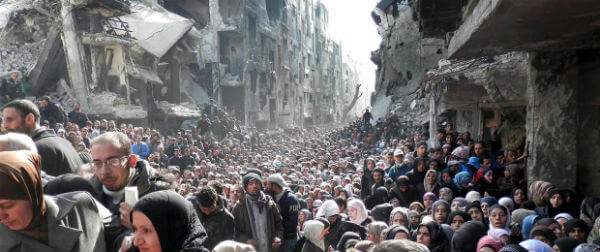
As the war has progressed, various rebel factions, like Islamic State and Nusra Front, have also adopted the strategy. But the vast majority of the people under siege in Syria are being starved by their own government. Today, up to a million people are being slowly and deliberately starved to death in the heart of the Fertile Crescent, many of them a stone’s throw away from grain silos full of wheat. [Continue reading…]
Syrian opposition see Obama’s support having been worthless
The New York Times reports: The United States and its allies have spent many millions of dollars backing Syrian opposition fighters they deem relatively moderate and secular, and civilian groups whose work on small businesses and local councils they billed as the cornerstone of Syria’s future.
But the very Syrians who benefited — and risked their lives in the process — now say that investment is in danger of going down the drain, and they see little urgency from Washington, diplomatic or military, to save it.
“What are you going to do, other than statements?” Zakaria Malahifji, the political chief of one of the largest rebel groups given weapons and salaries by the C.I.A. and its counterparts in several European and Arab states, demanded in a recent message to contacts at the French Embassy.
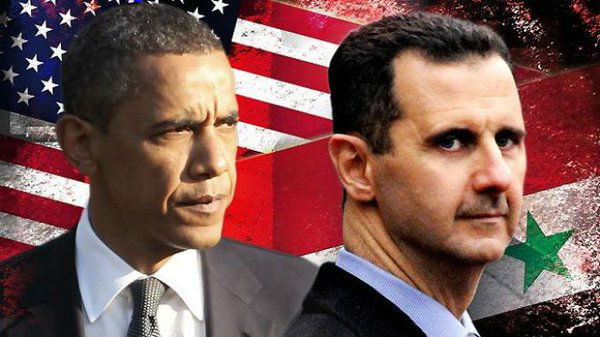
In nearly five years of war and insurrection, many Syrians have been repeatedly disillusioned by what they saw as a mismatch between tough American rhetoric against the Syrian government and comparatively modest efforts to aid some of its opponents. President Obama said President Bashar al-Assad must go, and drew a red line over the use of chemical weapons, but backed off on both, diminishing anti-government Syrians’ trust.
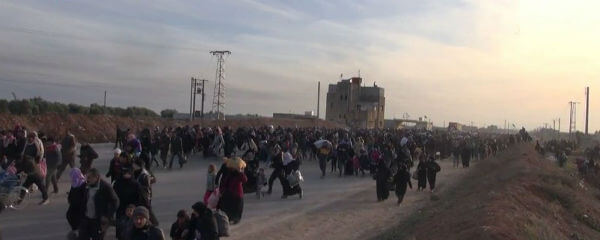
But the confusion and despair has reached a new level over the last week, as forces backing Mr. Assad have pushed farther north into Aleppo Province, sending tens of thousands of new refugees to the Turkish border. With insurgent groups losing troops and territory, their villages shattered by Russian warplanes, civilians and fighters have in recent days used phrases like “no hope,” “it’s finished” and “it’s over.”
“Bye-bye, revolution,” Abu al-Haytham, a spokesman for Thuwwar al-Sham, another rebel group supported through the C.I.A. program, said in a text message on Friday from Tal Rifaat, a town in northern Aleppo that is increasingly threatened by the government advance.
American-backed insurgents have long been used to the American stance in recent years, that the United States did not want them to actually win the war — lest a sudden toppling of Mr. Assad lead to Islamist rule — but wanted to prevent them from losing for long enough to pressure the government to negotiate for a political solution.
Now they fear that the United States and its allies may actually let them lose. [Continue reading…]
Why are Russian engineers working at an ISIS-controlled gas plant in Syria?
Foreign Policy reports: The Syrian government originally awarded the contract to construct the Tuweinan facility [the largest such facility in Syria, located 60 miles southwest of Raqqa] to Stroytransgaz in 2007. The construction utilized a Syrian subcontractor, Hesco, which was owned by Russian-Syrian dual national George Haswani. Last November, the Treasury Department sanctioned Haswani for allegedly brokering oil sales between the Islamic State and the Assad regime, charges he denies.
The partnership between Hesco and Stroytransgaz goes far beyond this one deal. The companies have worked in joint projects in Sudan, Algeria, Iraq, and the UAE since 2000, according to Haswani’s son-in-law, Yusef Arbash, who runs Hesco’s Moscow office.
Construction continued slowly until a coalition of Syrian rebel groups seized the facility in a joint operation with the al Qaeda-affiliated al-Nusra Front in January 2013. Abu Khalid, a member of the Qwais al-Qarani brigade, which was a part of the rebel coalition, said that when they entered the area, Russian engineers and advisors had already fled, leaving Syrian employees behind. “We decided to protect this plant; we thought it is belonging to Syrian people since it was owned by the Syrian state,” he said.
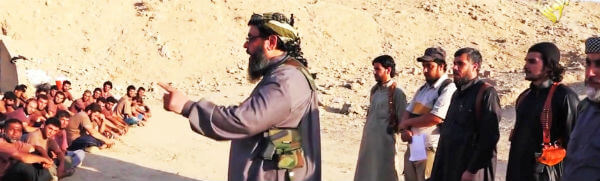
The Islamic State has been in control of the facility since early 2014. A senior Turkish official said that after its seizure, Stroytransgaz, through its subcontractor Hesco, continued the facility’s construction with the Islamic State’s permission. He also claimed that Russian engineers have been working at the facility to complete the project.
Syrian state-run newspaper Tishreen published a report appearing to corroborate this claim. In January 2014, after the facility was captured by the Islamic State, the paper cited Syrian government sources, saying that Stroytransgaz had completed 80 percent of the project and expected to hand over the facility to the regime during the second half of the year. The article didn’t mention that the facility was under the control of the Islamic State. [Continue reading…]
Chechen leader threatens foes in bid to gain Putin’s support

The Associated Press reports: The Kremlin-backed strongman of Chechnya has issued a stream of threats against Russia’s liberal opposition, but his primary audience appears to be the Russian president himself.
With Ramzan Kadyrov’s five-year stint as regional leader about to expire, he is trying to parlay his strong personal ties with President Vladimir Putin to extend his hold on power. The Russian president must now decide whether to keep him in place or yield to rising pressure from law-enforcement agencies to get rid of the wayward strongman, who has ruled Chechnya like his personal fiefdom.
Putin has seen the burly, red-haired 39-year-old former rebel as essential to keeping Chechnya stable after two separatist wars, and has given him privileges no one else in Russia’s tightly controlled political system has seen. If he backs Kadyrov for another term, the Chechen leader is certain to easily win the popular vote set for September.
Kadyrov has converted his personal relationship with Putin into a steady flow of federal subsidies and immunity from federal controls. Even Russia’s all-powerful security agencies have been forced to bow to Kadyrov’s diktat, maintaining a symbolic presence in Chechnya but depending entirely on his will.
Kadyrov’s unprecedented clout has worried many in Russia, who see it as a dangerous erosion of federal authority and a looming threat to the country’s integrity. The Chechen leader’s defiant posture also has won him numerous enemies among the leaders of law-enforcement agencies, but they have had to bite their tongues. [Continue reading…]
The Supreme Court halted Obama’s climate change plan. This doesn’t bode well

Scott Lemieux writes: Hours before New Hampshire’s primary voters made Donald Trump the favorite for the Republican presidential nomination Tuesday night – I can’t really believe this even as I type it – the US supreme court reminded us of why the upcoming presidential election is so important. On a party-line vote, the court temporarily stopped Barack Obama’s clean power plan from going into effect. This decision could well portend a future one that will have devastating consequences – not only for the climate but for the state of our lawmaking process.
The decision also underscores the urgency of the November elections in two ways: it will be a choice between a candidate who supports taking action against climate change and one who believes it should be ignored, and it will present a choice between a president who believes that the federal government has the authority to effectively regulate and one who believes that the supreme court should arbitrarily throw monkey wrenches into the political process. [Continue reading…]
Exodus and betrayal: How a Syrian Nakba was created

David Hearst writes: US Secretary of State John Kerry came close to revealing his true thoughts when he was accosted by two Syrian aid workers at a reception in London after the collapse of the Geneva talks last week.
The Syrians accused him of doing nothing to protect civilians from the onslaught they are facing in Aleppo. Kerry replied: “Don’t blame me – go and blame your opposition,” laying the fault for the government’s offensive on the opposition walking out of the talks.
Kerry got flustered in the encounter: “What do you want me to do? Go to war with Russia? Is that what you want?” the aid worker said Kerry told her. Kerry then anticipated three months of bombing during which time “the opposition will be decimated”.
Kerry’s off-mic encounter deviated significantly from the official line which was that Russia and Iran had offered Washington a ceasefire. Kerry’s remarks differed also from the State Department mantra that the brutality of Assad against the Syrian people had helped foster the growth of the Islamic State group. Apparently now, Syrians who resisted Assad’s brutality were responsible for the barrel bombs being dropped on them.
After multiple avowals that Assad’s army was on the point of collapse and the ill-fated CIA training programmes, Syrian rebels are being sold down the river by the country that urged them to rise up five years ago.
The Deraa protests started peacefully. To that everyone attests. Four factors turned those protests into an armed uprising: the brutality of the regime’s response, Assad’s decision to release Jihadis from Sednaya Prison, an act which “Islamised” the opposition, the Libyan intervention, and the intervention of foreign powers – Iran and Saudi Arabia.
The scenes today on the Turkish border are a direct consequence of Obama’s “intervention-lite” in Syria – a drip feed of weapons – but only 16 bullets per fighter per month. The Free Syrian Army has reportedly stopped receiving weapons for four months. In Libya, Obama boasted he was leading from behind. In Syria he is now wringing his hands from behind. [Continue reading…]
U.S. credibility is plummeting among Syrians and across the region
Josh Rogin writes: In the eyes of the Syrian opposition, Russia and Iran are making a mockery of the peace process, and Kerry’s reluctance to acknowledge this is putting them in deadly harm. It also creates more problems for America’s regional allies, aids the Islamic State and dims the prospects for future peace talks. “The failures of the negotiations end up lowering the credibility of the moderate opposition in front of the Syrian people,” said [Riyad] Hijab. [Hijab is leader of the High Negotiating Committee that represented the Syrian opposition at last week’s meetings in Geneva.] “United States credibility is plummeting within the population of Syria but also in the region as a whole.”
This week, it is Syrians near Aleppo who are paying the price. Regime forces, with Russian support, are advancing toward the Turkish border, threatening to cut off opposition groups and civilians from their source of aid. At least 35,000 people have joined the flood of refugees since the collapse of the talks, ahead of what many anticipate will be another in a long line of starvation sieges the regime is perpetrating on cities. Hijab said there are now 18 cities under siege, three more than when the talks began.
Moscow wants the peace talks to fail, Hijab said. He accused the Russian air force of using illegal cluster bombs indiscriminately against civilians. (Human rights groups support those claims.) “The situation has taken a horrible turn, specifically in terms of the scorched earth policy of the Russian aircraft and the way that they are bombing, literally destroying everything,” he said. “The other side has been moving to ensure the failure of any negotiation through horrendous bombardment.”
Hajib said the Obama administration is still pressuring the opposition to return to talks despite the ongoing offensive, but the opposition is insisting that Russia adhere by the UN resolutions first. In a press conference with reporters last week, Kerry said of the Syrian-Russian attacks on civilians, “It’s not going to stop just by whining about it.” He called on rebel leaders to return to the negotiating table. [Continue reading…]
While listening to U.S. State Department spokesmen John Kirby at yesterday’s press briefing, one might not have accused him of whining, but instead adopting President Obama’s standard position: a baseless confidence that whoever can make the most reasonable argument will win the day — as though politics conforms to the rules of a debating society.
Kerry and Obama must be very perplexed about how unreasonable it is that Russia regards bombing as more useful than diplomacy. But what is actually very unreasonable is the notion that anyone would be fooled by Washington’s toothless efforts at peacemaking.
Syria: Assad regime kills so many detainees it amounts to ‘extermination’ of civilian population, UN says
The Independent reports: The Assad regime is killing so many detainees in Syria that it now amounts to the crime against humanity of “extermination”, a UN report has found.
In a document published by the UN’s High Commissioner for Human Rights, investigators found the Syrian government responsible for “massive and systematised violence”.
The crimes against humanity committed by the Assad regime, according to the UN, far outnumber those of Isis militants and other jihadist groups. [Continue reading…]
The offline allure of ISIS

TSG IntelBrief: Two recent announcements highlight the difference between the so-called Islamic State’s reach on social media and its real-world appeal. On February 5, 2016, Twitter announced it had suspended more than 125,000 accounts for supporting terrorism since mid-2015. On the same day, UN Secretary-General Ban Ki-moon announced that 34 militant groups worldwide had pledged allegiance to the Islamic State as of last December, with more likely in 2016. The Islamic State’s social media efforts have always received disproportionate attention. Less attention has been paid to the offline power of the group in terms of radicalization and recruitment. Social networks matter more than social media when it comes to proliferating the ideology of bin-Ladinism espoused by both the Islamic State and al-Qaeda.
From pamphlets to audio cassette tapes—and now videos and mobile messaging apps—terrorists have always sought to broadcast their ideology to motivate and rally people to their cause. But the real propagation of terrorism requires salesmen and saleswomen—people who understand that the principles of persuasion begin with a deep understanding of the prospective customer. Graphic tweets may produce headlines, but persuasive individuals produce recruits, often in clusters.
The eight young men who left the Lisleby district of Fredrikstad, Norway, to join the Islamic State in Syria did not join because of social media, even if it did help spread the group’s message. All were reportedly motivated to join the Islamic State by the example of Abdullah Chaib, a charismatic local soccer player who traveled to Syria in 2012. The small group of friends created a feedback loop of motivation and encouragement that did not depend on Twitter or Facebook. Likewise, the terror recruit cluster in Molenbeek, Belgium thrived on networks built around friendship and familial ties, not Telegram or Kik. This same dynamic of peer-to-peer recruitment and consistent face-to-face interaction produced the cluster in the Minneapolis-Saint Paul region of Minnesota. Long-time foreign fighter hotbeds such as Derna, Libya, and Bizerte and Ben Gardane in Tunisia rely on decidedly offline networks to export extremism. [Continue reading…]
Shia village simmers amid Saudi crackdown
Financial Times reports: A month after Saudi Arabia executed firebrand Shia cleric Sheikh Nimr al-Nimr, his home town of Awamiya remains strewn with black flags commemorating his death.
The authorities have dubbed the dilapidated village in the oil-rich eastern province the most dangerous place in the conservative Sunni kingdom, and it bears the scars of confronting the state. Shia slogans are ubiquitous and some buildings are pockmarked with bullet holes. Two armoured personnel carriers stand sentry outside the local security post but the jittery police rarely patrol the streets.
“The people and the government are both waiting, ready to pounce,” said Mohammed al-Nimr, Sheikh Nimr’s brother. “There is only pessimism here now.”
The execution of Sheikh Nimr caused an uproar in Shia Iran and has prompted concerns that unrest within Saudi Arabia’s minority Shia, which claim to be the victim of decades of discrimination by the ruling al-Saud family, could become another front in the worsening regional cold war between Riyadh and Tehran. [Continue reading…]
Anywhere but home: An Afghan child labourer in Iran dreams of life in Sweden
The Guardian reports: Mohammad, 14, is an Afghan immigrant who recently joined the flow of refugees arriving in the holding centre for unaccompanied minors on the Greek island of Lesvos.
Leaving his parents behind in Iran, he crossed the Aegean Sea on an overcrowded rubber dinghy with 38 other passengers. Mohammad describes the nighttime crossing as the scariest moment in his life. But he would not allow himself to cry. Unlike the other children on the boat, his parents were not there to comfort him. He “needed to be brave” and “be a man,” he says. His family’s decision to send their eldest son on an uncertain journey to Europe was a difficult one – but it was the most promising option compared to returning to his homeland or staying in Iran.
Afghans account for the largest proportion of unaccompanied minors arriving in Lesvos. Over one-third of the 2,248 minors that passed through Lesvos last year hail from Afghanistan, according the Greek NGO Metadrasi.
Most Afghans fleeing war and economic strife in their homeland have spent time in Iran, which has hosted the second-largest population of Afghan refugees for over 30 years. But worsening living conditions in Iran are forcing young migrants like Mohammad to leave even their temporary homeland in search of yet another one.
An estimated 2.3-3 million Afghans now live inside Iran, of whom 800,000 are children. The first wave of Afghan refugees arrived in Iran following the 1979 Soviet invasion of Afghanistan and subsequent civil war. They had access to public education and opportunities to work. Some 97% of Afghans lived outside refugee camps, and were integrated into urban communities.
Since the 2001 US invasion of Afghanistan and the fall of the Taliban, Iran began instituting increasingly restrictive laws on Afghans, including bureaucratic hurdles, limitations on movement, deportation of minors and separation of families, and reduced access to education. [Continue reading…]
Will Germany give up on European integration?
Ivan Krastev writes: The millions of people storming the borders of the European Union today are right to believe that migration is the best revolution. It is a revolution of the individual, not the masses. The European Union is more attractive than any 20th-century utopia, for the simple reason that it exists. But as it looks today, the migrants’ revolution could easily inspire a counterrevolution in Europe.
The myriad acts of solidarity toward refugees fleeing war and persecution that we saw months ago are today overshadowed by their inverse: a raging anxiety that these same foreigners will compromise Europe’s welfare model and historic culture. Cellphone images of foreign-looking men attacking and abusing German women during New Year’s in Cologne crystallized the fear that liberal governments are too weak and confused to defend Europe, and that the situation with migration is spiraling out of control.
Even before Cologne, a majority of Germans had started to doubt that their country could integrate those hundreds of thousands of Syrians, Afghans and others who have arrived in the last year. Chancellor Angela Merkel, who until recently was the symbol of the European Union’s self-confidence and resilience, is now portrayed as a Gorbachev-like figure, noble but naïve, somebody whose “Wir shaffen es” — “We can do it” — policy has put Europe at risk.
But it is not only the refugees who have arrived, and those on the way, that keep Berlin’s government on the edge of a nervous breakdown. Germany has a second, less discussed but no less disturbing integration problem: European integration itself. [Continue reading…]
U.S. suffering from shortage of immigrants
Financial Times reports: US builders do not suffer from too many Mexican workers, but too few; they stand to gain from immigration reform, not lose. The joke in Texas is that if Mr Trump really wants to put up a wall between the US and Mexico, he will have to open the border first to find enough workers to finish the job.
Across the US, the construction sector — which contributes 4 per cent to US gross domestic product — is suffering from chronic shortages of workers that are pushing up wages and slowing down activity. Of the 1,358 companies surveyed last year by the Associated General Contractors of America, 86 per cent had trouble filling positions, up three percentage points from 2014. More than seven out of 10 contractors reported difficulty finding carpenters, 60 per cent for electricians and 56 per cent for roofers. In 2014, a builder called Camden Property Trust installed security guards at sites in Denver, Colorado, and Austin, Texas, to prevent competitors from poaching workers.
“I could be twice the size in terms of revenue if we had the flow of labour that we could be training,” says Chad Collins, owner of Bone Dry Roofing in Athens, Georgia. “We are handcuffed by the lack of a willing and skilled work force.”
The impact is particularly dramatic in Dallas. Even as US recession fears grow, the city and its suburbs are thriving as companies such as Toyota, Facebook and JPMorgan Chase build facilities. “There is a workforce issue,” says Keith Post, KPost chief executive. “People are stealing and overpaying [workers].” Steve Little, the company’s president, says labour costs have risen 15 per cent in the past two years.
Homebuilder Bruno Pasquinelli, president and founder of CB JENI Homes in Dallas, says delays are mounting. “It’s very difficult to predict when a house is going to get finished,” he says. “Houses that we used to build in 22 weeks are now taking upwards of 30 and bad ones could be 40.”
The labour shortages are counterintuitive. US construction employment fell from 7.7m to 5.4m during the downturn, and it was assumed there would be plenty of workers once business recovered. But some industry veterans retired. Others headed to the oilfields as the shale boom gathered pace. And many went home to Mexico — creating a problem, given the sector’s dependence on immigrants. [Continue reading…]