Mashable: The latest video posted by West African Islamist extremists Boko Haram marks a change in tactics for the militant group.
The footage, featuring a man believed to be Boko Haram leader Abubakar Shekau, depicts the reclusive leader delivering a 12-minute “message” to leaders in the Nigerian government and western democracies, condemning their rule of law and urging their leaders to turn to Allah.
But perhaps most interesting is the way in which the video was shared, the iconography used throughout, its higher resolution and the cues the group seems to be taking from its colleagues in the Islamic State (ISIS), militants thousands of miles away.
Category Archives: Analysis
Bank hackers find haven in Putin’s Russia
The Hill reports: The diplomatic standoff between the United States and Russian President Vladimir Putin is hobbling efforts to prosecute cyber crime against American banks.
Russian hackers played a major role in the newly exposed worldwide cyber heist, where thieves learned how to imitate bank employees to withdraw more than $1 billion from 100 banks.
While analysts suspect the heist originated in Ukraine and Eastern Europe, that information is of little use to American law enforcement officials who are getting no help from Moscow when it comes to catching cyber thieves.
“Trying to get cooperation from law enforcement in that area is, in many cases, actively hampered by the Russian government,” said Stu Sjouwerman, CEO of cybersecurity training firm KnowBe4, which most often works with banks.
“Given the current relationship between the United States and Russia, [cooperation] does not seem likely,” added Peter Toren, a cyber crime attorney who was part of the Department of Justice’s original batch of computer crimes prosecutors.
Last August, Russian digital thieves were blamed for the cyber attack on JPMorgan that exposed sensitive data on over 83 million households. Reportedly, the same attack infiltrated up to nine other major banks.
“Harassment of U.S. financial firms is just part of the bigger picture and it is the price of business to some degree,” Sjouwerman said.
Experts believe much of the hacking occurs either at the behest of Putin’s government, or with its tacit approval. Some speculated the JPMorgan hit was retaliation for the new U.S. sanctions that were slapped on Russia as the country amassed troops on the Ukraine border. [Continue reading…]
Wade Williamson writes: For several years now, cybercrime in the financial sector was synonymous with banking botnets such as Zeus and Carberp. By and large, these malware families and their many descendants worked by infecting banking customer’s computers and either stealing passwords or manipulating online banking sessions to steal funds.
A recent report from Kaspersky Lab shows that criminals have significantly raised their game with a new strategy focused on infiltrating and stealing directly from more than 100 different banks. Kaspersky named the operation the Carbanak APT and early estimates put losses in the range of $1 billion USD.
As you might expect, robbing a bank can be more lucrative than stealing from its customers. Even highly successful Zeus operations would typically net in the range of $100 million USD or less. Carberp, the banking botnet progenitor of Carbanak, was estimated to have earned a total of $250 million over years of use in the wild. This makes the $1 billion dollar Carbanak heist one of the most successful financial cybercrimes in history. [Continue reading…]
Russian researchers expose breakthrough U.S. spying program
Reuters reports: The U.S. National Security Agency has figured out how to hide spying software deep within hard drives made by Western Digital, Seagate, Toshiba and other top manufacturers, giving the agency the means to eavesdrop on the majority of the world’s computers, according to cyber researchers and former operatives.
That long-sought and closely guarded ability was part of a cluster of spying programs discovered by Kaspersky Lab, the Moscow-based security software maker that has exposed a series of Western cyberespionage operations.
Kaspersky said it found personal computers in 30 countries infected with one or more of the spying programs, with the most infections seen in Iran, followed by Russia, Pakistan, Afghanistan, China, Mali, Syria, Yemen and Algeria. The targets included government and military institutions, telecommunication companies, banks, energy companies, nuclear researchers, media, and Islamic activists, Kaspersky said. (reut.rs/1L5knm0)
The firm declined to publicly name the country behind the spying campaign, but said it was closely linked to Stuxnet, the NSA-led cyberweapon that was used to attack Iran’s uranium enrichment facility. The NSA is the agency responsible for gathering electronic intelligence on behalf of the United States.
A former NSA employee told Reuters that Kaspersky’s analysis was correct, and that people still in the intelligence agency valued these spying programs as highly as Stuxnet. Another former intelligence operative confirmed that the NSA had developed the prized technique of concealing spyware in hard drives, but said he did not know which spy efforts relied on it. [Continue reading…]
The Silk Road: where libertarian dreams collided with criminal realities
Henry Farrell writes: The Hidden Wiki holds the keys to a secret internet. To reach it, you need a special browser that can access ‘Tor Hidden Services’ – websites that have chosen to obscure their physical location. But even this browser isn’t enough. Like the Isla de Muerta in the film Pirates of the Caribbean, the landmarks of this hidden internet can be discovered only by those who already know where they are.
Sites such as the Hidden Wiki provide unreliable treasure maps. They publish lists of the special addresses for sites where you can use Bitcoin to buy drugs or stolen credit card numbers, play strange games, or simply talk, perhaps on subjects too delicate for the open web. The lists are often untrustworthy. Sometimes the addresses are out-of-date. Sometimes they are actively deceptive. One link might lead to a thriving marketplace for buying and selling stolen data; another, to a wrecker’s display of false lights, a cloned site designed to relieve you of your coin and give you nothing in return.
This hidden internet is a product of debates among technology-obsessed libertarians in the 1990s. These radicals hoped to combine cryptography and the internet into a universal solvent that would corrupt the bonds of government tyranny. New currencies, based on recent cryptographic advances, would undermine traditional fiat money, seizing the cash nexus from the grasp of the state. ‘Mix networks’, where everyone’s identity was hidden by multiple layers of encryption, would allow people to talk and engage in economic exchange without the government being able to see.
Plans for cryptographic currencies led to the invention of Bitcoin, while mix networks culminated in Tor. The two technologies manifest different aspects of a common dream – the utopian aspiration to a world where one could talk and do business without worrying about state intervention – and indeed they grew up together. For a long time, the easiest way to spend Bitcoin was at Tor’s archipelago of obfuscated websites.
Like the pirate republics of the 18th century, this virtual underworld mingles liberty and vice. Law enforcement and copyright-protection groups such as the Digital Citizens’ Alliance in Washington, DC, prefer to emphasise the most sordid aspects of Tor’s hidden services – the sellers of drugs, weapons and child pornography. And yet the effort to create a hidden internet was driven by ideology as much as avarice. The network is used by dissidents as well as dope-peddlers. If you live under an authoritarian regime, Tor provides you with a ready-made technology for evading government controls on the internet. Even some of the seedier services trade on a certain idealism. Many libertarians believe that people should be able to buy and sell drugs without government interference, and hoped to build marketplaces to do just that, without violence and gang warfare.
Tor’s anonymity helps criminals by making it harder for the state to identify and detain them. Yet this has an ironic side-effect: it also makes it harder for them to trust each other, because they typically can’t be sure who their interlocutors are. To make money in hidden markets, you need people to trust you, so that they will buy from you and sell to you. Having accomplished this first manoeuvre, the truly successful entrepreneurs go one step further. They become middlemen of trust, guaranteeing relations between others and taking a cut from the proceeds. [Continue reading…]
Bernard Haykel on the folly of bombing ISIS
Obama counters violent extremists with extremists
Jacob Siegel writes: There’s a gnawing contradiction at the center of a high profile White House summit being held this week dedicated to curbing violent extremism: The U.S. is heading the opposition to extremism at the same moment the country is increasingly allied with violent extremists in the fight against ISIS.
It’s one of a number of inconvenient issues as national and global leaders gather to figure out what to do about the radicals in their midst. Critics, including former administration officials and terrorism experts, are skeptical about the effectiveness of government initiatives. Many question whether the summit amounts to much more than a feel good PR spectacle.
The “Countering Violent Extremism” conference, which began Tuesday and runs through Friday, has drawn elected leaders and lawmakers from around the world, U.S. law enforcement officials, religious leaders, and experts on radical ideologies and their adherents. Participants are supposed to address a broad range of extremist threats, but it’s clear from President Obama’s own remarks that ISIS and the threat from jihadist groups have an outsized presence at the summit.
Few details about the summit’s agenda were released ahead of the event but even before it began there was debate over how extremism would be defined. The White House was accused, variously, of “avoiding the world Muslim” in its discussion of extremist threats and focusing too narrowly on Islamic radicalism at the exclusion of other violent groups. The terms of that debate miss another distinction. As the war against ISIS illustrates, there are extremist groups the government is willing to tolerate, and in some cases work alongside, and others it is not. [Continue reading…]
U.S. won’t back Egypt’s attacks on ISIS
Nancy A. Youssef reports: The Obama administration was given multiple chances Wednesday to endorse a longtime ally’s airstrikes on America’s biggest enemy at the moment, the so-called Islamic State. Over and over again, Obama’s aides declined to back Egypt’s military operation against ISIS. It’s another sign of the growing strain between the United States and Egypt, once one of its closest friends in the Middle East.
This shouldn’t be a complete surprise; Cairo, after all, didn’t tell Washington about its strikes on the ISIS hotbed of Derna, Libya. Still, Wednesday’s disconnect was jarring. White House Press Secretary Josh Earnest passed on a reporter’s question about an endorsement of Egypt’s growing campaign against ISIS. So did State Department spokeswoman Jen Psaki.
“We are neither condemning nor condoning” the Egyptian strikes, is all one U.S. official would tell The Daily Beast.
In other words, these once-close nations are now fighting separate campaigns against their mutual foe. And that could prove to be very good news for ISIS. The rift between U.S. and the region’s most populous country portends of another division that ISIS could exploit, this time for its expansion into northern Africa and the broader Middle East. [Continue reading…]
Brawl in Turkey parliament puts focus on Erdogan power plays
The Associated Press reports: Chairs flew and lawmakers traded punches. A brawl in Parliament over a new security bill has forced the spotlight on mounting suspicions that President Recep Tayyip Erdogan’s real goal is to hand himself more tools to crush dissent.
Five lawmakers were injured early Wednesday in the fight that broke out as opposition leaders tried to delay a debate on the legislation.
The government says the measures to give police heightened powers to break up demonstrations are aimed at preventing violence such as the deadly clashes that broke out last year between Kurds, supporters of an Islamist group and police. Critics say that the new measures are part of a steady march toward blocking mass demonstrations that threaten Erdogan’s iron grip over Turkish politics.
The bill would expand police rights to use firearms, allow them to search people or vehicles without a court order and detain people for up to 48 hours without prosecutor authorization. Police would also be permitted to use firearms against demonstrators who hurl Molotov cocktails. Demonstrators who cover their faces with masks or scarves during violent demonstrations could face four years in prison.
Crucially, the measures would give governors — not just prosecutors and judges — the right to order arrests. [Continue reading…]
Why the fight against ISIS is failing
Sarah Leah Whitson writes: Six months and 16,000 airstrikes into the campaign to defeat the Islamic State, with less than 1% of the territory it held in Iraq recovered, an honest accounting leads to only one conclusion: The U.S.-led strategy is failing.
With the effort focused almost exclusively on a military defeat of the armed group, also known as ISIS, neither the Iraqi government nor its anti-ISIS allies – Iran included – have seriously addressed the reforms and accountability for abuses that could earn back the support of Iraq’s Sunni population. The fragmentation of Iraq’s fighting forces into unaccountable sectarian militias responsible for horrific abuses against Iraqi civilians is part of Iraq’s slide into a broken state that no amount of foreign aid and military intervention will be likely to put back together.
Despite the grievances underlying initial Sunni support for ISIS, the anti-ISIS coalition has focused almost exclusively on an airstrikes campaign, with Shi’a militias supported by Iran as the primary boots on the ground.
The stunning takeover by ISIS of a massive swath of Iraqi territory testified to the alienation of Sunni communities. Many Sunnis welcomed ISIS fighters as “liberators” from the sectarian oppression of government forces. But let’s not forget how Iraq got to that point – with the U.S.-led Iraq war that displaced a dictator but resulted in an abusive occupation and destructive civil war, leaving more than a million dead. [Continue reading…]
Snowden supporters can’t handle complexity
If Glenn Greenwald had more interest in investigation and less interest in being a celebrity, he could find no better tutor than Steven Aftergood — someone who most of Greenwald’s followers have most likely never heard of. Even so, Greenwald certainly understand what plays well with a large audience: a simple story.
Aftergood writes: For some of Edward Snowden’s partisans and supporters…, the possibility that his leaks had negative as well as positive consequences involves more complexity than they can tolerate. If Snowden intended to defend constitutional values, as he insists, then how dare anyone suggest that he may have also aided America’s enemies, even indirectly?
This sort of complexity does not arise in Laura Poitras’s award-winning film Citizenfour about Snowden, as its few critical reviewers have noted.
Many of the documents Snowden disclosed “go far beyond exposures of spying on Americans,” wrote Fred Kaplan in a review of the film in Slate. “If Snowden and company wanted to take down an intelligence agency, they should say so. But that has nothing to do with whistleblowing or constitutional rights.”
Likewise, wrote George Packer in The New Yorker, “Among the leaked documents are details of foreign-intelligence gathering that do not fall under the heading of unlawful threats to American democracy–what Snowden described as his only concern. [Former NSA official William] Binney, generally a fervent Snowden supporter, told USA Today that Snowden’s references to ‘hacking into China’ went too far: ‘So he is transitioning from whistle-blower to a traitor’.”
And from Michael Cohen in The Daily Beast: “What is left out of Poitras’s highly sympathetic portrayal of Snowden is so much of what we still don’t know about him. For example, why did he steal so many documents that have nothing to do with domestic surveillance but rather overseas–and legal–intelligence-gathering operations?”
But for a discussion of Citizenfour that presents no such dissonant, skeptical notes or troublesome opposing views, see the late David Carr’s final interview with Snowden, Poitras and Glenn Greenwald.
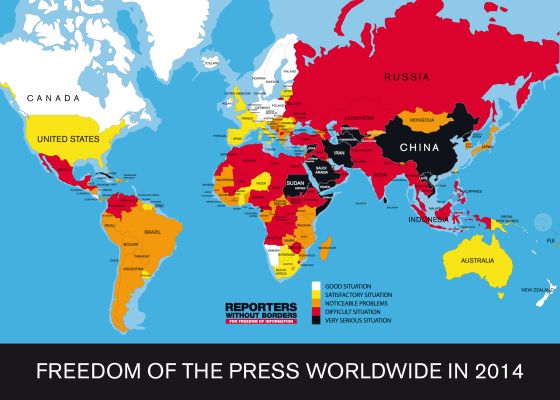
For me, one of the most memorable moments in that interview came when the participants scoffed at the United State’s poor ranking in the latest Borders Without Borders World Press Freedom Index.
At 46, the U.S. falls below countries such as Botswana — proximity which for Greenwald appeared to insult America’s reputation much more than it complimented Botswana.
While enjoying the freedom to speak from a stage in New York City (Greenwald’s fear of getting arrested in the U.S. seemed to disappear as soon as he got a Pulitzer and published his book), no mention was made of the fact that the country where Snowden resides ranks 148, while Greenwald’s home country of Brazil ranks 111.
No doubt, for as long as the U.S. retains the conceit of being “the leader of the free world,” it has little excuse for failing to rank number one in press freedom. At the same time, those who choose to characterize the U.S. government as the preeminent threat to personal freedom in the world, are either willfully ignoring or simply ignorant of much more egregious threats to freedom that can be seen in China, the Middle East, Russia and elsewhere.
Who are the women who join ISIS?
Anakana Schofield writes: There isn’t much primary source material on the foreign women who have gone voluntarily to Syria and Iraq and chosen to live under the Islamic State, alongside the thousands of women Isis have kidnapped, beaten, raped, forced to convert and sold into sexual slavery. We know the places the volunteers have left but can only speculate as to why.
The women who join Isis are often referred to as female foreign fighters or women jihadis. But according to Women of the Islamic State: A Manifesto on Women by the Al-Khanssaa Brigade, in a section headed ‘secondary functions of a woman’, it would require a fatwa for them actively to fight, ‘as the blessed women of Iraq and Chechnya did, with great sadness’.
The manifesto has been translated by the Quilliam Foundation, ‘the world’s first counter-extremism think tank’, which says that it is aimed at recruiting Arab women, especially from Saudi Arabia. It is supposedly written by women but doesn’t sound like it. It reads as if written by a bunch of men squashed in a hot shed. [Continue reading…]
Terror Inc.: How the ISIS became a branding behemoth
Alyssa Bereznak writes: When Robin Williams died last August, people around the world rushed online to mourn the loss of the actor. “Oh dear God. The wonderful Robin Williams has gone,” Bette Midler tweeted. “No words,” added a somber Billy Crystal. “Shame. I liked Jumanji,” tweeted one England-based Twitter user. “Good movie. Loved it as a kid,” replied an account with the handle @Mujahid4life.
“Mujahid,” for those unfamiliar, roughly translates to “jihadist warrior.” And this particular handle belonged to a 19-year-old British-born guy by the name of Abdullah, who happened to be both a supporter of the Islamic State and a big Robin Williams fan.
Abdullah’s opinion of the fallen star unleashed a torrent of blog posts, most of which marveled at the fact that a member of an organization that openly beheads its enemies could also have the emotional capacity to mourn a U.S. comedian on Twitter. But however surreal it was to watch Hollywood actors and terrorist sympathizers tangle online, those voyeuristic bloggers missed a larger point. That moment encapsulated a key pillar of the group’s now infamous social media fortress: Spreading extremist ideology doesn’t need to start with religious screeds and beheadings. It starts — as a social media 101 instructor might say — by simply taking part in the conversation. [Continue reading…]
Do Israelis have any idea how bad it is in Gaza?
Haggai Matar writes: “I’m extremely concerned that if you leave Gaza in the state it’s currently in, you’ll have another eruption, and violence, and then we’re back in a further catastrophe, so we’ve got to stop that,” warned Quartet envoy Tony Blair during a visit to the Gaza Strip on Sunday. It was his first trip to the Gaza since the last war, and Blair spent his time meeting with ministers and surveying the progress – or lack thereof – toward rehabilitating the Strip.
The scope of destruction in Gaza remains enormous. According to the UN, over 96,000 homes were either damaged or destroyed by Israeli air strikes. The donor states that have pledged to transfer money have yet to do so, re-building is going nowhere, many are still seeking refuge in UNRWA schools and the winter storms have only increased the damage to the homes and neighborhoods that survived.
The Israeli blockade, which prevents exports, economic development and importing building materials not previously approved by Israel, and which includes firing at fishermen, continues to choke the Strip. Furthermore, the Egyptian government has only tightened the blockade on its end over the past months. Egypt has destroyed all the tunnels into Sinai, keeps the Rafah crossing closed on a regular basis, and has destroyed large parts of Rafah in order to create buffer zone between the city and its Gaza counterpart. And all this after the Egyptian government banned Hamas’ military wing, calling it a “terrorist organization.” [Continue reading…]
Fear of Israeli leaks fuels distrust over U.S. talks with Iran
The New York Times reports: With the Obama administration racing to negotiate the outlines of a nuclear deal with Iran by the end of March, aides to Prime Minister Benjamin Netanyahu of Israel have charged in recent days that they are being deliberately left in the dark about the details of the talks. The Americans have said that is untrue, but even one of Washington’s closest negotiating partners reports being warned about being too open with the Israelis, “because whatever we say may be used in a selective way.”
The tensions between the United States and Israel over negotiating with Tehran have a long and twisted history, and they plunged to a new low when Mr. Netanyahu engineered an invitation to address a joint meeting of Congress, in less than two weeks, to warn against a “bad deal.”
Now, with Mr. Netanyahu maneuvering to survive a March 17 election, and Mr. Obama pressing for a breakthrough agreement that could end three decades of enmity with Iran and reduce the chances of a military confrontation, it seems that Washington and Jerusalem are engaging in the diplomatic equivalent of posting notes to each other on the refrigerator door.
The latest dispute has been building since the Israeli news media began running stories about Mr. Netanyahu’s being frozen out of the briefings about the talks, sourced to unnamed Israeli officials. Some of the reports have been accompanied by partial details about how many centrifuges, the machines that enrich uranium, would be left spinning in Iran’s facilities under an American proposal — oftentimes omitting key facts about how quickly the centrifuges could produce bomb-grade fuel. [Continue reading…]
Israeli sources dispute claims of CIA’s lead role in Mughniyeh assassination
Dan Raviv writes: In true-life espionage stories that inadvertently go public, there are often three stages: the initial revelation, the corrective second version from other sources, and – decades later – what really happened.
Newsweek and The Washington Post scored scoops last month, revealing that the CIA worked jointly with Israel’s Mossad to assassinate a Lebanese terrorist in February 2008 in Damascus: the military chief of the Iranian-controlled Hezbollah movement, Imad Mughniyeh.
The bomb explosion that killed Mughniyeh – who was held responsible for killing hundreds of Americans, notably in Beirut explosions that toppled the U.S. Embassy and a Marines barracks – was triggered from 135 miles away when a button was pushed in Mossad headquarters. A CIA man was inside the HQ near Tel Aviv.
This was a unique arrangement in which CIA and Mossad officers coordinated their undercover efforts in Syria’s capital, located the target, identified his habits, and parked a vehicle containing a bomb just outside an apartment he used.
According to the published accounts, the bomb had been designed, shaped, and repeatedly tested at an American base to be sure that only Mughniyeh and no other people would be killed.
Because of the revelation that the CIA was part of the mission, as well as details of how it was accomplished, Israelis close to their country’s security services wondered why American sources chose to leak so much about it.
One result was that some of those Israelis – apparently miffed that the Americans were taking too much credit – went to the trouble of speaking with Western officials and diplomats to offer corrections.
Basically, using a phrase inspired by the blue-and-white flag of Israel, they suggested that the assassination of Mughniyeh was “almost all blue-and-white, and just a little bit red-white-and-blue.”
Based on what they told their Western contacts this month, the Israelis claim that their Mossad and Aman (military intelligence) agencies managed to pick up the trail of the elusive terrorist – despite plastic surgery that changed his appearance. His biggest mistake was moving around Damascus without bodyguards, and specifically an unguarded area in front of his apartment building in the Syrian capital.
Contrary to the recent reports, the Israelis claim to have designed and tested the bomb, while respecting the CIA’s insistence that it not be too large so as not to kill any innocents. [Continue reading…]
What ISIS really wants
Graeme Wood’s 10,000-word feature article on ISIS, written for The Atlantic, is worth reading from beginning to end. But if you don’t have the time, here are most of the key passages:
The Islamic State, also known as the Islamic State of Iraq and al-Sham (ISIS), follows a distinctive variety of Islam whose beliefs about the path to the Day of Judgment matter to its strategy, and can help the West know its enemy and predict its behavior. Its rise to power is less like the triumph of the Muslim Brotherhood in Egypt (a group whose leaders the Islamic State considers apostates) than like the realization of a dystopian alternate reality in which David Koresh or Jim Jones survived to wield absolute power over not just a few hundred people, but some 8 million.
We have misunderstood the nature of the Islamic State in at least two ways. First, we tend to see jihadism as monolithic, and to apply the logic of al‑Qaeda to an organization that has decisively eclipsed it. The Islamic State supporters I spoke with still refer to Osama bin Laden as “Sheikh Osama,” a title of honor. But jihadism has evolved since al-Qaeda’s heyday, from about 1998 to 2003, and many jihadists disdain the group’s priorities and current leadership.
Bin Laden viewed his terrorism as a prologue to a caliphate he did not expect to see in his lifetime. His organization was flexible, operating as a geographically diffuse network of autonomous cells. The Islamic State, by contrast, requires territory to remain legitimate, and a top-down structure to rule it. (Its bureaucracy is divided into civil and military arms, and its territory into provinces.)
We are misled in a second way, by a well-intentioned but dishonest campaign to deny the Islamic State’s medieval religious nature.
[…]
The reality is that the Islamic State is Islamic. Very Islamic. Yes, it has attracted psychopaths and adventure seekers, drawn largely from the disaffected populations of the Middle East and Europe. But the religion preached by its most ardent followers derives from coherent and even learned interpretations of Islam.Virtually every major decision and law promulgated by the Islamic State adheres to what it calls, in its press and pronouncements, and on its billboards, license plates, stationery, and coins, “the Prophetic methodology,” which means following the prophecy and example of Muhammad, in punctilious detail. Muslims can reject the Islamic State; nearly all do. But pretending that it isn’t actually a religious, millenarian group, with theology that must be understood to be combatted, has already led the United States to underestimate it and back foolish schemes to counter it. We’ll need to get acquainted with the Islamic State’s intellectual genealogy if we are to react in a way that will not strengthen it, but instead help it self-immolate in its own excessive zeal. Continue reading
Libya’s Arab spring: The revolution that ate its children
Chris Stephen reports: “It was better under Gaddafi,” says the young Libyan student, studying the froth bubbling over the top of his cappuccino in a cafe in Tunis as he contemplates the revolution that swept Muammar Gaddafi from power four years ago. “I never thought to say this before, I hated him, but things were better then. At least we had security.”
Tuesday marks the fourth anniversary of that revolution but nobody is celebrating. Egyptian air strikes now hammering Islamic State positions in the east of the country, in response to the beheading of 21 Egyptian Christians, is a further twist in an already grim civil war. Four years ago the student picked up a gun and joined rebel militias. Now he wishes he had stayed home.
“If I had that time again, I would not join [the rebels],” he says. Like many of his former comrades, he has left the country, but won’t give his name, fearing retribution against his family back home.
“In the past, we would have a party for the anniversary of the revolution, but not this time,” says Ashraf Abdul-Wahab, a journalist. “A lot of people tell you it was better under Gaddafi, that the revolution was a mistake. What they mean is, things are worse now than they were then.”
Libya’s Arab spring was a bloody affair, ending with the killing of Gaddafi, one of the world’s most ruthless dictators. His death saw the rebel militias turn on each other in a mosaic of turf wars. Full-scale civil war came last summer, when Islamist parties saw sharp defeats in elections the United Nations had supervised, in the hope of bringing peace to the country. Islamists and their allies rebelled against the elected parliament and formed the Libya Dawn coalition, which seized Tripoli. The new government fled to the eastern city of Tobruk and fighting has since raged across the country.
With thousands dead, towns smashed and 400,000 homeless, the big winner is Isis, which has expanded fast amid the chaos. Egypt, already the chief backer of government forces, has now joined a three-way war between government, Libya Dawn and Isis.
It is all a long way from the hopes of the original revolutionaries. With Africa’s largest oil reserves and just six million people to share the bounty, Libya in 2011 appeared set for a bright future. “We thought we would be the new Dubai, we had everything,” says a young activist who, like the student, prefers not to give her name. “Now we are more realistic.”
Just why Libya’s Arab spring went so badly wrong is a matter of hot debate. Some blame Nato for not following up with political support after its air campaign; some argue that it was the lack of institutions to make democracy work, or Libya’s atomised tribal structure that makes cooperation hard and magnifies distrust. Many have simply given up.
“So many of the revolutionaries of four years ago have gone to ground, they have fled, ” says Michel Cousins, editor of the English-language Libya Herald newspaper. “They say a revolution eats its children.” [Continue reading…]
Fear and silence in Libya as divisions deepen
Reuters reports: On the surface life looks normal in the Libyan capital. Cafes are bustling with customers sipping cappuccino, while well-stocked shops sell anything from Italian underwear to French cheese.
But as in the days of Muammar Gaddafi, many residents prefer to avoid talking politics in Tripoli, where a self-declared government has ruled since an armed faction called Libya Dawn seized the capital by expelling its rivals in August.
Across Libya to the east, where the internationally recognised government operates and a former general is battling Islamist militants, many Libyans are just as wary, fearing any criticism will see them branded as traitors or worse.
The oil-producing nation is now effectively split in two with the internationally recognised Prime Minister Abdullah al-Thinni confined to the east since losing control of Tripoli and a rival administration controlling the capital and its surroundings.
Both governments are backed by former rebel brigades who united to topple Gaddafi in 2011 but have since turned their guns on each other as Libya slides toward a wider civil war.
The heavily armed groups have been fighting on different fronts for territory and control of oil ports. Hundreds of civilians have been killed and 400,000 displaced inside Libya since the summer, according to the United Nations.
With the country polarized between the two rival factions who dismiss each other as traitors, terrorists or war criminals, many Libyans explain that, as in the Gaddafi era, it’s best to say little and avoid trouble. [Continue reading…]


