The New York Times reports: President Trump has directed his administration to more aggressively enforce the nation’s immigration laws, unleashing the full force of the federal government to find, arrest and deport those in the country illegally, regardless of whether they have committed serious crimes.
Documents released on Tuesday by the Department of Homeland Security revealed the broad scope of the president’s ambitions: to publicize crimes by immigrants; enlist local police officers as enforcers; strip immigrants of privacy rights; erect new detention facilities; discourage asylum seekers; and, ultimately, speed up deportations.
The new enforcement policies put into practice the fearful speech that Mr. Trump offered on the campaign trail, vastly expanding the definition of “criminal aliens” and warning that such unauthorized immigrants “routinely victimize Americans,” disregard the “rule of law and pose a threat” to people in communities across the United States.
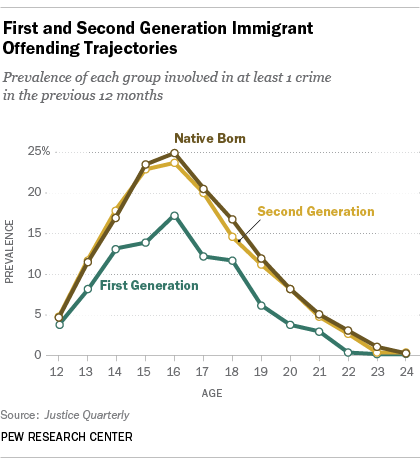
Despite Mr. Trump’s talk, research shows lower levels of crime among immigrants than among native-born Americans. [Continue reading…]
A report published by Pew Research Center in 2013 states: The crime rate among first-generation immigrants—those who came to this country from somewhere else—is significantly lower than the overall crime rate and that of the second generation. It’s even lower for those in their teens and early 20s, the age range when criminal involvement peaks. [Continue reading…]
Christopher Dickey writes: European politicians and policy makers have begun to feel they’re watching a horror movie: the tale of an American administration with a split personality as sinister as Dr. Jekyll and Mr. Hyde — the first perfectly reasonable and sociable, the other monstrous, unable, and unwilling to control its impulses. And all this as the very existence of the European Union and the credibility of NATO hang in the balance with far-right populists like Geert Wilders in the Netherlands and Marine Le Pen in France potentially set to gain enormous power through upcoming elections.
The respected French daily Le Monde describes this administration as one where there’s “a civil war at the top” between “the rationals” and “the radicals.” And over the last few days “the rationals” — Vice President Mike Pence, Secretary of Defense Gen. John Mattis, Secretary of State Rex Tillerson, Secretary of Homeland Security Gen. John Kelly — have been in Europe trying to find ways to say that the president does not really mean what he has said again, and again, and again, and keeps on saying. No, the rationals insisted, NATO is not “obsolete.” Yes, the United States supports the European Union.
And the rationals might have succeeded in convincing their closest European friends that the U.S. commitment was as serious as it sounded—until Europe saw video of President Donald Trump soaking up adoration at a staged rally in Florida on Saturday, as if slobbering fans could vindicate his trademark incoherence. [Continue reading…]
Politico reports: Lt. Gen. H.R. McMaster, the president’s new national security adviser, knows a thing or two about standing up to the commander in chief and his political confidantes — and the potentially disastrous consequences when you don’t.
He literally wrote the book on it.
The military’s leading warrior-intellectual drew key lessons about the workings of the National Security Council from his exhaustive history of White House deliberations during the Vietnam War.
They could come in handy as he takes the reins following the ignominious departure of President Donald Trump’s first national security adviser, retired Lt. Gen. Michael Flynn, and joins a White House similarly grappling with deep divisions in the country, public protests and open partisan warfare over Trump’s most controversial policies, from immigration to Russia.
The debacle that was Vietnam inflicted “one of the greatest political traumas” on the United States since the American Civil War, McMaster wrote in “Dereliction of Duty: Lyndon Johnson, Robert McNamara the Joint Chiefs of Staff, and the Lies That Led to Vietnam,” which was published in 1997 after he earned his doctorate from the University of North Carolina at Chapel Hill.
“It led Americans to question the integrity of their government.”
Even a quarter century after it ended, in his view, the shadow of the war — the 58,000 American lives lost , the billions of dollars spent, the social upheaval it caused — hung over American foreign and military policy and the nation itself. [Continue reading…]
The Washington Post reports: On the night of President Trump’s inauguration, Sebastian Gorka attended the celebratory balls in a high-necked, black Hungarian jacket. Pinned on his chest was a Hungarian coat of arms, a tribute to his father who had been tortured by the communists, and a civilian commendation from the U.S. military.
For years, Gorka had labored on the fringes of Washington and the far edge of acceptable debate as defined by the city’s Republican and Democratic foreign policy elite. Today, the former national security editor for the conservative Breitbart News outlet occupies a senior job in the White House and his controversial ideas — especially about Islam — drive Trump’s populist approach to counterterrorism and national security.
Amid the cheering, music and confetti that night, Gorka talked about Trump’s opening shot in a high-stakes civilizational war, still in its early days.
“Everything’s changed,” Gorka said.
He homed in on three words from Trump’s dystopian inaugural address that day: “Radical Islamic terrorism.”
“When he used those three words today — radical Islamic terrorism — he put the marker down for the whole national security establishment,” Gorka told an interviewer from Fox News.
For Gorka and his allies, the words are more than just a description of the enemy. They signal a radical break with the approach that Republicans and Democrats have taken over the past 16 years to counterterrorism and the Muslim world.
Only days after the Sept. 11, 2001, attacks, President George W. Bush insisted the terror strikes had “violated the fundamental tenets of the Islamic faith.”
“Islam is peace,” he told a nation still reeling from grief.
President Barack Obama sounded the same theme routinely during two terms in office.
Gorka has relentlessly championed the opposite view.
For him, the terrorism problem has nothing to do with repression, alienation, torture, tribalism, poverty, or America’s foreign policy blunders and a messy and complex Middle East. [Continue reading…]
Politico reports: Several experts interviewed by POLITICO puzzled over the gap between the numerous military academic credentials listed by Gorka — a political science Ph.D. who unfailingly uses the title “Dr.” — and their unfamiliarity with his work and views.
“When I first encountered his name during the transition, I did a triple-take. I’ve been in counterterrorism since 1998, and I thought I knew everyone. But I’d never heard his name and couldn’t recall anything he’d written or said,” said Daniel Benjamin, who served as counterterrorism coordinator under Secretary of State Hillary Clinton.
Retired Col. Peter Mansoor, a former top aide to Gen. David Petraeus in Iraq who helped rewrite the Army’s counterinsurgency manual, also said he’s never crossed paths with Gorka. “What I’ve heard has not been complimentary,” added Mansoor, who now teaches at Ohio State University and remains active in military circles. [Continue reading…]
The New York Times reports: has appeared in a number of television and radio interviews as a representative of the Trump administration and a member of a White House team called the Strategic Initiatives Group. The Daily Beast called it a think tank within the White House that was set up by Mr. Bannon and the president’s son-in-law and senior adviser, Jared Kushner.
The group’s formation raised red flags, said Julianne Smith, a former deputy national security adviser to Vice President Joseph R. Biden Jr. and the director of strategy and statecraft at the Center for a New American Security.
The National Security Council has traditionally played a decisive role in foreign policy decisions, she said. “Now we have the Strategic Initiatives Group and the National Security Council both working on issues of national security and strategy. So my question on Sebastian, ultimately, is: Who is he reporting to? Is he reporting to the National Security Council? Or is this a direct line to Bannon?” [The Washington Post article cited above says he reports to Bannon.] [Continue reading…]
Like most self-described “experts” on jihad, Gorka has never spoken to a jihadist:
That changed when I formally resigned last week. Despite working proudly for Republican and Democratic presidents, I reluctantly concluded that I cannot in good faith serve this administration as an intelligence professional.
This was not a decision I made lightly. I sought out the CIA as a college student, convinced that it was the ideal place to serve my country and put an otherwise abstract international-relations degree to use. I wasn’t disappointed. [Continue reading…]
Judy Dempsey writes: How Theresa May must be regretting the day she proposed inviting U.S. President Donald Trump on a state visit to the UK sometime in 2017. The British prime minister extended the invitation on behalf of the queen during her official visit to Washington on January 26–27. This was May’s way of proving that Britain could manage quite well without the European Union, thank you very much. London and Washington would have an even closer and even more special relationship than before now that the EU is soon going to be out of the way.
Just think of the trade deals the United States and Britain could forge, May argued, forgetting that as long as Britain remains a member of the EU, trade deals are the prerogative of Brussels, not of national governments. No matter. It was as if membership of the EU were hindering Britain’s foreign policy and its economic ties with third countries. Britain would now be free to go its own way.
No sooner had May returned home from the United States than a petition was launched to stop the visit “because it would cause embarrassment to Her Majesty the Queen.” The queen is not easily embarrassed. She has had no qualms in sharing the royal horse-drawn carriage with dictators including Romania’s Nicolae Ceauşescu, Zaire’s Mobutu Sese Seko, or Indonesia’s Haji Muhammad Suharto. Those visits were about political and ideological interests. [Continue reading…]
The New York Times reports: President Trump picked Lt. Gen. H.R. McMaster, a widely respected military strategist, as his new national security adviser on Monday, calling him “a man of tremendous talent and tremendous experience.”
Mr. Trump made the announcement at his Mar-a-Lago getaway in Palm Beach, Fla., where he has been interviewing candidates to replace Michael T. Flynn, who was forced out after withholding information from Vice President Mike Pence about a call with Russia’s ambassador.
The choice continued Mr. Trump’s reliance on high-ranking military officers to advise him on national security. Mr. Flynn was a retired three-star general and Defense Secretary Jim Mattis is a retired four-star general. His first choice to replace Mr. Flynn, who turned the job down, and two other finalists were current or former senior officers as well. [Continue reading…]
CNN reports: McMaster, currently serving as the director of the Army’s Capabilities Integration Center, is the first active-duty military officer to take the post since Gen. Colin Powell served in the role during the final years of the Reagan administration. As an active-duty service member, McMaster would likely have had difficulty turning down a job the commander in chief had asked him to fill. [Continue reading…]
Reuters reports: McMaster, 54, is a West Point graduate known as “H.R.,” with a PhD in U.S. history from the University of North Carolina at Chapel Hill. He was listed as one of Time magazine’s 100 most influential people in 2014, partly because of his willingness to buck the system.
A combat veteran, he gained renown in the first Gulf War – and was awarded a Silver Star – after he commanded a small troop of the U.S. 2nd Army Cavalry Regiment that destroyed a much larger Iraqi Republican Guard force in 1991 in a place called 73 Easting, for its map coordinates, in what many consider the biggest tank battle since World War Two.
As one fellow officer put it, referring to Trump’s inner circle of aides and speaking on condition of anonymity, the Trump White House “has its own Republican Guard, which may be harder for him to deal with than the Iraqis were.” The Iraqi Republican Guard was the elite military force of ousted dictator Saddam Hussein.
McMaster’s fame grew after his 1997 book “Dereliction of Duty” criticized the country’s military and political leadership for poor leadership during the Vietnam War. [Continue reading…]
Andrew Exum writes: One thing that stands out in the book is the way in which McMaster criticized the poorly disciplined national security decision-making process in the Kennedy and Johnson administrations, and especially the way in which the Kennedy administration made national-security decisions by a small group of confidants without a robust process to serve the president.
Like Ben Bernanke, a student of the Great Depression brought in to lead the Federal Reserve immediately prior to the Great Recession, McMaster comes to his job having carefully studied and criticized the national-security decision-making process for which he will now be responsible.
I have known McMaster for over a decade and cannot imagine a more decent man in his position today. This job is going to drive him crazy, because he does not suffer fools gladly. Unless he has been given some assurances about both staffing and process, he will struggle in a competition to influence the president—to be the last man in the room when the president makes a key decision.
Fritz Schaap writes: On an icy January evening in eastern Aleppo, a grotesque scene of destruction, five men are standing around a fire in a battered oil drum in a butcher’s shop.
Their trousers are dirty and their faces are covered with soot. There has been no running water for a long time. Every evening, the men come here to warm up, burning table legs and chairs from the ruins. In what is left of their apartments, there are no heating stoves.
The fear, though, is finally gone, says shop owner Ahmed Tubal. For over four years, various rebel groups had controlled their neighborhood of al-Shaar, but Syrian and Russian jets recently transformed half of the city into rubble to wipe them out.
The rebels and their supporters have left the city and following the regime’s victory, only those who support Syrian President Bashar Assad have remained. “The bombing was necessary to drive out the Islamists,” says Tubal, a short man with tired eyes. “Otherwise they would never have left.” The other men voice their approval. “We were so exhausted. We just wanted it to stop. And if that meant that everything had to be destroyed even further, then that was just the price we had to pay.”
A visit to Assad’s Syria, a rump state around the large cities in the west, over which the dictator has regained control thanks to Russian and Iranian support, is like entering an apocalyptic world. Large Mercedes tractor-trailers drive water tanks through Aleppo’s ruins while the streets are patrolled by armored vehicles manned by Russian soldiers. Assad can frequently be seen on television while fear can be seen in the eyes of many residents.
Our journey leads us to the three largest cities in northern and western Syria: Aleppo, Latakia and Homs. Aleppo has become symbolic of the brutal bombing campaign. Latakia, the regime stronghold on the Mediterranean, was largely untouched by the war and is still a popular vacation spot in the summer. And Homs, once the center of the uprising, was destroyed and is now slated to become a model of reconstruction. [Continue reading…]
The New York Times reports: President Trump escalated his attack on Sweden’s migration policies on Monday, doubling down on his suggestion — based on a Fox News report — that refugees in the Scandinavian country were behind a surge in crime and terrorism.
Mr. Trump set off consternation and ridicule on Saturday when he seemed to falsely imply to a throng of supporters at a rally in Florida that a terrorist attack had occurred in Sweden, which has admitted tens of thousands of refugees in recent years.
On Sunday, as questions swirled, a White House spokeswoman, Sarah Huckabee Sanders, said that “he was talking about rising crime and recent incidents in general, not referring to a specific issue.”
Mr. Trump then said on Twitter that he was referring to a Fox News segment about an American filmmaker who argues that the police in Sweden are covering up a migrant-driven crime wave.
Officials in both countries expressed alarm and dismay at Mr. Trump’s remarks. Senator Bob Casey, a Pennsylvania Democrat, said the president should get his information from intelligence agencies and not from television. The Swedish Embassy in Washington offered the Trump administration a briefing on its immigration policies. On Monday, Sweden’s prime minister, Stefan Lofven, said he was surprised by Mr. Trump’s comments, and noted that Sweden ranked highly on international comparisons of economic competitiveness, human development and income inequality. [Continue reading…]
FactCheck.org reports: Sweden saw a dramatic increase in asylum applicants in 2015, with more than 162,000 people arriving in the country, according to the Swedish Migration Agency. Of those, more than 51,000 were from Syria, with another roughly 42,000 from Afghanistan and 21,000 from Iraq. All told, Sweden has taken in nearly 200,000 refugees and migrants in recent years, more than any other country per capita in Europe, the BBC reported.
That’s a big number for a country with a population just under 10 million. (By way of reference, a comparable number based on the population of the U.S. would come to about 5.2 million. President Barack Obama set the level of refugees the U.S. would accept in fiscal year 2017 at 110,000 before he left office, but Trump cut that number to no more than 50,000.)
While there has been an uptick in some crime categories, government statistics from Sweden do not corroborate the claim of a major crime wave due to immigrants.
According to the Swedish National Council for Crime Prevention (Brå), lethal violence (murder, manslaughter and assault that results in death) totaled 112 victims in 2015. That’s up by 25 (a sizable increase) from 2014, but it’s about the same as the number in 2007, which was 111 victims.
“In a long-term perspective, ever since the 1990’s when Brå started the measurements, the trend shows that lethal violence is declining,” the website says. [Continue reading…]
Jim Rutenberg writes: Way back on Friday, President Trump declared that several news organizations — ABC, CBS, CNN, NBC, The New York Times — were “the enemy of the American people.” You know who’s not the enemy, in his book?
Mr. Jones, 43, has been around for a while. Like every media outfit in the Trump era, his platforms have gotten record traffic and, he told me last week, seen increases in revenue, with ads for water purification systems and for supplements to enhance “brain force” and virility.
But he is apparently taking on a new role as occasional information source and validator for the president of the United States, with whom, Mr. Jones says, he sometimes speaks on the phone.
Millions of listeners and viewers tune in to Mr. Jones on his websites (Infowars chief among them), on Facebook and through old-fashioned radio, and their loyalty partly explains how Mr. Trump maintains a hard-core faithful who don’t believe a word they read about him in a newspaper like this one. [Continue reading…]
Joel Mokyr writes: In early modern Europe, national boundaries mattered little in the thin but lively and mobile community of intellectuals in Europe. Despite slow and uncomfortable travel, many of Europe’s leading intellectuals moved back and forth between states. Both the Valencia-born Juan Luis Vives and the Rotterdam-born Desiderius Erasmus, two of the most prominent leaders of 16th-century European humanism, embodied the footloose quality of Europe’s leading thinkers: Vives studied in Paris, lived most of his life in Flanders, but was also a member of Corpus Christi College in Oxford. For a while, he served as a tutor to Henry VIII’s daughter Mary. Erasmus moved back between Leuven, England and Basel. But he also spent time in Turin and Venice. Such mobility among intellectuals grew even more pronounced in the 17th century.
If Europe’s intellectuals moved with unprecedented frequency and ease, their ideas travelled even faster. Through the printing press and the much-improved postal system, written knowledge circulated rapidly. In the relatively pluralistic environment of early modern Europe, especially in contrast with East Asia, conservative attempts to suppress new ideas floundered. The reputation of intellectual superstars such as Galileo and Spinoza was such that, if local censorship tried to prohibit the publication of their works, they could easily find publishers abroad.
Galileo’s ‘banned’ books were quickly smuggled out of Italy and published in Protestant cities. For example, his Discorsi was published in Leiden in 1638, and his Dialogo was re-published in Strasbourg in 1635. Spinoza’s publisher, Jan Riewertz, placed ‘Hamburg’ on the title page of the Tractatus to mislead censors, even though the book was published in Amsterdam. For intellectuals, Europe’s divided and uncoordinated polities enhanced an intellectual freedom that simply could not exist in China or the Ottoman Empire.
After 1500, Europe’s unique combination of political fragmentation and its pan-European institutions of learning brought dramatic intellectual changes in the way new ideas circulated. Books written in one part of Europe found their way to other parts. They were soon read, quoted, plagiarised, discussed and commented upon everywhere. When a new discovery was made anywhere in Europe, it was debated and tested throughout the continent. Fifty years after the publication of William Harvey’s text on the circulation of blood De Motu Cordis (1628), the English doctor and intellectual Thomas Browne reflected on Harvey’s discovery that ‘at the first trump of the circulation all the schools of Europe murmured … and condemned it by a general vote … but at length [it was] accepted and confirmed by illustrious physicians.’
The intellectual superstars of the period catered to a European, not a local, audience and enjoyed continent-wide reputations. They saw themselves as citizens of a ‘Republic of Letters’ and regarded this entity, in the words of the French philosopher Pierre Bayle (one of its central figures), as a free commonwealth, an empire of truth. The political metaphor was mostly wishful thinking and not a little self-flattery, but it expressed the features of a community that set rules of conduct for the market for ideas. It was a very competitive market. [Continue reading…]
When it comes to theories about what kind of quid pro quo must have been involved in Vladimir Putin helping Donald Trump become president, the most commonly expressed view has been that Trump would reward Putin by lifting sanctions.
A report in the New York Times describes a plan for a much intricate unfolding of interests that would see Andrii V. Artemenko, “the Ukrainian lawmaker, who sees himself as a Trump-style leader of a future Ukraine,” ousting Ukrainian president, Petro O. Poroshenko.
The report says Artemenko:
has fashioned himself in the image of Mr. Trump, presenting himself as Ukraine’s answer to a rising class of nationalist leaders in the West. He even traveled to Cleveland last summer for the Republican National Convention, seizing on the chance to meet with members of Mr. Trump’s campaign.
“It’s time for new leaders, new approaches to the governance of the country, new principles and new negotiators in international politics,” he wrote on Facebook on Jan. 27. “Our time has come!”
Mr. Artemenko said he saw in Mr. Trump an opportunity to advocate a plan for peace in Ukraine — and help advance his own political career. Essentially, his plan would require the withdrawal of all Russian forces from eastern Ukraine. Ukrainian voters would decide in a referendum whether Crimea, the Ukrainian territory seized by Russia in 2014, would be leased to Russia for a term of 50 or 100 years.
The Ukrainian ambassador, Mr. Chaly, rejected a lease of that kind. “It is a gross violation of the Constitution,” he said in written answers to questions from The Times. “Such ideas can be pitched or pushed through only by those openly or covertly representing Russian interests.”
The reaction suggested why Mr. Artemenko’s project also includes the dissemination of “kompromat,” or compromising material, purportedly showing that Mr. Poroshenko and his closest associates are corrupt. Only a new government, presumably one less hostile to Russia, might take up his plan.
The report says Michael D. Cohen, Trump’s personal lawyer, delivered Artemenko’s plan to the White House — Cohen now denies this, but the New York Timesstands by its story — where it was left on Michael Flynn’s desk.
He has a “pathological unwillingness to criticize anything the Kremlin does.” He is discrediting U.S. intelligence agencies and “telling the world they can’t be believed.”
As for Trump’s refusal to disavow Russian President Vladimir Putin and the murders and poisonings of Putin critics in recent years because, as Trump put it, America has “killers” too? “I don’t think we’ve ever had a more harmful statement come out of the Oval Office than that one,” says Rep. Adam Schiff, ranking member of the House intelligence committee, in an extensive interview for our new podcast, The Global Politico.
Schiff, a Harvard-trained lawyer who made his career by prosecuting an FBI agent caught in a sex-for-secrets trap by the Soviet Union, has been one of the leading Democrats calling for a more serious investigation of Trump’s mysterious ties to Russia. Last week, when national security adviser Michael Flynn was forced to resign after misleading the vice president about his December phone call with the Russian ambassador, Schiff quickly demanded an expansion of the House intel panel’s probe of the 2016 election hacking to include the Flynn matter, an expansion Chairman Devin Nunes reluctantly agreed to late last week. [Continue reading…]
Bloomberg reports: U.S. Senator Lindsey Graham promised that Congress will press ahead with a bill to sanction Russia for interfering in the U.S. presidential election, and investigate the methods it used, to make sure other countries don’t fall victim to similar hacking attacks.
Graham, a Republican from South Carolina, called on President Donald Trump to make a clear statement that Russia must pay a price for interfering with the election even though Democrats suffered most from the hacking. A Senate bill to sanction Russia is likely to get more than 75 votes and Trump should sign it, he told the Munich Security Conference on Sunday. [Continue reading…]
The Associated Press reports: In his first weeks as America’s top diplomat, [Secretary of State Rex] Tillerson has gone to great lengths to avoid attracting attention, despite a growing perception in Washington that the State Department is being sidelined by a power-centric White House.
Some State Department officials have been told by the White House to expect drastic budget cuts, with much of the reduction potentially coming out of U.S. foreign aid money. Trump and his team have also told those interviewing for top State Department jobs that significant staffing cuts will come. Some appear to have started already.
While Tillerson was in Germany, several senior management and advisory positions were eliminated. The staffers were reassigned. Some other top posts are vacant, and there are no signs they’ll be quickly filled.
While Tillerson has met or spoken with dozens of foreign counterparts in his first weeks, the White House is driving the front-page diplomacy. The lack of State Department involvement has flustered many long-time diplomats.
When Trump met Israeli Prime Minister Benjamin Netanyahu last week, acting Deputy Secretary Tom Shannon was assigned to represent the agency in the meeting because Tillerson was flying to Germany. At the last minute, Shannon was blocked from participating in the meeting. The meeting went on without State Department representation. [Continue reading…]
An editorial in the New York Times says: Americans have been watching the Trump administration unfold for almost a month now, in all its malevolent incompetence. From morning tweets to daytime news to late-night comedy, many watch and fret and mock, and then sleep, sometimes fitfully.
Others, a large minority, lie awake, thinking about losing their families, jobs and homes. They have been vilified by the president as criminals, though they are not. They have tried to build honest lives here and suddenly are as fearful as fugitives. They await the fists pounding on the door, the agents in black, the cuffs, the van ride, the cell. They are terrified that the United States government will find them, or their parents or their children, demand their papers, and take them away.
About 11 million people are living in this country outside the law. Suddenly, by presidential decree, all are deportation priorities, all are supposed criminals, all are threatened with broken lives, along with members of their families. The end could come for them any time.
This is not an abstract or fanciful depiction. It is not fake news. It’s the United States of today, this month, this morning. [Continue reading…]
Mattis, asked directly about Trump’s criticism of the media, said he has had “some rather contentious times with the press” but considers the institution “a constituency that we deal with.” The defense secretary added: “I don’t have any issues with the press myself.”
The comments came during a trip to Europe and the Middle East intended to reassure allies and gather information about ongoing operations. Mattis, a retired Marine general, also acknowledged concerns about the administration raised by Army Gen. Raymond “Tony” Thomas, the chief of U.S. Special Operations Command. Thomas said at a conference Tuesday that “our government continues to be in unbelievable turmoil” and that he hopes “they sort it out soon because we’re a nation at war.”
Mattis said Sunday that he has been talking with a “fair number of military commanders around the world” and believes Thomas was “probably taken a bit out of context because we all want to see everything moving smoothly.” But Mattis also acknowledged the chaotic nature of Trump’s administration so far.
“Welcome to democracy,” Mattis said. “It’s at times wildly contentious. It’s at times quite sporting. But the bottom line is this is the best form of government that we can come up with. So, the military’s job is to hold the line, and to hold the line, and to hold the line while our government sorts out the way ahead and our people speak. We don’t have any disarray inside the military, and that’s where my responsibility resides.” [Continue reading…]
Robin Wright writes: Trump’s baffling foreign policy is a central focus of the annual Munich Security Conference this weekend. Top officials from almost fifty countries — including Mattis and Vice-President Mike Pence — are attending the three-day event, which is the premier global forum on security policy. The preparatory report — written by an international team as the official “conversation starter” — uses stark language about the new American President. “The worries are that Trump will embark on a foreign policy based on superficial quick wins, zero-sum games, and mostly bilateral transactions — and that he may ignore the value of international order building, steady alliances, and strategic thinking,” it says. “Or, maybe worse, that he sees foreign and security policy as a game to be used whenever he needs distractions for domestic political purposes.” The report, “Post-Truth, Post-West, Post-Order?” adds candidly, “What is uncertain is how Trump’s core beliefs will translate into policy (and whether policies will be coherent).”
In an ominous introductory note, the conference’s chairman, Wolfgang Ischinger, a widely respected former German Ambassador to Washington, warns of the dangers to global order if the United States reneges on international commitments and pursues a more unilateralist and nationalistic agenda. He writes, “We may, then, be on the brink of a post-Western age, one in which non-Western actors are shaping international affairs, often in parallel or even to the detriment of precisely those multilateral frameworks that have formed the bedrock of the liberal international order since 1945. Are we entering a post-order world?” [Continue reading…]
The New York Times reports: Jeffrey Medford, a small-business owner in South Carolina, voted reluctantly for Donald Trump. As a conservative, he felt the need to choose the Republican. But some things are making him feel uncomfortable — parts of Mr. Trump’s travel ban, for example, and the recurring theme of his apparent affinity for Russia.
Mr. Medford should be a natural ally for liberals trying to convince the country that Mr. Trump was a bad choice. But it is not working out that way. Every time Mr. Medford dips into the political debate — either with strangers on Facebook or friends in New York and Los Angeles — he comes away feeling battered by contempt and an attitude of moral superiority.
“We’re backed into a corner,” said Mr. Medford, 46, whose business teaches people to be filmmakers. “There are at least some things about Trump I find to be defensible. But they are saying: ‘Agree with us 100 percent or you are morally bankrupt. You’re an idiot if you support any part of Trump.’ ”
He added: “I didn’t choose a side. They put me on one.” [Continue reading…]
Anna Nemtsova reports: Only a few months ago Denis Voronenkov and Maria Maksakova were two of the brightest stars in Moscow’s political firmament, trying to improve the system from inside, but very much a part of it. They rode in luxurious cars, dined with the Kremlin’s elite at expensive restaurants, vacationed in Paris and Cannes. Both were members of the Russian parliament, the Duma. He was a colonel in the Russian military — a veteran of the military prosecutor’s office — as well. She, a classic Russian beauty, was a diva at the Mariinsky (Kirov) opera. The couple lived the good life in President Vladimir Putin’s Russia. But then the system chewed them up and spat them out.
Now they are whistleblowers — defectors hunted by Russia’s Federal Security Service, the FSB, who have found asylum in Ukraine. And they say they are ready to open up in court about the inner workings of the Putin establishment.